Formulation and in vitro evaluation of quercetin loaded carbon nanotubes for Cancer Targeting
1Faculty of Chemical Engineering, Naghshe Jahan University, Isfahan 8199874941, Iran;

2 Faculty of Chemical Engineering, Naghshe Jahan University, Isfahan 8199874941, Iran
3 Faculty of Chemical Engineering, Naghshe Jahan University, Isfahan 8199874941, Iran
4Faculty of Chemical Engineering, Naghshe Jahan University, Isfahan 8199874941, Iran
5Faculty of Chemical Engineering, Naghshe Jahan University, Isfahan 8199874941, Iran ***
Abstract - Quercetin has high level antioxidant and antiradical properties that are consideredbeneficialtocancer treatment. However, therapeutic applications of quercetin have been restricted due to its limited solubilityandinstability in physiological medium. The purpose of this study was to develop quercetin – Loaded carbon nanotube and to evaluate the potential of the carrier as a topical delivery system in cancer therapy. The drug delivery system has been designed based on functionalized carbon nanotubes by chitosan. Then, quercetin was conjugated to the carrier. The highest loading efficiency (38%) was achieved at 4oC and equal initial weight ratio of drug/carrier. The drug delivery system is stableunder neutral pH conditions (pH 7.4), while effectively released quercetin at reduced pH conditions (pH 5.5). In vitro cytotoxicity assays showed that functionalized carbon nanotube did not exhibit notable toxicity against Hela cells; whereas, the cytotoxicity of quercetin conjugated carrier increased significantly in comparison with pure quercetin. Hence, such a targeting nanocarrierisasuitablecandidatefor targeted drug delivery in tumor therapy
Key Words: Carbon nanotube, Quercetin, Chitosan, targeting,Drugdelivery,Cancertherapy
1.INTRODUCTION
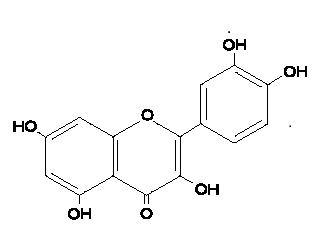
Cancerisoneofthemaincausesofdeathintheworldandits victims increase every day [1]. Quercetin (3, 3´, 4´, 5´-7penta-hydroxyflavone)(fig1)isoneofthemostabundant flavonoidsinplantsfoundinfruits,vegetablesandherbs[2]. It has a broad extent of chemotherapeutic properties for manydiseasessuchasanti-cancer,anti-inflammatory,antiviral, antiradical and anti-oxidant [3, 4]. However, its superioranti-canceractivityiswelldemonstratedincolon, breast,ovarianandlungcancercells[5,6].Invivoreversal efficacy of quercetin is not satisfactory when it is administered systemically via free drug due to its low solubility in aqueous media (7.7 µg/mL in water), poor permeability, low bioavailability (about 1% in men) [7], biodegradationlimitsandhighbindingratioofdrug–plasma protein(99.4%)[8].
Onewaytoovercomethesedrawbacksistoentrap/adsorb this molecule into carriers. Since nanoscale drug delivery carriers offer potential advantages, which include enhancement of quercetin solubility and bioavailability, improvedtissuemacrophagesdistribution,enhancementof pharmacologicalactivity,sustaineddelivery,andprotection fromphysicalandchemicaldegradation[9,10],anumberof carriers such as liposomes [11,12,13], lipids [14,15,16], micelles[17,18],polymericnanoparticles[19,20],magnetic nanoparticles[21,22]andgraphene[23]havebeenapplied forentrapmentofquercetin.Recently,singlewalledcarbon nanotubes(SWNTs)havebeenappliedfortargetingdelivery of various anti-cancer drugs such as doxorubicin and paclitaxel [1, 24]. Since single walled carbon nanotubes (SWNT)provideuniquepropertiessuchashighsurfacearea (1300 m2/gr) allowing for higher drug loading and possibilityforaccompanyingadditionaltherapeuticligands through surface functionalization, recently they have attractedmanyattentionsinthetreatmentanddiagnosisof cancer
However,drugdeliverysystemsbasedonSWNTsstillface criticalchallenges.Theyarepotentiallytoxicandextremely hydrophobic. Functionalization of carbon nanotubes by covalent and non-covalent interactions can improve their compatibility and cellular uptake, decrease their hydrophobicity,and,makethemnontoxic.Surfactants[27], peptides and polymers [1,28] have been used to modify SWNTvianoncovalentinteractions.Amongthefrequently usedbiologicalspecies,chitosanismuchmoreattractivedue to its biodegradability and biocompatibility which can endow the SWNTs excellent water solubility and good biological compatibility [29,30]. Moreover, presence of aminegroupinchitosanstructurecanfacilitateattachment oftargetingligandstothedrugdeliverysystem[31,32].In this paper, for the first time, to the best our knowledge, single walled carbon nanotube was used to targeting delivery of quercetin. Chitosan have been applied to functionalizationofcarbonnanotubes.First,theinfluenceof the binding conditions during the drug loading step (e.g., temperature,initialweightratioofdrug/carrierandinitial amountofchitosanappliedforfunctionalization)onthedrug
loading efficiency was investigated. Then pH dependent releaseofthedrugwasdemonstratedwhichpromotedits releaseinsidetumourcellsuponinternalization.Finally,folic acid (fig 1b) was also applied to the nanotube surface to endow targeting ability to the carrier and the therapeutic efficacyofthedrugdeliverysystemwasdeterminedbyin vitrocellviabilityassays.
UV-Visible spectroscopy (UV-2501, Shimadzu, Japan) was used for quercetin concentration measurement. Fourier transforminfrared(FTIR)(Perkin–Elmer,Spectrum65)and CHNS elemental analyzer (LECO 932, USA) were used for characterizationoffunctionalgroups.Infrared(IR)spectraof the samples were scanned in the range from 400 to4000 cm−1andobtainedataresolutionof4cm−1withaminimum of256scanperspectrum.
2.2. Functionalization of single walled carbonnanotubes
AsrawSWNTsareoftentoolongwithbundledoraggregated structures contaminated by heavy metal impurities, Single walled carbon nanotubes were cut and purified through oxidativeacidtreatmentusingtheproceduredocumentedin theliterature[33].Briefly,1goftheSWNTsweresuspended in250mLsolutionofnitricacid(65%)andsulphuric acid (98%)inavolumeratioof2:3thenrefluxedfor24hat50°C. Theresultantmixturewasdilutedwithultra-distillatedwater followedbycentrifugationforseveraltimestoobtainneutral ph. Finally, the precipitated oxidized SWNTs (ox-SWNT) containingcarboxylicacidgroupswerecollectedanddriedat 60°C over night. For functionalization of ox-SWNTs with chitosan,50mgofox-SWNTandpredeterminedamountof chitosanindifferentchitosan/ox-SWNTsweightratio(1/1, 1/2,1/3,1/4)weresuspendedinPBS(pH7.4,100ml);and sonicated for 1h. Then, mixture was stirred at room temperaturefor 16h. The product was filteredandrinsed withdistilledwatertoremovetheunboundpolymer;finally, thesolid(CS-SWNT)wascollectedandfreezedried.
2.3. Folate targeting
2-Experimental procedure
2.1. Materials and Methods
Single walled carbon nanotubes were purchased from Neutrino Company (Tehran, Iran). (Purity >99%, length >5µm, diameter 1–2 nm, surface area >380 m2/g). Low molecularweightchitosan(~50kDa)with75-85%degreeof deacetylation,folicacid,ethanol(≥99.5%),N,N′-dicyclohexyl carbodiimide (DCC), dimethylsulfoxide (DMSO), 3-(4, 5dimethylthiazol-2-yl)-2, 5-diphenyl tetrazolium bromide (MTT) and Quercetin (QU) were obtained from SigmaAldrich. Fetal bovine serum (FBS), RPMI 1640 and penicillin/streptomycin were obtained from Gibco Inc. HumancervicalcancerHeLacellswerepurchasedfromthe Pasteur Institute of Iran, Tehran, Iran. Analytical reagent grade salts and chemicals were used without further purification. HPLC grade (> 99%) solvents were used for thesestudies.
Folic acid (FA) was conjugated to the carrier, and make it targetabletocancercells.Folicacid(6mg)wasstirredwitha mixture of 10 mg DDC and 10 ml DMSO for 1 h at room temperature. Then, CS-SWNTs (3 mg) were added to the mixture and stirred for 16 h at room temperature in darkness.Theunreactedfolicacidwasremovedbyfiltration andwashingwithdistilledwater.Finally,theresultantsolid wasdriedatroomtemperatureandnamedasFA-CS-SWNT.
2.4. Drug loading
Quercetinloadingontocarrierswasperformedbymixing10 mg of carrier and pre-determined weight of quercetin in quercetin/CS-SWNTsweightratio(1/1thenbothcomponents weresubmergedin50mlmethanolandstirredfor16h.The suspensionwascentrifuged(13000rpm,30min),filtrated, and washed thoroughly with methanol until the filtrate became colorless. Finally, the products (known as QU-oxSWNTsandQU-CS-SWNTs)werecollectedandfreezedriedat 20 oC for 24 h. The above-mentioned procedure was conducted in 4, 25 and 60oC. The amount of unbound quercetin in the filtrate measured by UV/vis absorption spectroscopy at 370 nm (the characteristic absorbance of quercetin in methanol) respective to a calibration curve accomplished under the same conditions [34]. The
spectroscopy results were used to calculate drug loading efficiencyaccordingtothefollowingequations:
Drugloadingefficiency(%)=100×(wfeedQU-wfreeQU)/ WfeedQU (1)
Where Wfeed QC and wfree QC are the total amount of quercetin and the amount of unbound quercetin in the filtrate,respectively.
2.5. Drug release
1mgdrugloadedSWNTwasdispersedin10mlofsolutions ofPBSandmethanol(90:10v/v)inascrewcappedtubeand placedinashakerincubatorat37oCwithconstanthorizontal shakingat100rpm.Atspecifiedtimeintervals,thenanotubes wereseparatedfromthebufferbyultracentrifugation,and the whole release medium was replaced with fresh one. These experiments were carried out on pH 7.4 (normal condition)andpH5.5(tumorcondition).
2.6. Cell culture & cell viability experiments
HelacellswereculturedinT25cultureflasksinRPMI-1640 medium supplemented with10% fetal bovine serum and penicillin/streptomycin (100 units/mL penicillin and 100 µg/mL streptomycin)inan incubatorat37oCin which the CO2 level was maintained at 5%. In order to measure cell viability,culturedcellswereseededatadensityof104cells perwellinto96wellplateandincubatedfor24h,thenthe medium was replaced with fresh mediumscontaining 100 µg/mLCS-SWNTs,100µg/mLFA-CS-SWNTs,100µg/mLFAQU-CS-SWNTs(basedonquercetinconcentration)and100 µg/mL free QUat 37oC. In different time intervals (24, 48, 72h),theinvitrocellcytotoxicitywasassessedbytheMTT assay through addition of 10µl solution of MTT reagent (0.5mg/ml)andincubationfor4hat37oC.Then,themedium wasdiscardedandreplacedby100µLDMSOtodissolvethe formazan crystals of which the absorbance was calculated after1hofincubationat570nmusingmicroplatereader.
Thepercentageviabilityofcellswascalculatedastheratioof absorbanceoftriplicatereadingswithcontrolwells.
Results and discussion
Functionalization of single walled carbon nanotubes
Fig2displaysFTIRspectrumsofchitosanandCS-SWNT.The basicpeaksofchitosanareat3200-3500cm−1(O-HandN-H stretch), 2850 cm-1 (C-H stretch), 1596 cm-1 (N-H bend), 1420 (C-H bend), and 1090 cm-1 (C-O-C stretch). The spectrum of CS-SWNT display all the characteristic absorptionbandsofbothox-SWNTandchitosan,indicating ofsuccessfuladsorptionofchitosanonthecarbonnanotubes surface.

Drug loading
Loading of quercetin on QC-CS-SWNT confirmed by FTIR spectroscopy(Fig3).FTIRspectroscopiesofquercetin(Fig 3a)showsbroadpeaksat3290and1358cm−1whichare assigned to stretching vibration and phenolic bending of hydroxyl (O-H) groups. Peaks at 1662 and 1093 cm−1 assignedto(C=O)stretchingandC-Ostretchingvibrations from (C-O-C). Peaks at 1512 and 932 cm−1 represent the aromatic C=C stretching and C-H bending vibration of aromatic group [7]. The basic characteristic peaks of CSSWNT (Fig 3b) are at 3200-3500 cm−1 (O-H and N-H stretch),1640cm-1(N-Hbend),1152and1072cm-1(C-O-C stretch).LoadingofquercetinonCS-SWNT(Fig3c)leadsto presence of alkene and aromatic stretching vibration at 1630,1427and1377cm−1confirmofquercetinloadingon nanotubes.Moreover,peakat932cm−1inquercetin(Fig3a) relatedtobendingvibration ofC-Hbondinaromaticring, shifted to 891 cm−1 in QC-CS-SWNT which is due to the formationofhydrogenbondsbetweenquercetinandcarrier.

In-vitro quercetin releasing
Fig4aand4bdisplaycumulativedrugreleasecurvesfora duration of 96 hr. at 37 oC, in PBS pH=5.5 and 7.4, respectively.Theinvitroreleasekineticsshowsinitialburst releasefollowedbyaslowandsustainedrelease.Thisburst release is normally attributed to the fraction of quercetin which was adsorbed in the surface of the nanotubes. As shown in Fig 4 quercetin was released slower from the nanocarrieratneutralconditions(pH7.4).Therewasonly about32%ofthetotaldrugreleasedforQC-CS-SWNTafter 96h While under the pH of tumor tissues (pH 5.5) nearly 61.5%wasreleased.InpH7.4,thehydrogenbondsbetween quercetin and SWNTs were tightly bound; while, by decreasing the pH, quercetin was quickly released due to competition of H+ ion with functional groups capable of forminghydrogenbondingwithdrug.Ahigherreleaserate of quercetin was achieved for QC-CS-SWNT. As, chitosan increase hydrophilicity of CNT surfaces, which leads to weakeningoftheπ–πinteractionsofQCtotheCNTsurfaces, quercetincanbereleasedeasierandfaster. (a)
to study the inhibition of the cell growth rate using MTT assay.Resultsareshowninfigure5. Asshowninthisfig,CSSWNTdisplayednotoxiceffectoncells,andcellviabilitywas 94% even after 72 h. This clearly demonstrated that functionalized carbon nanotubes with chitosan have good biocompatibility. whereasquercetin-loadedSWNTs(QU-CSSWNT)withquercetinconcentrationof100µg/mlcaused significant Hella cancer cell death and the cell viability decreased to 44% after 72 h which could be higher compared to pure quercetin (57%) at the same concentration.ThetoxicityoftheHelacancercellsmightbe attributedtothestrongbindingbetweentheHelacellsand quercetinmoleculesduetothepartialreleaseofquercetin fromthenanotubes.


TheFA-QU-CS-SWNTsexhibitsacellviabilityof37%which demonstratethetargetingdrugcarrier,FA-QU-CS-SWNThad strongercytotoxicitythandidthenon-targetingone(QU-CSSWNT). Folic acid increased cellular uptake and internalization through receptor-mediated endocytosis mechanism,whichleadkillingofspecificcancercellsforthe targetingdrugcarrier[35].
Cell viability studies
Thecontrol,CS-SWNT,purequercetin,quercetinconjugated nanotubes QU-CS-SWNTs and FA-QU-CS-SWNTs were incubatedindividuallywithhumancervicalcancerHeLacells

3. CONCLUSIONS
AnefficientdrugdeliverysystembasedonmodifiedSWNTs was established. Chitosan and folic acid were applied for functionalizationofsinglewalledcarbonnanotubes.Then, ananticancerdrug(quercetin)wasloadedonthemodified carrierbyπ-πinteractionsandhydrogenbonds.TheFT-IR analysisdemonstratedthatquercetinformedintermolecular hydrogenbondingwithcarriers The loadingefficiency of quercetinonCS-SWNT was determinedto bearound38% under bestconditions(at4oC,chitosan/ox-SWNTweight ratio1/1anddrug/carrierweightratio1/1).Thismeans that1gramofchitosanwrappedcarbonnanotubesisableto deliver 0.38 g of quercetin, which an acceptable loading capacitycomparedwithmanyothercommonnanocarriers.
The introduced drug delivery systems displayed stability underphysiologicalconditions(pH=7.4andtemperatureof 37°C),whilesimulatingthecancercellconditionatpH=5.5, thequercetinwasefficientlyreleased(61.5%after96hfor QU-CS-SWNT). Based on the data gathered from in vitro studies,itcanbeconcludedthat,chitosancoatingofcarbon nanotubesenhancestheirbiocompatibilityandthusmaking them safe and efficient candidate for targeted delivery applications. Quercetin delivery by FA-CS-SWNT may be considered as an effective delivery system for improving pharmacokineticandpropertiesofquercetin.
REFERENCES
[1]AliMohammadi,Z.,Aghamiri,S.F.,Zarrabi,A.,Talaie,M.R., “Acomparativestudyonnon-covalentfunctionalizationof carbonnanotubesbychitosananditsderivativesfordelivery ofdoxorubicin”,ChemicalPhysicsLetters;vol.642,2015,pp. 22–28.
[2] Wu, T.H., Yen, F.L., Lin, L.T., Cham, T.M., "Preparation, physicochemicalcharacterization,andantioxidanteffectsof quercetin nanoparticles", Int. J. Pharm., vol 346, 2008, pp. 160–168.
[3]Song,X.,Zhao, Y.,Hou, S.,Xu,F. Chen, Q.," Dual agents loadedPLGAnanoparticles:Systematicstudyofparticlesize and drug entrapment efficiency", European. Pharm. Biopharm.,vol.69,2008,pp.445–453.
[4] Rajesh Kumar, S., Priyatharshni, S., Ponpandian; N, "Quercetin conjugated superparamagnetic magnetite nanoparticlesforin-vitroanalysisofbreastcancercelllines forchemotherapyapplications",J.ColloidandInterfaceSci. vol.436,2014,pp.234–242
[5] Park, J. H., Saravanakumar, G. and Kim, K. "Targeted delivery of low molecular drugs using chitosan and its derivatives",Adv.DrugDeliv.Rev.,62,2010,pp.28–41
[6]Wolski,P., Nieszporek,K., and Panczyk.T.,“Pegylated and folic acid functionalized carbon nanotubes as pHcontrolled carriers of doxorubicin. Molecular dynamics analysisofthestabilityanddrugreleasemechanism”Phys. Chem.Chem.Phys.,vol19,2017,pp.9300-9312
[7]Kumari,A.,Yadav,S.K.,Pakade,Y.B.,Singh,B.andYadav, S.C., "Development of biodegradable nanoparticles for deliveryofquercetin",ColloidsSurf.,B.,80,2010,pp.184–192
[8] Panczyk, T., Wolski,P., Jagusiak, A., and Drach, M.,” Molecular dynamics study of Congo red interaction with carbonnanotubes”,RSCAdv.,2014,47304-47312.
[9]Zarrabi,A.,Zarepour,A.,Khosravi,A.,Alimohammadi,Z., Thakur, V., “Synthesis of Curcumin Loaded Smart pH-
Responsive Stealth Liposome as a Novel Nanocarrier for CancerTreatment”Fibers;vol9,2021,19.
[10] AliMohammadi, Z., Aghamiri,S.F., Zarrabi, A., Talaie, M.R., “Liposomal Doxorubicin Delivery Systems: Effects of Formulation and Processing Parameters on Drug Loading andReleaseBehavior”;CurrentDrugDelivery.Vol13.2016, pp.1065-1070.
[11]Z.P.Yuan,L.J.Chen,L.Y.Fan,M.T.Tang,G.L.Yang,H.S. Yang,X.B.Du,G.Q.Wang,W.X.Yao,Q.M.hao,B.Ye,R.Wang, P. Diao, W. Zhang, H.B. Wu, X. Zhao, Y.Q. Wei, “Liposomal QuercetinEfficientlySuppressesGrowthofSolidTumorsin MurineModels”,Clin.CancerRes.12,2006,3193-3199.
[12] M.Y. Wong, G.N.C. Chiu, “Liposome formulation of coencapsulatedvincristineandquercetinenhancedantitumor activityinatrastuzumab-insensitivebreasttumorxenograft model”, Nanomedicine: Nanotechnology, Biology, and Medicine.7,2011,834–840.
[13]E.Alexopouloua,A.Georgopoulosa,K.A.Kagkadisb,C Demetzosa,“PreparationandCharacterizationofLyophilized LiposomeswithIncorporatedQuercetin”,J.LiposomeResh. 16,2006,17–25.
[14] H. Li, X. Zhao, Y. Ma, G.X. Zhai, L.B. Li, H.X. Lou, “Enhancementofgastrointestinalabsorptionofquercetinby solid lipid nanoparticles”, J. Controlled Release.133 ,2009, 238–244.
[15]C.Y.Guo,C.F.Yang,Q.L.Li,Q.Tan,Y.W.Xi,W.N.Liu,G.X. Zhai, “Development of a Quercetin-loaded nanostructured lipidcarrierforformulationtopicaldelivery”,Int.J.Pharm. 430,2012,292-298.
[16] S. Scalia, M. Mezzena, “Incorporation of quercetin in lipidmicroparticles:Effectonphoto-andchemicalstability” , JPharm.Biomed.Anal.49,2009,90–94.
[17] Q. Tan, W. Liu, G. Guo, G. Zhai, “Preparation and evaluation of quercetin-loaded lecithin-chitosan nanoparticlesfortopicaldelivery”,Int.J.Nanomedicine. 6, 2011,1621–1630.
[18]R.Trivedi,U.B.Kompella,“Nanomicellarformulations forsustaineddrugdelivery:strategiesandunderlying Principles”,Nanomedicine.5,2010,485–505.
[19] H.K. Ha, J.K. Kim, M.R. Lee, W.J. Lee, “Formation and characterizationofquercetin-loadedchitosan oligosaccharide/β-lactoglobulinnanoparticle”,FoodRes.Int. 52,2013,82–90.
[20] Y. Zhang, Y. Yang, K. Tang, X. Hu, G. Zou, “PhysicochemicalCharacterizationandAntioxidantActivity
ofQuercetin-LoadedChitosanNanoparticles”,J.Appl.Polym. Sci.(2007)DOI10.1002/app.26402.
[21] A.C.H. Barreto, V.R. Santiago, S.E. Mazzetto, J.C. Denardin,R.Lavi,G.,Mele,M.E.N.P.Ribeiro,G.P.V Icaro,T. Goncalves, N.M.P.S. Ricardo, P.B.A. Fechine, “Magnetic nanoparticles for a new drug delivery system to control quercetinreleasingforcancerchemotherapy”,J.Nanopart. Res.13(2011)6545
6553.
[22] S. Rajesh Kumar, S. Priyatharshni, V.N. Babu, D. Mangalaraj, C. Viswanathan, N. Ponpandian, “Quercetin conjugatedsuperparamagneticmagnetitenanoparticlesfor in-vitroanalysisofbreastcancercelllinesforchemotherapy applications”,J.ColloidInterfaceSci.436(2014)234–242.
[23] N. Rahmanian, H. Hamishehkar, J. Ezzati Nazhad Dolatabadi,N.Arsalani,“Nanographeme:Anovelcarrierfor oral delivery of flavonoids”, Colloids Surf. B Biointerfaces. 123,2014,331–338.
[24] X. Zhang, L. Meng, Q. Lu, Z. Fei, P.J. Dyson, “Targeted deliveryandcontrolledreleaseofdoxorubicintocancercells usingmodifiedsinglewallcarbonnanotubes”,Biomater.30, 2009,6041–6047.
[25]D.N.Mobarghei,F.Atyabi,M.R.Rouini,A.Golabchifar,R. Dinarvand, M. Amini, A.A. Golabchifar, R. Dinarvand, “Doxorubicin loaded folate-targeted carbon nanotubes: Preparation,cellularinternalization,invitrocytotoxicityand dispositionkineticstudyintheisolatedperfusedratliver” , Mater.sci.eng.C.39,2014,47-55.
[26]C.L.Lay,H.Q.Liu,H.R.Tan,Y.Liu,“Deliveryofpaclitaxel by physically loading onto poly(ethylene glycol) (PEG)graftcarbon nanotubes for potent cancer therapeutics” , Nanotechnol.21,2010
[27] X. Deng, S.Yang, H. Nie, H. Wang, Y. Liu, A generally adoptable radiotracing method for tracking carbon nanotubesinanimals,Nanotechnol.1,2008,91-11.
[28]T.Kean,M.Thanou,Biodegradation,biodistributionand toxicityofchitosan,Adv.DrugDeliv.Rev.62,2010,3-11.
[29]J.H.Park,G.Saravanakumar,K.Kim,Targeteddelivery of low molecular drugs using chitosan and its derivatives, Adv.DrugDeliv.Rev.62,2010,28–41.
[30]Razzokov,J.,Marimuthu,P.,Saidov,K.,Ruzimuradov,O., Mamatkulov.,”PenetrationofChitosanintotheSingleWalled ArmchairCarbonNanotubes:AtomicScaleInsight”,Crystals 2021,11,1174.
[31]Fakhimikabir,H.,Tavakoli,M.,Zarrabi,A.,Amouheidari, A.,Rahgozar,S.,“CouldFA-PG-SPIONsactasahyperthermia
sensitizing agent? An in vitro study,” Journal of Thermal Biology,78,2018,73-83.
[32] Mahajan, S., Patharkar, A., Kuche, K., Maheshwari, R., “Functionalized carbon nanotubes as emerging delivery systemforthetreatmentofcancer”InternationalJournalof Pharmaceutics,548,2018,540-558.
[33] Jurj, A., Braicu, C., Pop, L., Tomuleasa, C., Gherman ., Berindan-Neagoe, “The new era of nanotechnology, an alternative to change cancer treatment”, Drug Design, DevelopmentandTherapy,11,2017,2871-2890
[34]H.Huang,Q.Yuan,J.S.Shah,R.D.K.Misra,“Anewfamily of folate-decorated and carbon nanotube-mediated drug deliverysystem:Synthesisanddrugdeliveryresponse”,Adv. DrugDeliveryRev.63,2011,1332–1339.
[35] He, Y., Luo, L., Liang, Long, M., Xu, H., “Influence of probe-sonicationprocessondrugentrapmentefficiencyof liposomesloaded witha hydrophobicdrug”,International JournalofPolymericMaterialsandPolymericBiomaterials, 68,2019,193-197