AN EXPERIMENTAL INVESTIGATION ON STRENGTH CHARACTERISTICS OF CONCRETE BY PARTIAL REPLACEMENT OF CEMENT WITH DOLOMITE AND OYSTER SEA SHELL
D. Sreehari Rao1 , Guduguntla Venkata Sai Rithik21Assistant Professor, Department of Civil Engineering, S.V University College of Engineering, Tirupati, Andhra Pradesh, India.

2MTech Civil – Structural Engineering, S.V University College of Engineering, Tirupati, Andhra Pradesh, India. ***
Abstract - Concreteis most adaptable, durableandreliable construction material over the world and it is the most important basic material in all civil engineering structures. The production of cement in world has greatly increased, due tothis emissionofCO2 gas hasbeenincreased ultimatelyleads to environmental pollution. Research is taking place on all corners of the globe in search of different material options. The Present study aims to explore the feasibility and effectiveness ofusingDolomiteandOysterSea Shellas partial replacements of Cement in Concrete Production. Dolomite is an anhydrous carbonate mineral composed of calcium magnesium carbonate (CaMg(CO3)2). Oysters are the dead remains ofAquaticorganisms.TheExperimentalinvestigation is carried out on M30 Grade of Concrete. Firstly, the cement is partiallyreplaced withDolomitepowderrangesfrom0%,5%, 10%, 15%, to 20%. Further, find the optimum % of Dolomite powder. Then with that optimum % of Dolomite powder, the cement is replaced with Oyster Sea Shell powder in percentages of0%, 5%, 10%, 15%,and20%.Thepropertiesof hardened concrete such as Compressive strength, Split tensile strength, Flexural strength, Non-Destructive Tests like Rebound hammer and Ultrasonic pulse velocity are determinedbyconductinglaboratoryexperimentsonconcrete samples and the results are compared with conventional concrete. The findings of this study reveal that 10% of Dolomite powder and 10% of Oyster Sea Shell powder are optimum replacements which has significant effect on the strength properties of concrete.
Key Words: Dolomite powder, Oyster Sea Shell powder, Compressive strength, Split tensile strength, Flexural strength and Non-Destructive Tests, Concrete Mix design M30.
1. INTRODUCTION
Concrete is the most widely used man-made building materialintheworld,owingtoitsversatilityandrelatively lowcost,concretehasalsobecomethematerialofchoicefor theconstructionofstructuresexposedtoextremecondition (Lomborg(2001)). Concrete plays a vital role in the development of infrastructure Viz.., buildings, industrial structures,bridgesandhighwaysetc,leadingtoutilizationto
largequantityofconcrete.Cementmanufacturecontributes greenhouse gases both directly through the production of carbondioxidewhencalciumcarbonateisheated,producing lime & carbon dioxide and indirectly through the use of energy,particularlyiftheenergyissourcedfromfossilfuels. Thecementindustryproducesabout5%ofglobalmanmade CO2emissions,which50%isfromthechemicalprocess,and 40%fromburningfuel.TheamountofCO2 emittedbythe cementindustryisnearly1.0tonsofCO2forevery1.0tonof cementproduced.
Inthepresenteraofdevelopmentduetoadvanced techniques, material availability and growing standard of living, the construction activities are increasing exponentially with time. The increased construction activities and exploiting the available natural resources drastically are posing serious environmental problem. Howeverconstructionactivitiesleadingtodevelopmentin socialandeconomicaspectscannotbestoppedorreduced forthesakeofconservationofnaturalresources.Therefore, thereisaneedtoexplorealternativebuildingmaterialsfrom industrial, agricultural waste and coastal waste materials. Researchersallovertheworldtodayarefocusingonwaysof utilizingdifferenttypesofwastematerialsasasourceofraw materials for industry. Replacing alternative materials in cement for concrete production is important to address environmentalconcerns,conservenaturalresources,reduce costs,andimprovetheperformanceofconcrete.Dolomite powderandoysterseashellpowderaretwosuchmaterials thathaveshownpotentialinreplacingcementinconcrete production.
1.1 Dolomite Powder
It is a carbonaceous (or) carbonate material which is composedofcalciummagnesiumcarbonate[CaMg(CO3)2]. DolomitePowderisthelimestonepowderwithcomposition ofCaCO3andMgCO3pertainingto100%incombination,the proportion being varied as per mining zone. It is formed from limestone, which is subjected to high pressure and temperatureintheearth’scrust.Itisalsocalledasdolostone (DolomiteRock).Itiscommonlyusedasafillermaterialina wide range of industrial applications, including in the
construction industry, where it is used as a partial replacementforcementinconcrete.However,itisimportant tonotethattheamountofdolomitepowderthatcanbeused asapartialreplacementforcementwilldependonavariety offactors,includingthespecificpropertiesofthedolomite, thepropertiesofthecement,andthedesiredpropertiesof theconcretemix.Additionally,itisimportanttoensurethat the dolomite powder is of high quality and meets the relevant standards and specifications for use in concrete. Dolomitepowderhaspozzolanicproperties,itcanreactwith thecalciumhydroxideproducedbythehydrationofcement toformadditionalcementitiouscompounds.Thisreaction canimprovethestrengthanddurabilityoftheconcrete.
1.2 Oyster Sea Shell Powder
Oyster Sea Shell Powder is a fine, white powder made by crushing and grinding the shells of oysters that are harvested for their meat. It is a coastal waste material generatedfromtheseafoodindustryandisarichsourceof calciumcarbonate. OysterShellsareconsideredasa good alternativetocement,becauseoftheirphysicalandchemical characteristics.Inconcreteworks,oysterseashellpowderis usedasapartialreplacementforcement.Thisisbecauseit canactasafillermaterial,reducingtheamountofcement neededintheconcretemixture.Oysterseashellsareoften discardedaswaste,buttheycanberepurposedasavaluable in construction materials such as concrete, reducing the amount of waste generated and promoting sustainable resource use. It can be used as a partial replacement for cement up to certain percentage without significantly affecting the mechanical properties of concrete. The percentageofreplacementdependsonvariousfactorssuch as the quality of oyster shell powder, water-cement ratio, curing time, and so on. Quicklime is obtained from oyster shellswhentheCaCO3 intheshellisheatedatanexcessof 2000°F or about 1100°C and converted to calcium oxide (CaO),otherwiseknownaslime.
2. LITERATURE REVIEW
Dr.SachinV Admane,Tabassumsayyad et al.(2020) had examined the strength properties of concrete by partial replacementofcementwithdolomitepowder,becauseithas similar configuration as of the cement. Dolomite is a carbonate material composed of calcium magnesium carbonate (CaMg(CO3)2). Dolomite is preferred for construction material due to its surface hardness and density. M30 grade of concrete was used to prepare the concrete mixes. In this study, the dolomite as replaced in cementindifferentpercentagesi.e.,0%,5%,10%,and15%. Concretecubes,cylindersandprismsarecastedandcured for 7 and 28 days. Tests on hardened concrete like compressive strength, split tensile strength and flexural strength were conducted and test results found that 10% replacementofdolomitepowderinconcretemixincreased
the values of compression, split and flexural strengths of concrete.
Abhijeet B.Moghe, G.D. Dhawale et al. (2020) conducted anexperimentalproceduretoinvestigatetheeffectofusing oystershellpowderaspartialreplacementofcement.Tabby isatypeofconcretemadebyburningoystershellstocreate lime,thenmixingitwithwater,sand,ashandbrokenoyster shells. The main objective is to support the use of these outwardlywasteproductsasaconstructionmaterial.Inthis study, the oyster sea shell powder is partially replaced in cementwithvariouspercentagesi.e.,0%,5%,10%and15%. M25gradeofconcretewasused.TheCubes,Cylindersand PrismsareCastedandCuredfor7,14and28daysandthe Compressive Strength, Split Tensile and Flexural Strength tests were conducted. The replacement of oyster shell powderwithcementfoundtobeincreaseinstrengthwith 5%and10%replacementthanconventionalconcrete.Itwas observedthat,compressiveandsplittensileStrengthswere increasedwith10%replacementandFlexuralStrengthwas increasedwith5%replacementthantheControlConcrete.
3. MATERIALS
3.1 Cement: Ordinary Portland cement of 53 grade conformingtoIS:12269-2013isused.NameoftheCement bagusedisZuariCement.SpecificGravityofcementis3.14.
3.2 Fine Aggregate: Locally accessed Zone 2 Fine AggregateasperIS:383-1970isused.Fineaggregate,those fractions from 4.75 mm to 150 micron are termed as fine aggregate. Specific Gravity of Fine Aggregate is 2.57. FinenessModulusofFineAggregateis2.74.
3.3 Coarse Aggregate: The aggregate retained over IS sieve4.75mmistermedascoarseaggregate.TheShapeof the coarse aggregate used for the concrete is angular. Machinecrushedgranite aggregate confirming to IS: 3831970consisting20mmmaximumsizeofaggregateshasbeen obtainedfromthelocalquarry.Inthisstudy,60%of20mm and40%of12mmisusedtopreparetheconcretemix.The SpecificGravityandWaterAbsorptionofCoarseAggregateis 2.73 and 0.23% respectively. Fineness Modulus of Coarse Aggregateis7.17.
3.4 Dolomite Powder: Dolomitepowderisprocuredfrom AstrraChemicalsinChennaiinwhichitiscapableofpassing through a 90µm sieve. The following table shows the chemical composition of dolomite powder. The physical propertieslikecolourandspecificgravityiswhiteand2.85 respectively.
Table-1: ChemicalCompositionofDolomitePowder
4. METHODOLOGY
3.5 Oyster Sea Shell powder
OysterseashellpowderisprocuredfromAstrraChemicals inChennaiinwhichitiscapableofpassingthrougha90µm sieve.Thefollowingtableshowsthechemicalcompositionof oysterseashellpowder.Thephysicalpropertieslikecolour andspecificgravityiswhiteand2.45respectively.
Table-2: ChemicalCompositionofOysterSeaShell Powder
The materials required for this research work is collected fromdifferentsourcesandthepropertiesofthematerials areanalyzedasper IScodeofstandardprocedures.TheMix design of M30 grade of concrete using ordinary Portland cement is carried out for this study as per concrete mix proportioning guidelines specified by IS456-2000 and IS10262-2009.Firstly,theDolomitemixeswerepreparedby replacing it with cement in different proportions i.e., 5%, 10%, 15% and 20% and the optimum percentage of dolomite powder is determined. Then the concrete mixes werepreparedbykeepingoptimumpercentageofdolomite powder and the oyster sea shell powder is replaced in cementwithdifferentpercentagesi.e.,5%,10%,15%and 20%.Mixeswerepreparedatroomtemperature.
The Cubes of size 150mm x 150mm x 150 mm, Cylinders of size 150mm x 300mm and prisms of size 500mmx100mmx100mmwerecastedandcuredforallthe mixes of concrete. The tests were conducted on hardened concrete to determine the strength properties and the resultsobtainedofallthemixeswerecomparedwithcontrol concretemixtoobtaintheoptimumpercentageofdolomite andoysterseashellpowder.
5. RESULTS AND DISCUSSION
Tests which are conducted on the hardened properties of Control concrete, Dolomite mixes (Cement + Dolomite powder) and Oyster sea shell mixes (Cement + Optimum Dolomite powder + Oyster sea shell powder) and comparison of the results are drawn out. The results obtained from all the concrete mixes are drawn out and compared with the control concrete to investigate the difference between its effect on the cement concrete properties after adding Dolomite and Oyster sea shell powder.
5.1 Compressive Strength
3.6 Water: For experimental studies and for curing purposes, ordinary water available in the laboratory was used.Waterisasignificantcomponentincementconcrete response.Formixingandcuring,tap wateraccessibleina collegepremisesisused.
3.7 Super Plasticizer: Superplasticizersareadmixtures that increase the workability and flow ability of concrete without the need to add excess water. Super plasticizers allowareductioninwatercontentof30%ormore.Inthis research work, Conplast Sp-430 is used as a super plasticizer.SpecificGravityis1.2.
The Compressive Strength test was conducted on cement concretecubesofsize150mmx150mmx150mmmat3,7, 28,56daysofcuring.Resultsofthecompressivestrengthof concretemixesofM30gradearelisted.Theresultswerealso compared with control concrete in order to determine variations in compressive strength due to addition of DolomitepowderandOysterseashellpowder.
Table-3: CompressiveStrengthResults
5.2 Split Tensile Strength
The Split Tensile Strength test was conducted on cement concretecylindersofsize150mmx 300 mmat28 and 56 days of curing. Results of the split tensile strength of concretemixesofM30gradearelisted.Theresultswerealso compared with control concrete in order to determine variationsinsplittensilestrengthduetoadditionofDolomite powderandOysterseashellpowder.


Table-4: SplitTensileStrengthResults
S.NO Type of Mix Split Tensile Strength at different ages of curing
Chart-1: CompressiveStrengthfordifferentmix proportionsofdolomitepowder
Chart-2: CompressiveStrengthfordifferentmix proportionsofOysterseashellpowder.
Chart-3: SplitTensileStrengthfordifferentmix proportionsofDolomitepowder
Chart-4: SplitTensileStrengthfordifferentmix proportionsofOysterseashellpowder.
5.3 Flexural Strength
The Flexural Strength test was conducted on cement concretecylindersofsize500mmx100mmx100mmat28 and 56 days of curing. Results of the flexural strength of concretemixesofM30gradearelisted.Theresultswerealso compared with control concrete in order to determine variationsinflexural strengthdueto additionofDolomite powderandOysterseashellpowder.

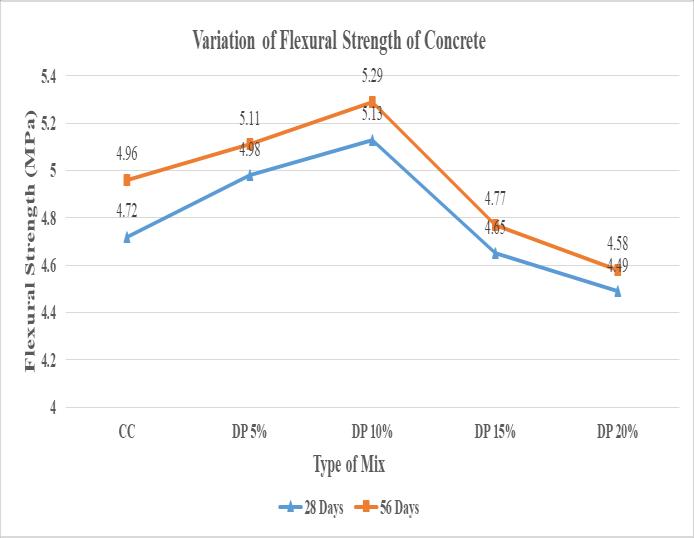

Table-5: FlexuralStrengthResults
Chart-5: FlexuralStrengthfordifferentmixproportionsof Dolomitepowder
Chart-6: FlexuralStrengthfordifferentmixproportionsof OysterSeaShellpowder
5.4 Rebound Hammer Test
The Rebound Hammer test was conducted on cement concretecubesofsize150mmx150mmx150mmmat28 and56daysofcuring.ResultsoftheReboundcompressive strengthofOptimummixesandcontrolconcretemixofM30 gradearelisted
Table-6: ApproximateCompressiveStrengthbased onReboundNumber
5.5
TheUltrasonicpulsevelocitytestwasconductedoncement concretecubesofsize150mmx150mmx150mmmat28 and56daysofcuring.Ultrasonicpulsevelocityisdoneon OptimummixesandcontrolconcretemixofM30gradeare listedbelow
6. CONCLUDING REMARKS
TheCompressiveStrengthofConcreteisgradually increasing with the replacement of Dolomite powderupto10%andthendecreasesafterfurther increase of Dolomite powder and the percentage increase when compared to control concrete is 15.48%,9.64%,7.35%and6.34%for3days,7days, 28daysand56daysrespectively.
TheCompressiveStrengthofConcreteusingOyster shellpowderbykeepingtheoptimumreplacement of Dolomite powder as constant is found to be increased up to 10% replacement and further decreasewiththeincreaseofOystershellpowder. Thepercentageincreasewhencomparedtocontrol concreteisfoundtobe33.66%,24%,17.71%and 15.96% for 3 days, 7 days, 28 days and 56 days respectively.
ForSplitTensileStrengthofconcretetheoptimum replacement of dolomite powder is 10% and percentage increase when compared to control concrete is 8.22% and 7.10% for 28 days and 56 daysrespectively.
TheSplitTensileStrengthofConcreteusingOyster shellpowderbykeepingtheoptimumreplacement of Dolomite powder as constant is found to be increased up to 10% replacement and further decreasewiththeincreaseofOystershellpowder. Thepercentageincreasewhencomparedtocontrol concreteisfoundtobe14.58%and13.19%for28 daysand56daysrespectively.
For Flexural Strength of concrete the optimum replacement of dolomite powder is 10% and percentage increase when compared to control concrete is 8.68% and 6.65% for 28 days and 56 daysrespectively.


TheFlexuralStrengthofConcreteusingOystershell powder by keeping the Optimum replacement of Dolomite powder as constant is found to be increased up to 10% replacement and further decreasewiththeincreaseofOystershellpowder. Thepercentageincreasewhencomparedtocontrol concreteisfoundtobe16.10%and13.51%for28 daysand56daysrespectively.
IntheCaseofReboundHammerTest,theRebound strengthforthemixwithDolomitepowderof10% and Oyster shell powder of 10% replacements is achievedmorecomparedtotheControlConcrete.
In the case of Ultrasonic Pulse Velocity Test of concrete,thequalityofconcreteisexcellentforall theoptimummixesincludingControlConcrete.
Theuseofdolomiteandoysterseashellaspartial replacements for cement in concrete can help in reducing the carbon footprint and utilizing waste materials.
So,itcanbeconcludedthattheoptimumpercentage replacementsofbothDolomitepowderandOyster seashellpowderisfoundtobe10%.
7. REFERENCES
1. IshitaGusain,SauravSharma,SamratDebarma, Amit Kumar Sharma, Nitin Mishra, Study of concrete mix by adding Dolomite in conventional concrete as partial replacement with cement, JournalofsciencedirectmaterialstodaybyElsevier.
2. Kausal Prajapati, Dr. Valsson Varghese, ExperimentalInvestigationonStrengthofconcrete by partial replacement of cement by dolomite powder, International Journal for Research in Applied Science and Engineering Technology, Volume7/Issue5/May-2019.
3. Bassam A. Tayeh, A.M.Zeyad, Properties of Concretecontainingrecycledseashellsascement partialreplacement,JournalofCleanerProduction (2019).
4. Preethi, Prince Arulraj, Effect of replacement of cement with dolomite powder on the mechanical properties of concrete, JETIR, Volume 2, Issue 4, April2015.
5. Abhijeet B.Moghe, G.D. Dhawale, Experimental InvestigationonPartialreplacementofcementby oystershellinplainconcrete,Journalofemerging Technologies and innovative research, Volume 7, 2020.
6. Kim Hung Mo, U.Johnson Alengaram, Mohd Zamin Jumaat, Siew chenglee, Wan Inn Goh, Choon, Wah Yuen,RecyclingofSeashellwastein concrete,ConstructionandBuildingMaterials162 (2018).
7. Dr.SachinV.Admane,TabassumSayyad,Yogesh gurav, Prasad Ghodake, Experimental Study of performanceofconcretewithpartialreplacement of cement by dolomite, International Research JournalofModernizationinEngineeringTechnology andScience,Volume:02/Issue:04/April-2020.
8. S.Abhinayaand S.PrasannaVenkatesh, AnEffect onOysterShellPowder’sMechanicalPropertiesin SelfCompactingConcrete,InternationalJournalof Innovative Research in Science, Engineering and Technology,Volume5,June2016.
9. KiranKumarPoloju,VineethaAnil,SaraHamed Nasser Ali Al-Yahmadi, Ruwa Malik Nasser AI Maaman, Investigating Possibilities for using sea shell on compressive strength properties of concrete,InternationalJournalofEngineeringand Technology,7(1),(2018).
10. Pramod Dhame, Dr.P.B.Nagarnaik,Experimental InvestigationonReplacementofcementinconcrete partiallybyusingDolomite Powder,International Journal of Trend in Scientific Research and Devolopment,Volume3,Issue3,Mar-Apr2019.
11. Bille Pradeepkumar, Dr. Vaishali G Ghorpade, Dr. H. Sudarsana Rao, AnExperimentalStudyon strength properties of Tabby Concrete with Sea Shell Coarse Aggregate, Journal of Northeastern University,Volume25,2022.
12. C.Venkata Sai Nagendra, C.Venkata Siva Ramaprasad, K.N.Rukmini Florence, An Experimental investigation on properties of concrete by partial replacement of cement with dolomite and sand with crushed sea shell, International Journal ofScientificand Technology Research,Volume8,Issue10,October2019.
13. J.Sree Nagachaitanya, Dr.K.Chandramouli, M.Anil kumar, Dr.N.Pannirselvam, An Experimental investigation on properties of concrete by partial replacement of cement with dolomite and sand with crushed sea shell, JETIR Volume8,Issue8,August2021.
14. I.S: 10262 – 2009: Recommended guide lines for concretemixdesign.
15. I.S:2386–1963:Testproceduresofaggregates.
16. I.S: 383 – 1970: Specification for coarse and fine aggregatefromnaturalresources.
17. IS 12269:1987 "Ordinary Portland Cement Specification - Part 1: Fly Ash Based", Bureau of Indianstandardinstitution,NewDelhi.
18. IS2720part3,"Determinationofspecificgravityof cement".
19. IS: 10262:2009 "Recommended guidelines for concretemixdesign”,BureauofIndianstandards, NewDelhi.
20. IS: 2386-1963 "Indian standards code of practice for methods of test for Aggregate or concrete", BureauofIndianstandardInstitution,NewDelhi.
21. IS: 383-1970 "Specification for Coarse and Fine Aggregates from natural sources or concrete"(Secondrevision).
22. IS: 456-2000 "Specifications for plain and reinforcedconcrete".NewDelhi,India.
23. ConcretetechnologybyM.S.Shetty–SChand&co; 2004.
24. Concrete technology by A.M. Neville – Pearson publication.