An Enhanced Algorithm for Load-based Handover Decision-making in 5G Wireless Networks.
Lama Douba1 , Ahmad Mahmoud Ahmad2 , Ahmad Saker Ahmad31PhD Student, Dept. of System and Computer Networks Engineering, Tishreen University, Latakia, Syria.
2Assistant Professor, Dept. of System and Computer Networks Engineering, Tishreen University, Latakia, Syria.

3Professor, Dept. of System and Computer Networks Engineering, Tishreen University, Latakia, Syria.
Abstract - The handover process is one of the most important aspects of mobility management in 5G networks, it ensures a user's network connection continuity while moving from one location to another. It is also the cornerstone of achieving mobility load balancing under the name of the offloading process. The decision-making phase is one of the handover stages that need improvement to choose the appropriate station and accurately determine the handover parameters to select the proper time to execute the handover. In this paper, we proposed a Load-based Handover Decisionmaking algorithm based on fuzzy logic, considering the cell's load before implementing the handover decision to determine whether the candidate cell is suitable for the handover process to avoid problems resulting from handover to a heavily loaded cell. The results showed that the proposed algorithm provided an improvement in terms of the standard deviation of the load in the network, average throughput, packet loss rate, and handover failure rate.
Key Words: 5G Networks, Handover, Handover Control Parameters, Cell Load, Fuzzy Controller
1.INTRODUCTION
Fifth-generation networks include many technologies thatofferfeaturesforusers.Still,atthesametime,theymay causenewproblems,whichrefertothedeteriorationofthe service provided by the network due to a failure in a particularstage,suchaswhensettingspecificparameters[1]. Despite the significant benefit of small cells, they cause difficulties that lead to a deterioration in the quality of service, such as interference, unnecessary and frequent handovers,failedhandovers,andPing-Pongevents[2].
Failure management [1] is one of the basic concepts in cellular networks, and given that the handover process is critical, especially in high-density networks that are accompanied by high mobility speeds, it is necessary to reducefailurecasesduringitsimplementationtomitigatethe negativeimpactonthequalityofserviceprovidedbythese networks. The heavily loaded target cells are one of the reasonsforthefailureofhandoveroperationssincetheyare eitherunabletoserveanewuserorlimitedserviceprovided. Thiswillresultinunsuccessfulhandoveroperationsandlead toadeteriorationinthequalityofserviceinthenetworkdue
to the loss of packets resulting from the connection interruption
2. THE IMPORTANCE OF THE RESEARCH AND ITS OBJECTIVES
The importance of this research lies in proposing a solution that ensures the target station has sufficient resourcestoserveanewuserbeforeexecutingthehandover decision,therebyensuringthattheusermovestoacellthat canservethemfirstandprovideconvenientservicefortheir requirementssecondly.Thisultimatelyachievestheresearch goal of improving service quality using the enhanced algorithm.
Theresearchaddressesthestudyofhandoverproblems in5G,sheddinglightontheconceptofcellloadanditsimpact onhandoverperformance,andthenproposesamodification tothehandoverdecision-makingalgorithmthatensuresnot moving to a congested cell. We then follow with practical implementation,involvingchoosingthemostsuitabletoolto simulate the required network, building the network, specifying the parameters, executing the simulation, and analyzing the results. Finally, the research concludes with recommendations that define the future direction of the research.
3. RELATED WORK
Severalexistingworksweredoneinresearchtoenrich the field of improving the handover process in the 5G wirelessnetworks.In[3],anFL-basedhandoverschemewas proposedfor5GUDNs,theproposedschemecandynamically adjusttwohandoverparameters,HOMandTTT,byusingthe SINRandhorizontalmovingspeedofUEasinputstoaFuzzy logiccontroller.
While the authors of [4] investigated various MRO (Mobility Robustness Optimization) algorithms for the 5G network at different mobility speeds and system setting scenarios to address Mobility Management (MM) issues during user mobility between cells to ensure a smooth connection.
On the other hand [5] presented the common types of MachineLearningandthetechniquesusedfromeachtypeto optimize the HCPs of the MRO functions. Moreover, highmobility-awareandnetworktopologiesarepresentedinthe MROfunctionforfurthersystemenhancements.Besides,the survey further highlights several potential problems for upcomingresearchandprovidesfuturedirectionstoaddress theissuesofnext-generationwirelessnetworks
Inthepaper[6]theeffectofdifferentHCPsettingson5G network performance was verified by analyzing fixed HCP settingsinvariousscenariostoexplaintheneedforapplying more advanced technology in 5G networks. The proposed algorithminthispaperwasusedtoassesstheHCPsettings. Theseoptimizationvalueswereestimatedaccordingtothe speedofUE’sandloadsofcells.
4. Background
4.1. Handover problems (handover failure):
Theincreaseindeploymentdensityofsmallbasestations (SBS)isasolutiontoobtainhighdatatrafficmobilityin5G wirelessnetworks.However,itcausesanincreasein pingpongevents,accompaniedbyincreaseddelayandhandover failure.Ping-pongeventsoccurwhentheservingcellhands overcontrolofthemobiledevicetothetargetcell.Then,the target cell hands back control to the previous serving cell withinalimitedtimeafterthelasthandover[7],causinghigh signalingduetothemessagesexchangedbetweennetwork elementsresultingfromunnecessaryhandoveroperations. Therefore, reducing frequent and unnecessary handover operations saves network resources and improves overall systemperformance[8].
Mobilityfailureoccurswhentheuserequipmentfailsto establisharadioconnectioninthesourcecellorcompletethe handover process in the target cell. There are different reasons for handover failure, either due to a problem in synchronizingthenecessarysignalingmessagestocomplete the handover process between the source and target base stationsorduetothelossofoneofthesesignalingmessages causedbyaproblemintheradiolink. Moreover,attempting tomovethephonetoanalreadycongestedcell[2]canalso resultincallfailureduetoresourcelimitations,makingthe handover operation unsuccessful. If the call is completed later,thisprocesswillreducetheservicequalityprovidedto theexistingusersandthenewuser.
Thetimingofthehandoverprocessiscritical.Therefore, the main challenge of Mobility Robustness Optimization (MRO) functions, which is the automatic adjustment of handover control parameters, is to avoid failure cases as muchaspossible.Forexample,reducingthevaluesofTTT andHOMcancauseanearlyandunnecessaryhandover,as therearetypesoferrorsthatoccurduetotheusermovingat differentspeeds,suchastheTooEarlyHandoverproblem, whichoccurswhenthesignalstrengthofthetargetstationis
still weak [9], The early handover occurs due to the low valuesofthehandovercontrolparameters(HCP),whichare then adjusted to high values due to poor connection, this causesfailuretoconnectquicklywhenthehandoverprocess begins.Asaresult,thedevicewill returntothepreviously servedstation,resultinginadditionalhandoveroperations.
In addition tothe TooLate HO problem,athighspeeds, very late handover occurs due to the user gnsssap through severalcellswithinashortperiod.Inthiscase,adjustinglow values for the handover control parameters is essential to reducethefailurerateoftheradiolink[10]
4.2. Radio resources in the cell:
The smallest unit of radio resources is the physical resource block (PRB), which consists of 12 subcarrier frequency slots. The cell load is measured by the ResourceBlockUtilizationRatio(RBUR)[11],definedas theratioofthereservedphysicalresourceblocks(PRBs)by thecellstothetotalnumberofavailableblocksinthesame cell. The RBUR ratio directly determines the use of the resource block by the number of devices that can be served at a specific data transmission rate and with specific latency constraints. Equation (1) [12] expresses theaverageRBURinthecell.
Where:
Is,j(τ)isabinaryindicatorthattakesthevalueof1ifuser jisservedbycells.
Ns,j (τ) is the number of reserved physical resource blocks(PRBs)bycellsforuserjduringtheperiodt.

PRB refers to the total number of available resource blocksincells,whereallcellshavethesamemaximum limit.
Therefore,thetotalnumberassignedbyacellatanygiven momentcannotexceedthevalueof
When the RBUR value reaches 1, the cell resources are exhausted,andanynewuserenteringthecellwilleitherhave theirconnectiondroppedorwillbeservedatalowerdata transmissionratethanneeded.
5. Proposed Algorithm: Load-based Handover Decision-making algorithm (L-HD):
This study proposes a modification to a previously introducedalgorithm[13],called(RHOT-FLC),designedfor handoverdecision-makingandcontrolparameterassignment basedonfuzzylogic.Thebasicalgorithmwasobservedtonot considertheloadvalueofthebasestationsbeforemakingthe handover decision, which could result in user issues that affectservicequality.
Also, the algorithm does not consider the case of a failed connectionestablishmentwiththetargetstation.Therefore, itisnecessarytoaddaconditiontotesttheloadvalueofthe cell before deciding while also ensuring the possibility of connecting to an alternative station in case of a failed connectionwiththetargetstation.
Thefollowingstepsrepresentthestagesofimplementingthe proposedalgorithm(L-HD),asshowninFigure1:
1. Both the Radio Signal Quality (RSRQ), Radio Signal Power(RSRP),UserEquipment(UE)velocity,andCell Loadareconsideredinputstothisalgorithm.
2. TheRSRPvalueforneighboringcellsisextractedfrom measurementreports,sorted,andcomparedtotheRSRP valueoftheservingcell.
3. The neighboring cell values are arranged according to the Cell Load value, which is calculated based on Equation(1)andtakesvaluesrangingfrom[0,1],where ahighervalueindicatesaheavierloadonthecell.
4. The condition for triggering the handover process is testedbasedontheRSRPs<RSRPt ,whereifitismet,the handoverprocessisnotexecutedsincethemobilephone hasnotapproachedthecellboundaries,andthesignal strengthreceivedfromtheservingstationisstillhigher thanthatreceivedfromthetargetstation.Ontheother hand,iftheconditionisnotmet,thenthereisaneedto triggerthehandoverprocess,andsincetheA3eventis usedinthisalgorithm,thefuzzycontrollerisreliedupon toobtaintheTTT&HOMvalues.
5. RSRQ,RSRP,andUEvelocityareconsideredinputstothe fuzzycontroller,whicharedividedintolevelsindicated inTable(1),wherethevaluesoftheseparametersare transformedintofuzzysets,andthedegreeforeachrule iscalculated,resultinginobtainingthecontrolleroutput whichisbothHOM&TTTvalues.
6. Iftheconditionofequation(2)isnotmetthehandover processisnotexecuted,andthecurrentcellremainsthe serving cell. However, if the condition is met, the Cell Load value of the candidate cell is tested, and if it is capable of serving a new user (Meaning the value of BRUR did not exceed 0.9), the handover decision is executed.Otherwise,thehandoverprocessisexecutedat thesecond-bestbasestation

Table(1)showsthenumberoflevelsofinputand output[13]:
Table
inputandoutputlevels
andtheparametersshowninTable(2)wereadopted,which werechosenbasedon[13]andaccordingtostandards.
Table -2: Simulationparameterssettings Parameters
Cellradius 150m
TxPowerofUE 23dBm
TxPowerofgNB 46dBm
NumberofMeasuredUE 10UEs
MaximumNumberofUE perCell 10
Channelbandwidth
Pathlossmode
400MHZ
Log-normalpathlossmodel (pathlossexponent=3.0)
FadingModel Friisspectrumpropagation lossmodel

Mobilitymodel
Carrierfrequency
Constantvelocitymobility model
25GHz
UEvelocity Upto160km/h
TTTrange
HOMrange
6 . Performance Evaluation
6.1.
Simulation Setup:
Itwasdecidedtoimplementthepracticalsectionusing MATLAB 2022a, relying on the 5g toolbox [14] [15] [16], which provides functions compatible with the established standardsforfifth-generationwirelessnetworks.Inaddition, itincludesreferenceexamplesformodeling,simulation,and verificationofcommunicationsystems.
Thenetwork wasbuiltina standalonemodebasedon previous studies showing better handover performance in standalone architecture [17]. In addition, the Fuzzy Logic Toolbox [18] was relied upon as it provides functions and applications for analyzing, designing, and simulating fuzzy logic systems. The fuzzy logic controller was designed as showninFigure2,
Adaptive:0ms 640ms
Adaptive:0db 1dB
Simulationtime 30s
6.2. Result analysis:
Theperformanceoftheproposedalgorithm(L-HD)was evaluatedbycomparingitwiththe(RHOT-FLC)algorithmfor threedifferentvaluesofuserequipmentvelocityintermsof several metrics, including quality of service and handover performance.Becauseimprovingthehandoverperformance contributestoimprovingthenetwork'soverallperformance [19].
6.2.1.
The standard deviation of the load indicates the load balancelevelinthenetworkcellsandiscalculatedasfollows inequation(3):

(3)
Where
PBURNet(t):theaverageloadinthenetworkconsistingof Scellsduringaperiodt
S:thenumberofactivecellsinthenetwork.
RBURs(t):theaverageloadincellsattimet.Thevalueof σrangesfrom7to1,andthecloserthevalueistozero, themorebalancedthenetworkis.
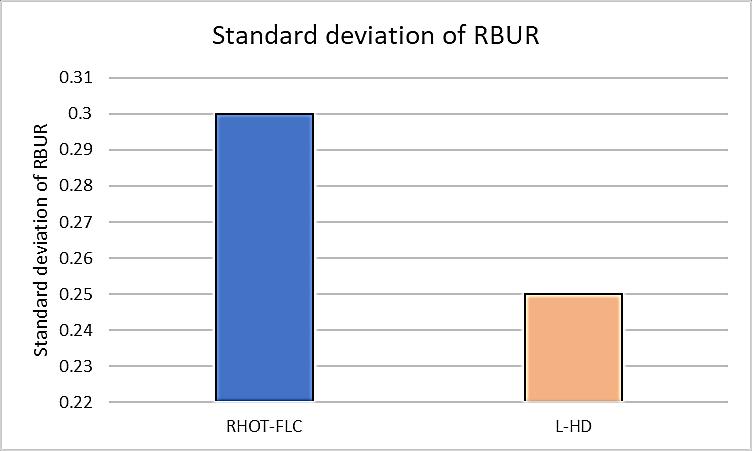
Chart1showstheperformanceevaluationofthealgorithmin terms of the standard deviation of the load. The proposed
algorithm (L-HD) performed better than the (RHOT-FLC) algorithmsinceitensuresthatthetargetcell'saverageload doesnotexceed0.9orittransferstheusertothesecond-best station,thuscontributingtoloaddistributionbetweencells andreducesthedifferencebetweenthem.
overthebaselinealgorithm(RHOT-FLC).Theimprovement ensures a reduction in the probability of connection interruptionresultingfromtheinabilityofthetargetcellto servetheuser.
Chart -1:standarddeviationofload
6.2.2 Average throughput :

The comparison of the two algorithms in terms of averagethroughputisshowninChart2,forthreedifferent user equipment velocities (10, 60, and 100 km/h). The proposedalgorithm(L-HD)gaveahigherthroughputthan thebaselinealgorithmsinceitguaranteestheuser'stransfer toacellcapableofservingitwithsufficientresources.Incase of failure to transfer to the candidate cell, there is an alternativecelltocompletethehandoverprocess,resultingin areducedprobabilityofconnectioninterruptionbetweenthe userequipmentandthecell.Moreover,sinceitcontributesto load balancing between cells, it increases the utilization of resources,resultinginhigherthroughput.

Chart -3:PacketLossRate
6.2.4 Handover failure :
Chart4showstheevaluationoftheproposedalgorithmin terms of the failure rate of handover processes. The improvement in (L-HD) contributed to a decrease in the handoverfailurerateduetoareductionintheunsuccessful handoverprocess.Theimprovementisevidentatlowspeeds sincehighspeedscauseanincreaseinthehandoverrateper second,whichincreasesthelikelihoodofhandoverprocess failure.

Chart -2:averageThroughput
6.2.3 Packet Loss Rate (PLR) :
Chart3showstheevaluationoftheproposedalgorithm(LHD)intermsofpacketlossrate,whichshowedimprovement
Chart -4: Handoverfailure
7. CONCLUSIONS
Thisresearchfocusesonimprovingapreviouslyproposed algorithm for making handover decisions and selecting controlparametersforhandover.Theimprovementincludes atestthatisappliedbeforemakingthehandoverdecision,in which it is verified whether the candidate cell can serve a newuser.Ifitisunabletodoso,thehandoveroperationis executedtothesecond-bestbasestation.Thisimprovement
reduces the probability of establishing a failed connection withacongestedcellandimprovesnetworkbalancesincethe phoneinvolvedinthehandoveroperationwillbetransferred tothesecond-bestcell,thusdistributingtheburdenamong cells.Theresultshaveshownthattheproposedalgorithm(LHD) improves the standard deviation of the load in the network,averagethroughput,packetlossrate,andhandover failurerate Basedontheresultsobtained,thefocuswillbe on improving the solution to increase the network load balancingratiowiththeshortestpossiblelatency.
ACKNOWLEDGEMENT
TheauthorswishtoacknowledgetheFacultyofInformation EngineeringatTishreenUniversityfortheirsupportofthis research.
REFERENCES
[1] TarriasA,FortesS,BarcoR.FailureManagementin5G RAN: Challenges and Open Research Lines. IEEE Network.2023;1–7.
[2] GuresE,ShayeaI,AlhammadiA,ErgenM,MohamadH.A ComprehensiveSurveyonMobilityManagementin5G Heterogeneous Networks: Architectures, Challenges, andSolutions.IEEEAccess.2020;1–1.
[3] Hwang WS, Cheng TY, Wu YJ, Cheng MH. Adaptive HandoverDecisionUsingFuzzyLogicfor5GUltra-Dense Networks.Electronics.2022Oct12;11(20):3278.
[4] Saad WK, Shayea I, Hamza BJ, Azizan A, Ergen M, Alhammadi A. Performance Evaluation of Mobility Robustness Optimization (MRO) in 5G Network With Various Mobility Speed Scenarios. IEEE Access. 2022;10:60955–71.
[5] Tashan W, Shayea I, Aldirmaz-Colak S, Aziz OA, Alhammadi A, Daradkeh YI. Advanced Mobility Robustness Optimization Models in Future Mobile Networks Based on MachineLearning Solutions. IEEE Access.2022;10:111134–52.
[6] SaadWK,ShayeaI,HamzaBJ,MohamadH,DaradkehYI, Jabbar WA. Handover Parameters Optimisation Techniques in 5G Networks. Sensors. 2021 Jul 31;21(15):5202.
[7] Tashan W, Shayea I, Aldirmaz-Colak S, Ergen M, Azmi MH,AlhammadiA.MobilityRobustnessOptimizationin FutureMobileHeterogeneousNetworks:ASurvey.IEEE Access.2022;10:45522–41.
[8] Gures E, Shayea I, Ergen M, Azmi MH, El-Saleh AA. MachineLearning-BasedLoadBalancingAlgorithmsin FutureHeterogeneousNetworks:ASurvey.IEEEAccess. 2022;10:37689–717.
[9] Tashan W, Shayea I, Aldirmaz-Colak S, Ergen M, Azmi MH,AlhammadiA.MobilityRobustnessOptimizationin FutureMobileHeterogeneousNetworks:ASurvey.IEEE Access.2022;10:45522–41.
[10] AlhammadiA,HaslinaHassanW,A.El-SalehA,ShayeaI, Mohamad H, Ibrahim Daradkeh Y. Conflict Resolution Strategy in Handover Management for 4G and 5G Networks. Computers, Materials & Continua. 2022;72(3):5215
32.
[11] AddaliKM,ChangZ,LuJ,LiuR,KadochM.MobilityLoad BalancingwithHandoverMinimizationfor5GSmallCell Networks.2020InternationalWirelessCommunications andMobileComputing(IWCMC).2020Jun.
[12] Addali KM, Bani Melhem SY, Khamayseh Y, Zhang Z, Kadoch M. Dynamic Mobility Load Balancing for 5G Small-Cell Networks Based on Utility Functions. IEEE Access[Internet].2019[cited2022Mar24];7:126998–7011. Available from: https://ieeexplore.ieee.org/iel7/6287639/8600701/08 826267.pdf
[13] AlraihS,NordinR,Abu-SamahA,ShayeaI,AbdullahNF, AlhammadiA.RobustHandoverOptimizationTechnique with Fuzzy Logic Controller for Beyond 5G Mobile Networks.Sensors.2022Aug18;22(16):6199.
[14] 5G Toolbox User’s Guide available at https://www.mathworks.com/help/pdf_doc/5g/index.h tml
[15] 5G Toolbox Getting Started Guide available at https://www.mathworks.com/help/pdf_doc/5g/index.h tml
[16] 5G Toolbox Reference available at https://www.mathworks.com/help/pdf_doc/5g/index.h tml
[17] Douba L, Ahmad Mahmoud Ahmad, Ahmad Saker Ahmad.“AStudyofHandoverPerformanceinBothSA& NSAArchitecturesasaSteptoAchieveLoadBalancing in5GWirelessNetworks”Vol.44No.5(2722):Tishreen UniversityJournal ofResearchandScientific StudiesEngineeringSciencesSeries.
[18] Fuzzy Logic Toolbox™ User's Guide, available at: https://www.mathworks.com/help/pdf_doc/fuzzy/fuzz y_ug.pdf
[19] Tanveer J, Haider A, Ali R, Kim A. An Overview of Reinforcement Learning Algorithms for Handover Management in 5G Ultra-Dense Small Cell Networks. AppliedSciences.2022Jan3;12(1):426.