Comparative analysis of Rootzone Treatment (Phytorid Technology) in Domestic Sewage Treatment System
1Student, Dept. of Civil Engineering, Amity University, Uttar Pradesh, India

2Student, Dept. of Civil Engineering, Amity University, Uttar Pradesh, India
3Student, Dept. of Civil Engineering, Amity University, Uttar Pradesh, India
4Assistant Professor, Dept. of Civil Engineering, Amity University, Uttar Pradesh, India
5Associate Professor, Dept. of Chemistry, Amity University, Uttar Pradesh, India
***
Abstract - At present, the global disposal of sewage is a major issue due to increased levels of pollutants and the diverse composition of sewage water. Sewage is generated from various sources, such as residential societies, industrial areas, and commercial zones, each containing specific sewage compositions. However, instead of segregating the sources, we still mix everything and send it to sewage treatment plants, resulting in lower treatment efficiency, water body pollution, and high waste generation. Due to a shortage of land, disposal itself is a problem, and to address this, we should encourage decentralization of sewage treatment. The Rootzone Treatment (Phytorid technology) is a type of system that can reduce the impact of sewage and convert it into useful water for gardening and irrigation purposes. To Compare the characteristics of the Phytorid bed, a prototype was built in the Hydraulics lab at Amity University, Greater Noida, Uttar Pradesh, and the quality check process was carried out in the Environmental lab.
Key Words: Rootzone Treatment, Phytorid Technology, Decentralization Waste Water Treatment, Domestic Sewage Treatment, Waste Water Treatment, urbanization, Disposal of Sewage
1.INTRODUCTION
Over the past few decades, India has experienced a significant increase in its urban population. To meet the growing demandforwater,alltownsandcitiesareenhancingtheirwatersupplies.However,theinsufficientwastewatertreatment facilitieshaveledtountreatedsewagebeingdisposedofintolakes,rivers,andotherwaterbodies,whichhashadnegative effects on both human health and ecosystems. Despite the limited revenue generated by local taxes, including water and seweragecharges,pollutioncontroliscrucial,butitischallenging.Nonetheless,Indiancitieshavethechancetoadoptnew ways of dealing with wastewater, such as Decentralized Waste Water Treatment (DWWT), which can help conserve resources and provide sanitation to unsanitary areas in Indian towns and cities. Additionally, the reuse and recycle of treatedwastewaterholdsimmensepotentialforoverallurbanenvironmental[1] sustainability, given the socio-economic context of urbanization. Unfortunately, the discharge of harmful substances into primary water sources has led to extensive pollution. Various studies have shown that for every cubic meter of polluted water discharged into water bodies, 8 to 10 cubic meters of clean water can become further contaminated. This is concerning, as contaminated water is responsible for 21 out of the 31 major diseases that cause death in developed countries.[2] These facts underscore the pressing need for improved water treatment methods to address challenges related to food security, water availability, and efficient water use. With energy set to become a major concern in the comingyears,it iscrucial toidentifyandadoptappropriatetechnologiesto mitigate these pressures.Thegoal ofsewage treatmentistostabilizetheorganicmatterinsewageandproducealiquideffluentandsludgethatcanbesafelydisposed of without posing health risks or causing inconvenience. To achieve maximum user satisfaction and value for money, modern and cost-effective technologies and equipment should be adopted. While septic tanks that use pure anaerobic processes can serve as preliminary sewage treatment plants, better treatment methods are needed, such as those that utilize aerobic processes. However, conventional sewage treatment plants require energy to achieve optimal results, particularly for the aerobic process, which requires oxygen to be supplied to bacteria. Moreover, the lifespan of sewage treatmentplantscandecreasewhenheavypollutantloadsarepresentinthesewagewater.Therefore,inmoderntimes,an eco-friendly approach is preferred, one that is efficient, cost-effective, and highly effective. Constructed wetland systems arean example of an eco-friendlyapproachtosewagetreatment,as muchof the treatment isconducted near thesource itself,makingitadecentralizedapproachtosewagetreatment.[3]
2. DECENTRALIZED WASTE WATER TREATMENT
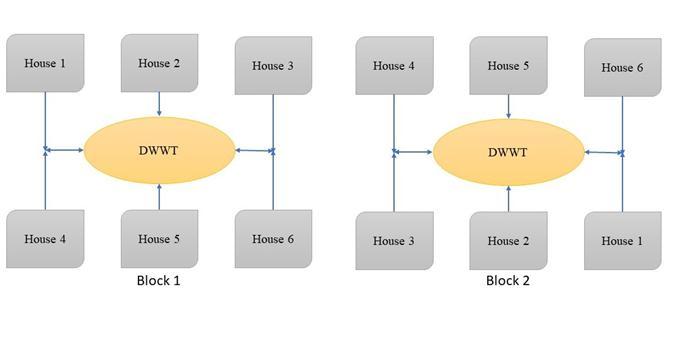
Decentralized water treatment involves treating water at its source to some degree, requiring public involvement and a morecomprehensiveapproachtovariousecosystems.Decentralizedwastewater treatment(DWWT)followstheprinciple of decentralization, enabling sewage treatment to be conducted at a more affordable cost, reducing the need for longdistance pumping, and promoting local reuse of treated sewage. By implementing suitable treatment technology at the community, institutional, and individual building levels, DWWT can contribute to achieving equity and sustainability objectives. In a decentralized system, wastewater collection networks are shorter and smaller, and the amount of wastewater to be treated at the end of the network is relatively small, allowing for simpler and more natural treatment methodstobeemployed.Inessence,sewagecanbemanagedatitspointoforigin.[4][5]
3. CONSTRUCTIVE WETLANDS
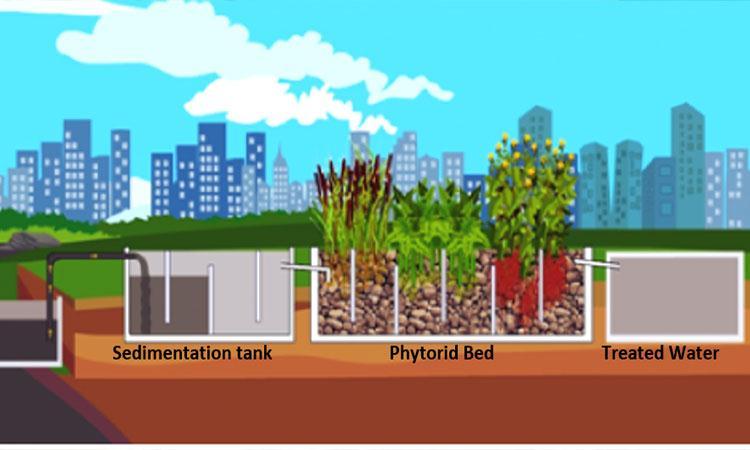
Constructed wetlands (CWs) are a natural and sustainable wastewater treatment technology that use plants, soil, and microorganisms to remove pollutants from wastewater. CWs have been used extensively in India as a low-cost and effective solution for the treatment of domestic and industrial wastewater. One type of CW that has gained popularity in India is the Phytorid technology, which was developed by the National Environmental Engineering Research Institute (NEERI)in2007afterfiveyearsofresearchanddevelopment,followedbysevenyearsoffieldexperimentationonvarious plants.PhytoridtechnologyisaCWsystemthatisdesignedtotreatdomesticwastewaterusingacombinationofvertical flowandhorizontalflowsystems. Thesystemconsistsofaninletchamber,averticalflowbed,ahorizontalflowbed,and an outlet chamber. The vertical flow bed is filled with coarse gravel and planted with wetland plants such as Canna, Colocasia, and Typha. The wastewater flows down through the vertical flow bed, where it is treated by the plants and microorganisms.Thetreatedwaterthenflowsintothehorizontalflowbed,whichisplantedwithgrassesandsedges.The treatedwaterthenpassesthroughalayerofsandandgravelbeforeitisdischargedintotheenvironment.
NEERIhasimplementedseveralPhytoridtechnologysystemsinIndia,includingtheoneinthecityofNagpur.TheNagpur system is designed to treat 1.5 million litres of wastewater per day and serves a population of around 50,000 people.[6] Thesystemhasbeeneffectiveinremovingorganicmatter,nutrients,andpathogensfromthewastewater,andthetreated waterissuitableforirrigationandothernon-potableuses.
NEERI has also conducted research on the performance of Phytorid technology and developed guidelines for its design, construction, and operation. The guidelines recommend the use of specific wetland plants, such as Canna, Colocasia, and Typha,andtheuseofspecificsubstrates,suchasgravel andsand.Theguidelinesalsorecommendtheuseofappropriate inletandoutletstructurestoensureproperflowandtreatment.[7]
Phytorid technology has several advantages over other wastewater treatment technologies. First, it is a low-cost and sustainable solution that uses natural processes to treat wastewater. Second, it can be implemented in both rural and urban areas, making it a versatile solution for wastewater treatment. Third, it has a small footprint, which makes it suitable for areas with limited space. Fourth, it can be easily adapted to local conditions and needs, making it a flexible solution for different types of wastewaters. constructed wetlands, and Phytorid technology, are an effective and sustainablesolutionforthetreatmentofwastewaterinIndia.NEERIhasplayedasignificantroleinthedevelopmentand
implementation of these technologies, conducting research, providing guidelines, and implementing systems across the country. The use of CWs and Phytorid technology for the treatment of wastewater has the potential to provide a sustainableandcost-effectivesolutionforthemanagementofwastewaterinbothruralandurbanareas.
4. METHODOLOGY
This section details the materials and procedures involved in the project's Investigation of phytorid technology. A prototype was built in the Hydraulic Laboratory to process 40 litres of water per day. The prototype's dimensions were measuredtoaccommodateavolumeof100litres,withroughdimensionsof{0.6m X0.5mX0.5m},equivalentto0.012 m3
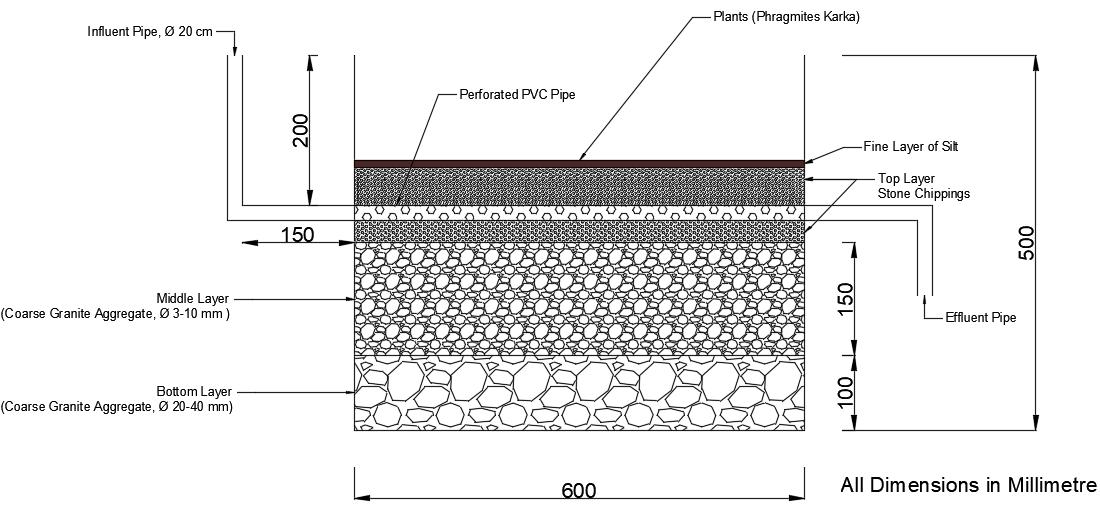
FollowingguidelinesfromthecentralpollutioncontrolBoard,theprototypewasmaintainedwithatopfreeboardof0.20 mandthesurfaceisplacedat0.15mfromthemodel'stoptoensuresubsurfaceflow.The maximumrevisedcapacitywas determinedtobe0.09m3 fortheprototype.
Afteraccountingforthevolumeoccupiedbytheaggregatesandroots,asamplewaspouredintotheprototypetoassessits maximum capacity. Approximately 40 litres of sample were drained to reach its capacity, indicating that the prototype's maximumcapacityis40litresperday.
Otherspecificationsofthemodelare:
Totaldimensionsofthemodel:0.9m×0.9m×0.5m
Dimensionsofthepipes:
• ForInfluent&effluent20mmDiaPVCpipesof150mmlength.
• 600mmlengthforAeratorConnections.
Locationoftheaeratorpipe:0.30mfromthetoplevelofprototype.
Buildingmaterialusedforprototype:
• 10mmthickglass
• 12mmthickplyboard
4.1 Building Material Used
Thefollowingmaterialswereusedinthedevelopmentofthephytoridbed:
Coarse Granite Aggregates: Graniteaggregatesarea typeofcrushedhard rock thatiscommonlyfoundonEarthandis often used as a building material due to its desirable properties. Granite is known for being solid (with grades ranging from 800-1200) and highly solid (with grades ranging from 1,400-1,600), as well as frost-resistant (with grades ranging from300-400)andhavingalowflakinessindex(5-23%).Additionally,itfallsintothefirstclassintermsofradionuclidity (with A (eff) <370nBq/kg), meaning that harmful components and additives are either absent or do not exceed norms. Certificates and research conclusions can confirm this fact. Granite is often used as a high-grade aggregate for concrete. Thestoneismostlycomposedoffeldspar,quartz,andmicacrystals,andthecontentofeachinfluencesthestone'scolour andshades.Thetypesofcoarseaggregateusedinthephytoridbedprojectincluded:[9]
Coarse Aggregate (Effective dia 20-40 mm):Itistypicallyutilizedasafoundationlayerbeneathasphaltsurfacesinroad construction.Itisalsousedforbothsmall-scaleandlarge-scaleprojects.Thisfractioniscommonlyemployedassub-base material for the construction of highways and railways, as well as in the production of concrete and reinforced concrete structures.Itisalsousedasafillerforparkingareasandfoundationsofworkareaswhereheavyconstructionmachinery operates,aswellasintheproductionofconcretewithhigherstrength.
Coarse Aggregate (Effective dia 3-10 mm): Theprimaryuseofaggregatesofthisfractionisintheproductionofpaving slabsandotherconstructionproductsthatrequirethisparticularsizeofaggregate.
Small stone chippings: Granite aggregates in the smallest sizes are utilized not only in road construction, but also for decorative purposes and to pave paths, cover sports grounds, and create safe surfaces for children's playgrounds. These smallaggregatesarealsousedtomanufacturereinforcedconcretestructuresandimprovetheslipresistanceofsurfaces. Additionally,granitesandisaneffectivematerialforlandscapearchitectureandgardening.[10]
Aerator: AperforatedPVCpipeconnectedtoafishtankaeratorwasutilizedtosupplyairtothebed.
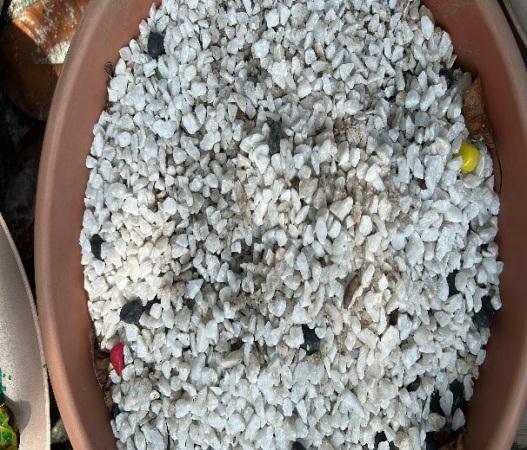
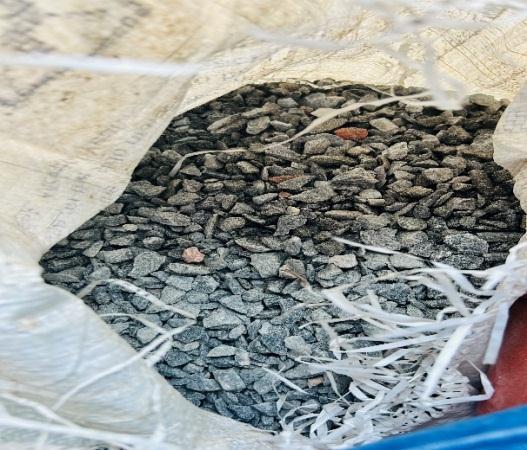
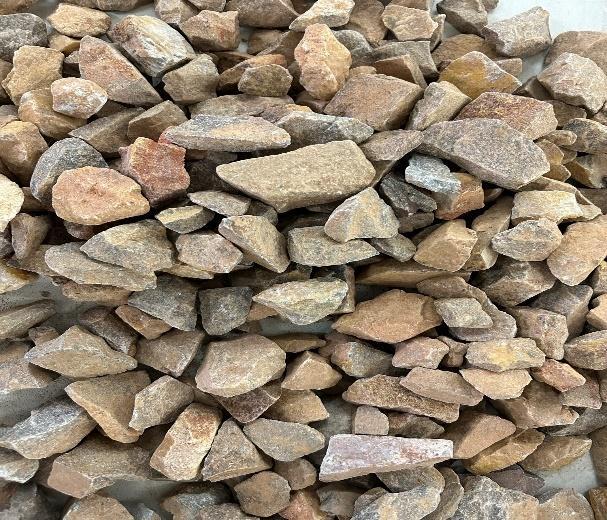
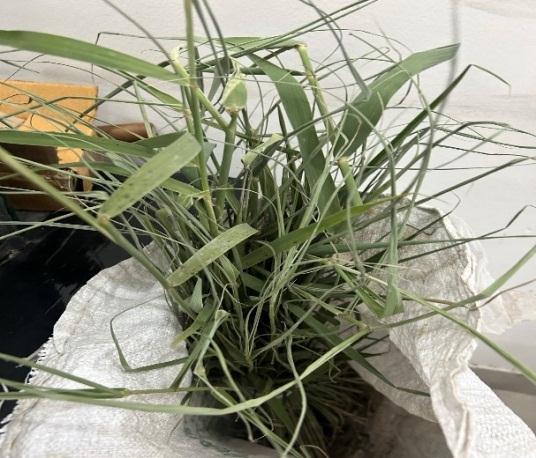
Reed plant (Phragmites Karka): PhragmitesKarka,commonlyknownas IndianReedorCommonReed,haslong,green leavesthatcangrowupto60cminlength.Theleavesareflat,smooth,andnarrow,withapointedtip.Theyarearranged alternately along the stem and can be up to 2 cm wide. The leaves play an important role in the plant's photosynthesis, whichiscrucialforitsgrowthandsurvival.PhragmitesKarkaleavesarewidelyusedinwastewatertreatmentduetotheir uniqueabilitytoremovepollutantsfromwater.[11]Theleaveshavealargesurfacearea,whichallowsfortheabsorption andretentionofcontaminantssuchasheavymetals,organicpollutants,andnutrients.Therootsoftheplantalsoprovide an environment for beneficial microorganisms, which help to break down and remove pollutants from the water. In additiontotheiruseinwastewatertreatment,PhragmitesKarkaleavesarealsousedforthatchingandasasourceoffiber for papermaking.[12] The plant's ability to remove pollutants from water makes it an important tool for environmental managementandconservationefforts.[13]
4.1 Building Material Used
A sample of approximately 45 litres of wastewater was Collected from the Chauganpur Lake, Chauganpur , Knowledge Park V, Greater Noida, Uttar Pradesh. During the initial sampling, the wastewater was found to have low oxygen levels, resulting in little to no aquatic life being present. The collection of the sample was done using a collector mug & the openingwassealedwithabottlecap
4.3 Parameter Tested
Turbidity: Turbidityisameasureoftheclarityorcloudinessofwater,causedbythepresenceofsuspendedparticlessuch assediment,algae,orotherorganicandinorganicmaterials.[14]Intreatedwastewater,highturbiditylevelscanindicate thepresenceofpathogensandothercontaminantsthatcanbeharmfultotheenvironmentandhumanhealth.Therefore, turbidity is an important parameter that must be monitored to ensure the safety of treated wastewater discharge. To reduceturbiditylevelsintreatedwastewater,variousprocessessuchassettling,filtration,anddisinfectioncanbeused.By maintaining low turbidity levels in treated wastewater, the environmental impact of wastewater discharge can be minimized.
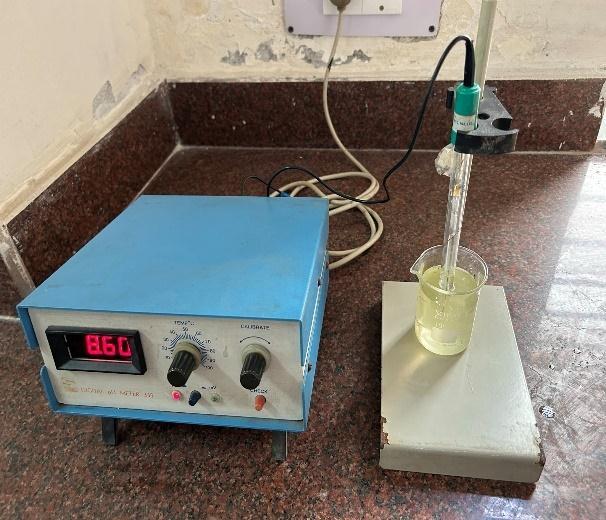
pH: pHisameasureoftheacidityorbasicityofasolution,anditplaysacriticalroleinwastewatertreatment.ThepHof wastewater can affect the solubility, speciation, and toxicity of various contaminants present in the water. It also has a significant impact on the performance of various chemical and biological treatment processes. In wastewater treatment, thepHrangeshouldbemaintainedwithinspecificlimitstoensureefficienttreatmentandsafedischargeoftreatedwater pH plays a crucial role in ensuring that treated wastewater is safe for discharge into the environment or reuse. Treated wastewateroftenhasa differentpHthan natural water,anda shiftinpHcanaffecttheecosysteminthereceivingwater bodies.Therefore,itisimportanttomonitorandcontrol pHlevelsintreatedwastewatertoensureenvironmentalsafety. The optimal pH range for treated wastewater discharge depends on the characteristics of the receiving water body. For example,apHrangeof6.5to8.5istypicallyacceptablefordischargeintofreshwaterbodies,whileapHrangeof7.5to8.5 is typically acceptable for discharge into marine environments. If the pH of the treated wastewater is outside of the acceptablerange,itcancauseecologicalharm,suchasalteringtheacidityofthewater,killingaquaticlife,andpromoting the growth of harmful algae. To ensure that the pH of treated wastewater is within the acceptable range, pH controllers canbeusedtocontinuouslymonitorandadjustthepHofthetreatedwastewaterbeforedischarge.[15]
Total Dissolved Solids: Total dissolved solids (TDS) is a measure of the amount of inorganic and organic matter that is present in water.[15] This includes minerals, salts, and other substances that have dissolved in the water. TDS is an important parameter to measure in wastewater treatment as it can affect the quality of the treated water and the efficiency of the treatment process. In wastewater treatment, high levels of TDS can cause issues such as scaling and fouling of equipment, which can lead to decreased treatment efficiency and increased maintenance costs. TDS can also impactthetreatedwater'ssuitabilityforreuse,dischargeintotheenvironment,orasadrinkingwatersource. Tocontrol TDSlevelsinwastewatertreatment,varioustechniquessuchasreverseosmosis,nanofiltration,andelectrodialysiscanbe used to remove dissolved solids. Additionally, monitoring and adjusting the influent water quality, such as limiting the dischargeofindustrialeffluent,canalsohelptocontrolTDSlevels.
Chloride Concentration: The chloride ion, denoted by the negatively charged anion Cl−, can be produced through two ways: either by chlorine gaining an electron or by dissolving a substance such as hydrogen chloride in polar solvents or water. These ions, such as sodium chloride, are extremely soluble in water and have essential functions in regulating cellularfluid,transmittingnerveimpulses,andmaintainingtheacid/baseequilibrium.Chlorideconcentrationisacrucial parameter to monitor in treated wastewater, as it can impact the quality of the receiving water body. Chloride can originate from various sources, including industrial wastewater, road salt runoff, and seawater intrusion. High chloride concentrations can lead to corrosion of infrastructure, including pipes and pumps. Reverse osmosis and ion exchange technologies are commonly used to reduce chloride levels in treated wastewater. Additionally, monitoring chloride concentration in treated wastewater is necessary to ensure that discharged water meets regulatory requirements and doesnotharmtheenvironmentorpublichealth.[16]
Dissolved Oxygen: Thedissolvedoxygen(DO)inawaterbodylikeariver,lake,orstreamindicatestheamountofoxygen available to support the growth of aquatic plants and animals. It is considered the most crucial indicator of the water body's health and its ability to sustain a balanced aquatic ecosystem. Wastewater containing organic pollutants that consumeoxygencanreducetheDOlevelsandresultinthedeathofmarineorganisms.Thelevelofdissolvedoxygenisan importantfactorindeterminingthewaterqualityandthewaterbody'sabilityto supportaquaticlife.Generally,ahigher levelofDOindicatesbetterwaterquality,whilelowlevelsmayleadtotheinabilityoffishandotherorganismstosurvive. TheDOinwatermainlycomesfromthedissolvedoxygenintheairandthephotosynthesisofaquaticplants.Sunnydays withdensealgaeorplantscanincreaseDOlevelsduetophotosynthesis,andstreamturbulencecanalsoincreaseDOlevels as air is trapped under rapidly moving water. Water temperature also affects DO levels, as colder water can hold more oxygenthanwarmerwater.[17]
Phosphate Concentration: Phosphateisanessentialnutrientforplantgrowthandvariousbiologicalprocessesinliving organisms.However,excessiveamountsofphosphatesinwaterbodiescancauseeutrophication,leadingtothedepletion of oxygen and the proliferation of harmful algal blooms. There are two types of phosphates found in wastewater: orthophosphate (soluble) and polyphosphate (insoluble). Orthophosphates are the most common form found in wastewaterandaretypicallyremovedusingchemicalprecipitationmethods,suchasaddingmetalsaltstothewastewater to form insoluble compounds that can be removed through sedimentation. Polyphosphates can be removed through biological treatment methods, such as activated sludge. Maintaining proper phosphate concentrations in treated wastewater is crucial for protecting the environment and public health. Excessive phosphate concentrations can lead to eutrophication, which can cause harm to aquatic ecosystems and human health. Therefore, monitoring and controlling phosphate concentrations in treated wastewater is critical for ensuring safe and sustainable wastewater treatment practices.[18],[19]
Hardness: Hardnessinwaterisameasureoftheconcentrationofdissolvedminerals,primarilycalciumandmagnesium. Itcancausescalinganddamagetowater-usingequipment,suchaspipes,boilers,andcoolingtowers.Therearetwotypes ofhardness:temporaryhardnessandpermanenthardness.Temporaryhardnesscanberemovedbyboilingthewateror throughtheadditionofchemicalssuchaslimeorsodaash.Permanenthardnesscannot beremovedthrough boilingand requires ion exchange or membrane filtration. Maintaining proper hardness levels in treated wastewater is essential for preventingdamagetoequipmentandensuringthelongevityoftheinfrastructure.Excessivehardnesscanleadtoscaling, corrosion, and reduced efficiency of water-using equipment, which can result in higher operating costs and increased energyconsumption. Therefore, monitoringandcontrollinghardnesslevelsintreatedwastewateriscritical forensuring efficientandsustainablewatertreatmentpractices.[20]
Biological Oxygen Demand (BOD): BiologicalOxygenDemand(BOD)isa measureoftheamountofoxygenrequiredby microorganisms todecomposeorganicmatterinwater.TherearetwotypesofBOD:carbonaceousBODandnitrogenous BOD.CarbonaceousBODistheprimaryfocusinwastewatertreatmentasitindicatestheleveloforganicmatterthatneeds to be removed to ensure safe and sustainable wastewater treatment practices. container with dissolved oxygen and
microorganisms.[21] The container is then incubated for five days at a specific temperature (usually 27°C) to allow the microorganisms to consume the organic matter and oxygen. The initial and final dissolved oxygen levels are measured, and the difference between the two values indicates the amount of oxygen consumed by the microorganisms during the incubation period. The BOD test is an important parameter in wastewater treatment as it provides an indication of the level of organic pollutantspresent in the wastewater.HighBOD levelscanlead toa depletion of oxygen in water bodies, causingharmtoaquaticlifeandcreatingunpleasantodors.[22]
5. COMPARITIVE ANALYSIS
The base model was created according to the design using 10 mm thick glass, PVC pipes, and corks. To ensure adequate stabilityduringloadingandtransportation,extraglassplateswereaddedatthe bottom.Theperforationswerecreatedby using a heated steel wire, and the dimensions of the base model were verified before all the connections were glued together.
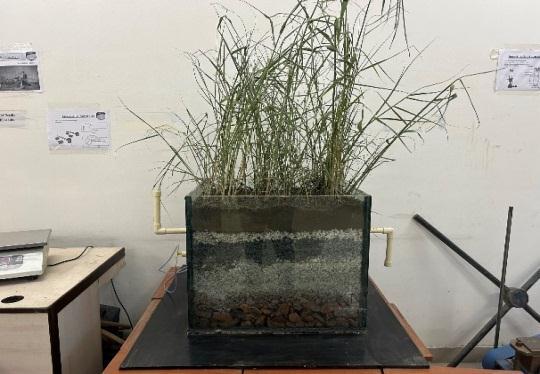

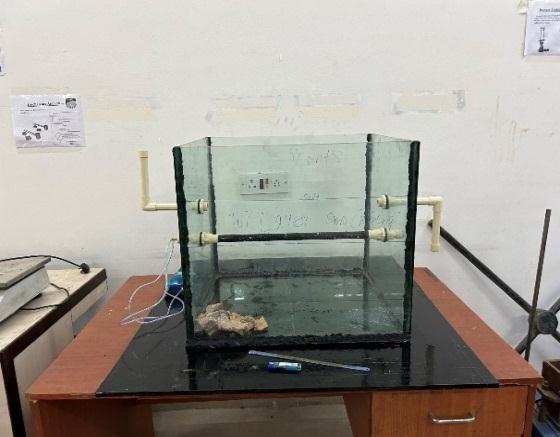
Theconstructionofthebedinthemodelbeganwiththeplacementofa10cmlayerof20-40mmgraniticaggregateasthe bottommostlayer.Thiswasfollowedbyalayerof3-10mmgraniticaggregateuptoaheightof15centimetres,takingcare to provide enough space for the perforated pipe without overloading it. After the intermediate layer was placed, a top layer was made using small stone chippings and a small amount of silt, and reed plants were planted on top. The plants werethenwatered,andthemodelwaslefttoallowtherootstodevelopfor24hours.
During this time, tests were conducted on the original sample. Once completed, the sample was introduced into the Phytorid bed through an inlet pipe until it reached the level of the influent pipe. Before the sample was drained into the bed, an aerator was attached to the perforated pipe and turned on. The inlet pipe was then sealed with a cork, and the arrangementwasallowedtositfor24hours,whichistheretentionperiodforbatchprocessing.
Oncetheretentionperiodhadended,the effluentpipe wasusedtoextractthefinal sample,whichwasthensubjectedto various tests (as mentioned earlier). The results obtained were compared to the initial sample to determine the
effectiveness of the Phytorid bed. These results were then compared to the pre-defined efficiencies established by the NationalEnvironmentalEngineeringResearchInstitute(NEERI).[2]
6. SAMPLE TESTING & RESULT DISCUSSION

The Comparative study yielded values for different parameters, which were then compared to the standard values providedbyNEERI.Thefollowingoutcomeswereobserved: Table
-1: ComparisonofInitial&FinalTestResults
7. CONCLUSION
In conclusion, the analysis conducted supports the viability of phytorid technology as an effective decentralized wastewater treatment solution with potential for water reuse. The treated water generated by phytorid systems demonstratessatisfactoryqualityandcanbeutilizedforvariouspurposes,includingirrigation,flushing,riverdilution,and gardening. NEERI's recommendation to extend the retention period to 48 or 72 hours is advised to achieve high-quality standards.[22]
Onenotableadvantageofphytoridtreatmentplantsistheirrelativelylowoperationalandmaintenancecostscomparedto other treatment processes, making them a promising option for future implementation. However, the requirement for larger land areas to accommodate high-capacity treatment systems poses a significant challenge. Ongoing efforts aim to enhance the capacity of these systems within smaller land areas, and it is crucial to raise public awareness about their installation,eveninresidentialsettings,withtheinvolvementofuntrainedworkers.[23]
To ensure the continued effectiveness of phytorid beds, it is recommended to replace the arrangement of plants and coarsebedsevery18months.Thismaintenancepracticehelpssustainoptimaltreatmentperformanceovertime.Overall, the implementation of decentralized wastewater treatment through phytorid technology holds promise for addressing waterscarcity,pollution,andsustainablewaterresourcemanagement.[24]
REFERENCES
[1] S. Bhamare, “Analysis and Design of Sewage Treatment Plant using Phytorid Technology,” Int J Res Appl Sci Eng Technol,vol.8,no.6,pp.1557–1563,Jun.2020,doi:10.22214/ijraset.2020.6252.
[2] “National Inventory of Sewage Treatment Plants Central Pollution Control Board Parivesh Bhawan East Arjun Nagar,Delhi,”2021.
[3] A.A.RavalandP.B.Desai,“ReviewArticleRootZoneTechnology:ReviewingitsPastandPresent,”2015.[Online]. Available:http://www.ijcmas.com
[4] C. Zaharia, “Decentralized wastewater treatment systems: Efficiency and its estimated impact against onsite naturalwaterpollutionstatus.ARomaniancasestudy,”ProcessSafetyandEnvironmentalProtection,vol.108,pp. 74–88,May2017,doi:10.1016/j.psep.2017.02.004.
[5] E.Engstler,D.J.Kerschbaumer,andG.Langergraber,“EvaluatingthePerformanceofSmallWastewaterTreatment Plants,”FrontEnvironSci,vol.10,Jul.2022,doi:10.3389/fenvs.2022.948366.
[6] M.Sawant,K.Aware,andY.Honrao,“PhytoridTechnology,”2020.
[7] Dr. K.R. Ranganathan et al., “Guidelines on Construction, Operation and Application of Rootzone Treatment SystemsfortheTreatmentofMunicipalandIndustrialWastewater.”[Online].Available:www.cpcb.delhi.nic.in
[8] Dr.RamanSharma,“PhytoridTechnology,”Phytoridtechnologyandimplemented projectsacrossIndia.
[9] R.S.Kumar,H.Mohammed,andM.Haripriya,“AnExperimentalstudyonpartialreplacementforcoarseaggregate byGraniteWaste,”2016.[Online].Available:www.ijiset.com
[10] Cescon and J. Q. Jiang, “Filtration process and alternative filter media material in water treatment,” Water (Switzerland),vol.12,no.12,Dec.2020,doi:10.3390/w12123377.
[11] N.S.M.Said,S.R.S.Abdullah,H.A.Hasan,A.R.Othman,andN.‘IzzatiIsmail,“EnduranceofPhragmiteskarkain removing colour and suspended solids from industrial coffee processing effluents in a continuous reed bed system,”JournalofWaterProcessEngineering,vol.40,p.101832,Apr.2021,doi:10.1016/J.JWPE.2020.101832.
[12] K. Angassa, S. Leta, W. Mulat, H. Kloos, and E. Meers, “Evaluation of Pilot-Scale Constructed Wetlands with Phragmites karka for Phytoremediation of Municipal Wastewater and Biomass Production in Ethiopia,” EnvironmentalProcesses,vol.6,no.1,pp.65–84,Mar.2019,doi:10.1007/s40710-019-00358-x.
[13] A. A. Asaad, A. M. El-Hawary, M. H. H. Abbas, I. Mohamed, A. A. Abdelhafez, and M. A. Bassouny, “Reclamation of wastewater in wetlands using reed plants and biochar,” Sci Rep, vol. 12, no. 1, Dec. 2022, doi: 10.1038/s41598022-24078-9.
[14] A.R. Mhaske and S. M. Taley and R. B. Biniwale, “Removal of tubidity from sewage water by phytorid sewage treatment plant: a study using the response surface methodology.,” International Journal of Agricultural Engineering,vol.7,2014.
[15] R. K. Kushwah, A. Bajpai, and S. Malik, “Characteristics of waste water in sewage treatment plant of BHOPAL, (India),”J.Chem.Pharm.Res,vol.3,no.6,pp.766–771,2011.
[16] YimingLiandZhongzhuYangandKaihuaYangandJingjingWeiandZihaoLiandChiMaandXuYangandTantan WangandGuangmingZengandGuanlongYuandZhigangYuandChangZhang,“Removalofchloridefromwater andwastewater:Removalmechanismsandrecenttrends,”ScienceofTheTotalEnvironment,vol.821,2022.
[17] Y. Nagvekar, “"Feasibility of Phytorid Technology For Waste Water Treatment ".” [Online]. Available: www.ijres.org
[18] J.T.Bunce,E.Ndam,I.D.Ofiteru,A.Moore,andD.W.Graham,“Areviewofphosphorusremovaltechnologiesand their applicability to small-scale domestic wastewater treatment systems,” Frontiers in Environmental Science, vol.6,no.FEB.FrontiersMediaS.A.,Feb.22,2018.doi:10.3389/fenvs.2018.00008.
[19] A.Cabo,S.Gouveia,C.Cameselle,andK.H.Lee,“Monitoringofphosphorusdischargeinasewagetreatmentplant with a phosphate automated analyzer,” Environmental Science: Advances, vol. 1, no. 4, pp. 483–490, Oct. 2022, doi:10.1039/d2va00062h.
[20] S. Saikia Kakati, “Assessment of Water Hardness Used for Domestic Purposes in Some Tribal Villages of DhakuakhanaSub-division,LakhimpurDistrict,Assam.”[Online].Available:www.neptjournal.com
[21] A. K. Khambete and R. A. Christian, “STATISTICAL ANALYSIS TO IDENTIFY THE MAIN PARAMETERS TO EFFECTING WWQI OF SEWAGE TREATMENT PLANT AND PREDICTING BOD.” [Online]. Available: http://www.ijret.org
[22] A. S. Manasi, M. J. Rutuja, P. N. Srushti, P. S. Shrunkhala, P. Sachin, and C. B. Sandeep, “Feasibility Analysis of Decentralized Wastewater remedy systems,” International Journal of Advanced Research in Science, CommunicationandTechnology(IJARSCT),vol.8,no.1,pp.207–219,2021,doi:10.48175/568.
[23] S.KumarandM.P.Choudhary,“PerformanceAssessmentofDomesticWastewaterTreatmentPlantsOperatingon Different Technologies,” Int J Eng Adv Technol, vol. 9, no. 3, pp. 1649–1653, Feb. 2020, doi: 10.35940/ijeat.C5454.029320.
[24] A. Petkar et al., “58 International Journal for Modern Trends in Science and Technology Treatment of sewage & Industrial Waste Water by using Phytorid Technology,” Phytorid Technology. International Journal for Modern TrendsinScienceandTechnology,vol.8,no.05,p.58,2022,doi:10.46501/IJMTST0805010.