Seismic Evaluation of Base Isolated Overhead Water Storage Tank
Arfat Rafiq, Mir Tabish Altaf, Shahid Rafeeq,1M Tech student, Department of Civil Engineering, Jamia Millia Islamia, New Delhi, India
2 M Tech student, Department of Civil Engineering, Jamia Millia Islamia, New Delhi, India
3 B E student, Department of Civil Engineering, Jadavpur University, Kolkata, India

4Assistant Professor, Department of Civil Engineering, Jamia Millia Islamia, New Delhi, India ***
Abstract - This paper presents the seismic analysis of reinforced concrete overhead water tank. An overhead water tank is analyzed for seismic zone V as per IS 1893: 2016 using SAP 2000 software. Non-linear time history analysis has been conducted to evaluate the behavior the OWT (Overhead Water Tank) at different water levels under the base fixed condition and base isolated conditions. The main parameters consider in this seismic analysis of OWT are lateral displacement, base shear and time period. From the analysis it is found that the response of the tank depends upon the support conditions, type of the quake, depth of water level in the tank and shows a complex behavior. The tank with fully filled gives maximum displacement in both the cases, maximum base shear and maximum time period. Tank with 75% water gives less displacement as compared to 50% water that is mainly due to strong sloshing effects in case of tank containing 75% water. Base isolation of overhead water tank does not give us rigid body motion of superstructure. There is a large relative displace at the staging levels.
Key Words: OWT (Overhead Water Tank), Earthquake, SAP 2000, Time history analysis, Displacement, Time periods,Baseshear.
1.INTRODUCTION
Elevated reservoirs are considered important structures that must continue to function as soon as a large earthquake happens, among other reasons to aid in relief operations and stop fires from spreading. The reservoirs are raised by creating a circular shaft or by staging. The columns and horizontal braces of the structural framework used for staging normally transfer the load to the foundation. Reinforced concrete elevated water tanks wereproventoperformpoorlyunderjoltsofearthquakes. Previous earthquakes damaged the supports of multiple tall water tanks despite their moderate magnitude and large epicentral distances. Because of this, the columns and braces are essential components of such structures and are built to withstand loads from wind and earthquakes.
Expected seismic load is dependent on a number of factors,includingthearea'sseismicity,thekindofsoil,the structure's dynamic properties, etc. The structure's naturaltimeperiodanddamping,whichhaveasignificant
impact on the anticipated seismic load, are its dynamic properties. The seismic code IS: 1893(Part I): 2016 states that more than 60% of India is earthquake-prone. Elevatedwatertanks'seismicanalysesdifferfromthoseof otherstructuresintwoways:
(i) Other constructions are not subject to the sloshing effects that occur when the fluid insidethetank exertshydrodynamicforceon thetankwallsduringseismicexcitation.
(ii) Elevated liquid storage tanks require more design seismic forces than other structures because they are less ductile and redundant, necessitating rigorous seismic analysis and exactdeterminationofthedesignearthquake load.
Ithasbeendeterminedtoimplementthe"IndianInstitute ofTechnology,Kanpur-GujaratStateDisasterManagement Act" because the Indian Standard (IS) code for seismic design does not have a provision on the seismic design of OWTs. (IITK-GSDMA 2007) guidelines for the seismic design of overhead liquid storage tanks (Moslemia et al. 2019).
1.1 SPRING-MASS IDEALIZATION OF OVERHEAD WATER TANK
TheidealizedtwoDOFsystemsforOWTswithandwithout water is composed of the impulsive mode and convective mode, as well as a single DOF. There won't be convective mode in the empty tank. Figure 1.4 illustrates the OWT's idealized structural design. When an OWT with enough freesurfaceandwaterfortheentireheightissubjectedto groundaccelerationfromanearthquake,thetankwalland water will both be excitedhorizontally.The water present inthetank'slowercontainerwillfunctionasamassthatis rigidly attached to the tank wall during the earthquake excitation. It is known as impulsive mass. The sloshing effects will have an impact on the water in the upper part of the tank, and this mass is known as convective mass. Impulsive hydrodynamic pressure and convective hydrodynamic pressure, respectively, are terms used to describe the hydrodynamic pressure caused by impulsive mass and convective mass. When analyzing the modal behavioroffilledtanks,atwo-DOFsystemissplitintotwo
single-DOFsystems,and the responsesof the twosystems are computed independently. Using the SRSS combination rule,theyarecombinedtoobtaintheentireresponse.
1. By considering variations in water levels, such as for tank empty condition, 25%, 50%, 75% water levels, and for full tank condition, the elevated reservoir in linked condition (fixed base) will be analyzedforaBhujearthquakeusingSAP2000.

2. Inordertodeterminetheseismicbehaviorunder all the aforementioned situations, SAP2000 will alsobeusedtoanalyzetheelevatedreservoirinan uncoupledcondition(baseisolatedusingarubber baseisolator).
In order to compare the maximum base shear, maximum displacement, relative displacement, and time for all the aforementioned examples in both coupled and decoupled settings.
1.2 BASE ISOLATION
Baseisolationsystems'principalpurposeistoseparate thesuperstructurefromthesubstructure,whichismostly exposed to seismic excitation. As a result, some of the energy that would have been delivered to the superstructurewillbelost.Thefoundationslab'smassand the isolation devices' lateral stiffness must be fixed as necessary. When isolation is offered, displacement at the level of the isolation devices will be extremely high, and thebehaviorofthesuperstructurewillappeartobethatof a rigid body. However, this rigid movement is questionable in the case of a highly elevated water tank since the bulk is concentrated at the top. This study's primary goal is to examine how elevated water tanks function during earthquakes, both with and without base isolation, and how that performance varies over a fundamentallynaturaltimespan.
2. OBJECTIVES
In the absence of soil structure interaction, an elevated reservoirismodeledashavingafixedbase.We'llanalyses the elevated reservoir with its fluctuating water level. The finiteelementapproachwillbeusedtoanalysestheraised storagereservoirbecauseitisthemosteffectiveanalytical techniquecurrentlyavailable.Anycombinationandtypeof loadingcanbeanalyzedusingthismethod.Inlightofthese realities, the ensuing goals have been proposed. To study thedynamicresponseofelevatedwaterreservoir.
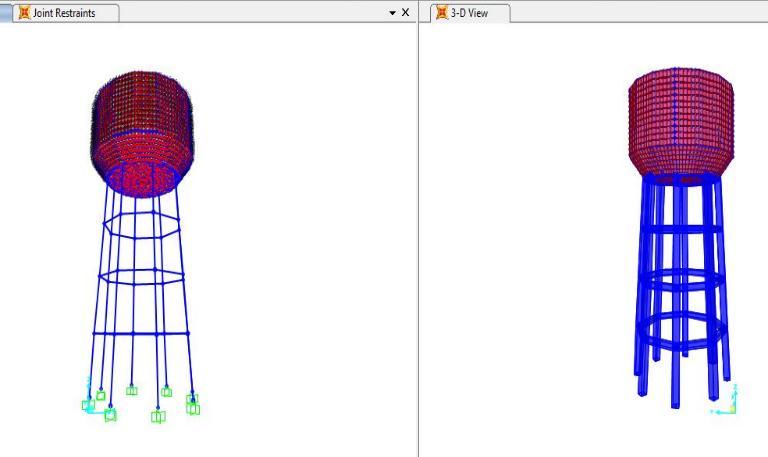
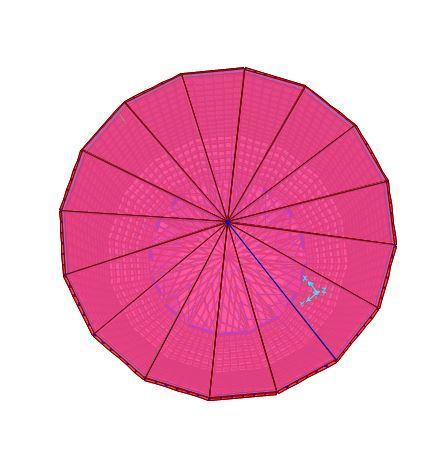
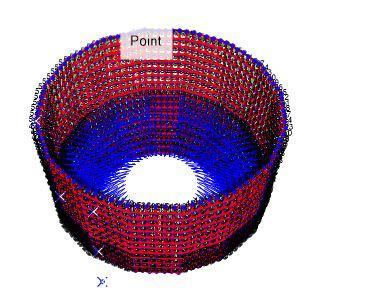

4.STRUCTURAL
4.1
Table -7: MaximumBaseshearinX-Direction
Graph1:
4.2
4.2.1
baseshearandwaterlevelintank
4.2.2
Table -9: MaximumdisplacementintheXdirection





Maximum displacement is the measurement of the lateral displacement that can occur along an elevation when a lateral load is applied. Time history analysis is used to determine the elevated tank's maximum displacement in theXdirection.
Table -8: MaximumdisplacementintheXdirection
Graph 3: PlotofMaximumLateralDisplacements(mm) versuselevations
4.3 TIME PERIOD (mm)
4.3.1 Base Fixed
Table -10: Timeperiod(sec)forfixedbaseatdifferent filledconditions
Graph 4: Timeperiodofbasefixedelevatedwatertank
Base Isolated
Table -11: Timeperiod(sec)forbaseisolatedtankat differentfilledconditions
3. CONCLUSIONS
Utilizing the technique of Time history Analysis, the seismic performances of OWTs subjected to the Bhuj earthquake have been examined. Different seismic reaction characteristics, such as base shear, maximum displacement, time period, etc., were considered. The resultingresultsareasfollows,whicharepresented.
In the case of the basic fixed condition, the time period is maximum for a fully filled above water tank and asynchronous for other circumstances, such as when the tank is only 75% full. This may be mostly because the 75% full tank has severe sloshingeffects.
When compared to a base fixed elevated reservoir,thetimeperiodislongerinthecaseofa base separated overhead water tank. The time periodlikewisegrowswiththedepthofthewater levelinthebase-isolatedelevatedwatertank.
Inthecaseofa base-fixedelevatedreservoir,the base shear rises with tank depth; it is maximum forfullyfilledtanksandminimumforemptyones.
Although the base shear can be reduced by utilizing a base isolator, the behavior is still comparable to that of a base-fixed elevated reservoir, i.e., maximal for a fully filled state and decreasingwithadropinthetank'swaterlevel.
Inthecaseofafixedsupportsystem,thelocation where the supporting system joins the container experiencesthemostdisplacement.
In the case of a base-isolated overhead water tank,thesystem'sgreatestdisplacementoccursat the roof level, with maximum displacement occurring in the full condition and decreasing percentagesof25%,50%,and75%inthatorder.
No stiff body movement was seen in the base isolatedOWTunderearthquakeexcitation.
REFERENCES
[1] Sanket Nimbekar et al 2021 IOP Conf. Ser.: Mater. Sci. Eng. 1197 012016 “Seismic Response Control of Elevated Water Tank using Base Isolation: A Review Young, The Technical Writer’s Handbook. Mill Valley, CA:UniversityScience,1989.
[2] Nayak et al 2012, “Seismic response of partially filled rectangular liquid tank”, Fourth International Congress on Computational Mechanics and Simulation”, 9- 12 Dec 2012, Hyderabad, India. K. Elissa,“Titleofpaperifknown,”unpublished.
[3] F. Omidinasab et al KSCE Journal of Civil Engineering (2012) 16(3):366-376, Seismic Response Evaluation of the RC Elevated Water Tank with Fluid Structure InteractionandEarthquakeEnsemble.
[4] B. Waghmare and N. M. Kanhe, "Seismic Response of Isolated Liquid Storage Tanks with Elastomeric Bearings(2013)."
[5] Ankesh Birtharia and Sarvesh K Jain “SEISMIC RESPONSE OF ELEVATED WATER TANKS: AN OVERVIEW”, International Research Journal of Engineering and Technology (IRJET) e-ISSN: 23950056Volume:02Issue:04|July-2015.
[6] S.C. Potnis et al, "Earthquake response of the liquid storage tank with various isolation systems (2013)." International Journal of Application or Innovation in Engineering & Management (IJAIEM) ISSN 2319 –4847Volume2,Issue11,November2013.
[7] Mrs. Meet Motwani, “Vibration Control of Elevated Water Tank Using Different Seismic Control Techniques – A Review”, International Journal of LatestEngineeringResearchandApplication(IJLERA) ISSN:2455-7137Volume–02,Issue–05,May–2017, PP–58-63.
[8] NasserDine etal, “International Journal of Innovative Technology and Exploring Engineering (IJITEE) ISSN: 2278-3075,Volume-9Issue-9,July2020.
[9] Suyash Nerkar1 et al, “Seismic behavior of elevated storage reservoir by finite element method’’, International Journal of Advanced Technology in Engineering and Science -Vol. No. 4 Special issue no. 01,March2016.41
[10] ] Ahmet H. Deringol & HuseyinBilgin 2018, ‘Effects of the isolation parameters on the seismic response of steel frames’, Earthquakes and Structures, An Int'l Journal,vol.15,no.3.
[11] Anil K. Chopra 2012, ‘Dynamics of Structures’, Fourth Edition, Dorling Kindersley (India) Private Limited, NewDelhi,India.
[12] Ahmet H. Deringol & HuseyinBilgin 2018, ‘Effects of the isolation parameters on the seismic response of steel frames’, Earthquakes and Structures, An Int'l Journal,vol.15,no.3.
[13] Centre for Engineering Strong Motion Data (CESMD), US Geology Survey (https://www.strongmotioncenter.org/).
[14] Chen JZ & Kianoush MR 2009, ‘Generalized SDOF System for Seismic Analysis of Concrete Rectangular LiquidStorageTanks’,EngineeringStructures,vol.31, no. 10, pp. 2426-2435. [16] Claudia Mori, Stefano Sorace & Gloria Terenzi 2015, ‘Seismic Assessment and Retrofit of Two Heritage-Listed R/C Elevated Water Storage Tanks’, Soil Dynamics and Earthquake Engineering,vol.77,pp.123-136.
[15] Hashemi S, Saadatpour MM & Kianoush MR 2013, ‘Dynamic analysis of flexible rectangular fluid containers subjected to horizontal ground motion’ Earthquake Engg Struct. Dym., vol. 10. [19] Houser GW 1963b, ‘The dynamic behavior of water tanks’, Bulletin of Seismological Society of America, vol. 53, No.2,pp.381-387.
[16] Halil Sezen, Ramazan Livaoglu & Adem Dogangun 2008, ‘Dynamic analysis and seismic performance evaluation of above-ground liquid-containing tanks’, EngineeringStructures,vol.30,pp.794-803.
BIOGRAPHIES
ARFAT RAFIQ, MTech (Earthquake Engineering) Dept.ofCivilEngineering, JamiaMilliaIslamia,NewDelhi.


MIR TABISH ALTAF, MTech (Earthquake Engineering)
Dept.ofCivilEngineering, JamiaMilliaIslamia,NewDelhi
SHAHID RAFEEQ, BE(CivilEngineering)


Dept.ofCivilEngineering, Jadavpuruniversity,Kolkata
DR. MOHAMMAD UMAIR, AssistantProfessor
Dept.ofCivilEngineering, JamiaMilliaIslamia,NewDelhi.