STRENGTHENING OF DISTRESSED STRUCTURAL ELEMENT BY USE OF GLASS FIBRE REINFORCED POLYMER

Shivani Singh, Swati Chaudhary
***
ABSTRACT
In modern concrete technology, Fibre Reinforced Polymer (FRP) is widely utilized because of its excellent mechanical properties, such as non-conducting, good tensile strength, anti-corrosive , high stiffness etc.,. Reinforced concrete (RC) structuralmemberswillgraduallylosedurabilitywithoutproperservicing,sothesedamagedRCstructuralmembersneed toberepairedandmaintainedproperly,orstrengthened. BoththeExternallyBonded(EB)andtheNearSurfaceMounted (NSM)method,bothofwhichuseFRP,mightbeusedtoreinforcethesedamagedRCelements.DependingontheFRPused, suchasAFRP,CFRP,GFRP,etc.,aswell as thedirection of theFRP,theimplementationofFRP toa damagedRCmember will result in an increase in strength. The primary objective of this papers is on the application of different FRP types to reinforce distressed RC components by raising their various strength metrics, including axial load carrying capacity, flexuralstrength,impactload,shearstrength,durability andtorsionalstrength.Anothermajorworryinthisevaluationis theFRP-enhancedRCmember'sfailure.
1. INTRODUCTION
Traditionaltechniquesincludingexternalpost-tensioningandsteelplateconnectionsarefrequentlyemployedtoreinforce reinforced concrete beams, slabs, and columns. These techniques have intrinsic flaws, such as difficult application and short durability. For reinforced concrete beams and columns, the connection of FRP plates or thin plates has recently gainedalotofpopularity.Inreality,theSwissFederalMaterialTestingandResearchLaboratoryreinforcedRCbeamswith CFRPplatesusingFRPforthefirsttimeinthemiddleofthe1980s.
This chapter is concerned with studying the behavior and strength of RC elements strengthened FRP plates and sheets. Beams strengthened with FRP suffix plate for flexural strength. RC beams wrapping with ‘D’ and full wrap for shear strength, columns wrap with main fiber horizontal for axial strength and slab wrapped at the soffit for flexural strengthening using FRP wraps. All the discussion are with reference to plain concrete beam and column, which have beenthepredominantconcernofpresentresearch.
2. LITERATURE REVIEW CUM. FUNCTIONAL PROPERTIES
2.1. AXIAL LOAD CARRYING CAPACITY OF COMPRESSION MEMBER
Althoughtheimprovementinstrengthisgreaterintheeccentricloadedcolumnthantheconcentricloadedcolumn,When wrapped in CFRP, the eccentrically laden column had a more noticeable impact. With more CFRP layers, a column's capacitytosupportweightrises.TheCFRPwrappingalsoincreasesthecolumn'sductility.
Accordingtoresearchby K.P. Jaya et al.,theweightcarryingcapabilityofacolumnwrappedin2,4,or6layersofGFRP increasesby8%,28%,or32%,respectively,comparedtothespecimenthatisn'twrapped.Whencomparedtounwrapped columns, columns that have been wrapped with CFRP have an average strength gain of 98.3%. Further comparing the improvement in load capacity wrapped in GFRP and CFRP, According to research by K.P. Jaya et al. (2012), while GFRP gainsmerely70%withsixlayers,CFRPgains98.3%withasinglelayer
Rochette et. al. investigationintothecompressed rectangularandsquarecolumnandenclosedwitharamidandcarbon
Theauthorcametotheconclusionthatanexcessiveamountofconfinementcausesahighlyabruptanddevastatingevent similar to a blast. The confinement effect is inversely correlated with the cross-sectional form for a specific number of wraps.
Chaallal et. al. had used CFRP wrap in an exploratory inquiry. The specimen featured cross sections that were square, rectangular, and round. They discovered that the CFRP wrapping boosts compressive strength more for square or rectangularsectionsthanthecircularsections.Additionally,theyfoundthatthecompressivestrengthsignificantlyrisesas
the number of wrapping layers grows. The results also demonstrate that, when compared to controlled specimens, concretecolumnwrappingcouldincreasestrengthbyupto90%.
Fam A. et, al. presented Experimental results of 3 short beams and 5 short columns composed of rectangular filament wound tube (CFRFT) filled with GFRP concrete. The tube includes fibres with a longitudinal axis orientation of 450 and 900 w.r.t. Additional longitudinal fibers are provided in the flange to improve flexural stiffness. The beam is made up of "partially filled concrete and fully filled tubes, which has a central hole to reduce its own weight using tubes of two differentsizes,theimpactofthereinforcementratiowasinvestigated.Concrete-FilledRectangularSteelTubes(CFRTSTs) and CFRFTs with comparable reinforcing ratios were tested for flexural behavior. The eccentricity ratio (e/h) of 0, 0.09, 0.18, and 0.24 was investigated for short columns, where (h) is the section depth. To assess the restraining effect, transverse strain is measured across the concentric load column's perimeter. Studies have revealed that CFRST is a workable system that can provide equivalent flexural strength to CFRST and that CFRFT is a feasible system that can do the same. The rolled tube's construction and increasing failure cause the beam to behave somewhat non-linearly. CompressionfailsdespitetheinternallydrilledCFRFTbeam'soverallstrength-to-weightratiobeing77%higherthanthat ofthefullyfilledbeam.TheconstrainingeffectsoftheCFRFTcolumnscanbereducedbyenlargingthem.
2.2. FLEXURAL STRENGTHENING
Intheirinvestigationofreinforcedconcretebeams,Philipetal.usedCFRP,GFRP,andAFRPasexternallybondedmaterials thatwereadheredtothetensionsideofthespan.ResearchersdiscoveredthatusingFRPplatesenhancesstiffnessby17% to99%andincreasestheflexuralstrengthofstrainedbeamsby40%to97%.
D. Kachlakev et. al. WhenresearchersreproducedfourbeamsfromacurrentbridgeandupgradedthemwithGFRPand CFRP for their inquiry, They found that the reinforced beam's ability to support static loads rose by almost 150%.
According to the analysis, the bridge's retrofitted GFRP and CFRP beams could readily support the bridge's structural requirements, which include a moment of 868 KN-m and static load of 658 KN. They also discovered that the midspan failure under flexural in the GFRP-retrofitted bridge beam was caused by the yielding of the tension failure, which representeda31%improvementoverthecontrolspecimen.Accordingtothisstudy,usingCFRPratherofGFRPresultsin higherstiffnessandgreaterdurability.
Intheirstudy,NingZhuangetal.lookedatdamagedRCbeamsthathadbeenreinforcedwithCFRPcomposites.Theyhad usedanaged,distressedanimalfortheirexperimentalinvestigation.
Inordertoperformtheflexuretestonthebeamspecimenforthebridge,whichhadalengthof2300mmandcrosssection of 200*250mm; four points of load were applied. They came to the conclusion that the best and most effective way to strengthen badly damaged RC beams is to use externally bonded CFRP sheets. According to their research, using CFRP helpstheyieldincreasefrom5%to36%.
According to Jamal A. Abdalla et al., the application of Galvanized Steel Mesh (GSM) and CFRP has their own benefits as well as drawbacks. The major drawbacks is that the bonded beams made of CFRP and GSM lack ductility, so Aluminium Alloys(AA)areusedtoaddressthisissue.Theyhadconductedanexperimentalinvestigationusing6beamsputthrougha flexuretestforthispurpose.
Theconclusionsshowanenhancementinductilityandflexuralstrength.WhencomparedtobeamsbondedwithGSMand CFRPalone,theexaminedbeamsofAAwithhighdensitysteelmesh(SMH) andAAwithCFRPexhibitedstraincapacities thatwere4.55 and6.52 timeshigher, accordingly.Due tothe hybridGSMandAAlaminateused tostrengthen the beam, theflexuralcapacityrisesbyabout28%.
Mohammed A. Mashrei et. al. analysisusingexperimentationtocomparetheabilitytoenhancementofRCreinforcedby groove-bonded CFRP using the EBRIG and EBROG procedures to unreinforced beams. Several methods are used to enhancethis13RCbeam.TheyfoundthatreinforcedRCbeams mightbeabletosupporthigherweight TraditionalCFRP strengtheninghasonlyenhancedthecapacitytohandleloadsby16.2% withasinglelayerapplicationandby77.5%with two layers of wrapping. EBROG and EBRIG have improved the capacity to carry loads by 62% and 95%, accordingly, by placingasinglelongitudinallayerofCFRPsheetongrooves.
Lamanna et. al. examined the practise of fastening fibre-reinforced polymer (FRP) reinforcing strips to concrete constructions, which needs a lot of time and labour that is only somewhat experienced. They suggested an alternative
method: employing a commercially available powder-actuated fastening mechanism to attach FRP strips to concrete. Predrilling,severalfastenerlengthsandlayouts,andthreedifferent stripmoduli'seffectswereinvestigated.Threeofthe reinforced beams with mechanically fastened FRP strips demonstrated strengthening on par with the reinforced beams withbondedFRPstrips.
Sharif et. al. AspartoftheinquiryontherepairofRCreinforcedconcretebeams,thestructurewasinitiallyloadedwith epoxyresin-bondedglassfibre reinforcedplasticpanels.In order to fix theRC beamswith plates and attachthem tothe beam ceiling, they were loaded to 85% of their maximum bending capacity. To assess the failure brought on by the significantconcentrationofpeelingstressintheboard'sreductionzone,thethicknessoftheboardwasadjusted.Tostop the aforementioned failures and guarantee ductility, several repair and anchoring techniques were used. The loaddeflectioncurveactsasarepresentationoftherepairedbeam,andseveralfailuremodesareinvestigated.
2.3. SHEAR STRENGTHENING
A.Bukhari et. al. has examined through experimentation how much the usage of CFRP boosts shear strength. In their study,theyinvestigatedsevencontinuousbeamswithrectangularcrosssections,oneofwhichwasacontrolspecimenand theothersixwerecoveredinCFRP.TheydeterminethatusingCFRPsignificantlyincreasesshearstrength,andtheyalso determine that 45 degrees is the ideal angle at which to install FRP in order to achieve the greatest increase in shear resistance.
Thanasis C. Triantafillou hisresearchtriestoprovideananalyticalframeworkthatadherestothecode. Thisstudyalso demonstratestheFRPorientation.Testingof11beamsreinforcedwithCFRPispartoftheexperimentalanalysis,andthe analytical portion of the investigation is concerned with creating a model that could illustrate the role of FRP in beam shear capacity. According to the According to the study's findings, this FRP reinforcement technique is very effective. To maximisetheFRP'sefficiency,itshouldbeorientedclosertothediagonalcrack'sperpendicular.
Haya H. Mhanna et. al. had carried out an experimentation in which a distressed RC beam with a shear resistance deficiency was strengthened using CFRP sheets that were externally bonded and wrapped in full wrapping and Uwrapping , respectively. In this inquiry, a T-beam is analysed, and two distinct T-beam specimens are also made. In the first,theentiredepthofthe beamisstrengthened,whereasinthesecond,theheightofthewebisstrengthened(WBR1). ThestudyfoundthatthefullywrappedWBR1andWBR2shearstrengthsincreasedby69.28%and201.63%,respectively, whiletheshearstrengthofthebeamenhancedwithU-wrappedCFRPincreasedby114.82%incomparisontothecontrol specimen.Accordingtothisresearch,fullwrappingwouldalsoprovidetheRCbeammoreductilitythanU-wrapping
D Kachlakev et. al. had created a copy of an existing beam to conduct an experimental inquiry. According to the study, addingGFRP(GlassFibreReinforcedPolymer)forshearcanmakeupforthelackingofstirrups,whichcausestheRCbeam to fail by steel yielding (under reinforced section) at the mid span. The greatest ultimate deflections permitted for the control beamareincreasedby200%byusingGFRP.Asignificantdiagonalcrackcausesthecontrol beamtofail,anditis shearinsufficient.
2.4. TORSIONAL STRENGTHENING
A.Ghobarah et. al. Afterconductinganexperimentalinvestigationontorsionstrengthening,8rectangularcross-sectional beams with GFRP and CFRP wraps along with three controlled specimens with varied configurations were cast. In this analysis,theRCbeamissubjectedtopuretension,angleofthebeam'stwist,thetorsionalcapacityandstrainareallnoted. The controlled specimen's torsional capacity increases by roughly 72%. This study suggests, after a number of investigations, that the whole wrapped design is superior to employing merely strips. It also suggests that the best FRP angleis450degreessinceitincreasestheRCbeam'sductilityandtorsionalstrength.
Vishnu H. Jariwala et. al. performed an experimental research. For this, 14 beams were cast for the analysis, GFRP wrapping wasemployedfor reinforcement,anda combined bending andtorsiontestwasperformed. Theusage ofGFRP strengthening also increases ductility. Their findings indicate that the RC beam's torsional strength increases, and the studyalsorevealsthattheangleoftwistincreasesatthetimeofthefirstcrack.Remember thatthediagonalstripshavea greatereffectontorsionresistancethantheverticalstrips.
Punam Patil et. al. their research aims to assess and compare the efficacy of variously configured epoxy-bonded GFRP andCFRP.Forthisexperiment,30rectangularcrosssectionbeamswereusedintotal.Dependingontheslendernessratio,
thedebondingofFRPorcrushingcausesfailureofCFRP-enhancedRCbeams.Thestudy'sfindingsshowthatCFRPhasa longer fatigue life than GFRP, that CFRP has stronger torsion resistance than GFRP, and that in an alkaline environment, CFRPismoredurablethanGFRP.
Shraddha B. Tibhe et. al. conductedresearchtoascertainhowRCbeamswerereinforcedwithGFRPandCFRPbehavein atorsionalmanner.Forthisanalysis,39rectangularspecimenswerecast,ofwhich18werewrappedinCFRP,18inGFRP, and3werecontrolspecimens.Whencomparedtocontrolsamples,theyfoundthatspecimenswrappedinCFRPandGFRP had higher torsional moment capacities by 60.47% and 47.46%, respectively. According to studies, the minimum and maximumincreasesintorsionalcapacitywrappedwithCFRPareadditionally40.2%and101.8%,respectively.TheGFRP's torsionalcapacityincreasedby8.76%and83.49%,respectively,whicharethebiggestandlowestimprovements.Angleof twist,ductility,andtorsionalresistanceallimprove.
3. RESULTS
3.1. Failures Pattern from CASE STUDIES
1 Sabauet.al(2018) NSM CFRP SideNSMstrips
Crushing of concrete caused by an intermediate fissure broughtonbydebonding
2 Sabauet.al.(2018) NSM CFRP BottomNSM strips concrete cover separation
3 Tenget.al.(2006) NSM CFRP NSM strips are accessible at mid spanonly
4 Tenget.al.(2006) NSM CFRP NSM bottom strips along97%ofbeam
5 Hawouldeh et. al. (2006)
EB CFRP Along soffit of the beam
separation of concrete fromconcretecover
Concrete crushing and coverseparation
Debonding of FRP from the surface of the RC member and steel yielding
6 Hawouldeh et. al (2006)
7 Hawouldeh et. al. (2006)
8 Attariet.al.(2014)
9 Ebead and Saeed (2017)
10 Ary and Kang (2012)
EB GFRP Alongsoffit Locally debonding and concretecrushing
EB Hybrid One layer of GFRP and one layer of CFRP
EB CFRP Paralleltotheaxis
EB Hybrid Pultruded CFRP andGFRPplate
EB CFRP Fully wrapped strips which is located at a distance equal to halfofdepth
Concrete crushing and flexural crack and locally debonding
Concrete crushing with FRPrupture
Steel yielding with debonding
RuptureinFRPstrips
11 Ary and Kang (2012) EB CFRP U-wrapped strips which islocated at a distance equalto halfofdepth
12 Castiloet.al.(2019) EB CFRP U-wrapped strips with straight CFRP anchor
13 Adhikary and Mutsuyoshi(2004) EB CFRP Two vertical sides wrapped with single layer of FRP which are spaced at a distance equal to half of depth
3.2. FAILURE OF FRP-STRENGTHENED REINFORCED CONCRETE BEAM
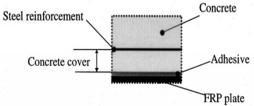
Debonding
FRP rupture along with concretecrushing
Cover Separation along with FRP rupture in horizontaldirection
SinceGCamataetal.(2004)outlinedthemanyfailurepointsfromwhichanRCbeamcoveredinFRPwouldfail,thefailure wouldcomefromtheweaklinks.Dependingontheweakpoint inthesystem,oneofthreethingswouldhappen:theFRP would debond from the surface of the RC member, the steel would yield, or the concrete would crush.Failure of RC reinforcedhappensforavarietyofreasons,includingFRPdebonding,concretecrushing,primaryreinforcementyielding, etc.
4. CONCLUDING REMARKS
This chapter is all about the work done by various researches done on Retrofitting of distressed structural element (i.e., flexuralstrengthening,shearstrengthening,torsionalstrengthening,axialloadcarryingcapacityofcolumn).
AlltheresearchshowsthatthestrengtheningofdistressedstructuralelementismostefficientlydonebytheuseofFRP.
TheresearchworkalsoshowsthatthebyuseofFRPthestrengthoftheconcreteincreasestremendouslyevenmostofthe timethestrengthafterretrofittingexceedstheactualstrengthorcharacteristicstrengthoftheconcrete.
REFERENCES
AbdallaaJamalA.AbubakrHawouldeh,(2018), Flexural strengthening of reinforced concrete beams with externally bonded hybrid systems, Procedia Structural Integrity 282312–2319,Issues11June2018.
Adhikary B.B., Mutsuyoshi H., (2004), Behavior of concrete beams strengthened in shear with carbon-fibersheets, Journal of Composites for Construction 8 258–264,Issues3June2019.
Ary M.I., Kang T.H.K., (2012), Shear-strengthening of reinforced & prestressed concrete beams using FRP:Part I Reviewofpreviousresearch, International Journal of Composites for Construction Material 641–47,Issues28March2012.
AttariN.,Amziane S., Chemrouk M.,(2012), Flexural strengthening of concrete beams using CFRP, GFRP and hybrid FRP sheets, Construction Building Material 37746–757,Dec2012.
Belarbi A., Acun B., (2013), FRP systems in shear strengthening of reinforced concrete structures, Procedia Eng. 57 (2013) 2–8, Issues10May2013.
Bournas D.A., Pavese A., Tizani W., (2015), Tensile capacity of FRP anchors in connecting FRP and TRM sheets to concrete, Engineering Structures 8272–81,Issues1Jan2015.
Bukhari I. A., Vollum R. L., Ahmad S. and Sagaseta J., (2010), Shear strengthening of reinforced concrete beams with CFRP, Magazine of Concrete Research,62,No.1,January2010,65–77.
Camata G., Spacone E.,Al-Mahaidi R., Saouma V.,(2004), Analysis of test specimens for cohesive near-bondfailure of fiber-reinforced polymer-plated concrete, Journal of Composites for Construction 8 December2004528
538.
CastilloE.delRey,GriffithM.,InghamJ.,(2019), Straight FRP anchors exhibiting fiber rupture failure mode, Composite Structures IssuesJune2019,207612–624.
Chaalla Omar, Shahwy Mohsen and Hassan Munzer, (2003), Confinement model for axially loaded shor rectangular columns strengthened with carbon fiber reinforced polymer wrapping, ACI structural Journal,Vol.100,No.2,pp.215221.
Ebead U., Saeed H., (2017), FRP stirrups interaction of shear-strengthened beams, Materials and Structures50 103, IssuesApril2017.
Elsanadedy H.M., Almusallam T.H., Abbas H., Al-Salloum Y.A. and Alsayed S.H., (2011), Effect of blast loading on CFRPRetrofitted RC columns a numerical study, Latin American Journal of Solids and Structures 855–81.
Ghobarah A., Ghorbel M.N., Chidiac S.E., (2002), Upgrading torsional resistance of reinforced concrete beams using fiber-reinforced polymer, Journal of Composites for Construction 6 (2002)Vol-6No.4,257–263.GraceC.,YangY.,SneedL., (2012), Fracture mechanics approaches to debonding behavior of reinforced concrete members with externallybonded fiber reinforced polymer laminates, American Concrete Institute,ACISpec.Publ.
Gribniak V., Tamulenas V., Ng P.L., Arnautov A.K., Gudonis E., Misiunaite I., (2017), Mechanical behavior ofsteel fiberreinforced concrete beams bonded with external carbon fiber sheets, Materials (Basel).
Gudonis E., Timinskas E., Gribniak V., Kaklauskas G., Arnautov A.K., Tamulėnas V., (2014), FRP reinforcement for concrete structures:State-of-the-ArtReviewofApplicationandDesign, EngineeringStructures Technology 5 147–158.
Hadi, Muhammad N. S and Rai Widiarsa, Ida Bagus, (2012), Axial and flexural performance of square RC columns wrapped with CFRP under eccentric loading. Faculty of Engineering and Information Sciences -Papers:PartA.8.
Huang Hui, Wang Wen-Wei, Dai Jian-Guo, Brigham John C., (2017), Fatigue behavior of reinforced concrete beams strengthened with externally bonded prestressed CFRP sheets, Journal of Composites for Construction, Volume 21 Issue3June2017ASCE,ISSN1090-0268.
J.HuoJ., LiZ., ZhaoL.,LiuJ.,XiaoY.,(2018), Dynamic behavior of CFRP-strengthened reinforced concrete beams without stirrups under impact loading, ACI Structural Journal 115775–787.
Jariwalaa Vishnu H., Patel Paresh V., Purohit Sharadkumar P., (2012), Strengthening of RC beams subjected to combined torsion and bending with GFRP composites,Chemical,CivilandMechanicalEngineeringTracksof3rdNirma UniversityInternationalConferenceonEngineering(NUICONE2012), Procedia Engineering 51 (2013)282–289.
Jaya K. P., Mathai Jessy, (2012), Strengthening of RC column using GFRP and CFRP, World Conference on Earthquake Engineering.
Kachlakev D. and McCurry D.D., (2000), Behaviour of full-scale reinforced concrete beam retrofitted for shear and flexural with FRP laminates, Volume 31, Issues 6–7, October 2000, Composites: Part B 31 445-452.Lee Jin-Young, Shin Hyun-Oh,MinKyung-Hwan,andYoonYoung-Soo,(2018), flexural assessment of blast-damaged RC beams retrofitted with CFRP sheet and steel fiber, International Journal of Polymer Science Volume2018,ArticleID2036436.
MhannaaHayaH.,RamiA.Hawouldehb,AbdallaJamalA.,(2019), Shear strengthening of reinforced concrete beams using CFRP wraps,ICSI,The3rd International Conference on Structural Integrity,ProcediaStructuralIntegrity17214–221.
Mohammed A. Mashrei, Ali Sultan, (2019), Flexural strengthening of reinforced concrete beams using carbon fiber reinforced polymer (CFRP) sheets with grooves,ArticleinLatin American Journal of Solids andStructures
NingZhuang,HonghanDong,DaChen,andYemingMa,(2018), Experimental study of aged and seriously damaged rc beams strengthened using CFRP composites, Advances in Materials Science and Engineering VolumeIssues21Oct2012, ArticleID6260724,9pages.
Obaidat Y.T., Heyden S., Dahlblom O., (2010), The effect of CFRP and CFRP concrete interface models when modelling retrofitted RC beams with FEM, Composites Structures 92.
Osman B.H., Wu E., Ji B., Abdulhameed S.S., (2017), Repair of pre-cracked reinforced concrete (RC) beams with openings strengthened using FRP sheets under sustained load, International Journal of Composites for Construction, Issues28Feb2015.
Ou Y., Zhu D., (2015), Tensile behavior of glass fiber reinforced composite at different strain rates and temperatures, Construction and Building Materials 96 648
656,IssuesOctober2015.
PatilPunam,Yendhe Vishal,(2018), Comparative experimental study on torsional strengthening of RC beam using CFRP and GFRP fabric winding, International Research Journal of Engineering and Technology (IRJET),Volume5-Issue4-April 2018.
PhamT.M.,HaoH.,(2016), Impact behavior of FRP-strengthened RC beams without stirrups, Journal of Composites for Construction 2004016011.
RemennikovA.,GoldstonM.,SheikhM.Neaz,(2017), Impact performance of concrete beams externally bonded with carbon FRP sheets, in: Mech. Struct. Mater. Adv. Challenges - Proc. 24th Australasian Conference on the Mechanics of Structures and Materials ACMSM24.
Richtchie Phillip A., Thamos David A., Le Wu Le and Connelly Guy, (1991), external reinforcement of concrete beams using fiber reinforced plastics, ACI structural Journal, Vol.88,No.4,1991.
RochettePierrreandLabossierePierre,(2003), Axial testing of rectangular column models confined with composites, Journal of Composites for construction,@ASCE,Volume4Issue3August2000,No.3,pp.129-135.
Sabau C., Popescu C., Sas G., Schmidt J.W., T. Blanksvärd, B. Täljsten, (2018), Strengthening of RC beams using bottom and side NSM reinforcement, Composites Part B Engginering Volume-14982–91Issues25September2018,ISSN,13598368.
Siddika A., Mamun Md., Alyousef R., Amran M., (2019), Strengthening of reinforced concrete beams by using fiberreinforcedpolymercomposites, Journal of Building Engineering,IssuesSeptember2019.
SorrentinoL.,TurchettaS.,BelliniC.,(2017), In process monitoring of cutting temperature during the drilling of FRP laminate, Composites Structures 168549–561.
Supian A.B.M., Sapuan S.M., Zuhri M.Y.M., Zainudin E.S. , Ya H.H., (2018), Hybrid reinforced thermoset polymer composite in energy absorption tube application: a review, Defence Technology Volume14,Issue4August 2018 291305.
Tang Taiping and Saadatmanesh Hamid, P.E., ASCE M., (2003), Behavior of concrete beams strengthened with fiberreinforced polymer laminates under impact loading, Journal of Composites for Construction,Vol.7,No.3Issues3August 2003.
TengJ.G.,LorenzisL.De,WangB.,LiR.,WongT.N.,LamL.,(2006), Debonding failures of RC beams strengthened with near surface mounted CFRP strips, Journal of Composites for Construction Volume10Issue2April2006.
Tibhe Shraddha B., Rathi Vijaykumar R., (2015), Comparative experimental study on torsional behavior of RC beam using CFRP and GFRP fabric wrapping, International Conference on Emerging Trends in Engineering, Science and Technology (ICETEST),ProcediaTechnology24140–147.
Triantafillou Thanasis C., (1998), Shear strengthening of reinforced concrete beams using epoxy-Bonded FRP composites, ACI Structural Journal,Titleno.95-S11.
ZhishenWu,XinWang,KentaroIwashita,TakeshiSasaki,YasumasaHamaguchi,(2010), Tensile fatigue behavior of FRP and hybrid FRP sheets, Composites: Part B 41,Volume41,Issue5,July2010,Pages396-402.