Experimental Investigation on Self-Compacting Mortar using GGBS and Alccofine
Hemanth Kumar. H1, S. Bhavanishankar2Abstract - The primary objective of the present work is to carry out an experimental investigation on rheological, mechanical and durability properties of SCM. A total of 18 mixes are proportioned where the control mix consists of 100% cement and rest of the mixes are proportioned with varying percentages of Ground Granulated Blast-furnace Slag (GGBS) and Alccofine used as partial replacement for cement. For each mix, suitable w/b ratio and SP dosage are achieved by various trials. The mixes are tested for mini slump cone and mini V-funnel in fresh state. The hardened mixes are testedfor compressive strength, flexural strength, sulphate resistance and sorptivity. The results show that M0 mix (100%C) is the most flowable mix with mini slump flow diameter of 257mm and mini V-funnel time of 7.6 sec M13 mix (70%C + 20%G + 10%A) has the highest compressive and flexural strengths of 51.17 MPa and 8.83 MPa at 28 days of curing respectively. M4 mix (60%C + 40%G) has the lowest volume expansion against sulphate attack with a change in length of0.026%at 11 weeks of immersion in sodium sulphate solution. M17 mix (50%C + 35%G + 15%A) has the lowest sorptivity coefficient of 0.37 x 10⁻³ cm/sec0.5 at 90 days of curing.
Key Words: Self-Compacting Mortar, Ground Granulated Blast Furnace Slag, Alccofine, Mini Slump Flow, Mini VFunnel,CompressiveStrength,FlexuralStrength,Sulphate ResistanceandSorptivity.
1. INTRODUCTION
Self-compacting mortar (SCM) is considered as new technologyproductspeciallypreferredfortherehabilitation and repair of reinforced concrete structures. By its high fluidity, great deformability and rheological stability, the self-compactingmortariscapableofensuringtheabilityto be easily implemented without vibration. However, its formulationrequiresalargevolumeoffinematerialswithan adequate dosage of cement, which is necessary to ensure requiredworkabilityandmechanicalstrengths.Ascement manufacturingresultsinemittingtonsofcarbondioxideinto theatmosphere,thecurrentenvironmentalconsiderations encourage reducing the production of cement. So, it is essential to use admixtures to replace cement because of theirgreatavailability,moderatepriceandcontributionto an economic sort to solve the problems related to the environment.Themechanicalanddurabilitycharacteristics of self-compacting mortars are similar to self-compacting concretes and could be utilized to study the SCC
performance mechanisms. Mortar phase has similar properties to concrete and research on mortar is more controllable.Infact,assessingfeaturesofSCMsisanintegral partofSCCdesign.Nowadays,mostoftheindustrialwastes suchasflyash,silicafume,GGBS,etc.areusedwithoutbeing taken full advantages of their properties or disposed of rather than used. This study investigates the effects of supplementary cementitious materials mainly, GGBS and alccofineonSCMmixespreparedwithsuitablew/bratioand SPdosage
2. EXPERIMENTAL PROGRAM

The main purpose of this study is to investigate the rheological, mechanical and durability properties of SCM mixes with varying percentages of GGBS and alccofine. A totalof18mixesareproportionedincludingthecontrolmix.
Themixratioforallthemortarmixesiskeptconstantat1:2. Thew/bratioandSPdosageareselectedbyevaluatingthe rheologicalpropertiesofeachmixconformingtoEFNARC2005guidelines.Toevaluatethemechanicalproperties,the mixesaretestedfortheircompressivestrengthandflexural strength. The compressive strength test is performed on cubes of size 70.6 x 70.6 x 70.6 mm at 7 and 28 days of curing.Theflexuralstrengthtestisperformedonprismsof size40x40x160mmat7and28daysofcuring.Toevaluate thedurabilityproperties,sulphateresistanceandsorptivity testsareperformedonthe mixes.Thesulphateresistance testiscarriedoutonprismsofsize25x25x285mmat28 daysofcuring.Thesorptivitytestisperformedoncubesof size70.6x70.6x70.6mmat90daysofcuring.
2.1 Materials
An Ordinary Portland Cement (OPC) of grade 43 conformingtoIS:8112-2013isusedtoproduceSCMmixes. The physical and chemical properties of cement are presented in Table 1 and Table 2 respectively. Ground GranulatedBlast-furnaceSlag(GGBS)andalccofine1203are the mineral admixtures used as partial replacements for cement.GGBSconformstoIS:16714-2018.Thephysicaland chemicalpropertiesofGGBSaregiveninTable3andTable4 respectively.Alccofine1203conformstoIS:16715-2018.The physical and chemical properties of alccofine 1203 are presentedinTable5andTable6respectively.
Manufacturedsand(M-sand)isthefineaggregateusedin thestudy.M-sandbelongstozoneIIandconformstoIS:3832016. The physical properties of m-sand are presented in Table 7. In addition, a polycarboxylates ether-based superplasticizer(SP)calledMasterGleniumSKY8233isused tolowerthewater-binder(w/b)ratioandthepropertiesare giveninTable8.
8: Propertiesofm-sand
2.2 Mix proportions
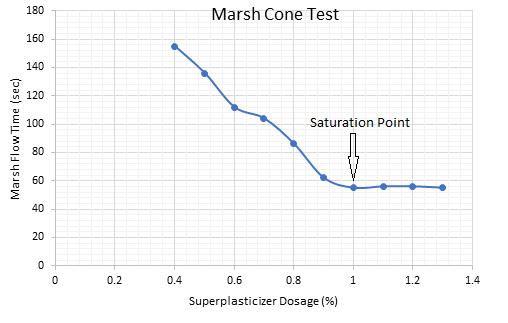
Atotalof18mixesarepreparedtoobservethebehavior ofSCMinfreshandhardenedstates.Themixratioandbinder contentarekeptconstantat1:2and630kg/m3 So,themsandcontentremainsconstantat1260kg/m3 .Water-binder ratioandsuperplasticizerdosageareselectedinsuchaway thattheSCMmixesgiveaslumpdiameterof240–260mm andV-funneltime7–11sec.Thebinaryandternarymixes consist of various percentages of GGBS and alccofine replacing cement by weight. Percentage replacement of cement(C)byGGBS(G)andalccofine(A)ineachmixwith theirdesignationisshowninTable9 ThevariationofMarsh flowtimefordifferentSPdosagesisshowninFig.1
Table 9: Designationofmixproportions
Fig. 1: VariationofMarshflowtime
Thequantityofmaterialsforeachmixperm3ispresentedin Table10
2.3 Production of test specimens
Forthiswork,inallthemixes,cement,mineraladditives andm-sandarefirstmixedfor1minute.Then,SPandwater are poured and mixed for an additional 4 minutes. The workabilityoffreshmortar isobtained immediatelyusing minislumpconeandminiV-funneltestasperEFNARC2005 standards. Mortars are cast into cubic molds with the dimensions70.6x70.6x70.6mmandprismmoldswiththe dimensions 40 x 40 x 160 mm and 25 x 25 x 285 mm for mechanical and durability tests. Specimens are demolded afterkeepinginthecastingroomfor24handarecuredin wateratthetemperatureof25±3°Ctillthedesiredage
3. TEST METHODS
3.1 Rheological tests for fresh SCM
ToevaluatetherheologicalpropertiesofSCM,minislump coneandminiV-funneltestsareperformed.Inminislump conetest,thetruncatedconeis filledwithmortarona flat plate and lifted upwards. The diameter is evaluated by averagingthetwoverticaldimensionsofthemortarspread InminiV-funneltest,afterfullyfillingthefunnelwithmortar, thebottomoutletisopenedtoallowthemortartoflowout. TheV-funnelflowtimeisthetimebetweentheopeningofthe bottomoutletandthestartofthefunnelfromthebeginning ofthelight.TheworkabilityvaluesofSCMsareconsidered accordingtoEFNARC2005acceptancecriteriawith240–260 mmand7–11secforminislumpflowdiameterandminiVfunnelflowtime,respectively.
3.2 Compressive strength test
The compressive strength test is conducted on cubic samplesofsize70.6x70.6x70.6mmthatarecuredinwater for 7 and 28 days. The samples are placed at the loading platform of the compression testing machine and load is applied gradually at the rate of 350 kg/cm2/min till the samplefails. ThistestisperformedconformingtoIS:4031 (part6)-1988
3.3 Flexural strength test
The flexural strength test is conducted on prismatic samplesofsize40x40x160mmthatarecuredinwaterfor 7and28days.Thesamplesareplacedbetweentherollersof theflexuretestingmachineandareloadedbetween2–6%of thecomputedultimateloadtillthesamplesfail.Thistestis performedconformingtoASTMC348-21.
3.4 Sulphate resistance test
The sulphate resistance test is conducted on prismatic samplesofsize25x25x285mmthatarecuredinwaterfor 28 days. The method involves the determination of length changeofprismaticsamplesimmersedinsodiumsulphate (Na2SO4)solutionofconcentration50g/L.After28daysof curing in water, three mortar specimens of each mix are measuredforlengthusingthelengthcomparatorandplaced insodiumsulphate(Na2SO4)solutionat21±2°C.Changesof lengthofthespecimensaremeasuredafterstorageperiodsof 1, 2, 3, 4, 5, 6 and 11 weeks, respectively. This test is performedconformingtoASTMC1012-04.
3.5 Sorptivity test
Thesorptivitytestisconductedoncubicsamplesofsize 70.6x70.6x70.6mmthatarecuredinwaterfor90days.At first, the specimens are putinto oven at 110± 5 °C untila constantweight.Inordertoavoidevaporationandachieve uniaxialwaterflow,foursidesofthesamplesaresealedwith waterproofing sealant and the other opposite faces are released open. The initial weights of the specimens are measured as 0.01 g. Then, the surface of the specimen exposedtowateratabout3–5mmbyputtingitinasalverto provide water access to the inflow surface. The water absorptionisdeterminedat5,10,30,60,180,240,360and 1440minutes.Thesorptivitycoefficientsofthemixescanbe calculatedasthefollowingformulation:
k=
where Q is the amount of water absorbed in cm3, A is the cross-sectionarea of specimen that is exposed to water in cm2 ,tistimeinsec,kisthesorptivitycoefficientincm/sec0.5 and this value is calculated from the slope of the linear relationbetweenQ/Aand byusingthesmallestsquares method.
4. RESULTS AND DISCUSSION
4.1 Rheological properties of SCM
TheresultsofminislumpconeandminiV-funneltestsare presented in Table11.Themortars with more slump flow diameter and less V-funnel flow time have a higher flowabilityandworkability.AlltheSCMmixesaredesignedto have a mini slump diameter of 250 ± 10 mm. This aim is achievedbytheadditionofadequateSPdosagetothemixes.
Table
AsitisclearfromTable11,slumpflowdiametersforSCMs areobtainedbetween240and257mmwhichareacceptable according to SCM requirements mentioned in EFNARC. IncreasingtheadmixturecontentinSCMsslightlydecreased slumpflowdiameter HigherthecementisreplacedbyGGBS and alccofine, lesser the slump flow diameter is achieved ThisisduetothelargespecificsurfaceareapresentinGGBS and alccofine particles that demand more water to be flowable.Comparedtoallthemixes,thecontrolmix(100%C) isthemostflowablemixwithaslumpflowdiameter257mm. ThesameconclusionisdrawnfromminiV-funneltest.Itis observed that the control mix (100%C) has the lowest Vfunneltimeof7.6sec.Asthefinenessofthemixincreased, the V-funnel time also increased. The SP dosage is also increasedaccordinglytoovercometheviscosityofthemix andsatisfytheEFNARCguidelines.
4.2 Compressive strength
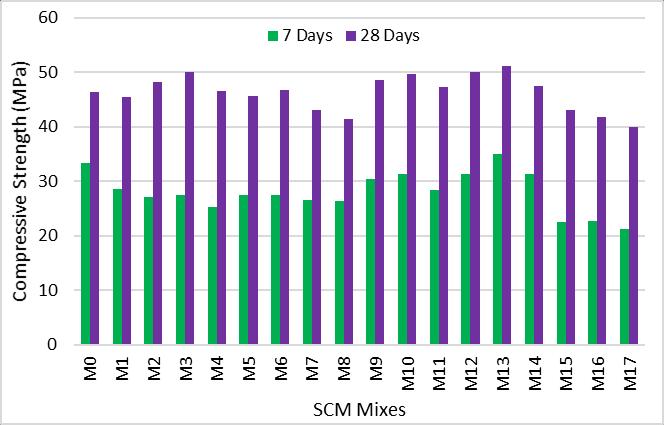
TheresultsofcompressivestrengthtestofSCMmixesare presented in Fig. 2 It is observed that the control mix M0 (100%C) has 7 days compressive strength of 33.27 MPa. ApartfromM13mix(70%C+20%G+10%A),thecompressive
strengthofall othermixes falls belowthecontrol mixat7 days. This is because the rate of hydration of GGBS and alccofine is slower compared to the rate of hydration of cement.Hencetheseadmixturesgainstrengthinlaterstage. Thisisevidentthatthe28dayscompressivestrengthofmany binaryandternarymixesarehigherthanthatofcontrolmix. Among the binary mixes, M3 mix (70%C+30%G) has the higheststrength of50.10 MPaandM8 mix (80%C+20%A) hastheloweststrengthof41.33MPaat28days.Amongthe ternary mixes, M13 (70%C+20%G+10%A) mix shows the highest compressive strength of 51.17 MPa and M17 mix (50%C+35%G+15%A)hastheloweststrengthof39.90MPa at28days.
4.3 Flexural strength
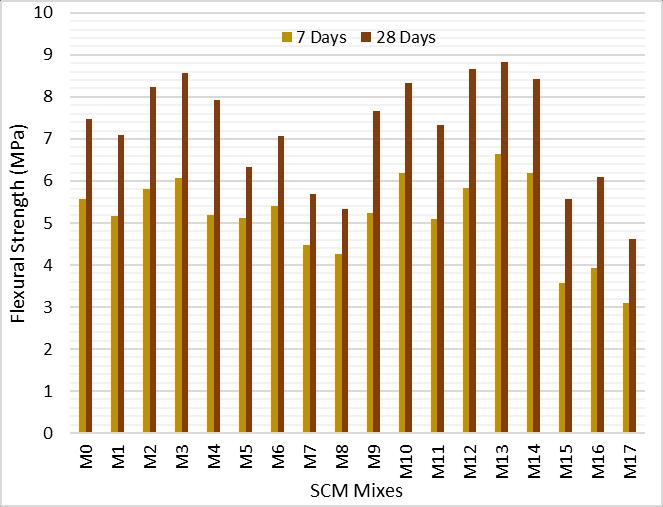
The results of flexural strength test of SCM mixes are presentedinFig.3
ItisobservedthatthecontrolmixM0(100%C)hasflexural strength of 5.57 and 7.47 MPa at 7 and 28 days of curing,
respectively.Amongthebinarymixes,M3mix(70%C+30%G) hasthehigheststrengthof6.07MPaand8.57MPaat7and 28 days, respectively. Among the ternary mixes, M13 mix (70%C+20%G+10%A)hasthehigheststrengthof6.63and 8.83 MPa at 7 and 28 days, respectively. M17 mix (50%C+35%G+15%A)hasthe loweststrengthof3.10and 4.63MPaat7and28days,respectively.
4.4 Sulphate resistance
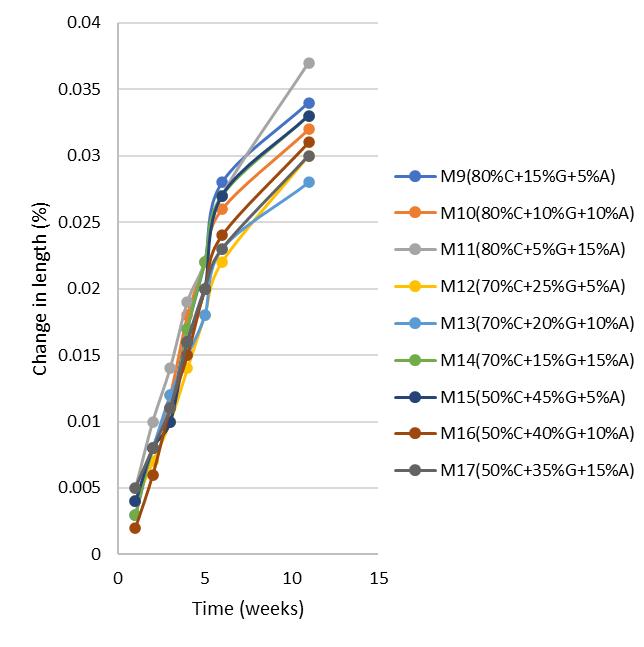
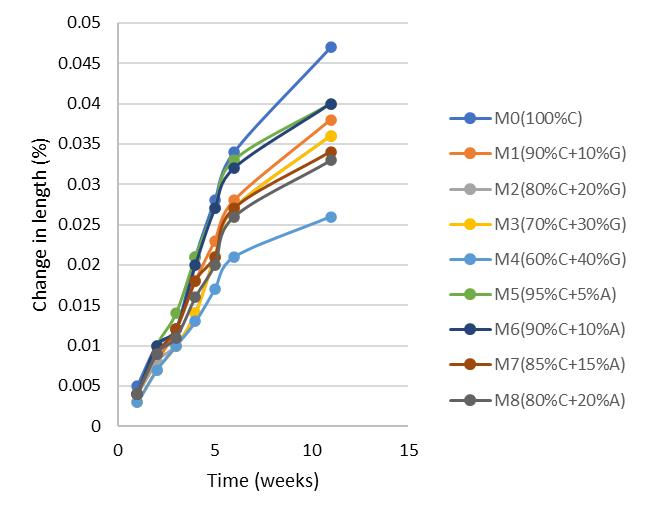
Thesulphateresistancetestprovidesagoodmeasureof relativeperformanceofmortarinsulphateenvironment.The resultsofsulphateresistancetestofSCMmixesarepresented inFig.4andFig.5 ThecontrolmixM0(100%C)showsthe most expansion to sulphate attack. After 11 weeks of immersioninsodiumsulphate(Na2SO4)solution,M0mixhas 0.047% expansion which is the highest change in length comparedtoallthemixes.Amongthebinarymixes,M4mix (60%C+40%G) shows the lowest expansion to sulphate attack with 0.026% change in length after 11 weeks of immersion. Among the ternary mixes, M13 mix (70%C+20%G+10%A)hasthelowestexpansionof0.028% change in length after 11 weeks of immersion. It is also observed that there is formation of efflorescence on the surfaceofprismaticsamplesimmersedinsodiumsulphate (Na2SO4)solution.
4.5 Sorptivity
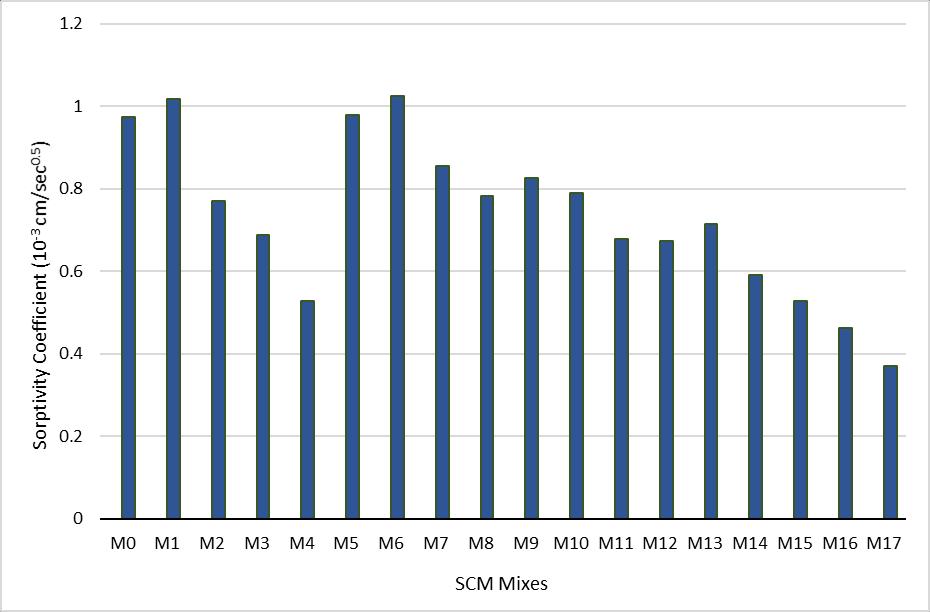
Thesorptivitytestindirectlyindicatesthevolumeofvoids presentinthehardenedmortar. Theresultsofsorptivitytest areobtainedintheformofsorptivitycoefficients.Higherthe sorptivitycoefficient,greatertheporosity/permeabilityand lesserthedurabilityofmortar.Thesorptivitycoefficientsof SCMmixesareshowninFig.6
It is observed that the control mix has the sorptivity coefficient of 0.9735 x 10⁻³ cm/sec0.5. Among the binary mixes, M4 mix (60%C+40%G) has the lowest sorptivity coefficient of 0.5275 x 10⁻³ cm/sec0.5 and M6 mix has the highestsorptivitycoefficientof1.025x10-3cm/sec0.5.Among
theternarymixes,M17mix(50%C+35%G+15%A)showsthe lowestsorptivitycoefficientof0.3706x 10-3cm/sec0.5and M9 mix (80%C+15%G+5%A) has the highest sorptivity coefficientof0.8259x10-3cm/sec0.5.ExceptforM1,M5and M6mixes,allothermixeshavelowersorptivitycoefficients comparedtothecontrolmix.
5. CONCLUSION
Basedontheresultsobtainedfromthisstudy,thefollowing conclusionscanbedrawn:
As the GGBS and alccofine content in SCM mixes increases, the dosage of SP also increases. This is because the fineness of GGBS and alccofine increases the viscosity of the mix. GGBS and alccofine have large surface area which demands morewater/SPcontenttomaintaintherheological propertieswithintheacceptablelimits.
AstheGGBSandalccofinecontentincreases,there isdecreaseinearlystrength(7days)andincrease inlaterstrength(28days).Therecanbeupto30% increaseinstrengthwhenGGBSandalccofinemixes arecuredfor90–120days.
This is because GGBS and alccofine react with calciumhydroxide[Ca(OH)2]whichisaby-product of hydration of cement to form C-S-H (calcium silicatehydrate)geltoincreasethestrengthofthe mix. So the strength gain depends on the time of availabilityofCa(OH)2.
Inbinarymixes,replacementofcementbyGGBSup to 30% by weight improves both mechanical and durability properties. When GGBS is used at 40% replacement, there is reduction in mechanical strengthsduetoslowrateofhydration.
M3 mix (70%C+30%G) has compressive strength 7.9%andflexuralstrength14.72%higherthanthe controlmix.Also,has36.17%decreasedchangein length subjected to sulphate attack and 29.34% lowersorptivitycoefficient.
In M4 mix (60%C+40%G), the change in length subjectedtosulphateattackisreducedby44.68% andsorptivitycoefficientby 45.81%comparedto the control mix. However, the compressive and flexuralstrengthsaresimilartothecontrolmix.
Alccofineat10%replacementlevelinbinarymixes, yieldscompressiveandflexuralstrengthscloseto thecontrolmixwithmoreorlesssimilardurability properties. When alccofine is used beyond 10% replacement level, similar to GGBS there is
reductioninmechanicalstrengthsduetotheslow rateofhydration.
In ternary mixes, replacement of cement by a combinationofGGBSat20%andalccofineat10% yieldsbettermechanicalanddurabilityproperties.
M13 mix (70%C+20%G+10%A) has compressive andflexuralstrengths10.21%and18.21%higher than the control mix. Also, has 40.42% decreased changeinlengthsubjected tosulphate attack and 26.62%lowersorptivitycoefficient.
GGBSandalccofinehavehighersilicacontentwhich means the calcium to silica (Ca/Si) ratio is lesser comparedtothePortlandcement.TheC-S-Hphase formed with low Ca/Si ratio is considered to improvethemechanicalanddurabilityproperties.
The control mortar mix M0 (100%C) is least resistanttosulphateattack.M4mix(60%C+40%G) has the lowest expansion to sulphate attack with 44.68% lower change in length compared to M0 mix.ThisshowsGGBSisresistanttosulphateattack andcanbeusedaspartialreplacementofcementin sulphateenvironment.
REFERENCES
[1] Sara,Bachene,AdjoudjMhamed,BoukendakdjiOtmane, and Ezziane Karim. "Elaboration of a Self-Compacting mortar based on concrete demolition waste incorporating blast furnace slag." Construction and Building Materials 366(2023):130165.
[2] Xu,Rongsheng,HaoranWang,QingkunZha,andJianLin. "Improving the carbonation resistance of alkaliactivated slag mortars with different additives: experimental evaluations." Construction and Building Materials 366(2023):130197.
[3] Türk, Esra, Mehmet Karataş, and Murat Dener. "Rheological, mechanical and durability properties of self-compactingmortarscontainingbasaltpowderand silica fume." Construction and Building Materials 356 (2022):129229.
[4] MarthishBabu,BhavanishankarS."StudyonFreshand Hardened Properties of Self-Compacting Mortar Containing GGBFS, Granite Powder and M-sand." International Research Journal of Engineering and Technology (IRJET).2022Mar.
[5] Prithiviraj, Chidambaram, Packirisamy Swaminathan, DeivasigamaniRameshKumar,GunasekaranMurali,and NikolaiIvanovichVatin."FreshandHardenedProperties
of Self-Compacting Concrete Comprising a Copper Slag." Buildings 12,no.7(2022):965.
[6] Bhavanishankar S, Charan U T. "Experimental Investigation on SCM using Different Admixtures." International Research Journal of Engineering and Technology (IRJET).Feb2022.
[7] Zhao, Zengfeng, Adèle Grellier, Mohamed El Karim Bouarroudj, Frédéric Michel, David Bulteel, and Luc Courard."Substitutionoflimestonefillerbywastebrick powder in self-compacting mortars: Properties and durability." Journal of Building Engineering 43 (2021): 102898.
[8] Hammat S, Menadi B, Kenai S, Khatib J, Kadri EH. "Properties of self-compacting mortar containing slag with different finenesses." Civil Engineering Journal 2021May1;7(5):840-56.
[9] Soma Prasanth Reddy, Sashidhar C, Kavyateja BV. "A studyontheperformanceofself-compactingconcrete with fly ash and alccofine." International Journal of Multidisciplinary Research (IJMR). 2021Sep9.
[10] Al-Jaberi, Layth A. "Role of mineral admixtures in self compacting concrete: Scanning electron microscopy approach." AIP Conference Proceedings,vol.2372,no.1, p.180005.AIPPublishingLLC,2021.
[11] TangadagiRB,ManjunathaM,SethD,PreethiS."Roleof mineraladmixturesonstrengthanddurabilityofhigh strength self compacting concrete: An experimental study." Materialia. 2021Aug1;18:101144.
[12] MehdizadehB,JahandariS,VessalasK,MirakiH,Rasekh H, Samali B. "Fresh, mechanical, and durability properties of self-compacting mortar incorporating alumina nanoparticles and rice husk ash." Materials. 2021Jan;14(22):6778.
[13] Hammat S, Menadi B, Kenai S, Khatib J, Kadri EH. "Properties of self-compacting mortar containing slag with different finenesses." Civil Engineering Journal 2021May1;7(5):840-56.
[14] Kavyateja BV, Jawahar JG, Sashidhar C. "Durability performanceofselfcompactingconcreteincorporating alccofine and fly ash." International Journal of Engineering. 2020Aug1;33(8):1522-8.
[15] Si-Ahmed,Mohammed,andSaidKenai."Behaviorofselfcompacting mortars based on waste brick powder." Current Materials Science: Formerly: Recent Patents on Materials Science 13,no.1(2020):39-44.
[16] KavyatejaBV,JawaharJG,SashidharC."Effectivenessof alccofineandflyashonmechanicalpropertiesofternary blended self compacting concrete." Materials Today: Proceedings. 2020Jan1;33:73-9.
[17] IS: 8112-2013 – Specification for 43 grade ordinary Portlandcement.
[18] IS:4031(part6)-1988–Standardmethodsofphysical testsforhydrauliccement.
[19] IS: 383-2016 – Specification for coarse and fine aggregateforconcrete.
[20] IS:9103-1999–Specificationforconcreteadmixtures.
[21] IS:16714-2018–SpecificationforGroundGranulated Blast Furnace Slag for use in cement, mortar and concrete.
[22] IS: 16715-2018 - Specification for Ultrafine Ground GranulatedBlastFurnaceSlagforuseincement,mortar andconcrete.
[23] ASTMC939-97–Standardtestmethodforflowofgrout forpreplacedaggregateconcrete(Flowconemethod).
[24] ASTM C348-21 – Standard test method for flexural strengthofhydrauliccementmortars.
[25] ASTM C1012-04 – Standard test method for length change of hydraulic cement mortars exposed to a sulphatesolution.
[26] ASTM1585-04-StandardTestMethodformeasurement oftherateofabsorptionofwaterbyhydrauliccement. European Federation of National Associations RepresentingforConcrete2005.