Volume: 10 Issue: 06 | Jun 2023 www.irjet.net


Volume: 10 Issue: 06 | Jun 2023 www.irjet.net
Department of CSE
Sri Venkateswara College of Engineering and Technology (Autonomous) Chittoor, India ***
Abstract - This research projectfocusesonthedevelopment and implementation of a binary classification model for predicting lung diseases using x-ray images. By leveragingthe power of machine learningalgorithms,specificallythosefound in the field of computer science known as machine learning, we aim to accurately assign class labels to data from the problem area. Throughout the project, we utilize popular Python libraries such as Tensor Flow, Keras, and NumPy to enhance the prediction accuracy. The results of this study provide valuable insights into the prediction of lung diseases based on x-ray images, offering potential advancements in diagnostic and prognostic methodologies
Key Words: Convolutional neural network, AI Lung Diseases classification, Machine Learning,
LungdiseasepredictionutilizingX-rayimagesinvolvesthe intricatetask ofdetectingthepresenceorabsence oflung ailmentswithin providedimages.This exceptional project has successfully implemented a cutting-edge machine learningmodelandastate-of-the-artConvolutionalNeural Network (CNN) architecture, leveraging powerful Python librariessuchasNumPy andTensorFlow.Theastonishing test accuracy of 91% has truly surpassed expectations, showcasing the project's triumph in achieving its primary objectives. Machine learning, an indispensable facet of artificial intelligence, empowers computers to acquire knowledge from past instances and discern intricate patterns within vast and noisy datasets. In the realm of medicine, machinelearning plays a pivotal role in disease detection,enablingearlyandaccuratediagnoses,whichhave the potential to save lives and alleviate the burden on healthcaresystems.Lungdiseases,beingaleadingcauseof mortality, demand precise diagnoses and predictions to improve patient care significantly. By synergistically amalgamating patient data with chest X-ray images and employing deep learning techniques such as CNN, this groundbreaking study has delved into respiratory issues encompassing diseases like Corona, Tuberculosis, Pneumonia, and Lung Cancer. The ultimate goal was to develop robust models for diagnosing lung disorders, assisting doctors in making informed decisions that are crucial for patient well-being. Harnessing the power of machinelearninganddeeplearningalgorithms,thisstudy
meticulously evaluated patient data to determine the presenceorabsenceof lung diseases. The central focus of thisbinaryclassification project revolved aroundutilizing chestX-rayimagesasinputanddiseasedetectionasoutput, with the overarching objective of enhancing the accuracy andefficiencyofdiagnosingandtreatinglungdiseases.This groundbreaking researchhasshedlighton the innovative application of machine learning techniques for predicting and managing lung illnesses, ultimately culminating in improvedpatientoutcomes.Byembracingthepotentialof advancedtechnologies,thisstudypavesthewayforafuture where early detection and accurate diagnosis of lung diseases become commonplace, thus revolutionizing the fieldofhealthcare.
The rapid pace of global change exerts strain on people's health,withdetrimentalshiftsinclimate,environment,and lifestylesignificantlyincreasingdiseasevulnerability.This opportunemomentallowsustocontributetothesolution, empowered by computers and abundant public data. By assistingthoseunabletoaffordmedicalcare,myapproach aimstoalleviatemedicalexpenseswhilegivingbacktothe community. Utilizing a deep learning model, the project focusesondetectinglungdiseasesinimages.Variouslungxraydatasets,encompassingNormal,Tuberculosis,Covid-19, and Pneumonia, are merged to form a comprehensive dataset.
The idea of the project: Detecting lung diseases using a deeplearningmodelfocusesonpredictingthepresenceor absenceoflungdiseaseingivenimages.Diverselungx-ray datasets from sources like Kaggle, encompassing Normal, Tuberculosis,Covid-19,Pneumonia,aremanuallycombined tocreateaunifieddataset.
Existingmodelsindividuallypredictdiseases,butouraimis to develop a single model for predicting multiple lung diseases.Inthepast,separatemodelswereutilizedforeach lung disease, but now we plan to consolidate them into a combined model. We employeddeeplearning, specifically convolutionalneuralnetwork(CNN)analysis,todetectand classifychronicobstructivepulmonarydisease(COPD)while
also predicting acute respiratory distress (ARD) episodes andmortality.
CNN,orConvolutionalNeuralNetworks,excelinphotoand video recognition tasks. It's a machine learning algorithm thatdetectspatternsinimages.CNNarchitecturesconsistof convolutionlayersthattransformimagedataandpassitto subsequent layers. Each convolution layer has specified filtersrecognizingedges,shapes,objects,andmore.These filters uncover complex patterns by layering them. Filters aretypically3x3or4x4imagekernelsappliedtotheentire image.Thestridedeterminesthenumberofpixelsthefilter moves across the input matrix. In our project, we transitionedfromindividualmodelsforeachlungdiseaseto acombinedmodel.
A.DownloadtheDatasetsandExtract:
KagglerecentlyreleasedavastcollectionofX-raylungdata, includinglabeledlungdiseasedata.Thispresentsanideal opportunity to initiate our project. The dataset for image categorizationcomprisesfourcategories:Pneumonia,Covid19, Tuberculosis, and Normal Chest X-Ray images. The updateddatasetensuresmorebalanceddistributioninthe validationandtestingsets.Withinthethreefolders(train, test, and Val), each image type is represented by a subdirectory.PriortoimplementingMachineLearningand DeepLearningtechniques,wewillthoroughlyanalyzeand evaluate the data to identify lung issues and specific diseases.Toaccommodatethedataset'ssize,Iwillinitially testourapproaches ona smallersampledatasetcollected frompublicsourcesonKaggle:
Corona&Pneumoniadataset
Tuberculosis&Normaldataset
B.DefiningtheDirectoriesinDataset:
From the Kaggle database, we extracted four classes, includingcovid,tuberculosis,pneumonia,etc.UsingaGoogle Colab notebook, we uploaded the dataset to Google Drive andproceededtoextractthedatafortestingandtrainingthe model. The training directories were organized to include picturesforeachclass,suchascovid,normal,tuberculosis, andothers.Theseclasseswerethenutilizedtoaccessthexray images. TensorFlow was employed to construct a ConvolutionalNeuralNetwork(CNN)forimagerecognition. We utilized the Sequential model process, an API for constructingdeeplearningmodels,bycreatinganinstance oftheSequentialclassandaddinglayerstoit.TheCNNwas executedonadatasetof1438x-raypicturesfromthefour differentclassestoassessitsaccuracy.
C.DefinetheModel:
DownloadtheDatasetsandExtractThem
DefiningtheDirectoriesinDataset
DefinetheModel
DataPre-processing
TrainingtheModel
RunningtheModel
While numerous existing models predict diseases individually,ourgoalistoachievethehighestaccuracyby predicting different diseases using a single model. We obtaineddatafromtheKaggledataset,whichwillundergo testingandsubsequenttrainingofallclasses.Themodelwill betrainedstepbystep,followingasequentialprocess.Each layerofthemodelsummarywillbecompletedlayerbylayer.
Upon completing the aforementioned process, we will import the Image Data Generator from TensorFlow's preprocessingmodule.Subsequently,wewillassessthemodel's accuracy
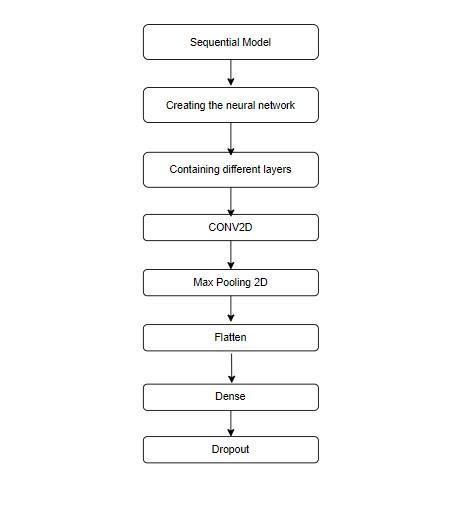
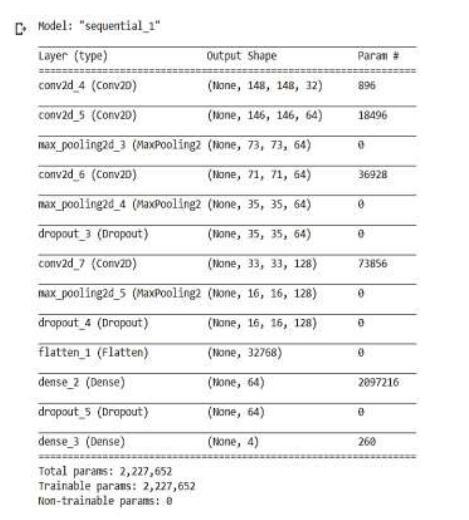
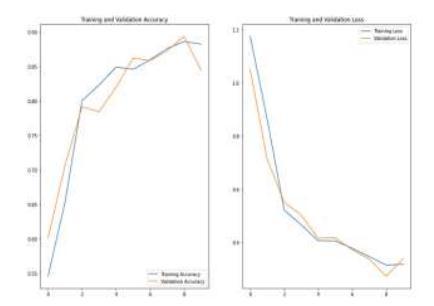
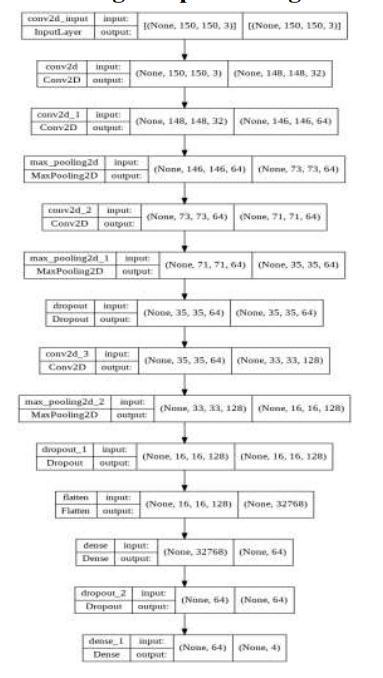
Initially,datawillbeextractedfromthedatabase,followed bythemodel'stestingforthefourclasses.Themodulewill thenbetrainedincrementally.Toexecutethemodel,theOS willbeimported,andthetrainingpictureswillbeorganized withinadirectory.Thelistdirectorywillencompassthefour classes. The CNN will subsequently scan all 5411 images. TensorFlowwillbeimportedforvisualimageryanalysis.The sequentialmodelwillincorporateCovin2D,max-pooling2d, dropout, flatten, and denser layers. The Image Data Generator from TensorFlow will be utilized to rescale the imagesto1./255.Thegeneratorwillbetrained,resultingin 5364 images for the training set and 281 images for the validation set. Additionally, the test data generator will consistof1488imagesforthefourclasses.Themodelwill savethedata,loadit,andevaluatethetestgenerator.Finally, agraphwilldepictthetrainingandvalidationaccuracy.
A.Covid-19x-rayimages:-
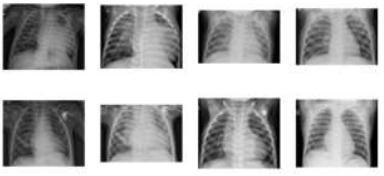
Result of the Covid-19 disease image that trained and implemented the model using an x-ray from the Kaggle database.
B.Pneumoniax-rayimages:-
Theresultsofthepneumoniadiseaseimageswereobtained by training and implementing the model using x-rays sourcedfromtheKaggledatabase.
C.Tuberculosisx-rayimages:-
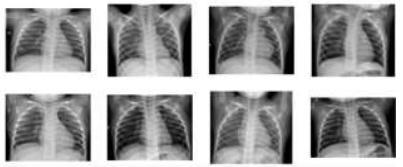
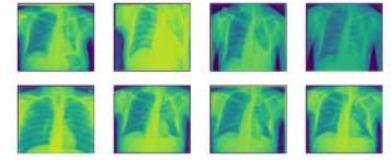
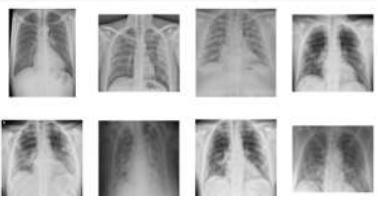
Theresultsofthetuberculosisdiseaseimageswereobtained throughtrainingandimplementingthemodelusingx-rays sourcedfromtheKaggledatabase.
D.Normalx-rayimages:-
Results of some normal disease images which are trained andimplementedthemodelbyusingx-raysFromtheKaggle database.
During the training process, we utilized 5411 images, which belonged to 4 classes (COVID, NORMAL,PNEUMONIA,andTB),totraintheCNN for10epochs.
For validation, we used a set of 283 images encompassingall4classes.
Asaresult,ourmodelachievedatrainingaccuracy of88%andavalidationaccuracyof84%.
ThroughtestingourCNNonatestdatasetcomprising1438 imagesacross4classes,weachievedanimpressiveaccuracy of approximately 91%. This research has highlighted the significance and practicality of Convolutional Neural Networksinvariousapplications,includingmedicalimage processing.Thestudyemphasizesthecrucialroleofaccurate pre-processingtechniquesinoptimizingmodelperformance. Additionally, the findings suggest that CNNs can extend beyond medical image processing to enable disease predictionusingMRIimages,potentiallyaidingintheearly detectionofdiseaseslikeLungCancerandBronchitis.
[1] Tensor Flow's main website, https://www.tensorflow.org/.
[2] Swetha,K.R.,etal."PredictionofPneumoniaUsingBig Data, Deep Learning, and Machine Learning Techniques." 2021 6th International Conference on CommunicationandElectronicsSystems(ICCES).IEEE, 2021.
[3] R. Nicole, “Title of paper with only first word capitalized,”J.NameStand.Abbrev.,inpress.
[4] Dey, Soumava, Gunther Correia Bacellar, Mallikarjuna Basappa Chandrappa, and Raj Kulkarni. "COVID-19 ChestX-RayImageClassificationUsingDeepLearning." medRxiv(2021).
[5] Tensor flow losses Module, https://www.tensorflow.org/ versions/r1.5/api_docs/python/tf/losses
[6] CNN, https://en.wikipedia.org/wiki/Convolutional_neural_ne twork.
[7] Hyper Parameters, https://en.wikipedia.org/wiki/Convolutional_ neural_network#Hyperparameters
[8] Swetha,K.R.,etal."PredictionofPneumoniaUsingBig Data, Deep Learning, and Machine Learning Techniques." 2021 6th International Conference on CommunicationandElectronicsSystems(ICCES).IEEE, 2021
[9] Patil, Swati, and Akshay Golellu. "Classification of COVID-19CTImagesusingTransferLearningModels." 2021 International Conference on Emerging Smart ComputingandInformatics(ESCI).IEEE,2021.
[10] Yadav,Anju,etal."FVC-NET:AnAutomatedDiagnosis of Pulmonary Fibrosis Progression Prediction Using Honeycombing and Deep Learning." Computational IntelligenceandNeuroscience2022(2022).
[11] Kogilavani, S. V., et al. "COVID-19 detection based on lung CT scan using deep learning techniques." ComputationalandMathematicalMethodsinMedicine 2022(2022)
[12] Aggarwal, Karan, et al. "Has the Future Started? The Current Growth of Artificial Intelligence, Machine Learning, and Deep Learning." Iraqi Journal For Computer Science and Mathematics 3.1 (2022): 115123.
[13] Ahmed, Shaymaa Taha, and Suhad Malallah Kadhem. "UsingMachineLearningviaDeepLearningAlgorithms toDiagnosetheLungDiseaseBasedonChestImaging:A Survey." International Journal of Interactive Mobile Technologies15.16(2021).
[14] Gowri, S., J. Jabez, J. S. Vimali, A. Sivasangari, and Senduru Srinivasulu. "Sentiment Analysis of Twitter Data Using Techniques in Deep Learning." In Data Intelligence and Cognitive Informatics, pp. 613-623. Springer,Singapore,2021.
[15] Srinivasulu,Senduru,JebersonRetnaRaj,andS.Gowri. "AnalysisandPredictionofMyocardialInfarctionusing MachineLearning."20215thInternationalConference onTrendsinElectronicsandInformatics(ICOEI).IEEE, 2021.
[16] Priya, T., and T. Meyyappan. "Disease Prediction by Machine Learning Over Big Data Lung Cancer." InternationalJournalofScientificResearchinComputer Science, Engineering and Information Technology (2021):16-24.
[17] Battineni,Gopi."MachineLearningandDeepLearning Algorithms in the Diagnosis of Chronic Diseases." Machine Learning Approaches for Urban Computing. Springer,Singapore,2021.141-164.