
FPGA Implementation of Accelerated Finite Impulse Response Filter for EEG Analysis
Nithish Vaasu, Mohammed Ashfaque A, G Bhuvanesh, Sanjith S, Sainath SStudent, Dept. of Electronics and Communication Engineering PSG College of Technology Coimbatore, India
Student, Dept of Electronics and Communication Engineering PSG College of Technology Coimbatore, India
Student, Dept. of Electronics and Communication Engineering PSG College of Technology Coimbatore, India
Student, Dept of Electronics and Communication Engineering PSG College of Technology Coimbatore, India
Assistant Professor, Dept of Electronics and Communication Engineering PSG College of Technology Coimbatore, India

Abstract Majority of the real time signal processing environments involve the processing of ample amount of data at a time. EEG Signal Processing is one such example, which demands the processing of EEG signals recorded over a larger time period for the study of brain activity. An electroencephalogram (EEG) is a test that measures electrical activity in the brain using small, metal discs (electrodes) attached to the scalp. The work presented in this paper is inclined towards the implementation of hardware accelerated Finite Impulse Response (FIR) filter for the processing of EEG signals. Discrete Wavelet Transform is used in the time-frequency analysis of EEG signals. The design is exported as an FPGA overlay which accelerates the processing of the EEG signal. We have used PYNQ –Z2 FPGA development board to implement the hardware accelerator.
Keywords Electroencephalography, EEG-SignalProcessing, PYNQ-Z2, Accelerated FIR Filter, Signal Processing
***
(15–30 Hz), and gamma (30–60 Hz). These individual frequencysub-bandsmaybetterrepresentbraindynamics than the EEG signal itself. Indeed, they contain more precise information on the neuronal activities and raise somealterationsthatdonotappearintherawEEG[1].
Hardware acceleration combines the flexibility of general-purpose processors, such as CPUs, with the efficiency of fully customized hardware (FPGA boards), suchasGPUs and ASICs, increasing efficiency by orders of magnitude when any application is implemented in the digitalcomputingsystems
FPGAsarereconfigurablehardwarechipsthatcan be reprogrammedto implementvaried combinational and sequential logic. Their programmability imparts excellent flexibility and the opportunity to quickly develop a prototype of a circuit keeping the same hardware this is due to the parallelism of FPGA accelerators which offer data,task,andpipelineparallelism,resultinginfasterdata process execution. A FPGA also complies with the high performance and low power operational needs of a given application,resultinginahigh-performanceratio.
Signal processing, is a major engineering domain which is usedtomanipulate,analysesorsynthesizevarioustypesof signals to extract out useful information. It is mostly done in a computer mainframe which has a generic DSP processor. The establishment of ASICs and FPGA prototyping aids in the development of dedicated hardware for a specific purpose. We have considered EEG signal processing in this paper and the implementation of the same in an FPGA development board, with an observation in the acceleration of processing speed by a factoroftwo(approx.)
AnalyzingEEGdataisanexceptionalwaytostudy cognitiveprocesses.Itcanhelpdoctorsestablishamedical diagnosis,researchersunderstandthebrainprocessesthat underliehumanbehavior,andindividualstoimprovetheir productivityandwellness.
There are commonly five sub-bands on the EEG signal:delta(0–4Hz),theta(4–8Hz),alpha(8–15Hz),beta
II. RELATED WORKS
Pari Jahankhaani et al. [2] proposed the DB4 algorithmor wavelet feature extraction methodtoclassify the EEG signal into different small signals based on their frequencies for decision making. Hojjat Adeli et al. [3] investigated on discrete Daubechies and harmonic waveletsforanalysisofepilepticEEGrecords.Itisusedto analyze and characterize epileptiform discharges. M. Popovic,M.Jankovic[4]proposedtechniquestoaccelerate the actual program for optimum linear-phase FIR filter design.Thetimerequiredforthedesignofthesefilterscan becutdownbyupto2.5timesbyutilizingthesestrategies independently.Theexecutiontimecan beincreased by up to 6 times when new methods are combined with other well-knownapproaches.
V.S. Lin et al. [5] has implemented FIR filter using dedicatedhardwaremappedontoaXilinxFPGAboard.For
more consistent and realistic results, the filter contains additional hardware that interpolates between adjacent coefficients. The identical filter is developed in MATLAB that has been optimized for software simulation. Another prominent technique used in contemporary communication systems is the fast Fourier transform (FFT).TheFIRandFFTblocks'softwaresimulationandcosimulationmethodsarecontrastedinthispaper.

Qi Li et al. [6] used FFT and Continuous Wavelet Transform (CWT) to improve the accuracy of EEG signal emotionrecognition.NitinKumaraetal.[7]usesbispectral analysisforemotionrecognitionwhileinthispaperweuse power spectral density method to find out the emotion. PauloPossaetal.[8]usedhardwareacceleratorstooffload specific tasks from the CPU, improving the global performance of the system and reducing its dynamic powerconsumption.HarikumarRajaguruandSunilKumar Prabhakar [9] have proposed the time frequency analysis (dBb2 and dB4) for epilepsy classification. In order to extract the features at level 4 from EEG signals, dB2 and dB4 wavelets are applied. The features are then categorized using a Linear Discriminant Analysis (LDA) Classifier.
III. PROPOSED METHOD
An EEG signal is a biological analog signal which needs to be handled in digital domain to extract out frequency specific information. The process flow of our systemisshowninfigure1.1
A. Process Flow
Therequiredsignaldataisobtainedfromstandarddata librarieslikeKaggle, SEEDandDEAP.Thedatasetconsists ofnumerousEEGsignalsrecordedfromvariousspecimens for different amounts of time. For the testing and validation of our FIR accelerator, we have considered an EEG signal recorded for a duration of 30 minutes. The scaled down signal is showed in Fig1.8(a). This signal is heavily corrupted by noise and so needs to be denoised. EEG signals do not possess frequencies beyond 55 Hz. Thus, the signal is first bandlimited with a cut-off frequency of 60 Hz. Db-4 wavelet transform is used to extract out the approximations and details of the EEG signalinastagedapproach.
AnFIRfilterisimplementedasasoftIPinXilinxVivado and configured for the required frequency specifications. ThisIPisinterfacedwiththeZynqProcessingSystem(PS) usingDirectMemoryAccess(DMA).Thedesignisdumped intotheFPGAboardandtheFIRfilter’stimeofexecutionis compared.
B. EEG Signals
The EEG signal data were taken from a renowned site called Kaggle (Kaggle, a subsidiary of Google LLC, is an online community of data scientists and machine learning practitioners).Thedatawerecollectedanddownloadedin CSVformat.
C. Data Processing
The collected EEG signal data needs to be filtered and noiseshouldberemovedtogettheusefulinformation. We had several filtering techniques but the one we used for our project is the Daubechies 4 wavelet transform (db4). As we know that analysis can be done in the time domain or frequency domain, but EEG real-time bio signals have composite frequency components so we intend to process the signal simultaneously in both the domains which is knownasthewavelettransform(db4).
WehavefourtypesofEEGsignalsandeachoneof them have varying frequency ranges in order to filter and then we need to have to do wavelet transform. Discrete Wavelet Transform (DWT) uses multilevel decomposition in order to convert the EEG signal into finer details. It allows finding the instant of any abrupt change. The conceptofthiswaveletanalysisisthedecompositionofthe signalintotwoparts:approximationsanddetails.
We used the Daubechies 4 wavelet transform (db4) to decompose the EEG signals into four levels. This wavelet decomposition yields five groups of wavelet coefficients (A4, D4, D3, D2, and D1) which correspond respectively to the waves: delta (0-4 Hz), theta (4-8 Hz), alpha(8-15Hz),beta(15-30Hz)andgamma(30-60Hz).
This decomposition process is based on the successive application of high pass filter (HPF) and low pass filter (LPF). These two filters calculate the wavelet coefficients (details and approximations) at each level. To keep the same number of output and input samples, the productofconvolutionfromthefiltersisdown-sampledby afactorof2.Onlytheoutputofthelowpassfilter,namely the approximation coefficients, is again processed by the twofilters.
= 2 i=1,2, . . . . ,l
A. Software Design
The afore-mentioned FIR filter for the db-4 wavelet transformalgorithmisimplementedinpythonwhichruns in the application layer of the PS part of Zynq-7000 PSOC. This software application uses the kernel running on the ARM Cortex A9 processor. The filter co-efficient are generated separately for each individual stage of the db-4 wavelettransform.

B. Hardware Design
= 2 i=1,2, . . . . ,l
Where: -
l : decompositionlevel
Aij/Di j : waveletcoefficients
N : numberofdetailsorapproximationco-efficient ineachdecompositionlevel
The PL part is configured in this stage. Xilinx Vivado’s IPintegratorisusedtodevelopthehardwaredesignofthe db-4 wavelet transform. FIR compiler (v7.0) from the IP repository is used to develop FIR filters with corresponding frequency specifications at each decomposition phase. Direct Memory Access (DMA) controllerisutilizedtobringdatainandoutofthePL.AXI (advanced extensible interconnect) is used to interface PS andPL.EEGsignalsareinitiallystoredintheDDRofthePS part and then brought into the PL through DMA. The system clock provides necessary clock signals to the PS andtheAXIbus.

1.2
Wavelet decomposition of EEG signal
IV. SYSTEM DESIGN AND IMPLEMENTATION
We implemented the hardware accelerator in the programmable logic fabric of the PYNQ-Z2 FPGA development board. It has the Zynq-7000 Programmable System on Chip (PSOC) which consists of a processing system (PS) and a programmable logic (PL). The PS is a hardIntellectual Property(IP)buildusing ARMCortex-A9 dual core processor, which has Linux OS as the kernel. In the higher abstraction level, python scrips can be run on the Linux kernel to control the PS – PL Interfacing. The development of this project is done in three stages –developing a software-based FIR filter using python, developing a hardware prototype of the same FIR filter using Xilinx Vivado then implementing both designs and comparingthespeedofexecution.
C. Accelerating Function
FIRfilterisimplementedinpython(PS)aswellas intheFPGAfabric(PL).EEGsignalisprocessedusingboth thefiltersandthetimeofexecutioniscompared


D. Bitstream Generation
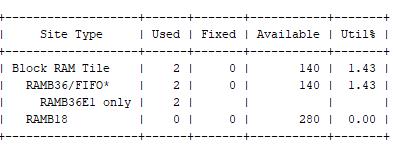
The block design is synthesized and implemented. The synthesis reports give information about the number of LUTs, BRAMs and DSP units utilized out of the available. Theimplementationreportsshowthepowerconsumption oftheentiredesignandthetimingparameters.Finally,the bitstreamisgeneratedanddumpedintotheboard.
International Research Journal of Engineering and Technology (IRJET) e-ISSN: 2395-0056 Volume: 10

V. IMPLEMENTATION



International Research Journal of Engineering and Technology (IRJET) e-ISSN: 2395-0056
Volume: 10 Issue: 06 | Jun 2023 www.irjet.net
[4] M. Popovic, M. Jankovic, “Accelerated techniques for linear-phase FIR filter design”, “1997 IEEE International Symposium on Circuits and Systems (ISCAS)”.
[5] V.S. Lin, R.J. Speelman, C.I. Daniels, E. Grayver, P.A. Dafesh, “Hardware accelerated simulation tool (HAST)”,“2005IEEEAerospaceConference”.
[6] Qi Li; Yunqing Liu; Cong Liu; Fei Yan; Qiong Zhang; Quanyang Liu; Wei Gao, “EEG signal processing and emotion recognition using Convolutional Neural Network”, “2021 International Conference on Electronic Information Engineering and Computer Science(EIECS)”
HardwareFIRexecutiontime(ms):9.2634
SoftwareFIRexecutiontime(ms):19.3455
Hardwareaccelerationfactor:2.0883

Difference(ms):10.0821
VI. CONCLUSION AND FUTURE SCOPE
The main contributions of this paper are the Hardware acceleration of the FIR Filter. With the help of the PYNQ – Z2 FPGA development board the filtering resultsobtainedwerefasterthantheconventionalmethod, an acceleration factor of 2 was achieved. This prototype can be used in the future and can be made as an ASIC. Furthermore, to improve this system Power Spectral Density (PSD) analysis can be added after the filtering process to find out the dominant frequency component in the considered EEG signal. A dedicated ML based design can be incorporated to assess the frequency and give the outputsbasedonthesignalemittedfromthebrain.
VII. REFERENCES
[1] Afef SAIDI, Slim BEN OTHMAN, Wafa KACEM*, Slim Ben Saoud, “FPGA Implementation of EEG Signal Analysis System for the Detection of Epileptic Seizure”,”2018InternationalConferenceonAdvanced SystemsandElectricTechnologies(IC_ASET)”.
[2] PariJahankhani,VassilisKodogiannis,KennethRevett, “EEG Signal Classification Using Wavelet Feature Extraction and Neural Networks”, “IEEE John Vincent Atanasoff 2006 International Symposium on Modern Computing(JVA'06)”

[3] Hojjat Adeli, Ziqin Zhou, Nahid Dadmehr, “Analysis of EEG records in an epileptic patient using wavelet transform”, “Journal of NeuroscienceMethods Volume 123,Issue1”
[7] Nitin Kumara, Kaushikee Khaunda, Shyamanta M. Hazarika, “Bispectral Analysis of EEG for Emotion Recognition”, “7th International conference on IntelligentHumanComputerInteraction,IHCI2015”.
[8] Paulo Possa; David Schaillie; Carlos Valderrama, “FPGA-based hardware acceleration: A CPU/accelerator interface exploration”, “2011 18th IEEEInternationalConferenceonElectronics,Circuits, andSystems”.
[9] Harikumar Rajaguru, Sunil Kumar Prabhakar, “Time frequency analysis (dB2 and dB4) for epilepsy classification”, “2017 2nd International Conference on CommunicationandElectronicsSystems(ICCES)”.