Fabrication and Operation of Ceramic 3D Printer by FDM Method
Huu-Nhan Tran1 , My-Thuat Thach2 , Quoc-Phong Pham3Abstract –The application of 3D printing technology in manufacturing is becoming more and more popular, that to production has increasing potential in many fields including ceramic production. This paper describes the process of designing and manufacturing an experimental 3D printer with kaolinceramic materials bythe FDM method, describing the process of preparing printing materials from ceramic solution and then printing the product and checking for errors of dimension by the 3D Scan method. This study aims to propose solutions to design ceramic printers with compact machine structures that can meet production in the field of creating fine art ceramic products. The research results show that the machine structure is very stable during operation and the printed patterns are created very evenly in the printinglayers, the measurement results from the 3D scanner show that the deviation is acceptable. This result can be applied in ceramic factories to create diverse fine art products.
Key Words: 3D printing, 3D Scan, FDM, Kaolin ceramic

1. INTRODUCTION
3Dprinting,alsoknownasadditivemanufacturing,has developedrapidlyandhasdemonstratedgreatpotentialfor manufacturing in many industrial areas [1, 2]. Today, 3D printing technology is changing the way and object of production of products as well as the time and place of production, additive manufacturing has been seen as a landmark event of the industrial revolution. new [3]. Specifically, 3D printing technology is changed and different materials are used, in addition to PLA or ABS plastic materials for production, the materials are also applied. Ceramic objects are applied in many fields, especially those used to store essentials, decorations, and construction[4,5].InFDM3Dprintingtechnology,plastic or metal materials,after being bonded layer bylayer, will have the property of shrinking when the temperature is reduced. The application of 3D printing technology with ceramic materials is similar, however, with ceramic materials,noheatingheadandheattableareused[6].
In recent years, many studies have evaluated FDM printing technology with different types of ceramic materials [7-9]. Author Mohamed Zied Chaari and colleaguesconductedanexperimenttoconvert3Dprinters (FDM) from plastic materials to 3D printers with WASP ceramic materials [10]. The test results have checked the operating mechanism of the printhead and the material properties suitable for each printing method. In the
research project of shaping ceramic products using 3D printingtechnology,theauthorsZhangandLingcompared media forming technology and ceramic technology using 3D printing technology. The authors found 3D printing to be more efficient and accurate, especially for the mass production of complex designs [11]. The team of authors ElizaRomanczuk-Ruszukandhiscolleaguesstudiedthe3D printingprocesswithceramicmaterials.Thepurposeofthe studyistoevaluatetheunderlyingtheoriespresentingthe maingroupsofceramicmaterialsproducedbyadditive3D printing(FDM)technology[12].
This paper describes the process of designing and manufacturing an experimental 3D printer with kaolin ceramic materials by the FDM method, the machine can produce ceramic parts in unique and diverse shapes, increasingproductivityandqualityintheceramicindustry. Thetestingprocessispresentedfromthestageofdesigning the printed product model with Computer Aid Design (CAD) to setting parameter settings, printing mode on UltimakerCurasoftware,andthenfabricatingproductson fine art ceramic printers. Kaolin ceramics has been tested on 3D printers to shape simple and complex products. Experimental results show that this study has met the requirements of creating diverse and rich products with veryevenandbeautifulprints.Thispapercancontributeon bring3Dprintingtechnologyintoproductioninthefieldof uniqueproductshapingforceramicproductionfacilities.
2. MACHINE DESIGN
2.1 Machine cofiguration
The fine art ceramic 3D printer built in this study is intended for application in shaping fine art products from ceramicmaterialswiththesizeoftheprintingspaceinthe range(150×150×150)mm.Themachinedesignincludesthe mechanical drive part and the electrical system. In the mechanical part, the detail assemblies need to be structurally calculated to ensure the stability and transmission in the limited stroke. The machine frame connectsthemachinepartsandtheshafttoensureprecise and flexible movement to form the most complete system [13,14].Basedontheprincipleofshapingceramicproducts by traditional manual methods, combining existing 3D printerstructures.Fromthere,theauthorshavedesigneda 3Dprinterwithaxesandcomponentsconfiguredtosuitthe ceramicprintingmaterial.Inparticular,theceramicfeeding andregulatingsystemisdesignedandmanufacturedbased on the characteristics of this ceramic material, which will
help the printed product tobe more beautiful and quality. ThemachineparametersareshowninTable1.Thefineart ceramicprinterisusedwithArduinoMega2560RAMPS1.4 controller circuit and Proterface software to operate the machine. This control circuit is modified and installed firmware according to the printer program for Cartesian coordinate system to match the designed machine configuration.
produces enough extrusion force to force the ceramic out. Thisfactor is relatedto the accuracyof the screw rotation speedandtheamountofceramicextrudedbyadjustingthe amount to form a uniform printing layer and the product printsbeautifullyandevenlyintheprintedlayers.
Components Parameters
Stepmotors(X,Y,Z,E0) Nema17/0.9°;42×42×38mm
StepmotorDriver DriverA4988;0÷2A
LinearmotionX-axis TimingbeltsGT2;Pully20tooth
LinearmotionY-axis TimingbeltsGT2;Pully36tooth

LinearmotionZ-axis BallscrewT8;pitch2mm/rev
Controller ArduinoMega2560,RAMPS1.4
2.2 Ceramic material printhead
The authors have designed and built a print head for ceramic materials that ensures stable working during printing.Thefeedingchamberisusedwithagluepumptube with a capacity of 300ml of printing material, using pneumaticforcetopushthecompressionpistontopushthe materialthroughthematerialregulatorasshowninFigure 2.Adjusttheamountofmaterialtobeadjusted.pushedout sothatthepneumaticvalvehelpstoadjustthepressureat the level of edema. This process is tested several times to select the most suitable pressure level to supply enough media to the ceramic regulator. Pneumatic pressure depends on many factors such as the flexibility of the materialbeingprepared,theadjustmentparametersonthe regulator,andensuringthattheceramicquantityisprinted evenlyduringtheformingprocessfortheproduct.Theprint head is driven by a NEMA 17 stepper motor. The screw is driventhroughacouplingtocompressandusetheceramic material.Ceramicmaterialwillbeledintothefeedhead,the compressionscrewregulatesbyrotationandcompression pushes the material down to the nozzle. The amount of materialsecreteddependsontheprintmodeandprinthead. Thenozzlewilldeterminethesizeofthematerialextrusion line[15,16].Thescrewinstalledonthe600step/mmdriver

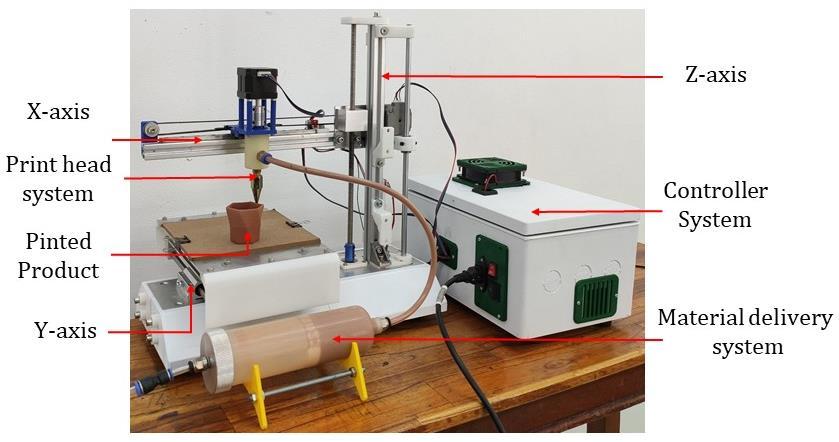
Parameters of the design compression screw are as followingscrewpitch5mm;diameterØ6(mm);totallength of the screw72mm;screwhead Ø5as shown inFigure 3. ThefeedheadhasadiameterofØ6.5(mm)andthenozzle hasadiameterofØ2.5(mm).Thescrewinstalledonthe600 step/mm driver produces enough extrusion force to force theceramicout.Thisfactorisrelatedtotheaccuracyofthe screw rotationspeed and the amount ofceramicextruded by adjusting the amount to form a uniform printing layer andtheproductprintsbeautifullyandevenlyintheprinted layers.
2.3 Ceramic material
Kaolin ceramic is a material widely used by countries withdevelopedindustriessuchastheUS,UK,France,Japan, etc. to study old ceramics [17-19]. The chemical composition of pure ceramic with the formula Al2O3.2SiO2.2H2OincludesthecompositionAl2O3 =39.48%, SiO2 = 46.60%, H2O = 13.92% [20]. Before printing, the ceramic needs to be treated to remove hardened ceramic particlesbyfilteringthroughameshscreenanddispensing with water at a level suitable for printing. The printed samples are mixed with water according to the ratio: 700 grams of ceramic mixed with 95 ml of water. In order to choose suitable dispensing ratio for ceramic printers, the authorshavetesteditmanytimesbeforeandfoundthatthis
ratioisjustsoftenough,notbroken,andsuitableregulating thequantityofceramicwhenprinted.
2.4 Printing parameter setting
Setting parameters is an important step in the FDM printing process. Set print parameters to synchronize the materialsused,printspeed,andprintqualityfactors.Setting parametersissimilartoprintingplasticmaterials,butwith FDM printing method with ceramic materials, it will focus oncorrectingkeyparametersthatmayaffectprintquality. First, the sample model was designed on Inventor Professional 2022 software and exported in STL format. Next, use Ultimaker Cura software to declare the parameters and print modes to be compatible with 3D ceramicapplications.FinallyexportthefileconvertingCAD filestoG-Codeasparameters(printlayerheight,printwall thickness, density, print speed, travel speed, ...). The modified printing parameters of Ultimaker Cura software areasfollows
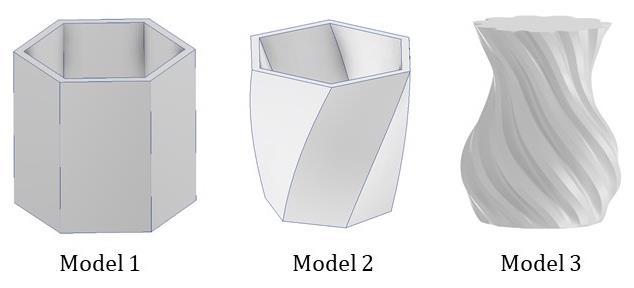
grams;Theprintingtimeofsample3is10minutes,themass ofceramicusedinthesampleis14grams.
3. RESULTS AND DISCUSSION
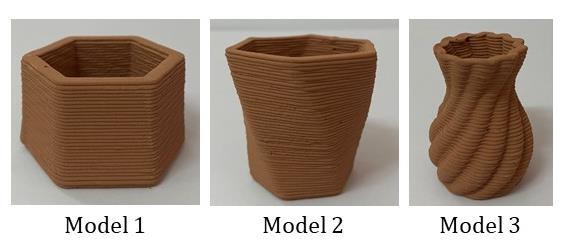
Toconductaprinterexperimentwithceramicmaterials, the authors designed three product samples that clearly showedthesimplicityofthemodelfromsimpletocomplex. Sample1isdesignedaccordingtoahexagonalblockwithan overall size of (45×48) mm2. Sample 2 is designed in a twisted hexagonal shape with an overall size of (45×48) mm2.Model3 isdesignedintheformofavasewith11sides andtwistededgesfromthebottomtothemouthofthevase with an overall size of (45×45) mm2 . After setting the printingparametersforthethreesamples,theprintingtime ofsample1was9minutes,thetotalvolumeofceramicused forthesamplewas15grams;theprintingtimeofsample2 is14minutes,themassofceramicusedinthesampleis25
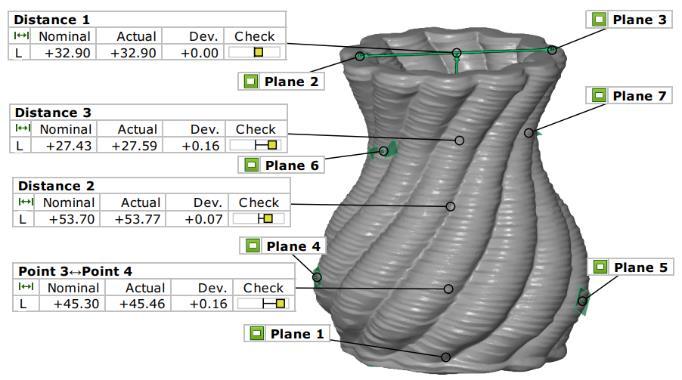
3D Scan technology will be applied to test the printed sampletoreviewthesizeandqualityoftheprintedsample. Themeasuringsampleisgluedwith1.5mmreferencepoints directlyonthesurfaceandplacedonadedicatedturntable for3DScan.Thesamplescanningprocesswillbecarefully handledbyapplyingwhitepowdersothatthemachinecan scanallsides.Whenthescaniscomplete,thesamplewillbe treatedforsurfacequalityanddimensionedonGomInspect software.Surfacesareprocessedinareasthataredefective due to unrecognizable machine scanning or in hidden corners,theprocessedmeshresolutionis0.01mm.Thetest resultsarepresentedinTables3andTable4.
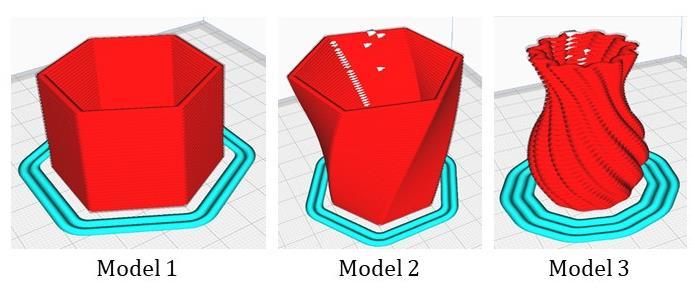
Aftertheformingprocessforthe3samples,theprinted sample will be measured and compared with the design model size and the printed sample size. The results of the printedsamplesareasfollows:theprintedsamplesdonot change in shape compared to the designed model. In particular, print pattern 1 has a simple shape, so the straight-motionprintheadprofilehaslittleinfluenceonthe change of running pattern and less vibration during printing,theprintinglayersarequiteevenandstablefrom the second printing layer. to the final printing layer, the height deviation is -1.4 mm and the width dimension deviationis+0.4mmcomparedtotheoveralldesignmodel size.For sample 2,the profile moves ina straightline, but thereisagreaterchangeintheprintline,sothevibrationis negligible and does not affect the print quality much, the other printing layers are even but unstable, and the error size with deviation in height is -1.1 mm and the size deviationinwidthis+0.5mmcomparedtotheoverallsize of the design model. For model 3, the motion profile is constantlychanging,sothere isa vibrationbutitdoes not affect the print quality, the printing layers are stable and even, the size difference in height is -2.77 mm, and the degreeofSizedeviationinwidth+0.3mmcomparedtothe overall size ofthe designmodel.The resultsshowthatthe samples meet the requirements in terms of shape and surface, but the height size is somewhat reduced and the widthsize increased,butthe deviationissmall,within the allowablerangeprintproductquality.
4. CONCLUSIONS
The article presented in detail the process of researching, designing, manufacturing 3D printers, and testing printing on kaolin ceramic materials. The machine structure including the transmission part, feeder part,and regulating part is described and explained. The process of setting printing and material handling parameters, and conducting test printing are presented and discussed. Research results show that the products created by 3D printers with ceramic materials are diverse and rich, creating a unique feature for ceramic. Thereby, the application of 3D printing technology by FDM method in ceramic art production is very appropriate. The results of this research will be the first stepsfor the developmentof theapplicationofhightechnologyinproduction,especially intheceramicindustry.
ACKNOWLEDGEMENT
The authors would like to express their acknowledgementthefullyfinancialsupportfromTraVinh Universityunder(291/HĐ.HĐKH-ĐHTV).
REFERENCES
[1] NShahrubudin,T Lee,andRRamlan,"AnOverviewon 3DPrintingTechnology:Technological,Materials,and Applications", Procedia Manufacturing, 35, 2019, 1286-1296.
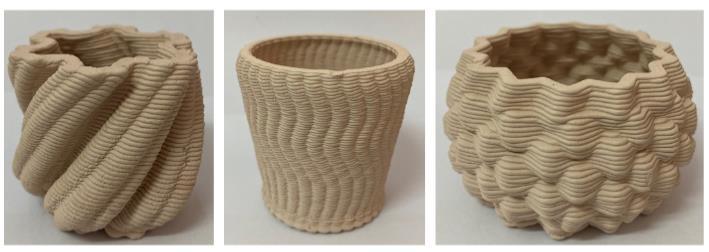
Figure 7: The model test results on printing
Inaddition,tobetterevaluatetheprintquality,the authors also tested 3 different samples with complex profiles. The printed samples are of good quality, the printing layer is very uniform and stable. Create a very diverse and rich shape. The above results show that the manufacturingandapplicationof3Dprintingtechnologyin production,especiallyinthefieldoffineartceramics,isvery positive.Thisresearchresultcancontributetofineceramic production facilities having more product development opportunitiesinthefuture.
[2] ZFeixiang,ZLiyong,andKXia,"StudyofImpactof3D Printing Technology and Development on Creative Industry", Journal of Social Science Studies, 3(2), 2016, 57-61.
[3] F. Hu, T. Mikolajczyk, D. Pimenov, and M. Gupta, "Extrusion-Based 3D Printing of Ceramic Pastes: MathematicalModelingandInSituShapingRetention Appoach", Multidisciplinary Digital Publishing Institute (MDPI), 14(5), 2021,1-22.
[4] K Faksawat, P Limsuwan, and K Naemchanthara, "3D printingtechniqueofspecificboneshapebasedonraw clay using hydroxyapatite as an additive material ", Applied Clay Science, 214,2021.
[5] M Gómez-Tena, J Gilabert, J Montolio, J Corrales, M Toledo,andMPérez,"3dPrintingOfCeramicPiecesBy ExtrudingClaySuspensions", 2016.
[6] F Zhong, W Liu, Y Zhou, X Yan, Y Wan, and L Lua, "Ceramic3Dprintedsweepingsurfaces.ComputGraph ", Computers & Graphics, 90,2020,108–115.
[7] A Jandyal, I Chaturvedi, I Wazir, A Raina, and M Haq, "3D printing – A review of processes, materials and applicationsinindustry4.0", Sciencedirect, 3,2022,3342.
[8] Dudek P, "FDM 3D printing technology in manufacturing composite elements", Archives of Metallurgy and Materials, 58(4),2013,1415-1418.
[9] MNadagouda,MGinn,andVRastogi,"Areviewof3D printing techniques for environmental applications", Current Opinion in Chemical Engineering, 28, 2020, 173-178.
[10]M Chaari, M Abdelfatah, and C Loreno, "A trial to convert a polymer FDM 3D printer to handle clay materials", Springer, 68,2022.
[11]M. Zhang and L. Yang, "Ceramic Product Forming Technologies Research Based on 3D Printing", The Multidisciplinary Open Access Journal (IEEE Access), 4, 2016,9345-9349.
[12]ERomanczuk-Ruszuk,BSztorch,DPakuła,EGabriel,K Nowak, and R Przekop, "3D Printing Ceramics MaterialsforDirectExtrusionProcess", Academic Open Access Publishing (MDPI), 6,2023,364–385.
[13]Quoc Phong Pham, My Thuat Thach, and Duc Dai Le, "Design and Programming Process for 5-Axis CNC Machine with Fusion 360", Journal of Science and Technology - The University of Da Nang, 20(5), 2022, 74-78.
[14]Quoc-Phong Pham and Thach My Thuat, "Design and Fabrication of Mini 5 Axis CNC Machine for GemstoneCarving", International Research Journal of Engineering and Technology (IRJET), 08(06), 2021, 437-441.
[15]K. Manikandan, X Jiang, A Singh, B Li, and H. Qin, "Effects of nozzle geometries on 3D printing of clay constructs: quantifying contour deviation and mechanical properties.", sciencedirect, 48,2020,678–683.
[16]M Matúš, L Šooš, P Križan, J Beniak, and J Ondruška, "Design Theory for Screw Geometry in a Briquette Press", Manufacturing Technology, 15(3), 2015, 384391.
[17]E Pérez-Monserrat, L Maritan, V Baratella, and M Vidale, "Production Technologies and Provenance of Ceramic Materials from the Earliest Foundry of PreRoman Padua, NE Italy", Academic Open Access Publishing (MDPI), 6(3), 2023,2956-2977.
[18]HoàngBáThịnhandĐàoHàQuang,"Côngnghệtuyển vàxửlýcaolanhbằngphươngphápthuỷlực,côngsuất
20.000tấn/năm", Khoa Học & Công Nghệ, 10(2012,4244.
[19]Li W, "Research on Innovative Design of Ceramic Products for Daily Use", 3rd International Conference on Art Studies: Science, Experience, Education (ICASSEE), 368,2019,350-355.
[20]Lê Anh Thi, Trần Hồ Minh Luyến, and Võ Duy Dần, "Nghiêncứuchếtạovàcấutrúc,vicấutrúccủacáchệ gốm không chì trên cơ sở (K,Na)NbO3", Tạp chí Khoa học, Đại học Huế, 5(74A), 2012,149-158.