Dementia Care Application
Abstract - Dementia is any decline in cognition that's significant enough to intrude with independent, diurnal functioning. madness is stylish characterized as a pattern rather than as one particular complaint. The causes of madness are myriad and include primary neurologic, neuropsychiatric, and medical conditions. It's common for multipleconditions tocontribute to anyone case's madness pattern. Neurodegenerative mania, like Alzheimer complaintandmadnesswithLewybodies,aremostcommon in the senior, while traumatic brain injury and brain excrescences are common causes in youngish grown-ups. While the recent decade has seen significant advancements in molecular neuroimaging, in understanding clinicopathologic correlation, and in the development of new biomarkers, clinicians still await complaint- modifying curativesforneurodegenerativemania.Untilalso,clinicians from varied disciplines and medical specialties are well poised to palliate suffering, aggressively treat contributing conditions, employ specifics to ameliorate cognitive, neuropsychiatric, and motor symptoms, promote substantiation- grounded brain-healthy actions, and ameliorateoverallqualityoflifeforcasesandfamilies
Key Words: Dementia, Symptoms, Patients
1.INTRODUCTION
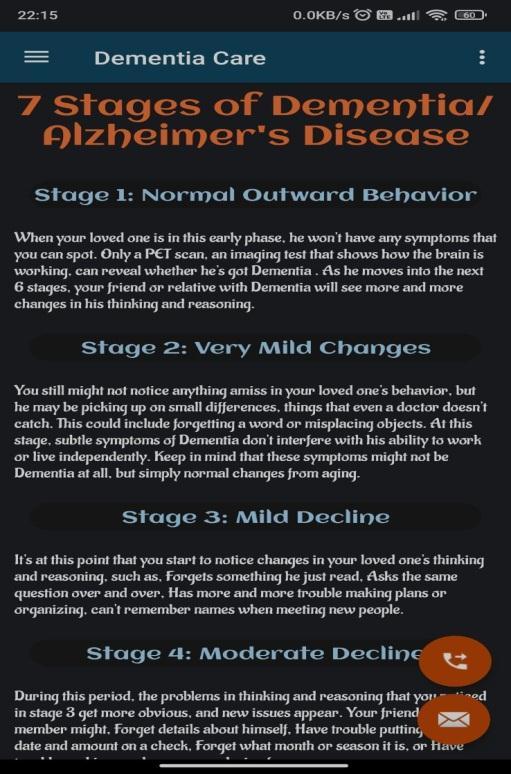
Dementiaisadisorderthatmanifestswithasetof accompanying symptoms, usually when the brain is damaged by injury or disease. Symptoms involve a progressive disorder in memory, thinking, and behavior that negatively affects a person's ability to function and carryoutdailyactivities.In additiontomemoryproblems and thought disturbances, the most common symptoms include emotional problems, language difficulties, and decreased motivation. Symptoms can be described as occurring in a multi-stage sequence. Consciousness is not affected. Dementia ultimately has a significant effect on individuals,caregivers,andsocialrelationshipsingeneral.
1.1 Overview
Dementia patients will profit froman Smartphoneapp. Theapp'sfeaturesetcorrespondstowhatpatientsneedon adailybasis.HelpingAlzheimer'ssuffererswithdailytasks would be a major challenge. Alzheimer care focuses on all of these issues and helps to integrate all functions into a
single app in the following section of this text, the list of featuresisexplained.
1.2 Problem Statement
DementiapatientswillprofitfromanSmartphone app. The Dementia is a disorder which manifests as a set of related symptoms, which usually surfaces when the brain is damaged by injury or disease. The symptoms involveprogressiveimpairmentsinmemory,thinking,and behavior, which negatively affect a person's ability to function and carryout everyday activities. Major problem with Alzheimer cases would be to help them with diurnal chores. Alzheimer care targets all similar problem and helps to get all features under one app. The being system hasoperationswhichareconfinedonlytoultra expensive druggies and high- end Smartphone The operations had only features of storing particular information in a textbook format and could have only limited information Alzheimer's disease is a degenerative kind of dementia that affects memory and thinking abilities as well as the capacitytoperformeventhesimplesttasks.Itaffects10% of people worldwide who are 65 years or older .The patient's long-term memory is still functional in the early stages,althoughrecentinformationliketimeanddaymay be forgotten. The disease also has a strong impact on the family members who must endure heartbreaking emotional experiences as a result of seeing an elderly parent or spouse in such a state. We consequently made thedecisiontodevelopanapptoassistcareersandfamily members in keeping the patient mentally active and thereby assisting with brain workouts Damage to your brainresultsindifferentsymptoms,dependingonthearea of your brain affected. Some dementias aren’t reversible and will worsen over time. Other dementias are due to other medical conditions that also affect your brain. Anothergroupofhealthissuescanresultindementia-like symptoms. Many of these condition treatable, and the dementiasymptomsarereversible.

2. Literature Survey
2021 TuckWoon,et.al Dementiacareapps for people with dementia and informal caregivers: a systematic review protocol
2022 AngelHWang,et.al
Beyond instrumental support: Mobile application use by family caregivers of persons living with dementia
Critical Appraisal Skills Programme (CASP) checklists will be used to assess the study quality.
Qualitative description approach
Sampled from Extensive databases
Knowledge gap in older adults were not explored in the review
involving the ages, location of the caregiver, relation ofthepatienttothe caregiver
Thestudy needsto explore persons living with dementia - needs, preferences could inform developers on what types of appsaresuitable
2022
D David, SY Lin, et.al
Aliviado Mobile App for Hospice Providers: A UsabilityStudy
Hospice Advanced Dementia Symptom Management.
Data was collected from 86 respondents filling out the questionnaire
Training to be given for app users &noofflineaccess
2021 PYang,GBi,et.al
Multimodal wearable intelligence for dementia care in healthcare 4.0: A survey
Tri-phasemodel
Data was collected from 100 respondents filling based on private research
Mostly focus on the prospective memory tasks but fail to cover retrospective memory
2019 Lefteris Koumakis, et.al
Dementia care frameworks and assistive technologies for their implementation: A Review
assistive technologies for dementia
EU research projects related to Dementia
No proper model beingproposed
2019 RidwanAlam,et.al
Multiple-Instance Learning for Sparse Behavior Modeling from Wearables: Toward DementiaRelated Agitation Prediction
smart watch inertialsensors
The data from 10 residential deployments
Mostly focus on the agitation phenomenon (continuous wrist motion monitoring), but doesn’t concentrate on day-to-day activities
3. PROPOSED SYSTEM
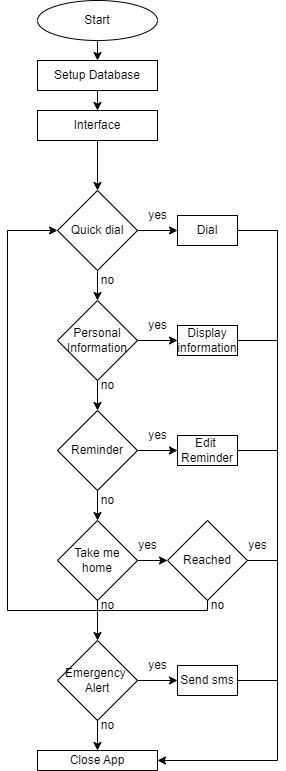
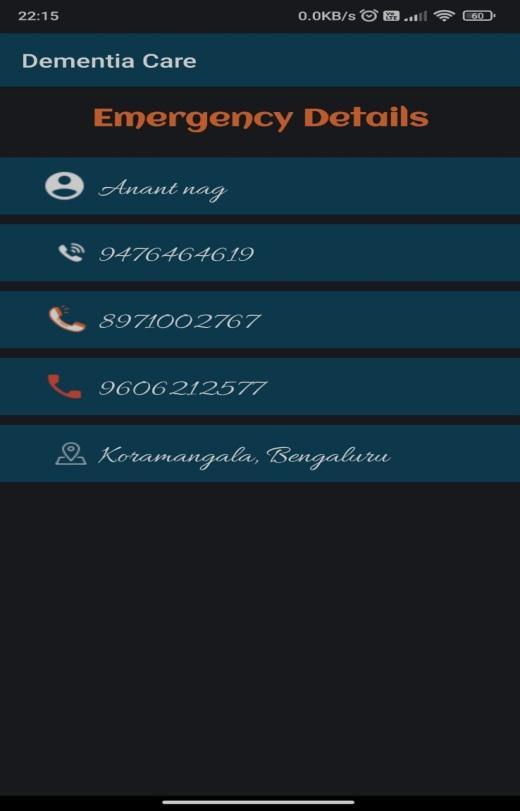
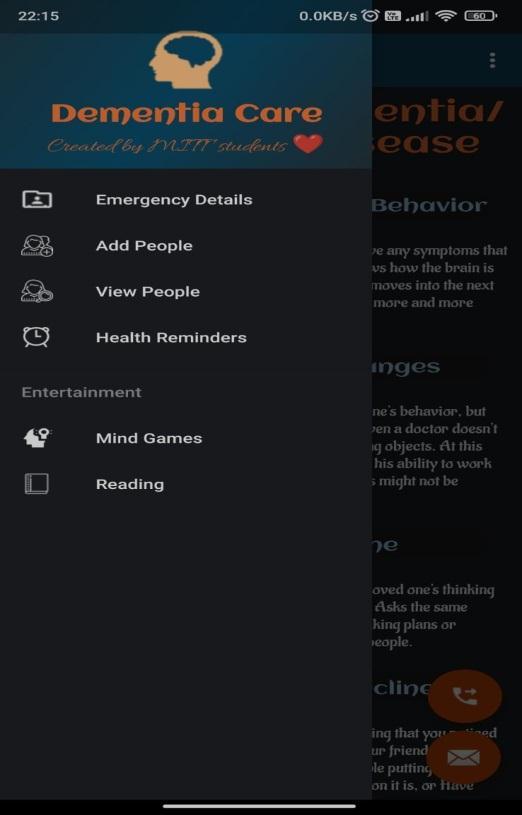
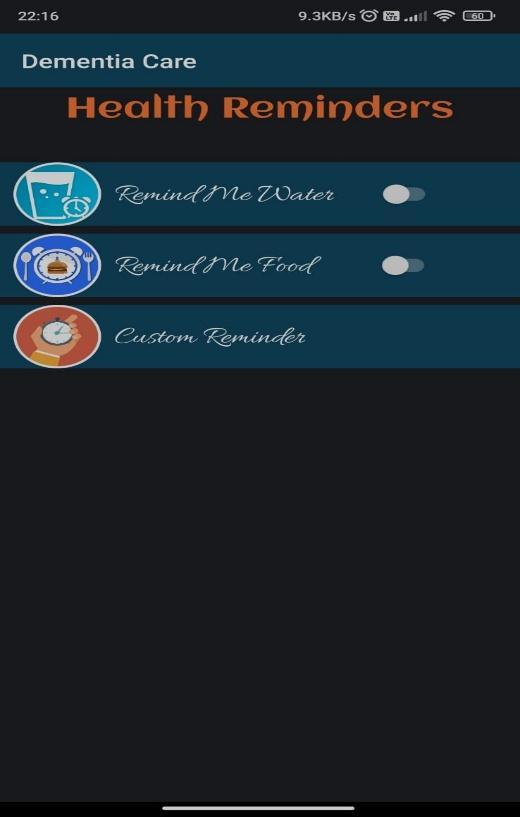
Proposed system consists of a native mobile applicationforandroidaswell asiOSbasedsmartphones. Our idea is to develop an application that helps them in their daily routine tasks, focusing on the problems they face in every stage, take Emergency Details, Set Food, Water,andCustom Reminders, emergencyMessagealerts and Quick dial module along with Personal information sectionNavigationtohomeusingGoogleMaps
Advantages:
•Quickdialmodule
•SetFood,Water,andCustomReminders
•EmergencyMessagealerts
•Personalinformationsection
•NavigationtoHomeusingGoogleMaps
4. SYSTEM DESIGN
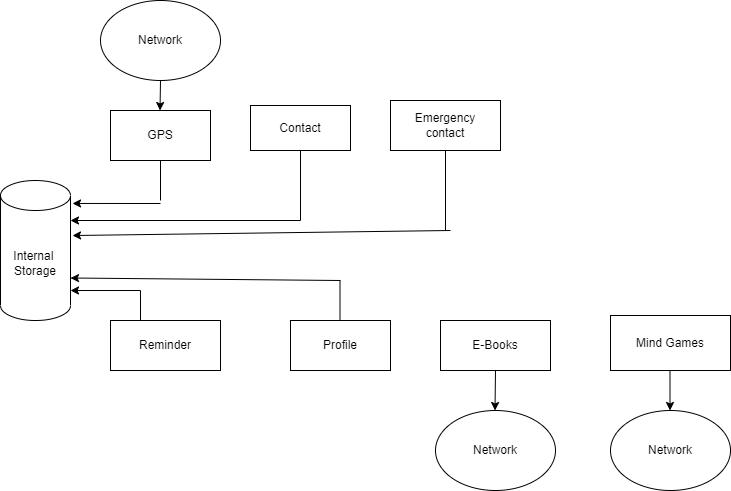
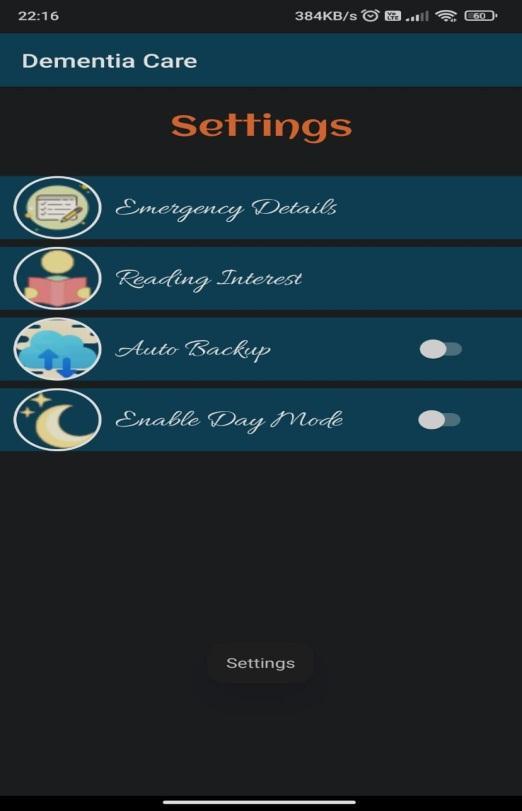
Someofthemoduleswillbeconnectedvianetwork.All thedatawillbestoredtoInternalStorageoftherespective devices.Usercanuselocationinordertofindtherewayto home.Usercansetdailytasksandsetremindertoperform day to day activities efficiently without the help of caretakers.
5.Implementation
Contact:- It is used to display contacts, which is in there personalcontact
Reminder:-Patientscaneasilyaddremindersofthereday todaychores
ToDo:-Theycanaddtask(whichisnotreminder)ofthere daytodaychores.
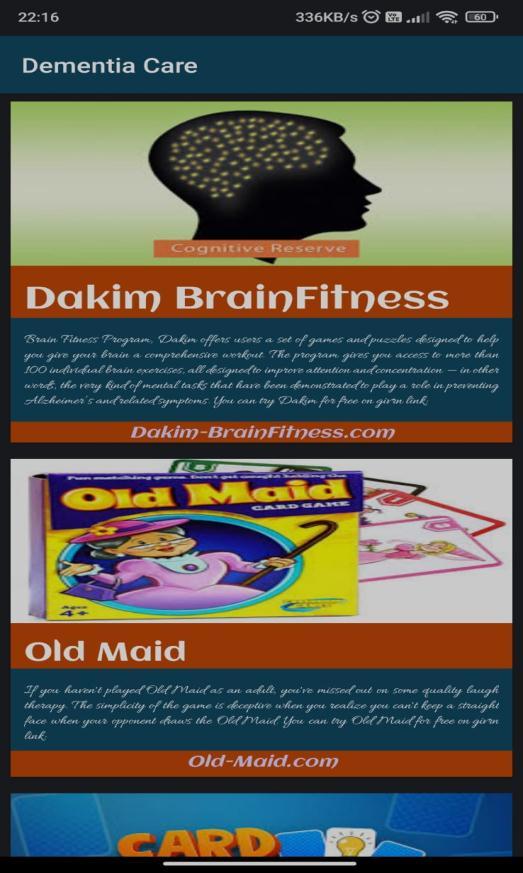
Mind game:- User can play games which will help to pass thetimeandimprovetheirmemory
Books:- If some user have the habit of reading, they can easilyreadanybook
GPS:-Itisusedtousedshowthedirectiontoanyplace.
6.FLOWCHART
8. CONCLUSIONS
Dementia is a degenerative ailment that ultimatelyaffectsaperson’scapabilitytolivesingly.There are numerous types of dementia, although Alzheimer’s diseaseisthemostcommontype.Deliriumanddepression canbeconfusedwithdementiaandathoroughevaluation should rule out other causes of cognitive loss previous to making a determination of dementia. Although people with dementia frequently parade actions that are challenging for family and professional caregivers to manage,theactionsarecausedbydamagetothebrainand aren't purposeful. Challenging actions can be caused by unmet requirements and may be a means of communication. By precisely observing what comes directly ahead and after a geste , the caregiver may be suitable to determine the underpinning need and learn howtopalliatethegruelinggeste.
REFERENCES
[1]WorldHealthOrganization.Dementia2020. Available from: https: //www.who.int/newsroom/factsheets/detail/dementia.
[2] Alzheimer Society Canada. Risk factors 2020.Available from:https://alzheimer.ca/en/
Home/About-dementia/Alzheimer-s-disease/Risk-factors.
[3]CentersforDiseaseControlandPrevention.Caregiving forfamilyandfriends:aPublicHealthIssue.2019.
[4] Crisis Prevention Institute. How to establish dementia care best practices and why they matter 2020. Available from: https: //www.crisisprevention.com/Blog/Dementia-Care-Best-Practices.
[5] Jennings LA, Palimaru A, Corona MG, Cagigas XE, Ramirez KD, Zhao T, et al. Patient and caregiver goals for dementiacare.QualLifeRes.2017;26(3):685–93.
[6] Alzheimer’s Association. 2020 Alzheimer’s Disease FactsandFigures.2020.p.391–60.
[7] Logsdon RG, McCurry SM, Teri L. Evidence- Based Interventions to Improve Quality of Life for Individuals with Dementia. Alzheimers care today. 2007; 8(4): 309–18.
[8] Kasper J, Freedman V, Spillman B. Disability and care needs of older Americans by dementia status: an analysis of the 2011 national health and aging trends study. Washington, DC: US Department of Health and Human Services;2014.
[9] deVugtME,StevensF,AaltenP,LousbergR,JaspersN, VerheyFR.Aprospectivestudyoftheeffectsofbehavioral symptoms on the in- stitutionalization of patients with dementia.IntPsychogeriatr.2005;17(4):577.
[10] MaustDT,KalesHC,McCammonRJ,BlowFC,Leggett A, Langa KM. Distress associated with dementia-related psychosisandagitationinrelationtohealthcareutilization and costs. Amy J Geriatr Psychiatry. 2017; 25(10): 1074–82.