ESTIMATION OF DEPTH OF RIVER BY BATHYMETRY OF SATELLITE IMAGES
Abstract - Thecollectionofbathymetricdataiscrucialfor examining the river environment, watershed hydrological response, and river hydraulics. However, traditional field surveys for acquiring such data are costly and timeconsuming, and may be hindered by inaccessibility to partiallyorcompletelysubmergedriverbeds.Tosupplement these surveys, remote sensing methods offer new possibilities. The objective of this research is to showcase how satellite imagery can be utilized to approximate the depthofwaterinariver.Specifically,thestudyfocuseson theshallowportionoftheMula-MuthaRiversituatednear Pune, utilizing four spectral bands of high-resolution multispectralsatelliteimagery(red,green,blue,andnearinfrared)withminimalcloudinterferenceandadequatelight penetration. Furthermore, correlation analysis between frequency bands and field measurements has been conductedatnumeroussurveysites.
Key Words: Satellite imagery, Bathymetry, Image processing,Machinelearning

1.INTRODUCTION
Theanalysisoftheunderwatertopographyorbathymetryof waterbodieslikerivers,streams,seas,andlakesiscrucial forpredictingshorelines,seabeddepth,andmanagingflood protectionandvesseloperations.Theobjectiveofthisisto createaprototypeusingmachinelearninganddeeplearning techniques that can perform bathymetry on a large scale. Bathymetry,whichreferstothestudyofthefloorsorbedsof water bodies, is an important area of research that has various applications in hydrology, water resource management,shippingoperations,andfloodmanagement. Traditionalapproachestocollectingbathymetrydata,such as field surveys, can be time-consuming and expensive. Furthermore,inaccessibleriverbedscanmakefieldsurveys challenging to conduct in many cases. Remote sensing techniques,suchassatelliteimageprocessing,providenew ways to supplement traditional field surveys. Satellite imageryoffersauniqueopportunitytoobtaininformation aboutthedepthandshapeofunderwaterland,enablingus to estimate river water depth and map the underwater featuresofrivers.Satelliteimageprocessingforbathymetry ofrivershasbecomeanareaofinterestinrecentyearsdue toitspotentialtoprovidelarge-scale,high-resolution,and accuratedepthestimationwithminimalcostandtime.Highresolution,multispectralsatelliteimageryisnowavailable., which can penetrate the water body with favorable
conditionsofsunlight,hasopenedupnewpossibilitiesfor researchers to explore this area.This study aims to demonstrate the estimation of river water depth using satellite images and to develop a method for mapping the underwaterfeaturesofrivers.
2. EXISTING WORK
HojatGhorbanidehno[1]discussedtheimportanceofriver bathymetry and the difficulty of obtaining direct measurements of depth. However, indirect measurements can be obtained using physics-based inverse modeling techniques.Anewdeeplearningframeworkisdevelopedand appliedtothreeproblemsofidentifyingriverbathymetryby combining connected principal component analysis (PCA) andDNN.
TatsuyukiSagawa[2]proposedamethodtocreateageneral depth estimation model, a shallow water bathymetric mapping approach was developed using Random Forest learningandmultitemporalsatelliteimagery.Theresearch looked at 135, Landsat-8 images and extensive training bathymetric data from five different regions. Satellite bathymetry (SDB) accuracy was tested against reference bathymetricdata.
Motoharu Sonogashira [3] performed deep learning-based imagesuper-resolutionexperimentstoimproveresolutionof bathymetric data. By implementing this technique, the quantityofseaareasorpointsthatrequiremeasurementis decreased,leadingtotheswiftanddetailedmappingofthe seabedandthecreationofhigh-resolutionbathymetricmaps oftheencompassingregio.
Manuel Erena [4] emphasized that the applicability and utilityofbathymetricinformationis:Theeffectivenessofthe approach is heavily reliant on the standard and spatial precisionofthedata,inadditiontotheconfigurationofthe modelnetwork.Heproposedusingvariousremotesensing toolstoobtainextensiveinlandbathymetricinformationand one approach is to obtain coastal water masses with progressivelyenhancedspatialresolution.
Jiaxin Wan [5] concluded that coastal bathymetry is an importantparameterincoastalresearchandmanagement. Previous research has shown the importance of obtaining high resolution coastal bathymetric data. The study found that the combination of high-resolution multispectral
imagerywithappropriatealgorithmscouldgenerateaccurate near-shorebathymetricdata.
3. METHODOLOGY
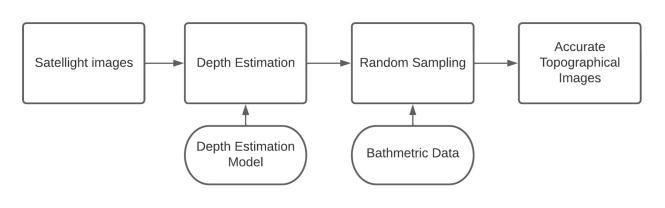
In this paper, the conventional least squares regression analysistoresolvethegradientofalineisnotused.Thisis because the choice of dependent variable band can significantlyimpacttheoutcome.Insteadofmeasuringthe root mean square error of the regression line along the dependentvariable,theapproachusedhereselectstheslice with the smallest root mean square error. The regression lineisthenpositionedaccordingly.Thefollowingequation illustratesthisapproach:
ki/kj=a+√(a2+1)
3.1 Land and Water Separation
The ability of light to penetrate decreases as the wavelengthincreases,andtheNearInfrared(NIR)bandis unable to penetrate deep into water due to strong absorption.Additionally,vegetationandsoilstronglyreflect NIRradiation,resultinginavisibledistinctionbetweenland and water bodies in NIR band images and a significant differenceinDN(digitalnumber)values.Thehistogramof NIRbandDNvaluesdisplaystwopeaks,representingwater pixelsandlandpixels,respectively.Thisthresholdvalueis usedtoexcludepointscorrespondingtoland,resultinginan arrayofsolelywaterbodypixelsforadditionalprocessing.
3.2 Water Column Correction
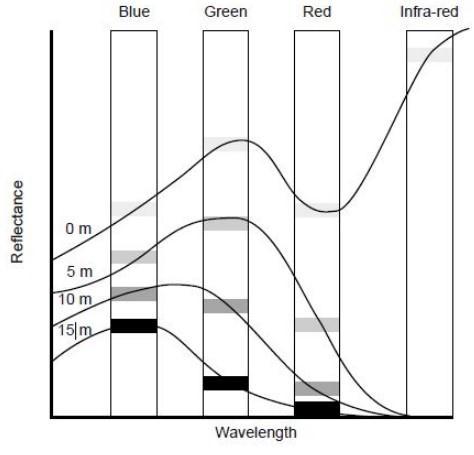
Attenuation is a phenomenon whereby the intensity of light passing through water decreases exponentially as depth increases, which affects remotely sensed data from aquaticenvironments.Inthevisiblespectrum,thedegreeof attenuation varies depending on the wavelength of electromagneticradiation,withlonger-wavelengthredlight attenuatingfasterthanshorter-wavelengthbluelight.The separabilityofhabitatspectradecreasesasdepthincreases. Despitethesamesubstratum,thespectralsignatureofsand at2metersdepthcandiffersignificantlyfromthatat10-20 metersdepth.Infact,at20meters,thespectralsignatureof sandmayresemblethatofseagrassat3meters
WaterColumn
3.3 Effect of variable depth
Toeliminatetheeffectofdepthonbottomreflectance,the following steps would be necessary:To comprehend the attenuationcharacteristicsofthewatercolumn,itiscrucial toacquireadepthmeasurementforeachpixelinanimage. However,generatingprecisedigitalelevationmodelsofdeep waterscanbea challenging task,particularlyincoral reef systems where the accuracy of charts is frequently uncertain.. As a compromise, Lyzenga [6] suggested a straightforward method to account for the variable depth effectwhenmappingbottomfeaturesthroughthecreationof a 'depth invariant bottom index' using pairs of spectral bandsinsteadofattemptingtopredictseabedreflectance. Approach involves the removal of atmospheric scattering andexternalreflectionfromthewatersurfacebysubtracting theaverageradianceofasignificantnumberof'deepwater' pixelsfromallotherpixelsineachband.Additionally,this techniqueisbasedontheconceptof'darkpixelsubtraction:
Atmospheric corrected radiance = Li - Lsi
Where Li represents the pixel radiance in band i and Lsi representsthedeepwateraverageradianceinbandi.
Theintensityoflightdecreasesexponentiallywithdepthin relativelyclearwater.Byapplyingnaturallogarithmstothe valuesoflightintensity(radiance),alinearrelationshipwith depth is established, represented by the symbol "ln". If Xi
representsthetransformedradianceofapixelinbandi,then thisstepcanbeexpressedinthefollowingmanner.Asthe depth increases, the transformed values of radiance will decrease linearly. In mathematical notation, this transformationcanbedenotedasfollows:
Xi = ln (Li-Lsi)
Theintensityoflightattenuationinwaterforthatspectral band is described by the irradiance diffuse attenuation coefficient(abbreviatedk).Thefollowingequationrelatesit toradianceanddepth,thisequationinvolvesaconstantterm represented by, bottom reflectance denoted by "r", and depthindicatedby"z":
Li = Lsi + a.r.e −2 kiz
Theequationforgeneratingabottomtypereflectanceimage, which was the intended parameter to be estimated, was manipulatedintheory.However,thepresenceofnumerous unknown variables, such as the value of constant "a", the attenuationcoefficientforeachband,andthewaterdepth foreachpixel,makesitachallengingtask,thistechniqueis not practical. Lyzenga's approach, on the other hand, circumvents this issue by employing data from multiple bands and does not necessitate the direct computation of theseparameters.Theattenuationcoefficientratiobetween two spectral bands is all that is required. Many of these unknowns are eliminated by using ratios, which can be calculatedfromtheimagery.
If radiance values for a different type of ocean floor were includedinthegraph,acomparablelinewouldresult,but the difference between the data points would only be in termsofdepth.Duetothedissimilarityinthereflectanceof thesecondtypeofoceanfloorascomparedtothefirstone, theplacementofanewlinewouldbeeitheraboveorbelow the current line. For instance, if the first line was created usingsand,whichreflectslighthighly,andthesecondline was produced using seagrass, In case the second line represents an area with lower reflectance, it would be situatedbelowthesandline.Itisnoteworthythattheslope of both lines will be identical, as the ratio of attenuation coefficientski/kjisdeterminedsolelybythewavelengthof the light bands and the clarity of the water. The mathematical formula for the depth-invariant index is straightforwardanditisbasedonthestraightlineequation:
y = p+q.x
Where p is the y-intercept and q is the y-x regression gradient. The y-intercept is obtained by rearranging the equation:
p = y−q.x
Depth invariant index = ln (Li−Lsi) − [(ki/kj).ln (Lj−Lsj)]
Foreveryspectralband,asolitarydepth-invariantbottom band is generated. When the satellite imagery includes numerous bands that possess strong water penetration capabilities,itispossibletodevelopseveraldepth-invariant bands.Duringimageprocessingorvisualexamination,the depth-invariant bands can be utilized rather than the originalbands.Theblueandgreenbandswerepreferreddue totheirabilitytopenetratethewaterdeeplyandproducea moredistinctdepictionofthesubstratefeatures.
3.4 Modules used
3.4.1 PyQt5
PyQt5isaPythonbindingfortheQttoolkit,whichisacrossplatformGUItoolkitwidelyusedinindustryfordeveloping graphicaluserinterfaces.PyQt5providesPythonbindings for the Qt5 framework, allowing developers to create desktopapplicationswithamodernUI,highperformance, andgreatcompatibilitywithmultipleplatforms.
3.4.2 NumPy
NumPyisaPythonlibrarythatcaterstoscientificcomputing needs and facilitates the handling of multi-dimensional arrays, mathematical functions, and linear algebra operations. It is one of the most widely used libraries in scientificcomputinganddataanalysis.
3.4.3 Rasterio
Rasterio is a Python library that specializes in handling geospatial raster datasets for the purpose of reading and writing. It is built on top of the GDAL (Geospatial Data Abstraction Library) and numpy libraries, making it a powerfulandefficienttoolforworkingwithgeospatialdata inPython.
3.4.4 MatPlotLib
Matplotlibisawidely-usedPythonlibrarythatfacilitatesthe production of static, animated, and interactive data visualizations.ItisconstructedontopoftheNumPylibrary and offers a diverse array of instruments for generating exceptional-qualityplots,charts,andgraphs.
3.4.5 SkLearn
Sklearn, commonly referred to as Scikit-learn, is a wellknown Python library utilized for machine learning, equippedwithaplethoraofdatamining,dataanalysis,and predictivemodelingtools.ItisconstructedontopofNumPy and SciPy, providing significant efficiency and potency in handlingvastdatasets.
4. RESULTS AND DISCUSSIONS
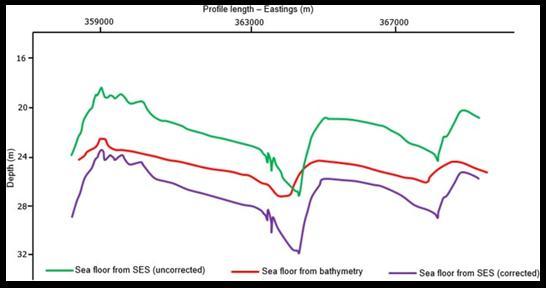
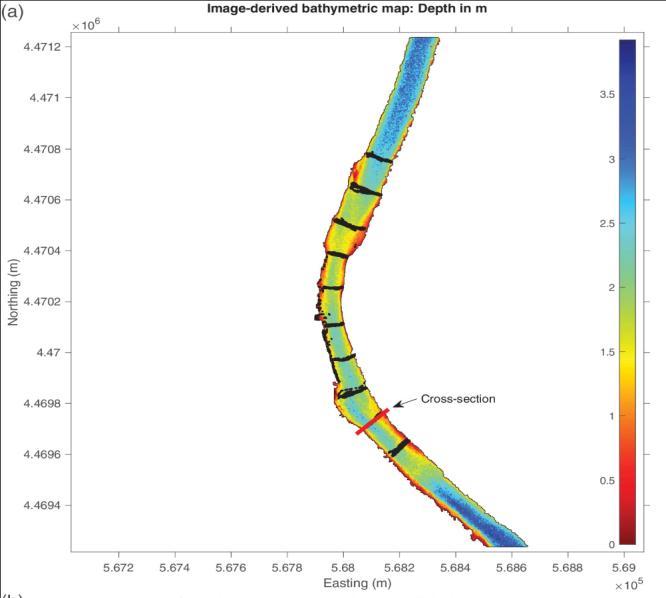
Thesestudiesshowthatitispossibletoestimateemissivity parametersindeepwater,leadingtodepthmodelssimilarto thoseobtainedinriverwateratseveralmetersdepth.There is a long history of using multispectral satellite imagery processingforbathymetricresearch(SDB)inwhichLorenzo Rossi,IreneMammi,andFilippoPelliccia[7]createddronederived multispectral bathymetry. High-Resolution BathymetrybyMotoharuSonogashira,MichihiroShonai,and MasaakiIiyama[3].Usingimagesuper-resolutionbasedon deeplearning,thenumberofwaterregionsorpointstobe surveyedcouldbegreatlyreducedtomaptheseabedand createhighresolutionmapsonaglobalscaleforbathymetric mapsofresolution.TheopticalriverbathymetrybyCarlJ. Legleiter [8] is shown in Figure 4. Mahmoud Al Najar, Grégoire Thoumyre, Erwin W.J. Satellite [9] Bathymetry BergsmaandRafaelAlmar,presentedthefirstuseofdeep learning for bathymetric estimation using wave physics. HojatGhorbanidehno,JonghyunLee,MatthewFarthing,and Tyler[1]introducedadata-basedinversemodelingmethod thatcanbeutilizedforlarge-scaleriveranalysisevenwith limiteddataandcomputationresources.Theyresolvedthe Bathymetryproblemconsistingofthreemajorcomponents thatperformedkeytasksinbathymetryestimation.Finally, XinjiIslandShallowWaterBathymetrymappingJiaxinWan andYiMa's[5]MultispectralSatelliteImageryusingDeep Learning described a proposed method for creating measurements with more detailed morphological informationthanordinarykrigingdatapoints.Themethods reviewed found that the combination of high-resolution multispectral imagery using different bands added with machine learning, regression techniques and appropriate algorithms could be used to generate an accurate topographicalmapoftheriverforbathymetry.
5. FUTURE WORK
Theapplicationofdeeplearningtosatellitebathymetryis demonstrated for the first time in this study using a syntheticcase.Thenextstepwillbetocreateasupervised datasetofreal-worlddatatotrainandtesttheNHOmodel usingtransferlearningtechniques.Showsthatthemodelcan estimatebathymetryfromsyntheticsatelliteimagesusing theappropriatenetworkarchitectureandlossfunction.In addition, the deep learning-based image super-resolution used increases the resolution of bathymetric data up to. Furtherresearchmayinvolveanalyzingtheperformanceof other maritime domains and -specific sensors, as well as fine-tuningnetworkparametersusingnewtrainingsamples to improve its accuracy. These efforts will increase the availabilityofbathymetricdataforseabedmodelsforwhich currentdataisinsufficientandimprovetheefficiencyofthe proposedlearning-basedmethods
6. CONCLUSION
Previous attempts to use machinelearning algorithms for bathymetry have been hampered by lack of data or difficulties in processing high-dimensional data. However, greateraccuracycanbeachievedbyusingalarger,higher quality dataset. Recent results showed that estimating radiative parameters in deep water was feasible, and the resulting depth models were comparable in accuracy to modelspreviouslyobtainedatdepthsofseveralmetersin riverwater.Theuseofseveralmachinelearningmodelscan greatlydecreasethenumberofareasorpointsthatrequire surveying,resultinginafastergenerationofcomprehensive seafloor maps and high-quality bathymetric maps. This approach enhances overall efficiency. The improved accuracycanbeusedinavarietyofapplicationssuchasdam operations,disasterrelief,humanitarianreliefwork,nearshorecomputing,andoverseascargotransportation.
REFERENCES
[1] HojatGhorbanidehnoJonghyunHarryLeeMatthew WalterFarthing(2020)Deeplearningtechniquefor fast inference of large-scale riverine bathymetry July2020DOI:10.1016/j.advwatres.2020.103715
[2] Tatsuyuki Sagawa, Yuta Yamashita, Toshio Okumura(May2019)SatelliteDerivedBathymetry Using Machine Learning and Multi-Temporal Satellite Images Remote Sensing DOI: 10.3390/rs11101155
[3] MotoharuSonogashira,MichihiroShonai,Masaaki Iiyama:(July2020)High-resolutionbathymetryby deep-learning-based image superresolution PLoS ONE 15(7):e0235487 DOI: 10.1371/journal.pone.0235487
[4] Bathymetry Time Series Using High Spatial ResolutionSatelliteImagesbyManuelErena,JoséA. Domínguez ,Joaquín F. Atenza ,Sandra GarcíaGaliano,JuanSoriaandÁngelPérez-RuzafaWater 2020, 12(2), 531; https://doi.org/10.3390/w12020531
[5] JiaxinWan,YiMaSeptember2021ShallowWater Bathymetry Mapping of Xinji Island Based on MultispectralSatelliteImageusingDeepLearning Journal of the Indian Society of Remote Sensing 49(9):2019-2032 DOI: 10.1007/s12524-02001255-9
[6] Lyzenga,David&P.Malinas,Norman&Tanis,F.J.. (2006). Multispectral bathymetry using a simple physicallybasedalgorithm.GeoscienceandRemote Sensing, IEEE Transactions on. 44. 2251 - 2259. 10.1109/TGRS.2006.872909.
[7] UAV-DerivedMultispectralBathymetrybyLorenzo Rossi, Irene Mammi and Filippo Pelliccia Remote Sens. 2020, 12(23), 3897; https://doi.org/10.3390/rs12233897
[8] TheopticalriverbathymetrytoolkitCarlJ.Legleiter First published: 28 January 2021 https://doi.org/10.1002/rra.3773
[9] MahmoudAlNajar,GrégoireThoumyre,ErwinW.J. Bergsma,RafaelAlmar,RachidBenshila&DennisG. Wilson(22July2021)Satellitederivedbathymetry usingdeeplearning