
BANKING CHATBOT USING NLP AND MACHINE LEARNING ALGORITHMS
Abstract: The increasing demand for efficient and personalizedcustomerserviceinthebankingindustryhas ledtothedevelopmentofChatbottechnology.Inthisproject, weproposethedevelopmentofaBankChatbot,whichacts asanintelligentagentandprovidespersonalizedcustomer experience using Natural Language Processing (NLP) and MachineLearning(ML)techniques.TheBankChatbotwillbe designed to handle customer inquiries, such as account balance, transaction history, and account details, in a conversational and intuitive manner. The data for this projectiscollectedfromopensourcelikeGithuborKaggle andperformtheimplementation.TheBankChatbotwillbe trained on a large dataset of customer queries and responses, using state-of-the-art Natural Language Processing (NLP) techniques for text pre-processing and Machine Learning (ML) models such as Support Vector Machine (SVM) and Navie Baye’s (NB) Classifier. The conclusion is based on the present performance of the systemcanbefurtherimprovedbyusingadvancedmachine learning algorithms such as Naive Bayes having 90.6% accuracy which has shown better accuracy than SVM is having the accuracy of 76.2% and highlights the potential benefitsofusingchatbotsinthebankingindustry.Thiswill enablethesystemtounderstandandrespondtocustomer queries accurately and efficiently, then we will create a front- end application by connecting it to a server and provide answers to the queries. Hence, a convenient customerandbankinterfacecanbedeveloped.
Index Terms Chat bot, bank, classification, NLP, Machine Learning, Streamlit.
I. Introduction
BANKINGCHATBOTusingNLPandMachineLearning isa projectaimedatdevelopingachatbotsystemforbanksthat can assist customers with their inquiries, account information, and transactions. This system will utilize NaturalLanguageProcessing(NLP)andMachineLearning (ML)algorithmstoprovideanintelligentandpersonalized customer experience. Developing a chatbot system that meetstheserequirementspresentsseveralchallenges.The systemmustbeabletoaccuratelyunderstandandinterpret customer inquiries, which can vary in complexity and language. The system must also be able to handle a high volumeofcustomerinquiriessimultaneously,ensuringthat waittimesareminimized.Additionally,thesystemmustbe able to recognize and personalize responses based on customerhistoryandpreferencestoprovideamoretailored
experience.Herewecreateacustomerfront-endapplication which further enhances the customer experience. This hypothesisissupportedbypreviouslypublishedliterature thathighlightsthepotentialbenefitsofchatbotsystemsin enhancingcustomerserviceinvariousindustries,including banking.Toreducetheburdenonhumancustomerservice representatives and provide customers with immediate assistance at any time. The base paper of this project is a literature survey of previously published works that have exploredtheuseofchatbotsystemsincustomerservice.The basepaperhighlightsthepotentialbenefitsofusingNLPand ML algorithms in developing chatbot systems that can handle complex customer inquiries and provide accurate responsesinnaturallanguage.
II. Literature Survey (Background study)

a. Title- Review on implementation techniques of chatbot:
Themethodologyemployedforthispaperisacriticalreview of chatbots and their current development strategies. The studyprimarilyreliesontheanalysisofexistingliteraturein the field of chatbots and AI, including academic research papers,industryreports,andonlinepublications.Thereview isfocusedonexploringthefunctionalitiesandlimitationsof chatbots, the available development frameworks, and the underlyingtechnologiesthatsupporttheirimplementation. The study reveals that chatbots are intelligent systems developedusingAIandNLPalgorithmsthatinterfacewith users and answer inquiries. They are widely used by organizations, government associations, and non-profit organizations, and are deployed by financial institutions, onlineretailstores,andstartups.Thereviewhighlightsthe challengesandlimitationsofchatbotdevelopment,including thehandinessandflexibilityofrealdialogues.Also,popular intelligent personal assistants such as Amazon's Alexa, Microsoft's Cortana, and Google's Google Assistant are identifiedinthestudy.Thecapabilitiesoftheseautomated assistantsarelackingandtoday'schatbotsuse rule-based methods,intuitivemachinelearningalgorithmsorretrieval techniquesthatdonotproducesatisfactoryresults.
b.Title-Enterprise Crowd Computing for Human Aided Chatbots:
The methodology used in this paper involved a literature reviewofexistingresearchonchatbots,theirlimitations,and the concept of Human Aided Chatbots. The paper also
discusses the potential benefits and drawbacks of Human Aided Chatbots and how enterprise mesh computing can help overcome the challenges they face. The authors introduce ECrowd, a platform designed for consolidating training data for rational systems, as a potential solution. The paper highlights the limitations of fully automated chatbotsandhowHumanAidedChatbotscanhelpovercome these limitations by leveraging human intelligence. The authors also discuss the potential benefits of using enterprise crowd computing to assist Human Aided Chatbots,suchasscalabilityandlow-latency.However,the paper also acknowledges the potential challenges and concerns related to privacy and security when using chatbotsoperatedbythehumans.
c.Title-"Nudge Your Workforce: A Study on the Effectiveness of Task Notification Strategies in Enterprise Mobile Crowd sourcing":
AsurveyofIBMBenelux's93staffmemberswascarriedout to determine the factors that might influence engagement with mobile business crowdsourcing. To study the effectivenessofdifferentnotificationstrategiesforspecific tasks,theresultsofthesurveyhasbeenusedtodevelopan experiment. The impact of factors such as time and the contextfornotificationonstaffparticipationandretention wasassessedinthisstudy.Thestudyfoundthatbreaktimes were the most suitable for crowd work. Employees were more likely to participate in crowd sourcing tasks during their breaks, as compared to other times of the day. In addition, the study showed that "aggressive disclosure strategies" had been shown to be a deterrent for participation, while simple but periodic nudges were significantly more likely to help retain contributions of proponents.Thestudyalsoidentifiedseveralotherfactors that affected engagement in mobile enterprise crowd sourcing,includingperceivedusefulnessofthetask,intrinsic motivation,andjobautonomy.
III. Methodology
Based on our literature review, we found that existing chatbot systems in the banking industry have some limitations, such as limited ability to understand natural language queries and provide accurate responses, lack of personalization, and inability to handle complex requests. The proposed algorithm will rectify these drawbacks by utilizing state-of-the-art NLP and Machine Learning techniquessuchasSupportVectorMachine(SVM)andNavie Baye’s(NB)Classifiertounderstandandappropriatelyand quicklyanswertonaturallanguageinquiries.Thenwewill be creating a front-end application for a more effective customerbankinterface.Thisaveryeye-catchingfeatureof our project, where in the time complexity is reduced and betterexperienceisprovidedtothecustomer.Thesystem architectureisshownbelow:

(3.1)SystemArchitecture
a.DATASETINFORMATION:
Thedatasetiscollectedfromanopen-sourcetool,namely Github.Thelinkforthedatasetismentionbelow:
https://github.com/MrJay10/banking-faq-bot
b.PYTHONPROGRAMMING:
Pythonisanadvancedprogramminglanguagedesignedto makereadingandusingiteasy.Itcanbeusedfreely,evenfor commercialpurposes,becauseitisopensource.Python,as wellasotherrelatedvirtualmachinesareavailableonMac, WindowsorUnixsystems.
Web applications and dynamic Web content is largelycreatedonthepythonplatformorotherframeworks like Ruby, Perl etc. A range of multi-dimensional imaging applications,makingitpossibleforuserstodevelopcustom plugins and extensions, also support python. The Python script.PYfilescanbeinterpretedandexecutedveryeasily; this increases the efficiency of the code. The compiled programs.pyC files, commonly used as programming modulesthatotherPythonprogramsmayreferto,arealso available for saving. Python comes with a number of interestingfeaturesthatdistinguishitfromtherestofthe programming languages. Object-Oriented Programming, ProceduralProgrammingandDynamicMemoryAllocations aresupported.
c.JUPYTERNOTEBOOK:
This is an open-source web application that allows you to create and develop major projects which include code implementation, driver codes front the application developmentandexploratorydataanalysisandalsothetest narrative. Its applications include the cleaning and
conversion of data, numerical simulation, statistical modelling,datavisualization,machinelearningormore.This applicationwasonceknownasIPythonNotebookisawebbased interactive computational environment for creating documentsforinteractivewebapplications.ProjectJupyteris a project dedicated to developing opensource software in variousprogramminglanguagesforinteractivecomputing, accordingtoitsofficialwebsite.
d.NUMPY:
You have a Python package named NumPy. It's called 'Numerical Python'. This library is composed of multidimensional array objects, as well as a collection of arraysprocessingroutines.ThenewNumarrayhasalsobeen developed, which adds a few other features. Travis Oliphant’s Numpy package was developed in 2005 and incorporated features from Numarray into the Numeric Package.TheOpen-Sourceprojectisbeingsupportedbya numberofcontributors.NumPy'smainfeatureisitsability to perform mathematical computations on entire arrays, whichmakesitsignificantlyfasterthantraditionalPython codethatreliesonloops.Thislibraryiswidelyusedinthe scientificandresearchcommunitiesbecauseofitsefficiency andversatility.
e.PANDAS:
Pandas is a well-liked open-source Python toolkit for handlingandanalysingdata.Itprovidesfast,efficient,and easy-to-use data structures for working with tabular, structured, and time-series data. The two primary data structuresinPandasareSeriesandDataFrame,whichallow foreasyindexing,filtering,aggregation,andtransformation ofdata.Withitsrichsetoftoolsfordatamanipulationand analysis, Pandas has become a standard tool for data scientistsandanalystsworkingwithdatainPython.
f.SCIKIT-LEARN:
The most effective and robust machine learning package available for Python is Scikitlearn. A set of rapid tools for machine learning and statistical modeling, such as classification, regression, clustering or dimensionality reductionhasbeendevelopedusingthePythonConsistency Interface.Thebasisofthispackage,whichismostlybasedon thePythonlanguage,areNumPy,ScipyandMatlibplot.SciKit features a number of functions that help you learn everything from data manipulation to metrics processing One of the greatest things about Scikit is its built learning algorithms for machine learning, which can be only tried withminimalalterationssuchassegmentation,regression, mode,model.
g.NATURALLANGUAGEPROCESSING:
NaturalLanguageProcessing(NLP)playsacrucialroleinthe development of the proposed Banking Chatbot using NLP
andMachineLearning.ThesystemwillutilizevariousNLP techniquestoanalyzeandunderstandcustomerqueriesin natural language and provide accurate responses in realtime. These techniques include text pre-processing techniquessuchastokenization,lemmatization,andcosine similarity,aswellassentimentanalysisandtopicmodeling. The system will be trained on a large dataset of customer interactions,allowingittolearnandenhanceitsresponse efficiencyovertime.WewillbeusingCountVectorizerclass forperformingnaturallanguageprocessing.Byleveraging NLP,thesystemwillbeabletoprovideapersonalizedand efficientcustomerserviceexperience,improvingcustomer satisfactionandloyalty.
h.SUPPORTVECTORCLASSIFIER:

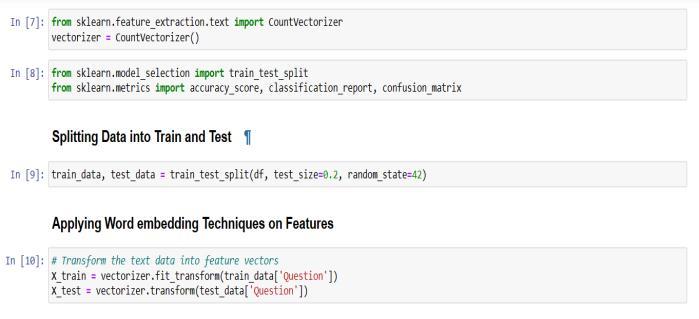
IntheBankChatBotproject,SupportVectorMachine(SVM) algorithmisoneofthetechniquesinmachinelearningused to build an intelligent and wise system that can provide personalizedandefficientcustomerserviceinthebanking industry.SVMisapowerfulalgorithmforclassificationand regressiontasks,widelyusedinvariousdomains,including NaturalLanguageProcessing(NLP).Intheproject,theSVM algorithm is trained on a large dataset of customer interactionstoclassifythecustomer'squeryintodifferent categories,suchasaccountinformation,transactionhistory, andbillpayments,andprovideaccurateresponses.
i.NAIVEBAYES:
Another supervised machine learning algorithm that is commonlyusedfortheclassseparationistheNaïveBayes
algorithm.NaïveBayesisbasedonBayes'theorem,whichis aconditionalprobabilitytheorythatexplainsthelikelihood ofaneventoccurringbasedonthepreviousknowledgeof conditionsthatmightberelatedtotheevent.NaiveBayes worksbyassumingthatallfeaturesareindependentofeach other, which is why it's called "naive". In spite of this presumption, the Nave Bayes can often be very good in situationswheretherearealargenumberofvariablesand limited data. In spite its simplifying assumptions, Naïve Bayes has shown to be effective in many applications, includingtextclassification.Inthisproject,itcanbeusedin conjunctionwithothermachinelearningalgorithmssuchas SVM to improve the chatbot’s overall accuracy and performance.

j.STREAMLIT:
Thescopeofdatascienceandanalyticsisincreasingrapidly daybydayandthemostimportantissuetobedealtwithis themodeldeployment.Streamlitisapythonlibrarywhich helps us to create applications to deploy our model. This adds more definition to our problem statement. In our project we will be creating an application where in the customercanaskanyquerieswhichwillbeansweredbyour model. The main purpose of this application is to create a verysustainableenvironmentforthecustomertoaccessthe chatbot.
system we might encounter from today's complicated environment.
k.UMLDIAGRAMS:

Tospecify,visualize,buildanddocumentsoftwaresystems' artifacts,UMLisastandardlanguage.ItstandsforUnified ModellingLanguage.ThedevelopmentoftheUMLrequiresa number of objectives, but defining some General Model Languagethatcanbeusedbyeverymodelerisessentialin ordertofacilitatetheirunderstandingandapplication.The system may be a computer, or not a computer. It must therefore be made clear that UML is not a development technique, rather it forms part of the process in order to create an effective system. Lastly, the UML goal can be definedasaneasymodelabletooltobuildanytypeofuseful


l.EVALUATIONMETRICS:
Apart from our new measurement, the corona score, it is worthnotingthatanumberofstatisticalmeasuresarebeing used to evaluate the performance of the planned architecture.
ACCURACY: The measurement of the methods abilitytoidentifytherightexpectedcases.
1. True Positive: The count of cases that have been accuratelypredictedareequaltotheTruePositive.
2. FalsePositive: Thecount of falsepositivecases is thesameasthecountofwrongexpectedtruecases.
3. True Negative: The count of correct negative forecastedcasesisequaltothetruenegative.
4. FalseNegative:Falsenegativesareequivalenttothe numberofincorrectlyforecastadversecases.
RECALL:Itisthemetricwhichgivesthesensitivity ofthemethod.
76.2%. With the advancement of technology, it can be expected that the chatbot system will become fully integratedintobanksoperations,providingmoreefficient andpersonalizedservicestocustomers.Usingstreamlitwe havecreatedtheapplicationforthechatbotforestablishing a more effective interface between the bank and the customer.

PRECISION: Precise is the measure of accuracy which only considers the true positives and false positives.

SPECIFICITY: Specificity is the model’s ability to predicttheratiooftruenegativetothesumoftrue negativeandfalsepositives.


F1-SCORE:TheF1scoreshallbethemeasureofthe complete model’s accuracy, that we get as the outputoftheproject.

V. References
[1] Mohamed, A. Ibrahim, A. F. A. Jalil, and A. K. Abdullah, "Natural language processing based on bank chatbot." International Journal of Academic Research in Computer Engineering(IJARCE),vol.1,no.2,pp.18-25,2018.
[2] N. Madrid and R. P. L. Leitão, "Bank chatbot: An intelligentassistantbasedonnaturallanguageprocessing." Proceedingsofthe2018IEEEInternationalConferenceon Systems,Man,andCybernetics(SMC),pp.292-297,2018.
IV. Conclusion
In conclusion, the Bank Chatbot using NLP and Machine Learningisapromisingsolutionforthebankingindustryto improve customer service and automate various banking processes. The performance of the system can be further improvedbyusingadvancedmachinelearningalgorithms such as Naive Bayes having 90.6% accuracy which has shownbetteraccuracythanSVMishavingtheaccuracyof
[3]S.B.Srinivasan,S.Raja,andM.Kumar,"Intelligentbank chatbotusingnaturallanguageprocessing."Proceedingsof the2018InternationalConferenceonSmartComputingand Communication(ICSCC),pp.21-25,2018.
[4]H. LiuandR.Li, "Design ofanintelligent bank chatbot basedonnaturallanguageprocessing."Proceedingsofthe
2019InternationalConferenceonIntelligentManufacturing andAutomation(ICA),pp.87-90,2019.
[5] S. S. Alghamdi, "Designing an intelligent chatbot for banking customer service using natural language processing." International Journal on Recent Trends in BusinessandTourism,vol.1,no.1,pp.1-10,2019.
[6] Automatic Extraction of Chatbot Training Data from NaturalDialogueCorpora,BayanAbuShawar,EricAtwell
[7]ChatbotEvaluationandDatabaseExpansionviaCrowd sourcing, Zhou Yu, Ziyu Xu, Alan W Black, Alexander I. Rudnicky
[8]AIBASEDCHATBOT,Prof.NikitaHatwar,AshwiniPatil, DikshaGondane
[9]DataMining:ConceptsandTechniquesJiaweiHanand MichelineKamber
[10]H.KopkaandP.W.Daly,DataMiningPracticalMachine Learning Tools and Techniques Ian H. Witten Eibe Frank MarkA.Hall