Smart Classroom Monitoring using Machine Learning and IoT
Niveditha S1 , Anushree N D2 , Chaithra Shree A V3 , Likhitha M C4 , Yogitha R51HOD and Assistant Professor , Department of Computer Science and Engineering, Jnana Vikas Institute of Technology, Karnataka, India
2Undergraduate Student, Department of Computer Science and Engineering, Jnana Vikas Institute of Technology, Karnataka, India
3Undergraduate Student, Department of Computer Science and Engineering, Jnana Vikas Institute of Technology, Karnataka, India
4Undergraduate Student, Department of Computer Science and Engineering, Jnana Vikas Institute of Technology, Karnataka, India
5Undergraduate Student, Department of Computer Science and Engineering, Jnana Vikas Institute of Technology, Karnataka, India ***
Abstract - Students are more willing to adopt creative teaching techniques and demand innovative university campus life in this era ofsmart classroom technologies. IoT and cloudcomputing technologies can offer solutions for a smart and sustainable campus to enhancestudents' learning processes and boost the effectiveness of routine tasks carried out within the institution. This project focuses on integrating the cloud into the educational processusing the IoTparadigm. IOT in education enables students to study cutting-edge technologies that aid in the development offreshconceptsand rational solutions to societal challenges. Using online portals, PDA users can view their homework assignments and test results. Online video lectures allow studentstoremotelyjoinin on class lectures thanks to the ability to upload videos to the cloud. Information sent to and from sensor modules is processed by the software module before being sent to cloud storage.
Key Words: microcontroller board, sensor, wireless and wiredinterfaces,softwaremodule,cloudstorage.
1.INTRODUCTION
Universities have recentlybeguntofocusonInternet ofThings and cloudcomputing to create smart campuses. A SmartCampusconnectsmanyperipherals,infrastructure, and facilities to provide smartlighting, security, tracking, and effective use ofresources like manpower, electricity, water, etc.According to the traditional classroom model, managing the classroom's daily operations and teaching musttakeupequalamountsoftime.Tohandletheworkflow thatdrasticallyreducestheamountoftimefacultyhaveto devotetoItextendstheamountoftimespentinstructingand interacting with students. This project demonstrates a techniquethatusescloudcomputing,IoT,andanapplication development platform to lessen secondary human labour Additionally,ithasautomaticfanandlighton/offfunctions that are based on the ambient conditions. With this approach,teacherswereabletoconcentratemoreonwhat
they do best teaching and less on running the classroom'sdailyoperations.
2.LITERATURE SURVEY
2.1 Services Computing System Based on Smart Classroom
Published in: ICTforSmartSociety2019International Conference(ICISS))
Abstract : In order to give its learning methods using AIbasedtechnology,asmartclassroomblendstraditionaland correspondence learning. Its goal is to support both synchronous and asynchronous learning. In order for teachers and students to apply a variety of teaching strategies,engageinactivelearning,andshareknowledge, thesmartclassroomalsomakesuseof theconnectivity of smartdevices.
2.2 Smart classroom: A universal classroom's entrance
design
Published in: 2014InternationalConferenceonWeband OpenAccesstoLearning(ICWOAL)
Abstract: Today new techniques and researches in computershelpedustoshiftfromconventionaleducationto smart classroom. The pupils should be able to cooperate withoneanotherusinglaptops,tablets,orothertechnology.
2.3 Automatic Light Switchingand Temperature based fan speedcontrolusingmicrowave.temperatureand LDR sensor.
Published in: 2021 International Research journal of EngineeringandTechnology(IRJET).
Abstract: Because it provides necessities, comforts, and conveniences, energy use has decreased; as a result, we dislikeitsuseTheapproachforautomaticlightingsystem

and temperature equipment switching will be covered in detailinthepaperthatfollows.Itentailsmonitoringsunlight intensity, detecting human presence, and regulating fan speedinaccordancewithambienttemperature.Ourdesign may be broken down into three different categories: a humandetection circuit usinga microwavesensor,a light detectioncircuitusinganLDRtodetectsunlight,andafan speed control system using a temperature sensor and associatedswitchingcircuits.
3.METHODOLOGY
The word "Smart Classroom" is used to describe a classroom that been outfitted with technology to support preaching Wefrequentlyseethattheinstructorspendsalot oftimefromthetimetheyentertheclassuntiltheyleaveit onsecondarytasksliketakingattendance,whichcantakea longtime(especiallyinclasseswithmorethan60students), and then changing the lighting in the room, among other things.Theteacheristhusonlygivenaportionoftheallotted time,whichisfrequentlynotenough.Thegreatestwaytofix thisproblemwouldbewithsmartclassrooms.
The secondary duty might be finished in a very little amount of the allocated time with the help of a smart classroom, making it easier for teachers to focus on their primary task of teaching. With the use of the facial recognitionsystem,itallowstheteachertotrackattendance. as well as manage the lighting and projector. The study materialsareevenaccessibletopupilsviaemail.Ourideafor asimplesmartautomationsystemcandoeverythingfrom recording attendees'attendanceusingfacialrecognitionto regulatingtheelectricaldevicesinthespace.It hasoccurred toustocreateanAndroid-basedapplicationthatwouldbe essential for performing numerous tasks, like taking attendanceandmanagingthelightsintheroom.Therouters thatmustbeputineachclassroom andlecturehall would allow this programme to run on the local server. This application would be accessed by the academic staff. The installationofacameraintheclassroomisnecessary,among otherthings,forfacialrecognitiontotrackattendance.There wouldbe asystemforstudentsinadditiontotheteaching flank. Each student would receive the study materials via mailafterapredeterminedamountoftime.Inafolderthey wish the pupils to have access to, the teachers upload the materials.
4.ARCHITECTURE DIAGRAM
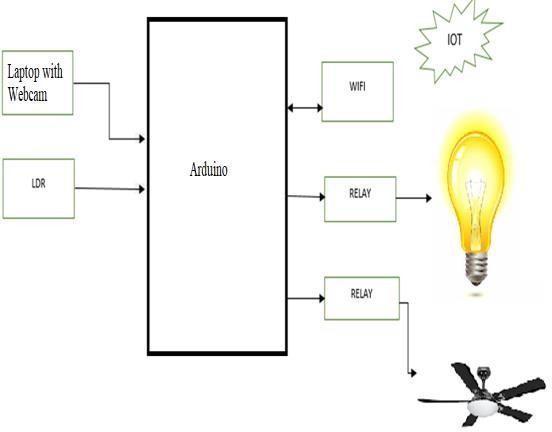
Fig-1 Hardware Architecture
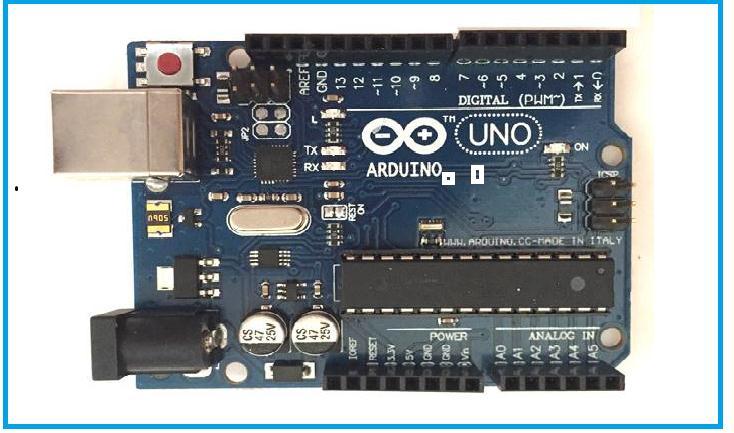
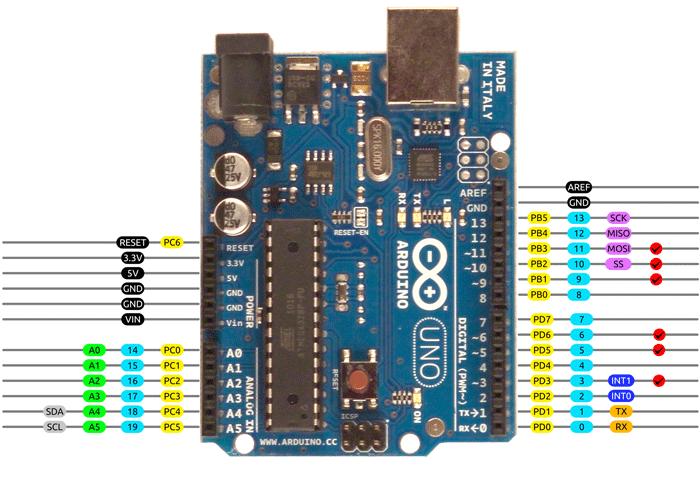
Arduino : Anopen-sourcepieceofhardwareandsoftware called Arduino makes single-board microcontrollers and microcontroller kits that may be used to build interactive objectsanddigitaldevicesthatcansenseandcontrolthings inboththerealworldandthevirtualone.Useoftheopensource hardware and software created by the project is governed under the GNU Lesser General Public Licence (LGPL).Commercially, Arduino boards are available as assembled products or as kits designed for a specific application. The Arduino Uno board and pin diagram, respectively.
ThereareothervariationsoftheArduinoUno,includingthe Arduino Nano, Arduino Pro Mini, Arduino Mega, Arduino Due,andArduinoLeonardo.
Wi-Fi: enablestheoperationoflocalareanetworkswithout wiresandwiring.
Relay: A relay is a switch used to manage circuits. An electricallycontrolledswitchisarelay.Mechanicalswitching is often operated by an electromagnet in relays. It is a 5terminal gadget with 1 coil inside. A slit moves from one pointtoanotherwhenthecoilisactivated.
LDR: LightDependentResistors(LDR)areusedtomeasure lightintensityortosignalthepresenceorabsenceoflight. Particularly in light/dark sensor circuits, LDRs, or light dependentresistors,areparticularlyvaluable.Theseaidin automaticallyturningonandofflights,suchasstreetlights, etc. Normally, an LDR's resistance is very high up to 1,000,000,000 ohms but when it is illuminated by light, that resistance drops sharply. Electronic opto sensors are objectsthatchangetheirelectricalpropertieswhenexposed to visible or infrared light. The light dependent resistor (LDR), photo diode, and phototransistors are the most popularproductsofthiscategory.
Open CV: OpenCVisasizableopen-source database.To recognize items, people, or even human handwriting, one canprocessphotosandvideos.
Open CV (View a picture)
Toreadanimage,usethefunctioncv2.imread().Theimage mustbeintheworkingdirectoryorhaveacompletepath specified.
Aflagservingasthesecondinputdesignateshowtheimage shouldberead.
A color image is loaded using cv2.IMREAD_COLOR. Any imagetransparencywillbedisregarded.Thisisthestandard flag.
•cv2.IMREAD_GRAYSCALEloadstheimageingrayscale
•cv2.IMREAD_UNCHANGED:Loadstheimageasis,withthe alphachannelincluded.
Open CV(Show a picture)
To display an image in a window, use the function cv2.imshow().Thewindowautomaticallyadjuststothesize oftheimage.
Thewindowname,whichisastring,isthefirstargument. Our image is the second defense. You can make as many windows as you'd like, but each one will have a different look. A keyboard binding function is ncv2.waitKey(). The timeinmillisecondsisitsmainpoint.Thefunctionwaitsa predeterminedamountoftimeforanykeyboardevent.The programmekeepsrunningifyoupressanykeyduringthat time. If 0 is passed, it continuously waits for a keystroke. Additionally,aswewilldiscussbelow,itcanbeconfiguredto recognizeparticularkeystrokes,suchasifkeyAispressed.
Simply put, cv2.destroyAllWindows() eliminates every windowwe'vecreated.
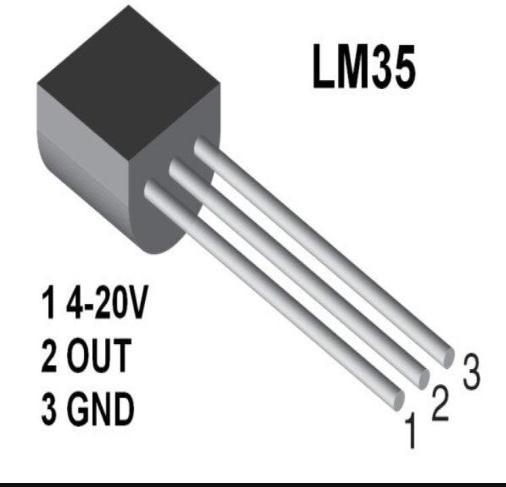
Temperature Sensor: A temperature sensor is a device designed specificallyto tells howhotorcold an object is. TheoutputoftheaccurateICtemperaturesensorLM35is proportionaltothetemperaturereading(in°C).TheLM35 canmonitortemperaturemorepreciselythanathermistor. Italsohascapableof minimalself-heatingandonlyslightly slightsthetemperatureofstillair,bynomorethan0.1°C. Therangeof operatingtemperature isbetween-55°Cand 150°C.The LM35 is exceptionally easy to interface with readingorcontrolcircuitryduetoitslowoutputimpedance, linearoutput,andperfectinternalcalibration.
AutomationWillhappenbasedoninputfromcamera.Using camerawewilldetectstudentsinsidetheclass.
5.ALGORITHM
5.1Haar Classifier:
This framework for object detection aims to deliver competitiveobjectdetectionratesinreal-time,suchasface detection in an image. A person can accomplish this effortlessly, but a computer need specific guidelines and limitations.Fullviewfrontaluprightfacesarenecessaryfor Viola-Jones in order to make the task more feasible. Therefore,thefullfacemustfacethecameraandcannotbe slantedinanydirectioninordertoberecognized Sincethe detection stage is typically followed by a recognition step, theselimitationsonposelookliketheywouldslightlyreduce the algorithm's utility, but in actuality they are fairly acceptablethequalities
TheViola-Jonestechniqueisapowerfuldetectionalgorithm becauseithasthequalitieslistedbelow:
a)Robust – Veryhightrue-positivedetectionrateandvery lowfalse-positivedetectionrateatalltimes.
b) Real time – At least two frames per second must be processedforpracticalapplications.
c)Onlyfacedetection,notfacerecognition–Sincedetection comesbeforerecognition,theobjectiveistotellfacesfrom otherobjects.
Features
An approach of detecting object with Machine LearningiscalledHaarcascade.
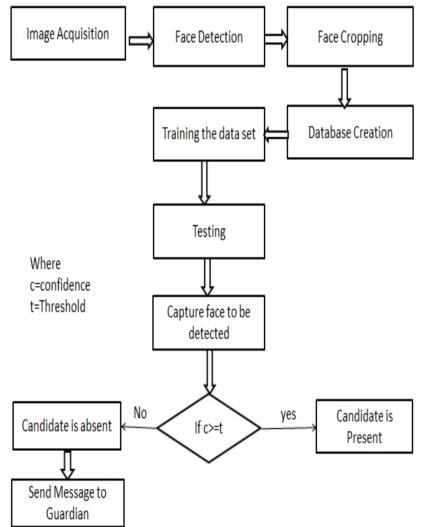
A situation where a cascade function is trained using a sizable number of both positive and negativeimages.
Then,usingthetrainingdata,itisusedtoidentify objectsintheotherimages.
Theyarelargeindividual.xmlfileswith numerous featuresets,andeachoneofthemrelatestoavery uniquekind ofusecase.Thisishowitworks.
5.2 Histogram of oriented gradients (HOG)
Itisafeaturedescriptorusedtoidentifyobjectsincomputer visionandimageprocessing.Usingadetectionwindowor region of interest (ROI), the HOG descriptor technique countsinstancesofgradientorientationintargetedregions ofapicture.
TheHOGdescriptoralgorithmisimplementedasfollows:
1. Calculateforeachcellintheimagebydividingit intosmall,connectedareascalledcells.
2. Acell'spixelhistogramshowingthegradientaxes oredgeorientations.
3. Weightedgradient is contributed by each cell's pixeltotheassociatedangularbin.
4. Blocks are thought of as spatial entities that consistofacollectionofcontiguouscells.Histogramsare normalizedandgroupedonthebasisofthearrangement ofcellsintoblocks
6.IMPLEMENTATION
TheimplementationoftheHardwareandSoftware.Using machine learning and IoT, there are various processes involved in creating the software components for a smart classroommonitoringsystem.
6.1 Hardware Implementation:
ThehardwareincludesanLDRsensorforsensinglight, whichmeansthatwhenthehumidityishigherorwhenitis darker outside, the device will turn on and off as needed. Otherdevices,likeasatemperaturesensor, areusedtoturn on and off fans. A few more include an Arduino Uno microcontroller board,a relay,a powersource,anLCD,an LED,andafan.The following actionsaretakeninorderto implementthehardwarearchitecture:
Compilethenecessaryhardwareparts.
1. Attachthepowersupply,ArduinoUno microcontrollerboard,andtemperaturesensorandLDR. Connect the proper pins on the power supply and microcontrollerboardwithjumpers.
2. In order to display the values that indicate the changing temperature and humidity, connect an LCD display to the microcontroller and powersupply.
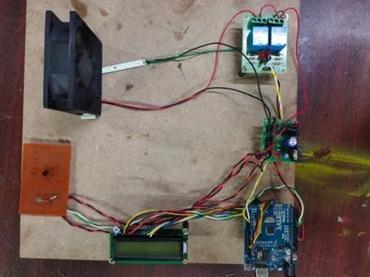
3. Tocontrolacircuitwithaseparatelowpowersignal,connecttherelaytothepowersource,the LED,andthefan.
4. TheFannowturnsonautomaticallyas thetemperaturerisesandviceversa.
5. The light itself automatically turns on whenthehumidityishighandviceversa.
6.2.Software Implementation:
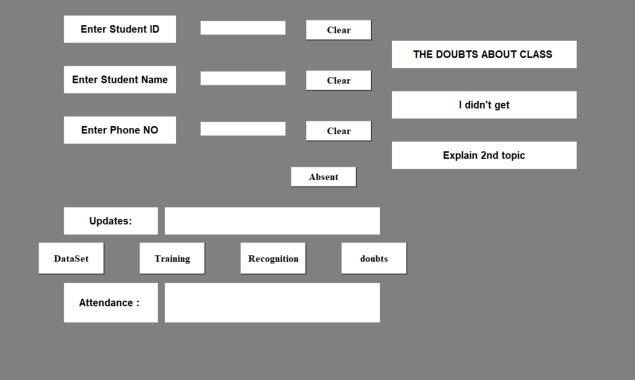
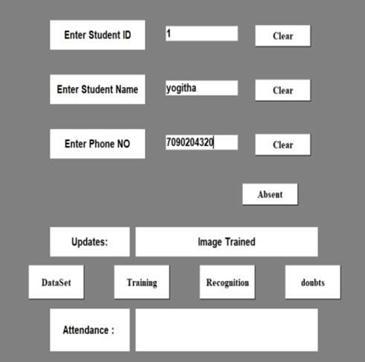
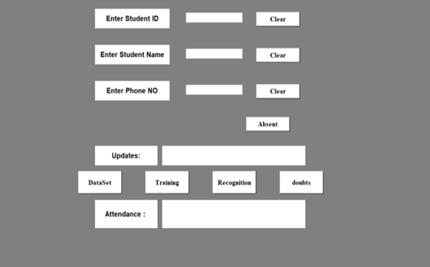
Thesoftwarecomponententailscreatinganapplicationthat gathersstudentinformation,displaysthenumberofpresent andabsentstudentsaswellasanylingeringquestionsabout thesubjectmatteroftheclass.Thesoftwareimplementation involvesfollowingsteps.
1. Installthenecessarysoftwaretools,suchas the OpenCV,Arduino,andAnacondalibraries.
2. Thesystemisbrokendownintothreemodules: database building, dataset training, testing, and alarmmessagesendingasanaddition.
6.2.1.Building Database
a) Restorethecamera'sdefaultsettingsandturnon thealertmessagetogetthestudents'attention.
b)ObtaintheuserID.
c)maketheimagegrayscaleandfindtheface.
d)Storethegiveninputinthedatabaseusingitasa labelforupto20frames.
6.2.2.Training
a)SetupLBPHfacerecognizer.
b) UsethedatabasefiletoretrievefacesandIDsfor theLBPHfacedetect
c)Hold thelearneddataasanxmlorymlfile.
6.2.3.Testing
The Haar classifier and LBPH face recognizer should be loadedalongwithtraineddatafromanxmlorymlfile.
a)Snapthephotousingthecamera,
b)Changeitintograyscale,
c)Recognizethefaceinitand
d) Usingtheaforementionedrecognizer,predictthe face.
6.2.4.For raising the doubts :
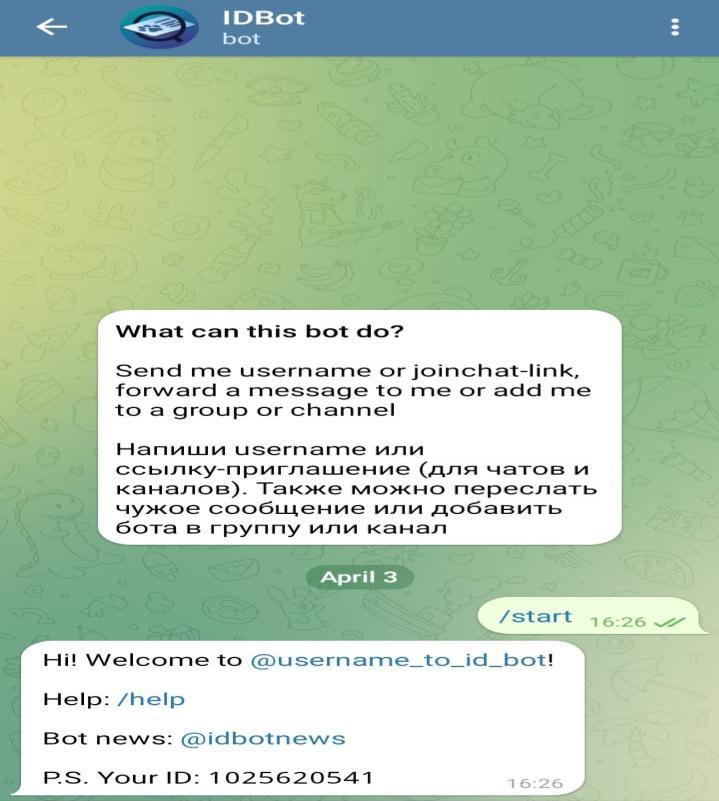
a) Createaserverusingtelegramapp.
b) ByusingBotfathercreateachannel.
c) Sendthedoubtsrelatedtothetopiccoveredusing the smart phone through the channel in the telegramapp.
d) The raised questions will get displayed on the screenorontheprojectorscreen.
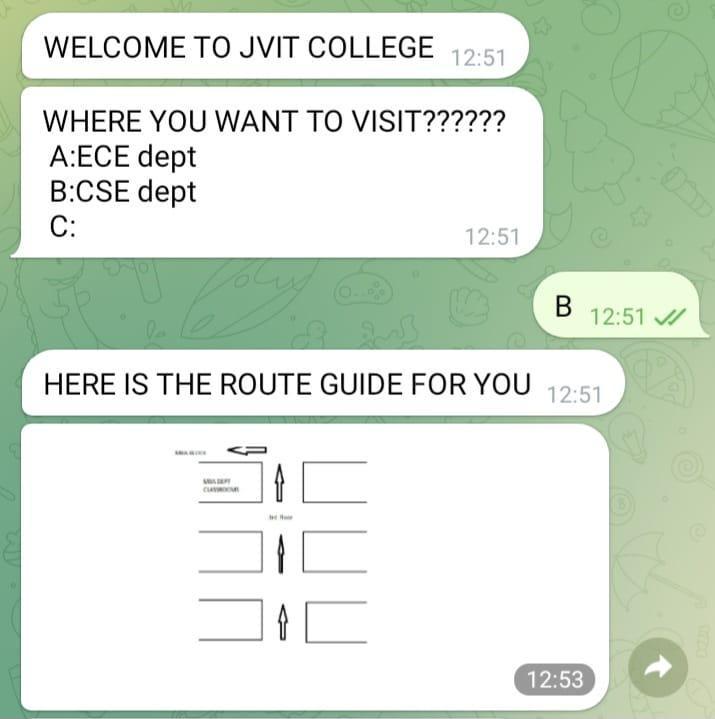
6.2.5. Indoor Navigation:
a) Createaserverusingtelegramapp.
b) ByusingBotfathercreateachannel.
c) Insertapicturerelatedtotheplacethrougha Microsoftwordthoughmapping.
d) As the text arises as to rise the doubt immediateanoptionwillbeprovidedtoselectthe requiredlocationortheplace.
e) After giving the option or after selecting the optiontheroutewillbeobtainedautomatically.
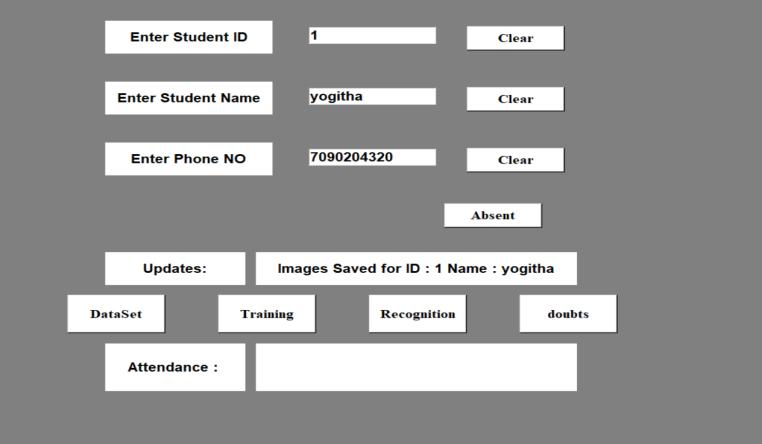
The IoT-based Cloud Integrated Smart Classroom for Smart and a Sustainable Campus is a development in the educationalenvironmentthatwillleadtohighefficiencyand effectiveness of the classroom teaching approach. This techniquewillincreasethecommunityofstudents'sincerity incompletingtheirassignmentsontime.Instead,facultyand administration may devote more time to teaching and learning. of controlling and observing the classroom's workflow.Inordertodeliveranintelligent,economical,and environmentallysustainablecampus,theproposededucation systemmodel.Theautomatedattendancesystem'sobjective is to reduce mistakes made by the current (manual) attendance taking system. The goal is to automate and developasystemthatisadvantageoustotheinstitutionor other organization. The up-to-date, accurate replacement formanualtechniquesthatcanbeusedtocollectattendance inworkplaces.Thisapproachisworkable,dependable,and sufficientlysafe.Withouttheneedforspecialisedhardware, thesystemcanbeimplementedintheoffice.Itcanbemade withacameraandcomputer.Itmay besaidthata manual and unreliable method for managing class attendance has beenreplacedbyonethatisdependable,secure,quick,and efficient.Timewillbesaved, lessworkwillneedtobedone by the administration, and already existing electronic equipmentwilltaketheplaceofthestationerycurrentlyin
use.Thesystemonlyrequiresacomputerandacamerafor installation,thereforenospecialised hardwareis required. Sincethecameraisnecessaryforthesystemtofunction,it
iscrucialtotesttheimagequalityandcameraperformance inreal-worldsituations ,when thesystem isconnected to thecamera.Thistypeofsystemcanalsobeusedinhighly reputedschoolsandcollegesandalsointhehome.
The main disadvantage of this is spoofing. In the upcomingdaysonemethodhasbeenbroughtintoforceto overcomethedisadvantagelikeeyeblinkdetectionmaybe utilizedto knowthedifferencebetweenpresent andstill images if face detection is made from snapshots of the classroom. Humaninterventionmightbeusedtomakethe system error-free based onthe system's overall efficiency, whichis83.1%.Therefore,a module makealistof all the unrecognizedpicturesandenablesthe teachertohimself check the attendance. In the future, several organized attendanceregistersforeachclassaswellastheabilityto generate itself monthlyabsentsand presents reports and automatically email them to the necessary employees for evaluationmaybeintroduced.
Indoornavigationandraisingdoubtsintheconferencehall is also the updated method inside the campus. Where an unknownpersoncaneasilyfindtheroutetothelocationhe hastovisitwithintheshortperiodoftime.
Raisingdoubtsletseverystudenttorepresenttheirdoubts withouthesitatingandalsomakestheinteractionveryeasy betweentheteacherandthestudent.
REFERENCES
[1] W. Zhao, R. Chellapra, P.J. Phillips, A. Rosenfeld, “Face Recognition: A Literature Survey,” ACM ComputingSurveys,Vol.35,No.4,December2003, pp.399-458.
[2] M.A. Turk, A.P. Pentland. “Face Recognition Using Eigenfaces,”IEEEConference onComputerVision andPatternRecognition,pp.586 591,1991.
[3] M.S. Bartlett, J.R. Movellan, T.J. Sejnowski, “Face RecognitionbyIndependentComponentAnalysis”, IEEE Trans. on Neural Networks, Vol. 13, No. 6, November2002,pp.1450-1464.
[4] Gottumukkal R., and Asari K.V., “System Level DesignofRealTimeFaceRecognitionArchitecture Based on Composite PCA,” Proc. GLSVLSI 2003, 2003,pp.157-160.
[5] Hau T. Ngo, Rajkiran Gottumukkal, Vijayan K. Asari. "A Flexible and Efficient Hardware ArchitectureforReal-TimeFaceRecognitionBased on Eigenface", isvlsi, pp. 280-281, Proc. IEEE
VLSI:New FrontiersinVLSIDesign,2005.
ComputerSocietyAnnualSymposiumon
[6] P. N. Belhumeur, J. P. Hespanha, D. J. Kriegman, “Eigenfacesvs.FisherfacesRecognitionusingclass specificlinearprojection,”IEEETrans.PatternAnal. MachineIntell.,vol.19,pp.711–720,May1997.
[7] Moritoshi Yasunaga, Taro Nakamura, and Ikuo Yoshihara, “A Fault-tolerant Evolvable Face Identification Chip,” Proc. Int. Conf. on Neural Information Processing, pp.125-130, Perth, November1999.
[8] In Ja Jeon, Boung Mo Choi, Phill Kyu Rhee. "Evolutionary Reconfigurable Architecture for Robust Face Recognition," ipdps, p. 192a, International Parallel and Distributed Processing Symposium(IPDPS'03),2003.
BIOGRAPHIES
NIVEDITHA S


HOD&AssistantProfessor,Dept.of ComputerScienceandEngineering.
ANUSHREE N D
B.EStudent,Departmentof ComputerScienceandEngineering.
CHAITHRA SHREE A V
B.EStudent,Departmentof ComputerScienceandEngineering.
LIKHITHA M C
B.EStudent,DepartmentofComputer ScienceandEngineering.
YOGITHA R
B.EStudent,DepartmentofComputer ScienceandEngineering.