Experimental Investigation To Prepared Mix Design of M25 And M20 Grade of Concrete By Using Concrete Rubble And Admixture
 Mr. Patel Dhanesh R.1 , Mr. Y.S.Patel2
Abstract - Buildingindustrydevelopmentisadvancingdaily all around the world. While new ones are being built utilising cutting-edge and modern designs, older ones are being demolished or repaired. When performing construction, repair, or demolition, developers, contractors, and builders must consider where to deposit the garbage. Concrete recycling is a method that is gaining popularity that involves removing the debris from demolished concrete structures. In today's era of heightened ecological consciousness, stricter environmental restrictions, and the drive to keep building costs as low as possible, recycling has emerged as a popular choice dueto itsmanyadvantages. Previously,concretewaste was regularly transported to landfills for disposal. In this research, we aim to create an IS-compliant mortar mix using concrete debris. This will aid the construction industry in protecting the environment, convince the government to find solutionsforproperwastedisposalinlandfillsandprotectthe environment,andeducatecontractorsanddevelopersonhow to enhance construction industry methods and services by utilizing recycled concrete debris. This project's objectives include designing a concrete mix for M20 grade using demolitiondebrisandasuperplasticizer,designingaconcrete mix for M25 grade using demolition debris and a superplasticizer, testing the aforementioned concrete mixes' slump cone performance and compressive strength, and performing various tests on recycled aggregate.
Keywords: Building, Concrete, superplasticizer, Aggregate
1. INTRODUCTION
The global building industry's expansion is getting better with time. Construction of roads, bridges, and other constructions, both residential and non-residential, is ongoing.Similartomanyothercountries,Indiaisseeinga sharpriseintheneedfornewstructures.Olderbuildingsare either renovated or replaced with cutting-edge, modern constructions.Thenon-hazardous,uncontaminatedthings thatresultarereferredtoasdebris.Theseincluderoofing, shingles,steel plates,glass,metal,wall coverings,drywall, plumbing fixtures, insulation, electrical cables, asphalt, bricks,andotherbuildingmaterials.Thesematerialscanbe separated and recovered before being disposed of. When performingconstruction,repair,ordemolition,developers,
contractors,andbuildersmustconsiderwheretodepositthe garbage. In order to reduce the amount of waste that is disposed of in landfills, which is what most people do for both environmental preservation and economic reasons, studies,research,andexperimentsarebeingconductedto findanswers.
2. OBJECTIVE
Theproject'sobjectivesareasfollows:
IUsinganadditiveandconcreteshardsfromademolition site,developa mixdesign forM20gradeconcrete(superplasticizer)
ii)Usinganadditiveandconcreteshardsfromademolition site,developa mixdesign forM25gradeconcrete(superplasticizer)
iii)ApplytheSlumpConeTesttothepreviouslydescribed concretemixture.
iv)Totestthecompressionstrengthoftheaforementioned concretemix.
v) To conduct several experiments on both recycled and naturalaggregatesandevaluatetheoutcomes.
vi) Determine whether recycling concrete is worthwhile basedontheresultsofthetestsindicatedabove.
3. METHODOLOGY
3.1 Collection of debris
The concrete aggregate collected from building sites is processedusingacrusherunit.Onlycleanconcretethatis devoidoftrash, wood, paper, and otherdebrisisaccepted by crushing facilities. Rebar and other metals that can be melted down and reused after being separated using magnets and other sorting equipment are acceptable. By size, the remaining aggregate pieces are arranged. Larger pieces might be put through the crusher once more. After crushing,additionalparticulatesareremovedusingavariety oftechniques,suchaswaterflotationandhandpicking.
3.2 Concrete Mix Design
Theobjectiveofconcretemixdesignistoproduceaconcrete withtherequiredstrength,durability,andworkabilityatthe
lowest possible cost by selecting the proper concrete elements and determining their proportions. Concrete's ratio of constituents is based on the demands placed on it in both its plastic and hardened forms. In the absence of workability, plastic concrete cannot be laid or compacted effectively. Therefore, the workability feature becomesveryimportant.
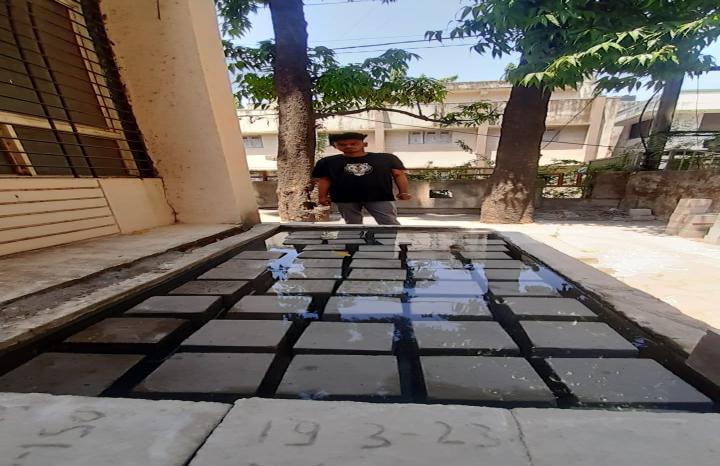
3.3 Necessity of Curing
Many people doubt that the concrete above can be sprayedwithwaterintimetopreventdryingoutwithintwo hours.Thelinkedquestioniswhetherthewater/cementratio willbeaffectednegativelyifwaterisaddedwithin,say,two hours.Toputitanotherway,thequestionishowsoonwater canbeaddedtoconcretesurfacestoprovideuninterrupted hydrationwithoutinterferingwiththewater/cementratio.
Fig-1: ConcreteCuring
3.4 Mandatory Testing Procedures
Thefollowingtwochecksarerequiredtoaccomplishthis project'sobjectives:
1. SieveAnalysis.
2. aConcretePenetrationTest.
3. ConcreteDensityandAbsorptionRatetoWater.
4. TheFreshConcreteSlumpConeTest.
5. HardenedConcreteCompressiveStrengthTest.
4. RESULTS & DISCUSSION
4.1 Results of M25 Mix
The tables below describe the findings of the numerous tests performed on M25 Grade Concrete Mix and, as necessary,comparethemtothestandardvalues.
Table-2: SieveAnalysisofM25GradeConcreteAggregate withaParticleSizeDistributionBelow10mm(in accordancewithIS2386Part1)
EachofthefiveM25mixspecimens'penetrationvaluesare listedaboveinthetable.Thestandardmixhasanaverage penetration8.61%higherthantheaveragepenetrationof theconcretedebriscombination.Thepenetration,however, mustbereadtotheclosest14inch(6.4mm).Becauseofthis, the penetration of the concrete debris combination was greaterthanthatofmortar.
4.2
Thetablesbelowdescribethefindingsofthenumeroustests performed on M20 GradeConcrete Mix and, as necessary, comparethemtothestandardvalues.
Table-7: AnalysisofM20ConcreteAggregateSized GreaterThan10mmbySieve(inAccordancewithIS2386 Part1)
Table-8: Aggregatefinerthan10mmwassieved(in accordancewithIS2386Part1)toproduceM20concrete.
EachofthefiveM25mixspecimens'penetrationvaluesare listed above in the table. Normal mix penetration is approximately 8.26% greater than mixture of concrete debrispenetration.Thepenetration,however,mustberead to the closest 14 inch (6.4 mm). Because of this, the penetrationoftheconcretedebriscombinationwasgreater thanthatofmortar.
5. CONCLUSION
The M25 and M20 concrete grades both feature recycled concrete as a primary aggregate. Compressive testing,slumpconetesting,aggregatespecificgravitytesting, water absorption testing, and sieve analysis are all performed.
Theresultsoftheaforementionedtestsdemonstrate that recycled concrete aggregates can be utilized in constructionsincetheymeetalloftherequirementsforsuch materialsinIndia.
Additionally,recycledconcretethatisusedtocreate newconcretemeetstherequirementsforworkabilitylisted in the I.S. regulations. Additionally, recycledconcrete hasa highercompressivestrengththanregularconcrete.
Utilizingrecycledconcreteisthereforeadvantageous from both a technical and environmental standpoint. Additionally, it is more affordable than conventional concrete.
Togainadeeperunderstandingofrecycledconcrete, other experiments including flexural testing, split tensile tests, vicat tests, etc., may be conducted in the project's futurescope
REFERANCES
[1] H.P. Satpathy, S.K. Patel, A.N. Nayak “Development of sustainable lightweight concrete using fly ash cenosphere andsinteredflyashaggregate”(2019)
[2]HozanK.Yaba,HarithS.Naji,KhaleelH.Younis,TalibK. Ibrahim “Compressive and flexural strengths of recycled aggregate concrete: Effect of different contents of metakaolin”(2021)
[3] Punith Gade, Jyothishya Bramha Chari Kanneganti , RangaRaoVummaneni“Durabilitystudyonmultiplegrades ofconcretewithterinaryblendsupplementarycementitious materials”(2020)
[4] Jianwen Shao, Han Zhu , Xian Zuo , Wolong Lei , Said Mirgan Borito , Jian Liang , Fuqiang Duan “Effect of waste rubber particles on the mechanical performance and deformationpropertiesofepoxyconcreteforrepair”(2020)
[5] V.Gokulnath,B.Ramesh,K.Priyadharsan,“Influenceof M-Sand in self compacting concrete with addition of glass powderinM-25grade”,(2019)
[6] Lei Wang , Guoxin Zhang , Pengyu Wang, Song Yu, “Effects of fly ash and crystalline additive on mechanical propertiesoftwo-gradedrollercompactedconcreteinahigh RCCarchdam”,(2018)
[7] S.Ramkumar,R.Dineshkumar,“ Experimentalstudyon impact on fineness of sand and M-sand in M20 grade of concrete”,(2019)
[8] VenkataKrishnaBhargavaV.,BrahmaChariK.J.,Ranga RaoV.,“ ExperimentalinvestigationofM40gradeconcrete withsupplementarycementitiousmaterialsandglassfiber, (2020)
[9] AlmirSales,FrancisRodriguesdeSouza,“Concretesand mortars recycled with water treatment sludge and constructionanddemolitionrubble”,(2009)
[10]FahadK.Alqahtani,GurmelGhataora,SamirDirar,M. IqbalKhan,IdreesZafar,“Experimentalstudytoinvestigate the engineering and durability performance of concrete usingsyntheticaggregates,(2018)
[11] B.Ramesh,V.Gokulnath,M.Ranjithkumar,“Reviewon the flexural properties of fiber reinforced self compacting concretebytheadditionofM-sand”,(2019)
[12] V.Gokulnath,B.Ramesh,S.SuveshaReddy,“Addition ofreinforcingmaterialsinselfcompactingconcrete”,(2019)
[13] Soner Guler , Zehra Funda Türkmenog˘lu , Ashraf Ashour, “Performance of single and hybrid nanoparticles added concrete at ambient and elevated temperatures”, (2020)
[14] B.Ramesh,V.Gokulnath,V.Vijayavignesh,“Areview onfiberreinforcedselfcompactingconcreteadditionwith M-Sand”,(2019)