Synthesis and Characterization of ethoxy salal thiosemicarbazone ruthenium(III) complexes
K. Sampath1 , KN. Thirumalaivasan21Department of Chemistry, School of Foundational Sciences, Kumaraguru College of Technology, Coimbatore, Tamil Nadu, India.
2Department of Electronics and Instrumentation Engineering, Kumaraguru College of Technology, Coimbatore, Tamil Nadu, India
Abstract - Thiosemicarbazones have garnered significant attentioninscientificresearchduetotheirvaluableproperties as ligands, including optical, antibacterial, antifungal, anticanceractivities,andmore.Byintegratingthesebioactive ligands with active metals, novel compounds with diverse propertiescanbesynthesized. Bearingthisinmind,wecarried out a study to prepare ruthenium complexes using thiosemicarbazone ligands substituted with endsubstitution. Through characterization, we determined that the resulting ruthenium complexes exhibit an octahedral geometry, as revealed by our investigation
Key Words: Ruthenium, salal derivatives, spectroscopy, end substitution, ligand substitution
1.INTRODUCTION
ThesynthesisandcharacterizationofrutheniumSchiff basecomplexeshavegainedconsiderableattentioninrecent years due to their significant potential in various fields of chemistry, including catalysis, materials science, and bioinorganicchemistry.Schiffbasecomplexesareformedby thecoordinationofametalcenter,suchasruthenium,witha Schiffbaseligand.TheSchiffbaseligandistypicallyderived fromthecondensationreactionbetweenanaldehydeandan amine.
The synthesis of ruthenium Schiff base complexes involves the careful selection of appropriate ligand componentsandreactionconditions.Thechoiceofaldehyde and amine precursors allows for the customization of the electronic,steric,andfunctionalpropertiesoftheresulting complexes[1][2].Thereactionistypicallyconductedunder inert atmosphere conditions using suitable solvents and moderatetemperatures.
Thiosemicarbazone ligands are a class of versatile molecules that have gained significant attention in coordination chemistry. These ligands possess a thiosemicarbazone functional group, which consists of a thioamide(-C=S)andahydrazine(-NH-NH2)moiety[3][4] Thiosemicarbazone ligands offer a diverse range of coordination possibilities due to the presence of different substituents on the parent thiosemicarbazone backbone. Thesesubstituentscanbemodifiedtoincorporatevarious
functional groups, allowing for fine-tuning of the ligand's electronic and steric properties [5]. Thiosemicarbazone ligands have demonstrated promising applications in the development of metal-based complexes for catalysis, bioinorganic chemistry, and medicinal chemistry [6] [7] Their ability to form stable complexes with various metal ionsmakesthemvaluabletoolsfordesigningnewmaterials andexploringtheirpotentialindifferentfieldsofresearch.
Characterization techniques play a crucial role in understanding the structural and electronic properties of ruthenium Schiff base complexes. Elemental analysis providesinformationabouttheelementalcompositionofthe complex, verifying the presence of ruthenium and other atomswithinthecomplex.Spectroscopictechniquessuchas UV-Vis,andInfraredspectroscopyareemployedtostudythe electronic transitions and vibrational modes of the complexes. These spectroscopic methods offer valuable insights into the bonding, coordination geometry, and electronicstructureofthecomplexes[8][9]
In summary, the synthesis and characterization of rutheniumSchiffbasecomplexesofferafascinatingavenue for exploring their structural, electronic, and reactivity properties.Thesestudiescontributetothedevelopmentof novel catalysts, functional materials, and bioinorganic systems with diverse applications in various scientific disciplines.
2.EXPERIMENTAL
All chemicals utilized in the study were of analytical reagent(AR)grade,andthesolventswerepurifiedanddried with standard procedures. The synthesis of metal starting complexes,[RuCl3(PPh3)3],[RuCl3(AsPh3)3],andSchiffbase ligands areshownbelow.Elemental analyses (C,H,N &S) wereconductedusingaVarioELIIICHNSanalyzeratSTIC, CochinUniversityofScienceandTechnology,Kerala,India.IR andMagneticmomentvaluesarerecordedinourresearch laboratory.
2.1 Synthesis of sample ligand
Theligandsamplewaspreparedfollowingtheprocedures described in prior published literature [9] 3-

ethoxysalicylaldehydeandthiosemicarbazide,ina1:1molar ratio,werecombinedinethanolandmethanol,respectively, undercontinuousstirringforonehour.Asaresult,awhite precipitatewasformed,whichwassubsequentlyfiltered The structureofthesampleligandisshowninFig.1.
2.4
Equalmoleratios(0.5mmol)oftheligandandtheinitial rutheniumcomplexesaredissolvedseparatelyinmethanol and toluene. Subsequently, the solutions are subjected to refluxforapproximately11hoursandthenallowedtocool. Thisprocessleadstotheformationofvibrantprecipitates, whicharesubsequentlyfiltered
Theinitialrutheniummetalcomplex,[RuCl3(PPh3)3],was synthesized following the documented literature [10]. Ethanol was used as the solvent for ruthenium trichloride trihydrate(1mmol),towhichconcentratedhydrochloricacid wasadded.Triphenylphosphine(3mmol)wassubsequently introducedintothesolution.Themixturewasthenrefluxed for approximately five minutes and allowed to cool. The resulting crystals, which exhibited a reddish-brown color, were isolated, washed withether, and subsequentlydried Thestructureofthestartingtriphenyphosphineruthenium complexisshowninFig.2.
3. RESULTS AND DISCUSSION
Fig.2.Thestructureofthe[RuCl3(PPh3)3]
2.3 Synthesis of starting ruthenium metal complexes, [RuCl3(AsPh3)3]
Theinitialrutheniummetalcomplex,[RuCl3(PPh3)3],was synthesized following the documented literature [11]. Methanolwasusedasthesolventforrutheniumtrichloride trihydrate(1mmol),andconcentratedhydrochloricacidwas addedtothemixture.Theresultingsolutionwassubjected to reflux for a duration of thirty minutes. Following this, triphenylarsine(3mmol)inmethanolwasintroducedand refluxedforanadditionalthirtyminutes.Theresultingoily substance was transferred to a mortar and left to air dry. Once dry, it was crushed using a pestle. The resulting materialwaswashedwithmethanolandsubsequentlydried undervacuum Thestructureofthestartingtriphenyarsine rutheniumcomplexisshowninFig.3.
Table1presentstheanalytical data forboththeligand and the complexes, while the spectroscopic data provides insights into their characteristics. Notably, the analysis reveals a 1:1 metal-ligand stoichiometry. It is worth mentioning that thesynthesizedcomplexesdemonstratea non-hygroscopic nature. For a better understanding, the synthesis process and the proposed structure of the complexesaredepictedintheabovescheme.
3.1 Infra-Red
TodeterminethebindingmodeoftheSchiffbaseligandin thecomplexes,themostsignificantIRspectralfrequenciesof the complexes (Table-2) were compared with those of the ligand. The complexes exhibited an azomethine C=N stretchingfrequencyat1615-1929cm-1,whichwaslower thanthatofthefreeligand(1621cm-1)[12].Thisconfirms thatoneofthebindingmodesoftheSchiffbaseligandwith therutheniummetalinvolvestheazomethinenitrogen.The phenolicCObandofthecomplexesdisplayedashifttowards higherfrequenciesat1241-1257cm-1comparedtothefree ligand(1240 cm-1), indicating anothercoordination mode throughC–O–Mbonding.TheC-Sstretchingfrequencyinthe
complexes showed a lower frequency at 723-746 cm-1 comparedtotheligand,suggestingcoordinationoftheC¬-S to the ruthenium atom [13]. In summary, the Schiff base ligandactsasa monobasic tridentateligandinthestudied complexes.
Theelectronicspectraofthecomplexes(Table-3)were recorded using DMSO as the solvent. The complexes displayedthreebandswithintherangeof309-427nm.The shiftsobservedintheligand-centeredtransitionsat309-394 nmconfirmedthecoordinationoftheSchiffbaseligand(308420nm)totherutheniumatom[13].Consequently,assigning the bands appearing in the visible region becomes challenging.Hence,thebandsobservedat421-427nmhave been attributed to charge transfer transitions, which align wellwithsimilarreportedruthenium(III)complexes[14].
3.3 Magnetic moment measurements
Both ruthenium(III) complexes exhibited a magnetic momentvalueofμB=1.39(PPh3)and1.41(AsPh3)atroom temperature, indicating their paramagnetic nature. This observation corresponds to the presence of an unpaired electroninalow-spin4d5 configuration,confirmingthe+3 oxidationstateofruthenium[15].
3.4 EPR spectra
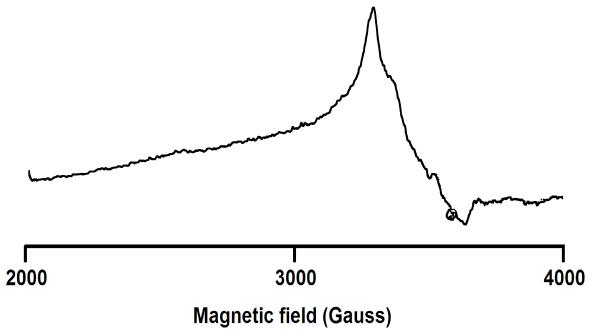
The room temperature EPR spectra of the powdered complexes were documented in the X-band (figure 3), withoutdisplayinganyhyperfinesplittingduetointeractions with other nuclei within the complexes. A single isotropic resonancewasobserved,withgvalues,2.35(PPh3)and2.49 (AsPh3) [14]. Although the complexes exhibited slight distortion in their octahedral geometries, the presence of isotropiclinesintheEPRspectraindicatesthattheunpaired electron occupies a degenerate orbital. The obtained EPR spectra are in accordance with ruthenium complexes previouslyreported[15]
3.2
3. CONCLUSIONS
The investigation focused on synthesizing and characterizing ruthenium complexes utilizing the ethoxy salalthiosemicarbazoneligandandrutheniumstarters.To characterize both the ligand and its complexes, elemental analysis and a variety of spectroscopic techniques were employed. The analysis of the spectra revealed that the derivedrutheniumcomplexesexhibitanoxidationstateof +3. The ethoxy salal thiosemicarbazone ligand binds to
rutheniuminanSNOmanner,providingconfirmationofthe octahedralgeometryobservedinthecomplexesinvestigated duringthisstudy.
REFERENCES
[1] K. Sampath, S. Sathiyaraj, and C. Jayabalakrishnan, “Synthesis, Spectroscopic Studies of Binuclear Ruthenium(II)CarbonylThiosemicarbazoneComplexes Containing PPh3/AsPh3 as Co-ligands: DNA Binding/Cleavage”, Bull. Korean Chem. Soc., Vol. 34, 2013,pp.367-373.doi:10.5012/bkcs.2013.34.2.367.
[2] J.Hafeez,M.Bilal,N.Rasool,U.Hafeez,S.A.AliShah,S. Imran and Z.A. Zakaria, “Synthesis of ruthenium complexes and their catalytic applications: A review”, Arab.J.chem., Vol.15,2022,pp.104165-104259. doi: 10.1016/j.arabjc.2022.104165.
[3] B.Ghosh,P.Adak,S.Naskar,B.Pakhira,P.MitraandS.K. Chattopadhyay,“Ruthenium(II/III)complexesofredox non-innocentbis(thiosemicarbazone)ligands:Synthesis, X-raycrystalstructures,electrochemical,DNAbinding andDFTstudies”,Polyhedron,Vol.131,2017,pp.74-85. doi:10.1016/j.poly.2017.04.013.
[4] N. Raja and R. Ramesh, “Mononuclear ruthenium(III) complexes containing chelating thiosemicarbazones: Synthesis, characterization and catalytic property”, Spectrochim. Acta A, Vol. 75, 2010, pp. 713-718. doi: 10.1016/j.saa.2009.11.044.
[5] M.Findik,B.Kuzu,S.Pehlivanoglu,S.Kaya,U.Sayin,E.G. Akgemci and A.O. Saf, “Synthesis of CarbazoleSubstitutedthiosemicarbazoneanditsCu(II)Complex, DNA/Protein Binding, Cytotoxic, antiproliferative activitiesandmoleculardockingstudies”,Inorg.Chem. Commun., Vol. 152, 2023, pp. 110711. doi: 10.1016/j.inoche.2023.110711.
[6] Q.Peña,A.Wang,O.Zaremba,Y.Shi,H.W.Scheeren,J.M. Metselaar,F. Kiessling,R.M. Pallares,S. Wuttke and T. Lammers,“Metallodrugsincancernanomedicine”,Che. Soc. Rev., Vol. 51, 2022, pp. 2544-2582. doi: 10.1039/D1CS00468A
[7] M.Jiang,S.Li,J.Wu,W.Li,X.Wen,H.Liang,andF.Yang, “Designingbiotin-humanserumalbuminnanoparticles to enhance the targeting ability of binuclear ruthenium(III)compound”,J.Inorg.Biochem.,Vol.215, 2021, pp. 111318-111328. doi: 10.1016/j.jinorgbio.2020.111318
[8] R.ManikandanandP.Viswnathamurthi,“Coordination behaviorofligandbasedonNNSandNNOdonorswith ruthenium(III)complexesandtheircatalyticandDNA interactionstudies”,Spectrochim.ActaA,Vol.97,2012, pp.864-870.doi:10.1016/j.saa.2012.07.028.
[9] K.Sampath,R.Ashokkumar,A.VenkatachalamandM. Shanmugaprakash, “Synthesis, characterization and cytotoxic antibacterial activity of Ru(II) ethoxysalal thiosemicarbazonecomplexes”,Rasayan.J.Chem.,Vol. 12, 2019, pp. 257-261. doi: 10.31788/RJC.2019.1214099.
[10] J. Chatt, G.J. Leigh, D.M.P. Mingos and R.J. Paske, “Complexes of osmium, ruthenium, rhenium, and iridiumhalideswithsometertiarymonophosphinesand monoarsines”,J.Chem.Soc.A,1968,pp.2636-2641.doi: 10.1039/J19680002636
[11] K. Sampath, S. Sathiyaraj, G. Raja and C. Jayabalakrishnan, “Mixed ligand ruthenium(III) complexes of benzaldehyde 4-methyl-3thiosemicarbazones with triphenylphosphine/triphenylarsine co-ligands: Synthesis,DNAbinding,DNAcleavage,antioxidativeand cytotoxicactivity”,J.Mol.Struct.,Vol.1046,2013,pp.8291.doi:10.1016/j.molstruc.2013.04.051
[12] E. Jayanthi, M. Venkataraman, S. Neethu, N.S.P. BhuvaneshandN.Dharmaraj,“Biomolecularinteraction and in vitro cytotoxicity of ruthenium complexes containingheterocyclichydrazone.Ismethanolanoninnocentsolventtoinfluencetheoxidationstateofthe metalandligationofhydrazone?”,Polyhedron,Vol.132, 2017,pp.39-52.doi:10.1016/j.poly.2017.04.026.
[13] M.M. Subarkhan and R. Ramesh, “Binuclear ruthenium(III) bis(thiosemicarbazone) complexes: Synthesis,spectral,electrochemicalstudiesandcatalytic oxidation of alcohol”, Spectrochim. Acta A, Vol. 138, 2015,pp.264-270.doi:10.1016/j.saa.2014.11.039.
[14] K. Sampath, S. Sathiyaraj, P. Indhumathi and M. Shanmugaprakash,“ResearchonBiologicalPropertiesof Ruthenium(III)HeterocyclicSchiffBaseComplexes”,Int. J.Inno.Tech.Exp.Engg.,Vol.8,2019,pp.332-334.doi: 10.35940/ijitee.L1086.10812S19.
[15] K.Sampath,S.SathiyarajandC.Jayabalakrishnan,“DNA interaction,antioxidant,andinvitroantitumoractivity ofbinuclearruthenium(III)complexesofbenzothiazole substitutedferrocenylthiosemicarbazones”,Med.Chem. Res.,Vol.23,2014,pp.958-968.doi:10.1007/s00044013-0698-x.