MULTILINGUAL SPEECH TO TEXT CONVERSION USING HUGGING FACE FOR DEAF PEOPLE
1Assistant professor, Dept. Of Computer Science Engineering, VNRVJIET college, Telangana, India

2,3,4,5 Student, Dept. Of Computer Science Engineering, VNRVJIET college, Telangana, India
Abstract - Internet has taken the place of traditional communication channels. The use of online communication has resulted in a rapid rise in audio and visual information. Although it has been beneficial for the majority of people, those with special needs, such as the deaf, have few resources at their disposal. A speech-to-text Conversion programme is written.The audio input is converted to text using speech recognition technology. Algorithms for Natural Language Processing are used to extract root words and segment words and translate to different languages.
Our goal is to create a multilingual speech-to-text conversion system employing Hugging Face for hearing-impairedpeople. The technology will make it possible for deaf individuals to instantly translate spokenlanguageintotext,assistingthemin a variety of tasks including listening to lectures, participating in meetings, or even having conversations with others. Hugging Face's[11] cutting-edge neural network models and natural language processing algorithms will improve the suggested system's precision and effectiveness.Thesystemwill also support many languages, enabling a widerangeofpeople throughout the world able to utilise it. Overall, the suggested technology would enable seamless communication and engagement in many contexts, greatly enhancing the quality of life for those with hearing impairments.
Key Words: transformers, whisper, Machine Learning, Automatic Speech recognition, web page, tokenizer, pipeline.
1.INTRODUCTION
Withthedevelopmentofmachinelearninganddeeplearning algorithms,automatedvoicerecognitionhasbecomeamajor studyarea.Usingpre-trainedlanguagemodels,likeHugging Face,forfine-tuningisonesuchmethod.
HuggingFace,awell-knownNLPlibrary,offerspre-trained models for a variety of NLP tasks, including text categorization,question-answering,andlanguageproduction [11].Accesstopre-trainedTransformerarchitecture-based speech recognition models is also made available by the library.
Inordertoincreasethemodel'sprecisionandperformance on a certain speech recognition task, fine-tuning Hugging Facemodels[11]forvoicerecognitionentailstrainingthe
pre-trainedmodelsonaparticulardataset.Whentrainedon domain-specific datasets, this method has been proven to greatlyincreasetheaccuracyofvoicerecognitionsystems.
Inthisstudy,oureffortswithhoningHuggingFacemodels forvoicerecognitionwerediscussed.Outlinedthetraining dataset, the fine-tuning procedure, and the assessment measuresemployedtogaugethemodel'seffectiveness.Also includedfrontendtorecordvoicefrommicrophoneinorder to test the model’s efficiency and accuracy. The front-end enables easy use of the model and provides good userexperience.
Our findings show the value of fine-tuning pre-trained language models like Hugging Face[11] for speech recognition, and thought this strategy has a great deal of promise for raising the precision and efficiency of speech recognitionsystemsacrossavarietyofdomains
2.LITERATURE SURVEY
Applicationsthattargetrescueweretheonesthatweremost prevalentwhensomecomparableonesenteredtheresearch sector.Theyare:
In[1],Themodelproposedinthispaperusesstandardinput speechtotextConversionenginetotaketheinputspeech. Withtheuseofcutting-edgeartificialintelligencemethods like Deepnets and Q learning, the search space is reduced usingtheHMM(HiddenMarkov)model,andtheoptimised results are then used in real time. The accuracy of the suggestedphoneticmodelis90%.
In[2],TheProposedapproachdealswithrecognitionoftwo differentlanguages–kannadaandEnglish.ADeeplearning voicerecognitionmodelisusedinconjunctionwithaword predictionmodel.Whenevaluatedonamultilingualdataset, theaccuracyis85%,andwhentheusertestsitinrealtime, theaccuracyis71%.Cosinesimilaritymodelwasemployed. Whenpredictionsweremadeusingtheaveragesimilarityof eachclass,a59%averageaccuracyforthecosinesimilarity modelwasattained.
In [3] This paper presents a complete speech-to-text conversionsystemforBanglalanguageusingDeepRecurrent Neural Networks. Possible optimization such as Broken Language Format has been proposed which is based on
propertiesoftheBanglaLanguageforreducingthetraining timeofthenetwork.Itwastrainedwithcollecteddataand whichyieldedover95%accuracyincaseoftrainingdataand 50%accuracyincaseoftestingdata.
In[4]Theopen-sourcedSphinx4framework,whichisbuilt inJavaandoffersthenecessaryproceduralcodingtoolsto construct an acoustic model for a unique language like Bengali, is required for the proposed model. To edit the recorded data, we utilised Audacity, a free digital audio workstation (DAW). Used an audio dataset of recorded speechfrom10differentspeakers,includingbothmaleand femalespeakers,andproducedtheirownuniquetranscript files to test the performance. Experimental findings show thatthesuggestedmodelhadanaverageaccuracyof71.7% forthedatasettheyanalysed.
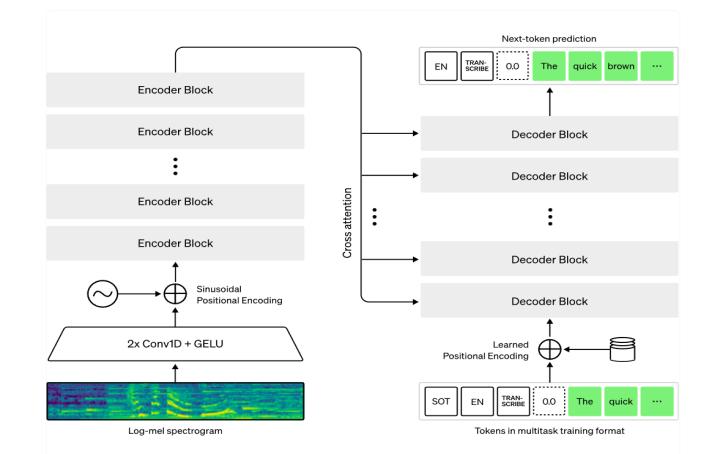
In [5] It is an encoder-decoder model based on Transformers,commonlyknownasasequence-to-sequence model. A series of audio spectrogram properties are translatedintoa seriesof texttokensusingthisapproach. First,thefeatureextractortransformstherawaudioinput intoalog-Melspectrogram.Thespectrogramisthenencoded usingtheTransformerencodertocreateaseriesofencoder hidden states. Finally, the decoder predicts text tokens autoregressively based on both the hidden states of the encoderandtheprecedingtokens.
In [6] This model used Recurrent Neural Networks to convert Speech to text. This model includes prosodic modellingmethod.Prosodicmodellingisdoneattheaudio decoding process post-processing stage with the goal of identifying word-boundary cues to help with language decoding. To comprehend the input prosodic information and the output text-boundary, the RNN Model has three layers. After the training of RNN Model then it is used to generatetheword-boundarycuestosolvetheproblemof word-boundary ambiguity. Two Schemas were proposed. FirstSchemadirectlytakesRNNoutputsanddirectlyaddsto the word-sequence hypothesis. Schema 2 is extension of Schema1byaddingFiniteStateMachines forsettingpath constraints.TheCharacteraccuracywere73.6%,74.6%using theschemas1and2.
3.METHODOLOGY
ThesuggestedsystemusesaTransformer-basedencoderdecoder as its foundation. The encoder receives a log-Mel spectrogram as input. Cross-attention techniques provide thedecoderwiththefinalconcealedstatesoftheencoder. Text tokens are conditionally predicted by the decoder autoregressivelybasedonhiddenstatesfromtheencoder andpreviouslypredictedtokens.
3.1 Data Collection
Anumberofcrowd-sourceddatasetcalledCommonVoicein whichpeoplerecordWikipediatextinavarietyoflanguages. Version 11 of the Common Voice dataset is used in this instance. As for our chosen language, Hindi, an Indian languageusedinthenorthern,central,eastern,andwestern partsofIndia,serveasthebasisforfurtherdevelopingofour model.
3.2 Feature Extraction and Tokenizing
Speechisrepresentedasatemporallyvarying1-dimensional array.Thesignal'samplitudeateveryparticulartimestepis representedbythevalueofthearrayatthatinstant.Speech includes an endless variety of amplitude values since it is continuous.Computerhardwarethatreliesonfinitearrays willhaveissues.Asaresult,discretizedourvoicesignalby takingsamplesofitsvaluesatpredeterminedtimeintervals. Thesamplingrate,whichisoftenexpressedinsamplesper secondorHertz(Hz),istheintervalwithwhichsoundsare sampled.
Althoughstoringmoreinformationpersecondisnecessary, sampling with a greater sample rate produces a better approximationofthecontinuousspeechinput.
Thefeatureextractorcarriesouttwotasks.Aseriesofaudio samplesareoriginallypaddedortruncatedsothateachone hasa30-secondinputtime.Byaddingzerostotheendofthe sequence, samples that are less than 30 seconds are stretched to 30 seconds (zeroes in an audio transmission signifyasilentornosound).Noneedtouseattentionmask aseverybatchispaddedortruncatedtomaximumlengthin input. Tokenizer has been pre-trained using the transcriptionsfor96pre-traininglanguages[11].Loadthe pre-trainedcheckpointandtrainitonthedatasetandfine tuneit.
3.3 Training and Evaluation
Defineadatacollator:Thisprogrammetakesthedatathat hasalreadybeenprocessedandcreatesPyTorchtensorsthat arerequiredforthemodel.
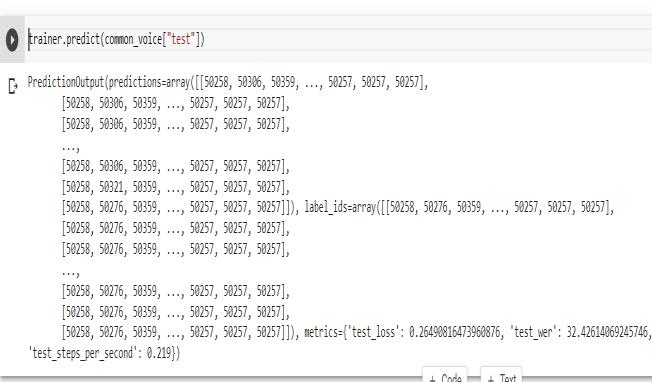
EvaluationMetrics:Usedworderrorrate(WER)measureto assessthemodel.
Loadpre-trainedcheckpoint:Loadthecheckpointthathas alreadybeentrainedandproperlysetitupfortraining.
Definethetrainingarguments:TheHuggingTrainer[11]will usethemtobuildthetrainingschedule.
3.4 Web Application
Fortheproject'spurposes,awebapplicationiscreatedthat provides complete control over the fine-tuned model. The webapplicationservesasauserinterfaceforthemodeland iswrittenusingGradio.
An interface page with controller choices makes up the application.Onthepage,optionslikerecording,clearing,and submittingareprovided.Theend-usercanmanuallyenter voice from microphone with the help of these control choices.
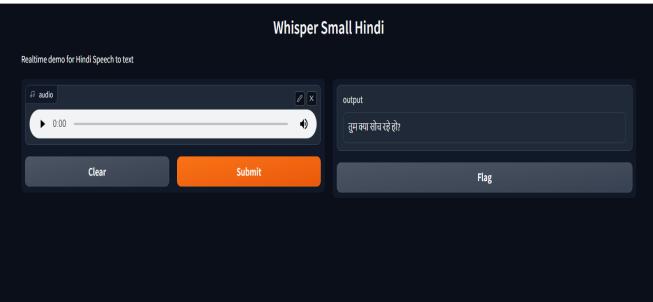
Thebackendsupportoftheapplicationisfine-tunedmodel. TheViewportionisastraightforwardfront-endcomponent withonlyonepage.Thecomputerandmodelmustbelinked toaWi-Finetworkinorderforthewebapplicationtowork. No extra setup is required. First clicking on record button enables microphone and records the voice that is spoken. Stopbuttonisprovidedinordertostoptherecording.After recording, submit and clear buttons are provided. When submitisclicked the model transcribes itanddisplays the textresultinthetextboxprovided.YoucanuseFlagbutton tostorethatrecording.
3.5 Results
Theproceduregoesasfollows.Themachinelearningmodel isdirectlyconnectedtothemicrophone.Whenanaudiois recorded through the microphone the machine learning model processes the audio and displays the text corresponding to the recorded audio on the screen. The recognizedspeechisthensegmentedinto30secondsandif it is less than that then 0’s appended at the end. These segmentsthenareconvertedintoLog-MelSpectruminside themodelandthroughseverallayersitdividesspeechinto tokensandprintstheresultedtext.Whiletranscribingthe added0’swillbedeleted.TheWERofthemodelis32.42% whichisveryless.
3. CONCLUSIONS
Our work helps the deaf people in understanding others speechbyconvertingittotextbyusinghuggingface[11].The motivationforthiskindofstudyandexperimentsisthefact that whisper [12] is a simple ASR system for its perfect understandability in human face-to-face communication. SpeechRecognitionforHindiLanguageandConversioninto HindiTextisdone.Theimplementedmodelistrainedona dataset of 3500 audios and achieved a word error rate of 32.42%. It is shown that whisper signals, can give high scoresinwordrecognitionforspeech.ForOpenAIwhisper smalltheWERis87.30%[12]andnowourworkfine-tuned themodelandreducedtheWordErrorrateto32.42%.
REFERENCES
[1] GulbaksheeDharmale,DiptiD.Patil andV.M.Thakare, “ImplementationofEfficientSpeechRecognitionSystem on Mobile Device for Hindi and English Language” InternationalJournalofAdvancedComputerScienceand Applications(IJACSA),10(2),2019.
[2] MultilingualSpeechtoTextusingDeepLearningbased onMFCCFeaturesPDeepakReddy,ChiragRudreshand AdithyaAS,PESUniversity,India.
[3] M. T. Tausif, S. Chowdhury, M. S. Hawlader, M. Hasanuzzaman and H. Heickal, "Deep Learning Based Bangla Speech-to-Text Conversion," 2018 5th International Conference on Computational Science/ Intelligence and Applied Informatics (CSII), Yonago, Japan,2018,pp.49-54,doi:10.1109/CSII.2018.00016.
[4] A. U. Nasib, H. Kabir, R. Ahmed and J. Uddin, "A Real TimeSpeechtoTextConversionTechniqueforBengali Language," 2018 International Conference on Computer, Communication, Chemical, Material and Electronic Engineering (IC4ME2),Rajshahi,Bangladesh,2018,pp. 1-4,doi:10.1109/IC4ME2.2018.8465680.
[5] https://arxiv.org/abs/2212.04356
[6] Wern-JunWang,Yuan-FuLiao,Sin-HorngChen, RNN-basedprosodicmodelingformandarinspeechand its application to speech-to-text conversion,Speech Communication,Volume36,Issues3–4,2002,Pages247265,ISSN 0167-6393,https://doi.org/10.1016/S01676393(01)00006-1.
[7] SoftwareEngineering-APractitioner’sApproach,Roger S.Pressman,McGraw-Hill
[8] Machine Learning, Tom M. Mitchell, McGraw-Hill InternationalEdition,6thEdition,2001
[9] https://huggingface.co/datasets/mozillafoundation/common_voice_11_0
[10] https://huggingface.co/blog/fine-tune-whisper
[11] https://huggingface.co/docs
[12] https://openai.com/research/whisper