International Research Journal of Engineering and Technology (IRJET) e-ISSN:2395-0056

Volume: 10 Issue: 05 | May 2023 www.irjet.net p-ISSN:2395-0072
International Research Journal of Engineering and Technology (IRJET) e-ISSN:2395-0056
Volume: 10 Issue: 05 | May 2023 www.irjet.net p-ISSN:2395-0072
1PG student, department of civil engineering, DVVP COE Ahmednagar, India
2PG guide, department of civil engineering, DVVP COE Ahmednagar, India ***
Buildings in seismically active regions need to be constructed with special consideration for their lateral stability. With the development of India Infrastructure development coincides with India's economic growth. Many high-rise buildings are currently being built in Indian metropolises, but as building heights rise and wind pressure increases, more support structures are required to prevent displacement. Due to the terrible earthquake in Turkey, it is crucial for architects to take extra precautions to ensure the safety of both the expensive structures and the priceless lives they contain. In India, viscous fluid dampers are not frequently employed. Except for the north side near the India-China border, most of India is in zones II and III, which are not prone to earthquakes. Area on the south-west side of Goa. Even though the data is not so favourable, it is vital to take into account the probability of an earthquake occurring. We cannot overlook the calamity in Turkey, where a structure collapsed and hundreds of lives were lost. We will use viscous fluid dampers in the construction of this research. Numerous researches have already established the effectiveness of VFD in reducing the movement of structures under wind and seismic loads or earthquake forces. This paper focuses on evaluating different patterns on 12 story structure and contrasting their effectiveness on diverse structures and comparing its effectiveness of pattern on 17 story structure. This report employs response spectrum analysis to produce results that are more precise.
Keywords: ViscousFluidDampers,earthquakeforces,ResponseSpectrumAnalysis
Viscous Fluid dampers, or seismic dampers as they are likewise known, are devices that, when incited, disseminate the energy that seismic events, wind buffering, or warm movement force on a construction. The idea is straightforward: by dissipating the heat created by the structural movement into the air, the viscous dampers obey the rules of physics by followingtheprincipleofenergyconservation.Thesesmallbutmightydampersraisestructuraldampinglevelstoasmuch as50%ofcritical,leadingtoaremarkablydramaticdecreaseinstressanddeflection.Thedependabilityanddurabilityof our products are ensured by individually testing each damper at the highest forces and velocities that the customer has chosen.
Theconstitutiveequationbelowidealisesthebehaviourofafluidviscousdamperasapuredashpot:
DampingForceF=DampingConstantCxVelocityV α
This Condition gives the connection between the damper result power and speed, where C and alpha are the damping steadyandspeedexample,individually.Thevalueofalphaof1.0representslineardampers,whereasvaluesotherthan1.0 indicatenonlineardampers.Specificationsforalphatypicallyrangefrom0.3to1.0;thesimplewaytoputit,thelowerthe exponentthemoreefficientdampingforseismicenergydissipation
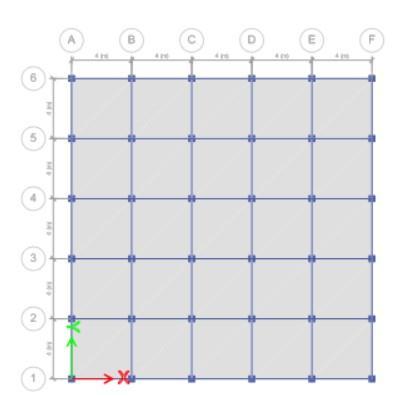
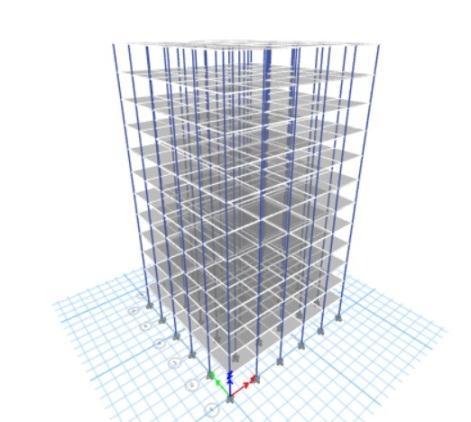
Thebuildinganalysedinthisstudyis12storystructurewith20x20mdimensionacolumnof450mmandatotalnoof36 4mcentertocenterabeamof230x450mmwasadoptedandtypicalstoryheightof3mwasadopted withtypicalheightof 3mandatotalheightof36.4m.
Thesecondstructurewas17storywithdimensionof20x20matotalnoof36columnofsize450x450mmwith4mcenter tocenterdistancewithtypicalheightof3mandatotalheightof51.4m.ThestructurewasdesignedasperIScode.
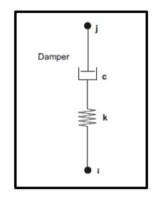
Inthisstudythelowestforceoutputofdamperwasusedbecausethemainaimwas tofindtheeffectivepositionandformaximumdampingoutput.Throughtheformal request the Company Taylor Devices inc provided the damper configuration used inthisstudy.
Table-SuggestedCvalueprovidedbytaylordevices
Extended three dimension analysis building software was used in this study to modal and analyse the structure .it is a powerful tool and has been in market for a long time .It has a lot of tool for structure modelling and analysis because of thatdampermodellingwaspossible.inthisstudyetabs20wasused.
1. Thestoryshearincreasesfrom1655 kN base12story to3273kN forstructurewithmaxnumberofdamperfor thisstudy.
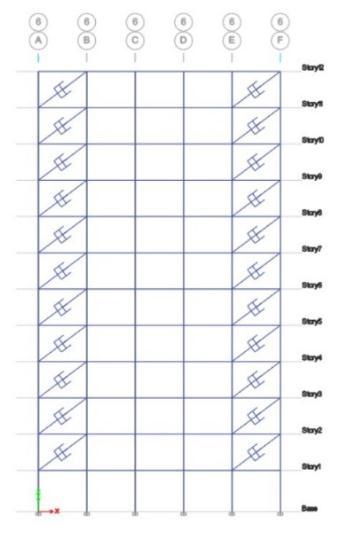
2. The most effective pattern 6 gave a max displacement of 7.65 mm compared to structure without damper 41.87mm,for12storystructure.
3. The Drift decreased from 0.00149 of structure without damper to 0.00107 structure with damper pattern 6 as observedfromresult.
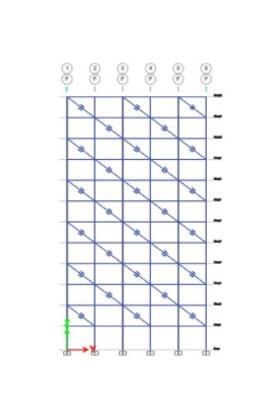
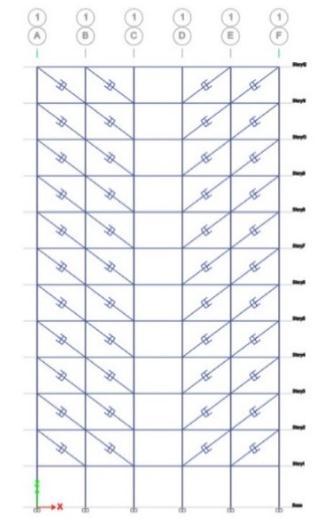
4. Thestoryshearfor17storyincreaseform1872knbasemodelto3270knpattern4.
5. Thedisplacementreducedfrom71mmwithoutdamperto16.3withdamperpattern6.
6. Themaxdrift0.0017forbase17storymodelto0.0012pattern6.
Table–Outputofresultsfor17storystructurefromETABs
From the following Research it is concluded that Viscous Dampers Are Efficient in reducing the displacement of building.
ThedisplacementinStructurewithdamper1st patternandwithoutdamperis42mmto33.3formpatten2. That givesthereductionindisplacementof8mmorabout20.71%.
WithDifferentpatternscomesdifferentefficiency.
Theminimumdisplacementwasobservedinpattern6whichgivesusthemostefficientpattern.
TheMindisplacementpatternofdamperwasconfirmedbyboth12storeystructureand17storeystructure.
TheMaxdisplacementwasobservedinpattern2thearrangementofdamperisnotrecommendedinstructure,its efficiencywasverifiedon17storeystructurewithsamepatterncomparingitwithoutviscousfluiddamper.
Withtheincreaseinnumberofdamperthelateralloadincrease.
The number of damper is not directly proportional to the output of damping as we tested in pattern 3 building coveredwithdamper.
Toseeifnumberofdamperisnotdirectlyproportionaltoincreaseindampingwecancomparepattern3and6.
International Research Journal of Engineering and Technology (IRJET) e-ISSN:2395-0056
Volume: 10 Issue: 05 | May 2023 www.irjet.net p-ISSN:2395-0072
Withjustslightchangeinpositioningkeepingthenumbersameasseeninpatter1and2wecanseethechangein dampingoutput.
Theincreaseinnumberofdampergivemoredampingbuttheplacementofdamperismoreimportant.
1. NaziyaGhanchi,ShilpaKewate.DYNAMICANALYSISOF25STOREYRCCBUILDINGWITHANDWITHOUTVISCOUS DAMPERS International Journal of Scientific & Engineering Research, Volume 6, Issue 12, December-2015 ISSN 2229-5518
2. VijayKumar,DineshSen.SeismicAnalysisofHighRiseBuilding(G+10)UsingEtabsInternationalResearchJournal ofEngineeringandTechnology(IRJET)e-ISSN:2395-0056Volume:07Issue:09|Sep2020www.irjet.netp-ISSN: 2395-0072
3. Sayyed Feroz Sikandar , Shaikh Zameeroddin. S , Prof. Agrawal. A. S .Analysis and Design of Multistory Building usingETABS2017ijeseISSN23213361©2019IJESC
4. A.Brown , M. Uno , J.Stratford and J.Thompson .Steel Moment Frame With Supplemental Fluid Viscous Dampers –12 Moorhouse Avenue A Case Study .Steel Innovations Conference 2015 Auckland, New Zealand 3-4 September 2015
5. Puneeth Sajjan , Praveen Biradar Study On The Effect Of Viscous Damper For Rcc Frame Structure . International JournalofResearchinEngineeringandTechnologyeISSN:2319-1163|pISSN:2321-7308
6. EnricoTubaldi1*,LauraGioiella2,FabrizioScozzese2,LauraRagni3andAndreaDall’Asta
7. A Design Meathod Of Viscous Dampers Connecting Adjacent Structure.Frount .Build Eviron,19 Mar 2020,Sec.Earthquake.EngineeringVol6-2020IHttp://Doi.Org/10.3389/Fbuil.2020.00025
8. DrKRamaRaju,FellowGGHernanth,Non-MemberKSRekha,Non-MemberDrNRIyer,FellowSeismicDesignOf BuildingsWithViscousFluidDampers-AMethodology
9. KunDing,XinZhao,YueYangAndLiweiYe ApplicationOfViscousDampersForSuperTallResidentialBuildingsIn High-WindStrong-SeismicArea.The2016WorldCongressOnThe2016StrucutresJejuIslandKoreaCongress
10. M.D.Symans,M.C.Constantinou,D.P.Taylor,AndK.D.Garnjost.Semi-ActiveFluidViscousDampersForSeismic ResponseControl,