COVID-19 CASES PREDICTION USING MACHINE LEARNING
ABSTRACT - The COVID-19 prevalent has caused catastrophic consequences for the economy andpublic health throughout the world. Informed decisionsconcerningeffective allocations of resources can be made bypoliticians andpublic health experts with the aid of precise forecasts of the virus's progress. [1] With the use of Support Vector Machines (SVM), Multiple Linear Regression (MLR), and Bayesian Ridge Regression (BRR) algorithms, we present a method in this study to forecast the number of COVID-19 instances [1]. A more precise and thorough forecast of COVID-19 instances is provided by our suggested methodology, which takes into account a variety of socioeconomic and environmental variables that may have an impact on the propagation of the virus. Using choosing features approaches, we gathered information on the number of COVID-19 cases in various nations andareas and determinedthemost essentialvariables to anticipate COVID-19 cases.Ourmodelwastrainedusingthe SVM, MLR, and BRR algorithms, and its performance was assessed using a wide range of metrics, such mean absolute error (MAE), coefficient of determination (R^2), and root mean squared error (RMSE). Our findings show that the quantity of COVID-19 cases may be forecasted with an elevated level of accuracy using the suggested approach. Our research offers perceptions into the variables that have the biggest influence on the total amount of COVID-19 cases, that may help health professionals and politicians in making wise choices and properly allocating resources.
KEYWORDS: covid-19,supportvectormachine,multiple linear regression, Bayesian ridge regression, Mean absolute error.
1.INTRODUCTION:
The COVID-19 epidemic has significantly impacted both general health as well as the global economy while disturbingpeople'slivesallacrosstheworld.Toefficiently deploy resources and make educated decisions, policymakers must be able to forecast the anticipated numberofCOVID-19cases.WiththeuseofSupportVector Machines (SVM), Multiple Linear Regression (MLR), and BayesianRidgeRegression(BRR)algorithms,wepresenta methodinthisstudyforpredictingthenumberofCOVID-19 instances.
SVM, MLR, and BRR are just a few examples of machine learning models that are frequently used to forecast the
propagationofinfectiousillnesses.WhileMLRandBRRare multivariatelinearregressionmodels,SVMisasupervised learningmethodthatisfrequentlyemployedforregression analysisandclassification.
Theadvantagesofeachofthesealgorithmsareemployedin ourapproachtogenerateanaccurateandaccurateforecast ofCOVID-19situations.
[2] Information on the overall number of COVID-19 cases across various nations and regions, together with several socioeconomic and environmental variables that may influencethevirus'spread,wereusedtocreateourmodel [2].Ourfindingsdemonstratethatourmethodpredictsthe number of COVID-19 cases with high accuracy, low root mean squared errors (RMSE), and elevated coefficient of determination(R^2)values.
2.TECHNOLOGIES USED:

Python:
Python has fundamentally altered how software is developed and how data is evaluated. Both beginner and experiencedprogrammersfavouritbecauseofitssimplicity, adaptability, and readability. Python's ability to smoothly connecttoadditionalprogramminglanguageslikeC++and Javaisoneofitsuniquecharacteristics,makingitaneffective tool for creating complicated systems. In order to further expand the capability of Python, a large number of independentlibrariesandtoolsareavailable.Pythonoffers an assortment of uses, from web development to computationalscience,makingitausefultoolinnumerous sectors. Python will stay an important player in the programmingandtechnologyindustriesforyearstocome thanks to its rising popularity and robust developer communities.
LIBRARY FUNCTIONS IN PYTHON:
• Modules are nothing more than files containing Pythoncode.
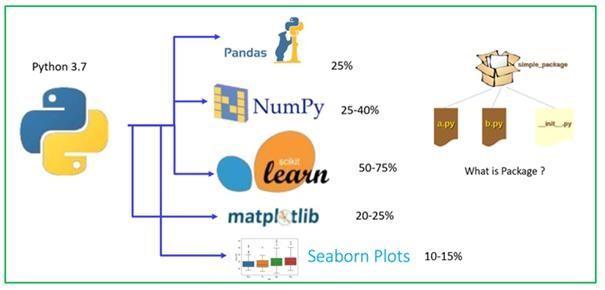
• A package is a directory for modules and sub packages.[fig.1]
• ThereisnouniquecontextinthePythonlibrary.
Some of the python libraries:
Numpy
Matplotlib
Pandas
Random
Sklearn
Numpy:
Forapplicationsincomputingforscience,analysisofdata, and machine learning, Numpy is an essential Python package.Itsprincipaladvantageistheabilityforquickand effective matrix operations, making it an essential part of manydifferentdatascienceprocedures.Furtherimproving Numpy's flexibility is the vast array of mathematical operations it offers, such as linear equations, Fourier transformations, and random number generation. In addition, Numpy includes integrated support for multifaceted arrays, making it possible to store and manipulatebigdatasetseffectively.Numpykeepsgrowing and getting better thanks to its open-source nature and vibrantdevelopmentcommunity,assuringthatitwillremain relevant in the dynamic field of data science and machine learning.
Matplotlib:
AfamousPythonlibrarytogenerateexcellentvisualizations anddata plotsiscalledMatplotlib.Itisanideal choicefor datascientists,engineers,andresearchersduetoitsstrong graphing capabilities. among Matplotlib's distinctive characteristicsisitscapacityofproducingcustomplotsand visualizations,allowinguserstocustomizetheirgraphicsto their particular needs. Matplotlib is a very flexible tool to createcomplicatedillustrationsbecauseitalsooffersawide rangeoffeaturesandsettingsforcustomization.Matplotlib includes a variety of instruments for creatively and instructively showing data, which range from straightforward line graphs to 3D surfaces displays. The instrument'sversatilityandsimplicityofusehaveboostedit toacrucialinstrumentinavarietyofindustries,including research,engineering,andfinance.Matplotlibwillcontinue
tobeausefultoolfordatavisualizationthankstoongoing enhancementsandenhancements.
Pandas:
For data analysis and manipulation, a popular Python module called Pandas is utilized. Its major strength is the capacitytooperateondatathatisorganized,includingthat found in databases, spreadsheets, and comma-separated value (CSV) files. Pandas is a preferred tool for many analysts and data scientists due to its broad collection of featuresandcapabilitiesforinformationwrangling,cleaning, andanalysis.
The DataFrame object, that allows users to maintain and modify information in an organized manner like to a spreadsheet,isoneofthedistinctivecharacteristicsofthe Pandas programming language. With this format, complicateddatatransformationslikesorting,arrangement, andaggregationaresimpletocarryout.Inordertofurther enhance its flexibility, Pandas also offers abilities for workingwithfield,time-series,andmissingdata.Pandasisa crucial tool in the field of data analysis and manipulation because of its open-source architecture and vibrant development community, that ensure that it will keep growingandbecomingbetter.
Sklearn:
A robust Python package for data analysis and machine learninghasthenameScikit-Learn,orjust“sklearn”.Sklearn hasanextensiverangeoftechniquesandmodelsfortackling a variety of machine learning issues, include regression, clustering,classification,anddimensionalityreduction.This isoneofitsdistinguishingcharacteristics.Sklearnservesas aone-stopshopformachinelearningactivitiesbyoffering resources for data pre-processing, model selection, and performance evaluation. Another distinguishing quality of sklearnisthatit's compatiblewithotherPythonlibraries, like NumPy, Pandas, and Matplotlib, enabling simple incorporation into current data science workflows. In addition,SklearnfeaturesastraightforwardAPIthatenables users of all skill levels to quickly construct and execute machinelearningmodels.
Random:
For creating arbitrary numbers, sequences of data, and selections,Python'srandomlibraryisanexcellentresource. It has multiple features for producing random integers as wellfloating-pointnumbers,andseriesofnumbersthatfall intoparticularrangesordistribution.Beingabletoproduce pseudo-random numbers numbers that appear random butareactuallyproducedusinganestablishedalgorithm is one of the special qualities of the random package. For testingandexperimentation,thisisanexcellentmethodto producerepeatablerandomsequences.Therandompackage
also offers functions for picking random elements from collections and reordering them randomly, allowing the generation of random choices and sequence in a range of applications.Therandommodulemayalsoproviderandom informationforuse in machinelearninganddata analysis taskswhenusedwithotherPythonlibrarieslikeNumPyand Pandas. The random package is a useful tool in many different fields, including as cryptography, game creation, and scientific research, due to its simplicity of use and versatility.
Machine learning:
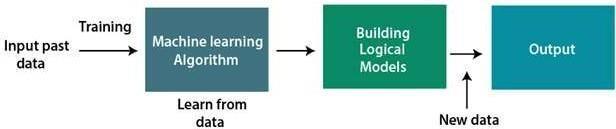
An area of artificial intelligence referred to as "machine learning"focusesoncreatingmodelsandalgorithmsthatlet computerslearnfromexperiencesandmakejudgementsor forecastsbasedondata.Oneoftheuniquecharacteristicsof machinelearningisitscapacitytoimplicitlyrecogniselinks andtrendsindatawithoutexplicitprogramming.Thismakes itapotenttoolforhandlingdifficultproblemsinsectorslike banking,healthcare,andmarketing.
Itmightalsobedividedintotwotypesofalgorithms:
Clustering
Association
Reinforcement Learning:
In reinforcement learning, the algorithm takes up fresh abilitiesthroughtrialanderrorwhilereceivingfeedbackin theformofrewardsorpenaltiesfromitsenvironment.
Recent advances in hardware, data accessibility, and algorithmdevelopmentallcontributedtomachinelearning's rapid development. It is a fluid and quickly growing field havinganextensivevarietyofpotentialapplications,from self-drivingcarstopersonalisedhealthcare.
The different Classification of Machine Learning model are [fig.3]
•Supervised learning
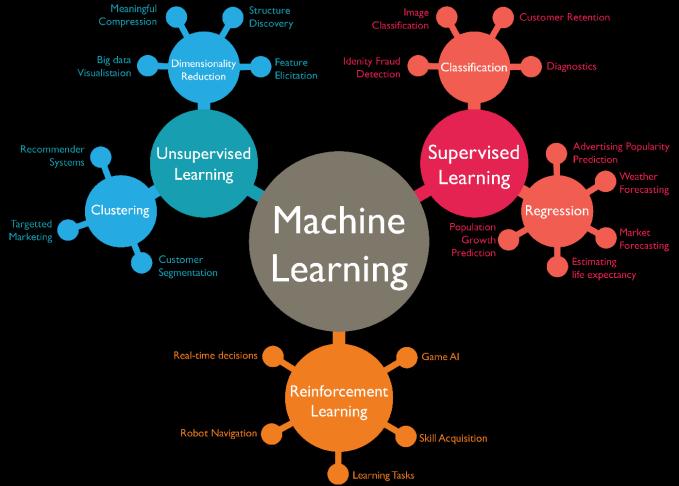
•Unsupervised learning
•Reinforcement learning
Supervised learning:
Insupervisedlearning,the methodistrainedona dataset withlabelswithknownpairsofinputandoutputdatawith theintentofforecastingtheresultforfreshinputdata.
Unsupervised learning:
Unsupervisedlearningincludeseducatingthealgorithmona datasetwithnolabelswiththeaimoffindingconnections andpatternsintheinformationwithoutknowingthefinal result.
Models for forecasting the propagation of the virus have multipliedasaresultoftheCOVID-19pandemic.Toforecast the number of COVID-19 cases, several existing models employ machine learning algorithms as Support Vector Machines (SVM), Multiple Linear Regression (MLR), and BayesianRidgeRegression(BRR).
TheSEIRmodel,thatmeansSusceptible,Exposed,Infectious, and Recovered, is one of the most often used models. Depending to the population's standing in relation to the virus,theSEIRmodeldividesitintofoursections,creatinga compartmentalizedsystem.Themodelsimulatestheshifts between the two compartments and forecasts the anticipated number of COVID-19 occurrences using differentialequations.
The autoregressive integrated moving average (ARIMA) model,atimeseriesmodelthatforecastsavariable'sfuture valuesusingitspastvalues,isanotherwell-likedapproach. [1]InordertoforecasttheanticipatednumberofCOVID-19
casesinvariouslocationsandnations,theARIMAmodelwas applied[1].
Thesemodelsdo,however,havedrawbacks.TheSEIRmodel demandsalotofinformationandmakestheassumptionthat thepopulationishomogeneous,whichmightnotbetruefor COVID-19. The COVID-19 data may not conform to the ARIMAmodel'sassumptionthatthedurationseriesdataare stationary.
Disadvantages of existing system:
1.Limitedscope:Themajorityofcurrentapproachessimply believetheanticipatednumberofCOVID-19casesnottaking intoconsiderationothercrucialelementsliketheinfluence ontheenvironmentanddemographicfactors.
2.Inaccuracy:Duetotheintricacyofthevirus'transmission dynamicsandtheconstrainedrangeofthedataemployedin themodelsforprediction,certainexistingsystemsexhibit lowaccuracyrates.
3.Lackofopenness:Manycurrentstructuresuseintricate models and algorithms that are tricky to comprehend, making it impossible to analyse the outcomes or pinpoint areasforimprovement.
4.Absenceofreal-timedata:Mostpresentsystemsrelyon previousdata,whichmightnotfullyreflectthescenarioat hand.Predictionscouldturnouttobeincorrectduetothe lackofreal-timedata.
5. Dependence on additional factors: Many current structures are dependent on outside variables, such as government laws and public health initiatives, which are subject to quick change and may generate unreliable forecasts.
4. PROPOSED SYSTEM:
The Support Vector Machines (SVM), Multiple Linear Regression (MLR), and Bayesian Ridge Regression (BRR) algorithmsareusedinthisstudytoofferauniquemethod for predicting the number of COVID-19 instances. By consideringintoaccountmultiplesocioeconomicandnatural factorsthatmightimpactthepropagationofthevirus,our methodseekstoprovideagreaterdegreeofaccuracyinthe predictionofCOVID-19cases.
WewillgatherinformationontheprevalenceofCOVID-19 casesfromvariouslocationsandnationsaswellasavariety of demographic and environmental parameters, including informationonpopulationsize,airquality,temperature,and mobility.ThemostimportantfactorsforpredictingCOVID19instanceswillbedeterminedthroughdatapre-processing andfeatureselectionprocedures.
Next,wewillevaluatehowwellSVM,MLR,andBRRperform atpredictingCOVID-19casesafterusingthesemethodsto train our model. We will evaluate the effectiveness of our model using a wide range of measures, including mean absoluteerror,coefficientofdetermination,androotmean squarederror.
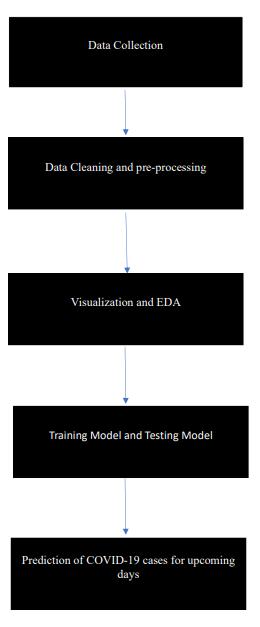
We will also perform a thorough examination of the variablesthathavethebiggestinfluenceonthetotalamount ofCOVID-19casesandofferinsightsintothefundamental processesdrivingthevirus'spropagation.Officialsincharge ofpublichealthwillbeabletodistributeresourceswisely withtheaidofthisanalysis.
As a result, our suggested strategy offers a reliable and accurate forecast of COVID-19 cases, that may assist in reduce the pandemic's impact and educate public health policy.
5. SYSTEM ARCHITECTURE:
Fig -4: system architecture
6.FUTURE SCOPE:
Thepresentresearchhasproducedpositivefindingsforthe suggested approach of forecasting COVID-19 cases using SVM, MLR, and BRR algorithms. Though there is always space for enhancement, additional study in this field may resultinforecastsofthevirus'sspreadthatarebothmore preciseandthorough.
Integratingmoresophisticatedmachinelearningtechniques, suchasdeeplearningandensemblelearning,isoneofthe research's next goals in order to increase the precision of COVID-19 case predictions. These methods can handle intricate non-linear interactions among data and identify patternsthattraditionallinearmodelsmightoverlook.
To offer more personalized predictions of COVID-19 instances,anotherfutureobjectiveistoaddgreaterdetail data,suchasdataateachperson'slevel.
Thismayhelpinidentifyingindividualswhoareathighrisk foracquiringthevirusandintheestablishmentoffocused preventionstrategies.
Furthermore,thesuggestedapproachcanbeusedtoforecast additionalcrucialCOVID-19parameters,especiallymortality andhospitalization rates.This canaidinidentifyingareas and groups that are more vulnerable to severe COVID-19 results and helping to allocate resources appropriately. Lastly,thesuggestedmethodcanbeusedtootherfieldslike financeandeconomicstoforecasttheimpactofepidemics on the world economy. It can also be used to forecast the developmentofadditionalinfectiousillnesses.
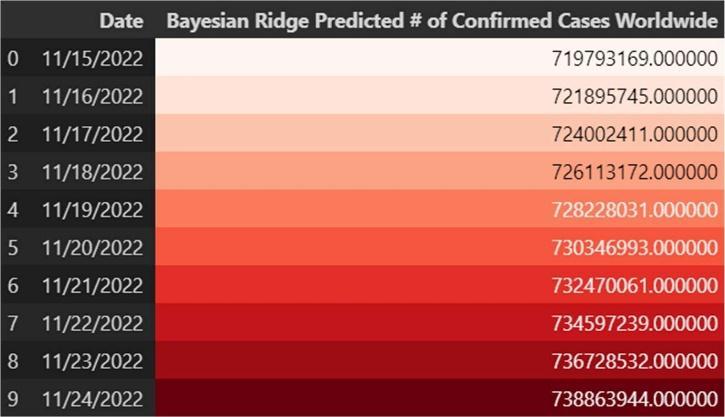
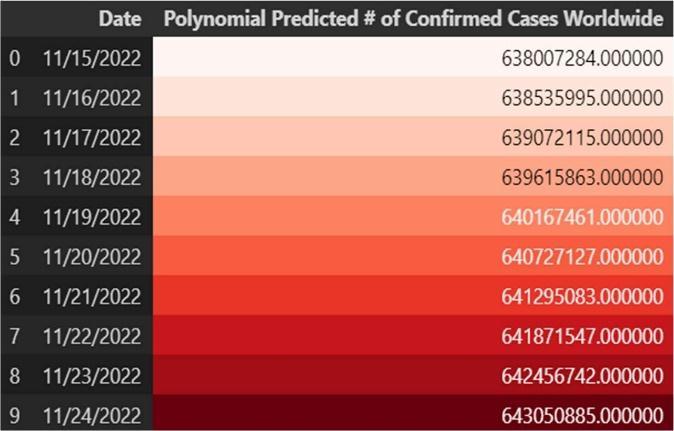
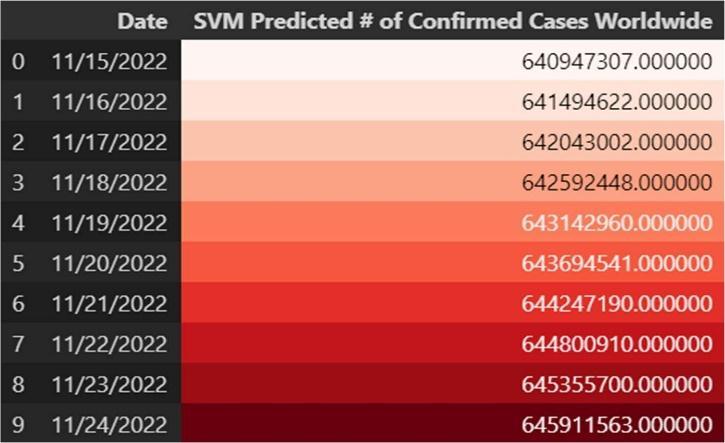
7. RESULTS:
8. CONCLUSION:
SincetheCOVID-19pandemichaspresentedseriousthreats toboththeworldeconomyandpublichealth,itisimperative that predictions of the virus's progress be precise and thorough. Using SupportVectorMachines(SVM),Multiple Linear Regression (MLR), and Bayesian Ridge Regression (BRR) methods, we presented a method to forecast the numberofCOVID-19instancesinthisstudy.
[3] In order to provide a more precise and thorough prediction of COVID-19 cases, our suggested strategy included numerous demographic and environmental elementsthatmayhaveanimpactonthepropagationofthe virus[3].ThemostimportantfactorsthatpredictCOVID-19 caseswerefoundusingfeatureselectionapproachesafter we collected information about the number of COVID-19 casesfromvariousnationsandregions.
Our model was trained using the SVM, MLR, and BRR algorithms,anditsperformancewasassessedusingavariety of assessment measures, including mean absolute error (MAE),coefficientsofdetermination,androotmeansquare error (RMSE). Our findings showed that the proposed method was highly accurate in estimating the number of COVID-19cases.
Insightintothevariablesthatmostinfluencetheprevalence ofCOVID-19caseswasalsorevealedbyourstudy,whichcan help healthcare providers and policymakers allocate resourceswiselyandmakewell-informeddecisions.
In conclusion, the strong and precise COVID-19 case predictionprovidedbyoursuggestedapproachcanhelpto lessenthepandemic'seffectsandguidepublichealthpolicy. To increase the precision of COVID-19 case predictions, more research is required to hone our approach and incorporatethesenewtraits.
8. REFERENCES:
1.FarhanMohammadKhan,RajivGupta."ARIMAand NAR basedPredictionModelforTimeSeriesAnalysisofCOVID19casesinIndia",JournalofSafetyScienceandResilience, 2020
2. "Intelligent Data Communication Technologies and Internet of Things", Springer Science and Business Media LLC,2022
3. Kamila Tomczak. "Transmission of the 2007– 2008 financial crisis in advanced countries of the European Union”,BulletinofEconomicResearch,2022
9. BIOGRAPHY:
SOMULA VENKATA MADHAVA REDDY
is currently studying B.Tech with specification of ARTIFICAL INTELLIGENCE AND MACHINE LEARNING in NRI Institute of Technology. He done internship on AIandML
KOMPALLI VENKATA RAMANA is currently studying B.Tech with specificationofCOMPUTERSCIENCE in NRI Institute of Technology. He doneinternshiponAIandML.




MATTA TARUN KUMAR iscurrentlystudying B.Tech with specification of COMPUTERSCIENCEinNRIInstitute ofTechnology.Hedoneinternshipon AIandML.
MANDAPAKA RAMA KRISHNA iscurrentlystudying B.Tech with specification of COMPUTERSCIENCEinNRIInstitute of Technology. He done internship onAIandML.