A Review on Bi-Propellant Engines
B. Jaswanth SaiStudent, Dept. of Aerospace Engineering, Amrita School of Engineering, Tamil Nadu, India

Abstract - Bipropellant rocket engines have been playing a vital role in space vehicle launches and advancements in space exploration. This paper mainly focuses on providing a brief analysis of Bi-propellant engines, their essential components, the types of engine cycles, and the cryogenic engine. The paper begins by discussing the propellant-feed mechanism, giving a detailed review of each type of rocket engine cycle, their limitations, a brief look at the cryogenic engine, and what makes it take the edge over normal rocket engines and its challenges.
Key Words: gasgenerator,pre-burner,turbineefficiency, multi-stageturbopumps,twinshaft,inter-propellantturbine seal,backflow,thermalshock,pre-chill.
1. INTRODUCTION
A Bipropellant rocket engine utilizes two different propellants to generate high thrust and propel spacecraft beyondthesky.Knowingandunderstandingthechallenges andadvancementsoftheseenginesarenecessarytoimprove theirreliabilityandefficiency.
Oneoftheprimaryadvantagesofthebi-propellantengineis its ability to create high specific impulse and its greater efficiency to convert chemical energy into kinetic energy. There is a lot of flexibility in changing performance and reliability within themselves, which can be achieved by simplychangingthecombinationoffuel, andoxidizerand changingtheenginecycle.
The processes that happen inside the engine are mainly based on the principle of pressure gradient force, which statesthatanyfluidnaturallywilltravelfromhigh-pressure regionstolow-pressureregions.
2. Propellant-fed mechanism
A propellant-fed mechanism's role is to ensure that the propellantsreachthecombustionchamber.Asweknow,fluid flowalwaysoccursfromthehigh-pressureregiontothelowpressure region. This means that the pressure in the propellantstorageshouldbehigher.Thehigherthepressure instoragetanks,thethickershouldbethewallsofthetank, whichinternmakesitheavierandoneoftheworstenemies ofanylaunchvehicleisweight.Toavoidtheissueofextra weight that heavier tanks cause and to make sure the propellants enter the combustion chamber with high pressure,comestheplayofthepropellantfeedmechanism.
Otherreasonswhyweneedpropellanttohavehighpressure are
1) increasedflowrate:whichhelpsinachievinghighthrust andspecificimpulse.
2) Preventcavitation:whenthefluidtravelthroughpipes atfasterratesthereisa tendencytoformairbubbles whichcancauseanefficiencydropbyinterruptingthe combustion process. These bubble formations don’t occurwhenthefluidishighlypressurized.
Therearetwotypes,
1. Pressure-fed: it uses inert gases stored in small highlypressurizedtankstopushthepropellantsfrom theirtanks.
2. Pump-fed: it uses motor pumps to pull the propellants and pressurize them to drive into the combustionchamber.
3.
BIPROPELLANT ROCKET ENGINE:
Abipropellantrocketengineusestwopropellantsasitsname suggests. Which are fuel and oxidizer. These are stored in separatetanksandgetmixedinthecombustionchamberat the times of combustion. Generally, bi-propellant rocket engines are far more efficient and provide better performancethanmono-propellantengines.So,bipropellant enginesaremostcommonlyusedinspaceapplicationsand launchvehiclescomparedtomonopropellantengines.
3.1 Pressurefed
3.2 Pumpfed
3.2.1 Electricpumpfed
3.2.2 OpencycleorGasgeneratorcycle
3.2.3 Closedcycle
3.2.3.1 Closedcycle(oxidizer-rich)
3.2.3.2 Closedcycle(fuel-rich)
3.2.3.3 Full-flowstagedcombustion
3.2.4 Combustiontap-offcycle
3.2.5 Expandercycle
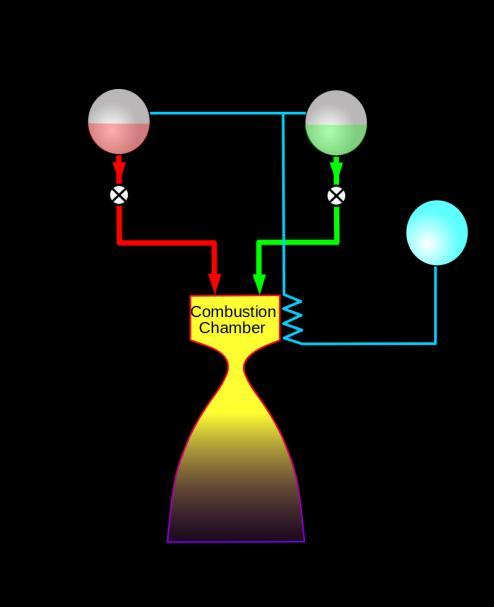
3.1 Pressure-fed Bipropellant engine
Inthistypeofengine,thetwopropellanttanksi.e.,thefuel tankandoxidizertankareconnectedtotwodifferenthighly pressurized tanks which are filled with an inert gas, generally,Heliumtomakesurethatthesepressurizedfluids don’tinteractwiththefueloroxidizerwhichmayaffectthe combustionprocess.
3.2 pump-fed bipropellant engine
In this type of engine, the propellants are pumped to the combustionchamberfromthepropellantstoragetanksusing apump.
3.2.1
The amount of pressure that a pump can generate is a lot comparedtothepressurethatiscreatedbythepressure-fed system and there is no need for us to pre-pressurize the propellant in the storage tanks themselves as they are pressurizedbythepumpsaftertheypass.
Hereelectric motorsareusedtorunthepumpswhichare poweredbybatteries.
Before the start of the engine the valves of the two pressurized Helium tanks are opened to pressurize the propellant tanks. After the propellant tanks reach the required amount of pressure, then the valves of the propellanttanksareopenedtopassdownthepropellantsto thecombustionchamber.
Themainconstraintherecomesintheformoftheamountof pressurethepressurizedHeliumtankscanprovide,whichis limited.
Example:
1) Orbital maneuvering system (OMS) engine in the spaceshuttle.
2) UpperstageofSpaceXFalcon1,poweredbyKestrel engine.
3) SpaceXDracoandsuperDracoengines.
4) SecondstageofDeltaIIlaunchvehicle,poweredby AJ10andTR-201engines.
Table -1:
Thelimitationhereistheamountofpowerthatthemotors requiredtorunatthathighrpmisveryhigh.Themorepower itrequirestorun,thegreaternumberofbatteriesorheavier batteries should be used which again can affect the performanceofthelaunchvehiclebyincreasingtheweight.
Example:
1) Rocketlab’selectronrocket,poweredbytheRutherford engine
2) AstraSpace’sRocket3,poweredbytheDelphinengine.
Table -2:
Enginename stage propellant Thrust(N) Specific impulse(s)
3.2.2 Open cycle or Gas generator cycle
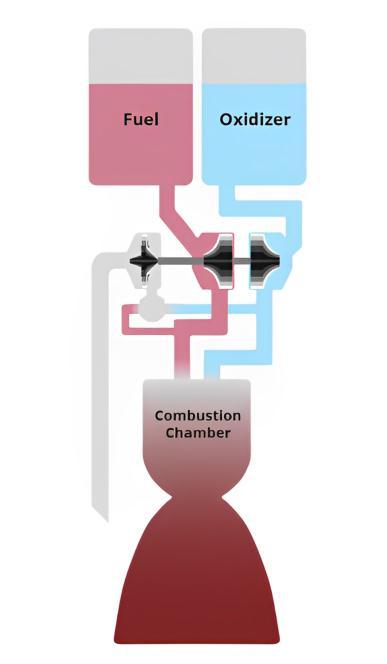
As we said earlier the amount of pressure produced by a pumpishuge.So,keepitinmindnowweneedtocomeup withsomeideathatmakesthepumprunathigherspeeds withoutmuchinvestmentinthepowersourcethatmakesthe launch vehicle comparably heavier. Here comes the gas generatorwhichisaminirocketenginethatintakesquitea smallamount(2to7percent)offuelandoxidizerfromthe mainflowpipesthatreachthecombustionchamber.
Asthefuelandoxidizerreachthegasgenerator,combustion startswiththehelpofasmalligniter.Thehigh-velocity,highpressureexhaustgasesofthisgasgeneratorarethenflushed over the turbine to run at greater speeds. This turbine is again connected to a shaft which is connected to the fuel pump and oxidizer pump which drives their respective propellantintothemaincombustionchamber.Thisexhaust gasisagaindrivenoutintotheatmosphere.
offuelisveryhigh.So,wetrytoavoidusingtheoxidizer-rich mixtureattheexpenseofthesafetyoftheturbine.
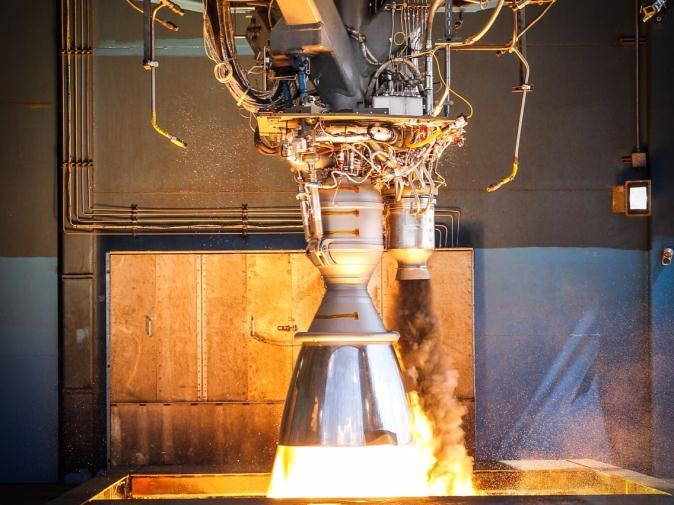
One of the major disadvantages of the open cycle is the wastageoffuelintheformoffuel-richexhaustgasfromthe gasgenerator.Aswecanseeinthepicturebelow,theexhaust fromtheoutletnozzleontherightsideistheexhaustgasof thegasgenerator.Itisinablack,sootycolourbecauseofthe unburntcarbon-basedfuelpresentinthefuel-richexhaust.
-3:Gasgeneratorcycle
Generally,the propellants thatare fedtothe gasgenerator havealargeamountoffuelcomparedtotheoxidizermaking themafuel-richmixture.Becausewewouldliketokeepthe temperatureoftheexhaustgasabitlow,aswedon’twantour turbinetomeltawayduetothelargeamountofheatthatis producedwhilecombustion.Theamountofheatthatafuelrichmixtureproducesislowcomparedtotheoxidizer-rich mixture. As we know in a fuel-rich mixture there is not enoughoxygentocompletelyoxidizethefuel,asaresult,the amountofheatproducedperunitoffuelisless.
Whereasinanoxidizer-richmixture,thefueliscompletely burnt as there is enough oxygen to oxidize the fuel completely,asaresult,theamountofheatproducedperunit
Example:
1) Ariane5rocket,poweredbyVulcain2engine.
2) Saturn 1B and Saturn V rockets, powered by J-2 engine.
3) SpaceX’sFalcon9B5rocket,poweredbyMerlin1D FTengine.
4) DeltaIVrocket,poweredbyRS-68Aengine.
3.2.3 Closed cycle or Pre-burner cycle
Aswesawintheearliercycle,theamountofpowerthatagas generatorproducestoruntheturbineisenormous.So,now wewouldfurtherwanttogoandmaketheopencyclemore efficientandreliable.
Closed cycle, as the name suggests we are interested in makinga closedloopbyredirectingtheexhaustofthegas generatorintothemaincombustionchambertomakeuseof the unburnt fuel. So, can we connect the gas generator exhaustpipedirectlytothemaincombustionchamber?NO. Becausetherearequiteafewconsequences.
1) If we consider a fuel-rich mixture of RP-1 (Refined Petroleum-1), RP-2 (Refined Petroleum-2), or any carbon-basedpropellants,theyproducesootwhenthey are unburnt. This soot is heavy and dense which can cause clogging in the injectors and they can also get arrestedonthewallsofthemaincombustionchamber which reduces the efficiency of the engine by interrupting the flow. In worst-case scenarios, this cloggingmightevencausetheenginetoexplode.
2) Anothermainreasonisthelowpressureintheturbine section.Asweknowtheturbineextractstheenergyfrom theexhaustgasesofthegasgenerator,heretheexhaust gasesexpandandlosepressurewhichisusedtorotate theturbine.So,toincreasetheefficiencyoftheturbine byefficientlyextractingenergyfromtheexhaustgases the pressure difference between the upstream and downstream of the turbine should be high i.e., the pressure before crossing the turbine should be higher than the pressure after passing through the turbine. Hence the pressure in the exhaust pipe is generally lower.Butinthemaincombustionchamber,thepressure isa lothigher. So, if weplugthe exhaust pipeintothe maincombustionchambertheflowwillbereversed,asa flowalwaystendstomovefromahigh-pressurezoneto alow-pressurezone.
In order to answer this question, scientists have come up withasolutionbymakingeitherallofthefuelorallofthe oxidizerpassthroughthegasgenerator.Now,herethegas generatorisnotonlyusedtoruntheturbinebutalsoisused for the preliminary combustion of the fuel and oxidizer mixture before it enters the combustion chamber. Hence, nowthegasgeneratoriscalledapreburnerbecauseofthe extra task it has acquired and due to the redirection of exhaustgasintothemaincombustionchamber.
Nowtheclosedcycleisagaincategorizedbasedonthetypeof propellant that passes through the pre-burner completely and enters the main combustion chamber through the turbine,
A) Closedcycle(oxidizer-rich)
B) Closedcycle(fuel-rich)
3.2.3.1 Closed cycle (oxidizer-rich)
As we said earlier the closed cycle engines are classified dependingonthetypeofpropellantthatpassesthroughthe pre-burner and enters the main combustion chamber throughtheturbine.Now,forthiscycle,weareconsidering theoxidizerasthepropellantthatpassescompletelythrough the pre-burner with a little fuel added to it to start the combustion. Whichmakesthepropellantmixture entering thepre-burner,oxidizer-rich.
But we already know the behaviour of the oxidizer-rich mixturewhencombusted.Itproducesavastamountofheat energyasthefueliscompletelycombustedandtheamount of heat produced per fuel burnt is very high which may totallymeltthepre-burner,turbine,oranythingthatcomesin itsway.
Nowweareparticularlyinterestedinusingtheoxidizer-rich closedcycle,despitethefactthatitcanmeltdowntheengine completely. We might even try cooling techniques such as regenerativecooling,filmcooling,etc,butitjustmakesthings morecomplexandaddafewmorechallengestotheproblem wewanttosolve.Themostchallengingparthereisthehighly reactivenatureoftheoxidizer.Itstraightupwants toreact withanythingincontact,eventhecoolingpipes.So,fornow, theonlysolutionthat wehaveinourhandsistocreate an alloythatcanwithstandthebruteheatthattheoxidizer-rich mixtureproducesduringcombustion.
Supposesaythatwehavesuccessfullycreatedanalloythat canwithstandthisheatandnowwearereadytogo.
Coming to the pre-burner, all the oxidizer is now flowing throughitandwejustwanttomakesurethatsufficientand just the right amount of fuel is passing along with the oxidizer in order to start the combustion. Because as we know,theoxidizer-richmixtureproducesmoreheat.Evenif youincreasetheamountoffuelpassingthroughit,itremains oxidizer-richandproducesmoreheatwhencomparedtothe sufficientlyrightamountoffuel.Tomaintainthepre-burner at as minimal temperature as possible we only allow a sufficientamountoffueltopassthroughit.
Nowcomingtotheproblemthatwediscussedearlier,which was about the low pressure after the exhaust gas expands andlosespressuretorotatetheturbine.So,tomakethings worktheexhaustpressuremustbehigherthanthatofthe chamberpressure.Forthistohappenweneedtocompress thecompleteoxidizerthatpassesthroughthepre-burnerto themaximumpressurewhichshouldremarkablybehigher thanthatofthemaincombustionchamber.
Whataboutthesmallamountoffuelthatpairsupwiththe oxidizer while entering the pre-burner? Here we need to makesurethatnotallthefueliscompressedtoitsmaximum limit.Becauseonlyasmallfractionoffuelisenteringthepreburner which needs to be highly compressed and the remaining large portion of the fuel is compressed to a sufficientamounttorundirectlyintothemaincombustion chamber. If we compress all the fuel in the fuel tank to its maximum pressure, not only in the pre-burner will the pressure be increased but also in the main combustion chamber.Whichagainleadsusbacktothesameproblemof reverseflow.Sonowweneedapumpwhichcancompress somefueltothemaximumandsomefueltojustasufficient amount.
Inordertosolvethisissue,wehavemulti-stageturbopumps. Asthenamesuggeststheseturbopumpshavemultiplestages ofpumps. Thepropellanttravelsthrougha seriesofstages witheachstageprovidinganextraboostinpressure.Inthis case,thefuelwhichissenttothemaincombustionchamber is pumped only through a few stages, which are sufficient enoughtogettherequiredpressure,andthefuel whichis senttothepre-burnerforpre-combustionispumpedallthe waythroughthelastpumptoattainmaximumpressureto make sure that the pressure after the turbine section has higherpressurecomparedtothemaincombustionchamber.
Nowwearedonesolvingourissue.Theoxidizer-richmixture has attained enough pressure which is higher than the pressureinthemaincombustionchamberandnowmoreor lessitisinagaseousphaseandwithmoreenergyduetothe pre-combustion.Asitisanoxidizer-richmixturetherestillis a large quantity of unused oxidizer. This unused gaseous oxidizerintheoxidizer-richmixturewillnowmixwiththe fuelfromthefueltankandstartscombustiongivingoutan enormousamountofenergy. Example:
1) Energiarocket,poweredbyRD-170
2) Protonrocket,poweredbyRD-253
3) VulcanandNewGlennrockets,poweredbyBE-4
4) AtlasIII,Vrockets,poweredbyRD-180
Table
3.2.3.2 Closed cycle (fuel rich)
Inthiscase,thepropellantthatpassescompletelythrough thepre-burnerandentersthemaincombustionchamberis the fuel. So now the pre-burner will run with a fuel-rich mixtureasweareaddingjusttherightamountoftheoxidizer requiredtostarttheprecombustionandrotatetheturbine. We know from the earlier discussions that the fuel-rich mixturetendstocreatesootduetothepresenceofunburnt fuel if the fuel is based on long-chained carbons. So how possiblycanwesendthispre-combustedfuel-richmixture directly into the main combustion chamber while it has a tendencytochoketheinjectors?
The answer is not to use fuels like RP-1 which have long chainedcarbonstructure.Insteadfuelslikeliquidhydrogen and liquid methane can be used. Based on the design requirementsstagedcombustionenginescanbeclassifiedas
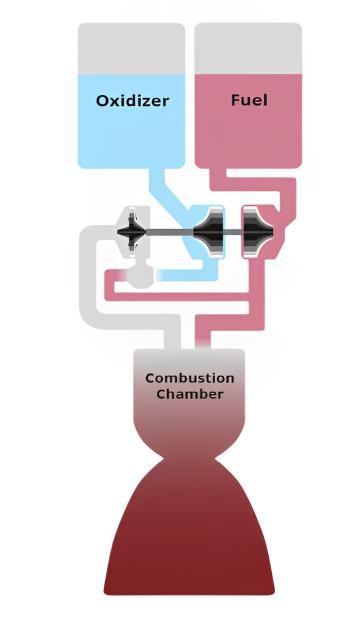
1) single-shaft
2) twinshaft.
Thesingle-shaftdesignconsistsofasinglepre-burneranda single turbine that runs both the fuel and oxidizer turbopumps. Here the turbopumps and the turbine are locatedonthesameshaft.Itisasimpledesignthatdoesn’t requiretheuseofalotofgears,bearings,andceilings.
Thetwin-shaftdesignconsistsofdualpre-burnerswhichare intern connected to their respective turbines and pumps. Eachsetofpre-burnersandtheturbinespowerthefueland oxidizerturbopumps.Itallowsmoreflexibilityasthefueland oxidizerpumpscanbecontrolledindependentlybysettingup theamountofpropellantpassingthroughthem.
As fuels with long chained carbons cannot be used, let us considerliquidhydrogenasthefuelandseetheworkingof theTwin-shaftdesignasthesingle-shaftworksthesameas wesawintheoxidizer-richclosedcycle.
Sonowallthefuelinthiscycleshouldpassthroughboththe pre-burners.Hereonepre-burnerrunsafuelturbopumpand anotherpre-burnerrunsanoxidizerturbopump.Thefuelis passedintoboththepre-burnersseparatelyalongwiththe sufficient amount of oxidizer required to start the precombustion.
Even in this engine cycle, we face the same issue with the pressure.So,ourgoalshouldbethatthepressureafterthe turbinesectionshouldbemuchgreaterthanthepressurein the main combustion chamber. To attain that we need to pressurizethefueltothemaximuminthiscase.
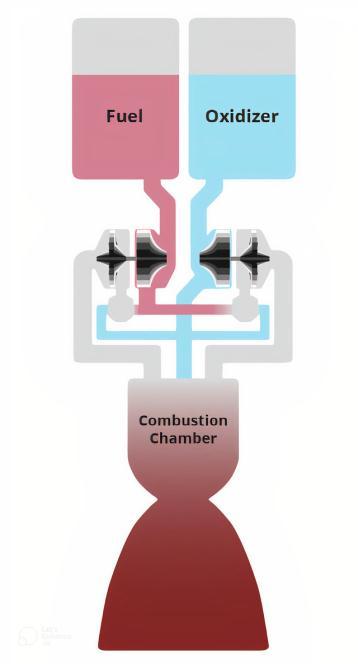
Herecomesanothercomplication.Weareheretalkingabout pressurizinghydrogenfuel,whichistheleastheavyfueland it has very low density. Because of these properties, it occupiesa largeamount ofspaceintanksanditishard to pressurize. It requires a greater number of stages in the turbopump compared to the oxidizer to make it reach the requiredpressure.Itisoneofthemainreasonswhylaunch vehiclesusingliquidhydrogenfuelusetwin-shaftdesignsfor theirengines.
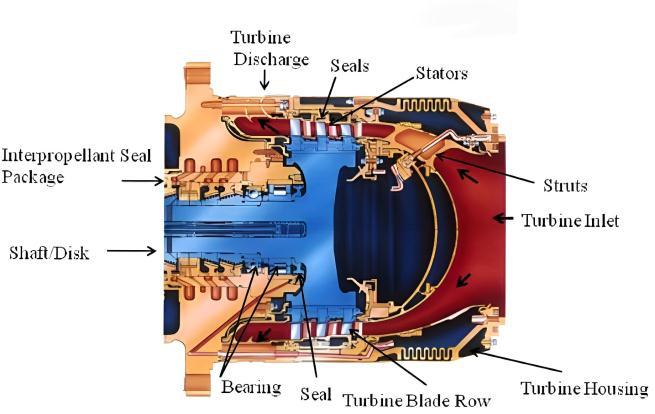
Low density and low weight are not only the issues with hydrogen. It has a lot of mobility and a piercing nature. Hydrogentriestogetintoeventhetiniestcrackinthewalls. Keepingthispropertyinmindnowlet’slookattheoxidizer turbopump. Here the pre-burner consists of a hot gaseous hydrogen-rich mixture. The turbine that runs with this exhaustgasliesonthesameshaftastheoxidizerpumps.As we know for a shaft to rotate it should not be constrained completely and there should be at least a possible gap betweentheshaftandthewall.Thisisatmostenoughgap for the hot gaseous hydrogen to escape and reach the oxidizer pump to react with the oxidizer and cause an explosion. Here comes the role of inter-propellant turbine seal which prevents the leakage of propellant between stationary and rotating parts by sealing the gaps between them.
Firstly,thehydrogenispasseddownintothefuelturbopump andgoesthroughaseriesofturbopumpstages.Thensomeof the pressurized hydrogen fuel passes into the pre-burner thatrunsthefuelturbopumpandtheremainingfuelissent totheotherpre-burnerthatrunstheoxidizerturbopump.In theoxidizerturbopump,onlyafractionoftheoxidizerthat mixeswiththefuelispasseddowntomultiplestagestoreach thepressureofthefuel.Theremainingoxidizerthatpasses directlyintothemaincombustionchamberjustgoesthrough onlyafewstagesofturbopumptoacquiresufficientpressure inordertoavoidthebackflowasfaraspossible.
Now all the hot gaseous fuel-rich mixture from the preburnerspassesthroughtheirrespectiveturbinesandenters themaincombustionchamber.Thereisstillunburntfuelin the pre-combusted fuel-rich mixture. It combines with the oxidizerthatispumpedintothemaincombustionchamber tostartthecombustion.
Example:
1) spaceshuttleandSLSrocket,poweredbyRS-25engine.
2) Energiarocket,poweredbyRD-0120engine.
3) GSLVMk1rocket,poweredbyRD-56(KVD-1)engine.
burnerthat runstheoxidizerturbopumpanda fraction of oxidizerissenttothefuel-richpre-burnertostarttheprecombustionthatrunsthefuelturbopump.Similarly,thefuel from the storage tank is passed into the fuel turbopump completelytogetpressurizedandthepressurizedfuelissent tothefuel-richpre-burnerthatrunsthefuelturbopumpand a fraction of fuel is sent to the oxidizer-rich pre-burner to startthepre-combustionthatrunstheoxidizerturbopump.
3.2.3.3 Full-flow staged combustion
Now coming to the most complex engine cycle that ever existed.Itisthecombinationofboththefuel-richclosedcycle and oxidizer-rich closed cycle. It is a twin-shaft staged combustionengine.Unlikesinglecompletepropellantpassing throughtheindividualpre-burners,inthiscycle,boththefuel and the oxidizer pass through both the pre-burners respectively.Whichmakespropellantinonepre-burnerfuelrichandpropellantinanotherpre-burneroxidizer-rich.
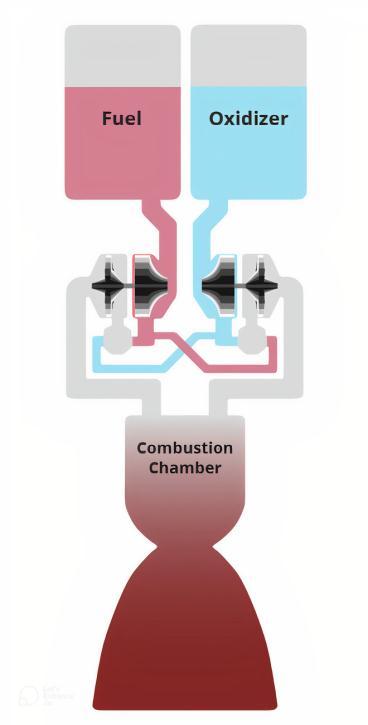
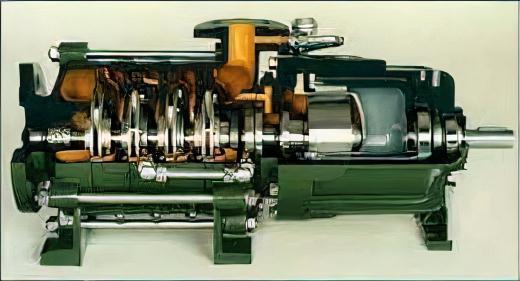
Here the oxidizer-rich pre-burner runs the oxidizer turbopump and the fuel-rich pre-burner runs the fuel turbopump.Theoxidizerfromthestoragetankisfirstpassed intotheoxidizerturbopumpcompletelytogetpressurized andthepressurizedoxidizerissenttotheoxidizer-richpre-
As both the fuel and oxidizer enter their respective preburnersforpre-combustion,theexhaustoutcomefromthem willbeahotgaseouspropellantmixture.So,fromafuel-rich pre-burner, the end outcome is a hot gaseous fuel-rich mixture, and from an oxidizer-rich pre-burner, the end outcomeisahotgaseousoxidizer-richmixture.
Incontrasttothesituationinthefuel-richclosedcyclewhere therewasanissuewithhotgaseoushydrogenreachingup theoxidizerpumpthroughthegapbetweentheshaftandthe wall, here there is no need to worry about it. Because the turbinethatrunswithahotgaseoushydrogen-richmixture liesonthesameshaftasthehydrogenfuelturbopump.So, evenifthehotgaseoushydrogengoesupthegapandmeets the liquid hydrogen there won’t be any reaction. A similar explanation isapplicable totheoxidizer turbopump where the hot gaseous oxidizer-rich mixture runs the oxidizer turbopump.Hencethereisnoparticularrequirementforan inter-propellantturbineseal.
Generally, in the main combustion chamber of a fuel-rich closedcycleoranoxidizer-richclosedcycle,therewillbean interaction between a hot gaseous fuel-rich mixture and a
liquid oxidizer or hot gaseous oxidizer-rich mixture and liquidfuel.wheretheinteractionisbetweenliquidandgas. Unlike them, in the full-flow staged combustion cycle, the interactionisbetweenthehotgaseousfuel-richmixtureand the hot gaseous oxidizer-rich mixture. The gas-gas interaction provides a faster chemical reaction and is very efficient.
Another important feature that makes the full-flow staged combustioncyclemoreefficientcomparedtoothercyclesis theworkloadonthepre-burner.Thisreducedworkloadand increasedefficiencycanbeinterpretedintwoways;
1) Highmassflowrate.
2) Workdistributionbetweenthepre-burners. Inthiscycle,theamountofmassflowisveryhighcompared toothercycles.Themassflowthatwearetalkingaboutisthe propellantthatpassesthroughthepre-burners.Onlyinthe full-flowstagedcombustioncycleboththefuelandoxidizer flowcompletelythroughthepre-burners,whereasineither fuel-richclosedcycleoroxidizer-richclosedcycle,onlyeither of the propellants is passed completely through the preburners.
The efficiency also depends on the temperature difference betweentheupstreamanddownstreamoftheturbine.The turbineexpandstheflowthatpassesthroughitbyextracting theenergy.So,aftertheflowpassesthroughtheturbinethe temperatureoftheflowdecreases.Thehighermassflowrate means the amount of gas passing through the turbine is more,whichindicatesthatthetemperaturedropisgradual, whichisa low-temperature difference.But the lower mass flowraterepresentsthatthetemperaturedropismorerapid, which is a high-temperature difference. As we know the temperature difference is the driving force for a heat flow. Thehigherthetemperaturedifference,thehigherwillbethe heattransfer.Thehighertheheattransfer,thehigherwillbe the heat load, which is considered as one of the biggest obstaclesthatshouldbeavoided.Thiscyclehasalowheatload in the turbine which means less energy loss for the precombusted gases before they enter the main combustion chamberandhence,hasmoreefficiency.
Unlike the single shaft engine design where a single preburner runs both the oxidizer and fuel pumps, here twin shaft design is used where the workload is distributed between two pre-burners. A lesser workload means the amountoftemperaturerequiredtodothesameamountof workisless.Lesserthetemperatureinthepre-burner,the lesserwillbetheheatlosstothesurroundingandthewalls. Thelessertheheatlossinthepre-burner,themoreefficientit is.
The only disadvantage of that full-flow staged combustion cycle has been the complexity of making, maintaining, and
usingtheengine.Becauseeverythinginthisenginecycleis connectedtooneanother.Evenasmallissueinonepartof theenginemightaffecttheworkingofthewholeengine.
Examples:
Duetothecomplexityofmakingtheengine,onlyahandfulof theseenginesweremade.
1) Starshiprocket,poweredbyRaptorengine.
2) UR-700(cancelled)andUR-900(cancelled),poweredby RD-270engine.
Engine name stage propellant Thrust
3.2.4 Combustion tap-off cycle
Asweknowmostofthepump-fedrocketengineshaveeither gasgeneratorsorpre-burnerstoruntheturbopumps.But thetap-offcycledoesn’thaveeitherofthem,instead,theytake thegastoruntheturbinedirectlyfromthemaincombustion chamberandafterrunningtheturbinetheflowisexhausted. It is made possible by making a connection from the main combustion chamber by using a pipe and routing it to the turbine.Thehigh-pressurehotgasesflowfromtheoutletand runtheturbine.
Itsoundssimplewhenwesaytousethehotgasesfromthe main combustion chamber to run the turbine. But we are here talking about the hot gases which have their temperature around 3000 k. This is more than enough temperature to meltdown theturbine. So, weneed tocool downthehotgasescomingfromtheoutlet.Tocoolthegases downwecanaddextrafueltoit,butnotoxidizerasitmixes to form an oxidizer-rich mixture which again causes hightemperatureissues.
To reducethe wastageoffuel inthe processof coolingthe incominggas,wecanconsidertakingthehotgasesfromthe cooler parts of the main combustion chamber where the combustion gas is more likely to be fuel rich. This cycle is closelyrelated to the open cycleor gas-generator cycle but withtheabsenceofagasgenerator.
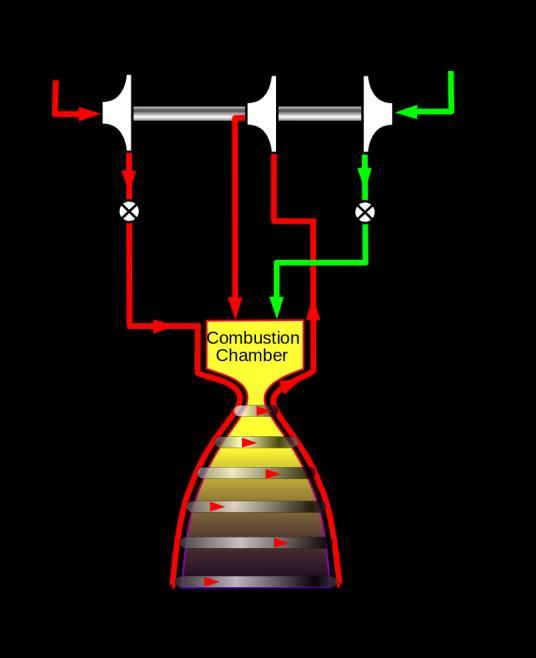
Onemajordisadvantageofthiscycleisthelossofefficiencyof thecombustionchamberduetotheextractionofcombustion gasoutthroughahole.
Example:
1) NewShepardrocket,poweredbyBE-3engine.
2) Alpharocket,poweredbyLightning1engine.
3) Alpharocket,poweredbyReaver1engine.
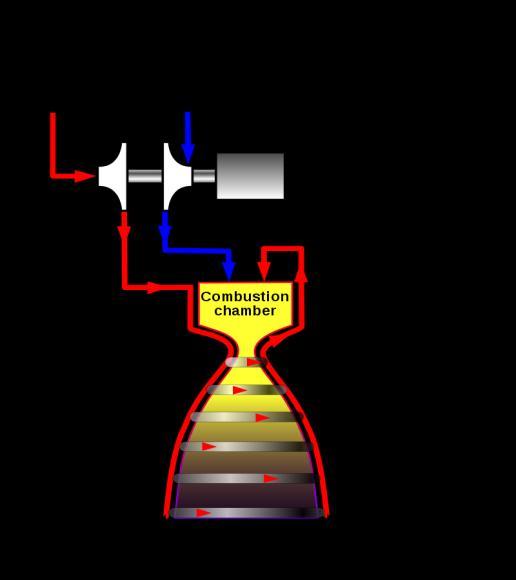
turbine. Here there is no need to worry about the performancelossofthemaincombustionchamberlikeinthe tap-offcycledue to the outlet.As weknowthe wallsofthe main combustion chamber are very hot due to the high temperaturecreatedinsidebycombustion.Basically,wejust wanttousetheheatthatthechamberwallspossesstorun theturbine.
The walls of the chamber are covered with small tubes entirelyandeitherfueloroxidizerispumpedthroughthem tocoolthechamber.Whilecooling,theheatispickedupby thepropellantthatpassesandchangesitsphasetogas.This high-temperature,high-pressuregasisthenpassedontothe turbinethatconnectsthefuelandoxidizerturbopumps.The hotgasesthendrivetheturbineandthepropellantisinjected backintothecombustionchamber.
Expander cycle
It goes into the same category as the tap-off cycle without requiring either gas generators or pre-burners to run the
Forthisenginetorunthephasechangeofthepropellantisat most necessary as it is required to run the turbine. It is limited by the square-cube law, which states that when a shape’ssizeincreases,inthiscase,abell-shapednozzle,the surfaceareaisincreasedbythesquareoftheradius(R2),and thevolumeisincreasedbythecubeoftheradius(R3).So,the amount of the propellant to be heated at the walls is the squareoftheradiusandtheamountofthepropellantthatis combustedisthecubeoftheradius.
As we increase the size of the combustion chamber the propellantflowingthroughthewallsincreasesandsoasthe coolingcapacityofthechamber.Butthecoolinggetsdifficult ifwedecreasethesizeofthecombustionchamber.Thesame positiveattributethatlargeengineshavecanleadtoanother problem. As the size of the engine increases, we would requiremoreenergytoruntheturbopumps,buttheamount of energy gained by the propellants in the walls of the
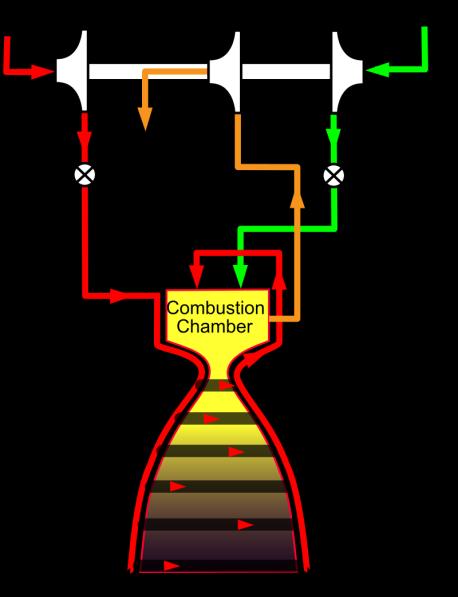
combustionchamberislessastheflowrateismore.Theheat exchangebecomeslessefficientasthesizeincreases.
Anotherissuetobeconsideredisthepressureoftheexhaust oftheturbinewhileenteringthemaincombustionchamber. Thepressureaftertheturbinesectionshouldbemorethan theinletofthemaincombustionchamber.Butasthesizeof theengineincreasestheamountofpressurecreatedinthe gasenteringtheturbinesectionislessduetothepoorheat exchange. Hence, limiting the usage with the size of the engine.
Example:
1) Angararocket,poweredbyRD-0146engine.
2) AtlasIIIB,Vrockets,poweredbyRL-10A-4-2engine.
3) Delta III, IV, and SLS rockets, powered by RL-10B-2 engine.
4) NewGlennrocket,poweredbyBE-3Uengine.
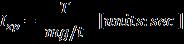
So, the more the specific impulse, the more thrust will be producedforthesameamountofthepropellantconsumed, which is a necessity for rocket engines. Now the thrust basicallydependsontheexhaustvelocityofthegases,which inturndependsonthetemperatureoftheexhaustgases.So, toproducehighthrustwewouldrequiremoretemperature intheexhaust,whichisobtainedbythecombustionofthe fuelandoxidizer.Forthefueltoreleasemoreamountofheat, thecalorificvalueshouldbehigher.
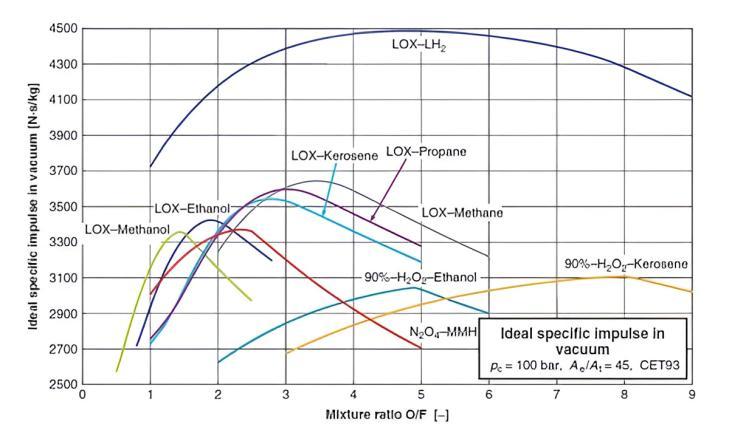
The fuel with the highest amount of calorific value is hydrogen, whose calorific value is 150 MJ/kg and has the leastweightcomparedtootherfuels.Asthespecificimpulse isdirectlyproportionaltothrustandinverselyproportional totheweightofthepropellant,Hydrogengivesthehighest amountofspecificimpulsecomparedtoanyotherfuel.Aswe knowhydrogenisverylessdenseandoccupiesmorevolume in gaseous form. So, the amount of gaseous hydrogen fuel requiredtotakethelaunchvehicletospacewouldrequire verylargetankscomparedtootherfuelswhicharedenseand requirelessvolume.
4. Cryogenic Rocket Engine
The fundamental element which differentiatesa cryogenic enginefromanormalrocketengineisthetypeofpropellant used.Asthenamesuggeststhepropellantsusedareliquified andstoredatextremelylowtemperatures,whichislessthan -150oCor-238 oF.Butwhydoweneedtousepropellantsof suchlowtemperatures?Toanswerthisquestion,first,letus know about the term specific impulse. It is known as the amountofthrustproducedperweightflowrateofpropellant.
1-: SpecificImpulsevsmixtureratio
These large tanks would definitely result in an aerodynamic efficiencylossof the vehicle as they increase drag.So,forhydrogenoranyotherlighterfuelstobeused withoutfacingthoseproblems,theyshouldbeliquifiedasit increases the density and reduces the volume consumed. Hydrogenliquefiesatatemperaturebelow-253oCor-423oF. Due to the same challenge that gaseous oxygen faces, it is liquified ata temperaturebelow -183 oC or -297 oF. liquid hydrogenandliquidoxygenaretypicallyusedincryogenic engines.
Cryogenic engines can run on a gas-generator cycle, expandercycle,orstagedcombustioncycle.Theuseofacycle istotallybasedonthemissionrequirement.Gasgenerators arelessefficientandproducemorethrust,sotheycan’tbe dependableforallthestagesoftherocket.Hence,theyare typicallyusedasboostersfora rocket.Theexpandercycle cannotproducemorethrustcomparedtothegasgenerator cycleduetothelessinletpressurethatitpossessesbecause oftheabsenceofagasgeneratororpre-burner.Hence,they
aretypicallyusedintheupperstagesoftherocketwherethe thrustrequiredislessastheearth’sgravitationaleffectsare less. The staged combustion cycle is more efficient and producesmorethrustcomparedtotheothertwocycles.But theonlydrawbackisthecomplexityofmakingit.Itcanbe usedinanystageofanengine.
Oneofthemainadvantagesofusingcryogenicfuelsis,it keeps the temperature of the walls of the combustion chamber as cool as possible with the regenerative cooling method.Butthisadvantagehasitsowncounterpart,whichis thetemperaturegradientoftheengine.Thepartswherethe liquidpropellantsflowhasatemperatureaslowas-150 oC and parts where the hot gases are produced like the preburner, gas-generator, and combustion chamber have a temperature as high as 3000 oC. This high-temperature gradientaffectsthestructureoftheenginebyincreasingthe thermalstresses.So,whiledesigningacryogenicenginethe insulationofthepartsshouldbemosttakencareof.
One common problem that rocket engine faces in the turbopumpsectionistheformationofshocksatthetipofthe turbines, because of the high amount of RPM that they achieveduetotheexhaustofthepre-burnerorgasgenerator.
Nowletuswritethespeedofthesoundequation,
drivenintothepartsoftherocketenginetomakethemcool inordertopreventthermalshocks,whicharecauseddueto the high-temperature gradients, which occur when the cryogenicpropellantofhighpressureispumpeddirectlyinto the parts of the rocket engine that are at ambient temperature.
Due to the thermal shock, the walls of the functioning parts might form cracks. Similar to the case when cooled waterispouredonahotmetal.Anotherproblemis,weare heretalkingaboutcryogenicpropellantswhichhaveverylow boilingpoints.Forexample,theboilingpointofhydrogenis252.9°C and for oxygen is -183 °C. If they come in direct contact with the parts of the rocket engine at ambient temperaturetheywillevaporateandformsmallgasbubbles. ThisformationiscalledCavitation.Thesesmallgasbubbles can disturb the flow and can even interrupt the ignition processwhichcancauseefficiencyloss.
ThecombinationofLH2andLOXismostlypreferredfor cryogenic enginesandtheyaretypicallyusedintheupper stagesoftherocketbecausetheyproducethehighestspecific impulse,whichmeanstheycanproducemorethrustperunit fuelcombustedcomparedtoanyotherpropellants.whichin turnmeanstherocketcancarrylessfuelandmorepayload. ThecombustionproductofLH2andLOXisonlywaterinthe vaporstate,whichmakesitacleanfuel.
ThecombinationofCH4(liquifiesat-160 oC)andLOXis anothermostcommonlyusedcryogenicpropellantafterLH2 andLOX.
Here,
a=speedofthesound
Ru =characteristicgasconstant
T=temperature
M=molecularmass
Asthemassofthemoleculeincreasesthespeedofsound decreases.Thisallowstheturbinestoachievethespeedof soundatalowerRPMcomparedtothespeedofsoundwhen lower molecular mass propellants are used. When the turbinesreachthespeedofsounditproducesshockwavesat thetips,whichareprimarilyknownfortheirperformancedegradingability.So,ina cryogenicengine,itwon’tbethe caseas the main fuel is hydrogen (H) whichisthelightest element out there and they provide the highest turbine efficiency.



One important thing to do before starting a cryogenic engineisEngineChillorPre-Chill.Thisprelaunchprocedure isnotonlyforacryogenicenginebutalsoforanyenginethat uses a cryogenic propellantcombinationsuchas RP-1and LOX. In this process, the cryogenic propellants are slowly
Example:
1) AtlasIIIB,Vrockets,poweredbyRL-10A-4-2engine.
2) GSLVMkIIrocket,poweredbyCE-7.5engine.
3) SpaceshuttleandSLSrocket,poweredbyRS-25engine.
4) Delta IV and IV heavy rockets, powered by RS-68A engines.
5) Starshiprocket,poweredbyRaptorengine.
5. CONCLUSIONS
Thedevelopmentandworkingofabi-propellantengineare not without any challenges. Each engine cycle has its advantages,disadvantages,anditsownwayofrunningthe engine. Each of the propellants has to be taken care of individuallyasfromstoringthepropellanttopumpingthem into the main combustion chamber is accompanied by a different range of challenges. The selection of the rocket enginecycleistotallybasedonthemissionrequirement.For example, the expander cycle is mostly used in the upper stages of the rocket mission due to its precise throttle control,whilegasgeneratorandstagedcombustioncycles are mostly used in primary stages as they produce more thrust.
REFERENCES
[1] DP Mishra. (2017), Fundamentals of Rocket Propulsion(1sted.,pp.175-186,261-297).CRCPress, Taylor&FrancisGroup.
[2] George P. Sutton, Oscar Biblarz. (2010), Rocket Propulsion Elements (8th ed., pp.194-236, 245-265, 271-275,289-295,366-370).JohnWiley&Sons,INC.
[3] https://spinoff.nasa.gov/Spinoff2018/t_3.html
[4] https://blogs.nasa.gov/J2X/2012/08/08/post_13444 32475773/
[5] https://flownex.com/industries/spaceflight/
[6] https://ntrs.nasa.gov/api/citations/20100035254/do wnloads/20100035254.pdf
[7] https://en.wikipedia.org/wiki/Liquidpropellant_rocket
[8] https://ocw.mit.edu/courses/16-512-rocketpropulsion-fall2005/8b2220397190eb677d156c4b486dd069_lectur e_25.pdf
[9] https://blog.softinway.com/a-comparison-ofdifferent-rocket-engine-cycles-throughout-the-years/
[10] https://blogs.nasa.gov/J2X/tag/gas-generator/
[11] https://en.wikipedia.org/wiki/Gas-generator_cycle
[12] https://blogs.nasa.gov/J2X/tag/closed-cycleengine/
[13] https://en.wikipedia.org/wiki/Staged_combustion_ cycle
[14] https://space.stackexchange.com/questions/22947 /what-are-the-advantages-of-ox-rich-stagedcombustion
[15] https://ntrs.nasa.gov/api/citations/19820002372/ downloads/19820002372.pdf
[16] Scott Manley. (2017). KSP Doesn't Teach: Rocket Engine Plumbing [Video]. YouTube. https://www.youtube.com/watch?v=4QXZ2RzN_Oo
[17] https://web.archive.org/web/20160308045601/ht tp://aerospace.wpengine.netdna-cdn.com/wpcontent/uploads/crosslink/V5N1.pdf
[18] https://en.wikipedia.org/wiki/Combustion_tapoff_cycle
[19] https://commons.erau.edu/cgi/viewcontent.cgi?art icle=1005&context=pr-honors-coe
[20] https://blogs.nasa.gov/J2X/2014/03/24/insidethe-leo-doghouse-the-art-of-expander-cycle-engines/
https://en.wikipedia.org/wiki/Expander_cycle
https://www.iasgyan.in/blogs/cryogenic-engine [23] https://www.nasa.gov/exploration/systems/sls/en gineers-chill-space-launch-system-rocket-enginesbefore-launch.html
[24] https://en.wikipedia.org/wiki/File:Pressure_fed_ro cket_cycle.svg
[25] https://en.wikipedia.org/wiki/File:Electric_feed_ro cket_cycle.svg
[26] https://flownex.com/wpcontent/uploads/2021/11/Different-Cycles2048x913.png
[27] https://i.insider.com/5a03a2813dbef4e3058b4d16 ?width=1136&format=jpeg
[28] https://blogs.nasa.gov/J2X/wpcontent/uploads/sites/212/2013/09/pump.jpg
[29] https://upload.wikimedia.org/wikipedia/commons /thumb/e/e1/Combustion_tapoff_rocket_cycle.svg/330px-Combustion_tapoff_rocket_cycle.svg.png
[30] https://upload.wikimedia.org/wikipedia/commons /thumb/1/1b/Expander_rocket_cycle.svg/413pxExpander_rocket_cycle.svg.png
[31] https://qph.cf2.quoracdn.net/main-qimgb591b84b3625edf06691f7b229ec24d0-pjlq