
"DESIGN AND ANALYSIS OF BRAKE DISC PLATE USING FINITE ELEMENT ANALYSIS (FEA) "
Ankit Sahu1 , Ishan Khan2 , Dr, Rajeev Arya31MTech. Scholar Mechanical Eng. Dept. NIIST, Bhopal, India.
2Asst. Prof. Mechanical Eng. Dept. NIIST, Bhopal, India.

3Director,NIIST,Bhopal,India ***
Abstract - A brake is a mechanism that applies resistance through friction to a rotating disk in order to decrease or halt the movement ofa vehicle. Whenbraking,thecontactbetween the disk and brake pads generates frictional heat, resulting in elevatedtemperatures. Theexcessiveheatonthesurfaceofthe rotor can cause various undesired effects, including thermal elastic instability (TEI), premature wearing, and thermally induced vibrations (TEV). In this project, we examine the thermalandstatic structural characteristics ofthe brake disk rotor, comparing the use of Titanium alloy (Ti 550) and the conventional Stainless-Steel material. The analysis is performed in the ANSYS R 19.2 software through finite element modeling of the disc brake rotor in CREO PARAMETRIC 5.0. Ultimately, a comparison is made between the conventional stainless steel and Ti 550 materials, evaluating the magnitude of Von Mises stresses, temperature distribution, and deformation based on the coupled thermal analysis.
Key Words: FEA, Ansys, Stress, Efficient Brake, Titanium alloy, Creo Parametric
1.INTRODUCTION
Brakesplayavitalroleinensuringthesafetyofvehiclesby slowing down or stopping the rotation of wheels. This is achievedbyapplyingbrakepadsonbothsurfacesofarotor ordisc,whichcreatesmechanicalforcetohaltthewheel's motion. Brakes are an indispensable component for safe vehicle operation as they convert the car's kinetic energy intoheatenergy,therebyreducingitsspeed.
1.1 Disc Brake
Adisc brakemechanismconsistsofa robustcircularplate affixedtothewheelhubandanimmovablehousingforthe caliper.Thehousingislinkedtoastationarycomponentof thevehicleandencompassestwocompartmentsthatcontain pistons.Friction-inducingpads,securedbyretainingpinsand spring plates, are positioned between the pistons and the circular plate. The caliper incorporates passages for fluid flow,enablingtheentryandexitoffluidineachcompartment while facilitating the process of bleeding. Each cylinder features a sealing ring made of rubber that is situated betweenthepistonandthecylinder.
2. LITERATURE REVIEW
Ali Belhocine and Oday Ibrahim Abdullah et. al. (2021)The study used numerical simulations to analyse the behaviour of three brake disc materials. It included 3D thermal analysis to understand heat distribution and a comparativeanalysistoidentifythebestmaterialforoptimal vehicle braking. Results were visualized using a thermomechanicalmodeltodrawconclusions.[1]
Srushti Newase, Pradnya Kosbe et. al. (2021)- This research aims to analyze the thermal properties of vented disc brake rotors for Mahindra Bolero. The goal is to find materialsforthebrakerotorsandpadsthatcaneffectively dissipate heat generated during braking, while ensuring structuralsafety.[2]
Adarsh Bhat et. al. (2021)- This project analyses the advantages of disc brakes over drum brakes in terms of stopping distance,heat dissipation,and more. While drum brakes have cost benefits, research aims to improve disc brake designs and materials to reduce deformation and improvethermalcharacteristics.[3]
Aakash Jawla, Rahul Anand, Shobhit Agarwal et. al. (2020)- Thisstudyusesthermalanalysistoinvestigatethe performanceofstainless-steelmaterialsindiscbrakedesign, focusing on heat generation during braking and resulting thermalstress.SolidWorksandANSYSWorkbenchareused for analysis. The findings will contribute to understanding disc brake thermal behaviour and material selection for improvedperformance.[4]
Sanket Darekar, Ajinkya Dhage et. al. (2020)- Theproject designsthediscbrakeofBajajPulsar220Fwith3Dmodelsin CATIAsoftware,andanalysesthetemperaturedistribution duringbrakingusingANSYSWorkbench.Thestudycompares various disc brake models to select an optimized design basedonanalysisresults.[5]
Bikesh Suwala, Sanjeev Maharjan et.al. (2020)-Thestudy analysestheimportanceofdisc brakesystemsinensuring vehiclesafetyanddesignsfour-discrotormodelstoimprove the weight, mechanical, and thermal performance of the originaldiscbrakeofYamahaFz-25.Theanalysissuggests
that disc rotor model 4 is the best design with improved performanceandreducedproductioncost.[6]
S.A.M Da Silva, DVV Kallon et. al. (2019)- This research aims to compare the performance of a grooved-disc brake anda drilledandgrooveddisc brakerotorunderdifferent appliedlinearloads.Thestudywillanalyzeparameterslike stress concentrations, load, and displacement to identify criticalzonesoneachrotorusingBrembobrakerotordesign foraRenaultvehicleandsoftwareanalysis.[7]
Anurag Parag Borse et. al. (2019)- Theabstractdiscusses the importance of brakes in vehicles and focuses on the analysis of the disc or rotor of a disc brake, which is a commonlyusedformofbrakeformotorvehicles.Thestudy analysesthethermo-mechanicalbehaviourofthebrakedisc duringthebrakingphaseusingANSYSsoftware.[8]
Joyson Sam Devapaul P, Paul Gnanam J et. al. (2018)-The projectaimstoanalysethethermalandstructuralbehaviour of a two-wheeler brake disc using Solid works and Ansys software. The study investigates the effects of different materials on stress, deformation, and temperature distributioninthedisc.[9]
B.Subbarayudu, Ginjala Kishore et. al. (2018)- The objectiveofthisstudyistoanalyseaventilateddiscbrakeby creatingFiniteElementmodelsusingSolidWorksandANSYS. Thestudyaimstodeterminetheoptimaldesignofthebrake discrotorbyevaluatingitsstrengthundervaryingheatflow rates and materials with different cross-sectional variations.[10]
Deekshith Ch et. al. (2017)-Theworkisaboutanalysingthe thermalandstructuralbehaviourofadiscbrakerotorofa vehicle. Two different materials and thicknesses are consideredfortheanalysisusingCATIAandANSYSsoftware. Theobjectiveistocomparethetemperaturedistributionand heat flux of the two materials to optimize the rotor's manufacturingusingCNCmachine.[11]
Alampally Sainath1,Prathamesh Mahesh Dehadrayet.al. (2015)- This study aims to use ANSYS to analyze how motorcyclediscbrakesaffecttheirsurfacethroughthermal stressanddeformation.Thegoalistopreventdamagecaused by heat generation and identify the best material for improvedperformanceintermsoftemperature,stress,and deformation.[12]
Ali Belhocine, et. al. (2014)- Thestudyexaminestheeffect ofheatandmechanicalstressonbrakediscsusingANSYS11 software.Throughmodeling,itidentifiesanidealgeometric designforventilationinvehicles.Theanalysisalsomeasures deformation,stress,and pressuredistribution.Thestudy's resultsareconsistentwithexistingliterature.[13]
3. METHODOLOGY
3.1 Design of Existing Rotor Disc1 and New Rotor Disc2
Existingmodelofdiscrotorandnewrotorisdesignedusing Creoparametric5.0basedandanalysedusingAnsysR19.2. FollowingTableNo.1showsthedimensionsofbrakerotor Disc1andDisc2
Table No.1:-DimensionofDisc1andDisc2
Properties of TITANIUM 550 (Ti-6Al-4V) and SS 410
The following Table No.2 shows the mechanical properties of the Titanium 550 (Ti-6Al-4V) material and StainlessSteel(SS410)
Table No.2: -MechanicalpropertiesoftheTi550(Ti6Al-4V)andSS410
3.2 Input parameters for calculation
Rotordischeatfluxiscalculatedassuming,thebikemoving with a velocity 27.78 m/s (100kmph) and the following Table No.3 shows the input parameter for heat flux calculation.
Theoretical calculation
Deceleration (a)
For safe braking purpose, taking deceleration
(a)=18ft/s2=(ft/s2)/3.281
a= 5.49 m/s2
Time (t)
Time taken to bring the bike at rest= u/a = 27.78/5.49
t=5.06 sec
Average braking power on the front wheel (qa)
Brakingpowerqoisgivenby=(u*a*w)/2*g= (27.78*5.49*210*9.81)/2*9.8
(qo) = 16013.78 W
Average braking power(qa)= 16013.78*.65*0.5
(qa)= 10408.96 W
Note: -Thedynamicweighttransferduringbrakingon frontandrearaxleis65:35percentoftotalvehicleweight respectively. Hence, Weight distribution on front wheels=0.65
Sinceonlyonesideofbrakediscisconsidered=0.50
Swept area (A)
Swept area of rotor = {π*(0.242-0.182)}/4 = A=0.0198 m2
Heat Flux (Φ)
Heat flux is given as = qa /(A*t) = 10408.96/(0.0198*5.49)
Φ =51947.14 W/m2
4. MODELLING AND ANALYSIS
4.1 Modelling in Creo Parametric 5.0
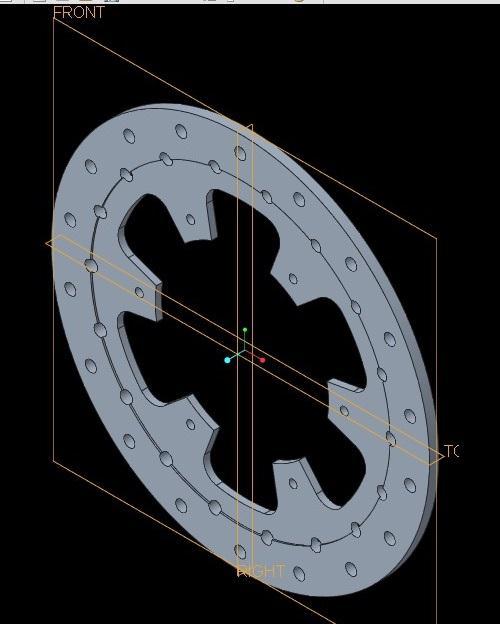
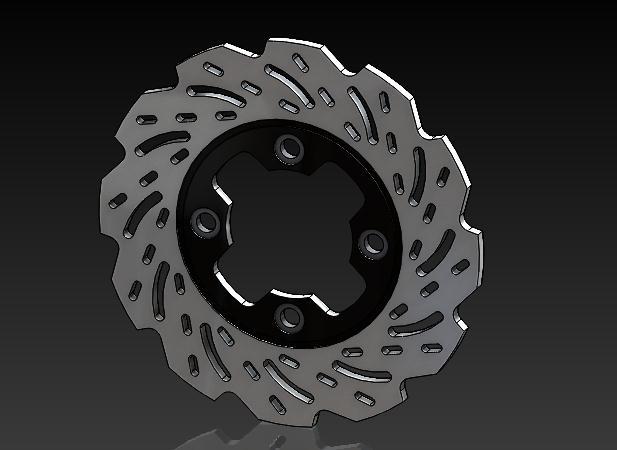
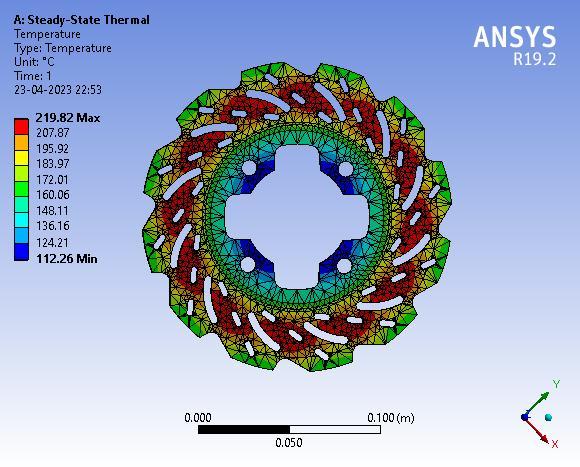
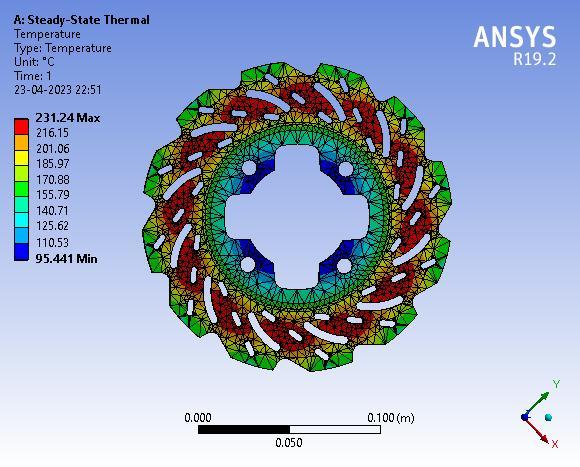
Discstructuresignificantlydefinestheairflowcharacteristics, ExistingdiscwithdrilledholesshowninFig.1andNewdisc rotor shown in Fig.2 with different shape and grooves is modelledinCreo5.0software.
4.2 Analysis
Meshing of the disc
Meshingisimportanttosimulatetheboundarytechniqueof problem. Mesh quality has great influence on the results. Meshsizedecidesthenumericalconvergenceofsolution.If themeshsizeispoorthenitwillnotgiveproperresults.Fine meshgivesnumericalconvergencewithaccurateresults.
4.3 Steady state thermal analysis
Oncetheheatfluxthermalboundaryconditionsarecreated, theyareimplementedontothefiniteelement(FE)modelto acquireanapproximationofthetemperatureandheatflux distribution within the disc rotor. The thermal boundary conditionsfortherotorcanbefoundinTableNo.4provided below, demonstrating the prescribed conditions for the rotor'sthermalbehavior.
Table No.4: - ThermalBoundaryconditionvalues
4.4 Static structural analysis
Static analysis determines stress, strain, deformation in structureorcomponentcausedbyloadsthatdonotinduce inertiaanddampingeffects.Thisprojectdealswiththestudy ofstress,deformationondifferentbrakediscmodelsunder static condition. Pressure is applied on the swept area of brake disc and the bolt holes are fixed. Static structure analysisisperformedwithcombinedthermalloadsonthe rotor. The following Table No.5 shows the boundary conditionsparametersforstaticstructuralanalysis.
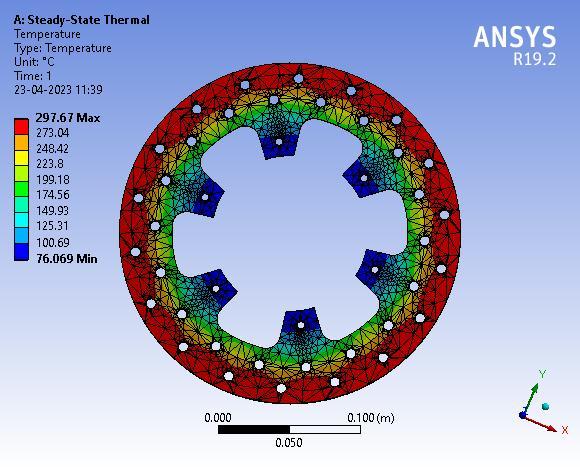
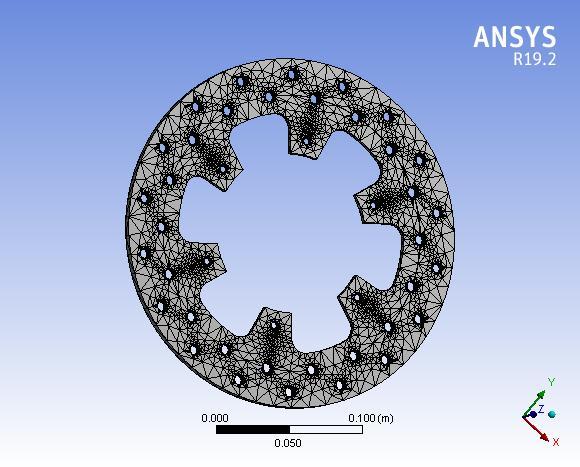
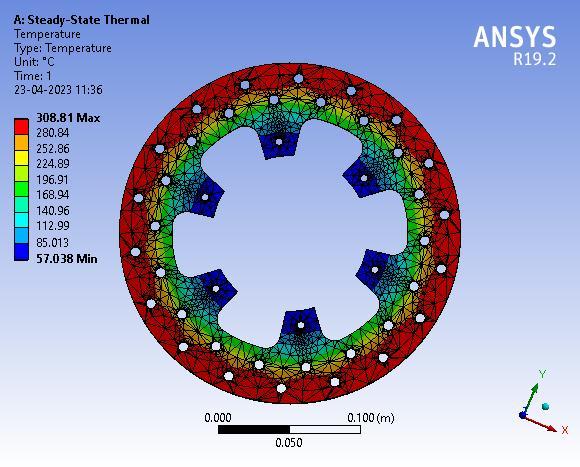
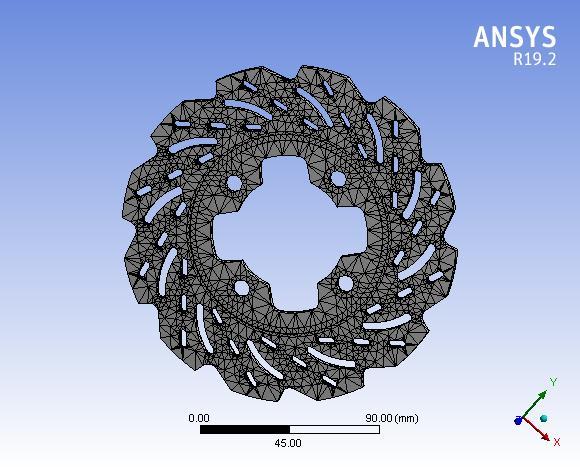
Table No.5: -StaticStructuralBoundarycondition values
5. RESULTS
5.1 Thermal Analysis results
Maximum values of temperature in Disc1 and Disc2
5.2 Static structural analysis results with combined thermal loads
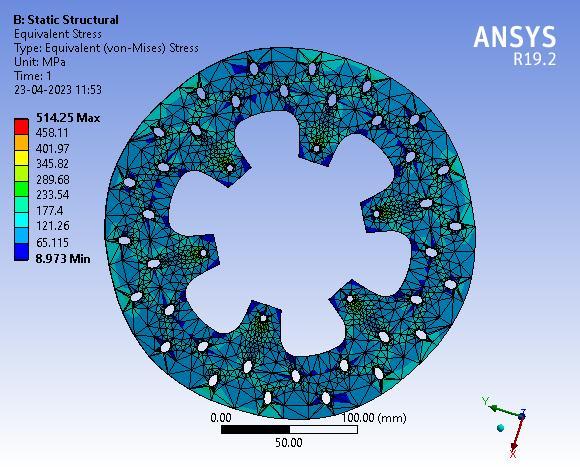
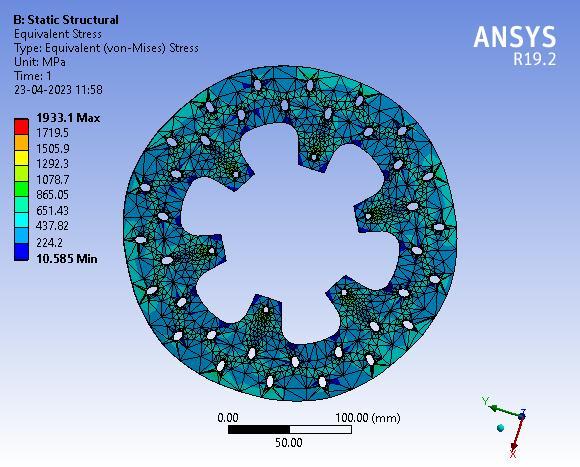
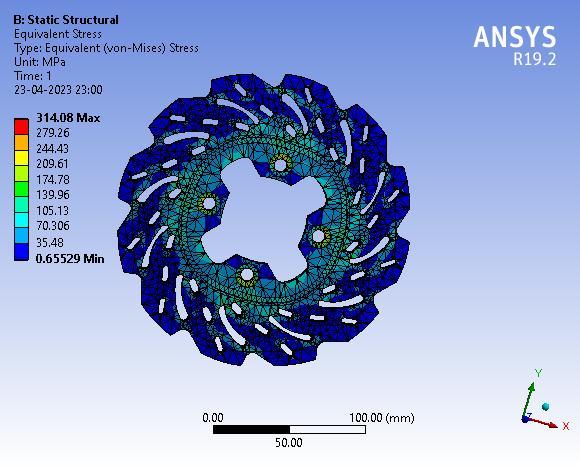
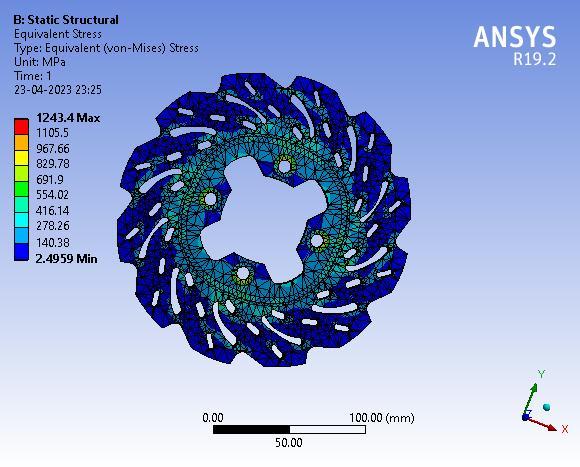
Maximum values of Von Mises stress in Disc 1 and Disc 2
Maximum values of Total Deformation in Disc 1 and Disc 2
5.3 Result Comparison
The steady state thermal and coupled static structural analysis gives the values of Temperature, Stress and DeformationinDisc1andDisc2.Thecomparisonisdonein the following tables to understand thermal and structural loadvariationduetochangeindesignandmaterial.
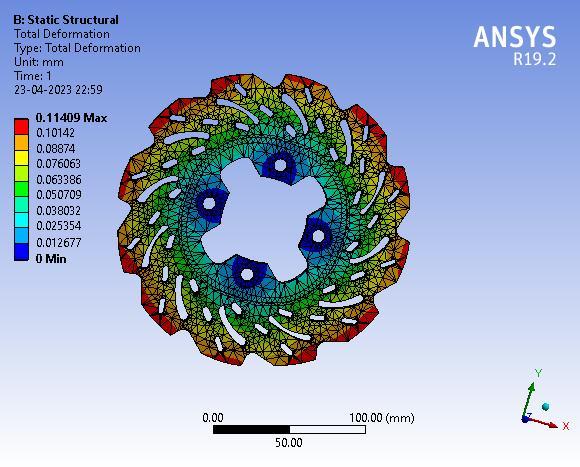
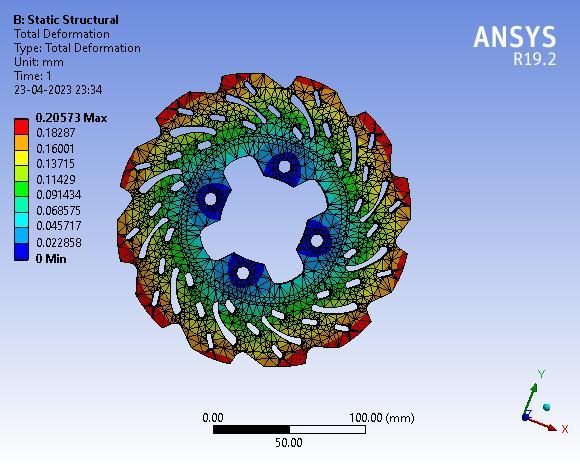
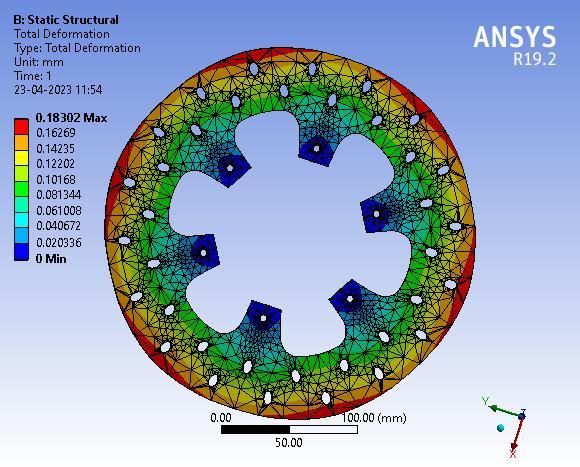
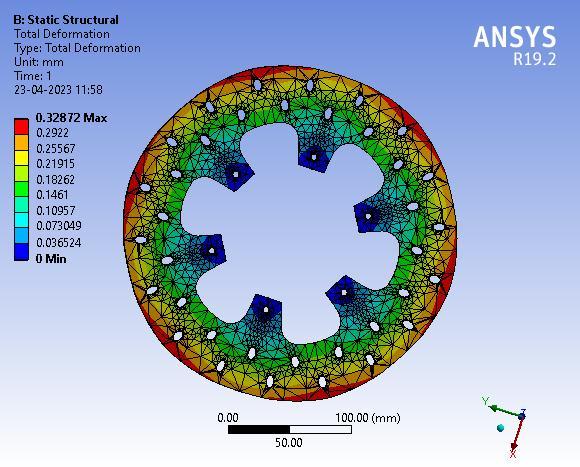
Table No.7: -MaxStressvaluesinDisc1&Disc2
Table No.8: -MaxDeformationvaluesinDisc1&Disc2
[2]SrushtiNewase,PradnyaKosbe,ThermalAnalysisofDisc BrakeSystem,ISSN:2321-9653;ICValue:45.98;SJImpact Factor:7.429Volume9IssueVIIIAug2021-
[3]AdarshBhat,StructuralAnalysisofATwo-WheelerDisc Brake,IopConf. Series:Materials ScienceAndEngineering 1013(2021)
[4]AakashJawla,RahulAnand,DesignandThermalAnalysis ofBrakeDiscforOptimumPerformance,ISSN:2321-9653;IC Value:45.98;SJImpactFactor:7.429Volume8IssueIVApr 2020
[5] Sanket Darekar, Ajinkya Dhage, Designand Analysisof Automotive Disc Brake using FEM, International Research JournalofEngineeringandTechnology(IRJET)e-ISSN:23950056Volume:07Issue:01|Jan2020
6. CONCLUSION
From the above comparison, the following points can be concluded
Material SS 410 exhibits higher maximum temperaturesinbothDisc1andDisc2comparedto Ti 550, indicating that it may experience higher thermalloadsduringbraking.
Material SS410alsoshowshighermaximumVon Mises stress values in both Disc1 and Disc2, suggestingthatitmayexperiencehighermechanical loadsduringbraking.
Material SS 410 has higher total deformations in bothDisc1andDisc2comparedtoTi550,indicating that it may undergo more deformation or wear duringbraking.
MaterialTi550exhibitslowervaluesformaximum temperature,maximumVonMisesstress,andtotal deformation in both Disc1 and Disc2, suggesting that it may have better thermal and mechanical performancecomparedtoSS410.
Based on the given data, Ti 550 may be a more suitable materialforbrakediscrotorsasitshowslowervaluesfor temperature, stress, and deformation, which could potentiallyleadtobetterperformanceandlongerdurability underbrakingconditions.
REFERENCES
[1] Ali Belhocine and Oday Ibraheem Abdullah, A thermomechanicalmodelfortheanalysisofdiscbrakeusing the finite element method in frictional contact, Journal of Engg. Research Vol.10 No. (4B) pp. 128-141 DOI: 10.36909/jer.8617
[6]BikeshSuwala, SanjeevMaharjan,Design ofRotorDisc BrakeusingStructural&ThermalAnalysis,ISSN:2350-8914 (Online),2350-8906(Print)Year:2020
[7]S.A.MDaSilva,DVVKallonFEAOnDifferentDiscBrake Rotors, 2351-9789 © 2019 The Authors. Published By Elsevier B.V. Peer-Review Under Responsibility Of The OrganizingCommitteeOfSMPM2019.
[8]AnuragParagBorse,DesignandAnalysisofBrakeRotor (DISC), International Research Journal of Engineering and Technology(IRJET)e-ISSN:2395-0056Volume:06Issue:08| Aug2019
[9] Joyson Sam Devapaul P1, Paul Gnanam J, Thermal and Structural Analysis of Two-Wheeler Disc Brake Using Softwares,www.ijirset.comVol.7,Issue11,November2018
[10]B.Subbarayudu,GinjalaKishore,DesignAndAnalysisOf VentilatedDiscBrake,IOSRJournalOfMechanicalAndCivil Engineering(IOSR-JMCE)E-ISSN:2278-1684,P-ISSN:2320334X,Volume15,Issue5Ver.I(Sep.-Oct.2018),PP46-59 Www.Iosrjournals.Org
[11] Deekshith Ch, Design, Analysis and Manufacturing of Disc Brake Rotor, International Journal of Engineering ResearchandDevelopment,Volume13,Issue11(November 2017)
[12]AlampallySainath,PrathameshMaheshDehadrayThe ThermalAndStressAnalysisOfDiscBrake,IOPConf.Series: MaterialsScienceAndEngineering1128(2021)012015IOP PublishingDoi:10.1088/1757-899X/1128/1/01201
[13] Ali Belhocine, Mostefa Bouchetara, Structural and ThermalAnalysisOfAutomotiveDiscBrakeRotor,Vol.Lxi 2014Number110.2478/Meceng-2014-0005