Sepsis Prediction Using Machine Learning
Kriti Ohri Nandini1Professor, VNR Vignana Jyothi Institute of Engineering & Technology, Hyderabad

2345Under Graduate Student, VNR Vignana Jyothi Institute of Engineering & Technology, Hyderabad ***
Abstract - Sepsis is a potentially life-threatening and serious condition that occurs when an infection spreads across the body and triggers a widespread inflammatory response. It has a significantly high death rate, especially for patients in the ICU. Early detection and treatment of sepsis is necessary. Machine learning models for sepsis detection can be trained on a variety of data sources, such as electronic health records (EHRs), vital signs, laboratory test results, and demographic information. Exploratory Data analysis was performed using different preprocessing techniques. To classify the disease, the Random Forest Classifier is used and comparison also performed among various Classifiers like MLP, KNN, etc.
Key Words: (Sepsis Prediction, Random Forest Classifier, vital signs.)
1.INTRODUCTION
Asaresultofanunbalancedbody'sresponsetothesetoxins, sepsiscanaffectseveralorgansystems.Sepsisisadisease that anyone can get as a result of infections. People with chronicdiseaseslikecancer,diabetes,renal,lung,andkidney disease,aswellaspregnantwomen,aremorelikelytocatch it because of their compromised immune systems. Also at dangerareinfantsunderoneyearold.Thisillnessposesa significantrisktopublichealthbecausetoitshighmortality, high cost of care, and morbidity. The outcomes can be improved with early identification and antibiotic therapy. Pneumonia, stomach infections, kidney infections, and bloodstream infections are all factors that contribute to sepsis. Fast heartbeat, low blood pressure, hypothermia (very low body temperature), hyperventilation (rapid breathing), and severe pain or discomfort are all signs of sepsis.IVantibioticstofightinfection,vasoactivemedicines to boost blood pressure in individuals with low blood pressure,andIVantibioticstotreatinfectionmakeupthe treatmentforsepsis.
2. LITERATURE REVIEW
Vital sign-based detection of sepsis in neonates (2023) Sepsis prediction was performed using the Naive Bayes algorithm in a maximum a posteriori framework up to 24 hours before clinical sepsis suspicion. Data on vital signs were continuously and automatically collected for this investigation.Comparedtoresearchusingmanuallyobtained vitalsigns,thistakeslesstimeandislesspronetodataentry mistake. However, due to its therapeutic relevance, this technique restricts the number of positive instances and
changes how the cases are distributed among the various subgroups.
Learningrepresentationsfortheearlydetectionofsepsis with deep neural networks (2021) Thisstudy'sobjective was to contrast the new deep learning methodology's performance and viability with that of the regression approach using traditional temporal feature extraction. Through comparison with hand-crafted, the accuracy, performance,andfeatureextractioncapabilityofDNNsare improved.Havingthegoalvariableset,accesstoenoughdata, andsufficientexplanatorypower.
A computational approach to sepsis detection (2021) EvaluatingtheInsightalgorithm'ssensitivityandspecificity threehoursbeforeaprotractedSIRSeventintheprediction of sepsis. The examination of correlations between nine widelyusedvitalsignmeasuresyieldsthisprediction.The sensitivityof90%,specificityof81%,andquickpredictionof this model are its benefits. SIRS criteria are sensitive to sepsis, but it also has a high proportion of false positive results,whichisadrawback.
A Deep Learning-Based SepsisEstimationScheme(2020)
Ofthe34featuresinthemachinelearningimplementation, seven values were chosen from the six data quantification channels. Physiochemical prediction models are created using SVM classifiers that are decision-tree based. The proposedplanforthevalidationprocedureofLSTM-RNNand SVMclassifiersisvalidatedusingtheACNNclassifierandtwo more intelligentclassifiers.It isvery precise, which shows that the model can accurately forecast the start of shock, severesepsis,andconsequences.Lackssensitivity;ineffective foranydatabasesthatcontainavarietyofdata.
Machine learning for prediction of sepsis: a systematic review and meta-analysis of diagnostic test accuracy (2020) Three steps were used in the feature selection process: reviewing previous sepsis screening models, speakingwithlocalsubjectmatterexperts,andfinallyusing supervised machine learning known as gradient boosting. Important plots and the fundamental simplicity of the individualtreesarebenefitsofthis.Havingthegoalvariable set,accesstoenoughdata,andsufficientexplanatorypower wasobservedfromthisstudy.
Prediction of Sepsis in the ICU: A Systematic Review (2019) Threestepsweretakentopickfeatures:reviewing current models for sepsis screening, consulting with local
subject matter experts, and using supervised machine learning algorithm known as gradient boosting. Key indicators included alert rate, receiver operating characteristiccurvearea under,sensitivity,specificity,and precision.Becauseofitsgreatspecificity,themodelisableto accuratelyforecastthedevelopmentofshock,severesepsis, andsequelae.Lackssensitivity;inapplicabletoalldatabases whenthereisamixofdata.
Evaluation and Development of a Machine Learning Model for Early Identification of Patients at Risk for Sepsis (2019) Threestepswereusedinthefeatureselection process: reviewing previous sepsis screening models, speakingwithlocalsubjectmatterexperts,andfinallyusing supervised machine learning known as gradient boosting. Alertrate,areaunderthereceiveroperatingcharacteristic curve, sensitivity, specificity, and precision were some importantperformanceindicators.Advantagesoutperform available standards in terms of discrimination, sensitivity, precision, and timeliness. The disadvantages include the ongoing difficulty in developing criteria-based diagnostic proceduresforsepsis.
Machine LearningAlgorithmtoPredictSevereSepsisand Septic Shock: Implementation and Impact on Clinical Practice (2019) Topredictseveresepsisandsepticshock, createamachinelearningalgorithm,putitintopractice,and assesshowitaffectsclinicalpracticeandpatientoutcomes. Advantage:Theprecisionhasimproved.Therequirementfor asubstantialamountofexcellentlyannotatedmedicaldatais adrawback.
Using machine learning algorithmstopredictin-hospital mortality of sepsis patients in the ICU (2019) Tocreate predictionmodels,theyusedtheleastabsoluteshrinkageand selectionoperator(LASSO),randomforest,gradientboosting machine, and the conventional logistic regression (LR) approach.Betterresourceuseisanadvantage.Theethical issuesarounddataprivacyandtherestrictedavailabilityin low-resourceenvironmentsaredisadvantages.
Evaluation of machine learning algorithm for advance prediction of sepsis using six vital signs (2019) In this paper,agradient-boostedensemblemachinelearningtoolfor sepsis detection and prediction is validated, and its performance is compared to that of other approaches. Continuouspatientmonitoringisachievablewithquickerand moreprecisedetectionthanwithconventionaltechniques. dangerofbiasinthedataanddangerofbiasinthemodels requiresignificantamountsofannotateddata.
3. EXISTING SYSTEM
Sepsis isapotentiallyfatalorganfailurebroughtonbyan improperly controlled host response to infection. It is necessarytoimprovetheearlydetectionofsuspectedsepsis in prehospital and emergency circumstances in order to reducethehighcasefatalityratesandmorbidityforsepsis
andsepticshock.ANNmodelslikeLongShort-TermMemory (LSTM), Recurrent Neural Networks (RNN), Radial Basis Function Neural Networks (RBFNN), etc. are used in the current methodology. They are a kind of recurrent neural network that can pick up order dependence in situations involving sequence prediction. In this case, training the modelisexceedinglychallengingsinceitcannothandlethe lengthy sequences. They are created with the ability to identify the sequential properties of data and then use patterns to foresee future events. The model's slow computationalcapacityaffectsaccuracy.Theyalsohavethe issueswithgradientfadingandexploding.Withthecurrent systems,thecomputationisslow,andtheclassificationwill takelongerandhaveanaccuracyofonly82–87percent.
4. PROPOSED SYSTEM
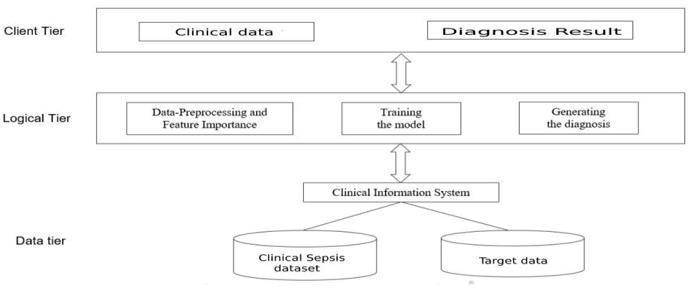
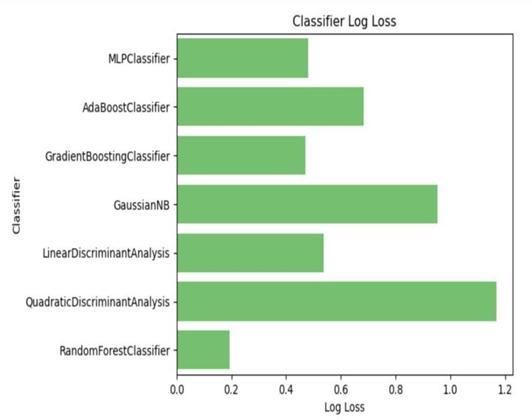
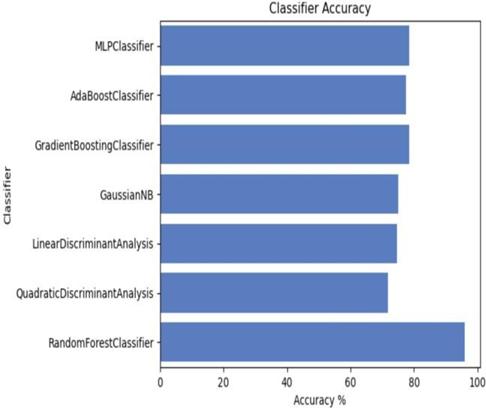
Designingandcreatingamethodforsepsisearlydetection usingRandomForestClassifieristhemaingoalofthisstudy. Pre-processing, determining the value of features, and classifying data are the three main processes in the suggestedmethodology.Thedata will firstgothroughthe resampling method of pre-processing. Using log plots and Yeo Johnson, the feature importance is calculated. The suggestedclassifier,knownastheRandomForestClassifier, providesresultsforthesepsisdetection.Thearchitecture,or block view, of the proposed system's modules, which representsthetechniquewesuggested.Pythonwillbeused to put the suggested method into practice. In order to demonstrate how well the technique works, the system is assessedintermsofAccuracyandLogLoss.Themeasured performanceofthemethodsuggestedinthisresearchwillbe contrastedwiththatofthepreviouswork.
5. SYSTEM ARCHITECHTURE
Fig 1: System Architecture
6. MODULES
A. Data Collection: Data from electronic health records (EHR), information on vital signs, and findings from laboratory tests. HER improves patient care in all areas, including safety, effectiveness, patient-centeredness, communication,timeliness,efficiency,andequity.
B. Tools Used: The libraries for machine learning, including Sklearn, Numpy, Pandas, and Matplotlib. The most widely used library for model validation and meaningful feature extraction is called Sklearn. SMOTE analysis is one of the numerous resampling techniques offeredbytheImbalanced-learnlibrary.
C. Data Preprocessing: Thedataset'ssignificantnumber of missing values required to be imputed for better predictionresultsutilisingseveralmethods,includingthe mean, median, mode, and missforest methods. It uses RandomForestasitsfoundation,handlingeverymissing valueinaccordancewithitsspecifications.
D. Machine Learning Algorithms: One of the finest algorithmsforclassifyingobjectsanddisplayingaccurate performanceisRandomForest.Thebestpredictionismade afterallthefindingsfromweakdecisiontrees havebeen combinedandshowntoexhibititerativephenomena.Vital indicatorssuchHR,temp,O2Sat,MAP,andResptakensix hours prior to prediction, laboratory results, and demographicdatawereusedtoconstructthepredictionof sepsis.
7. UML DIAGRAMS
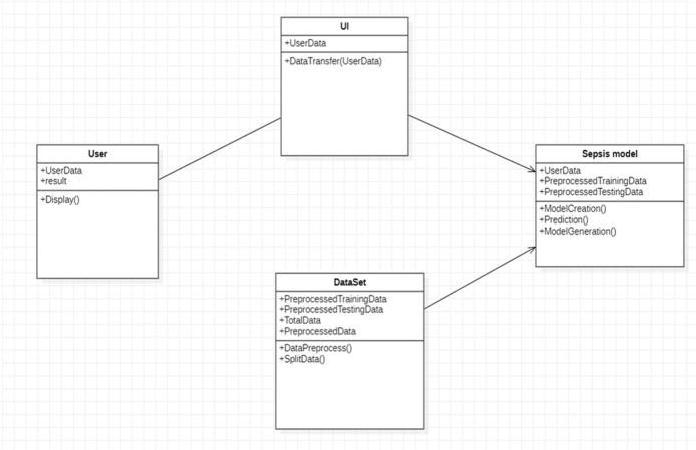
Intheclassdiagram,themajorclassisSepsismodelwhich is connected to UI and DataSet. It contains the attributes likeuserdata,preprocessedtrainingdataandpreprocessed testingdata. Thearetwofunctionsformodel creationas wellasmodelgeneration.Thepredictfunctionpresentin themodelisusedtoanalyzetheparametersandpredictthe sepsis.Theuserclassisusedtoprovideinputanddisplay.
Firstly,thedatasetsarefetchedintotheJupyterNotebook. Then the datasets are trained and tested using various algorithms.Whentheusergivesvitalsigns,demographics andclinicalreportsasinput,themodelanalysesparameters andpredictsthesepsis.
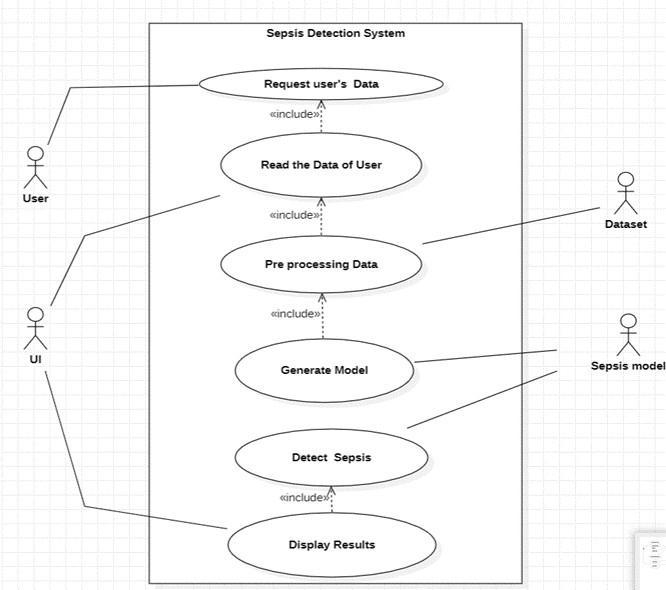
Intheusecasediagramshownbelow,arequestissentby thesystem,requestinguser’sdataforsepsisclassification. User communicates with the website to fill up the form fields.Thepre-processingofdataisperformedonthesepsis dataset. The machine learning model to detect sepsis will classifysepsis andcalculatethesepsis results.Theresults aredisplayedtotheuserusingtheSepsisAPI
Fig 2: Class Diagram
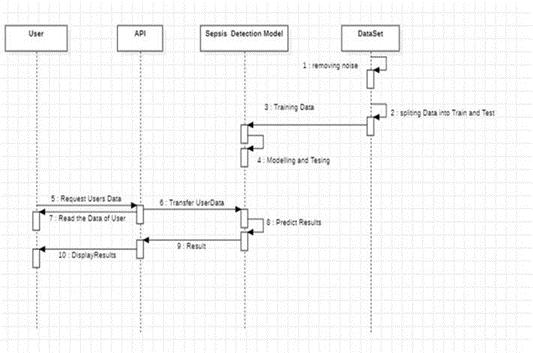
Inthesequencediagrambelowthelifelinesare:
• User
• API
• Dataset
• Machinelearningmodel
8. RESULTS
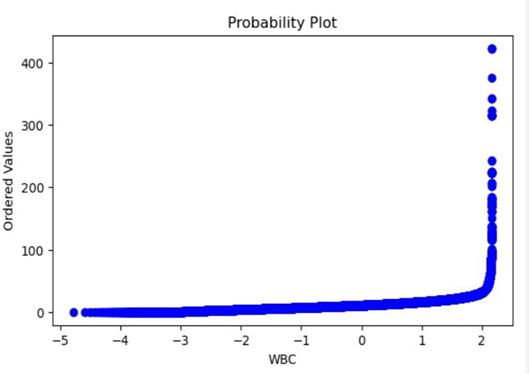
ExploratoryDataAnalysisperformedonthecollecteddata setbycheckingonthebasicparametricrequirements.
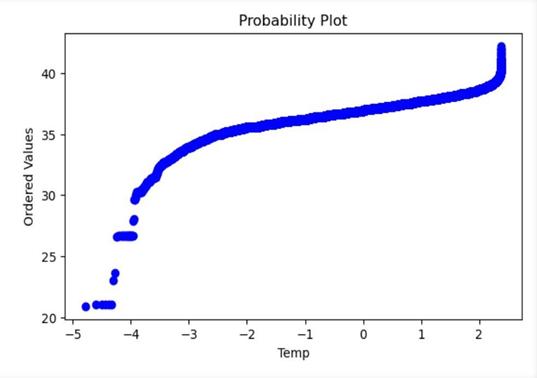
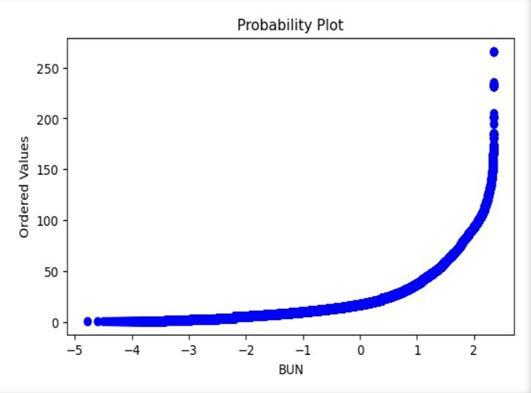
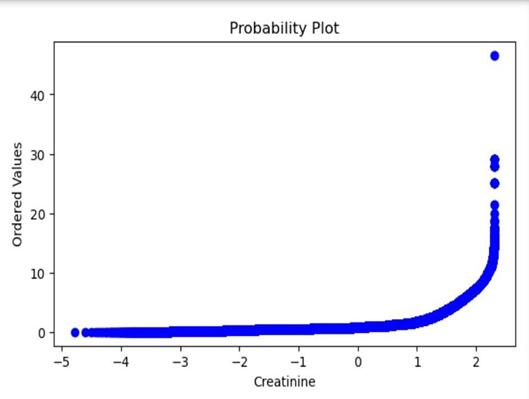
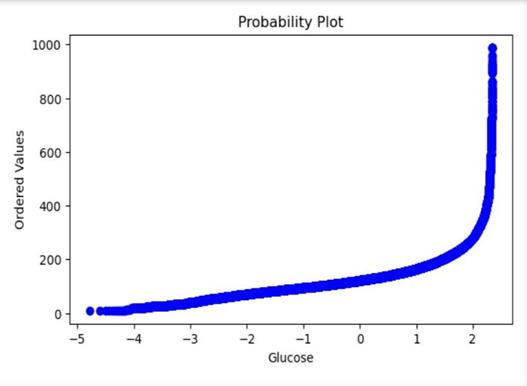
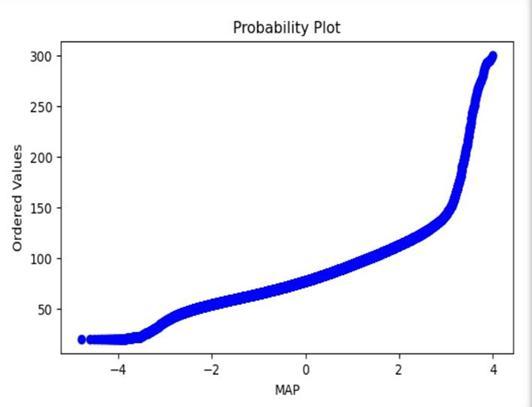
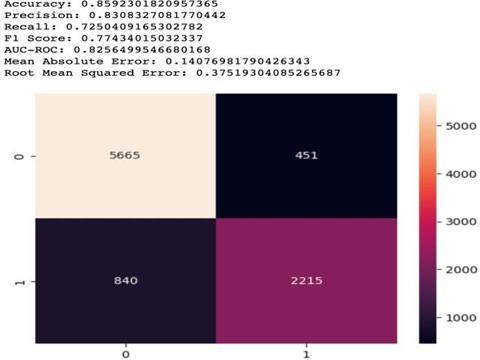
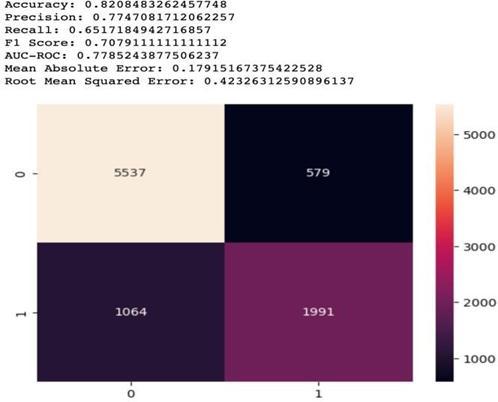
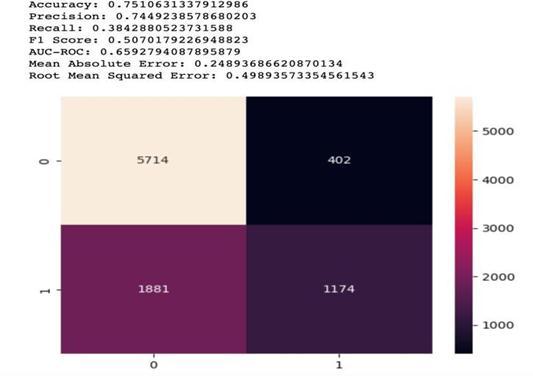
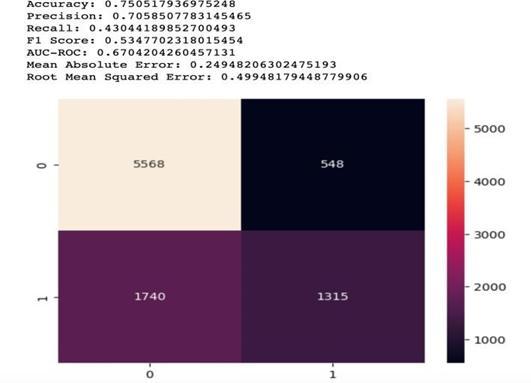
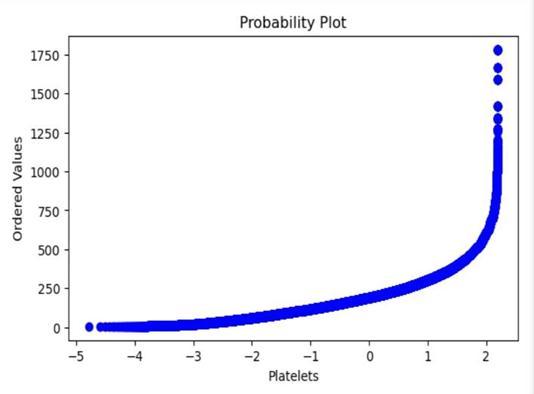
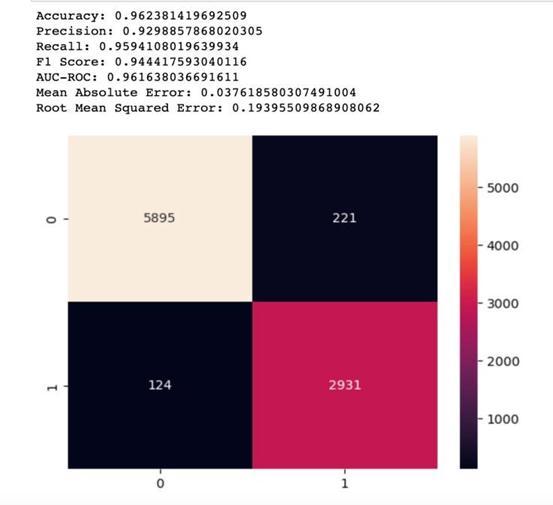
Probabilityplotswereplottedbetweensomeattributesand theorderedvalues.PlotswereplottedforO2Sat,Temp,MAP, BUN,Creatinine,Glucose,WBC,Platelets.Datasetwasfitinto variousalgorithmsandthebestwasfoundbasedonvarious
attributes such as accuracy, precision, recall, f1 score, confusionmatrix,etc.ClassifierAccuracyandLogLosswere plotted.
Probability plot
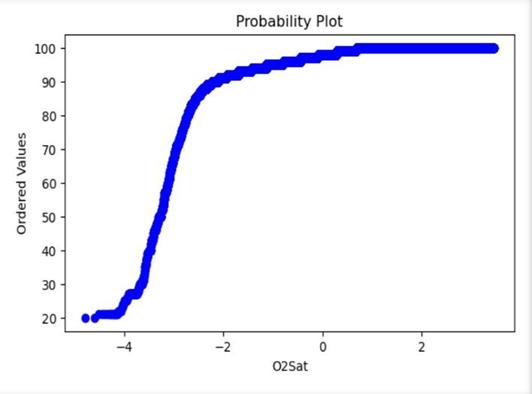
O2Sat vs Ordered Values Probability plot
Temp vs Ordered Values Probability plot
Creatinine vs Ordered Values Probability plot
vs Ordered Values Probability plot
Glucose vs Ordered Values Probability plot
9. CONCLUSION
Sepsisisaseriousconditionthatcausestissueharm,organ failure, or even demise of the person. The main goal is to identifysepsisassoonasapatientarrivesattheemergency roomforcare.Fewsepsisdetectionsystemscurrentlyinuse areLSTMandRNN.However,themaindisadvantageofRNN is that, because of its recurrent nature, an RNN model's computation is slow and only provides 82% accuracy. To address these issues, a method for early sepsis diagnosis employing stacking classifiers including KNN Classifier, NaiveBayesClassifier,andRandomForestClassifier that involves feature importance, pre-processing, and classification hasbeencreated.Thismethodisquick,less likelytoproduceincorrectfindings,andprovidedaccuracy of96.23%.
Thisprojectalsodemonstratestheearlyandmoreaccurate detectionofthisdiseaseusingavarietyofclassifiers,witha focus on stacking classifiers to create accurate prediction modelsandreducetheneedfortime-consuminglabtests.In thefuture,wehopetoimprovetheapplicationbymakingit customer-specific, implementing this model in a hospital website,andassistingthemedicalstaffinspottinganyearly indicationsofdisease.
REFERENCES
[1] NachimuthuS.K.,HuagP.J.EarlyDetectionofSepsisin the Emergency Department using Dynamic Bayesian Networks; Proceedings of the 20 12 AMIA Annual Symposium;Chicago,IL,USA.3–7November2012;pp. 653–662.[PMCfreearticle][PubMed][GoogleScholar]
[2] Sutherland, A., Thomas, M., Brandon, R.A. et al. Development and validation of a novel molecular biomarker diagnostic test for the early detection of sepsis:https://doi.org/10.1186/cc10274
[3] Karen K. Giuliano; Physiological Monitoring for CriticallyIllPatients:TestingaPredictiveModelforthe EarlyDetectionofSepsis:https://doi.org/10.4037/ ajcc2007.16.2.122
[4] M. Fu, J. Yuan, M. Lu, P. Hong and M. Zeng, "An Ensemble Machine Learning Model For the Early Detection of Sepsis From Clinical Data," 2019 ComputinginCardiology(CinC),Singapore,Singapore, 2019,pp.Page1-Page4
[5] Kam, Hye Jin, and Ha Young Kim. "Learning representationsfortheearlydetectionofsepsiswith deep neural networks." Computers in biology and medicine89(2017):248-255.
[6] Kaylor, R. Andrew, et al. "Prediction of in‐hospital mortality in emergency department patients with sepsis: a local big data–driven, machine learning
approach."Academicemergencymedicine23.3(2016): 269-278
[7] https://www.healthline.com/health/sepsis
[8] https://physionet.org/content/challenge-2019/1.0.0