
A STUDY OF COMPRESSIVE STRENGTH OF CONCRETE BY PARTIAL REPLACEMENT OF COARSE AGGREGATE WITH EXPANDED POLYSTYRENE BEADS IN CONCRETE
weightaggregatewithregularparticles.Thisarticlemakes
Abstract -Themajor goal of thiswork isto examinethe characteristics of concrete incorporating Expanded Polystyrene (EPS) beads, including compressive and tensile strengths. Its characteristics arecontrastedwith thoseofregularconcrete,whichisconcretewithoutEPS beads. As a partial replacement for coarse aggregates, EPSbeadsareemployed.Thefindingsindicatedthatthe qualities of hardened concrete are affected by the number of polystyrene beads added to the concrete. When compared to concrete, it was discovered that the compressive strengths of 0.1%, 0.2%, 0.3%, 0.4%, and 0.5 % EPS integrated concrete were 94%, 82%, 75%, 62%, and 52%, respectively. It can't absorb water because it has a closed-cell structure. It is impact resistant and exhibits high sound and thermal insulation properties. Foams made of polystyrene cannot decompose naturally.
Expandable polystyrene beads are a good example. Aggregates, both coarse and fine
1. INTRODUCTION
A lightweight cellular plastic substance called expanded polystyrene(EPS)ismadeupoftiny,sphericalparticlesthat are roughly 98% air and 2% polystyrene. For building construction, concrete offers the greatest degree of flexibility. For fundamental structural applications, the Structure self-weight is crucial because it reveals the majority of the load specifics. Lightweight concrete with dependableacceptablecompressivestrengthcanbecreated bypartiallyorentirelyreplacingthecoarseportionoflow-




an effort to address the potential for using Expanded Polystyrene (EPS), a packing substance that is used as beadsinconcreteandposesarisktowastemanagement and disposal otherwise. Environmentalists are worried aboutthissubstance.Inthis study,EPSbeadsareusedto replace some of the coarse aggregates. Environmental issuesareexploredalongwithageneralreviewofEPS,its production,anditsuse.Tounderstandhowthepolystyrene aggregatebehaves,strengthmetricsarecomparedtothose oftraditionalconcrete.Thisefforttriestosubstitutesomeof thecoarseaggregateswithexpandedpolystyrenebeadsat theratesof.01%,0.2%,0.3%,0.4%,and0.5%.
2. Literature Review:
Experimental Study on Properties of Concrete by Using Expanded Polystyrene Beads (EPS) as a Partial Replacement of Coarse Aggregate Prabhunath B. Kulkarni, Prof.G.N.Shet (2022). It is noted that the workabilityofEPSBEADSincreaseswithanincreasein the proportion of trash. According to the results of the currentinvestigation,concreteretainsitsstrengthupto 5%ofreplacementandstartstodeteriorateat15%.Itis feasible to employ leftover EPS beads in concrete to increase its flexural and compressive strengths. As performance indicators for concrete workability and strength in this experimental study, expanded polystyrenebeads(EPSBeads)areusedinplaceofsome coarse aggregate, sand, cement, coarse aggregate, and water.

Expanded polystyrene beads in structural grade concrete with various aggregateparticlesizesmadeof normal weight Elsevier Bogdan Rosca, Vladimir Corobceanu (2020). Accordingtothisstudy,the7to28 days compressive strength ratio varies within the same margins for each examined percentage of replacing normal-weight aggregate with EPS beads for all considered water-to-cement ratios and particle distributions of normal-weightaggregate. Given that the water-to-cement ratios employed in this study are moderatetolow-moderate,itisstillconceivabletoachieve betterconcretestrengthswithlowerratios.Becauseithas somebeneficialqualities,suchaslowdensity,lowthermal transmissioncoefficient,insignificantabsorptioncapacity, etc., expanded polystyrene (EPS) material with broad application.
Expanded Polystyrene is Added to Lightweight
Concrete to Adjust Proportions (EPS) S. Aishwarya and. M.Gunavel (2020) This study found that whereas compressive strength generally rises with age during curing, densities and strength decreases as EPS beads grow in size. When EPS beads are replaced, the content falls and the split tensile strength declines. Expanded PolystyreneBeadsareaddedat10%,20%,and30%inthe currentwork.Theirflexural,splittensile,andcompressive strengths are investigated. According to the findings, a maximumof10%oftheexpandedpolystyrenebeadscanbe replacedbythevolumeoffineaggregate.Itcanbeutilized for structures made of ordinary concrete, though M25 concrete is preferable. The EPS and M sand's fineness helps to better cement and aggregate bonding, which resultsinhigh-qualityconcrete.
Effect of Expanded Polystyrene (EPS) on Strength
Parameters of Concrete as a Partial Replacement of Coarse Aggregates Hitesh Patidar, Mayur Singi, Abhijeet Bhawsar (2019) In this essay, it is claimed that asmodernconstructiontechniquesadvance,sodoesthe dailydemandforbuildingsupplies.Thisstudycontrasts traditionalconcreteblockswithconcretethathascoarse aggregatepartiallyreplacedwithpolystyrenebeads.The compressivestrength,splittensilestrength,andflexural strength for M30 and M40 when coarse aggregate is replaced by 5%, 10%, 15%, 20%, 25%, and 30%. Low water/cement ratios result in very high workability of the mixture.Concrete'scompressivestrengthisdecreasedas theamountofEPSbeadsinthemixisincreased.
3. Scope And Objectives :
1. Toassesstheworkabilityofconcretecontainingand excludingEPSinvariousratiosatvariousgrades.
2. Tocomparethecompressivestrengthofconcretethat contains and does not contain EPS in various ratios at various grades.To compare concrete with and without EPSinvariousratiosandgradesinordertoestablishthe SplitTensileStrength.
4. Methodology :
Flow chart




Materials and methods:
4.1 Cement: Ordinary Portland Cement (OPC) of grade43wasemployed,andbothitscompositionand physical characteristics complied with Indian Standard Organization requirements. The mix design of M-25 grade is prepared using regular Portland cement. The cement used was brand-new and lumpfree. Using IS 456:2007 As a guide, the water-tocementratioforthismixdesignis0.42.
4.1.1 Physical properties of Cement:
substance.Thewasteproductsleftbehindfromthepacking industry. That causes a transfer problem. Concrete made with pulverized polystyrene is a successful waste transfer method.
4.6 Properties of Expanded polystyrene beads: Table No:- 2
4.2 Sand: Sand is a naturally occurring coarse material made up of rock and mineral particles that have been carefullyseparated.Itssizedistinguishesitasbeingfinerthan gravel and coarser than silt. In terms of the particle size employed by geologists, sand may also be assigned to a texturalclassofsoilorsoiltype,i.e.,asoilthatcontainsmore than 85% of sand-sized particles (by mass); sand particles rangeindiameterfrom0.0625mmto2mm.
4.3 Aggregate: The primary component of concrete is aggregate.Theygivetheconcretebody,lessenshrinkage,and boosttheeconomy.Sand,gravel,crushedstone,slag,recycled concrete, and geosynthetic aggregates are just a few of the coarseparticlematerialsknownas"constructionaggregate," orsimply"Aggregate,"thatisutilizedinconstruction.
4.4 Water:Cleanlinessandtheabsenceofharmfullevelsof oils, acids, alkalis, salts, sugar,andorganiccomponents are required for the water used for mixing and curing. For mixing concrete, potable water is typically considered sufficient.Itisforbiddentomixandcureusingseawater.The pHvaluemustbeatleast6.
4.5 Expanded Polystyrene Beads: EPS, or expanded polystyrene,isatypeofplasticmaterialthatcontains98per cent air and 2 per cent polystyrene. They are made up of tiny,roundparticlesandarelightinweight.Itisincapableof absorbing water like a closed-cell structure. Inconel has good impact resistance, temperature resistance, and acoustic resistance properties. EPS is a biodegradable
The casting of Specimen: Cubes150mmx150mmx 150mm test specimens will be produced using common moulds.Thespecimensarepreparedforcasting.Thesamples areremouldedandcuredinawatertankfor7to28daysafter casting for 24 hours. In order to test properties like compressiveandflexural strength, atotal of48 specimenswere cast. 24 cube samples of 150 mm x 150 mm x 150mm dimension will be cast for varied percentages of partial replacement of expanded polystyrene beads with coarse aggregate.Theconcretemixesare0.1%,0.2%,0.3%,0.4%, and 0.5%
whenexpandedpolystyrenebeadsarepartiallysubstituted forcoarseaggregate.Withtheaidofamachinevibrator,all cubeswillbecastinoneliftandconsolidated.Afterthecubes have reached theirfinal set,thecubemouldsareremoved,and

the cubesare kept in the water tank for 7 to 28 days of curing.
5. Testing of specimen: Thespecimensweretaken outofthemouldafter24hoursandwater-curedfor7and 28 days, respectively. According to Indian standard specification IS: 516-1959, the specimens were tested for compressive and flexural strength after curing using a compressivetestingapparatuswithacapacityof200KN.The strengthofthecubewasassessedafter7and28days.After28 days,thebeamstrengthwasassessed.
5.1 Slump Test: The percentage of coarse aggregate replaced by polystyrene (as a partial replacement of aggregate)wasshowntoaffecttheworkabilityofthemixes, sothehigherthereplacementofpolystyrene,thehigherthe workability. This test was performed to see whether thefreshly laid concrete was workable.According to IS 456:2000, the aggregate size used in testing shouldnot be greaterthan20mm.
5.2 Compressive Strength Test: Atestis administered in accordance with IS:516- 1959. Concrete and mortar cubesof150mmx150mmx150mmwereusedforthe test, and specimens were removed from thecuring tank after7,14,and 28daysofcuring.Then,surfacewater was permitted to fall. Afterwards, samples were examinedon aCompressionTestingMachinewitha200-toncapacity (CTM).Bydividingthehighestcompressiveforcebythe cross-sectional area, the compressive strength was computed.Compressivestrengthisassessedafter7and 28days.Thefindingsdemonstratethatthecompressive strength increases as the amount of expandedpolystyrene beads increases from 0% to 5%,butdeclinesas thenumberofEPSbeadsincreases.We areabletosubstituteupto5%ofthetimeasaresult.
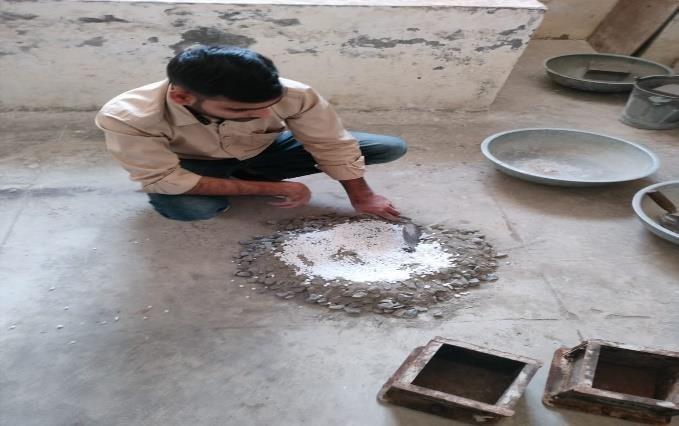
5.3 Split Cylinder Test: The cylindrical specimen has dimensions of 150 mm indiameter and 300 mm in height. Concrete splitting tensile strength is 2P/3.14 DL N/mm2.wherep=maximumloadapplied(KN).diameter (mm)andlength(L)(m).


6. Results And Discussion:
6.1Compressive strength test result:
Compressive strength (N/mm2) of 7,14, and 28 day
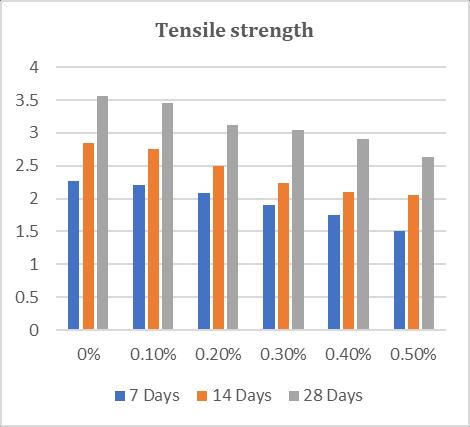
6.2 Tensile behaviour (splitting test)results: Table No 5
Compressivestrengthisassessedafter7,14,and28days. Thefindingsdemonstratethatthecompressivestrength increasesastheamountofexpandedpolystyrenebeads increasesfrom0%to0.5%,butdeclinesasthenumber ofEPSbeadsincreases.Weareableto substituteupto 0.5%ofthetimeasaresult




6.3 Flexural Strength Test: IS: 516-1959, Flexural strengthisthetermusedtodescribethetensilestrength of concrete. Flexural strength is used to estimate the loadingatwhichcrackinginastructurebeginstooccur.

flexural strength test results : FlexuralStrength at 28days
7 Conclusions :
decreases the material's compressive and tensilestrengths.
2. As the amount of polystyrene beadsgrows, workabilityalsorises.
3. While compressive strength typicallyrises with age during curing, densities and strength fall as EPSbeadsincreaseinaccordancewithage.
4. WhenEPSbeadsaresubstituted,thesplittensile strengthreducesandthecontentdoestoo.
5. As EPS beads were replaced, the content's flexuralstrengthwasalsoreduced.
6. The greatest strength (compressive,split tensile, and flexural) was reached at 0.1% of expanded polystyrene and was shown to decrease for 0.5% of expanded polystyrene;nonetheless, itcan be used for

single-story buildings tomake them more affordableandto lowerthedeadload.
8.References:
3. The Impact of Expanded Polystyrene (EPS) as a Partial Replacement of Coarse Aggregates on Concrete Strength Parameters Mayur Singi,Hitesh Patidar,andAbhijeetBhawsar2019.
4. "Lightweight Concrete Utilizing EPS," International Journal of Scienceand Research, Volume 4 Issue 3, 2007–2010;AbhijitMandlik,Tarun
5 P.L. Chowdary, "Strength Properties of Expanded Polystyrene Beads, Concrete," Journal of Environmental Science, Computer Science,andEngineering&TechnologyJECET,Vol.4. No.3,734742(2015).
6 Expanded polystyrene (EPS) reinforced concrete: state-of-the- report, American Concrete Institute committee 544, ConcreteInternational: Design and Construction, 4(5):9–30,Detroit,Michigan,USA,1982.
7 Bureau of Indian Standard, Manak Bhavan, Bahadurshah Zafar Marg, New Delhi, 1970. IS 383-1970: "Specifications for Coarse and Fine Aggregates from Natural Sources for Concrete" (SecondRevision).
2. Concrete of structural grade contains expanded polystyrene beads with various aggregate particle sizes.BogdanRoscaandElsevierCorobceanu
1. Prabhunath's Experimental Research on Concrete Properties Using Expanded Polystyrene Beads as a PartialReplacementofCoarseAggregateB.Kulkarni, G.N.Shet,and(2022). (2020). Modification of lightweight concrete by expandedpolystyrene inclusion (EPS) Gunavel M., AishwaryaS.2020.