FEA of Ultra High Performance Fibre Reinforced Concrete -Encased Steel Composite Beams
Simi K R1 , Ancy Eldho2 , Manjusha Mathew31M Tech, Structural and Construction Management, MGMCET, APJ Abdul Kalam Technical University, Kerala, India

2,3Assistant professor, Civil Department, MGMCET, Pampakuda P.O, Muvattupuzha, Kerala, India ***
Abstract – The steel- Ultra highperformance fiber reinforced concrete composite(UHPFRC)beamsissimulatedasnonlinear finite element model, to compare the behaviour of each elements individually and as composite beam. Three types models are analyzed, steel beam with and without vertical stiffeners, an UHPFRC beam and a composite UHPFRC beam. The study investigated the encasement effect of steel, the role of shear span to depth (a/d) ratio in composite beam and the effect ofeffectivelengthofthe steelbeamonductility,stiffness, ultimate load bearing capacity and failure pattern of composite sections.
Key Words: Composite beams; Ultra high performance; Numerical models; Shear response; Encased beams; Non-linear analysis; Encased effect
1.INTRODUCTION
Tomeettherequirementsofglobalization, Indiahasdoinga majorleaponinfrastructuresdevelopmentsuchasexpress highways,industrial andpowerstructures,largedamsetc. Conventionally, for the construction of civil engineering works, concrete play main role and a large quantum of concreteisbeingutilized.Toachievetheintendeddurability andsustainability,thecurrentinfrastructureincorporatesa mixofuniquedesignstyles,powerfultechnology,andhighend durable construction materials. The Construction Materials & Technology Promotion Council (BMTPC) was establishedbytheIndiangovernmentin1990toencourage and promote the use of sustainable, energy-efficient, and environmentalfriendlybuildingmaterials.Thisleadstothe evelution of composite section. Pure steel and concrete construction now replacing withsteel concrete composite sectionsanditacceptedasasuitablealternative.
1.1 Composite Structures
Using reinforced concrete member, increase the size of structureandcostofconstructionwithloadandspan.It’s possiblewithcompositesections,samecrosssectionswith different load and moment resistances can be created by changingthesteelthickness,concretestrengthandsizeof reinforcement. It helps the section to keep the outer dimensionsasconstant,anditmakesmoreeasinessinthe construction and architectural detailing. The composite
sectionscanwithstandinhighstressesandhaveexcellent ductility.
1.2 Use of UHPFRC
TheUHPFRCmatrixiscomposedofhighamountofcement and silica fume, steel fibers, very low Water/cement ratio (0.18 to 0.25) and water reducers. It offers almost no shrinkageorcreepandmakingitverysuitableforconcrete members under long-term loading. Compared to normal strength concrete, UHPFRC shows strain-hardening behaviourduetothebridgingeffectofshortfibers.Presence ofnano-additivesimprovethemechanicalpropertiesrefines theporestructure,favourscementhydration,andimproves durability.Moreover,inthecrackedstate,nano-constituents improve the self-healing capacity of concrete. Due to the densemicrostructureanddamage-tolerancecharacteristics, the UHPFRC provides significant enhancement in the sustainabilityofconcretemembers.Theprestressedhybrid pedestrian bridge at Sherbrooke in Canada, is the first structuralapplicationofUHPFRC,whichwasconstructedin 1997.60meteristhetotalspanlengthofthebridge.
2. PERFORMANCE ANALYSIS OF MODELS
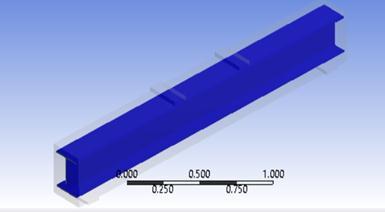
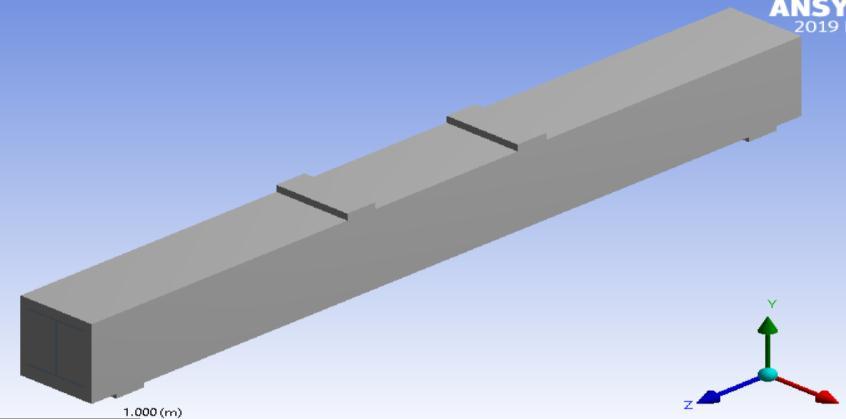
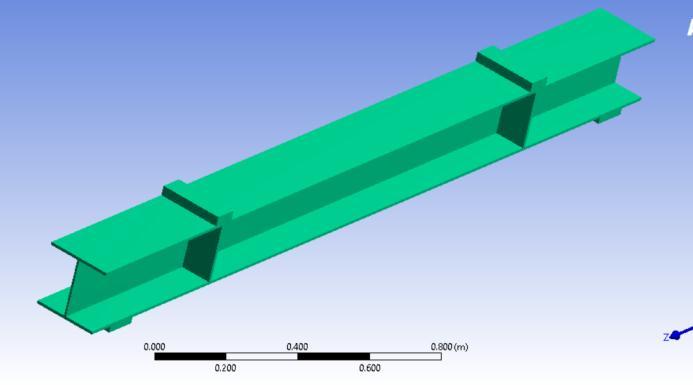
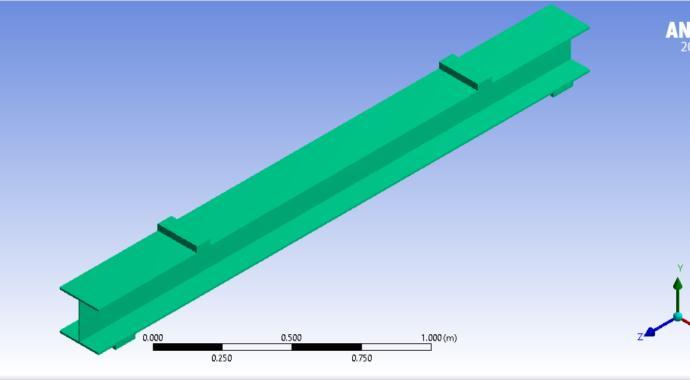
There are four beam models with total five patterns consideredunderthreeconcepts.Theyareshownintable1 andthemodelgeometriesareshowninfigure1,2,3and4. ThedensityofUHPFRCcanvarydependingonitsspecific compositionandtheproportionoffibersused,buttypically ranges from 2200 kg/m3 to 2600 kg/m3. The density of steelfibersusedinUHPFRCcanalsovarydependingontheir specific composition and shape. However, as a general approximation,thedensityofsteelfibersusedinUHPFRC ranges from 7800 kg/m3 to 8000 kg/m3. The addition of steel fibers to UHPFRC can significantly improve its mechanical properties, such as its tensile and flexural strength, as well as its resistance to cracking and impact. Table2showsthematerialpropertiesadoptedforanalysis. The simulation process was carried out with ANSYS Workbench2019R3.
250 CompositeBeam (250mmx300mm)
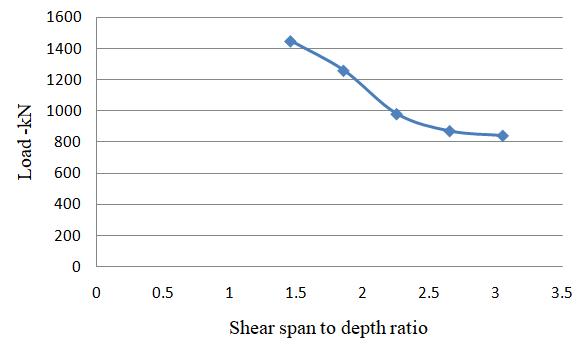
Consideredaspanof2500mmformodels.Twoendsupports areprovidedasboundarycondition.Oneendwithahinged support and the second with a roller support. ANSYS Workbenchautogeneratemostsuitablemeshforthemodel. Rangeofa/dratioconsideredfrom1.456to3.056with0.4 intervalswereanalyzed. Thisaimedtofindtheeffectofthe a/dratioontheloadcarryingcapacity,ductilityandfailure patternofthecompositebeams.
3. RESULT AND DISCUSSION
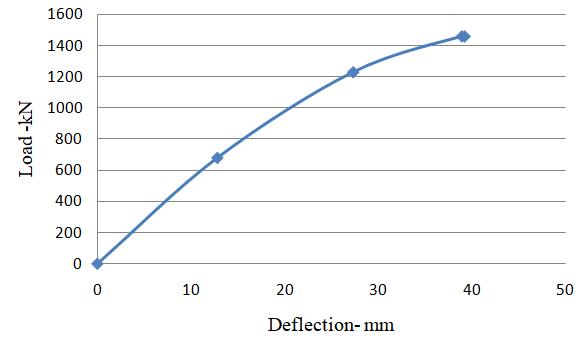
In the simulation process, ISWB 250 performs better than ISHB 200, even they have almost equal per meter weight. Withandwithoutverticalstiffenersnotexhibitscomparable differenceinperformance.HenceISWB250sectionwithout vertical stiffeners is used for composite beam, as an economicalsection. Incomparisonwiththethebehaviourof idividual elements, the combined beam’s failure pattern is appreciably high. The stiffness of composite beam also increasedbyencasement.
Theresultssaysthatthefailurepatternnotaffectedby the a/d ratio and at the same time the deflection of beam affected, but not considerably . Flexural cracks in the bending zone is the reason of failure in all beams, before failure,shearcrackspropagatedinthecriticalshearspan. Allbeams(samplesconsidered))hashighductilitybefore failure.Thestiffnessandtheultimateloadcarryingcapacity ofcombinedsectionisinverselypropotional toa/dratio. Table4andchart1showstheresults.
Approximatelyidentical.Whentheembeddedsteelsection length decreases with respect to UHPFRC beam, area of bonding decreased. In addition, as the reduction in encasementlength,thevalueofbendingmomentaffecting thetwoendsofthesteelsectiongrows.
Theencasedsteelbeamlengthvariedto70,80,90and100% oftotallength.TheresultsinTable5andchart2showsthat thelengthofthesteelbeameffectivelyaffectsthebehaviour of composite beams, in load-midspan deflection, stiffness, ductility and cracks propagations. When the encasement lengthwasreducedto10%(ie.,0.9L),thestructuralresponse ofthecompositebeamisalmostequalbecausethebonded areabetweenthetwoelementswassame,andthemidspan deflectioncurvesofthetwocompositebeamswere
4. CONCLUSIONS
Theconclusionsofthestudyfocussedinsomespecificpoints, first point is that the UHPFRC-encased steel beams exhibits noticable improvement in failure pattern than individual performance of each material. Shear-flexural cracks is the failurereason ofthecomposite beamandwhichwasdueto withoutlocalbucklingofencasedsteelsection.Secondly,the performanceofthecompositeelementwas8.6timesand12 timeshigherthan(inultimateloadcapacity)thatofthesteel and UHPFRC beams, respectively. Only the combined beam exhibitsductilityindex before failurein theanalysed varied models such as steel beam, UHPFRC beam and composite beam.
There is no significant effect with difference in a/d ratio, in deflectionatyield.Asthea/dratioincreased,theultimateload capacity and stiffness of composite beams decreased. Accordingtothefindings,theencasementeffect,thea/dratio, andtheencasementlengthinfluencetheshearperformanceof composite beams. These are the main factors that must be consideredwhiledesigna UHPFRC-encasedsteel composite beams.
REFERENCES
1. IS 11384 (1985): Code of Practice for Composite Construction in Structural Steel and Concrete
2. IS 3935 (1966): Code of Practice for Composite Construction
3. EuropeanCommitteeforStandardization.EN1994-2: (2005), Design of composite steel and concrete structures - Part 2: General rules and rules for bridges, Brussels
4. Al-Sarraf S. Z., Yang J., and Kadhum A. F.,(2010), BehaviorofShortSpanCompositeBeamsStrengthened withCFRPStrips, Eng. and Tech.Journal, Vol.28,No.1.
5. GraybealB.(2011),Ultra-highperformanceconcrete, No. FHWA-HRT-volume11-038
6. ZhengW,LiL,LuS.(2011),Experimentalresearchon mechanical performance of normal section of reinforced reactive powder concrete beam. J Build Struct, volume32(6),page125–34.
7. KhareN,ShingadeV.(2016),Experimentalstudyonthe performance of composite beams with and without shear reinforcement, Int J Eng Res Develop Volume 12(7),page10–6.
8. Prem PR, Murthy AR. (2016), Acoustic emission and flexural behaviour of RC beams strengthened with UHPC overlay, Constr Build Mater , volume123, page 481–92.
9. Hadi MNS, Algburi AHM, Sheikh MN, Carrigan AT. (2018), Axial and flexural behaviour of circular reinforced concrete columns strengthened with reactive powder concrete jacket and fibre reinforced polymer wrapping, Constr Build Mater, volume 172, page717–27.
10. Egyptian Code of Practice for Steel Construction and Bridges (Allowable stress design), ECP 205-2001, (2018), Housingand Building NationalResearchcenter, Giza
11. Pourbaba M, Joghataie A, Mirmiran A. (2018) Shear behavior of ultra-high performance concrete, Constr Build Mater, volume183,page554–64.
12. He Ji, Chao Liu, (2020), Ultimate shear resistance of ultra-high performance fiber reinforced concretenormalstrengthconcretebeam, EngineeringStructures volume 203
13. T.A.Mohammed,Parvin.Azadeh, (2020), Vehicle collisionimpactresponseofbridgepierstrengthened withcompositesASCE, Practice PeriodicalonStructural Design and Construction
14. MansourW,TayehBA.(2020),ShearbehaviourofRC beamsstrengthenedbyvariousultrahighperformance fibre-reinforcedconcretesystems. Adv Civil Eng
15. Basha A, Fayed S, Mansour W. (2020), Flexural strengthening of RC one way solid slab with Strain HardeningCementitiousComposites(SHCC). AdvConcr Constr, Volume9(5)Page511–27.
16. S. Kumaraguru, P. Alagusundaramoorthy, (2021), Flexural strengthening of steel beams using pultruded CFRP composite sheets with anchorage mechanisms, Structures,Elsevier, page1414–1427
17. Tesfaye Alemu Mohammed, Solomon Abebe, (2022) Numerical investigation of steel-concrete composite (SCC) beam subjected to combined blast-impact loading,Helion,Volume8,Issue9
18. T.A.Mohammed,T.Alebachew, (2022), Numerical investigation of as-built and carbon fiber reinforced polymerretrofittedreinforcedconcretebeamwithweb openings under impact loading, ASEAN Eng.,volume 12(1),page173-182
19. WalidMansour,BassamA.Tayeh,Lik-hoTam,(2022), Finite element analysis of shear performance of UHPFRC-encased steel composite beams: Parametric study, Engineering Structures,volume 271.