FLOATING SOLAR PV PLANT
Abstract - Floating photovoltaic is a new design option for photovoltaic (PV) power plants; floating photovoltaic systems (FPVS) are often installed in bodies of water such as natural lakes or swimming pools, and external solutions are also being explored. The cost effectiveness of FPVS can be greatly improved if the floating structure also performs other functions, such as reducing water evaporation. The purpose of the is to evaluate and compare the electrical and thermal performance of the FPVS with an onshore photovoltaic system (OPVS) of similar capacity. Therefore, this study primarily deals with the development of photovoltaic systems, then examines the energy production of photovoltaic systems and finally analyses the ability to complement the advantages and disadvantages of floating photovoltaic systems. Also found that FPVS has up to 2.33% more daily energy than OPVS. Also, an experimental test was performed in this study to compare the power of the FPVS at different tilt angles.
Test results confirm that the FPVS produces the highest power when installed on the best annual slope. Therefore, it is recommended to set the PV modules at a good angle for FPVS. also discusses the role of other factors in FPV heat, such as PV equipment or frequent biofouling. Finally, an estimate of the economic impact of thermal behaviour on FPV value and competition is presented.
Key Words: photovoltaic system;floatingsystem; water basin; evaporation, Cooling system, dams’ reservoirs. overlandPVsystem

1. INTRODUCTION
Landusebyphotovoltaic(PV)shopscanbeincompletelyor fullyavoidedbyenforcinganarisingsolartechnologyknown as floating PV, which seeks to break the paradigm that mountingsolarpanelsonbodiesofwaterisaexpensiveand complicatedprocessstationedinsystemsaroundtheworld( 1).FPVSsgenerallycorrespondofarackassemblymounted onfloatingstructures(FS)similarasraftsorpontoonsthat areinstalledinenclosedbodiesofwatersimilarasbudgets, ponds, and small lakes. Due to the novelty of these PV results,utmostsystemsarepersonalandsmalltomedium sized. still, numerous different models and systems of different scales( up to the megawatt scale) have been created,withindeedbiggerplansforthefuture.Intheonce decade, floating photovoltaic systems( FPVS) installed on
waterbodiessimilarasnaturallakesorleveebudgetshave attractedmoreandmoreglobalattentionandhaveformerly beenstationedinseveral countriesincludingJapan,South Korea, and the USA. The floating PV power factory is an arisingtechnologyproposedbytheauthorsnearly10times agone,andseveralstudiesconfirmtheirrapid-firegrowth( 2). How important water would be lost without FPVS depends on the point and original climate and must be preciselycalculatedtoestimatethiscriticalbenefit.Onthe other hand, it should also be mentioned that this effect physicallycontradictstheformerone,thatis,thelowerthe evaporationintheforce,thelowertheevaporativecooling caused by the water body and the lower the increase in photovoltaic effectiveness. field. In this report, we will explore how combining FPVS with standard wastewater treatment tanks is a veritably intriguing integration with environmental benefits and profitable benefits for both sectors energy product and water conservation. Technologicalinventionsandadvancementsforharvesting energyfromrenewablesourcessimilarassolar,windand water are crucial factors that determine the future of renewable energy systems( 1). FPVS have multitudinous advantages compared to OPVS, specifically 1) FPVS don't bear any space on the ground which represents a huge profitableadvantage.Theycanbeinstalledinunusedspace on water bodies, similar as hydroelectric levee budgets, wastewatertreatmentponds,etc.(Cazzanigaetal.,2018);) Floatingstructuresgiveshadetoa bodyof waterwhich it reduceswaterevaporationandthusmaintainsthevolumeof stored water( Qin etal., 2019). Clot etal. reported in their work that FPVScould reducewater evaporationlosses by 15,000 to 25,000 m3 for each MWp installed( Rosa- Clot etal.,2017).Overall,theliteraturereportsthatwaterlosscan be reduced by 25 to 70 with FPVS( Do Sacramento etal., 2015;Sahuetal.,2016);)Theshadethatfloatingstructures producecanhelphelpalgaegrowthandtherebyameliorate water quality( Pringle etal., 2017); ) Since solar panel effectivenessdecreaseswithaddingtemperature,bodiesof water that host floating structures can help cool the solar panels, meaning that FPVS can profit from the natural cooling effect of water and operate. with advanced effectivenesscomparedtoOPVS(Rosa-ClotandMarcoTina, 2020;SongandChoi,2016).Ingeneral,FPVScanincrease the effectiveness of photovoltaic modules by over to 12( Ranjbaranetal.,2019);)Thenaturalreflectivityofthewater face increases the prevalence of solar radiation in the PV
modules,thereforeaddingtheproductofPVenergy(RosaClotetal.,2017).InadditiontoenvironmentalgoodsonFPV performance,considerationmustbegiventotheimpactthat FPV installations themselves can have on the terrain. FPV can be anticipated to affect wind speed and water temperature.Indeed,PVmodulesinescapablyinducetones andreducethequantumofvisiblesunreachingthewater. Thisreducedincomingradiationcanbeanticipatedtolead to cooler water bodies. still, Armstrong etal.( Armstrong etal.,2020)refocusedoutthatthepresenceofmodulescould alsoreducegregariousheatfluxes,leadinginsomecasesto warmerfacewater.Inaddition,itshouldbeconsideredthat theFPVmodulescouldactaswindbreaks.thus,whilelower radiationwouldleadtolowertemperatures,reducedwinds maybegetreducedwindmixing,addingwaterpositionand thereforewaterfacetemperature.Thesetwofactorswere also lately studied by Exley etal.( Exley etal., 2021). The authors estimated that the presence of FPV is likely to reduce face water temperature, but also stressed the possibility of advanced water temperatures when wind speedisreducedsignificantlyfurtherthansolarradiation. The magnitude oftheconvincedchanges wouldvary with FPV face content lower temperature changes should be anticipated at small contents( 50). Yang etal.( Yang etal., 2021)conductedpreciousexplorationontheenergybudget of floating photovoltaic systems and concluded that their heatbalanceisdominatedbylong-surgeradiation.Indeed, theauthorssetupthat whilethepresenceofthemodules reduces the shortwave radiation entering the water, the incoming longwave radiation increases due to the high temperatureoftheFPVmodulesduringtheday.Inaddition, nightly radiative cooling is affected. Overall, they set up advanced air and water temperatures under the modules compared to open water. set up advanced air and water temperaturesunderthemodulescomparedtoopenwater.
2. INOVATION: -
2.1. Self-Cleaning Solar
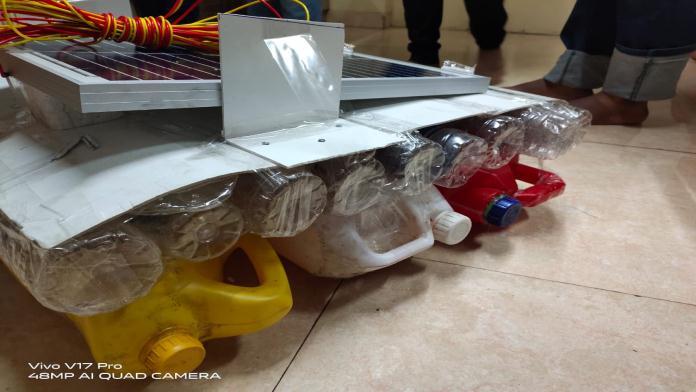
Self-cleaning means that thecleaning operation does not requireanymanuallabor,movablemechanismsorrobotsto beattachedtothesolarpanelforcleaningpurposes.Thus, the surface the panels can keep clean by repelling all contamination,oractivelycleanthemselvesasneededand whenneeded,independentlyoftimeoftheday,availability ofsunorrain.
2.2. Fish Food Funnel
Duetomassreductioninaquaticlifewehaveusedfishfood funnel method in our floating module to maintain rich aquaticlife.Bottomofthefloatingmoduleconsistofafunnel pipethroughwhichfishfoodissprayedinwater.
2.3. Evaporation Reducing Liquid
There are some types of chemicals used evaporation reducinginwaterbodies.Hexadecanoloracetylalcoholand octadecanoyl or stearyl alcoholor a mixture of these two chemicals is commonly used for suppressing evaporation fromlakesandreservoirs.Wehaveprovidedsmallpipeduct to spread this liquid in water bodies to reduce the water evaporationatsomeextent. Thischemicalsdoesn’tharms aquaticlife.
Fig.1.Model of Floating Solar
2. DICUSSION: -
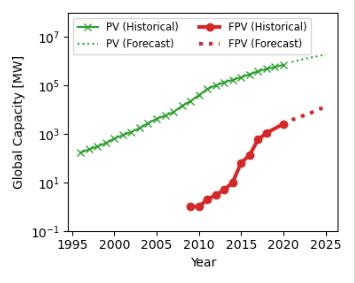
PV and renewable energies in general have higher land requirementsthanconventionalsources(Capellán-Pérezet al., 2017). This means that large-scale deployment of PV could deduct agricultural land and/or pose risks to biodiversityifPVisbuilton landavailableatlowcostbut withhighecologicalvalue(Serranoetal.,2020).Therefore, thephotovoltaiccommunityhasbeenlookingatalternative solutions, such as floating photovoltaics (FPV), to avoid achievingglobalenergytargetsattheexpenseofbiodiversity and/orfoodproduction.InFPV,PVmodulesareinstalledon bodies of water instead of on land. This will prevent competitionforlanduseandgenerallyensurelowerrents. AsshowninFig.1,FPVhasreachedaglobalcapacityof2.6 GWinjusttenyears(Haurwitz,2020),whichisexpectedto double by the end of 2022 (Deloitte, 2022). In addition, recent forecasts predict 13 GW of FPV capacity by 2025 (Deloitte, 2022), which could provide up to 2% of global electricity generation by 2030. Understanding the proper thermalbehaviourofFPVsystemsisessentialtosupportthe developmentanddeploymentofthistechnology.Infact,FPV systemsareusuallymountedatlowpitchanglescompared toLPVstolimitwindloadsonthefloatingstructure(Silverio etal.,2018).Althoughtheseanglesareclosetotheoptimal bank angles in regions around the equator, at higher and lowerlatitudes,lowanglescangeneratemorereflectionand angular losses, reducing FPV yield. Lower operating temperaturescanatleastpartiallyoffsetlossesduetolow pitch. A techno-economic analysis (Campana et al., 2019) showed that FPV with an 11% efficiency increase due to cooling could achieve significantly higher reliability and
lower levelized electricity costs compared to LPV in Thailand.A more recent study conducted in the same country(CromartieClemonsetal.,2021)showedthata10% higher efficiency due to better cooling could cut FPV electricitycostsinhalfcomparedtoLPVsandachievesimilar payback periods. Similarly, a study published in 2020 (PadillaCamposLopesetal.,2020)foundthata5%increase in power output due to cooling could make FPV costcompetitivewithLPVinBrazil.Furthermore,anotherwork (Michele,2021)showedthatiftheexpectedloweroperating temperatureswereconfirmed,FPVcouldalreadycompete withLPVinSpainintermsoflifetimeelectricitycostsand profits.
2.1. Effect of temperature
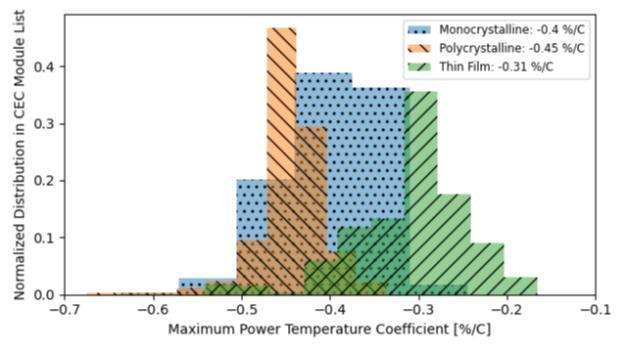
PV modules directly convert sunlight into electricity. However,mostoftheincidentsolarradiationcannotbeused bythemodulesandisthereforeconvertedintoheat,which increasesthetemperatureofthePVcell.TheefficiencyofPV modules decreases with increasing temperature, so it is important to keep it to a minimum. In addition, cell temperature is one of the main precursors of PV module degradation(Ascension-Vásquezetal.,2019).Indeed,high absolute module temperatures can, in combination with other specific conditions, cause hydrolysis and photodegradation,whilehightemperaturechangescanlead to thermomechanical stress. PV modules are made of differentsemiconductormaterialsandtheydonotallhave the same response to temperature. Their behaviour is typically expressed by temperature coefficients, which describetherateatwhichthevariouselectricaloutputsof themoduleschangewithrespecttotemperature(Kingetal., 2000). These are negative if the value of a parameter decreaseswithincreasingtemperature,suchasopen-circuit voltageandmaximumpower.Otherwise,theyarepositiveas farastheshortcircuitcurrentisconcerned.AsshowninFig. 2,differentmaterialshavedifferenttemperaturecoefficients. Typical performance values range between -0.45%/°C for crystalline silicon technologies and -0.20%/°C for amorphoussilicon(Theristisetal.,2018).
2.2. Floating photovoltaics
FPV has already been the subject of a number of reviews.TrapaniandSantafé(TrapaniandRedónSantafé, 2015)describedthestateofthetechnologyin2014,listed offshore FPV power plants installed in the period 20072013, and also described new FPV designs capable of withstanding harsher offshore conditions. They reported thattheownersofthe500kWpowerplantinBubano,Italy claimeda20-25%increaseinelectricityoutputduetothe coolingeffectofthewater.Thefirstcomprehensivereview waspresentedin2016bySahuetal.(Sahuetal.,2016).In this work, the authors discussed the advantages and disadvantages of this technology compared to other PV applications.Among the pros of FPV, they cited increased
efficiencyduetothelowerambienttemperatureduetothe cooling effect of water.In addition, they analysed the economics of FPV and reviewed commercially available designs.
2.3. Literature review
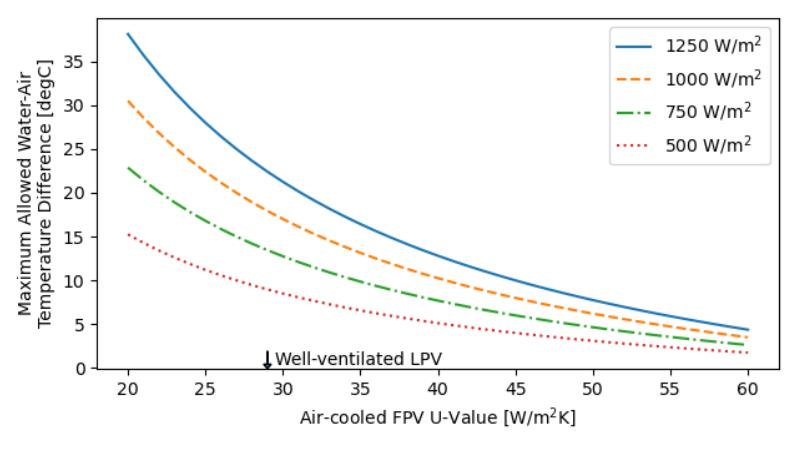
Fromathermalpointofview,FPVsystemscanbedivided into two groups based on whether the rear surface of the module is in contact with air or water. Each group is discussedseparatelyinoneofthetwofollowingsubsections (3.1 for air) and (3.2 for water).Tilted FPV modules are generally air-cooled, although some partially submerged designs have been presented (and are discussed in 3.2).Horizontal FPV modules are usually in direct contact withwater.However,insomecasesthehorizontalmodules have been suspended above the water surface and are thereforeair-cooled.
2.4. Air cooled FPV
Manycasestudiesonthethermalandelectricalperformance ofFPVhavebeenreportedintheliterature.However,most studies are site and/or design specific and difficult to generalize.Choi(Choi,2014)investigatedtheperformance ofvariousFPVsystemsinKorea.First,theauthorfoundthat the 100 kW and 500 kW FPV systems at Hutcheon Dam producedyields10%to13.5%higherthantheLPVsystem installed60kmaway.Inaddition,theauthorcomparedthe performanceoftheFPVsystemandtheLPVsystem,which are located and installed with a tilt of 11 degrees also in Korea. FPV showed a consistently better capacity factor duringthestudyperiod(JanuarytoJuly2012).
3. CONCLUSIONS
Floating photovoltaics is one of the emerging solutions capable of mitigating competition in urban planning for photovoltaics.Inadditiontolimitedlandrequirements,FPVs areoftenattributedwithloweroperatingtemperaturesthan LPVs and are therefore expected to operate with higher efficiency. If confirmed, the improved thermal behaviour could help make this technology cost-competitive and successful. In this light, this work evaluates the current knowledge on the thermal behaviour of FPV systems and reviewsindepththeliteratureavailableonthesubject.
Todate,publicationsonFPVhaveoftenbeensiteordesign specific,makingitdifficulttoidentifyuniversalconclusions. However, the current review points out that in order to betterdescribetheirthermalbehaviour,FPVsystemsshould beclassifiedaswater-cooledorair-cooled.Accordingtothe available literature, the former can be expected to reach lower temperatures than LPV, due to better water heat transfer. Additionally, the data suggests that these lower temperaturescouldalsoberecordedforwatertemperatures higherthanairtemperatures.Also,air-cooledsystemscan achievebetterthermalperformancethanLPV,butexamples ofhighertemperaturesthanLPVhavebeenreportedinthe literature. Some initial comparative experimental studies
havebeenpresented,showingthatsomedesignsfavourheat exchange (open structure and/or small footprints), while FPVs with closed structures and larger footprints can be hotter than LPVs. The results are explained by the role of wind speed in air cooling; the highest heat transfers are foundinstructuresthatsupportairflow.However,bythe same token, some local conditions may impede FPV heat transfer,suchaslowwindspeed,asysteminstalledbelow ground level, and/or the presence of vegetation and buildingsaroundthewatershed.
(1) Due to water cooling, the average ambient water temperatureisapproximatelylowerthanthatonlandwith allotherconditionsbeingequal.Thispapercreatedafinite element model and found a difference in operating temperature between a floating photovoltaic cell and a terrestrialcell.
(2)Basedonthewatercoolingeffect,thestudyfoundthat the efficiency of floating photovoltaic systems can an increase of approx. 1.58-2.00% compared to traditional terrestrialPVsystems.
(3)Thepotentialoffloatingphotovoltaicsystemscanreach 160 GW, covering about 2500 km2 of water Surface. This wouldhelpsave2*1027m3ofwaterfromevaporationper year. If the saved water can be used with hydropower, it would further contribute to an indirect water saving of approx.1.25*1012m3.Inaddition,floatingPVsystemscan greatlyfacilitatecompetitionforland.
REFERENCES
[1] Annualreport2015,ReportIEAPVPS.IEAInternational EnergyAgency,2015.
[2] Trapani K.and Santafe M R. A review of floating photovoltaic installations: 2007–2013. Progress in Photovoltaics: Research and Applications, 2014; 524–532;
[3] Choi,Young-Kwan.2014.“AStudyonPowerGeneration Analysis of Floating PV System Considering Environmental Impact.” International Journal of SoftwareEngineeringandItsApplications8,no.1:7584.https://doi.org/10.14257/ijseia.2014.8.1.07.
[4] Su S,Yuan G. International Clean Energy Development Report[M].SocialScienceLiteraturePress.2016
[5] Evans, D.L., 1981. Simplified method for predicting photovoltaicarrayoutput.Sol.Energy27,555–560.
[6] NREL. 2018. “International Activities: Country Programs.” National Renewable Energy Laboratory (NREL). 2018. https://www.nrel.gov/international/ country-programs.html.
[7] RonnietoC.Mendoza,GlendyD.Aguilar,AlexanderT. Demetillo,"DesignofFloatingSolarPowerSystemfora LocalCommunityApplicationwithSamplePrototypefor a Single Panel",20216th International Conferenceon Development in Renewable Energy Technology (ICDRET),pp.1-6,2021.
[8] G Mamatha, P S Kulkarni, "Feasibility analysis of FloatingSolarPhotovoltaicPlantatSrisailaminAndhra Pradesh: India", 2021 IEEE 2nd International Conference on Smart Technologies for Power, Energy andControl(STPEC),pp.1-6,2021.
[9] VijayKumar,KusumLata,RohitBhakar,ParulMathuria, "SolarPhotovoltaicOnWaterBodiesinRajasthan",2021 9th IEEE International Conference on Power Systems (ICPS),pp.1-6,2021.
CURRICULUM VITAE
1) D.W.Gawatre, “Environmental Impact of Construction Materials & Practices to Save Planet Earth”,InternationalJournalofAdvanceScientific Research&EngineeringTrends(IJASRET),Volume05,Issue12,Aphril-2021.Pp118-124.E-ISSN24560774.
2) D.W.Gawatre, “Environmental Impact of Construction Materials & Practices to Save Planet Earth on Lean Technique-Case Study”, Quest Journal, Journal of Architecture and Civil Engineering,Volume-06,Issue05,June-2021.pp12-37.e-ISSN2395-1052.
3) D.W.Gawatre,“Exploration ofWastePlasticBottles use in Civil Construction and Decorative Material (compoundwall)”IntentionalResearchJournalof Modernization in Engineering Technology and Science (IRJMETS) e-ISSN:2582-5208.Volume-04 Issue-5,May-2022Pp.3891-3895.
4) D.W.Gawatre, “Planning and Development of Satellite city” Intentional Journal of Research in EngineeringandScience(IJRES)e-ISSN:2320-9356. Volume-10Issue-5,May-2022.Pp.-55-61.