Credit Card Fraud Detection Using Machine Learning
Abstract – Fraud is the act of depriving a person/organization of money through willingness, deceptionorotherunfair means. The unforeseen event of Covid-19 has led to many people embracing digital transactionsandonlineshopping.Thiscombinedwithother benefitsprovidedbycreditcardissuerssuchasrewardshas increased the usage of credit card, and in turn increased credit card frauds. Credit card default can have serious implications on credit card holder and can affect financial stabilityofcreditcardissuers.Thereisaneedforasystem thatcanpredictdefaultsaheadoftimesothatappropriate measurescanbetakenbycreditcardissuers.Inthispaper, we have provided a comparative analysis of various machine-learningalgorithmsoftenusedinfrauddetection suchaslogisticregression,decisiontreeclassifier,random forestclassifierandsupportvectormachineclassifier.The modelswerecomparedonthebasisofprecision,recalland accuracytofindthebestalgorithmforpredictingprobable defaulters
Key Words: Credit Card fraud, Credit Card default, Machine Learning, Support Vector Machine, Decision Tree, Logistic Regression, Random Forest
1.INTRODUCTION
The banks earn money by various means such as lending loanstoothercustomersusingthedepositor’smoney.The interestgainedistheprofitearnedbythebank,butwhenthe borrower defaults, the loan becomes a NPA and is a huge blowtothebank’sstatements.Itwasestimatedthatthetotal amountofNPAsinIndiaincreasedfrom2.39lakhcrorein 2014 to 10.36 lakh crore in 2018. Therefore, an effective systemmustbedevelopedtocurbthesedefaultsevenbefore theyoccur.Differenttypesofdefaultsinfinanceinclude:
Loan default: This is the most common type of default.Inthiscasetheloanborrowerfailstorepay theloan.
Creditcarddefault:Thisoccurswhenthecreditcard holder uses his/her credit card to buy items that they cannot afford but doesn’t repay the money spent.
Bond default: when the organization/government fails to repay the loan/principal amount, it is consideredasbonddefault.
Wehavefocusedondevelopinga systemtopredictcredit card defaulters. A comparative analysis was done on the
performance of various algorithms such as logistic regression,decisiontree,randomforestandsupportvector machine based on precision, recall and accuracy. The traditional systems available such as CIBIL score uses demographic data, credit history and so on to calculate a score. This score is employed by many money lending organizations to judge whether to issue the loan to this applicantornotandtosetthecreditlimitincase ofcredit cards.However,thissystemonlygivesanideatobanksof thelevelofriskinvolvedingrantingthepersonloan.Hence, wehavedevelopedamodelthatpredictwithprecisionthe probabilityofauserdefaulting.
2. LITERATURE REVIEW

The paper by author Yue Yu, [1] concentrates on the importanceofcreditcarddefaultpredictionbyhighlighting theneedoftimelyandprecisepredictiontopreventfinancial lossesforbothbanksandtheusers,thenproceedingtomake anoutlineofvariousmachine-learningbasedalgorithmsby explainingtheirprinciples,advantagesandcomparingtheir performances. YueYu thenintroducesthedatasetused in thepaper,whichincludesthirtythousandentriesofcredit cardusersfromaTaiwanesebankcontainingtheirprevious creditcardtransactioninformation,card-userdemographics, and payment behavior to train and evaluate these algorithms.Thepaperthenpresentsananalysisofapplying theselectedmachinelearningalgorithmstothedatasetand evaluating their performance using parameters such as accuracy, precision, recall, score of harmonic mean and ReceiverOperatingCharacteristicgraph.Theresultsshow thatallthealgorithmsconsideredforthetestproducegood results but artificial neural networks and support vector machinegivingbetteraccuracyandperformancerates.The article ends by admitting some drawbacks and potential scopeforfuturestudy.
Authors,YashnaSayjadah,KhairlAzharKasmiran,Ibrahim AbakerTargioHashem,andFaizAlotaibi, [2] intheirpaper, have recognized challenges associated with credit card default prediction, such as imbalanced datasets and the requirementforprecisemodels.Toanalyzetheirstudy,the authors obtained a dataset containing credit card information and default status which is pre-processed by handling missing values, encoding certain variables, and conductingfeatureascending.Followingwhichthedatasetis categorizedintotrainingandtestingpurposes.Accuracyof differentalgorithmswasnotedforthepossibleoccurrenceof default credit card. Algorithms used here are logistic
regression,decisiontreeandrandomforest,theaccuracyof thesewere75%,64%and77%respectively.Baseduponthis theauthorshaveconcludedthatbankscanadapttherandom forestalgorithmtodetectthecreditcarddefaulterssothat theycananalyzetheriskbeforegivingthecreditcardtothe clients. In general, the paper captures a thorough examinationofcreditcarddefaultpredictionusingmachine learningmethodsandaseeminglybrightplatformforfuture hypothesis.
Alžbeta Bačová and František Babič’s paper, [3] draws attention towards creating a model that can predict the possibilityofacustomerboundtomisshispayment.Forthe purpose of their investigation, the authors employed a dataset that contained generic data on credit card users. Fromthethesis,itwasdeducedthatpredictiveanalyticsmay effectivelyidentifyclientswhoaremorelikelytoforgetto payusingacreditcard.Theresearchersfoundthatspecific variablefeature,definitelyinfluencehowapredictioncanbe made. The trained model was accurate, which hints that there is a way for them to find purpose in the credit card market.Thepaperestablisheshowpredictiveanalyticsmay be used to identify credit card defaulters and reduce financialrisksforcreditcardissuers.Tosumitup,thepaper servesasavaluableresourceforcreditcardcompaniesand industry professionals keen in implementing predictive analyticstopredictdefaultsofcreditcardholders.
ThewritersTalhaMahboobAlam,KamranShaukat,Ibrahim A. Hameed, Suhuai Luo, Muhammad Umer Sarwar, Shakir Shabbir,JiamingLi,andMatloobKhushi, [4] investigatesthe problemofcreditcarddefaultpredictionusingimbalanced datasets.Theauthorsstartwithcitingtheneedofaproper detection and prediction system to identify precise and accurate default predicting project, as it helps establishments identify dicey borrowers and make calculated decisions regarding credit approvals. There is alwaysanimbalancepresentwhilegoingthroughdifferent datasets.Thiscanleadtobiasedmodelsthatperformpoorly inpredictingdefaults.theimpactofdatasetsoncreditcard default prediction is investigated along with different techniques to address this issue. The authors find that regular classifiers trained on imbalanced datasets tend to benefitthemajorityclass,resultinginsmallerrecallscorefor thedefaults.However,byapplyingsamplingtechniques,the performanceoftheclassifiersimprovesdrastically.Adaptive Synthetic Sampling consistently beats other techniques, providingbetterpredictionaccuracyandrecallprecisionfor defaultinstances.Theauthorshighlighttheneedformore comprehensiveanddiversecreditcarddefaultdatasetsto validate the findings of this study and to facilitate the developmentofbettermodels.
Thepaperpreparedbyauthors,SaraMakki,ZainabAssaghir, YehiaTaher,RafiqulHaque,Mohand-SaïdHacid,andHassan Zeineddine, [5] introduces different approaches for detectingcreditcardfraudsoccurringthroughimbalanced
datasets. The experimental arrangement involves using a practicalcreditcardtransaction.Theauthorsnotethatwhile hybridsamplingandcertainalgorithmsprovidetherequired results, choosing the proper algorithm may depend invariably on the problem at hand. The paper shows differentoverviewofresearchesofexistingapproachesand techniques to check the ones who have defaulted. They arrive at a solution that no algorithm alone is suffice to address the issue of imbalance in datasets. The research workbriefsaboutconfusionmatrixandrelatedresultsare formulatedintables.Theconfusionmatrix,isalsogivenby thetermerrormatrix,itisatablethatisfrequentlyusedto assess how well a categorization model is working. It summarisesthemodel'spredictionsandthedegreetowhich theyagreewiththeactuallabelsordataclasses.Thegenuine class labels and anticipated class labels are represented, respectively,byrowsandcolumnsinagridthatrepresents the confusion matrix. For the purpose of detecting credit cardfraud,thepaperoffersanexperimentalinvestigationof unbalanced classification algorithms. To increase the accuracyoffrauddetection,itevaluatesthebodyofresearch, discusses various methodologies, shows experimental findings,andstressesonbalancingclasses.
D.Tanouz,GVParameswaraReddy,RRajaSubramanian,A. RanjithKumar,D.Eswar,CHVNMPraneeth, [6] havemade areportaboutthegrowingthreatofcreditcardfraudand thenecessityforeffectivedetectionsystems.Theapproach depicts promising results and contributes to the development of strong fraud detection systems by recognizingtherisingthreatofcreditcardfraud,theauthors dwell into a broader spectrum of the research of various algorithms suitable for fraud detection. To validate their proposed approach, the researchers conduct experiments usingapracticalcreditcarddataset.Theyaswellassessand compare the parameters of the different algorithms employed.Theefficiencyofmachinelearningalgorithmsin detectingcreditcardfraudbyleveragingpatternsismarked and regular techniques process the results and upon tabulatingtheoutcomesvariousfeatureswereconsidered whichwereputintotablesevidentinthepaper.Theauthors examine approaches such as primary component study, featurerankingandengineering,providingvisionsintotheir impact on the accuracy and efficiency of the systems. The authors also discuss the importance of dataset preprocessingandhandlingtechniquestoaddresstheinherent classimbalanceproblemincreditcardfrauddatasets.The authors conclude by making a reference to a number of studies, research papers, and publications in the area of creditcardfrauddetection.
3. METHODOLOGY 3.1 DATA
Thedatasetusedforbuildingthemodelswasobtainedfrom UCI Machine Learning Repository. It consists of 30,000
observationsand24features.Thisinformationwascollected fromTaiwanaspartofaresearchintheyear2005.Itconsists of demographic details of the user, payment history, bill amountandtheamountpaidbytheuser.
Feature Description
ID
LIMIT_BAL
SEX
EDUCATION
Itisanumberusedtoidentify theuser
Itisthelimitofthecreditcard
Indicatesthegenderofthe user(1=male,2=female)
Itindicatesthelevelof educationoftheuser(1= graduateschool,2= university,3=highschool, 4,5,6,0=others)
Thecontributionofvariouscategoricalvaluesthatisgender, education and marital status was analyzed in terms of default.
MARRIAGE
PAY_0 to Pay_6
Itindicatesthemaritalstatus oftheuser(1=married,2= single,3,0=other)
Itindicatesthepayment statusofthecreditcardfrom ApriltoSeptember2005(-2= noconsumption,-1=payduly, 1=onemonthdelay,2=twomonthdelay….9=nine-month delay)
BILL_AMT1 to BILL_AMT6
PAY_AMT1 to PAY_AMT6
DEFAULT
Itindicatedthebillamounted onthecreditcardfromApril toSeptember2005
Itindicatestheamountpaid bytheuser
Itindicatesiftheuser defaultednextmonthornot (0=non-defaulter,1= defaulter)
3.2 EXPLORATORY DATA ANALYSIS
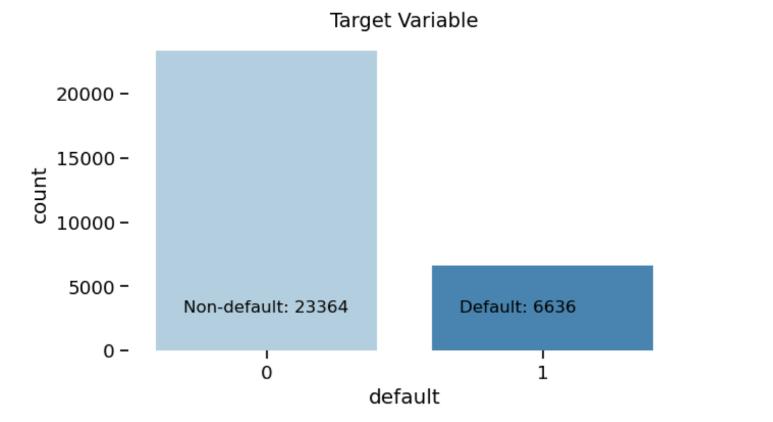
Wehaveusedmatplotlibandseabornlibrariestovisualize andgetbetterunderstandingofthedata.Itisclearfromthe bargraphinfigure-1thatthedataishighlyimbalancedi.e., the number of non-defaulters is far more than defaulters, this can lead to a bias towards class 0(non-default) while modelling.
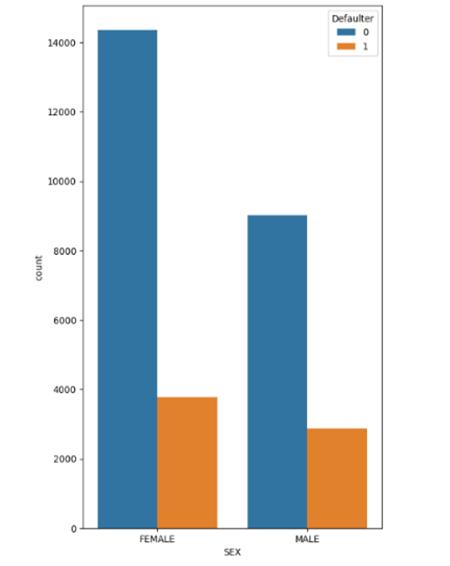
It can be observed from figure-2 that there was generally morefemaledatainthedatasetcomparedtomaledata,and asaconsequencemorefemaleshavedefaultedascompared tomales.
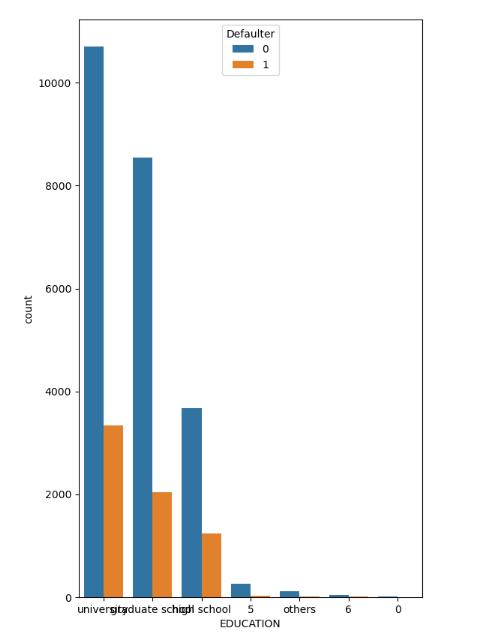
Visualizingeducationallevelintermsofdefault
Majorityoftheusersinthedatasethaveeducationallevelof university,theuserswitheducationallevelhavedefaulted more,followedbyeducationallevelofgraduateandfinally highschool.
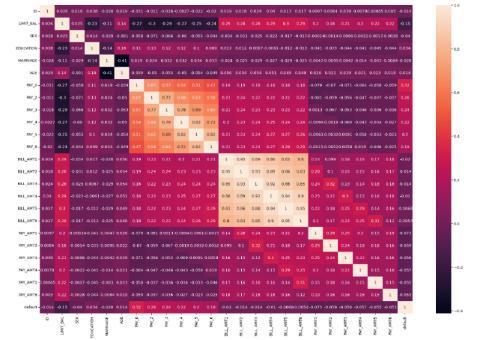
It can be noticed that default is only positively correlated with payment status features. The limit_bal is positively correlatedwithbill_amtandpay_amt,whichisobvioussince the credit card issuers tend to give higher credit limit to applicants with good credit history. Also bill_Amt and payment status features are also positively correlated to each other and bill_amt and pay_Amt are also positively correlated.
3.3 DATA PRE-PROCESSING
Fromthefigures-3andfigure-4itcanbenoticedthatthereis inconsistencyinthelabelsofthesecategoricalfeatures,that ismultiplelabelsseemtobeindicatingthesamecategory.In ‘Education’ categorical feature, the label 4,5,6 and 0 all indicate the ‘other’ category. In ‘marriage’ categorical feature,thelabel3and0indicateusersin‘other’category. This can cause confusion for the model in prediction of default, so we have removed these inconsistencies by combiningtheselabelsintoone.
Some algorithms can be sensitive to categorical features. Thus,weencodedthesecategoricalfeaturesusingtheLabel Encoderclassofscikit-learnlibrary.
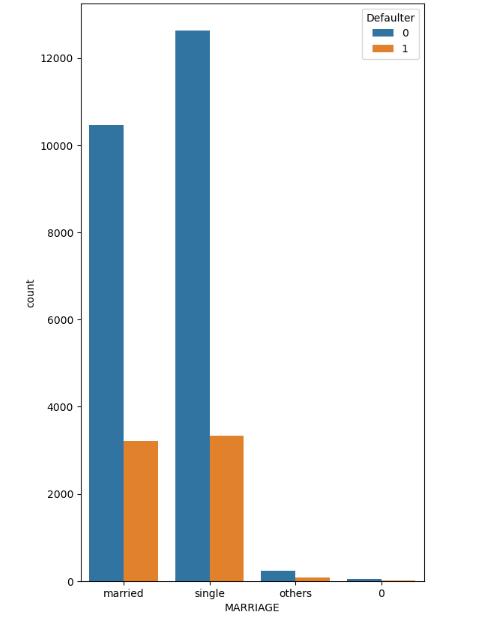
Figure4:Visualizingmaritalstatusintermsofdefault
Itcanbenoticedfromfigure-4thatthedatasetmostlyhas users who are single. There is not much difference in numberofdefaulterswhoaresingleanddefaulterwhoare married. A slight percent of ‘other’ category has also defaulted.
Finally,acorrelationheatmapwasplottedtounderstand the relationshipofvariousattributedwith eachotherand thetargetvariable.
Wedroppedthefeature‘ID’sinceitisonlyusedtoindicate theuserandhasnocontributiontowardsthepredictionof default.Thenthedatasetwassplitintothetrainsetandthe testset(80:20)usingthetrain_test_splitclassofscikit-learn library.
Finally,westandardizedthedatasetbyscalingthedata in termsofmedianabsolutedeviationusingsklearnlibrary.
3.4 MACHINE LEARNING ALGORITHMS
The main objective of the project is to predict probable defaulters for which we have used four most popular machinelearningalgorithmsoftenusedforfrauddetection. Theseare:
Logistic regression:
This is popular classification algorithm that can takes any input value and gives the probability of the dependent variablebetween0and1.Itthenfitsasigmoidfunctionand when the new input data point comes it calculates its probability,iftheprobabilityisgreaterthanthethresholdit ispredictedas1oritispredictedas0.
Decision tree:
Decision tree builds tree that predicts the outcome of the dependentvariable.Themodelasksaquestionandbasedon the answer splits the dataset into subset, here one node corresponds to the answer yes and another node correspondstoanswerno.Themodelkeepssplittinguntil max_depth value has reached or the node contains values fromsameclass.
Random forest:
Random forest is based on ensemble learning which combines multiple decision tree and predicts dependent variablebytakingaverageofallthedecisiontree.Thisgives betteraccuracyandreducestheproblemofoverfitting.
Support vector machine:
Support vector machine algorithm creates a decision boundary (hyperplane) that separates default and nondefault cases. This hyperplane is chosen such that it maximizesthemarginbetweenthetwoclasses.Themargin is created by calculating the distance between the hyperplaneandsupportvectors.
K-Nearest Neighbor:
KNNalgorithmstoresallthedataduringthetrainingphase and when the new data point comes in, it calculates the distance between the new point and the neighbors. Then selectsthestatednumber ofnearestneighbors.Finally,the number of default and non-default outcomes are counted, whicheverhasthemajorityisassignedastheoutcomeofthe newdatapoint’sdependentvariable.
4. RESULTS
The various algorithms were evaluated on the basis of accuracy, precision and recall. Accuracy is the measure of predictions that are correctly predicted out of the total predictions.Precisionismeasureoftruepositivethatwere actuallycorrect.Recallismeasureoftruepositivesthatwere correctlyidentified.Highrecallwillleadtofewerdefaulters being precited as non-defaulters where as High precision will reduce the number of defaulters predicted as nondefault.However,thereisatrade-offbetweenprecisionand recall. For our problem statement it is important to have high precision, since we don’t want our system to be predictingnon-defaultersasdefaulter.
Decisiontreehastheleastaccuracyandthebestaccuracy isgivenbySVM.
It can be noticed that generally the precision is more for class 0 (non-defaulter), this is due to the imbalance in dataset. As a result, even though the accuracy is good for someofthealgorithms,theyhardlycanpredictdefaulters correctly.Butonchangingthedecisionthresholdofsupport vector machine, the precision for class 1(defaulter) drasticallyincreased,whichmeansitcancorrectlypredict 64%defaultersand84%non-defaulters.
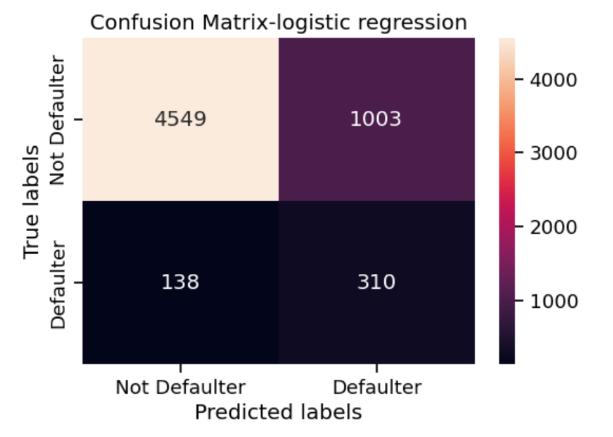
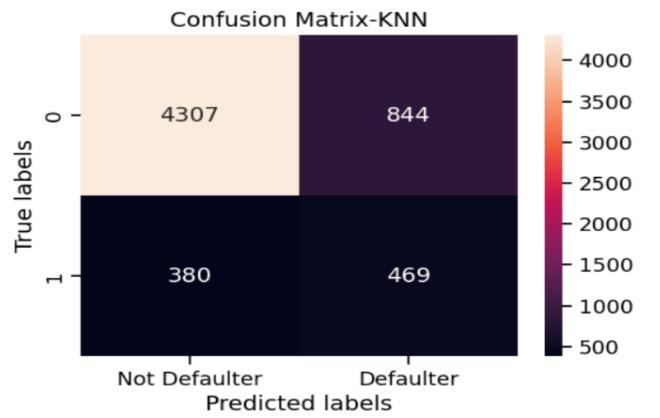
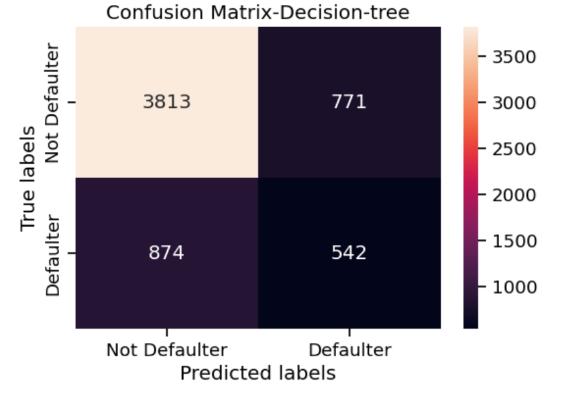
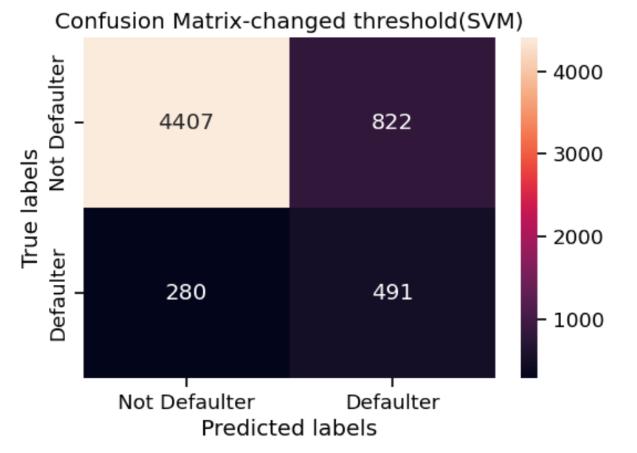
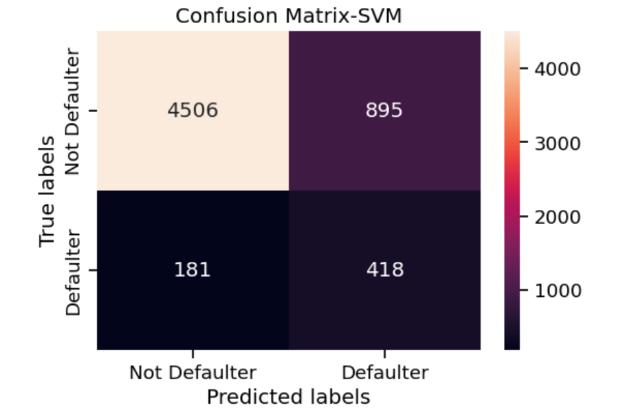
Incaseofrecalltoo,generallytherecallforclass0ismore than class 1. The best recall for class 1 was from support vector machine. The confusion matrix for the various algorithmswereasfollows:
AlthoughKNNhashightruepositiveandtruenegatives,still thenumberoffalsepositiveandfalsenegativeisquitehigh.
SVM seems to be doing well with good number of true positivesandtruenegativesandlowfalsenegatives.
Logisticregressionhashightruepositives,itperformsquite badatpredictingdefaulters.Thus,logisticregressiondoesn’t servethepurposeofthisproposedsystem.
However,changingthethresholdtoincreasetheprecision forclass1,providesfarbetterresults.Thenumberoftrue negatives has increased and the number of false positives hasdecreased.
Eventhoughdecisiontreehaspredictedthegreatestnumber ofdefaultsbyfar,thetruepositiveshavereducedandfalse negatives have increased, which means quite a lot of defaulterswereletofftheradar.
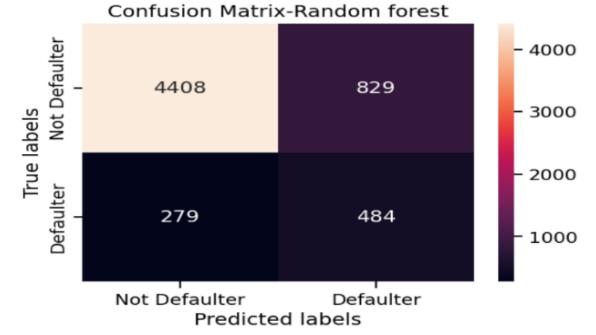
Random forest too has performed good with high true positives,truenegatives.
However, SVM with changed threshold seems to be performing the best with both true positive and true negativesbeinghighandreducingfalsepositives.
5 CONCLUSIONS
Themainobjectiveofthisproposedsystemistocorrectly predict defaulters. We employed KNN, logistic regression, decisiontree,randomforestandsupportvectormachineto find the best algorithm for the problem statement. We evaluated these algorithms based of accuracy, precision, recall and comparing their confusion matrix. The major challenge we faced was the imbalanced dataset, however under sampling or oversampling seems to be misrepresentingtherelationshipbetweenXandYleadingto poorperformance.Thus,wehaveusedthedatasetwithout anysamplingformodelling.Itcanbenoticedthataccuracy alonecannotbeusedtojudgetheperformanceofamodel. Even though logistic regression has high accuracy, it performed poorly on test set. In conclusion, both support vectormachineandrandomforesthavegoodaccuracy.SVM with slightly changed threshold performs the best with reduced number of false negatives and better recall and precision.However,itishardtonarrowdownononeofthe models, because of the limited user data available due to confidentiality.
REFERENCES
[1] Yue Yu, “The Application of Machine Learning Algorithms in Credit Card Default Prediction”, International Conference on Computing and Data Science, 978-1-7281-7106-7/20 © 2020 IEEE DOI:10.1109/CDS49703.2020.0050.
[2] Yashna Sayjadah, Khairl Azhar Kasmiran, Ibrahim Abaker Targio Hashem, Faiz Alotaibi, “Credit Card Default Prediction Using Machine Learning Techniques”,978-1-5386-7167-2/18©2018IEEE.
[3] Alžbeta Bačová, František Babič, “Predictive Analysis for Default of Credit Card Clients”, SAMI 2021, IEEE 19th World Symposium on Applied Machine IntelligenceandInformatics,January21–23,Herl’any, Slovakia,978-1-7281-8053-3/21/$31.00©2021IEEE.
[4] Talha Mahboob Alam, Kamran Shaukat, Ibrahim A. Hameed,SuhuaiLuo,MuhammadUmerSarwar,Shakir Shabbir,JiamingLi,MatloobKhushi,“AnInvestigation Of Credit Card Default Prediction In The Imbalanced Datasets”,DOI:10.1109/ACCESS.2020.3033784.
[5] Sara Makki, Zainab Assaghir, Yehia Taher, Rafiqul Haque, Mohand-Saïd Hacid, Hassan Zeineddine, “An Experimental Study With Imbalanced Classification Approaches for Credit Card Fraud Detection”, DOI: 10.1109/ACCESS.2019.2927226.
[6] D. Tanouz, G V Parameswara Reddy, R Raja Subramanian, A. Ranjith Kumar, D. Eswar, CH V N M Praneeth,“CreditCardFraudDetectionUsingMachine Learning”,FifthInternationalConferenceonIntelligent
Computing and Control Systems ICICCS 2021, IEEE Xplore Part Number CFP21K74-ART; ISBN: 978-07381-1327-2.