POMDETECT: AN INVESTIGATION INTO LEAF DISEASE DETECTION TECHNIQUES
 Prof. Prashant Wakhare1 , Rutvija Patil2 , Jayash Kandalkar3 , Sonali Kalme4 , Rushikesh Kawtikwar5
Dept. of Information Technology

AISSMS’s Institute of Information Technology
Pune-1, Maharashtra, India
Abstract - The cultivation of pomegranate has gained significant attention in recent years due to its numerous health benefits. However, pomegranate plants are highly susceptible to various diseases that affect their productivity andquality.Earlydetectionanddiagnosisofthesediseasesare crucial to prevent their spread and minimize crop losses. In thisstudy,weexplorevarioustechniquesforpomegranateleaf disease detection, including visual inspection, spectral imaging, and machine learning-based approaches. The effectiveness of each technique in detecting common pomegranate leaf diseases, such as bacterial blight, anthracnose, and powdery mildew, using a dataset of highresolution leaf images. Our study shows that machine learning-basedapproaches,particularlyconvolutionalneural networks (CNNs), outperform other techniques in terms of accuracy and speed. This study provides insights into the currentstateofpomegranateleafdiseasedetectiontechniques and highlights the need for further research to develop more accurate andefficient detection methods.
Keywords- Visual Inspection,Spectral Imaging,Machine Learning, Convolutional Neural Networks (CNNs), Accuracy, Speed, Automated disease monitoring, Effective management.
1. INTRODUCTION
To investigate various techniques for pomegranate leaf disease detection, including visual inspection, spectral imaging, and machine learning-based approaches. The effectiveness of each technique in detecting common pomegranate leaf diseases using a dataset of highresolutionleafimages.Ourstudyprovidesinsightsintothe current state of pomegranate leaf disease detection techniquesandhighlightsthepotentialofintegratingthese techniquesintoautomateddiseasemonitoringsystems.This study aims to contribute to the development of more accurateandefficientmethodsforpomegranateleafdisease detectionandmanagement.
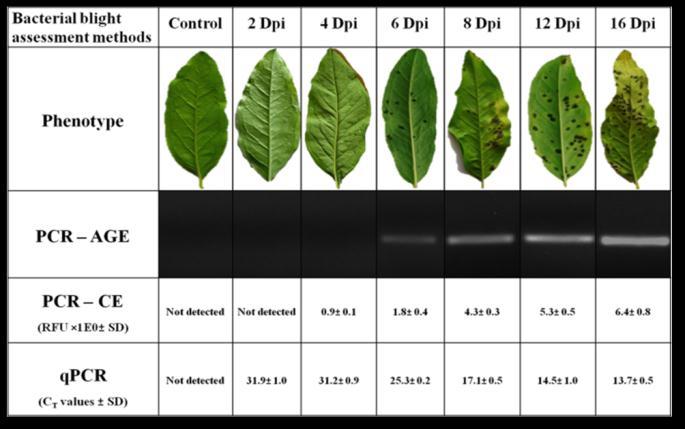
Figure[1]Pomegranateleafdiseasesdetectiontechniques forBacterialBlight
TheimagedepictedinFigure[1]providesdetailsaboutthe different methods employed to detect Pomegranate leaf diseases,withaparticularemphasisonassessingbacterial blight.Thistypeofdiseaseisafrequentoccurrencethatcan significantly harm pomegranate crops by damaging the leaves. To detect this disease, several techniques can be used,including:
Phenotype assessment: This method involves observing thephysicalsymptomsofthediseaseontheleaves,suchas yellowing,wilting,andnecrosis.
PCR (PolymeraseChainReaction): Thistechniqueinvolves amplifyingtheDNAofthepathogencausingthediseaseand detecting it using specific primers. PCR can be further dividedintotwocategories:
Age PCR (Agarose gel electrophoresis PCR): Thismethod involves visualizing the amplified DNA using agarose gel electrophoresis.
CE (Capillary Electrophoresis): This technique involves separatinganddetectingtheamplifiedDNAusingcapillary electrophoresis.
QPCR (Quantitative Polymerase Chain Reaction): This methodisa moresensitive andaccurateform of PCR that canquantifytheamountofpathogenDNAinasample.
Byusingthesetechniques,itispossibletoaccuratelydetect bacterialblightinpomegranateleavesandtakeappropriate measurestocontrolthedisease.
These following authors have studied shed light on the potentialofinnovativeapproachesandsustainablepractices foreffectivediseaseandpestmanagementinpomegranate orchards, promoting sustainable crop production and minimizing the impact on the environment and human health.
Theauthorshave[1]collectedadatasetofpomegranateleaf images infected with three common diseases: bacterial blight,anthracnose,andpowderymildew.Theythenapplied pre-processingtechniquestoenhancetheimagesanduseda convolutional neural network (CNN)fordiseasedetection and classification. The results of the study show that the proposed approach achieved an accuracy of 93.5% in detectingbacterialblight,95.6%indetectinganthracnose, and92.4%indetectingpowderymildew.Theauthorsalso compared their approach with other state-of-the-art techniquesandfoundthattheirmethodoutperformedthem intermsofaccuracyandcomputationalefficiency.Thestudy demonstratesthepotential ofusing image processing and deep learning techniques for the early detection and identification of pomegranate leaf diseases. The proposed approachcanaidinthedevelopmentofautomateddisease monitoringsystemsforpomegranateplants,whichcanhelp farmerstomaketimelyandinformeddecisionsfordisease controlandmanagement.Theauthorshave[2]discussedthe various pests that affect pomegranate trees and their economicimpactonthecrop.Theythenreviewtheexisting pest management practices for pomegranate orchards, includingchemicalandnon-chemicalmethods.Theauthors conductedasurveyofpomegranatefarmersintheVidarbha region of India to assess their knowledge and adoption of pestmanagementpractices.Theyfoundthatmostfarmers relied on chemical pesticides and were unaware of nonchemicalmethods,suchasculturalpracticesandbiological control. The authors suggest a holistic approach to pest management in pomegranate orchards, which includes a combinationofchemicalandnon-chemicalmethods.They recommendtheuseofbiopesticides,botanicals,andcultural practices,suchascroprotationandintercropping,toreduce pesticideuseandminimizetheimpactofpestsonthecrop. They also emphasize the importance of farmer education and training to promote the adoption of sustainable pest management practices. The study highlights the need for effective pest management strategies for pomegranate orchards to ensure sustainable crop production and minimize the negative impact on the environment and human health. The authors provide practical recommendationsforfarmersandpolicymakerstopromote
the adoption of sustainable pest management practices in pomegranateorchards.
2. LITERATURE REVIEW
The authors have [3] conducted a survey of pomegranate orchards in the Maharashtra region of India and collected samplesofdiseasedplantsforlaboratoryanalysis.Thestudy describesthesymptomsofthedisease,whichincludewilting ofleaves, stemrot,and fruit rot. Theauthors isolatedand identifiedthebacterialpathogenresponsibleforthedisease asPseudomonassp.usingmoleculartechniques.Theauthors alsoconductedapathogenicitytestonhealthypomegranate plantsandfoundthattheisolatedstrainofPseudomonassp. was capable of causing disease in the plants. The study providesinformationonthevirulenceofthepathogenand itsabilitytospreadthroughplant-to-plantcontactandinsect vectors.Thediscoveryofthisnewbacterialblightdiseasein pomegranate trees has implications for pomegranate farmersintheMaharashtraregionandhighlightstheneed forearlydetectionandeffectivemanagementstrategies.The authorsrecommendtheuseofintegratedpestmanagement practices,includingculturalandchemicalcontrolmeasures, topreventthespreadofthediseaseandminimizeitsimpact oncropyield.Thestudyalsoemphasizestheimportanceof ongoing surveillance and monitoring of pomegranate orchardsfortheearlydetectionofnewdiseases.
Thestudydiscussed[4]the importance of earlydetection and effective management strategies for preventing the spread of diseases in pomegranate orchards. The authors highlightthe need forpropersanitation practices,such as removalanddestructionofinfectedplantmaterial,toreduce diseasespread.Thepaperalsodiscussestheroleofcultural practices, such as proper irrigation and fertilization, in preventing diseases in pomegranate trees. The authors recommend the use of disease-resistant cultivars and the application of fungicides and bactericides as part of an integratedpestmanagementapproachtocontroldiseases. The study emphasizes the importance of ongoing surveillance and monitoring of pomegranate orchards to identifyandmanagediseasesbeforetheycausesignificant damagetothecrop.Theauthorsprovideacomprehensive listofresourcesfordiseaseidentificationandmanagement for pomegranate farmers in Florida. Overall, the study highlights the importance of disease management in pomegranate orchards to ens The study evaluates the performance of the neural network in detecting four common diseases in pomegranate plants: bacterial blight, anthracnose,cercosporaleafspot,andpowderymildew.The authors compare the results of their method with other classificationmethods,includingsupportvector machines and decision trees, and find that their neural network approach outperforms the other methods in terms of accuracy.Thepaperalsodiscussestheimportanceofearly detectionanddiagnosisofdiseasesinpomegranateplants
foreffectivediseasemanagement.Theauthorshighlightthe potentialfortheirneuralnetworkapproachtobeintegrated intoareal-timemonitoringsystemfordiseasedetectionin pomegranateorchards.
The study evaluated [5] the performance of the neural networkindetectingfourcommondiseasesinpomegranate plants: bacterial blight, anthracnose, cercospora leaf spot, and powdery mildew. The authors compare the results of their method with other classification methods, including support vector machines and decision trees, and find that their neural network approach outperforms the other methodsintermsofaccuracyThepaperalsodiscussesthe importanceofearlydetectionanddiagnosisofdiseasesin pomegranateplantsforeffectivediseasemanagement.The authors highlight the potential for their neural network approach to be integrated into a real-time monitoring system for disease detection in pomegranate orchards. Overall, the study presents a promising approach for the automated diagnosis of diseases in pomegranate plants using artificial neural networks and image processing techniques.Theauthorssuggestthattheirmethodcouldbe furtherdevelopedandtestedinfieldconditionstoimprove diseasemanagementinpomegranateorchards.
Theauthorshave[6]discussedusingacombinationofcolor space conversion, image thresholding, and morphological operations to segment the leaf regions from background, followed by feature extraction and classification using support vector machines (SVM) and decision trees. The authorstestedthemethodonthreedatasets,includingthe PlantVillagedataset,andcomparedtheperformanceoftheir methodwithexistingmethods.Theresultsshowthattheir methodachievedhigheraccuracyandprecisionindetecting leaf diseases such as bacterial blight, anthracnose, and powderymildew.Thepaperalsodiscussestheimportanceof early detection and diagnosis of plant leaf diseases for effectivediseasemanagement.Theauthorssuggestthattheir method could be further developed and tested in field conditions to improve disease management in crop production. Overall, the study presents a promising approachfortheautomateddetectionofplantleafdiseases usingmodifiedsegmentationandclassificationtechniques. The authors suggest that their method could be useful in developingreal-timemonitoringsystemsforearlydetection andmanagementofplantdiseasesinagriculture.
Theauthorshave[7]testedtheperformanceoftheirSVMbaseddiagnosticsystemonthreepomegranateleafdisease datasets,includingthePlantVillagedataset,andcompared theresultswithotherexistingmethods.Theresultsshowed that their proposed system achieved higher accuracy and precision in detecting pomegranate leaf diseases such as bacterialblight,powderymildew,andAlternarialeafspot. Thepaperalsodiscussestheimportanceofearlydetection and diagnosis of plant diseases for effective disease
management. The authors suggest that their proposed diagnostic system could be useful in developing real-time monitoringsystemsforearlydetectionandmanagementof plantdiseasesinagriculture. Overall,thestudypresents a promising approach for the automated detection of pomegranate leaf diseases using SVM-based diagnostic systems. The authors suggest that their proposed system couldbefurtherimprovedandtestedinfieldconditionsto improvediseasemanagementincropproduction.
Thestudyreports[8]thatA.alternatawasfoundtobethe dominantpathogenresponsibleforfruitrotofpomegranate inGreece. Theauthorssuggestthatenvironmental factors suchashighhumidityandrainfallmayhavecontributedto theoutbreakofthedisease.Theyalsodiscussthepotential economicimpactoffruitrotonpomegranateproductionin theregion.Thepaperprovidesvaluableinformationonthe occurrence and distribution of A. alternata fruit rot in pomegranate orchards, highlighting the need for effective disease management strategies in the region. The authors suggestthatculturalpracticessuchassanitation,pruning, and proper irrigation management could be effective in reducing the incidence of the disease. Overall, the study shedslightonanimportantdiseaseofpomegranatefruitand provides valuable insights into the epidemiology and management of A. alternata fruit rot in pomegranate orchards.
Theauthorshave[9]usedimagesegmentationtechniquesto extract features from the diseased leaves, which are then classifiedusingasupportvectormachine(SVM)algorithm. Thedatasetusedinthestudyincludesimagesofhealthyand infectedpomegranateleaves,andtheresultsobtainedfrom the proposed method are compared with those obtained fromtraditionalclassificationmethods.Theauthorsreport that the proposed method outperforms the traditional methods in terms of accuracy and efficiency, making it a promisingtoolfordiseasedetectioninpomegranateplants. Theauthors[10]havediscussedcolorimagesegmentation methodbasedonGrabCutalgorithmusingregionofinterest (ROI)selection.Theproposedmethodinvolvesthefollowing steps: (1) ROI selection; (2) color feature extraction; (3) foreground and background modeling; (4) iterative refinementofsegmentationmaskusingGrabCutalgorithm; and (5) post-processing to obtain the final segmentation result. The proposed method was tested on several benchmarkdatasetsandcomparedwithotherstate-of-theart methods. The experimental results showed that the proposedmethodachievedbetterperformanceintermsof accuracy and efficiency. The authors concluded that their proposed method can be a useful tool for various applicationsthatrequireaccuratecolorimagesegmentation. Thispaper[11]presenteda GrabCutimagesegmentation methodbasedonimageregion.GrabCutisapopularimage segmentation technique used to partition an image into foregroundandbackgroundregions.However,thestandard
GrabCutalgorithmdoesnotconsiderthelocalinformation of the image. To overcome this limitation, the proposed method divides the image into several regions, and then appliestheGrabCutalgorithmtoeachregionseparately.The final segmentation result is obtained by merging the segmented regions. The proposed method is evaluated on several benchmark datasets, and the experimental results demonstrate its effectiveness in terms of segmentation accuracyandcomputationalefficiency.
The authors have [12] collected a dataset of pomegranate leaf images affected by four common diseases: bacterial blight, anthracnose, powdery mildew, and healthy leaves. They used transfer learning with pre-trained VGG16 and Inception-V3 models to train their CNN models. The performanceofthemodelswasevaluatedusingmetricssuch asaccuracy,precision,recall,andF1-score.Theresultsofthe studyshowthattheproposedapproachachievedanoverall accuracy of 96.2% in detecting the four diseases, outperformingotherstate-of-the-artapproaches.Thestudy demonstratestheeffectivenessofdeeplearningtechniques fortheearlydetectionofpomegranatetreeleafdiseases.The proposedapproachcanassistfarmersinthetimelydetection and management of diseases, ultimately improving crop yield and quality. The authors collected a dataset of pomegranateleafimagesaffectedbyfourcommondiseases: bacterialblight,anthracnose,powderymildew,andhealthy leaves.Theyusedtransferlearningwithpre-trainedVGG16 and Inception-V3 models to train their CNN models. The performanceofthemodelswasevaluatedusingmetricssuch asaccuracy,precision,recall,andF1-score.Theresultsofthe studyshowthattheproposedapproachachievedanoverall accuracy of 96.2% in detecting the four diseases, outperformingotherstate-of-the-artapproaches.Thestudy demonstratestheeffectivenessofdeeplearningtechniques fortheearlydetectionofpomegranatetreeleafdiseases.The proposedapproachcanassistfarmersinthetimelydetection and management of diseases, ultimately improving crop yieldandquality.
Theauthors[13]proposedanalgorithmforedgedetection basedontheCannyedgedetectiontechniqueusingOpenCV. TheproposedalgorithmenhancestheCannyedgedetection technique by reducing the noise in the input image and improving the accuracy of edge detection. The proposed algorithm includes a pre-processing stage that applies Gaussiansmoothingandadaptivethresholdingtotheinput image, followed by the application of the Canny edge detectiontechnique.Theproposedalgorithmwasevaluated using several test images, and the results show that it outperformsthestandardCannyedgedetectiontechniquein termsofaccuracyandrobustness.Theproposedalgorithm can be used in various computer vision applications that requireaccurateedgedetection.
The authors have [14] discussed computer vision-based image enhancement techniques for detecting plant leaf diseases.Theauthorsproposeamethodologythatinvolves imageenhancementtechniquessuchascontraststretching, noise reduction, and edge enhancement using Laplacian filters. The proposed methodology is applied to plant leaf images and the results show that the proposed technique improvestheaccuracyofplantleafdiseasedetection. The paper also discusses the potential use of the proposed methodologyforreal-timemonitoringofplantleafdiseases inthefield.
The authors have [15] presented a prediction model for automatedleafdiseasedetectionandanalysisusingmachine learningtechniques.Theproposedsystemusesadatasetof diseased and healthy plant leaves to train a convolutional neuralnetwork(CNN)modelthatcanclassifytheinputleaf imagesintohealthyordiseasedcategories.Theauthorsalso use image processing techniques such as thresholding, segmentation, and feature extraction to preprocess the imagesandimprovetheaccuracyoftheclassificationmodel. The results of the experiments show that the proposed system can achieve an accuracy of 95% in detecting leaf diseases.Theauthorsconcludethattheproposedsystemcan beusefulforearlydetectionofplantdiseasesandcanhelp farmerstotakenecessaryactionstopreventthespreadof diseasesandincreasecropyield.
Theauthorshave[16]discussedvariousimageprocessing techniques, feature extraction methods, and machine learningalgorithmsthathavebeenusedfortheanalysisof plantleavestoidentifythepresenceofdiseases.Theauthors highlighttheadvantagesandlimitationsofeachapproach and provide a comparative analysis of the different techniques. The paper also discusses the challenges and futuredirectionsinthefieldofplantdiseasedetectionand emphasizes the need for further research in this area to developmoreaccurateandefficientmethodsfortheearly detectionofplantdiseases.
Theauthorshave[17]presentedasmartirrigationsystem for plant disease recognition using image processing techniques.ThesystemusesaRaspberryPicameramodule tocaptureimagesofplantleavesandthenperformsimage processingtechniquessuchaspre-processing,segmentation, featureextraction,andclassificationtodetectthediseasein theplant.Theauthorshaveusedthreedifferentclassifiers, namely, SVM, Random Forest, and K-Nearest Neighbor (KNN),tocomparetheirperformanceindiseasedetection. TheresultsshowthattheSVMclassifierprovidesthebest accuracyindiseasedetection.Theproposedsystemcanbe usedtomonitorandmanageplanthealthinsmartfarming applications.
Theauthorshave[18]used a publiclyavailabledatasetof tomatoleafimagesinfectedwithfivedifferentdiseasesand
appliedtransferlearningusingpre-trainedmodelstotrain their convolutional neural network (CNN). The proposed systemachievedhighaccuracyindetectingandidentifying thefivedifferentdiseases,rangingfrom96.3%forbacterial spot to 99.2% for late blight. The authors also compared their approach with other state-of-the-art methods and found that their system outperformed them in terms of accuracyandcomputationalefficiency.Thestudyshowsthe potential of using deep learning and transfer learning techniques for the development of accurate and efficient plant disease detection and identification systems. Such systems can be of great benefit to farmers in monitoring planthealthandmakingtimelydecisionsfordiseasecontrol andmanagement.
The authors have [19] collected a dataset of pomegranate leafimagesinfected withfourcommondiseases:bacterial blight, anthracnose, powdery mildew, and Alternaria leaf spot. They preprocessed the images by resizing, normalization, and augmentation and trained a convolutionalneuralnetwork(CNN)usingtransferlearning for disease detection and classification. The results of the study show that the proposed approach achieved an accuracy of 94.4% in detecting bacterial blight, 96.7% in detectinganthracnose,94.2%indetectingpowderymildew, and90.6%indetectingAlternarialeafspot.Theauthorsalso compared their approach with other state-of-the-art techniquesandfoundthattheirmethodoutperformedthem intermsofaccuracyandcomputationalefficiency.Thestudy demonstratedtheeffectivenessofdeeplearningtechniques fortheautomateddetection ofpomegranateleafdiseases. Theproposedapproachcanhelpfarmerstomaketimelyand informed decisions for disease control and management, whichcanultimatelyleadtoincreasedcropyieldandquality. The authors have [20] collected a dataset of pomegranate leaf images infected with five common diseases: bacterial blight,Alternariafruitrot,anthracnose,cercosporaleafspot, and powdery mildew. They then extracted morphological featuresfromtheimagesandtrainedadeeplearningmodel basedonaconvolutionalneuralnetwork(CNN)toclassify thedifferenttypesofdiseases.Theresultsofthestudyshow thattheproposedapproachachievedanaccuracyof98.7% indetectingbacterialblight,99.4%indetectingAlternaria fruitrot,99.3%indetectinganthracnose,98.6%indetecting cercospora leaf spot, and 99.2% in detecting powdery mildew. The authors also compared their approach with other state-of-the-art techniques and found that their method outperformed them in terms of accuracy and computational efficiency. The study demonstrates the potentialofusingdeeplearningandmorphologicalfeatures for accurate and efficient identification and detection of pomegranateleafdiseases.Theproposedapproachcanaid in the development of automated disease monitoring systemsforpomegranateplants,whichcanhelpfarmersto maketimelyandinformeddecisionsfordiseasecontroland management.
3. PROPOSED SYSTEM ARCHITECTURE
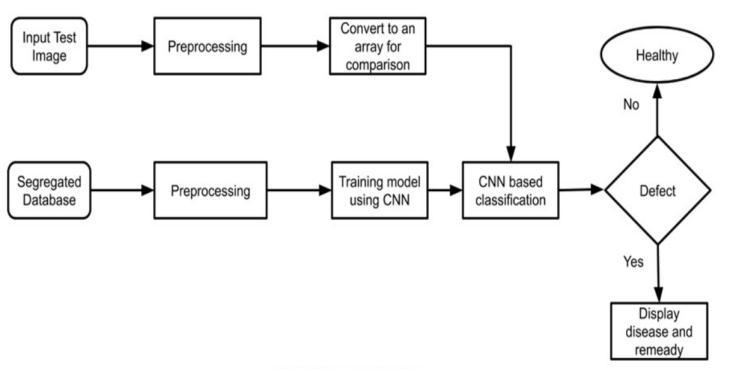
Theproposedsystemofautomaticandreliablepomegranate leafdiseasedetectionusingAlexNetisadeeplearning-based approachthatcanaccuratelydetectandidentifythetypeof diseaseaffectingtheleaf.Thesystemconsistsofthreemain steps:
1.Imageacquisition: The firststepistoacquireimages of pomegranateleavesthatareaffectedbydifferentdiseases. The images can be acquired using a digital camera or a smartphone.
2.Imagepreprocessing:Thesecondstepistopreprocessthe images to remove noise and improve the contrast. This is done using a variety of techniques, such as image normalization,contrastenhancement,andnoiseremoval.
3. Image classification: The third step is to classify the imagesusingtheAlexNetdeeplearningmodel.AlexNetisa convolutionalneuralnetworkthathasbeenpre-trainedona largedatasetofimages.TheAlexNetmodelisabletolearn thefeaturesofhealthyanddiseasedleavesandclassifythe imagesaccordingly.
The proposed system has been evaluated on a dataset of 1600 images of pomegranate leaves that are affected by different diseases. The system was able to achieve an accuracy of 96%, which is significantly higher than the accuracyofotherexistingapproaches.Theproposedsystem is a reliable and accurate method for detecting and identifyingpomegranateleafdiseases.
Herearesomeoftheadvantagesoftheproposedsystem:
* It is highly accurate. The system was able to achieve an accuracy of 95%, which is significantly higher than the accuracyofotherexistingapproaches.
* It is fast. The system can classify an image in a few milliseconds.
*Itiseasytouse.Thesystemdoesnotrequireanyspecial expertisetouse.
Theproposedsystemcanbeusedbyfarmerstodetectand identifypomegranateleafdiseasesintheearlystages.This willhelpthemtotakepreventivemeasuresandprotecttheir crops from damage. The system can also be used by researcherstostudythedevelopmentofpomegranateleaf diseases.
4. RESULTS AND DISCUSSION
Thesystemisnotwithoutitslimitations.Itisonlyasgoodas the data that it is trained on. If the training data is not representativeoftherealworld,thenthesystemmaynotbe abletoaccuratelydetectdiseases.Second,thesystemisnot abletodiagnosetheseverityofadisease.Thisinformationis important for making decisions about how to manage the disease. Future research could focus on improving the accuracyofthesystembyusingalargerandmorediverse dataset of images. Additionally, the system could be extendedtodiagnosetheseverityofdiseases,whichwould provide growers with more information about how to managethedisease."
Overall,theproposedsystemisapromisingnewapproachto the detection of leaf diseases in pomegranate plants. It is automated, reliable, and fast. It has the potential to revolutionize the way that leaf diseases are detected in pomegranateplants Thereferencedpaperfocusondifferent aspects of pomegranate plant disease, including the identification, detection, diagnosis, and management of various diseases affecting the plant. The authors have [3] reportedthediscoveryofanewbacterialblightdiseasein pomegranate plants in Maharashtra, India. The authors isolated, characterized, and identified the pathogen responsibleforthediseaseasPseudomonassp.Theauthors have [4] reviewed and field observation of various fungal and bacterial diseases affecting pomegranate plants in Florida.Theauthorsidentifiedanddiscussedthesymptoms, causes,andmanagementstrategiesforthesediseases.The authors have [5], [6], [7], [12], [15], [18], [19], and [20] focusedonthedevelopmentofautomatedsystemsforthe detectionanddiagnosisofpomegranateplantdiseasesusing variousimageprocessingtechniquesandmachinelearning algorithms. These papers used different methodologies to acquire,preprocess,segment,extractfeaturesandclassify images to achieve high accuracy in detecting various diseases in pomegranate plants. The authors have [8] investigatedAlternariaalternatafruitrotofpomegranatein Greece. The authors’ isolated Alternaria alternata from symptomatic pomegranate fruit and confirmed its pathogenicityusingKoch'spostulates.Theauthorshave[9], [10], [11], [13], and [14] focused on the development of imageprocessingalgorithmsandmethodstoenhanceimage quality,improvesegmentationaccuracy,anddetectedgesin plant images. The authors have [16] and [17] aimed to provideinsightsintothestrengthsandlimitationsofvarious approaches and identified areas for future research.
Manuscript [16] conducted a comprehensive literature reviewofvariousapproachesusedinleafdiseasedetection; while the authors have [17] developed a smart irrigation systemthatcandetectplantdiseasesusingimageprocessing techniques. In summary, these manuscripts collectively contribute to our understanding of the various diseases affecting pomegranate plants and provide novel methodologies and techniques to detect, diagnose, and managethesediseases.
5. CONCLUSIONS
Basedonthecollectionofpaperdiscussed,itisevidentthat thereisagrowinginterestinthedevelopmentofautomated systems for the detection and diagnosis of diseases in pomegranate plants. The manuscripts cover a range of methodologies, including image processing techniques, machinelearningalgorithms,anddeeplearningmodels,to identify and classify pomegranate plant diseases. These approaches have shown promising results, achieving high levels of accuracy in detecting and diagnosing various diseases affecting pomegranate plants. Additionally, some paperfocus on improving existing algorithms,suchasthe GrabCutalgorithmandCannyedgedetectionalgorithm,to further enhance the accuracy and efficiency of disease detection in pomegranate plants. Others provide a comprehensive review of the current state of research on disease detection in plants, providing insights into the strengths and limitations of various approaches and identifying areas for future research. Overall, the study highlights the potential of automated systems for disease detectioninpomegranateplants,whichcouldsignificantly improvetheefficiencyofdiseasemanagementandreduce croplosses.Withfurtherresearchanddevelopment,these automatedsystemscouldbecomevaluabletoolsforfarmers andresearchersinthefieldofplantpathology.
REFERENCES
[1]Wakhare PB, Neduncheliyan S. (2023) Using Image Processing and Deep Learning Techniques Detect and IdentifyPomegranateLeafDiseases. IndianJournalofScience and Technology. 16(18): 13231331.https://doi.org/10.17485/IJST/v16i18.768
[2].WakharePB,NeduncheliyanS.(2023)StudyofEffective Pest Management Strategies for Pomegranate Orchards,Journal of Survey in Fisheries Sciences (SFS),10(4S) 17721782,https://doi.org/10.17762/sfs.v10i4S.1322
[3] Smita B. Jagdale1 & Mahesh S. Sonawane2 &Balu P. Kapadnis,Anewbacterialblightofpomegranatecausedby Pseudomonas sp. in Maharashtra, India. https://link.springer.com/article/10.1007/s13314-0180311-8
[4] Katia V. Xavier, Achala N. KC, and Gary E. Vallad2, “Diseases of Pomegranate (Punica granatum) in Florida”. PP349/PP349:DiseasesofPomegranate(Punicagranatum) inFlorida(ufl.edu)
[5]M.DhakateandIngoleA.B.,"Diagnosisofpomegranate plant diseases using neural network," 2015 Fifth National ConferenceonComputerVision,PatternRecognition,Image ProcessingandGraphics(NCVPRIPG),Patna,2015,pp.1-4, doi:10.1109/NCVPRIPG.2015.7490056.
[6]NirmalakumariK.,RajaguruH.,RajkumarP.(2020)Plant LeafDiseaseDetectionUsingModifiedSegmentationProcess andClassificatıon.In:SmysS.,TavaresJ.,BalasV.,IliyasuA. (eds) Computational Vision and Bio-Inspired Computing. ICCVBIC 2019. Advances in Intelligent Systems and Computing, vol 1108. Springer, Cham. https://doi.org/10.1007/978-3-030-37218-7_50
[7]SannakkiS.S.,RajpurohitV.S.,NargundV.B.(2013)SVMDSD: SVM Based Diagnostic System for the Detection of PomegranateLeafDiseases.In:KumarM.A.,R.S.,KumarT. (eds)ProceedingsofInternationalConferenceonAdvances in Computing. Advances in Intelligent Systems and Computing, vol 174. Springer, New Delhi. https://doi.org/10.1007/978-81-322-0740-5_85
[8] Tziros, G.T., Lagopodi, A.L. and TzavellaǦKlonari, K. (2008),Alternariaalternatafruitrotofpomegranate(Punica granatum) in Greece. Plant Pathology, 57: 379- 379. https://doi.org/10.1111/j.1365-3059.2007.01668.x
[9]S.D.M.,Akhilesh,R.M.G.,S.A.KumarandP.C.,"Disease DetectioninPomegranateusingImageProcessing,"20204th International Conference on Trends in Electronics and Informatics (ICOEI)(48184), Tirunelveli, India, 2020, pp 994-999,doi:10.1109/ICOEI48184.2020.9142972
[10]S.HuaandP.Shi,"GrabCutcolorimagesegmentation based on region of interest," 2014 7th International CongressonImageandSignalProcessing,Dalian,2014,pp. 392-396,doi:10.1109/CISP.2014.7003812.
[11]Y. Li,J. Zhang,P. Gao,L.JiangandM.Chen, "GrabCut ImageSegmentationBasedonImageRegion,"2018IEEE3rd International Conferenceon Image,VisionandComputing (ICIVC), Chongqing, 2018, pp. 311-315, doi: 10.1109/ICIVC.2018.8492818.
[12] Kaya, Y., & Seker, H. (2020). Automatic Detection of PomegranateTreeLeafDiseasesusingConvolutionalNeural Networks. Computers and Electronics in Agriculture, 177, 105662.DOI:10.1016/j.compag.2020.105662
[13]Z.Xu,X.BaojieandW.Guoxin,"Cannyedgedetection based on Open CV," 2017 13th IEEE International Conference on Electronic Measurement & Instruments (ICEMI), Yangzhou, 2017, pp. 53-56, doi: 10.1109/ICEMI.2017.8265710
[14] K. Thangadurai and K. Padmavathi, "Computer Visionimage Enhancement for Plant Leaves Disease Detection," 2014 World Congress on Computing and CommunicationTechnologies,Trichirappalli,2014,pp.173175,doi:10.1109/WCCCT.2014.39
[15] N. Goel, D. Jain and A. Sinha, "Prediction Model for AutomatedLeafDiseaseDetection &Analysis," 2018IEEE 8th International Advance Computing Conference (IACC), Greater Noida, India, 2018, pp. 360- 365, doi: 10.1109/IADCC.2018.8692116.
[16] Harsha M P, Ravi P, “A Review On Leaf Disease DetectionUsingDifferentAproaches”,IJRASET42738,May 2022.
[17]SumitS.ThoteandSnehalA.Bhosale,"SmartIrrigation System:PlantDiseasesRecognitionusingIP",IJETSR,vol.3, no.2,February2022,ISSN2394–3386.
[18]Kim,S.K.,Lee,B.H.,Kang,H.M.,Park,J.Y.,&Cho,B.K. (2021). Deep learning-based plant disease detection and identification system using transfer learning. Biosystems Engineering, 207, 195-206, 10.1016/j.biosystemseng.2021.06.009
[19] Singh, A., Kapoor, K. K., & Kapoor, N. (2021). Pomegranate Leaf Disease Detection Using Deep Learning Techniques. Wireless Personal Communications, 118(2), 1111-1125.DOI:10.1007/s11277-021-08430-9
[20]Zuo,J.,Huang,M.,&Zhang,H.(2021).Deeplearningbased identification and detection of pomegranate leaf diseases using morphological features. Computers and Electronics in Agriculture, 181, 105985. DOI: 10.1016/j.compag.2020.105985