PROSPECTS FOR THE USE OF GYPSUM WASTE FOR THE PRODUCTION OF BUILDING GREEN CERAMICS

Verónica González Molina, Jesús Agüero López, Abigail Parra Parra, Pedro Antonio Márquez Aguilar, Marina Vlasova
Centro de Investigación en Ingeniería y Ciencias Aplicadas de la Universidad Autónoma del Estado de Morelos, Av. Universidad 1001, Col. Chamilpa, Cuernavaca, Morelos, México.
Abstract
The study considers the prospects of using large-scale wastes of gypsum molds from the ceramic industry and phosphogypsum to produce blocks/bricks for the construction industry. The technology was based on the principle of obtaining gypsum concrete. To initiate the binding properties of gypsum wastes, they were subjected to low-temperature treatment in the range of 200-300 oC. Additionally, phosphogypsum was subjected to neutralization without subsequent washingfromnewlyformedcompounds.CompressivestrengthtestsofsamplesshowedthatformixturesofPortlandcementgypsum molds Fcomp. varies from 170 to 90 kg/cm2 at a cement content of 90-10 wt%. For mixtures of Portland cementphosphogypsumFcomp. variesfrom150to100kg/cm2 atacontentof90-60wt%cement.Forcomparison,similarmixturesof Portlandcementandcommercialsemi-aqueousgypsumwereprepared.
Keywords: Portlandcement,wastegypsummolds,phosphogypsum,glassfibers,concrete,greenceramics
1. Introduction
GypsumintheformofCaSO4‧0.5H2OandCaSO4 iswidelyusedbothinconstruction[1-4]andintheproductionoffine ceramics(porcelain,semi-porcelain,faience,etc.)[5],whenslipispouredintogypsummolds. Asaresult,theproductionand use of gypsum products is accompanied by the accumulation of large volumes of waste. As a rule, gypsum wastes are representedbyCaSO4‧2H2O.Oneofthemostimportantpropertiesofsuchgypsumwastesistherelativeeaseofobtainingnew (secondary) binders from them, namely, CaSO4‧0.5H2O [4, 6, 7]. It is known that primary dihydrate calcium sulfate (CaSO4‧ 2H2O)whenheatedinthetemperaturerangeof140–170°Cturnsintohemihydratecalciumsulfate(CaSO4 0.5H2O).However, for waste from spent gypsum molds, as established in [4], the transition temperature (CaSO4‧2H2O) → (CaSO4‧0.5H2O) can reach300 oCduetotheaccumulationofelectrolytesolutionsintroducedintotheclaytoliquefyitbythegypsummatrix.This featureofgypsumwasteshouldbetakenintoaccountforthecompleteconversionofCaSO4‧2H2OintoCaSO4‧0.5H2O.
Phosphogypsumisaby-productoftheproductionofphosphorus-containingmineralfertilizersandphosphoricacid[8]. These large-tonnage wastes are removed from the territories of enterprises to sludge storages, which turn out to be environmentalpollutants.Phosphogypsumcontainsfrom80to98%gypsumandcanbeclassifiedasagypsumrawmaterial, sothemostpromisingareasfortheutilizationofphosphogypsumisitsuseintheproductionofgypsumbinders. However,the presence in their composition of acidic fluorine- and phosphorus-containing impurities, which pass into the gaseous phase duringheattreatment,significantlycomplicatesthedirectuseofphosphogypsumasa high-temperatureorlow-temperature binder. To overcome the negative impact of steam and gas emissions on the environment in the technological process of obtaining"puregypsum",asarule,proceduresareusedtoneutralizeandwashoffwastephosphogypsum[9,10].Thisleadsto significantcapitalandenergycostsandhindersthelarge-scaleprocessingofthistypeofwaste.
Phosphogypsumcanbeusedin thecementindustrytoproducePortlandcement, aswell asa mineralizer duringfiring andanadditiveinclinkergrinding[11].Phosphogypsumcanbeusedasanadditiveandfillerinmixedbinderswithouttheuse ofheattreatmenttoobtainphosphoconcrete[12,13].
The aim of the work was to study the properties of unfired building blocks/bricks obtained both on the basis of Portland cement and waste gypsum molds, and Portland cement and phosphogypsum subjected to the neutralization of aggressiveacid-baseproperties,butwithoutwashingoffthenewlyformedcompounds.
2. Preparation of specimens
In this work, we investigated the properties of samples obtained from three types of mixtures: a. portland cementcommercial gypsum (CaSO4‧0.5H2O); b. portland cement - CaSO4‧0.5H2O), obtained during the processing of gypsum mold waste;c.Portlandcement-(CaSO4 0.5H2O),obtainedbyprocessingphosphogypsum.
To obtain semi-aqueous gypsum from spent gypsum molds (option b), the latter were crushed and then subjected to heat treatment at 300 oC to convert (CaSO4‧2H2O) to (CaSO4‧0.5H2O) [4]. To obtain semi-aqueous gypsum from phosphogypsum (option c), these wastes were also ground, then neutralized with CaO/Ca(OH2) to obtain Ph = 6 - 7. This powderwassubjectedtoheattreatmentat200°Cfor2htotransfer(CaSO4 2H2O)in(CaSO4 0.5H2O).
WaterwasaddedtohomogenizedpowdermixturesofPortlandcement-CaSO4‧0.5H2Otoobtainmoldingpastes. Asthe contentofhemihydrategypsumincreased,thewatercontentwasincreasedfrom35mlto50mlper100gof themixture(or water/solidchanged from0.35to0.5). The10gofglassfiber2cmlongand0.1mmthick wereintroducedintothemolding pastes. The resulting pasty mixtures were poured into molds 2x2x2 cm in size. After hardening, the samples were removed fromthemolds.Thepropertiesofthesampleswerestudiedafterexposuretoairfor72h.
The obtained specimens were investigated by the X-ray diffraction (XRD) method in Cu Kα radiation (Siemens D-500 diffractometer). Electron microscopy study and electron-probe microanalysis were performed with the use of installations SU1510 HITACHI, and Oxford X-Act The mechanical properties of the ceramics were by standard investigation techniques [14]. The hydrogen index (pH) was determined with the use HANNA instrument HI2550 pH/ORP&EC/TDS. The water absorptionwasdetermined bytheformula: W,%=[(P1 – P0)/ P0]·100,where P0 istheinitial weightofaspecimenand P1 is the weight of the specimen after water absorption. To determine the leaching of the samples, the destroyed samples were boiledindistilledwaterfor2h.
3. Results and discussion
3.1.X-raydata
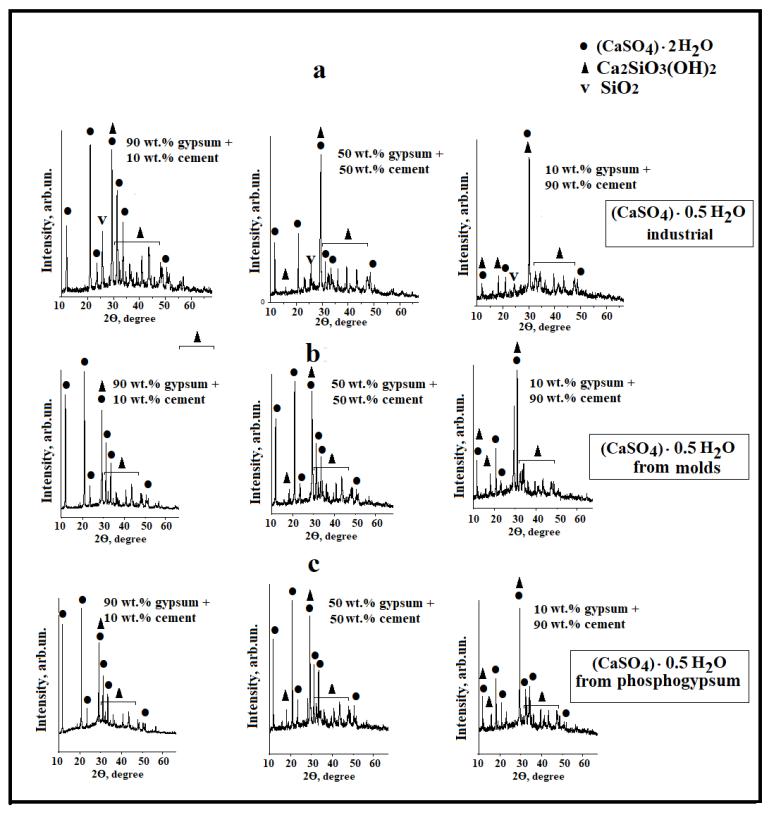
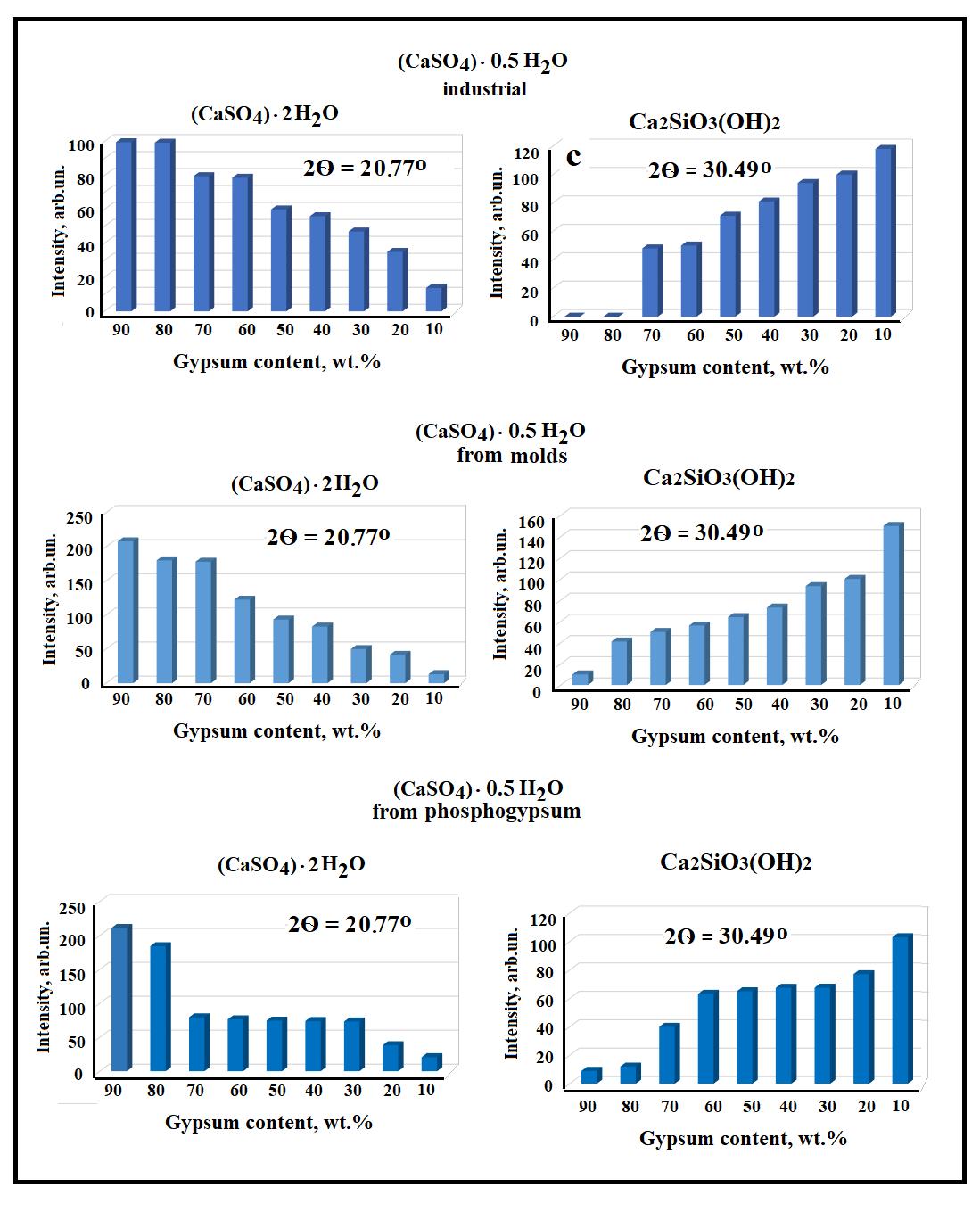
It has been found that in all mixtures, as the cement content in the mixture increases, the intensity of the two-water gypsum(CaSO4‧2H2O)peaksdecreasesandtheintensityoftheCa2SiO3(OH)2 orC-S-Hpeaksincreases(see Fig. 1).Alongwith these main phases, there are a number of other hydro silicates of various compositions, the content of which is much lower. The phase composition of samples obtained from mixtures a-c containing gypsum components of various origins is almost identical.Thedifferencesareonlyintheintensityofthepeaks,thatis,inthecontentofthesephases(see Fig. 2).
3.2SEM/EDSdata
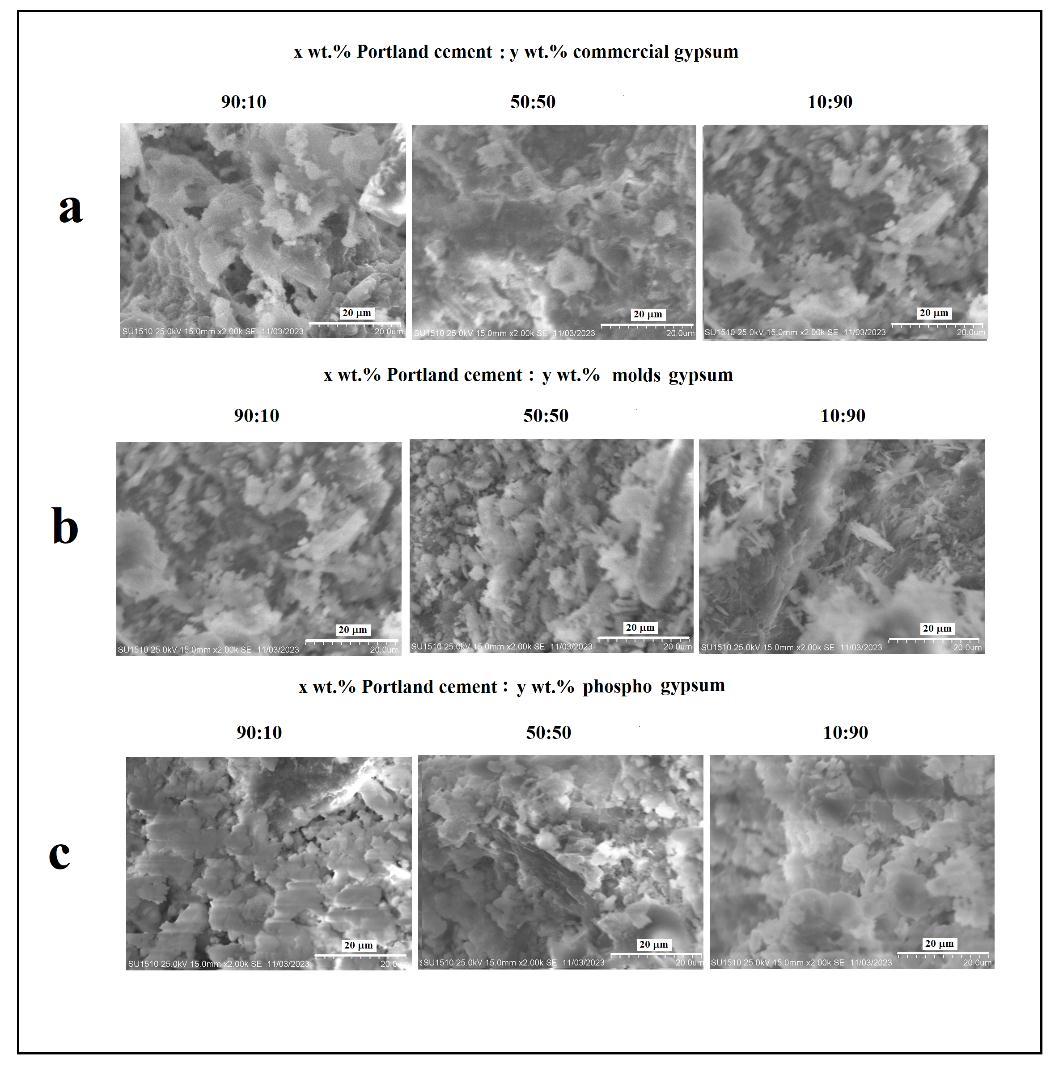
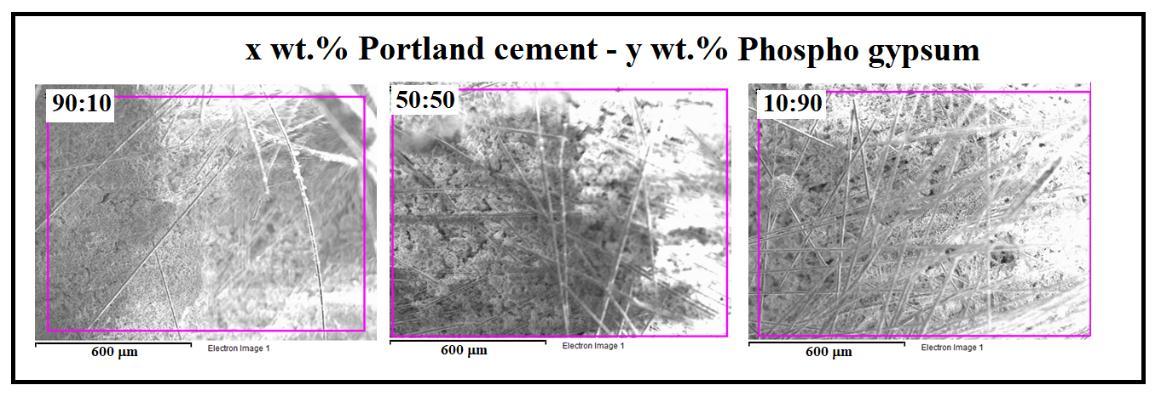
Fig. 3 showsthatsampleswithdifferentcontentcomponentsareasetofagglomeratesofdifferentsizes.Asthegypsum contentincreases,alooserstructureisformed.Suchatransformationofmorphologyshouldleadtoadecreaseinthestrength ofthesamplesandanincreaseinwaterabsorption.
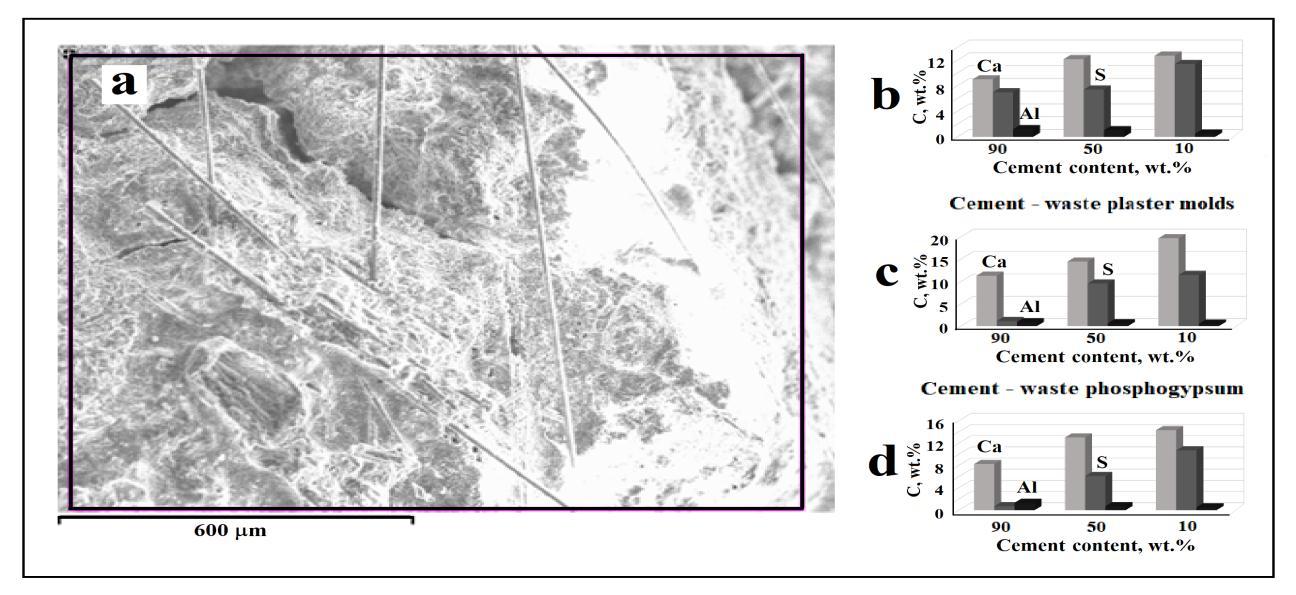
Fig. 4 a shows the glass fibers present in the samples, and Fig. 4 b shows the change in the content of the main elementsoftheelements:Ca,S,andAl.Thedecreaseinthealuminumcontentisconsistentwiththedecreaseinthecontentof Portland cement in the samples. Since Ca and S are present in both components of mixtures, the change in their content reflectsonly thetotalvalueoftheseelements
3.3.Waterabsorptionofspecimensandcorrosionstability
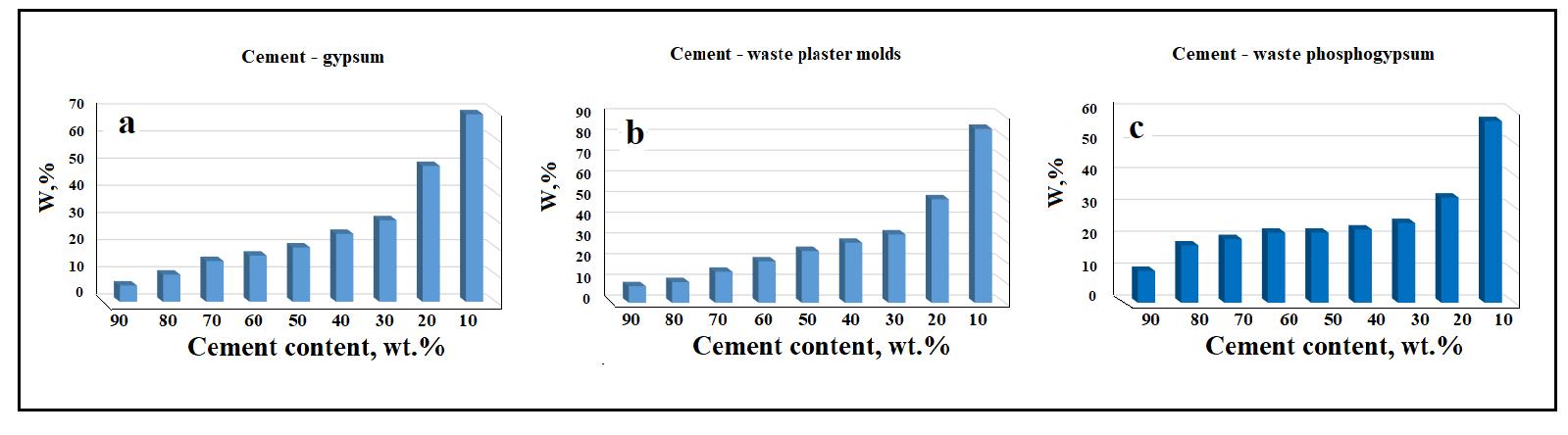
In Fig. 5 itcanbeseenthatwithahighcontentofPortlandcementintheinitialmixtures(90-50wt.%),waterabsorption (W) is largely determined by the cement component of the compositions. However, as the content of Portland cement in
mixtures decreases (40-10 wt.%), the amount of water absorption increases significantly. This is due to the fact that the gypsumcomponentofthemixturesislessstableintheaquaticenvironment.Thisismostclearlymanifestedduringprolonged boilingofthesamples(see Fig. 6),whichcanbeconsideredasatestforthecorrosionresistanceofthesamples.
SomedifferencesintheWvalueofsamplesobtainedfromdifferentmixtures(seeFig.5a-c)dependonthepropertiesof thegypsumcomponentused,andultimatelyonthetemperatureoftheconversionofCaSO4‧2H2OtoCaSO4‧0.5H2O[4].Itcan be assumed that with the complete transformation of waste gypsum dihydrate into hemihydrate gypsum, the water absorptionwilldecrease.
Sincetheabsorptionpropertiesofceramics/productsdependonthesystemofopenporesinthematerialunderstudy,it canbeconcludedthatintheareaofconcreteformation(90-50wt.%Portlandcement)thecorrosionresistanceofthematerial issignificantlyhigherthanintheareaofgypsummaterialformation(40-10wt.%Portlandcement).
The durability and strength of concrete and brick materials depend on the development of physicochemical and chemical corrosion processes [14]. These types of corrosion are largely dependent on the composition of the mineral componentsthatformthesolid/product.
Corrosion resistance testing of samples of Portland cement-gypsum hemihydrate under extreme conditions (boiling water)revealedleachingofboththecementandgypsumcomponents(see Table 1).Thisisevidencedbytheinvarianceofthe pHoftheaqueoussolutionduringtheprocessingofvariouscompositionsofPortlandcement-gypsumcomponents According to[15],corrosionoccursduetothereleaseofCa(OH)2 Itistheleachingprocessthatcausesanincreaseintheporosityofthe material.However,asignificantincreaseinwaterabsorptionandporositywhenprocessingsampleswithahighcontentofthe gypsum component indicates active leaching of the gypsum component as well (see Figs. 5, 6). As a result of the leaching of the main components of the mixtures (Portland cement and gypsum), there is an apparent increase in the content of glass fibersinthesamples(see Fig. 6).Itcanbeconcludedthattheeffectofthedestructionofthemacrostructureofthecomposite materialdependsontheratioofthecomponents.
3.4.Strengthpropertiesofspecimens
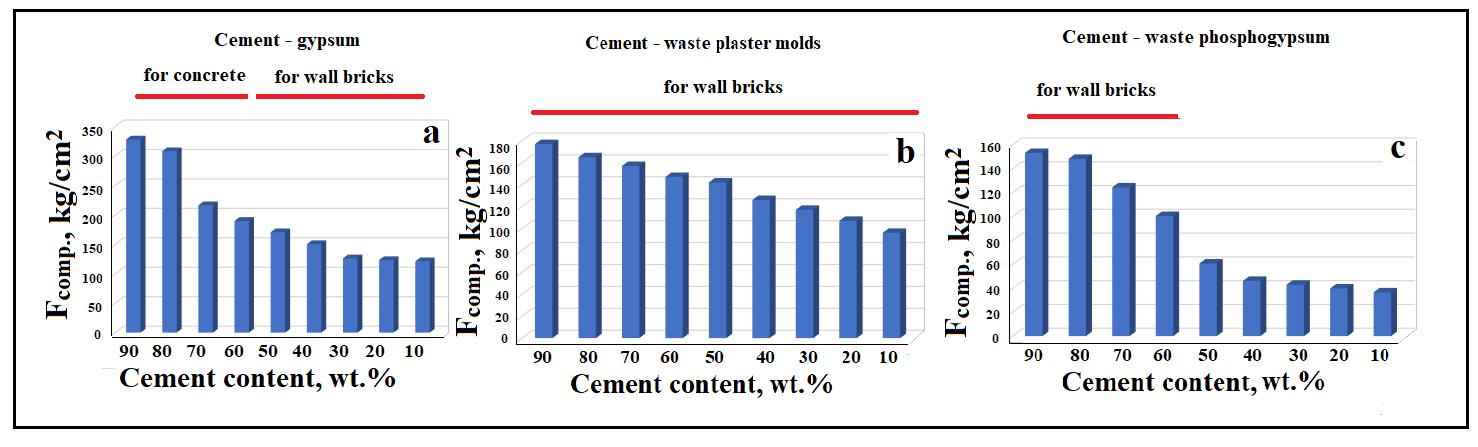
Compressivestrengthtestsofsamplesshowed(Fig. 7)thatasthecontentofthegypsumcomponentintheinitialmixtures Fcomp. decreases. Samples obtained using virgin (commercial) (CaSO4)‧0.5H2O have the best characteristics (Fig. 7 a). Depending onthecontentofsemi-aqueous gypsum,itispossibletoobtainconcretesthatcanbeused forlayingfoundations with a low load (Fcomp.~ 100-120 kg/cm2), for concreting load-bearing structures of low-rise buildings (Fcomp.~ 130-160 kg/cm2), for the installation of monolithic foundations and ceilings, buildings of normal height, concreting of retaining walls (Fcomp.~ 190-300 kg/cm2). Samples containing ~10 wt.% (CaSO4) 0.5H2O have the best strength properties. From such mixtures it is possible to obtain concrete intended for devices of critical structures (Fcomp.~ 330 kg/cm2). At the same time, mixtures with a Portland cement content of 10-50 wt.% are suitable for the manufacture of brick products for various purposes.
When using waste from gypsum molds and phosphogypsum, the compressive strength of the samples is significantly lowerthaninthepreviouscase(see Fig. 7 b, c).Iffrommixtures(90-10)wt.%Portlandcement-(10-90)wt.%wastegypsum molds,youcangetsampleswithastrengththatsatisfieswallbrickproductsforvariouspurposes,thenfrommixtures(90-10) wt.% Portland cement - (10-90) wt.% phosphogypsum To obtain wall bricks, mixtures containing only (10-40) wt.% phosphogypsumshouldbeused.
4. Conclusions
The basis for obtaining unfired/green ceramics is the principle of preparing composite mixtures from Portland cement and large-tonnagewastesofgypsummoldsofceramicproductionandphosphogypsum.Theconductedstudieshaveshownthat:
•whenusingthesetypesofwaste,itisnecessarytocarryouttheirlow-temperaturetreatmentintherangeof200-300 oCto transform (CaSO4•2H2O) → (CaSO4•0.5H2O) and the neutralization of the acidic properties of phosphogypsum by the introductionof CaO/Ca(OH)2 aqueous solutionuptopH=6- 7withoutsubsequentwashingfromnewlyformedsolubleand insolublecompounds;
• By changing the content of secondary CaSO4•0.5H2O in Portland cement, it is possible to obtain building blocks-bricks of variousstrengths.ForPortlandcement-gypsummoldwastecomposites,thecontentofthegypsumcomponentcanbechanged from 10 to 90%. For composites Portland cement-phosphogypsum waste the content of the gypsum component can be changedfrom10to40%;
•toincreasethecompressivestrengthofunfiredceramicsinamixtureofPortlandcement-gypsumwaste,fibrousmaterialof varioustypes,suchasglassfibers,shouldbeintroduced;
The developed non-firing technology is not only energy-saving and water-saving, simple in technological design but also ensuresenvironmentalsustainability,preventingsoilandwaterpollution.
Figure captions
Fig. 1. X-ray patterns of specimens obtained from different mixtures of (CaSO4) 0.5H2O-Portland cement. (a) mixtures from industrialmaterials.For(b,c)the(CaSO4)‧0.5H2Oobtainedfromthetreatmentofwastes.
Fig. 2 Change of peaks intensity of (CaSO4)‧2H2O and Ca2SiO3(OH)2 (b) depending on the content of portland cement and (CaSO4)‧0.5H2Oinmixtures.
Fig. 3 SEM image of fracture surfaces of samples with different content of cement and gypsum components. a) Portland cement-commercialgypsum; b)Portlandcement-moldsgypsum; c)Portlandcement-phosphogypsum
Fig. 4. SEM imageofthefracturesurfaceofthespecimenwith50wt.% Portlandcement-50wt.%phosphogypsum(a), and (b-d)changesinelementscontentonthefracturesurfaceofspecimens
Fig. 5. Changes in the water absorption of samples depending on the composition of the initial mixtures. For specimens Portland cement- commercial gypsum mixtures (a); for specimens Portland cement- molds gypsum mixtures (b); for specimens Portlandcement-phosphogypsummixtures(c).
Fig. 6.SEMimagesofspecimensafterboilinginwaterfor2h.
Fig. 7. Changeinthecompression(a–c)strengthofspecimensdependingontheinitialcompositionofmixtures.(a)forinitial mixtures of Portland cement-commercial gypsum; (b) for initial mixtures of Portland cement-waste plaster molds; (c) for initialmixturesofPortlandcement-wastephosphogypsum.
References
[1]Gypsum:Properties,ProductionandApplication,2011.Ed.Sampson,D.H.NovaSciencePublishersInc.,NewYork,371pp.
[2]TheGypsumConstructionHandbook,2014.7thEdition,Willey,USG,ISBN:978-1-118-74984-52014.576p.
[3]M.Sophia, N. Sakthieswaran, O. GaneshBabu,(2016).Gypsumasa constructionmaterial-reviewof recent developments. Int.J.Innov.Res.Sci.Eng.Technol.(IJIRST)2(12),315-323.
[4] A. Parra Parra, P. A. Márquez Aguilar, M. Vlasova, R. Pochotitla Hernandez, R. Guardian Tapia, M. Fuentes Perez, (2022). Preparationofsecondarygypsumbindersfromwasteplastermoldsoftheceramicindustryandtheirproperties,International JournalofTechnical&ScientificResearchEngineering(IJTSRE),5(5),1-19.
[5]P. P.Budnikov,A. S.Berezhnoy, I.A.Bulavin, G.P. Kalliga,G.V.Kukolev,D. N.Poluboyarinov,Technology of Ceramics and Refractories,StatePublishingHouseofLiteratureonConstructionandArchitecture,Moscow,1955.
[6]K.C. Vrancken, B.Laethem,(2000)Recyclingoptionsforgypsumfromconstructionanddemolitionwaste. WasteManage. Series,1,325-331.https://doi.org/10.1016/S0713-2743(00)80045-8
[7]R.H.S.Geraldo,M.M.Pinheiro,J.S.Silva,H.M.C.Andrade,J.Dweck,J.P.Gonçalves,G.Camarini,(2017)Gypsumplasterwaste recycling: A potential environmental and industrial solution. J. Cleaner Prod. 164, 288-300. https://doi.org/10.1016/j.jclepro.2017.06.188
[8] Y. Chernysh, O. Yakhnenko, V. Chubur, H. Roubík, (2021) Phosphogypsum Recycling: A Review of Environmental Issues, CurrentTrends,andProspects Appl.Sci.11(4),1575.https://doi.org/10.3390/app11041575
[9] Xuemei Chen, Jianming Gao, Chuanbei Liu, Yasong Zhao, (2018) Effect of neutralization on the setting and hardening charactersofhemihydratephosphogypsumplaster.ConstructionandBuildingMaterials,v.190,30November,53-64.
[10] A. Kaziliunas, V. Leskeviciene, B. Vektaris, Z. Valancius, (2006) The study of neutralization of the dehydrate phosphogypsumimpurities,Ceramics–Silikáty,v.50(3)178-184
[11]G.M.SadiqulIslama,F.HabibChowdhury,M.TanveerRaihana,S.KumarSikderAmita,M.Rafiqul Islam,(2017)Effectof PhosphogypsumonthePropertiesofPortlandCement.ProcediaEngineering171,744–751.
[12]P.K.Mehta,J.R.Brady,(1977)UtilizationofphosphogypsuminPortlandcementindustry,CementandConcreteResearch, v.7,537-544.
[13]M.Singh,(2002)Treatingwastephosphogypsumforcementandplastermanufacture,CementandConcreteResearch,v. 32,1033-1038.
[14] ASTM C773-88. Standard test method for compressive (crushing) strength of fired whitewares materials. West Conshohocken,PA:ASTMInternational;2002
[15]G.C.Bye(1999)PortlandCement:Composition,Production,andProperties.ThomasTelfordPublishing,London.
[16] S. Miletic, M Ilic, Copkov, R. Munitlak, (2000) Carbonation and leaching of portland cement with various blending materials,WasteManagementSeries,v.1,75-86.DOI:10.1016/S0713-2743(00)80020-3
Table 1.pHvaluesofwaterafterboilingdestroyedsamplesfor2h
waterabsorptionofsamplesdependingonthecompositionoftheinitialmixtures.Forspecimens Portlandcement-commercialgypsum
(a);forspecimensPortlandcement-moldsgypsummixtures(b);for specimens Portlandcement-phosphogypsummixtures(c).
ontheinitialcompositionofmixtures.(a)forinitial mixturesofPortlandcement-commercialgypsum;
ofPortland