Wireless Power Transfer for Electric Cars
Dr. S. Muthukumar1 , Deepika .K.P2 , Gayathri .B3, Haripriya .S 41Professor and Head, Dept of ECE Sri Venkateswara College of Engineering, Sriperumbudur, TamilNadu
234Students of Electronics and Communication Engineering, Sri Venkateswara College of Engineering, Sriperumbudur, TamilNadu
Abstract— The demand for electric vehicles is rising, which ultimately results in an increase in the number of charging stations. In this project, the vehicle is wirelessly charged via inductive coupling, and payment is made using RFID technology. This project helps tackle the issue of building independent charging stations. Instead, this system can be incorporated in places like malls where people tend tospend longer, and thus parking time can be efficiently converted to charging time. The technology known as wireless power transfer (WPT) employing inductive coupling has the potential to relieve people from obtrusivewires. Additionally, a person can use the RFID tag to pay for the charging costs of that vehicle through the Internet of Things-based collection system that is designed. The system determines if the user has enough money in their account before taking the necessary deductions and updating the balance. No human interaction is necessary for this system. Along with a DC motor that will serve as a gate opener, we also used IR sensors to check for open slots. To track the vehicles that were charged at the stations, a web application was also created.
Keywords Wireless Power Transfer, IoT, RFID, Smart ParkingSystem,AndroidApplication
1. INTRODUCTION
New technologies are always beingdeveloped in the field of technological innovation to make living easier. Tochargeelectricvehicle,westill relyontheclassicaland conventional wire system. Wired charging systems has problems like when numerous electric vehicles are being charged at once, the traditional wiring system becomes a mess. They need bulky charging connectors and cords. Additionally, the charger needs to be manually linked. Lethalelectricshockscouldbecausedbya shortcircuitor by the insulation of the charging cable failing because of conditions like high temperatures, ground contact, or the chargingdeviceitself.
Toreducechargingtimehugenumberofbatteries canbeemployed,orthedepletedbatteriescanbeswapped out for the charged batteries as needed. The batteries, however, have their own set of issues. The batteries are expensiveinitially,hefty,and havea shortlifespan.Future advancementsinenergy storagetechnology mightmake it possible to solve these issues. The WPT is yet another approach that might be used to get around the batteries' issues.Moreover,themanualpluggedinchargingsystems'
trouble with wires and connectors is eliminated by the WPTapproach,makingitconvenient.
Wireless power transfer (WPT) allows electric vehicles (EVs) to recharge their batteries without using a physical connection to a charging station. This technology offers several advantages over traditional wired charging, includinggreaterconvenienceandreducedwearandtearon thevehicle'schargingport.
Byenabling wireless charging, WPTtechnologycan helpincreasetheadoptionofEVsbyreducingthehassleand inconvenience of plugging and unplugging cables and by providing a more seamless and user-friendly charging experience. Additionally, WPT technology has the potential to increase the range of EVs by enabling dynamic charging while driving or parked, reducing the need for frequent stopsatchargingstations.
RFID is used to make payments easier and safer. The self- operated gate at entry and exit is implemented using an IR sensor and a servo motor. Electric vehicles can be controlled using an Android application, which makes parkingaccurate.
2. LITERATURE REVIEW

M.AhmedandO.O.Khalifaintroducedadistinctive approachtowirelesscharging intheirworktitled"Wireless Power Transfer for Electric Vehicle Charging." They conducted tests under different conditions, evaluating distance and alignment, and achieved an impressive efficiency rate of 90% Emphasizing the critical role of coil design, their findings underscore the significance of optimizingthiscomponent[1].
Addressingparking-relatedchallenges,DenisAshok, Akshat Tiwari, and Vipul Jirge developed a "Smart Parking System using IoT Technology." By harnessing the power of the Internet of Things (IoT), their system creates a wellorganized parking environment. Users are seamlessly directed to available parking spaces through illuminated indicators, eliminating the need for time-consuming searches.Thesystem'sautomatednaturealsoreduceslabor requirements,enhancingefficiency[2].
To enhance power transfer efficiency in electric vehicles, R. Kavin, V. Koushika Gowri, M. Naveenaa, T. Navishree, and J. Nithish proposed a novel approach titled
Volume : 10 Issue:05 |May 2023 www.irjet.net
"Wireless Power Transmission in Electric Vehicles Using Solar Energy." Their method incorporates MOSFET switches in the inverter to improve coil performance and achieve faster and more efficient charging. By leveraging higher frequencies, this approach enhances the overall driving experience of electric vehicles, addressing challengesrelatedtochargingtime,range,andcost[3].
Another noteworthy contribution to smart parking systems comes from Yash Agarwal, Punit Ratnani, Umang Shah, and Puru Jain, who developed an "IoT-based smart parking system." Their solution involves a userfriendly mobile application that provides real-time information on nearby parkinglots, including availability status. Users can conveniently reserve a parking spot through the app and authenticate their access using RFID technology upon arrival. This IoT-based approach significantly improves efficiency, reliability, and convenience while optimizing the utilization of parking resources[4].
Zamani, M Nagrial, J. Rizk, and A. Hellany conducted a comprehensive review titled "A review of inductivepowertransferforelectricvehicles."Focusingon inductive coupling, their review encompasses the fundamental principles of inductive power transfer and offers an overview of state-of-the- art wireless power transfer systems for electric vehicles. This work contributes to the understanding and advancement of inductive power transfer technologies in the context of electriccarcharging[5].
3. EXISTING PROBLEM
The current wireless charging electric vehicle model has a receiving pad that is mounted on the underside of the vehicle and a charging pad that is normally installed on the ground at a parking area. The two charging pads electronically communicate when the car is parked on top of one of them to transmit electricity to the battery. The installation and positioning of the necessary WPT parts, such as the transmitter coils, receivercoils,andpowerelectronics,mightbechallenging due to the constrained space in parking slots. The installation and use of WPT systems in parking infrastructure could have regulatory and safety implications. There may be concerns about electromagneticinterferenceorradiation,aswellasissues related to standardization and interoperability of WPT systemsacrossdifferentmakesandmodelsofEVs.
4. CHARGING PROCESS
There are two modes for charging the EV batteries. In one configuration, the charging voltage may change while the charging current remains constant. The constant current (CC) charge is the term used to describe it. The other option allows the charging current to fluctuate while maintaining a constant charging voltage. Theterm"constantvoltage"(CV)charge"referstothis.
p-ISSN: 2395-0072
CCmodeisutilisedtobegintheprocessofcharging adepletedbattery.Typically,thecharging currentiskeptat around10%ofthe battery'srated capacity.TheCVmodeis thenutilisedtochargethebatteryassoonasthebatterySoC gets close to its rated capacity, let's say 75%. This guarantees a straightforward charging procedure without overheatingandbatterydamage.
AstrongchargingcurrentmayariseiftheCV mode is used to start charging a depleted battery, which could cause the battery to overheat or get damaged. Thus, CV modeisnotemployedwhenabatteryischargedchargedto less than 75% of its capacity. When a battery is charged closer to its rated capacity using CC mode it results in overcharging which could overheat the battery or battery getsdamaged.
PWM and PFM are two modulation methods that can be applied to constant-duty converters to handle load changes. PWM and PFM can both be utilized as modulation techniquesasopposedtoonlyone.
5. OVERVIEW OF BATTERIES
Typically, electric vehicles are parked either at residences or storage facilities. To charge the vehicle, the battery chargerisconnectedtoadomesticsingle-phaseAC socket, allowing for slow overnight charging. The duration ofthe charging processvariesdependingonfactorssuchas battery capacity and depth of discharge, but it generally takesaround7to9hours,withamaximumchargingcurrent of14A.
Battery chargers play a crucial role in the advancement of electric vehicles. The charger's parameters haveanimpactonbothchargingtimeandbatterylifespan.A reliable and efficient battery charger is required, with considerations for low cost, small size, and light weight. Additionally,anEVcharger mustensureminimal distortion and a high power factor when drawing current from the utility,aimingtominimizetheimpactonpowerquality and maximizetheavailablerealpowerfromtheutilityoutlet
5.1 LEAD-ACID BATTERIES
Lead-acid batteries are widely available and have a proven, economical, and reliable manufacturing process. However, concerns arise regarding their disposal and the need for effective pollution control to reduce emissions duringrecycling.These batteries,duetotheirlargerweight, arenotsuitableforportableapplications.
5.2 NICKEL METAL HYDRIDE BATTERIES
Nickelmetalhydridebatteriesofferahigherenergy density.Withanenergydensityofapproximately70 Wh/kg, they have been utilized in various all-electric plug-in vehicles. They have also found applications in hybrid vehicles. toxic These batteries generally have a lower environmentalimpactastheydonotcontaincadmium.
International Research Journal of Engineering and Technology (IRJET) e-ISSN: 2395-0056
Volume : 10 Issue:05 |May 2023 www.irjet.net
5.3 LITHIUM-ION BATTERIES
Lithium-ion batteries are highly preferred for electric cars due to their superior range per charge. They arealsolessexpensivethannickel-metalhydridebatteries and have a low discharge rate. To extend the lifespan of lithium-ion batteries, it is recommended to charge them early and often, avoid depleting them below their minimum voltage, andkeep them cool. Table 1 compares differentbatterychargers.
6. COIL PARAMETERS
6.1 COIL RESISTANCE
The greatest impediment to the delivery of power in WPTS is the resistance of the primary and secondary coils. Consequently, figuring out their resistanceisessential.Thetransformer'sefficiencywould actually be 100 percent if resistances were zero. The joule effect that coil resistances cause must be contained withinallowablelimits.Becauseofthis, joulelossesmust be kept to a minimum when buildingWPTS in order to maximize efficiency and transferredPower.
6.2 MUTUAL INDUCTANCE
When a change in current in one coil causes an emf in a different coil close by the first coil, mutual inductanceoccurs.ForthedesignoftheWPTsystem,this parameteristhemostreliable.
6.3 SKIN EFFECT
The center of a conductor made up of one or more concentric circular pieces will have a larger magnetic flux surrounding it than the outer parts. There will be a variation in current density between the conductor's center and surface as a result of the selfinduced back EMF being stronger towards the conductor's center. The skin effect, which is caused by
p-ISSN: 2395-0072
this additional concentration at the surface, raises the conductor'seffectiveresistance.
6.4 PROXIMITY EFFECT
Theproximityeffect,whichislinkedtothemagnetic fields of two conductors that are adjacent to oneanother, alsocausesanincreaseineffectiveresistance.Theremote halfofthecross-sectionthereforecarriesahighershareof the current distribution, which is not uniform over the cross- section. The portions that are close together will carry a higher current density if the currents are flowing inopposingdirections.
7. PROPOSED SOLUTION
To overcome the problem, we have incorporated WPT technology into already-existing parking facilities, including parking garages, retail centers, theatres, and jewellery stores, among others. This could entail adding WPT components to already-existing parking spaces or planning new parking buildings with WPT systems built rightin.
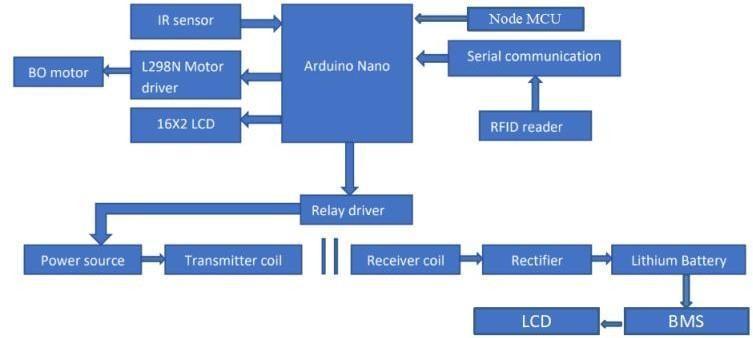
AnotheralternativeistocreateWPTsystems,suchas portable or modular WPT systems, that are simple to install and remove from parking spaces. When necessary, thesedevicesmaybetransferredbetweenparkingspaces. They can also be employed in places where permanent installation is neither possible nor desirable. The proposedidea'sblockdiagramisshowninFig-1.
STEP 1: AnIRsensorandservomotorareconnected toanArduinoNanoinordertodetectacarandopengates forparking.TheavailableslotsareshownonanLCD.
STEP 2: An android application can be used to control the electric automobile, allowing for precise parking.
STEP 3: The battery level will be shown so that the user can choose whether to charge the vehicle or simply park.
STEP 4:
CASE 1: CHARGING: Charging pad is installed on the ground at a parking spot and the receiving pad is installed on the underside of the vehicle. The two pads communicatewirelesslytotransferpowertothebattery. RFIDisusedtodetecttheamountbased onthecharging unitsandparkingcharges.
CASE 2: PARKING: The user only need to park the vehicle.SotheRFIDdetectstheamountforparking.
8. WORKING
Initially once the electric car enters the parking area, the IR sensors detect the slot vacancy. Then the RFID tag is read and card balance is displayed. If the driver has sufficient balance he/she can enter the slot. Depending upon the driver’s choice,separate cards are givenforparkingandchargingrespectively.
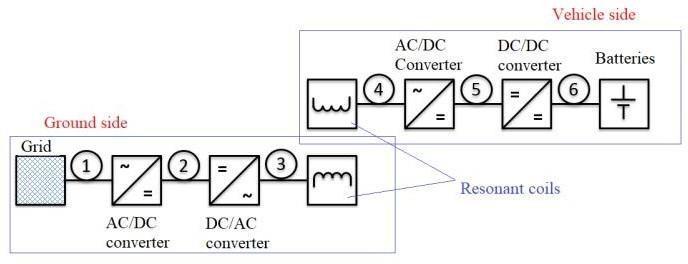
Once the car has been parked properly in the slot, the charging of the battery takes place. The frequency should be high for efficient transfer of power from primary to secondary coil. Thus, the low frequency AC currentsuppliedbythegridisconvertedintoDC.
Then AC/DC converters convert it to high frequencycurrent.Thetransmittercoilreceivesthishigh frequency AC, which subsequently produces an alternatingmagneticfieldthatcutsthereceptioncoiland results in the output of AC power in the receiver coil. After being rectified and converted to DC, the voltage that was induced on the secondary side issubsequently delivered to the battery via the Battery Management System (BMS).Compensation networks are implemented onbothsidestopreservetheresonantfrequencies.
Once the car enters the slot, the time count starts. During exit the RFID card is read and charge is deduced fromthecarddependinguponthetimeduration,thecar hasbeenparked/chargedin theslot.
Finally the data about the history of all the cars parked/charged in the slots is displayed in a web page application.WehaveinterfacedNodeMCU with Arduino Nanotosend thecorresponding datatothewebpage
9. CONTROL OF WIRELESS CHARGING SYSTEM
9.1 EFFICIENCY OF WPT
WPT's maximum efficiency is attained as a result of three different types of factors: The firstgroup takes care oftheloadchange.Inordertoachievethebestimpedance, impedance matching techniques are used. Inductors and capacitors are passive elements used in passive impedance matching, whereas DC-DC converters are used in active impedance matching to match the load. The second group focuses on output control, which includes frequencycontrolandloadvariation.Thethirdcategoryis devoted to controlling input power. Reactive power input is kept to a minimum to boost system effectiveness. The output voltage needs to stayconstant. WPT systems can accomplish this by using numerous pads on the primary side. The two-step tracking method is what this is known as.Wecanchangethedirectionandratioofthecurrentin the primary coil on the transmitting side may both be changedforbestsystemefficiency.
9.2 SYSTEM MISALIGNMENT
The coefficient of coupling between the transmitter and receiver coils determines how well power is transferred. Increased lateral misalignment results in a reduction in mutual inductance. The efficiency of the charging mechanism suffers as a result, decreasing the transmitted power. There has been some research on vehicle lateral misalignment, and a few methods to boost system effectiveness have been put forth. These methods usetwo-dimensionalcoilposition,variouspadstructures, three coil detection systems, and adaptive impedance matchingcircuits.The efficiencyof thesystemcan alsobe increasedbyfrequencyregulation.
9.3 LOSSES
In power electronics, loss analysis is crucial to evaluating the system's performance and optimizing its design characteristics. The growing use of power electronics in various applications underscores the importanceofhigh-accuracypowerlossmeasurement.For measuring totalsystemloss,itis importanttounderstand the losses of each componentof the system, particularly theconverter'sconductionandswitchinglosses.
Resonantswitchingcanbeachievedbyswitchingthe inverter at the resonance frequency. Thistechnique also allows for high-frequency operation compared to hardswitchingPWMconverters.
The converter's conduction losses are dependent on the type of switches used, with SiCMOSFETs being a common type. The conduction losses are affected by the current flowing through the switch and the on- state drain-to-source resistance. Understanding these loss
mechanisms is critical for optimizing the design and improvingtheefficiencyofpowerelectronicssystems
10. OUTPUT AND RESULTS
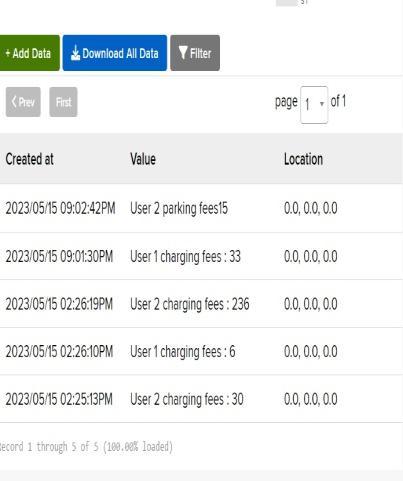
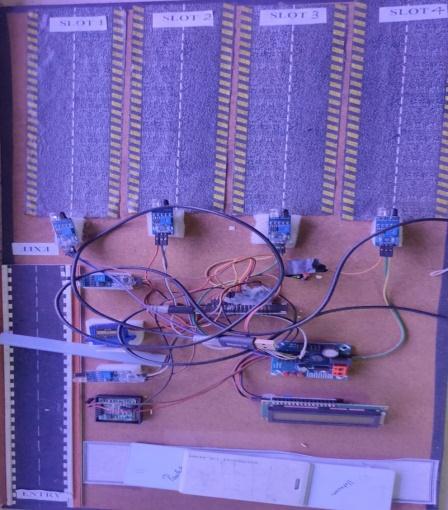
The project demonstrates that wireless power transmission for electric vehicles using inductive coupling, RFID tags, and intelligent parking stations is a promising technology that can offer a practical, secure, andeffectivemethodofchargingelectricvehicles.

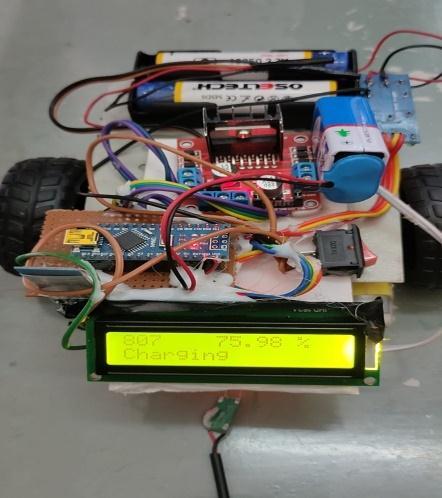
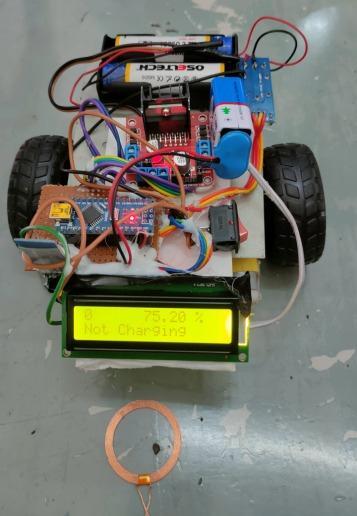
Wireless charging is made possible by the use of inductive coupling, which eliminates the need for physical cords or connectors and lessens the strain on the charging port on the car. While smart parking stations equipped with sensors and communication technologiesenablereal- timemonitoringandcontrol of thechargingprocess,RFIDtechnologyisusedtoidentify andtrackelectricvehiclesastheyapproachandleavethe chargingstation.Inordertooptimizetheeffectivenessof the charging process and regulate the charging current and voltage to ensure safe and effective charging of the electricvehiclebattery,powerelectronicsareusedinthe charging station to control the flow of energy between thetransmittercoilandthereceivercoil.
11. INVOLVEMENT OF INDUSTRIES
Numerous industry and government entities are actively involved in the development of Wireless Power Transfer (WPT) technology. Notable WPT suppliers includeQualcomm,Evatran, WiTricity, SEW,LG,Samsung, Momentum Dynamics, and HaloIPT. Additionally, infrastructure companies such as NRG Energy, Better Place, and Southern California Edison are participating in the initiative. Several prominent Auto OEMs, including
BMW, Mitsubishi, Audi, Daimler, Ford, GM, Honda, Chrysler, Nissan, Phoenix, and Toyota, are also contributing to the efforts. Furthermore, bus manufacturers Proterra and Volvo are part of the collaborative endeavor. Tier 1 suppliers such as Delphi, Magna, Maxwell, and Panasonic are actively engaged in the project. Lastly, government and research organizationsarekeyparticipants.
12. DISCUSSION AND FUTURE RESEARCH
The cultural acceptance of EVs has grown, and morepeoplearecurrentlydrivingthemthaneverbefore thankstothedevelopmentandgrowthofthesupporting technology.ForEVstomaintainapracticaldrivingrange, theremustbeenoughbatteriesforenergystorage.When compared to conventional cable charging, EV wireless charging is a significant enabling technology that offers many advantages. It makes it possible to charge EVs without the usage of connectors. The wireless charging method decreases the size of the battery, lowers the starting cost, saves time, and increases the driving distance. . However, there are still a lot of areas where wireless charging solutions can be improved, which is nowachievablethankstotechnicaladvancement.Butthe increased operating frequency causes the inverter's switching losses to increase. Additionally, using semiconductor devices at high frequencies may cause them to reachhigh temperatures, necessitatingthe need for a cooling system. Therefore, a trade-off between chargingspeedandcoilsizeisnecessaryforoptimalcoil design. The coil design also affects other factors including energy efficiency, leakage flux, power density, and tolerance to misalignment in addition to quick charging capability. Therefore, it is advised that additional research be done in the area of the best couplerdesigntofulfillthegoals.
The primary and the secondary side coils must be exactly aligned to produce a WPT that is very effective. Flux leakage caused by the misalignment lowers the effectiveness of the system. A metal object nearby may become linked because of the flux leakage, which could harm the object in addition to causing energy loss. Misalignment is a significant issue that needs to be resolved in wireless charging systems. To increase the toleranceformisalignment, variousstrategieshavebeen suggested. These suggested techniques employ various coil geometries combined into a single unit, overlapping arrangement, and resonance frequency tuning circuits. These techniques could add to the weight and demand more room. The misalignment issue is being addressed usingalternativetechniquesthatdonotrelyonchanging the coil geometry. After that, the receiver coil and transmitter are aligned using an autonomous control system. Electromagnetic meta material can also be used tocorrectthemisalignment.
An open space exists between the wireless charging system and the electric vehicle (EV) when it is utilized to charge the latter. While the EV is being charged, a foreign object could fall within this open space. If the object is made of metal, the strong magnetic field will cause eddy currents to flow, which will heat it up. As a result, the charging mechanism may operate differently than usual andresultinasafetyincident.Awirelesschargingsystem should employ metal object detection (MOD) and foreign object detection (FOD) which comprises and living object detection (LOD). The three different types of detection system works based on the principle - system parameterbased detection, wave- based detection and field-based detectionmethods.
ThecommonconsensusisthatEVswithDWCSneed small-sized batteries. Both the cost and the weight of the EVs are decreased as a result. The best battery and wirelesschargingsystemsizehasbeenevaluatedbysome research. Another issue that needs to be resolved is interoperability between various charging system types and EVs. Both sides' compensation networks should have compatibleshapes,sizes,andotherparameters.
13. CONCLUSION
Wehavereviewedchargingofelectricvehiclesusing wireless power transmission. Due to its user-friendliness and environmental friendliness, wireless charging is seen asbeingsuperiortoconventionalcablechargingsolutions. Additionally, it does away with the need for cables and mechanical connectors, avoiding the inconveniences and risks that come with them. In general, either microwave, laser, or mutual coupling are used for wireless power transmission. However, only mutual coupling-based techniques are frequently used in wireless charging. The mutual coupling-based inductive and capacitive power transfer techniques are employed for contactless power transfer and charging of electric devices. It is determined that inductive power transmission offers advantages and is the best approach for wirelessly charging electric vehiclesafteradiscussion,comparison,andcontrastofthe two techniques. Also reviewed and presented are crucial components of a wireless charging system, including the charging pad, compensation topologies, system misalignment, communication, and control. A brief summary of battery kinds and models is also provided because the batteries affect a number of charging system factors.
ACKNOWLEDGEMENT
I would like to express my deepest gratitude to Sri Venkateswara College of Engineering for providing me withtheresourcesandsupportnecessarytocompletethis project.Iamalsoextremelygratefultomymentors, Dr. S. Muthukumar (Head of Department - ECE), Mrs. K S Subhashini, for their invaluable guidance, feedback, and encouragement throughout this process. Their expertise
andinsightwereinstrumentalinshapingthedirectionof this project and refining its execution. Thank you for sharing your time, knowledge, and expertise with me. Your contributions have been immeasurable and will alwaysberemembered.
REFERENCES
[1]. A. M. Ahmed and O. O. Khalifa , “ Wireless power transferforelectricvehiclechargingConferencePaper” , AIP conference, doi:10.1063/5.0032383, December 2020.
[2]. D. Ashok, A. Tiwari and V. Jirge, "Smart Parking System using IoT Technology," 2020 International Conference on Emerging Trends in Information Technology and Engineering (ic-ETITE), Vellore, India, 2020,pp.1-7,doi:10.1109/ic-ETITE47903.2020.457.
[3].R.Kavin,V.K.Gowri,M.Naveenaa,T.NavishreeandJ. Nithish, "Wireless Power Transmission in Electric Vehicle Using Solar Energy," 2021 3rd International Conference on Signal Processing and Communication (ICPSC), Coimbatore, India, 2021, pp. 78-80, doi: 10.1109/ICSPC51351.2021.9451697.
[4].Y.Agarwal,P.Ratnani,U.ShahandP.Jain,"IoTbased Smart Parking System," 2021 5th International Conference on Intelligent Computing and Control Systems (ICICCS), India, 2021, pp.464470,doi:10.1109/ICICCS51141.2021.9432196.
[5]. M. Zamani, M. Nagrial, J. Rizk and A. Hellany, "A review of inductive power transfer for electric vehicles," 2019 International Conference on Electrical Engineering Research & Practice (ICEERP), Sydney, NSW, Australia, 2019, pp. 1-5, doi: 10.1109/ICEERP49088.2019.8956971.
[6]. M. Zucca, P. Squillari and U. Pogliano, "A measurementsystemforthecharacterizationofwireless charging stations for electric vehicles," 2020 Conference on Precision Electromagnetic Measurements (CPEM), Denver, CO, USA, 2020, pp. 1-2, doi: 10.1109/CPEM49742.2020.9191828.
[7]. J. Qu, L. He, N. Tang and C. -K. Lee, "Wireless Power Transfer Using Domino-Resonator for 110-kV Power Grid Online Monitoring Equipment," in IEEE Transactions on Power Electronics, vol. 35, no. 11, pp. 11380-11390, Nov. 2020, doi: 10.1109/TPEL.2020.2989757.
[8]. H. Feng, R. Tavakoli, O. C. Onar and Z. Pantic, "Advances in High-Power Wireless Charging Systems: Overview and Design Considerations," in IEEE TransactionsonTransportationElectrification,vol.6,no. 3, pp. 886-919, Sept. 2020, doi: 10.1109/TTE.2020.3012543.
[9]. X. Mou, R. Zhaoand D.T. Gladwin, "Vehicle-to-Vehicle charging system fundamental and design comparison," 2019 IEEE International Conference on Industrial Technology (ICIT), Melbourne, VIC, Australia, 2019, pp. 1628-1633,doi:10.1109/ICIT.2019.8755057.
[10].D. Patil,M. K.McDonough,J. M.Miller,B.Fahimi and P. T. Balsara, "Wireless Power Transfer for Vehicular Applications: Overview and Challenges," in IEEE Transactions on Transportation Electrification, vol. 4, no. 1,pp.3-37,March2018,doi:10.1109/TTE.2017.2780627.