International Research Journal of Engineering and Technology (IRJET) e-ISSN:2395-0056

Volume: 10 Issue: 05 | May 2023 www.irjet.net
International Research Journal of Engineering and Technology (IRJET) e-ISSN:2395-0056
Volume: 10 Issue: 05 | May 2023 www.irjet.net
1M.Tech Student, Civil Engineering Department, IIMT University, Meerut Uttar Pradesh, India
2Assistant Professor, Civil Engineering Department, IIMT University, Meerut Uttar Pradesh, India
3Assistant Professor, Civil Engineering Department, IIMT University, Meerut Uttar Pradesh, India ***
ABSTRACT: Infrastructure development plays a crucial role in driving the overall growth of the Indian economy. However, constructing engineering structures on weak or soft soil poses significant challenges in terms of safety and stability.Thefoundationofanystructuremustpossesssufficientstrengthtosupporttheentireload.Amongthedifferent typesofsoil,alluvialsoiliscommonlyusedbutitexhibitsvaryingbehaviorwithchangesinmoisturecontentandhaslow bearingcapacity.Soilstabilizationtechniquesoffereffectivesolutionstoenhancethepropertiesofsuchsoil.Additionally, the increasing pace of urbanization and industrialization has led to the generation of large quantities of waste materials, posing environmental challenges in their disposal. Utilizing these waste materials for soil stabilization presents an alternative approach that allows for their high-volume consumption and reduces environmental impact. This paper aims to stabilize alluvial soil using marble dust, burnt brick dust, lime, and burnt brick dust as stabilizing agents. Laboratory investigations encompass determining the Atterberg limits, dry density, California bearing ratio (CBR), and unconfined compressive strength (UCS). The proportions of the stabilizing agents vary from 0% to 40%, with increments of 10% by massofthe dry soil.The resultsreveal a decreasingtrendin the plasticityindexas the content of marbledust, lime, and burntbrickdustincreases.Furthermore,thereisageneralincrease inthemaximumdrydensity(MDD)andadecreasein the optimum moisture content (OMC) with higher proportions of marble dust, lime, and brick dust. Moderate improvements in CBR and UCS are observed with increasing marble and burnt brick dust content, while significant enhancements are found with higher lime and burnt brick dust content. The stabilization of soil leads to improved subgradestrength,therebyreducingtherequiredthicknessofthepavement.Thesefindingsdemonstratethepotentialof utilizing waste materials for soil stabilization, resulting in improved engineering properties, cost-effectiveness, and sustainability in infrastructure construction. By implementing such techniques, the industry can address both environmentalconcernsandtheneedforrobustfoundationsinvariousconstructionprojects.
Keywords: Wastematerials;Soilstabilization;Atterberg'sLimits;Compaction;CBR;UCS
The predominant soil in the study area is Gangetic alluvium, which is commonly found in the Indo-Gangetic plain region. Alluvial soils typically have low strength, and their engineering properties vary with changes in moisture content. Constructing roads on virgin alluvial soil often requires a thicker pavement and a large quantity of construction materials, resulting in higher costs. Furthermore, the use of quarried aggregates for road construction is prohibitedbythegovernment.Therefore,thereisaneedforinnovativeapproachestoreduceconstructioncostswhile ensuringsufficientquality.
Soil stabilization is one technique used to improve the quality of subgrade soil and reduce construction costs. However,conventionalstabilizingmaterialssuchascement,lime,andchemicalsareexpensive.Cementstabilizationis also less preferable nowadays due to the rising costs and environmental concerns associated with its production. Hence, there is a growing emphasis on promoting the use of non-conventional and waste materials like fly ash, rice husk ash, sugar cane bagasse ash, marble dust, and burnt brick dust for soil stabilization. Several researchers have conductedstudiesinthisfield,andafewoftheirfindingsarementionedhere.
Anitha K. et al. (2009) investigated the effects of marble dust on different types of subgrade soil. They observed a significant reduction in the plasticity index as the percentage of marble dust varied, while the optimum moisture content(OMC)decreasedandthemaximumdrydensity(MDD)increasedwiththeadditionofmarbledust.
JustoC.E.GandKrishnamurthy(2008)conductedlaboratorystudiesonsoilstreatedwithmarblepowderstabilizer.They observedareductionofabout35%to40%intheplasticityindexvalueswiththeadditionof6%stabilizer,andthesoaked CBR(CaliforniaBearingRatio)valueofthestabilizedsoilsshowedasignificantincrease,evenwitha2%stabilizercontent.
Lekha B.M. and A.U. Ravi Shankar (2014) investigated the laboratory performance of marble dust-stabilized soil for pavements.Theyfoundthatthetreatedsoilsexhibitedahighfatiguelifewhensubjectedtorepeatedloading,comparedto theuntreatedsoils.
Bell(1996)studiedtheuseoflimeasastabilizerforclaymineralsandsoil.Theresearchindicatedthatlimecouldenhance thegeotechnicalpropertiesofthesoil.
Firat(2012)replacedtwotypesofnaturalsoilwithlime,brickdust,andwastesand.Thestudyshowedthatlimeandbrick dustwereeffectiveadditivematerialsforroadsubgradefill,improvingtheCBRandswellingratio.Areplacementlevelof 15%fortheseby-productswasfoundtobesuitableformediumandlowplasticitysoils.
Theobjectiveofthispaperistoinvestigatetheengineeringpropertiesofalluvial soilwithandwithoutstabilizingagents suchasmarbledust,lime,andburntbrickdust.
JustoC.E.GandKrishnamurthy(2008)conductedlaboratorystudiesonsoilstreatedwithmarblepowderstabilizer.They observedareductionofabout35%to40%intheplasticityindexvalueswiththeadditionof6%stabilizer,andthesoaked CBR(CaliforniaBearingRatio)valueofthestabilizedsoilsshowedasignificantincrease,evenwitha2%stabilizercontent.
Lekha B.M. and A.U. Ravi Shankar (2014) investigated the laboratory performance of marble dust-stabilized soil for pavements.Theyfoundthatthetreatedsoilsexhibitedahighfatiguelifewhensubjectedtorepeatedloading,comparedto theuntreatedsoils.
Bell(1996)studiedtheuseoflimeasastabilizerforclaymineralsandsoil.Theresearchindicatedthatlimecouldenhance thegeotechnicalpropertiesofthesoil.
Firat(2012)replacedtwotypesofnaturalsoilwithlime,brickdust,andwastesand.Thestudyshowedthatlimeandbrick dustwereeffectiveadditivematerialsforroadsubgradefill,improvingtheCBRandswellingratio.Areplacementlevelof 15%fortheseby-productswasfoundtobesuitableformediumandlowplasticitysoils.
Theobjectiveofthispaperistoinvestigatetheengineeringpropertiesofalluvial soilwithandwithoutstabilizingagents suchasmarbledust,lime,andburntbrickdust.
By studying the engineering properties of alluvial soil with different stabilizing agents, this research aims to provide valuable insights into the effectiveness of marble dust, lime, and burnt brick dust as potential alternatives for soil stabilization. The findings from this study have the potential to contribute to the development of cost-effective and environmentallyfriendlysolutionsforroadconstructionandinfrastructureprojects.Byutilizingwastematerialsandnonconventional additives, it is possible to enhance the geotechnical properties of the subgrade soil, reduce pavement thickness requirements, and improve overall construction efficiency. Such advancements in soil stabilization techniques canleadtosustainableandeconomicalpracticesinthefieldofcivilengineering.
Themarbledustusedinthisstudywasobtainedfromlocal sourcesandisa byproductofcuttingandgrinding marble.It hasa veryfineparticlesize, isnon-plastic,andisnearly well-graded.Limeandbrick dustwereobtainedfrom a chimney and were in a dry form. Before being mixed with the soil, the lime and brick dust were sieved through a 425-micron IS sieve. The chemical composition of the soil, marble dust (MD), lime, and brick dust (BD) are provided in Table 1. The physicalpropertiesofmarbledust(MD),lime,andburntbrickdust(BD)arepresentedinTable2.
Table 1: Chemicalcompositionofadmixtures
Thebasic testsconductedinthisstudywerecarriedoutinaccordancewiththerelevantIndianstandardcodes.These codesincludeGrainSizedistribution(IS:2720,Part-IV),SpecificGravity(IS:2720,Part-III),Atterberg’slimits(IS:2720, Part-V), Compaction characteristics (IS:2720, Part-VII,VIII), UCS (IS:2720, Part-X), and CBR soaked and unsoaked (IS:2720, Part-XVI). These standard codes provide guidelines and procedures for determining the respective propertiesandcharacteristicsofthesoilsamples.
Thesoilsampleusedforthisstudyiscollectedatadepthof 1.5mto2.5musingthemethodofdisturbedsampling.AccordingtoIndianStandardsoil classificationsystem,thesoil was classified as intermediate plastic clay (CI). Index properties are 16% shrinkage index and 52% free swell index. The degree of expansion and severity are medium and marginal (BIS-1498:1970).Virgin alluvial soil is stabilized with marble dust and burnt brick dust from 10 to 40% with increment of 10%. Virgin soil is also stabilized with lime including burnt brick dust (i) keeping 2% lime and varying percentage of brick dust from 10 to 40% and (ii) keeping 4%lime,andvaryingpercentageofbrickdustfrom10to40%.
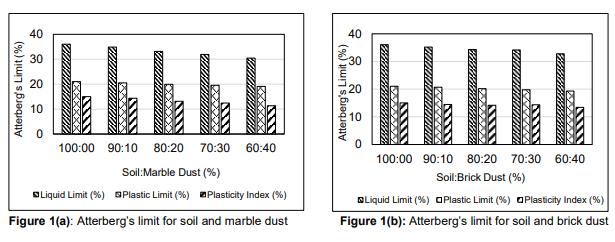
The results of Atterberg's limits for soil and marble dust are depicted in Fig 1(a), while the results for soil and brick dust are shown in Fig 1(b). It can be observed that the index properties of the soil decrease as the stabilizer content increases.Thisdecreasemaybeattributedtothetransformationofsoilgrainsfromfinerto coarser.
Specifically, when stabilized with marble dust, the liquid limit decreases from 36% to 30%, and the plastic limit decreasesfrom21%to19%.Similarly,ata40%additionofburntbrickdust,theliquidlimitdecreasesby9%,andthe plasticityindexalsodecreasesby10%.
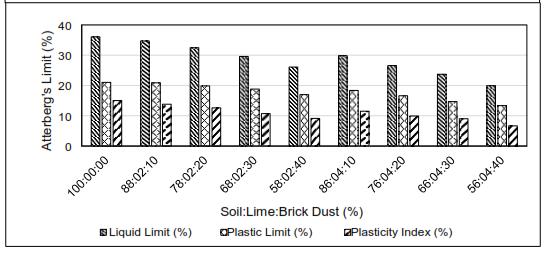
When stabilized with 2% lime and varying percentages of brick dust from 0% to 40%, the liquid limit decreases from 36% to 26%, and the plasticity index decreases from 15% to 9%. Similarly, at 4% lime content and varying percentages of brick dust from 0% to 40%, the liquid limit decreases from 36% to 20%, and the plasticity index is reducedfrom15%to7%(Fig2).
Thevariationsintheoptimummoisturecontent(OMC)andmaximumdrydensity(MDD)withanincreaseinstabilizer content are presented in Table-3. It is observed that as the stabilizer content increases, the OMC decreases while the MDD increases. This can be attributed to the chemical reaction between the stabilizers and soil particles, which effectivelytransformthesoilgrainsfromfinertocoarser.
Whenmarbledustisaddedtothesoil,theMDDvalueincreasesfrom1.64to1.72g/cc,whileadecreaseisobservedin theOMCvaluefrom17to14.6%.Asimilartrendisobservedwhenbrick dustismixedwiththesoil,withasuccessive increment of 10%. The MDD value increases by 7.3% and the OMC value decreases to 15%. For 2% lime content with varyingpercentagesofbrickdustfrom10%to40%,theMDDvalueincreasesby15.24%andtheOMCvaluesdecrease by 22.9% compared to the virgin soil. In the compaction test conducted at 4% lime content and different percentages ofbrickdust(10%to40%),theMDDvalueincreasesby20.12%whiletheOMCdecreasesby27.64%.
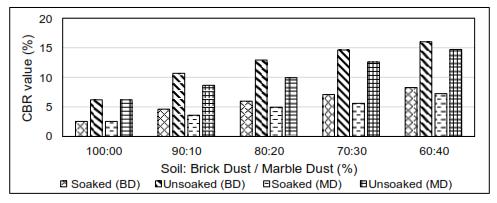
TheCBRcharacteristicsofboththevirginsoilandthestabilizedsoilaredepictedin Figure3andFigure4.Itis observed that the unsoaked and soaked CBR values increase as the content of the stabilizer increases. This improvement can be attributedtotheenhancementingrainsizeandthepozzolanicactionofthechemicalspresentinthesoilandstabilizers.
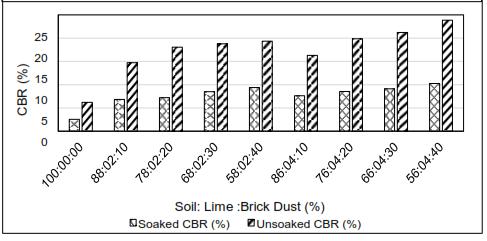
The addition of BD and MD leads to an improvement in the soaked CBR value. A significant increase of 69.16% is observed with BD, while an increase of 67.77% is observed with MD. Similarly, the unsoaked CBR value shows a substantialimprovement,witha64.78%increasewithBDanda57.88%increasewithMD,comparedtothevirginsoil.
The results indicate that the soaked California Bearing Ratio (CBR) exhibits an increase from 2.55% to 9.37% when 2% lime is used, with varying percentages of brick dust ranging from 10% to 40%. Furthermore, at 4% lime content, the soakedCBRvaluereaches75.1%withdifferentpercentagesofbrickdust. Similarly, the unsoaked CBR value shows a significant improvement when 2% lime is utilized, along with varying percentages of BD. Compared to the virgin soil, the unsoaked CBR value is enhanced by 67.9%. The trend remains consistentat4%limecontent,withtheunsoakedCBRvalueincreasingto74%asthepercentageofBDvaries. These findings are visually represented in Figure 4, illustrating the increase in CBR values with different lime and BD compositions.
Thevariationsinunconfinedcompressivestrength(UCS)arepresentedinTable4.TheresultsindicatethattheUCSof themixincreases when2%limecontentisadded,reachingamaximumvalueof4.27kg/cm2forthemixconsistingof 68% soil, 2% lime, and 30% brick dust. Upon further increasing the lime content to 4%, the UCS initially continues to increase,withthemaximumvaluerecordedat4.51kg/cm2forthesamemixcomposition.
Notably, a significant improvement is observed when incorporating the admixtures BD and MD. The UCS value increasesby47.02% withtheadditionofBD, whileMDcontributestoa 42.73%increaseinUCS.Thisenhancementin UCScanbeattributedtothepozzolanicactionandthepresenceofchemicalsinthesoilandstabilizers.
The trend of increasing UCS values with higher concentrations of stabilizing agents suggests their positive impact on thestrengthcharacteristicsofthemix.
Basedonthefindingsofthisstudy,thefollowingconclusionscanbemade:
1. The alluvial soil examined in this study was classified as intermediate plastic clay (CI) according to the Indian Standard classification system. The soil was stabilized using three waste materials: marble dust (MD), lime, and brickdust(BD).Thesematerialsexhibitedsufficientcementitiousproperties.
2. Significant improvement was observed in the soil's properties when stabilized with marble dust, brick dust, lime, andacombinationoflimeandbrickdust.Thehighestlevelofimprovementwasachievedwitha4%limeandbrick dustcontent.
3. Stabilization with marble dust, brick dust, lime, and brick dust led to an increase in maximum dry density and a decrease in optimum moisture content (OMC). The highest dry density of 1.97 g/cc was achieved at an OMC of 12.3%witha4%limeand40%brickdustcontent.
4. TheCaliforniaBearingRatio(CBR)valueincreasedwiththeadditionofmarbledust,brickdust,lime,andbrickdust content. However, an optimum CBR value was not identified. The highest soaked CBR value obtained was 10.26% witha4%limeand40%brickdustcontent.
5. The unconfined compressive strength (UCS) of the stabilized soil increased with the addition of marble dust, brick dust, lime, and brick dust content. However, an optimum UCS value was not determined. The highest UCS value recordedwas4.68kg/cm2.
6. Consequently,marbledustandburntbrickdustcanbeeffectivelyusedaswastematerialstoenhancetheproperties ofsubgradesoilandreducethethicknessofadjacentlayers.
Theseconclusions are basedon the resultsandanalysisconducted inthisstudy. Theysuggestthepotential forutilizing wastematerialstoimprovethecharacteristicsofsubgradesoilforroadconstructionpurposes.
[1] AnithaKR, R.Ashalatha, Arvee Sujil Johnson, (Nov2009). Effects Of marble dust OnDifferentTypesOfSubgrade Soil.10th National Conference on Technological Trends, pp6-7.
[2] Bell,FG(1996).Limestabilizationofclaymineralsandsoils.JournalofEngineeringGeology,Vol.42(4),pp223-237.
[3] C.E.G. Justo, Krishnamurthy (2008). Laboratory studies on properties of soils treated with marble powder stabiliser, RASTACenterforraodtechnology,.
[4] IS:2720(PartIII/Sec2)-1980.DeterminationofSpecificGravity,BureauofIndianStandards,NewDelhi
[5] IS:2720(Part4)-1985.GrainsizeAnalysis,BureauofIndianStandards,NewDelhi.
[6] IS:2720(Part5)-1985.DeterminationofLiquidLimitandPlasticLimit,BureauofIndianStandards,NewDelhi.
[7] IS: 2720 (Part 7)-1980. Determination of Water Content-Dry Density Relation Using Light Compaction, Bureau of IndianStandards,NewDelhi.
[8] IS:2720(Part10)-1991.DeterminationofUnconfinedCompressiveStrength,BureauofIndianStandards,NewDelhi.
[9] IS:2720(Part16)-1987.LaboratoryDeterminationofCBR,BureauofIndianStandards,NewDelhi.
[10] Kumar, M.A and Raju, G.V.R (2009). Use of Lime cement stabilization pavement construction. Journal of Engineering&MaterialsSciences,Vol.16,pp269-276.
[11] Lekha B.M. and A.U. Ravi Shankar (2014). Laboratory Performance of marble waste Stabilized Soil for Pavements,Vol.5(2),pp105-110.
[12]Miller.G.AandAzad,S.(2000).Influence ofsoiltype onstabilizationwithcementkilndust. Journal ofconstruction& BuildingMaterials,Vol.14(2),pp89-97.
[13] Rahman,M.A,(1987). Effect of cement-rice husk ash mixtures on geotechnical properties of lateritic soils. Journal of soilfoundation,Vol.27(2),pp61-65.
[14] Sharma,N.K(2012). Stabilization of clayey soil with fly ash and lime: a micro level investigation. Geotech GeologyEngg,pp1197-1205.
[15] Singh H.P (2012). Improvement in CBR value of soil reinforced with jute geotextile layers. International journal of earthscience,Vol.05,pp1438-1442.
[16]Tastan(2012). Stabilization of organic soil with fly ash. Journal of geotechnical & geoenvironmentalengineering ASCE,pp819-833.
[17]ZhangandXing(2012).Stabilizationofexpensivesoilsbylimeandflyash.JournalofWuhanuniversityoftechnology, Vol.17(4),pp73-77.