
Study of Strength of Concrete with doping of ceramic dust.
Er. Rajni Vikal , Er. Monu Kumar , Er. Ali Akbar1 M.Tech Student, Civil Engineering Department, IIMT University, Meerut Uttar Pradesh, India
2 Assistant Professor, Civil Engineering Department, IIMT University, Meerut Uttar Pradesh, India

3 Assistant Professor, Civil Engineering Department, IIMT University, Meerut Uttar Pradesh, India ***
ABSTRACT
- Investigating the Influence of Ceramic Dust and Polypropylene Fiber on the Mechanical Properties of Concrete
This research focuses on the utilization of mineral admixtures such as ceramic dust, fly ash, and metakoline to produce high-performance concrete. The study examines the impact of ceramic dust percentage and polypropylene fiber on the mechanical properties of concrete. The aim is to understand the effects of substituting cement with ceramic dust, polypropylene fibers.
KEYWORDS- Ceramic Dust, Polypropylene Fibers, Concrete,Strength,Waste
I. INTRODUCTION
The utilization of concrete and mortar as cost-effective, durable,andstructurallystrongbuildingmaterialsmakes them highly desirable for construction . Their malleability in their fresh state allows for easy shaping according to specific requirements. However, the inherent weaknesses such as low tensile strength, susceptibility to moisture fluctuations, and vulnerability to failure necessitate the use of fiber reinforcement to overcome these limitations in a practical and affordable manner. Fiber reinforcement, especially with polypropylenefibers,significantlyimproveskeyqualities of these materials, including flexural strength, durability, fatigue resistance, impact permeability, and abrasion resistance. The ceramic industry faces challenges in waste disposal, with ceramic waste being irresponsibly dumped, leading to environmental pollution and land occupation issues. By incorporating ceramic waste into concrete, significant cost savings, energy efficiency, and reduced environmental impact can be achieved. Additionally, the development of new concrete technologies, such as using pozzolanic materials and nanotechnology, presents opportunities to reduce the reliance on natural resources and improve overall
construction practices. By replacing cement with ceramic dust and polypropylene fibers, environmentally friendly building techniques can be realized, as demonstratedbythefindingsofthisstudy.
The need for cost-effective methods to cope with the demands of expanding road networks in India is particularly crucial due to limited fiscal resources. Utilizing locally available soil as granular layers in pavement construction can significantly reduce construction costs. This approach involves the use of stabilizers, which offer an economical solution for pavementconstructionandmaintenance.Addressingthe issue of waste disposal generated by industries is another important aspect. By repurposing these waste materials for engineering purposes, the problems associated with disposal and environmental impact can bemitigated.
In a pavement section, bituminous layers are typically placed over a base and/or sub-base, which are compacted on a suitable subgrade. The soil subgrade plays a critical role in the pavement section, as inadequate bearing capacity can lead to rutting in the granularbaseandsubbaselayers,eventuallyresultingin fatigue cracking in the bituminous layers. Therefore, improving the properties and performance of the soil subgrade is essential for ensuring the longevity and stabilityofthepavementstructure.
II. MATERIALS AND METHODS
In this study, OPC Grade 43 cement was selected as the typeofcementused[22].Fineaggregateswereobtained from Standard Ennore sand, while crushed stone with a maximum graded aggregate size of 12.5mm was used. The concrete mixture adhered to the guidelines set by the Indian standard code IS 456-2000, which specifies the use of potable water for concrete production [23]. Sand classification was conducted following the standards outlined in IS 383 (1970). All materials were
procured from local vendors, ensuring accessibility and availability. The concrete making and casting processes followed the procedures outlined in IS 516:1959, which wasreaffirmedin1999.
To ensure accuracy, the quantities of cement, coarse aggregates (20mm and 10mm size), fine aggregate, and water were individually weighed for each batch, with a precision of 0.1 kilogram. For testing the compressive
strength, cube specimens measuring 150 millimeters in length were used, as specified by the Indian standard specifications BIS: 516-1959. The splitting tensile strength was measured on cylindrical specimens with a diameter of 150 millimeters and a length of 300 millimeters after 7, 28, and 90 days of ageing, following the recommendations of the Indian standard specifications BIS: 516-1959.
III. RESULT AND DISCUSSIONS
A. Workability
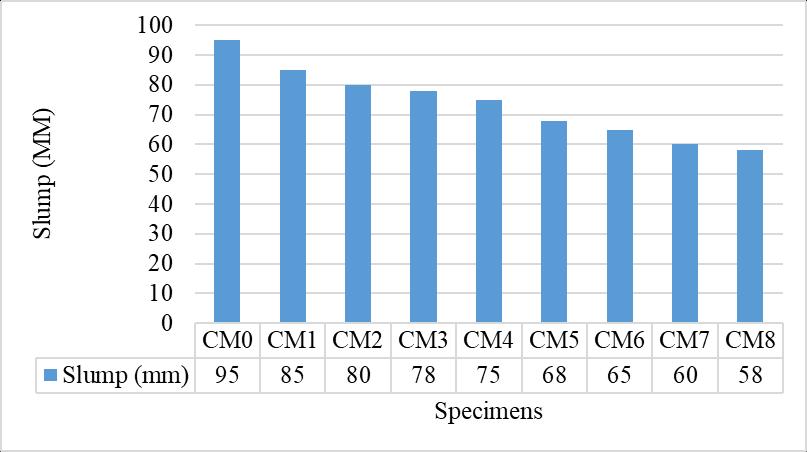
Theaddition ofceramicdusttotheconcrete mixture has a detrimental effect on its workability. The results of the slump cone test revealed that the workability of the control mix was 95 millimeters. However, as ceramic dust was gradually incorporated, the workability gradually decreased, reachingaminimumvalueof75millimeterswhen20 percent ceramic dust was added. This reduction in
workability can be attributed to the small particle sizeoftheceramicdust[14].
Furthermore, even a small percentage of polypropylene fibers exacerbates the decline in workability, with a workability value of only 51 millimeters when 1.0 percent of polypropylene fiber is added. This decrease in workability can be attributed to increased particle packing and enhanced intermolecular forces resulting from the presenceofthefibers.Asthefibersactasfillersand reinforcing materials, their inclusion ultimately leads to a loss in workability [24] (Figure 1).
B. Compressive Strength
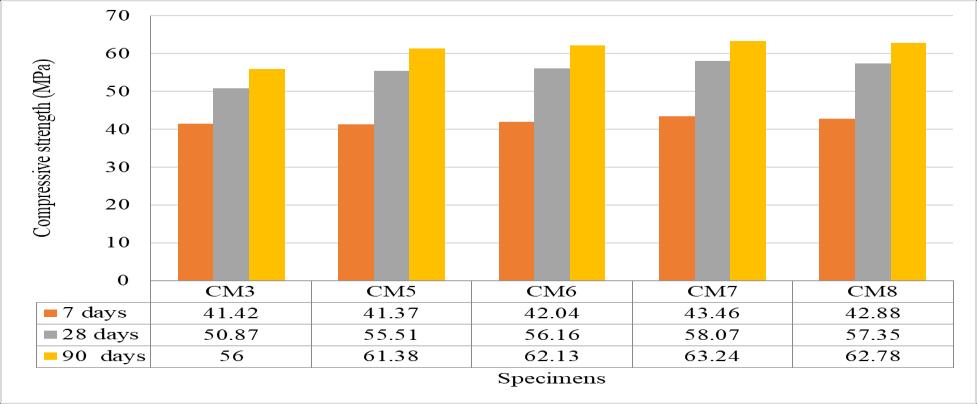
Using a compression testing machine and 150millimeter cubes, the compressive strength of the concretemixwasdeterminedafter7,28,and90days.A comparison with the control mix, which had no additives, revealed that the compressive strength increased in all mixtures and curing periods. At 7 days, theadditionof5percent,10percent,15percent,and20 percent ceramic dust resulted in a percentage increase in compressive strength of 2.81 percent, 9.71 percent, 13.98 percent, and 13.13 percent, respectively. At 28 days, the percentage increases were 2.48 percent, 6.67
percent, 11.61 percent, and 5.42 percent, and at 90 days, they were 4.96 percent, 7.63 percent, 14.82 percent,and6.73percent,respectively.
The improvement in compressive strength in the concrete containing ceramic dust can be attributed to enhanced packing percentage and reduced voids. This led to an enhancement in the microstructure and improvedbindingbetweentheaggregateandthepaste. Theadditionofceramicdustimprovedthelinkbetween the sand, aggregate, and the hydrated cement matrix, resulting in an increase in compressive strength (Figure2).
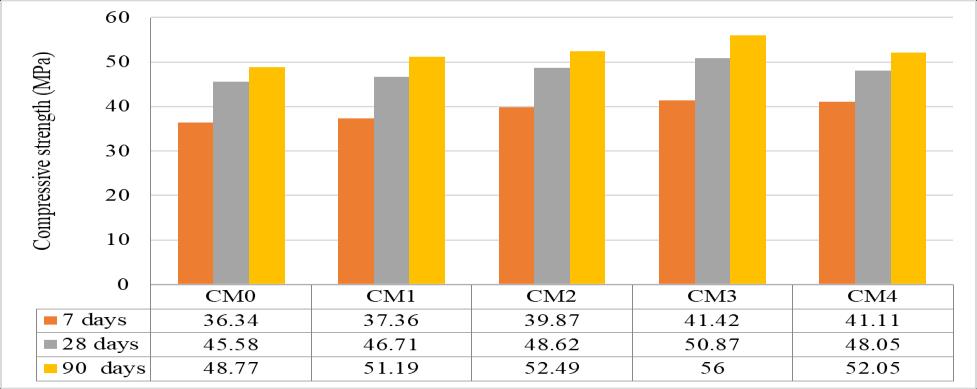
The addition of polypropylene fibers to the concrete mix resulted in an increase in the material's compressive strength. The presence of polypropylene fibers acted as a reinforcing material, reducing the number of microcracks in the concrete . This reduction inmicrocrackscontributed toa morecompactconcrete structure, leading to an improvement in compressive strength. The optimal combination of ceramic dust and polypropylene fibers in terms of their percentage content resulted in a significant increase in the compressive strength of the material. This increase indicatesthatthe pozzolanicpropertiesofceramicdust and the crack-limiting effect of fibers can enhance the compressive strength of concrete to a greater extent thanbefore (Figure3).
C. Split Tensile Strength
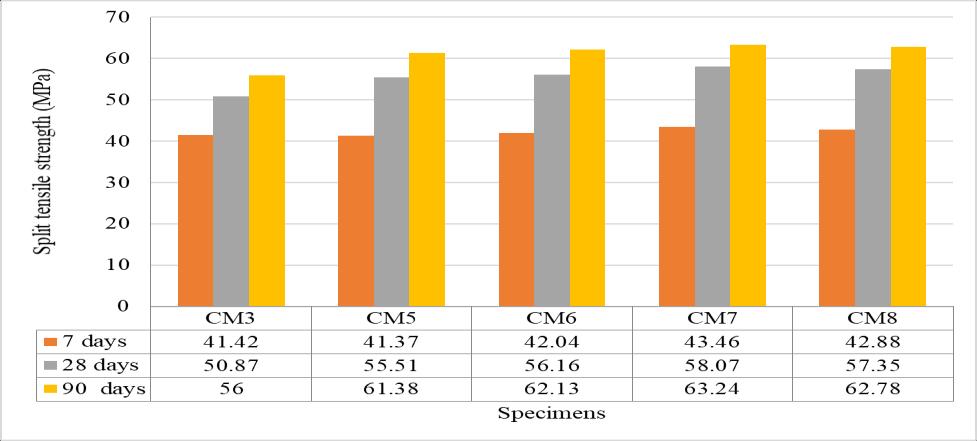
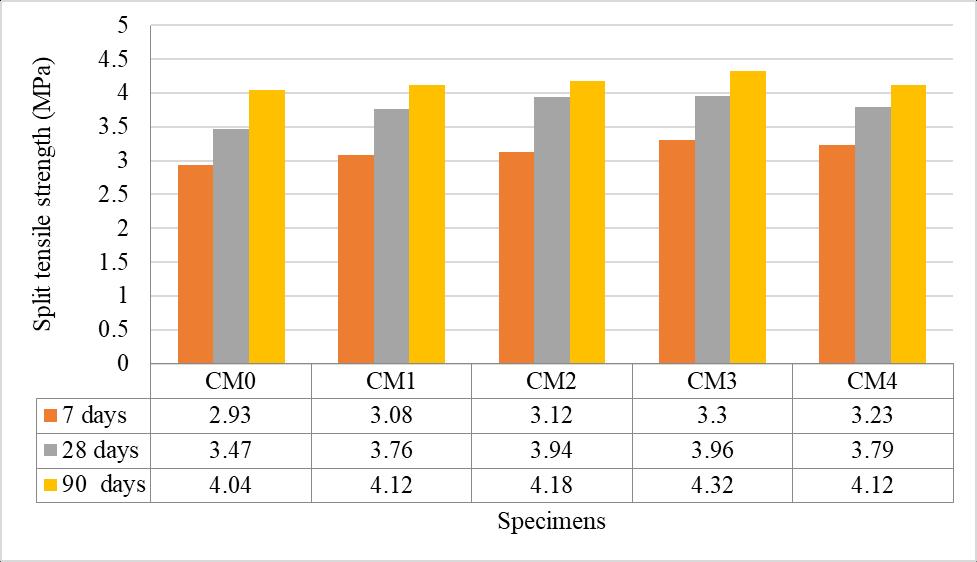
The split tensile strength of the concrete mix was determined using a compression testing machine with cylinders measuring 150 mm in diameter and 300 mm inheight[27].Incomparisontothecontrolmixwithout any additives, it was observed that the split tensile strengthincreasedforallmixturesandcuringdurations. Thestudyrevealedthattheadditionofhighpercentages of ceramic dust did not significantly enhance the split tensilestrength,andbeyondacertainpercentage(15%), adeclineinthesplittensilestrengthwasobserved[19]. Furthermore, the inclusion of polypropylene fibers resulted in an improvement in the split tensile strength ofthematerial.
The inclusion of polypropylene fibers resulted in a percentage increase in split tensile strength of 10.92 percent, 17.06 percent, 21.16 percent, and 33.11 percent for the addition of 0.25 percent, 0.50 percent, 0.75 percent, and 1.0 percent fibers, respectively, after 7 days ofcuring.Similarly,after28days,thepercentageincrease was 14.41 percent, 20.17 percent, 26.80 percent, and 36.31percent,andafter90days,itwas2.97percent,4.21 percent, 12.87 percent, and 21.78 percent [28]. These findings highlight the positive impact of polypropylene fibers on enhancing the split tensile strength over differentcuringages.
In contrast, the addition of ceramic dust to the concrete mix did not exhibit a pozzolanic behavior and instead resulted in a decrease in the split tensile strength of the composite material. On the other hand, the inclusion of polypropylene fibers contributed to a denser concrete matrix and exerted a filler effect, leading to improved particle distribution and an increase in the split tensile strength [29]. The optimal combination of ceramic dust and polypropylene fibers resulted in a significant enhancementofthesplittensilestrengthinthecomposite material.
This improvement can be attributed to the enhanced dispersion of polypropylene fibers in the concrete specimenswhenceramicdustispresent,which ultimately contributes to the enhancement of the split tensile strength[30].Overall,thecombinedeffectofceramicdust and polypropylene fibers in the concrete mix results in a notable increase in the split tensile strength, indicating the potential for enhanced performance of the concrete material.
IV. CONCLUSION
Theobjectiveofthisstudywastoinvestigatetheeffectsof substituting cement with ceramic dust, polypropylene fibers,oracombinationofbothinconcrete.Basedonthe findings of this research, the following conclusions can bedrawn:
The inclusion of ceramic dust, polypropylene fibers, or their combination reduces the workability of concrete. This is primarilyduetothe improvedpacking ofceramic dust particles and the enhanced intermolecular forces resulting from the dual role of the fibers as both fillers andreinforcingmaterialsintheconcrete.
The compressive strength and split tensile strength of the concrete mix increase over time, but the percentage increase in compressive strength varies depending on thedurationofconcretecuring.
The addition of ceramic dust up to 15 percent enhances both the compressive strength and split tensile strength of the concrete, after which both strengths start to decrease. Similarly, the inclusion of polypropylene fibers increases the compressive strength and split tensile strength up to 0.75 percent, beyond which there is a declineinbothstrengths.
It was observed that the split tensile strength of all concrete mixes with additives showed improvement compared to the control mix without additives. This improvement can be attributed to the enhanced dispersion of polypropylene fibers in the concrete specimensduetotheadditionofceramic dust,leadingto anincreaseinthesplittensilestrength.
REFRENCES
1. P.R. de Matos, J.C.P. Oliveira, T.M. Medina, D.C. Magalhães,P.J.P.Gleize,R.A.Schankoski,R.Pilar,Use of air-cooled blast furnace slag as supplementary cementitious material for self- compacting concrete production, Constr. Build Mater. 262 (2020). https://doi.org/10.1016/j.conbuildmat.2020.12010 2.
2. A.M. Rashad, H.E.-D.H. Seleem, A.F. Shaheen, Effect of Silica Fume and Slag on Compressive Strength and Abrasion Resistance of HVFA Concrete, Int. J. Concr. Struct. Mater. 8 (2014) 69–81. https://doi.org/10.1007/s40069-013-0051-2.
3. J. Lee, T. Lee, Durability and engineering performance evaluation of CaO content and ratio of binary blended concrete containing ground granulated blast-furnace slag, Appl. Sci. 10 (2020). https://doi.org/10.3390/app10072504.
4. R. Garg, M Bansal, Y. Aggarwal, Strength, rapid chloride penetration and microstructure study of cement mortar incorporating micro and nano silica, Int. J. Electrochem. Sci. 11 (2016) 3697
3713. https://doi.org/10.20964/110455
5. Rishav Garg, Manjeet Bansal, Yogesh Aggarwal, Split Tensile Strength of Cement Mortar Incorporating Micro and NanoSilica at Early Ages, Int. J. Eng.Res. Technol. 5 (2016) 16–19 https://doi.org/10.17577/ijertv5is040078.
6. A. Nazari, S. Riahi, Splitting tensile strength of concrete using ground granulated blast furnace slag and SiO2 nanoparticles as binder, Energy
Build. 43 (2011) 864–872. https://doi.org/10.1016/j.enbuild.200.12.006.
7. H. Sharma, R. Garg, D. Sharma, M. umar Beg, R. Sharma, Investigation on Mechanical Properties of Concrete UsingMicrosilica and Optimised dose of Nanosilica as a PartialReplacement of Cement, Int.J.RecentReasearchAsp 3(2016)23–29
8. S.C. Pal, A. Mukherjee, S.R. Pathak, Investigation of hydraulic activity of ground granulated blast furnace slag in concrete,Cem Concr.Res.33(2003) 1481–1486 https://doiorg/101016/S00088846(03)00062-0.
9. R. Sharma, D. Sharma, R. Garg, Development of SelfCompacted High Strength Concrete using Steel Slag as PartialReplacement of Coarse Aggregate, Int. J. New Inn 5 (2016)556–562
10. R. Garg, R. Garg, N.O. Eddy, Influence of pozzolans on properties of cementitious materials: A review, Adv Nano Res.11 (2021) 423–436 https://doiorg/1012989/anr.2021114423
11. N.O. Eddy, R. Garg, R. Garg, A.O. Aikoye, B.I. Ita, Waste toresource recovery: mesoporous adsorbent from orange peel fortheremovaloftrypanbluedye from aqueous solution, Biomass Convers. Biorefinery (2022). https://doiorg/101007/s13399-0202571-5.
12. R. Garg, R. Garg, N. Okon Eddy, A. Ibrahim Almohana, S.Fahad Almojil, M. Amir Khan, S. Ho Hong, Biosynthesized silica-based zinc oxide nanocompositesforthesequestrationofheavymetal ions fromaqueous solutions,J. King Saud Univ.-Sci. 34 (2022) 101996. https://doi.org/10.1016/j.jksus.2022.101996.
13. R. Sharma, D. Sharma, R. Garg, H. Sharma, Development of Self Compacted Concrete Using Steel Slag as Partial Replacement of Coarse Aggregate vibrators to realize consolidation by the access is stuck by slender gaps between it ’ s difficult or not possible to use mechanical term ultra-high compres, in: Proc ICAST-2017 McGraw Hill Publ., 2017: pp.88–89.
14. R. Garg, R. Garg, N. Okon Eddy, Handbook of Research on Green Synthesis and Applications of Nanomaterials Edited by, IGI Global, 2022. https://doiorg/104018/978-1-7998-8936-6
15. R. Garg, T. Biswas, M.D.D. Alam, A. Kumar, A. Siddharth,D.R. Singh, Stabilization of expansive soil by using industrial waste, J. Phys. Conf Ser. 2070 (2021) https://doiorg/101088/17426596/2070/1/012238.
16. C.M. Kansal, S. Singla, R. Garg, Effect of Silica Fume & Steel Slag on Nano-silica based High-Performance Concrete, IOP Conf Ser. Mater. Sci. Eng 961 (2020) https://doiorg/101088/1757899X/961/1/012012
17. H. Sharma, R. Garg, R. Sharma, Investigation on Microstructure of Concrete Using Microsilica and Optimized Dose of Nanosilica as Partial
Replacement of Cement, in: Proc. ICAST- 2017 McGrawHillPubl.,2017:pp.3–4.
18. S. Mondal, A. (Dey) Ghosh, Review on microbial inducedcalcite precipitation mechanisms leading to bacterial selection for microbial concrete, Constr. Build. Mater. 225 (2019) 67–75 https://doi.org/10.1016/j.conbuildmat.2019.07.122.
19. R. Garg, R. Garg, S Singla, Experimental Investigation of Electrochemical Corrosion and Chloride Penetration of Concrete Incorporating Colloidal Nanosilica and Silica fume, J. Electrochem. Sci. Technol. 12 (2021) 440–452. https://doi.org/10.33961/jecst.2020.01788
20. M.U. Beg, R. Garg, C. Khajuria, Experimental studyon strength of concrete using composite replacement of coarse aggregate, Int. J. New. Inn. 5 (2016) 563–567.https://doi.org/10.22214/ijraset.2018.1451.
21. R.Garg,P.Rani,R.Garg,N.O.Eddy,Studyonpotential applications and toxicity analysis of green synthesizednanoparticles, Turkish J. Chem. 45 (2021) 1690–1706. https://doi.org/10.3906/kim2106-59
22. N.O.Eddy,U.J.Ibok,R.Garg,R.Garg,A.Iqbal,M Amin, ABrief Review on Fruit and Vegetable Extracts as Corrosion Inhibitors in Acidic Environments, Molecules. 27 (2022) 1–19. https://doi.org/10.3390/molecules27092991.
23. R. Garg, R. Garg, M.A. Khan, M. Bansal, V. Garg, Utilization of biosynthesized silica-supported iron oxide nanocomposites for the adsorptive removal of heavy metal ions from aqueous solutions, Environ Sci. Pollut. Res. Accepted f (2022) 1–10 https://doi.org/https://doi.org/10.21203/rs.3.rs139 4501/v1.
24. A Garg, A SIngh, R. Garg, Effect of Rice Husk Ash & Cement on CBR values of Clayey soil, in: Int. Conf Adv Constr. Mater Struct, 2018: pp 1–7 http://lejpt.academicdirect.org/A11/047 058.pdf?or igin=publication_detail.
25. IS: 6042, Indian standard code of practice for construction of lightweight concrete block masonry, IndianStand Institution,NewDelhi,India.(1969).
26. M Bansal, R. Garg, V.K. Garg, R. Garg, D. Singh, Sequestration of heavy metal ions from multimetal simulated wastewater systems using processed agricultural biomass, Chemosphere 296 (2022) 133966
https://doi.org/10.1016/j.chemosphere.2022.13396
27. A Singh, A Garg, R. Garg, Influence of NanoSilica andGround Granulated BlastFurnace Slagon Cement Using Statistical Design of Experiment, in: Int.Conf.Adv.Constr.Mater.Struct.,2018.
28. K. Kumar, M Bansal, R Garg, R. Garg, Mechanical strength analysis of fly-ash based concrete in presence of red mud,Mater.TodayProc.52(2022) 472–476.
https://doiorg/101016/jmatpr.202109233
29. K. Kumar, M Bansal, R Garg, R. Garg, Penetration and Strength Analysis of Pervious Concrete, J. Phys. Conf. Ser. 2070 (2021) 012244.
https://doi.org/10.1088/17426596/2070/1/012244
30. D. Prasad Bhatta, S Singla, R. Garg, Microstructural and strength parameters of NanoSiO2based cement composites, Mater. Today Proc 46 (2020) 6743–6747
https://doiorg/101016/jmatpr.202104276
31. IS 2250 (1981): Code of Practice for Preparation and Use of Masonry Mortars [CED 13: Building Construction Practices including Painting, Varnishing and Allied Finishing], Bur. Indian Stand NewDelhiNewDelhi.Reaffirmed(1981).
32. R. Garg, M. Kumari, M. Kumar, S. Dhiman, R. Garg, Greensynthesis of calcium carbonate nanoparticles using waste fruit peel extract, Mater. Today Proc 46 (2021) 6665–6668 https://doi.org/10.1016/j.matpr.2021.04.124.
33. A Singh, S Singla, R. Garg, R. Garg, Performance analysis of Papercrete in presence of Rice husk ash and Fly ash, IOP Conf Ser. Mater. Sci. Eng 961 (2020). https://doi.org/10.1088/1757899X/961/1/012010.
34. M Kumar, M Bansal, R Garg, An overview of beneficiary aspects of zinc oxide nanoparticles on performance of cement composites, Mater. Today Proc. 43 (2021) 892–898. https://doiorg/101016/jmatpr.202007215
35. S. Dhiman, R. Garg, R. Garg, S Singla, Experimental investigation on the strength of chipped rubberbased concrete,IOP Conf. Ser. Mater. Sci. Eng. 961 (2020).https://doi.org/10.1088/1757899X/961/1/012002.
36. D. Prasad Bhatta, S. Singla, R. Garg, Experimental investigationon theeffect ofNano-silica onthe silica fume-based cement composites, Mater. Today Proc. 57 (2022) 2338–2343 https://doi.org/10.1016/j.matpr.202201.190.
37. IS 15917-2010, Building Design and Erection using Mixed/ Composite Construction - Code of Practice, (2011).
38. R. Garg, R. Garg, A. Thakur, S.M. Arif, Water remediation using biosorbent obtained from agricultural and fruit waste, Mater. Today Proc. 46 (2021) 6669–6672 https://doi.org/10.1016/j.matpr.202104.132.
39. R. Garg, R. Garg, Effect of zinc oxide nanoparticles on mechanical properties of silica fume-based cement composites, Mater. Today Proc. 43 (2021) 778–783. https://doi.org/10.1016/j.matpr.2020.06.168.
40. R.Garg,R.Garg,M.Bansal,Y.Aggarwal,Experimental study on strength and microstructure of mortar in presence of micro and nano-silica, Mater. Today Proc. 43 (2020) 769–777. https://doi.org/10.1016/j.matpr.2020.06.167.
41. G.M. Fani, S Singla, R. Garg, R. Garg, Investigation on Mechanical Strength ofCellularConcrete inPresence of Silica Fume, IOP Conf. Ser. Mater. Sci. Eng. 961 (2020) 012008. https://doi.org/10.1088/1757899X/961/1/012008.
42. T Biswas, R. Garg, H. Ranjan, A Kumar, G Pandey, K.Yadav, Study of expansive soil stabilized with agricultural waste, J. Phys. Conf Ser. 2070 (2021). https://doi.org/10.1088/17426596/2070/1/012237.
43. V Kumar, S Singla, R. Garg, Strength and microstructure correlation of binary cement blends in presence of waste marble powder, Mater. Today Proc. 43 (2020) 857–862. https://doiorg/101016/jmatpr.202007073
44. G Singh, M Bansal, R. Garg, Influence of the Incorporation of Polypropylene Fiber in High Performance Concrete, in: Natl. Conf. “Recent Trends Environ. Sci. Technol., 2016: pp. 140–143.
45. IS 456-2000: Plain and Reinforced Concrete - Code of Practice [CED 2: Cement and Concrete], Bur. IndianStand.NewDelhi.Reafflrmed(2000).
46. R. Garg, R. Garg, B. Chaudhary, S Mohd Arif, Strength and microstructural analysis of nano-silica basedcementcompositesin presence ofsilica fume, Mater. Today Proc. 46 (2020) 6753– 6756. https://doi.org/10.1016/j.matpr.2021.04.291.
47. R. Garg, R. Garg, Performance evaluation of polypropylenefiber waste reinforced concrete in presence of silica fume,Mater. Today Proc. 43 (2021) 809–816.
https://doiorg/101016/jmatpr.202006482
48. R. Sharma, D. Sharma, R. Garg, Development of Self Compacted High Strength Concrete using Steel Slag as Partial Replacement of Natural Fine Aggregate,(2016)96
99.
49. M.U. Beg, A Goyal, C. Khajuria, R. Garg, Study of Mechanical Properties of Concrete by Partial Replacement of Cement with Rice Husk Ash and Alccofine as Mineral Admixture, (2016)72–77
50. M Sahmaran, G Yildirim, T.K. Erdem, Self-healing capability of cementitious composites incorporating different supplementary cementitious materials, Cem Concr. Compos. 35 (2013) 89
101
https://doiorg/101016/jcemconcomp20120801 3.