An automated severity classification model for diabetic retinopathy
M Sai Praneeth,V Sujay Keertan T.Samved, Dr.V SOWMYA DEVIAssistant Professor, Department of Computer Science and Engineering, SNIST, Hyderabad-501301, India

1,2,3 B. Tech Scholars, Department of Computer Science and Engineering, SNIST, Hyderabad-501301, India
Abstract - Diabetic Retinopathy (DR) - a complication developed due to heightened blood glucose levels- is deemed one of the most sight-threatening diseases. Unfortunately, an ophthalmologist, a process that can be considered incorrect and time consuming, manually acquires the DR screening. In view of the huge increase in diabetic patients over recent years, automated diagnostic tests for diabetes have also become an increasingly important research topic. Additionally, Convolutional Neural Networks (CNN) have proventhemselvestobestate-of-the-artforDRstagediagnosis in recent times. This study offers a fresh, automatically learning-basedmethodfor determiningseverityfromasingle Colour Fundus Photograph (CFP). The suggested method builds a visual embedding using DenseNet169's encoder.. Convolutional BlockAttentionModule(CBAM)isalsoaddedon top of the encoder to boost its ability to discriminate. The model is then trained using the Kaggle Asia Pacific TeleOphthalmology Society (APTOS) dataset using cross-entropy loss. In comparison to state-of-the-art performance on the binary classification test, we achieved (97% accuracy, 97% sensitivity,98.3%specificity,and0.9455,Quadratic Weighted Kappa score (QWK)). Additionally, for severity grading, Our networkdemonstratedhighproficiency(82%accuracy-0.888 (QWK)). The suggested approach makes a substantial contribution by accurately classifying the degree of diabetic retinopathy severity while requiring less time and spatial complexity, making it a promising contender for autonomous diagnosis.
Key Words: Diabetic retinopathy, convolutional neural networks(CNN),attentionmechanism,deeplearning.
1.INTRODUCTION
Hyperglycemia,asymptomofthechronicmetabolicdisorder diabetes mellitus, has a long-term negative impact on the body'sbloodvesselsonbothamicroandmacrolevel.The WorldHealthOrganisation(WHO)estimatesthattherewere 422milliondiabeticsworldwidein2014,andthatfigureis expected to rise to 700 million by 2045 [1], [2]. diabetes retinopathy,aprogressiveanomalyexposedandrecognised through ocular pathologies, which results in blocking and bleeding of the retinal capillaries, is one of the long-term diabetesmicro-vascularconsequences.Fortunately,vision damage can be avoided by early identification. Without routine inspection, it could cause irreparable harm. According to the International Diabetes Federation (IDF), thereare93milliondiabeticsworldwide.
***
Eyeinjury,butthereareonly200,000ophthalmologistsin theglobe[3].Gradinginconsistencies,aseriousshortageof ophthalmologistsinthefield,aswellastheproblematiclab procedure,continuetobebarrierstotheearlydiagnosisof diabetic retinopathy. To lessen the heavy burden on healthcaresystems,retinopathytestsshouldbeautomated. Thishasspurredmajorattemptstoimprovecomputer-aided medicaldiagnostics(CAMD)systems.
DR grading methods can be divided into two groups: separating diabetic retinas from healthy ones (binary classification problem) and determining the severity of afflictedretinasfromclass0(healthy)toclass4proliferative DR(PDR)(multi-classclassificationtask).Algorithmsused for traditional machine learning (ML) are examples of artificial intelligence(AI) methods that gain knowledgeby beingexposedtodata.
GradientBoostedTrees(GBT)[6]asaclassificationmodel andArtificialFloraAlgorithm(AFA)[5]forfeatureselection. Furthermore,byusingthefeatureengineeringmethodand Support Vector Machines (SVM) as a classifier for DR detection, Gharaibeh et al. took use of this in [7] and [8]. Despite their effectiveness, ML algorithms require individualisedexperienceandsubjectexpertisetofindthe mostinformativerepresentation.
Through the representation of the universe as a layered hierarchyofconcepts,eachconceptinDeepLearning(DL) hasestablishedafootholdinavarietyofdomains[10].
Utilisingthecapabilitiesofconvolutionalneuralnetworksin themedicalfieldhasledtothedevelopmentofmoredurable treatments,particularlyintheDRsector.Theefficacyofsuch a method for retinal vascular segmentation was shown in [16]and[17].Similarly,Zhaoetal.[18]wereabletocreate fundus images using generative advertisement networks (GANs).FortheearlydetectionofMicro-aneurysms(MA),Dai etal.[19]usedamulti-sievingconvolutionalneuralnetwork andpicturetotextmapping.[20]assessedtheeffectiveness ofVGG16,VGG19,andInceptionV3asthreewell-knownCNN architectures.usingtransferlearningandadjustingforbinary andmulti-classclassification[21,22].Inordertocategorise fundus images into two grades, Zeng et al. [23] proposed Siamese-likearchitecture[24]trainedwithtransferlearning.
2.EXISTING SYSTEM:
Diabetic retinopathy (DR), a result of high blood glucose levels,isoneofthedisordersthatposesthebiggestdangerto vision. Unfortunately, DR screening must be manually collected through an ophthalmologist, which is timeconsuming&pronetoerror.AnemphasisonautomatedDR diagnosis has emerged in recent years as a result of the dramaticincreaseinthenumberofdiabeticpatients.There are several existing systems for automated severity classification of diabetic retinopathy (DR) using different approaches.Someofthenotablesystemsare:
"EyeArt" System: This system uses a machine learning algorithm to analyze retinal images and classify them into different severity categories. The system is designed tobe user-friendlyandrequiresminimaltrainingtooperate.Ithas been approved by the US Food and Drug Administration (FDA)foruseinclinicalsettings.
"IDx-DR"System:Thissystemusesanartificialintelligence algorithm to analyze retinal images and diagnose diabetic retinopathy. The system is fully automated and does not requireatrainedspecialisttointerprettheresults.Ithasalso beenapprovedbytheFDAforuseinclinicalsettings.
"RetinaScope" System: This system uses a deep learningbasedapproachtoanalyzeretinalimagesandclassifythem intodifferentseveritycategories.Thesystemisdesignedto beusedbynon-experthealthcareprovidersandcanprovide adiagnosisinunderaminute.Ithasbeentestedinseveral clinicalstudiesandhasshownpromisingresults.
"GoogleAI"System:Thissystemusesadeeplearning-based approachandhasbeendevelopedbyGoogleAIresearchers. Thesystemwastrainedonalargedatasetofretinalimages andachievedstate-of-the-artperformanceontheDRdataset. Ithasnotyetbeenapprovedforclinicaluse.
DLS-DR" System: This system uses a deep learning-based approach and has been developed by researchers at the UniversityofMichigan.Thesystemachievedanaccuracyof 95.3%ontheDRdatasetandcanclassifyretinalimagesinto differentseveritycategories.Ithasnotyetbeenapprovedfor clinicaluse.
In conclusion, there are several existing systems for automated severity classification of DR using different approaches,includingmachinelearninganddeeplearningbasedmodels.Thesesystemshavethepotentialtoimprove accesstotimelyandaccuratediagnosisofDR,whichcanhelp preventvisionlossandblindnessinpatientswithdiabetes. However,furthervalidationandclinicaltrialsareneededto ensuretheirsafetyandefficacyinreal-worldsettings.
2.1.DISADVANTAGES OF EXISTING SYSTEM:
• MustmanuallygatherDRscreening
• Whichtakestime
• ispronetoinaccuracy.
3.PROPOSED SYSTEM:
In this study, we examine the effectiveness of lightweight deep learning architecture considering quick & reliable diabeticretinopathyseverityrating.Oursystemisbuiltona modifiedversionofDenseNetthatincorporatesanattention mechanism considering further feature refinement. Additionally,weanalyzehowdataimbalanceaffectsmodel performance&employanimbalancedlearningstrategyto counteractit.
3.1ADVANTAGES OF PROPOSED SYSTEM:
1. For severity grading, our network demonstrated greatcompetency.
2. The suggested framework makes a substantial contribution through effectively grading the degree of diabetic retinopathy severity while requiring less time & space complexity, making it a feasible option considering autonomousdiagnosis.
4.SYSTEM REQUIREMENTS:
Thefunctionalneedsoftheapplicationarefurtherdescribed inthissection.TheSRScanbebrokendownintomodules, eachofwhichhasspecifications.Thefollowinghardware& softwareareneedtocompletetheproject.
5.HARDWARE REQUIREMENTS:
• HardDisk : 40GB
• FloppyDrive : 1.44MB
• Monitor: 15VGACOLOUR
• RAM : 512MB
5.1SOFTWARE REQUIREMENTS:
• PythonIDE3.7version(or)
• Anaconda3.7(or)
• Jupyter(or)
• GoogleCollaboratory
6.CONVOLUTIONAL NEURAL NETWORK:
Convolution neural network is mainly used for applicationsinimageandspeechrecognitionasitsbuilt-in convolutional layer reduces the high dimensionality of imageswithoutlosingitsinformation.
Convolutional Neural Network (CNN) is the most populardeeplearningframework
CNNisoneofthebestarchitecturesthatcanprocess theseimagesandimplementtheproposedarchitecture.
7.DATA FLOW DIAGRAM:
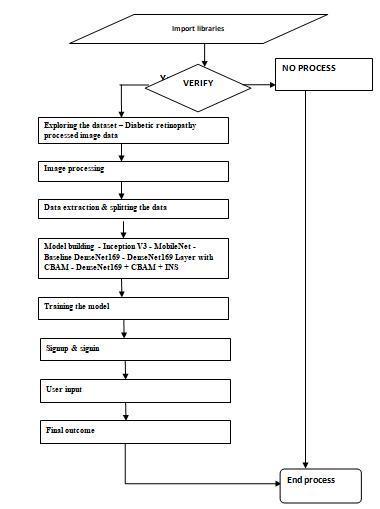
TheDFDisalludedtoasanairpocketoutlinetoo.Adirect graphicalformalismmightbeutilizedtoportrayaframework asfarasinformationthatistakencareofintoit,varioustasks that are performed on it, & information that is delivered becauseofthosetasks.
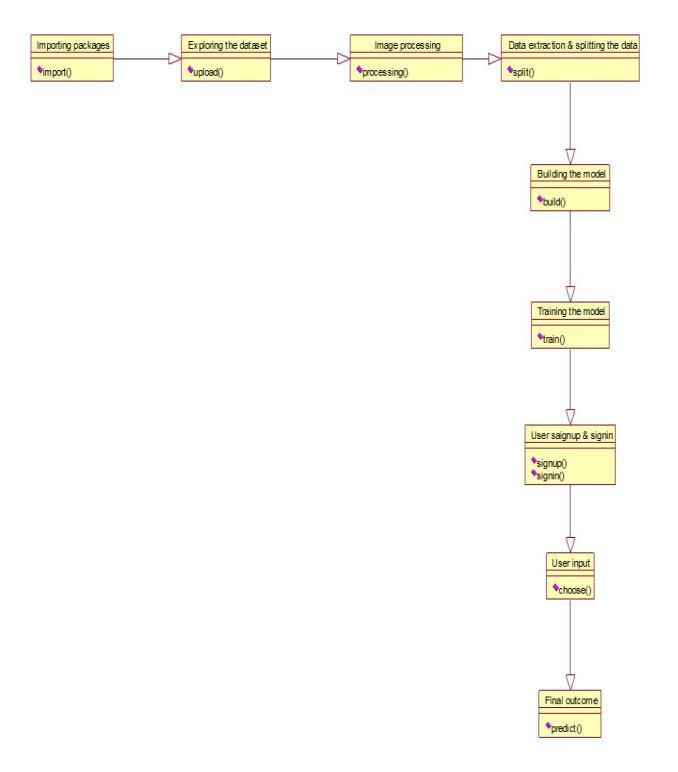
8. CLASS DIAGRAM FOR DIABETIC RETINOPATHY:
The class chart is utilized to clean utilize case outline & indicate a careful framework plan. use case graph's entertainersareorderedintovariousinterconnectedclasses utilizingclasschart.Itisconceivablebelievingtheretobea will be a or has-a interface between classes. Different functionalities may be accessible from each class in class outline.Thesehighlightspresentedthroughclassareknown as its"techniques." likewise,eachclasscouldhavespecific "credits"thatexplicitlyrecognizeclass.
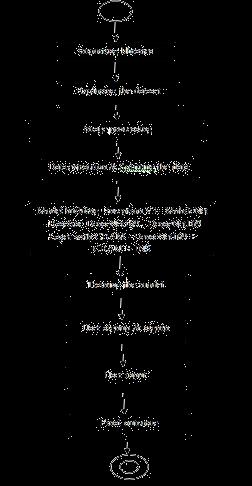
9.ACTIVITY.DIAGRAM.FOR.DIABETIC RETINOPATHY:
Inactionoutline,framework'scyclestreamsareportrayed. An action outline has same components as a state chart, including exercises, activities, changes, introductory & last states,&gatekeeperconditions.
10.IMPLEMENTATION
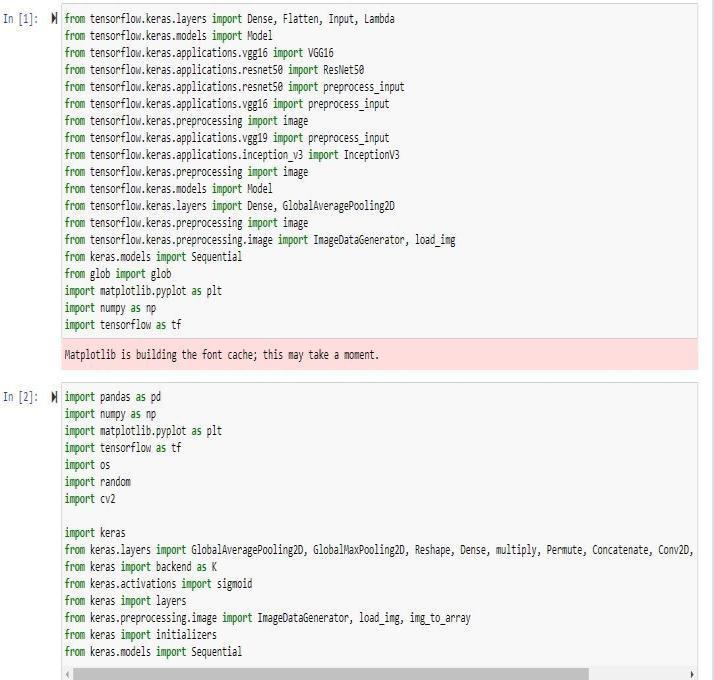
Importingthepackagesandmodulesneeded
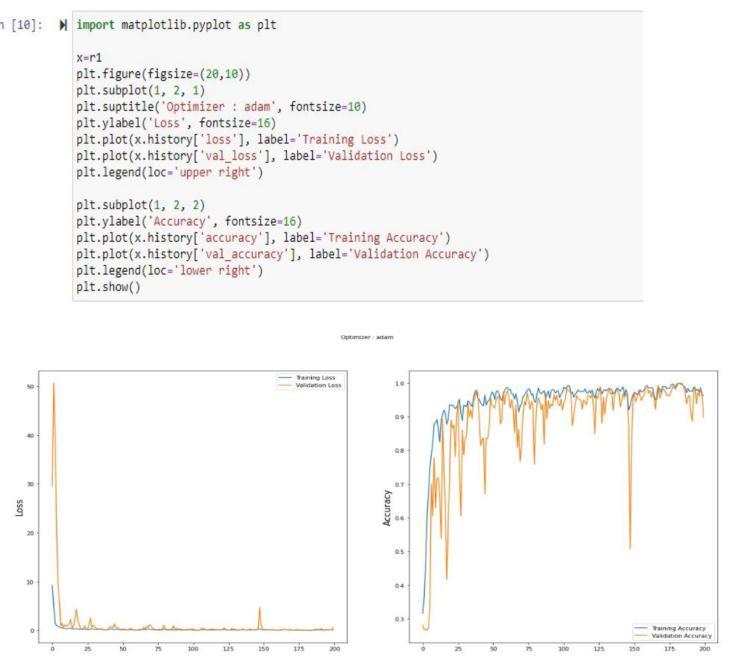
UsingInceptionV3toholdhiddenlayersandoptimizerAdam isusedfortakinglessmemoryforlargedataparameters
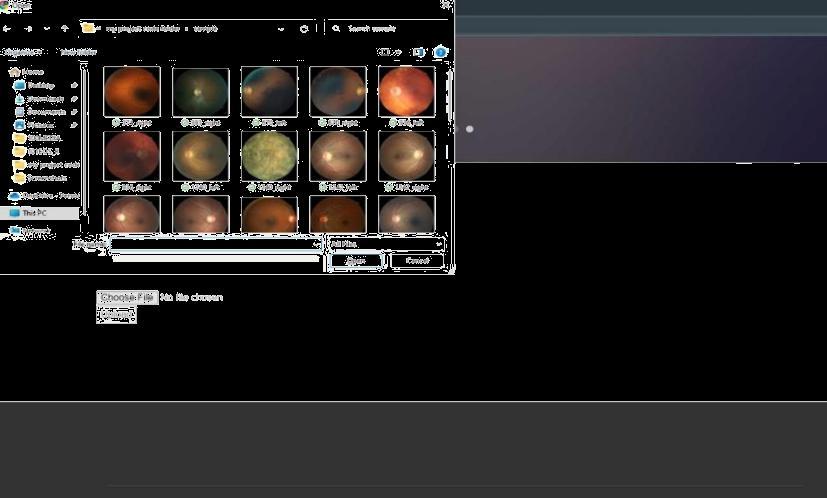
Choosefilefromthefolderandselectanimageandupload theimage.

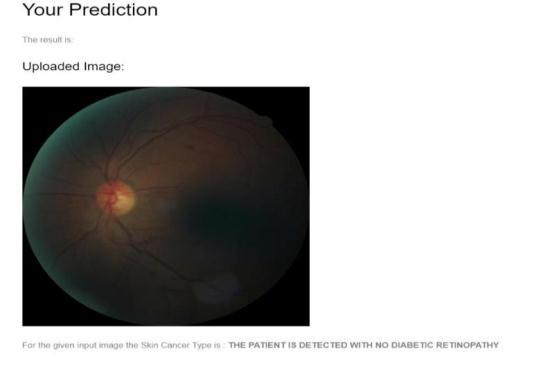
Afteruploadingyourpredictionisshownheresoherethe patient severity condition is detected with no diabetic retinopathy

12.CONCLUSIONS
Inthisstudy,wetookadvantageofanovelCNNmodelbuilt ontheDenseNet169architecture&coupledamongCBAMas a supplement to be added considering improving representational power. The suggested approach reduced theburdenofspace&timecomplexitywhiledemonstrating solid performance & comparable quality criteria. A 2-D Gaussian filter also improves the quality of fundus photographs.Finally,inordertoaddresstheclassimbalance &enhancethemodel'sabilitytoforecastacrossallclasses, weemployedINStocreateourweightedlossfunction.We comparetheeffectivenessofseveral CBAMconfigurations considering future research directions. Additionally, expandingthedatasetsize&experimentingamongvarious unbalanced learning algorithms will result in improved performance.
13.REFERENCES
[1] Global Report on Diabetes, World Health Organization(WHO),Geneva,Switzerland,2016.
[2] Diabetes Atlas, International Diabetes Federation (IDF),Brussels,Belgium,2019.
[3] Diabetes Eye Health a Guide for Health Professionals, International Dia- betes Federation (IDF), Brussels,Belgium,2017.
[4] P.Nagaraj,P.Deepalakshmi,R.F.Mansour,andA. Almazroa,‘‘Arti-ficialfloraalgorithm-basedfeatureselection withgradientboostedtreemodelfordiabetesclassification,’’ Diabetes,MetabolicSyndromeObesity:TargetsTherapy,vol. 14,pp.2789–2806,Jun.2021,doi:10.2147/DMSO.S312787.
[5] L.Cheng,X.-H.Wu,andY.Wang,‘‘Artificialflora(AF) optimizationalgorithm,’’Appl.Sci.,vol.8,no.3,p.329,Feb. 2018. [Online]. Available: https://www.mdpi.com/20763417/8/3/329,doi:10.3390/app8030329.
[6] T.ChenandC.Guestrin,‘‘XGBoost:Ascalabletree boostingsystem,’’2016,arXiv:1603.02754.
[7] N.Gharaibeh,O.M.Al-hazaimeh,A.Abu-Ein,andK. M.O.Nahar,‘‘AhybridSVMNAÏVE-bayesclassifierforbright lesionsrecognitionineyefundusimages,’’Int.J.Electr.Eng. Informat., vol. 13, no. 3, pp. 530–545, Sep. 2021, doi: 10.15676/ijeei.2021.13.3.2.
[8] O.M.AlHazaimeh,K.M.O.Nahar,B.AlNaami,and N. Gharaibeh, ‘‘An effective image processing method for detection of diabetic retinopa- thy diseases from retinal fundusimages,’’Int.J.SignalImag.Syst.Eng.,vol.11,no.4,p. 206,2018,doi:10.1504/IJSISE.2018.093825.
[9] T. Evgeniou and M. Pontil, ‘‘Support vector machines:Theoryandappli-cations,’’inAdvancedCourse
on Artificial Intelligence, vol. 2049. Berlin, Germany: Springer, 2001, pp. 249–257, doi: 10.1007/3-540-446737_12.
[10] I. Goodfellow, Y. Bengio, and A. Courville, Deep Learning.Cambridge,MA,USA:MITPress,2016.
[11] O.Abdel-Hamid,A.-R.Mohamed,H.Jiang,L.Deng,G. Penn,andD.Yu,‘‘Convolutionalneuralnetworksforspeech recognition,’’ IEEE/ACM Trans. Audio, Speech, Language Process.,vol.22,no.10,pp.1533–1545,Jul.2014.
[12] A.vandenOord,S.Dieleman,H.Zen,K.Simonyan,O. Vinyals, A. Graves, N. Kalchbrenner, A. Senior, and K. Kavukcuoglu,‘‘WaveNet:Agenerativemodelforrawaudio,’’ 2016,arXiv:1609.03499.
[13] K. Xu, J. Ba, R. Kiros, K. Cho, A. Courville, R. Salakhutdinov,R.Zemel,andY.Bengio,‘‘Show,attendand tell:Neuralimagecaptiongenerationwithvisualattention,’’ 2015,arXiv:1502.03044.
[14] J.RedmonandA.Farhadi,‘‘YOLOv3:Anincremental improvement,’’2018,arXiv:1804.02767.
[15] L. A. Gatys, A. S. Ecker, and M. Bethge, ‘‘A neural algorithmofartisticstyle,’’2015,arXiv:1508.06576.
[16] Z.Yan,X.Yang,andK.-T.Cheng,‘‘Jointsegment-level andpixel-wiselossesfordeeplearningbasedretinalvessel segmentation,’’IEEETrans.Biomed.Eng.,vol.65,no.9,pp. 1912
1923,Sep.2018.
[17] Y.Wu,Y.Xia,Y.Song,Y.Zhang,andW.Cai,‘‘NFN+:A novel network followed network for retinal vessel segmentation,’’ Neural Netw., vol. 126, pp. 153–162, Jun. 2020.
[18] H. Zhao, H. Li, S. Maurer-Stroh, and L. Cheng, ‘‘Synthesizingretinalandneuronalimageswithgenerative adversarialnets,’’Med.ImageAnal.,vol.49,pp.14–26,Oct. 2018.
[19] L.Dai,R.Fang,H.Li,X.Hou,B.Sheng,Q.Wu,andW. Jia,‘‘Clin-icalreportguidedretinalmicroaneurysmdetection withmulti-sievingdeeplearning,’’IEEETrans.Med.Imag., vol.37,no.5,pp.1149–1161,May2018.
[20] A. Jain, A. Jalui, J. Jasani, Y. Lahoti, and R. Karani, ‘‘Deep learning for detection and severity classification of diabetic retinopathy,’’ in Proc. 1st Int. Conf. Innov. Inf. Commun.Technol.(ICIICT),Apr.2019,pp.1–6.
[21] K. Simonyan and A. Zisserman, ‘‘Very deep convolutionalnetworksforlarge-scaleimagerecognition,’’ 2014,arXiv:1409.1556.
[22] C.Szegedy,V.Vanhoucke,S. Ioffe, J.Shlens,andZ. Wojna,‘‘Rethinkingtheinceptionarchitectureforcomputer vision,’’2015,arXiv:1512.00567.
[23] X. Zeng, H. Chen, Y. Luo, and W. Ye, ‘‘Automated diabeticretinopathydetectionbasedonbinocularsiameselikeconvolutionalneuralnetwork,’’IEEEAccess,vol.7,pp. 30744–30753,2019.
[24] G.Koch,R.Zemel,andR. Salakhutdinov,‘‘Siamese neural networks for one-shot image recognition,’’ in Proc. ICMLDeepLearn.Workshop,vol.2,Lille,France,2015.
[25] S.H.Kassani,P.H.Kassani,R.Khazaeinezhad,M.J. Wesolowski, K. A. Schneider, and R. Deters, ‘‘Diabetic retinopathy classification using a modified xception architecture,’’ in Proc. IEEE Int. Symp. Signal Process. Inf. Technol.(ISSPIT),Dec.2019,pp.1–6.
[26] F.Chollet,‘‘Xception:Deeplearningwithdepthwise separableconvolu-tions,’’2016,arXiv:1610.02357.
[27] Z. Gao, J. Li, J. Guo, Y. Chen, Z. Yi, and J. Zhong, ‘‘Diagnosis of diabetic retinopathy using deep neural networks,’’IEEEAccess,vol.7,pp.3360–3370,2019.
[28] J.D.Bodapati,V.Naralasetti,S.N.Shareef,S.Hakak, M.Bilal,P.K.R.Maddikunta,andO.Jo,‘‘Blendedmulti-modal deep ConvNet features for diabetic retinopathy severity prediction,’’Electronics,vol.9,no.6,p.914,May2020.
[29] A. K. Gangwar and V. Ravi, ‘‘Diabetic retinopathy detection using transfer learning and deep learning,’’ in Evolution in Computational Intelligence, V. Bhateja, S.-L. Peng, S. C. Satapathy, and Y.-D. Zhang, Eds. Singapore: Springer,2021,pp.679–689.
[30] M.T.Al-AntaryandY.Arafa,‘‘Multi-scaleattention networkfordiabeticretinopathyclassification,’’IEEEAccess, vol.9,pp.54190–54200,2021.
[31] G. Huang, Z. Liu, L. van der Maaten, and K. Q. Weinberger,‘‘Denselyconnectedconvolutionalnetworks,’’ 2016,arXiv:1608.06993.
[32] O.Russakovsky,J.Deng,H.Su,J.Krause,S.Satheesh, S.Ma,Z. Huang, A.Karpathy,A.Khosla,M.Bernstein,A. C. Berg, and L. Fei-Fei, ‘‘Ima- geNet large scale visual recognitionchallenge,’’2014,arXiv:1409.0575.
[33] Y. Wang, M. Yu, B. Hu, X. Jin, and Y. Li, ‘‘Deep learning-baseddetec-tionandstagegradingforoptimising diagnosis of diabetic retinopa- thy,’’ Diabetes/Metabolism Res. Rev., vol. 37, no. 4, p. e3445, 2021, doi: 10.1002/dmrr.3445.
[34] S. Qummar, F. G. Khan, S. Shah, A. Khan, S. Shamshirband,Z.U.Rehman,I.AhmedKhan,andW.Jadoon, ‘‘A deep learning ensemble approach for diabetic
retinopathy detection,’’ IEEE Access, vol. 7, pp. 150530–150539,2019,doi:10.1109/ACCESS.2019.2947484.
[35] S.Toledo-Cortés,M.DeLaPava,O.Perdómo,andF. A. González, ‘‘Hybrid deep learning Gaussian process for diabetic retinopathy diagnosis and uncertainty quantification,’’2020,arXiv:2007.14994.
[36] A. Sugeno, Y. Ishikawa, T. Ohshima, and R. Muramatsu, ‘‘Simple methods for the lesion detection and severitygradingofdiabeticretinopathybyimageprocessing and transfer learning,’’ Comput. Biol. Med., vol. 137, Oct. 2021, Art. no. 104795, doi: 10.1016/j.compbiomed.2021.104795.
[37] V. Vives-Boix and D. Ruiz-Fernández, ‘‘Diabetic retinopathy detection through convolutional neural networks with synaptic metaplasticity,’’ Comput. Methods ProgramsBiomed.,vol.206,Jul.2021,Art.no.106094,doi: 10.1016/j.cmpb.2021.106094.
[38] C.Zhang,T.Lei,andP.Chen,‘‘Diabeticretinopathy grading by a source- free transfer learning approach,’’ Biomed.SignalProcess.Control,vol.73,Mar.2022,Art.no. 103423,doi:10.1016/j.bspc.2021.103423.
[39] B. Graham. (2015). Kaggle Diabetic Retinopathy Detection Compe- tition Report. [Online]. Available: https://www.kaggle.com/c/diabetic- retinopathydetection/discussion/15801
[40] G. Hinton and S. Roweis, ‘‘Stochastic neighbor embedding,’’inProc.Adv.NeuralInf.Process.Syst.,2002,pp. 833
840.
[41] S. Ioffe and C. Szegedy, ‘‘Batch normalization: Accelerating deep network training by reducing internal covariateshift,’’2015,arXiv:1502.03167.
[42] X. Glorot, A. Bordes, and Y. Bengio, ‘‘Deep sparse rectifier neural net- works,’’ in Proc. 14th Int. Conf. Artif. Intell.Statist.,vol15,FortLaud-erdale,FL,USA,2011.
[43] S.Woo,J.Park, J.-Y.Lee,and I.SoKweon, ‘‘CBAM: Convolutional block attention module,’’ 2018, arXiv:1807.06521.
[44] M. Raghu, C. Zhang, J. Kleinberg, and S. Bengio, ‘‘Transfusion:Under-standingtransferlearningformedical imaging,’’2019,arXiv:1902.07208.
[45] M. Abadi et al., ‘‘TensorFlow: A system for largescalemachinelearning,’’2016,arXiv:1605.08695.
[46] K.He,X.Zhang,S.Ren,andJ.Sun,‘‘Delvingdeepinto rectifiers:Surpassinghuman-levelperformanceonImageNet classification,’’inProc.IEEEInt.Conf.Comput.Vis.(ICCV), Dec.2015,pp.1026–1034.
[47] N. Srivastava, G. Hinton, A. Krizhevsky, I. Sutskever, andR.Salakhutdinov,‘‘Dropout:Asimplewayto preventneuralnetworksfromoverfitting,’’J.Mach.Learn. Res.,vol.15,no.56,pp.1929–1958,2014.
[48] R. Taylor and D. Batey, The Need to Screen. Hoboken, NJ, USA: Wiley, 2012, ch. 4, pp. 29–41, doi: 10.1002/9781119968573.ch4.