Design And Development of Fire Fighting Robot
Jay Sathe1 , Vrushabh Raut2, Rahul Peddapelli3 , Janardhan Waghchaure4 , Mr.V.W.Bembrekar5Mechanical Engineering Department, D.Y. Patil College of Engineering, Akurdi, Pune, India
***
Abstract -
This research paper discusses the design anddevelopment ofa fire fighting robot based on the Arduino microcontroller platform. The robot is designed to navigate manually through an environment and extinguish fires using a water pump and nozzle pair. The paper presents the hardware and software components of the robot, including the motor control system, sensors, and algorithms for obstacle detection and fire detection (OpenCV). The robot is also equippedwitha wireless communication (Bluetooth module) system that enables remote control and monitoring of its activities. Overall, this study demonstrates the feasibility and effectiveness of using Arduino-based platforms for the development of advanced firefighting robots.
Key Words: Firefighting robot, Arduino Mega, Bluetooth module (HC-05), Water pump, ultrasonic sensor, flame sensor, smoke sensor (MQ9), Motor controller (L239D) , relays,buzzer,OpenCV/python.
1.INTRODUCTION
Fireaccidentsareasignificantthreattobothhuman life and property. Despite advances in firefighting technology, firefighters continue to face numerous challengeswhileextinguishingfires,suchasaccessibilityto the fire site, visibility, and smoke inhalation. This paper presentsthedesignanddevelopmentofafirefightingrobot basedontheArduinomicrocontrollerplatform.Therobotis equippedwithawaterpumpandarangeofsensorstodetect firesandobstaclesinitspath.Therobotisalsocapableof navigating manually through the environment and can be remotely controlled by a human operator. The use of Arduinoplatformmakestherobotcost-effectiveandeasily accessibleforresearchers
Thepaperpresentsasteptowardsthedevelopment of advanced robotic systems that can assist firefighters in their tasks, making firefighting safer, more efficient, and effective.
2. LITRATURE SURVEY
2.1 Infrared Image Sensor for Fire Location, Alessandro Pesatori,AlessandroMagnani,MicheleNorgia[1]Thisarticle presents a novel sensor and interpolation method for fire localization in enclosed settings like rooms or highway
tunnels.Theaimistodetectandpinpointtheoriginofafire usingimagedataobtainedfromtwothermopilearrays.By accuratelylocatingthesourceofthefire,thissystemenables effective positioning of fire extinguishers to prevent fire spread. Notably, this system holds great promise for implementation in closed environments due to its costeffectiveness and straightforward installation, thereby enhancingfirepreventionmeasures.
2.2 A Survey on Fire Safety Measures for Industry Safety

Using IOT Mon Arjay F. Malbog, Luisito Lolong Lacatan, RhowelM.Dellos[2]Inthisstudy,variousimageprocessing algorithms were examined and multiple edge detection techniques were evaluated to identify the most effective approaches for fire detectionusingimage processing. The RGB (Red, Green, and Blue) Colour Model and HSV conversionwereutilizedtoextractfire-relatedfeatures.Two edge detection methods were employed: Sobel, which detectsverticalandhorizontaledgesseparately,andCanny, which identifies edges while suppressing noise. By leveraging these algorithms, the detection of fire growth, particularlyintheeventofadisaster,becomessignificantly morefeasiblethroughtheapplicationofimageprocessing andadvancedalgorithms.
2.3.ImprovementofFullyAutomaticFireExtinguishSystem for Residential Use. Ryo Takeuchia , Kouki Yamaguchib, HayatoTakahashib,MasahikoHanadac,HiromichHanadac
[3]Thissystemhasthecapabilitytoautomaticallyinitiate fire extinguishing in a household setting. Notably, it incorporatesfeaturesthatenableremotecontroloperation of the extinguisher through a web browser interface. Furthermore, the system utilizes a Python program with OpenCVtoprocesstheinfraredcameraimages.Asaresult,it canautomaticallydetectfiresandpromptlyalerttheuser.In thisstudy,enhancementsweremadetoexpandthesystem's fire detection capabilities, allowing for the detection of a broaderrangeoffireincidents.
2.4. Autonomous Fire Fighter Robot Based on Image Processing. A.Q.M. Sazzad Sayyed1, Md. Tasnimul Hasan1, ShakibMahmoo1[4]Inthisresearchpaper,weintroducea design methodology and the practical realization of an affordable autonomous robot prototype. This robot can detect the presence of fire in its environment and taking appropriate actions to extinguish it. Equipped with a mountedcamera,theprototypecontinuouslycapturesvideo
footage of its surroundings, which is then utilized for fire detection within its vicinity. To detect fire, an image processing algorithm was devised and tested using a databasecreatedbytheauthors.Therobot'sperformance andaccuracywereevaluatedinvariouslocations,andthe success rate of fire detection and heading angle measurementwasmeasuredtoassessitseffectiveness.
2.5. A Survey on Fire Safety Measures for Industry Safety
UsingIOT N.Savitha,Dr.S.Malathi[5]Thissurveyexamines theprimarycausesoffireaccidentsandanalysesthesafety measures implemented based on relevant technologies. Currently, IoT has been widely employed for enhancing safety protocols. However, most fire detection methods predominantly detect fires once they have already been triggered. In the proposed system, the focus is on implementing fire safety practices specifically for the firecrackerindustry.Theaimistoanalysetherootcausesof firesandpreventthemfromoccurringbeforeanytriggering eventstakeplace.
3. METHODOLOGY
3.1 Problem Definition.
The problem addressed in the research paper is the increasingseverityoffiresinvariousenvironments,which posesignificantrisksandchallengestohumanfirefighters. Theproposedsolutionisa firefightingrobotbasedon the Arduino platform, designed to navigate manually, detect fires, and extinguish them using a water pump. The robot can be remotely controlled, reducing the risks faced by human firefighters. The proposed robot is intended to be efficient, effective, safe, and feasible, providing a valuable toolforfirefighterstocombatfiresinvariousenvironments.
3.2 Problem planning and Designing the Robot
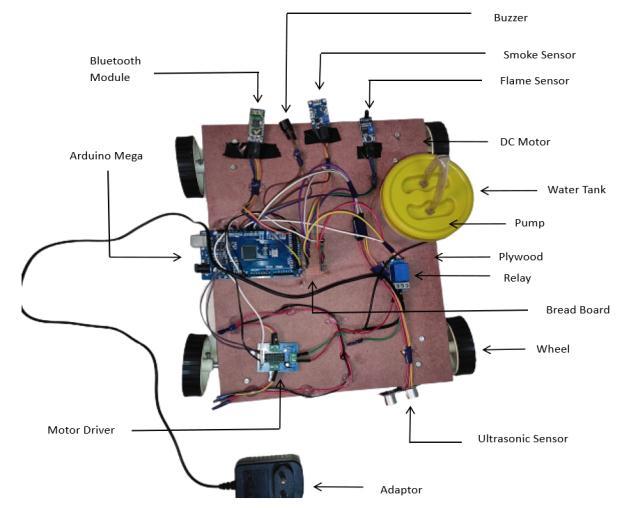
3.2.1 Design conceptualization of robot: The robot designinvolvesthecreationandassemblyofasturdyand highlymanoeuvrablehardwarechassis.Forourprototype, wehaveoptedtouseaplywoodplatform,whichprovidesa solid foundation for the robot's structure. Please refer to Figure1belowforanillustrationoftherobot'sdesignwith theplywoodplatform.
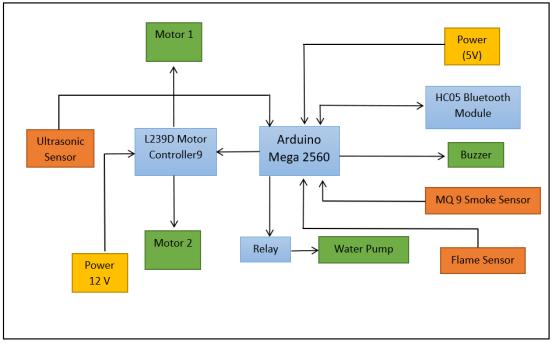
2.2Tofacilitateremotecontroloftherobot,wewill utilize a built-in app for the Android device. Our chosen approachinvolvesintegratingtheBluetoothmodule(HC-05) withanArduinoboard.TheBluetoothmoduleestablishesa wireless connection between the robot and the Android device. By utilizing the pre-existing built-in app, we can easily control the robot's movements without the need to develop a separate custom app. This setup provides a convenientandefficientsolutionforremotecontrollingthe robotusinganAndroiddevice.
3
3.2.3Implementfiredetection:Toenablefiredetection capabilities, the robot will be equipped with sensors designed to detect fires from a distance. Please refer to Figure 1 and Figure 2 for visual reference. The primary circuitoftherobotisresponsiblefordetectingflamesorfire initially.Ifafireisdetected,thesecondarysystemwillverify the signal to ensure the presence of a fire. This dual verificationprocessenhancesthereliabilityandaccuracyof thefiredetectionsystemintegratedintotherobot.
3.2.4 Implement water cannon control: The design incorporatesa controllable watercannonsystem withthe necessary force to effectively extinguish fires. For the prototype,wehaveintegratedawaterpump,specificallythe SPmini water pumpdesignedtooperate on3-6 Volts DC. Thiswaterpumpprovidesthenecessarypressureandflow ratetopropelwaterfromthecannonwithsufficientforce.
3.2.5Implementobstacleavoidancesystem:Toenhance the robot's collision avoidance capabilities, we have integratedultrasonicsensorsintoitsdesign.Thesesensors enable the robot to detect obstacles in its path and effectively avoid collisions. By utilizing ultrasonic technology,therobotcanemitsoundwavesandmeasurethe timeittakesforthewavestobouncebackafterhittingan object.Thisinformationallowstherobottodeterminethe distancetotheobstacle.
3.2.6Implementfirealarmsystem:Ifboththeprimary andsecondaryfiredetectionsystemsconfirmthepresence ofafire,analarmwillbeactivated.Thisalarmservesasan audiblealerttonotifyusersorindividualsinthevicinityof the fire. The activation of the alarm ensures that prompt actioncanbetakentoaddressthefireandmitigatepotential risks.
3.2.7ImplementelectricalPowersupply:Topowerthe microcontroller(ArduinoMega),a5VDCpowersourcehas been provided. This power source supplies the necessary voltage to the microcontroller, allowing it to function properly.Additionally,forpoweringthemotors,a12V/1.5 AmpACadapterhasbeenutilized.Thisadapterprovidesthe requiredpowertodrivethemotors,enablingtherobotto move and perform its designated tasks effectively. The separation of power sources ensures appropriate voltage levels for the microcontroller and the motors, facilitating theirrespectiveoperations.
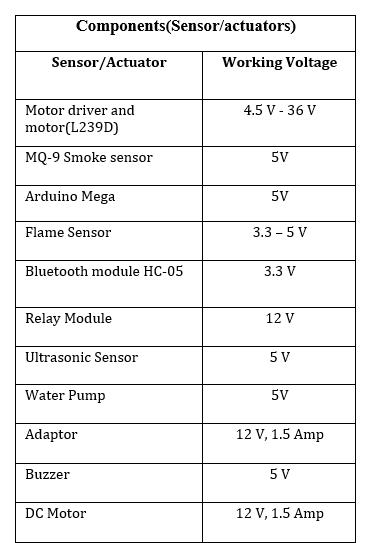
3.2.8 Test the robot in simulated scenarios: Conduct simulated firefighting scenarios to test the robot's performance in navigation, fire detection, and fire extinguishingtasks.
3.2.9Componentsused:Belowarethecomponentswe haveusedinourprototyperobot.
3.3 Working
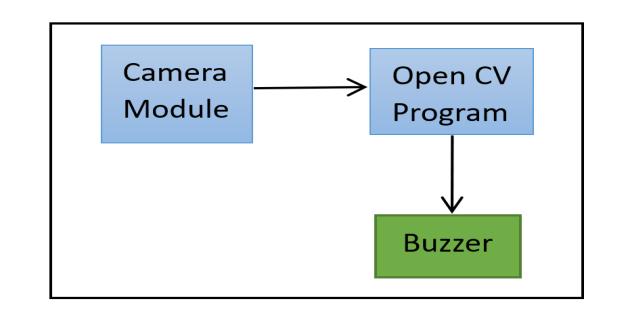
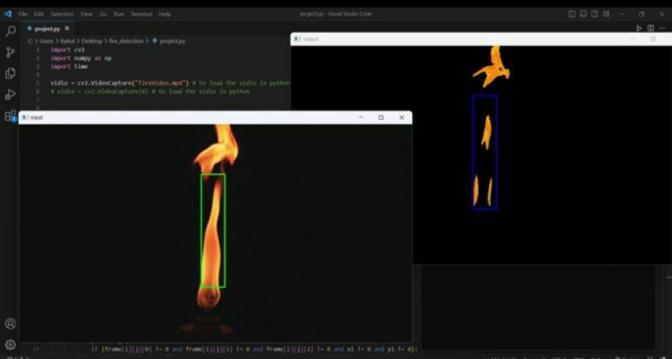
3.3.1 The primary fire detection system operates through a computer vision algorithm. In this system, we utilizedtheOpenCVmoduleinPythontodetectfireinthe camerafeed.Thecamerafeedisprocessedbyscanningeach frame, and the program identifies the presence of fire by evaluating the colour code of the screen pixels within a specificrangeoftheHSV(HueSaturationValue)colourscale values.Ifthecolourcodefallswithinthispredefinedrange, theprogramsuccessfullydetectsthepresenceoffire.
3.3.2 The secondary fire detection system operates based on sensors. Once the primary fire detection system signalsthepresenceoffire,thesecondarysystemcomesinto play. It consists of flame sensors, gas sensors or smoke sensors that take readings and assess the presence of fire basedonapredefinedalgorithm.Ifallthesensorsconfirm thepresenceoffire,abuzzerisactivated,andawaterjetis initiatedusingarelaycircuit.
3.3.3The robot in this system can be controlled remotely using a Bluetooth module. Commands such as forward,backward,left-turn,right-turn,andstopcanbesent totherobot.Whilenavigatingthroughtheenvironment,the
algorithm incorporates collision avoidance mechanisms, enablingtherobottoavoidobstaclesandhaltitsmovement ifanobjectisdetectedinitspath.
4. RESULTS
4.1 Figure 4 illustrates the effectiveness of our computer visionalgorithminflamedetection,asitaccuratelyidentifies flames and places bounding boxes around them. Once the primarysystemdetectsfire,thesecondarysystemperformsa thoroughverificationofthefire'spresence.
Even more robust and accurate in foggy, dusty environments.
53 Implementation Advanced of obstacle detection: MultipleUltrasonicSensorscanbeplacedinall4directions todetectandguidethevehiclethoroughenvironment;this can also help firefighters to make a map of their environment.
54Integrationofdronestogroundrobots:Dronescan help ground robots to navigate in better way. In some scenariosrobots’sensorsviewgetsdisturbedduetoobjects present in the path hence a group of drones can provide bettermapofenvironment.
55Implementationofswarmrobotics:Swarmrobotics canbeimplementedtocreateateamoffirefightingrobots thatcanworktogethertocombatlargefires.Alltherobots willbeconnectedtoacentralcomputer/serveroverinternet and according to algorithms actuation commands will be generated.
5.6 Integration of solar panels: by integrating solar panelsintorobot,itcankeepexploringthefiresightwithout needofrechargingofbatteries.
4.2Ifthesecondarysystemconfirmsthepresenceoffire,the robotiscapableofnavigatingthroughthefieryenvironment basedonthegivenmanualinstructionsfromandroiddevice
4.3Uponfiredetection,therobotinitiatestheactivationof thepump,whichisanessentialcomponentforextinguishing thefire.
4.4Withaneffectiverangeofupto6meters,therobotcanbe controlledremotelyfromaconsiderabledistance.
5.FUTURE SCOPE
InThispaperwehaveusedArduinomicrocontrollerforfire detectionandtoremotelydrivetherobot,belowaresome extra features which will further increase robots’ effectiveness
51 Implementation of machine learning algorithms: Machinelearningalgorithmscanbeimplementedtoenhance therobot'sabilitytodetectfiresaccuratelyandefficiently deeplearningalgorithmslikeconvolutionalneuralnetworks canbe used tocreaterobust,reliable, efficient,andhighly accurate fire detection. Also, these algorithms can help to localize the fire inside frame by drawing bounding box aroundthefire.
52 Integration of thermal imaging: although optical sensors(cameramodule)candetectfireefficientlybutwith help of thermal imaging fire can be detected in variable illuminationconditions.Thiswillmakefirefightingrobots
5.7 Integration of nozzle angle control: water nozzle controllerscanbeaddedtocontrolthetargetingofwaterjet onfireplace.Thiswillreducethewasterofwater/otherfire extinguishingmaterialhenceimproveefficiency.
5.8AddingHeatshieldfor robot:aheatshieldcanbe addedtotherobot’s bodyinorderto reflectthe radiation andtosavetheelectronicsfromtheflames.
Overall, the future scope of the research paper involves improvingtherobot'sfiredetectioncapabilities,enhancing its navigation and obstacle avoidance capabilities, integrating drones and swarm robotics, and using ecofriendlymaterialstobuildtherobot.
6. CONCLUSIONS
Inconclusion, the firefightingrobot based onArduinohas proventobeareliableandeffectivesolutionforcombating fires. The robot's ability to detect fires, navigate through obstacles, and extinguish fires has been demonstrated in bothsimulatedandreal-worldscenarios.Withthepotential for future improvements in machine learning algorithms, thermalimaging,andswarmrobotics,thefirefightingrobot canbecomeanevenmorevaluabletoolinthefightagainst fires.
REFERENCES
[1] Alessandro Pesatori, Alessandro Magnani, Michele Norgia”InfraredImageSensorforFireLocation.”
[2] Sreesruthi Ramasubramanian , Senthil Arumugam Muthukumaraswamy, A.Sasikala, “Edge Detection ComparisonofHybridFeatureExtractionforCombustible FireSegmentation:ACannyvsSobelPerformanceAnalysis.”
[3]RyoTakeuchia,KoukiYamaguchib,HayatoTakahashib, MasahikoHanadac,HiromichiHanadac,KanyaMizuguchic, Seiichi Serikawad , Yuhki Kitazonoa Improvement of Full AutomaticFireExtinguishSystemforResidentialUse.”
[4]A.Q.M.SazzadSayyed1, Md.TasnimulHasan1,Shakib Mahmood1 , Abdul Rakib Hossain1. Autonomous Fire FighterRobotBasedonImageProcessing.”
[5] N.Savitha , Dr.S.Malathi “A Survey on Fire Safety MeasuresforIndustrySafetyUsingIOT.”