
“THE PROJECT REPORT ON WIRELESS CHARGING STATION FOR ELECTRIC VEHICLES WITH A SOLAR ENERGY CHARGING ARRANGEMENT AS A BACKUP”
 Arpita S. Kurankar*, Dipali V. Parpelliwar*, Umesh G. Bonde**
*Students of Electrical Engineering at Shri. Sai College of Engineering and Technology, Bhadrawati
**Assistant Professor in Electrical Engineering Department at Shri. Sai College of Engineering and Technology, Bhadrawati***
ABSTRACT:-
Combininggreenenergy sourcessuchassolarenergy withelectricvehicleshasgrowninpopularityoverthelastdecade duetotheimpactonnon-renewablefossilfuelsandthepollutiontheyproduce.Electricvehicle(EV)chargingstationscan be used with solar panels to reduce the load on the controller. This study provides proof of state-of-the-art analysis of remotecontrol transmissiontochargeelectricvehicle batteriesusingsolarpanelstogenerateelectricity.The purposeof thisresearchistoexpandknowledgeaboutthewirelesspowertransfer(WPT)framework,aswellastolearnmoreabout the solar electric car charging station. To achieve this goal, various types of solar EV charging stations have been extensively researched. After learning a few principles, the different WPT components are explored in several sections. Examinationofthecompensationandmultiplecoilmodelsandtheadvantagesofeachcoilovertheothersweremadein theframeworkofwirelesspowertransmissionforsolar-poweredelectricvehicles.
Keywords: electric vehicle, wireless charging, wireless power transfer, inductive power transfer, capacitive power transfer.dynamicwirelesscharging
1. INTRODUCTION :-
The concept of wireless transmission for charging and poweringenginesanddeviceshasbeendiscussedsincethe Tesla days. But that didn't work as there was no technical support at the time. In 2007, researchers took an importantstepinthisdirectionbybeingabletocontrolthe light from a wireless source two meters away. Since this significant achievement, significant progress has been made in the field. One of the many other applications of wireless power transmission (WPT) is charging electric vehicles (EVs), which has many advantages and is being researched.
The term "conductive charging system" also applies to conventionalwiredorplug-inchargingmethods.Thereare someissueswiththeattachedsolutions.Forexample,they needthickchargingcablesandconnectors.Inaddition,the charger must be manually connected to the power source andtheproducttobecharged.Thewiredchargingsystem is also not friendly to users and the environment. Due to factors such as temperature, ground contact, or self chargingequipment,thecharginglinemayshortoutorthe insulation may deteriorate, resulting in electric shock. Theycanbeusedwithmultiplebatteries,oranon-capacity battery can be replaced on a single charge as needed, shorteningchargingtimeandreducingrisk.Forexample,if acarcantravelacertaindistanceononechargewithsome batteries, it can be increased times by using more
batteries.Alternatively,thevehiclebatterycanbechanged tochargeatthechargingpointwhiledriving.Butbatteries alsohavesomeproblems.
Batteries are heavy, initially expensive, and have a long lifespan. After a certain point, it becomes unable to carry any more batteriesdue totheweight.Theseissueswill be resolvedwithfutureupdatestoelectronicstoragedevices. WPT is another method that can be used to fix battery problems. For example, by using a wireless charging system, the initial cost can be reduced by avoiding large and bulky batteries. The WPT method is efficient and effective as it eliminates the clutter of cables and connectors that come with manual add-on payment systems.
With a careful review of the relevant research literature, we discuss and analyze the working ideas, strategies, materials, methods, and various aspects of EV wireless chargingsystemsinthisstudy.
Thefollowinglistcontainsthemainresultsofthisstudy:
Provideresultsandcommentsonrelevantquestions.
Before going into details about EV wireless charging systems and the various methods used for this purpose, a brief introduction to the WPT method is given.
Completed the review of SWCS and DWCS and providedanoverviewofthedesignprocess.
The IPT-based DWCS prototype and design have been reviewed.
Wireless charging system communication and control powermanagementandsystemcompatibility.
called a gap, the air between the electrodes is ionized, producingelectricity.
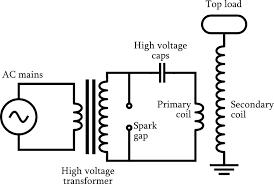
Primarycapacitorscanbeconnectedinseriesandparallel, the difference between and is between the primary capacitor and the primary coil, and the other end of the capacitor is connected to the high-voltage generator. The RFgroundisattheotherendofthefirstcoil.
Fig.No.2-Wirelesspowertransferoverashortdistanceis accomplished using inductive coupling. Power is transferred by use of mutual induction between two coils. The receiving antenna is made up of the secondary coil, whereasthetransmittingantennaistheprimarycoil.



2. 1 WORKING PRINCIPLE OF TESLA COIL
Tesla coils are high-voltage transformers that are often usedastransmittersforwirelesspowertransmission.The Tesla coil is a resonant transformer, the primary and secondaryLCcircuitsareonlylooselyconnected.Weuseit as a transmitter because it's a transformer but it works differently than a normal transformer, it gives us a lot of power and a high-frequency output that produces more induction on the load side. Tesla coils use a high-voltage generator to charge a capacitor (called a primary capacitor) and temporarily store the charge. When the capacitorisfullychargedandconnectedtoaspecialswitch
Tesla coils are high-voltage transformers that are often usedastransmittersforwirelesspowertransmission.The Tesla coil is a resonant transformer, the primary and secondaryLCcircuitsareonlylooselyconnected.Weuseit as a transmitter because it is a transformer but it works differently than a normal transformer, giving us more power, and more frequency output, which has a greater impact on the cargo. Tesla coils use a high-voltage generator to charge a capacitor (called a primary capacitor) and temporarily store the charge. When the capacitorisfullychargedandconnectedtoaspecialswitch called a gap, the air between the electrodes is ionized, producingelectricity.
Primarycapacitorscanbeconnectedinseriesandparallel, the difference between and is between the primary capacitor and the primary coil, and the other end of the capacitor is connected to the high-voltage generator. The RFgroundisattheotherendofthefirstcoil.


2. 2 AC TO DC CONVERSION CIRCUIT
All electrical or electronic equipment must be validly powered. While Tesla coils operate at different frequencies,mostofthedevicesweuseeverydayoperate at 50 or 60 Hertz. To keep the LC resonant frequency constant,theTesla coiloperatesathigher frequenciesand produces higher frequencies. Tesla coil power cannot be used directly by any device; instead, it must be converted to a form that can be used by other devices. According to
thelawofconservationofenergy,energyexistsforeverbut canbechangedfromoneformtoanother.
This concept also applies here. The load coils are used to capture the high frequency voltage and send it to the full powerstationwhichconvertsACtoDC.
Maintaining the resonant frequency of the transmit and receive coils is important for good wireless charging, so balancing is present on both sides to control the resonant frequency.Abatterymanagementsystem(BMS)orbattery packisusedtopowerthebattery,andatthereceiverside, ACpowerisconvertedtoDCpower.
2.4 DEVELOPMENT OF WIRELESS CHARGING :
By replacing the cable needed with wireless charging, the losses in the cables can be eliminated. People holding the wrong cables while plugging and unplugging for charging can be dangerous. While wireless payments are efficient and time-saving, they have some drawbacks. After plug-in parking, the stationary electric vehicle is designed as a system that can charge electric vehicles (EVs) in the parking lot or in the parking lot when the vehicle is not a longway.Theabilitytochargeelectriccarswhiledrivingis verypopular.
Dynamic wireless charging happens when the electric vehicleischargedwhiledriving.
WEVCScanbedividedinto2classes:-
1) Staticwirelesscharging.
2) Dynamicwirelesschargingsystem

2. 4. 1. STATIC WIRELESS ELECTRIC VEHICLE CHARGING SYSTEM:
The details of all bridge rectifiers are done sharply and vividly.Figure5showsa schematicdiagramofa complete rectifierbridgeconvertingACvoltagetoDCvoltage;Figure 4showsthecircuitconfigurationofthefullbridgerectifier. In our project, this AC-DC converter was used twice, once to supply DC voltage to the load LED at the receiving end andonceintheoscillatorcircuit.

2. 3 BASIC WORKING PRINCIPLE :-
The operation of the transformer and wireless charging are the same. There are wire coils and receiver coils used in wireless charging. Through AC/DC and DC/AC converters, the 220V 50HZ alternating current of the electricalgridisconvertedintohigh-frequencyalternating current, which is sent to the transmitting coil. Create alternating magnetic flux, disconnect the receive coil , and havethereceivercoilcombinetheACoutput.
As the name suggests, it charges while the vehicle is stationary, allowing for quick and easy changing of plugs without involving the driver. In other words, since the vehicle has a wireless charging system, we can stop it and charge the battery. The transmitter is installed, the receiverisplacedunderthecar.
Before we start charging the car, we need to plug in the transmitter and receiver. The distance between the transmitter and the receiver, the size of the pad, and the power level of the power supply all affect charging time. SWCS is recommended where vehicles are usually parked forlongperiodsoftime.Thedistancebetweentrafficlights shouldbebetween150-300 mm. SWCScan beinstalledin parking lots, office buildings, residential, shopping malls andotherplaces.
When it comes to electric cars, wireless charging technology,whichchargesthecaronthego,representsthe pinnacle. It has been successful when it comes to wireless charging technology. The power and range of electric vehiclesarethefocus.Dynamicwirelesschargingwillhelp boost the vehicle's charge and keep the battery charged while the vehicle is driving on and off the highway. It also reducestheneedforalargepowerreserveandfurther reduces the weight of the vehicle. From a transmitting station to a receiving coil, energy is transmitted through theair.
3. ADVANTAGES AND DISADVANTAGES
3.1 ADVANTAGES
EcologicallyFriendly
Compared to a similar gas-powered vehicle, operating costsareloweredby80%.
Therearenofuelcosts.
Less maintenance is required than for a gas-powered vehicle.
Pollution-freeandlightweightvehicles
ElectronicallySecure
Chargingispractical
Infiniterangeandinstantaneouscharging.
MultipleEVscanbechargedsimultaneously.
Quieterthanstandardautomobilesinnature
3. 2 DISADVANTAGES
Limitedrangeandpower
It'sexpensive
4. Results :-
Wireless power transfer for electric car using ATmega328 microcontroller can be done by different methods such as inductive coupling or resonance coupling using ic555 circuit, and power MOSFET circuit with primary and secondary coil works well. The results of this project will depend on characteristics such as efficiency, range and power transfer capacity, as well as specific usage and design options. It is important to consider the safety, EMI, and overall performance of the system. The result will depend on the success of hardware integration, firmware programming, energy storage for the EV battery on both sides where the coils are energized, and this car is solar powered, both wireless and solar energy is stored in the battery.Anotherexplanationoftheprojectishowlongthe batterylasts.Thisprocesswill bedonewiththeoperation oftheATmega328microcontroller.
5. FUTURE SCOPE
Thecityandcountryshouldpreparetohaveelectricity in the future. It is based on the instructions of the authoritiesandthelatesttechnology.Offeringthebest performance, safety, and economy, electric vehicles havethepotentialtochangethewaytransportation.
Dynamic electric car charging is essential; The technology could also power biomedical implants, enable supersonic hyperloop travel, and create humanoid robots. The opportunities offered by businessproblemsarelimitless.
Today, the electric vehicle market is growing rapidly. WEVC may become more competitive as new technologiesandequipmentaredeveloped.
Power electronics can also benefit from advanced equipment. In addition to leakage currents, switching losses are another important energy waste in WEVC systems. Static WEVC can release workers after removing the job from the ledger, but not the pay change.
6. CONCLUSION
Inthisstudy,wirelesschargingofelectricvehicleswas investigated. Wireless charging for electric vehicles is themosteffectivetechnology.

Wireless charging has many advantages over wireless charging. Due to his extensive travels. It reduces the time required to charge the car and even allows chargingEVsonthego.
Although the initial cost is high, the cost of treatment willdecreaseovertime.Itisusedmorefrequentlydue
to its superiority over traditional cable systems can reduce the effect of power and reduce power loss by usingWCEV.
It is predicted that the world will be completely wireless in the future. Wireless charging has many advantagesoverwirelesscharging.
With further advancements in technology, wireless charging of electric vehicles could become a reality. Inverter design control, topology, and personal safety stillneedfurtherresearchintheshortterm.
7. REFERENCES
1. Elena Paul, Nimmy Paulson, Rijo Bijoy, Benny K.K, “WIRELESS CHARGING OF ELECTRIC VEHICLES”, International Research Journal of Engineering Technology,Vol.6,Issue6,June2019.
2. Asst Prof.Swapna Manurkar, Harshada Satre, Bhagyashree Kolekar, Pradnya Patil, Samidha Bailmare, “WIRELESS CHARGING OF ELECTRIC VEHICLE”, International Research Journal of EngineeringTechnology,Vol.7,Issue03,March2020.
3. KiranMaiMomidi,"WirelessElectricVehicleCharging System[WEVCS].July12,2019.
4. Falvo,M.C.;Sbordone,D.;Bayram,I.S.;Devetsikiotis,M. EV charging stations and modes: International standards. In Proceedings of the 2014 International Symposium on Power Electronics, Electrical Drives, AutomationandMotion,Ischia,Italy,18–20June2014; IEEE:Piscataway,NJ,USA,2014;pp.1134–1139.
5. Rasel, S.I.; Ali, R.N.; Chowdhury, M.S.U.; Hasan, M.M. Design & Simulation of Grid Connected Photovoltaic System Using Simulink. In Proceedings of the International Conference on Advances in Electrical Engineering (ICAEE), Dhaka, Bangladesh, 17–19 December2015.
6. Al-Amoudi, A.; Zhang, L. Optimal Control of a GridConnected Pv System for Maximum Power Point Tracking and Unity Power Factor. In Proceedings of the Seventh International Conference on Power Electronics and Variable Speed Drives, London, UK, 21–23September1998.
7. Kobayashi,K.;Takano,I.;Sawada,Y.AStudyonaTwoStage Maximum Power Point Tracking Control of a PhotovoltaicSystemunderPartiallyShadedInsolation Condition. In Proceedings of the 2003 IEEE Power Engineering Society General Meeting, Toronto, ON, Canada,13–17July2003.
8. Mosammam, B.M.; Mirsalim, M.; Khorsandi, A. Modeling, Analysis, and SS Compensation of the Tripolar Structure of Wireless Power Transfer (WPT) SystemforEVApplications.InProceedingsofthe2020 11th Power Electronics, Drive Systems, and Technologies Conference, Tehran, Iran, 4–6 February 2020.
9. Caval-Canti, M.C.; Oliveira, K.C.; Azevedo, G.M.; Moreira, D.; Neves, F.A. Maximum Power Point Tracking Techniques for Photovoltaic System. In Proceedings of the PELINCEC 2005 Conference, Warsaw,Poland,15–20October2005.
10. Liu, X.; Lopes, L.A.C. An Improved Perturbation and Observation Maximum Power Point Tracking Algorithm for PV Array. In Proceedings of the 35th Annual IEEEPower Electronics Specialists Conference, Aachen, Germany, 20–25 June 2004. Sujatha, B.G.; Aruna, Y.V. Wireless charging of electric vehicles using solar energy. Gradiva Rev. J. 2022, 8, 167.
11. Rufer, A. The efficiency of energy storage systems-the influenceoftheexchangedpowerand