Micro Silica as Partial Replacement of Cement in Concrete
1Assistant professor,Department of Civil Engineering Viswajyothi College Of Engineering and Technology, Vazhakulam, Kerala, India
2,3,4,5 UG scholars Department of Civil Engineering, Viswajyothi College Of Engineering and Technology,Vazhakulam, Kerala, India ***
Abstract –Concrete that has been treated with silica fumesisflowableinnaturebutstillcohesive,producinghigh early and later age strength as well as resistance to hostile environments. This investigation explores the characteristics of silica fume and how they affect the characteristics of recently-poured concrete. The strength properties of concrete have been investigated through the partial replacement of cement with silica fume. Researchers looked at the strength characteristics of concrete without any partial replacement. Then, using cubes, cylinders, and beams cast in silica fume and tested using a compression testing machine (CTM), strength parameters were investigated. For cube, cylinder, and beam construction, silica fume was utilized to replace 5% to 15% of the cement by weight at increments of 2.5%. The results demonstrated that the compressive strength of the cube and split tensile strength of the cylinder were significantly affected by partially replacing cement with silica fume. The ideal value of compressive strength will be attained at 12.5% replacement. The strength of concrete increases quickly as thesilicafumelevelincreases.
Key Words: Silica fume, compressive strength, splitting tensilestrength, flexuralstrength.
1.INTRODUCTION
1.1 General
Concrete is the most important engineering material, and adding other materials can change the properties of concrete. Micro Silica is a pozzolanic substance that has beenusedsuccessfullyallovertheworldsince1900andis environmentally stable. It is an industrial by-product of theferro-alloyandhighpurityquartzindustries.Amineral additive known as micro silica is made up of small, solid silicon dioxide (SiO2) spheres. Nearly all of micro silica particles have a diameter of less than 1 micron (0.00004 inch),whichis50to100timessmallerthantypicalcement or fly ash particles. Fine amorphous silica is known as microsilica orsilica fume. Themostcrucial component of anengineeringdesignisconcrete. Pozzolanicportionsare added to concrete to boost its mechanical strength and durabilitybecausethesilicainthesematerialsblendswith thecalciumhydroxidegeneratedduringcementhydration toyieldmorecalciumsilicatehydrate(C-S-H).
1.2 Objectives
a) To evaluate the workability of concrete that has been0%,10%,12.5%,and15%partiallyreplaced withmicrosilica.
b) To determine the optimum percentage of micro silicainconventionalconcrete.
c) Toascertaintheflexural,splittensile,and compressivestrengthsofconcreteusingseveral substitutionsofmicrosilica
2.METHODOLOGY
The methodology adopted comprised of both preliminary andexperimentalinvestigations:
a) Literature review : The journals related to the topic are referred and collected. It helps to understand various aspects of the project and leadtheprogressoftheproject

b) Material collection : Cement, fine aggregate, coarse aggregate of required quantity is collected from the market. Micro silica is collectedfromferro-alloyindustry
c) Preliminary test : Specific gravity, setting time and consistency of cement are determined. Gradation bulk density and specific gravity of sand and micro silica are determined. Gradation and specific gravity of coarse aggregateisalsofound.
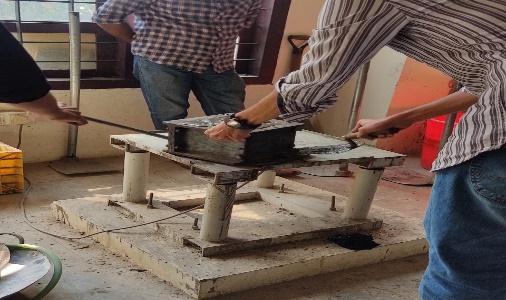
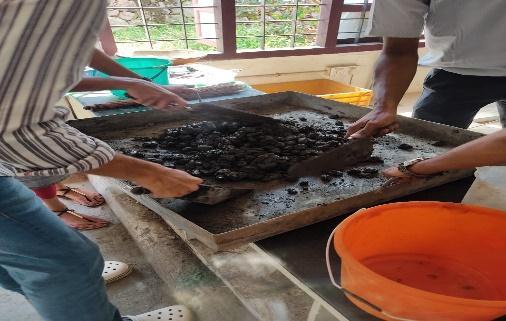
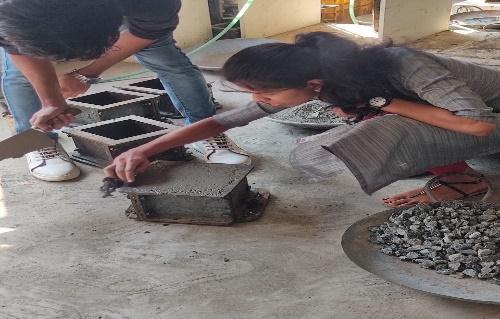
d) Castingoftestspecimen:Workabilityistested using slump test. Mix proportioning is carried out for M 30 concrete. Components are mixed in required proportions and specimens are castedascubes,cylindersandbeam.
e) Curing : The specimens are cured in a curing tankfor28days.
f) Specimen testing : The cube specimens are tested to determine compressive strength, the cylinder specimens for split tensile strength andbeamsforflexuralstrength.
g) Comparison and analysis of result : The value of different strength properties of concrete
partiallyreplacedwithmicrosilicaiscompared with that of traditional concrete. The result obtained is analysed to find optimum percentageofreplacement.
h) Conclusion and report : The result obtained from the experiment are summarized and the influence is noted. A detailed report is preparedbasedontheobservations
3. MATERIALS AND METHODS
3.1. Micro Silica
Silica fume, a crystalline variant of silicon dioxide, is additionally recognised as micro silica. It is a byproduct generated when quartz, limestone, and iron are used to produce silicon and ferro-silica. It comprises of mostly amorphous SiO2 (82%–96%) and very small, sphereshaped particles (with a maximum dimension of less than 1m).
The following tests are conducted on coarse micro silica andresultsareasfollows
a. Specificgravity–2.71
3.2. Cement
For this work 53 grade Ordinary PortlandCementisused. As per IS 12269:1987 following tests were conducted on cementandresultsareasfollows
a. Standardconsistency–34%
b. Initialsettingtime–60minutes
c. Specificgravity–3.12
3.3. Fine aggregate
Msandisusedforconductingthe test.AsperIS383:1970 followingtestsareconductedonfineaggregateandresults areasfollows
a. Sieveanalysis–Wellgradedsand
b. Specificgravity–2.54
c. Bulkdensity–1574kg/m3
3.4. Coarse aggregate
Stones from local quarry is used. As per IS 383:1970 following tests are conducted on coarse aggregate and resultsareasfollows
b. Specificgravity–2.73
c. Bulkdensity–1620kg/m3
3.5. Concrete
Workabilitytestsareconductedonconcreteandobserved resultsareasfollows
a. Slumpconetest–40mm
b. VeeBeetest–7sec
c. Compactionfactortest–0.78
3.6. Mix design details
Mixproportion–1:2.53:3.26
Quantityofmaterialsfor1m3ofconcrete(M30with w/c0.44)
Weightofcementrequired = 333.79 kg
Weightoffineaggregaterequired = 844.5 kg
Weightofcoarseaggregaterequired =1088.17 kg
Weightofwaterrequired = 133.52 kg
Table 1: Preparation of specimen
4.
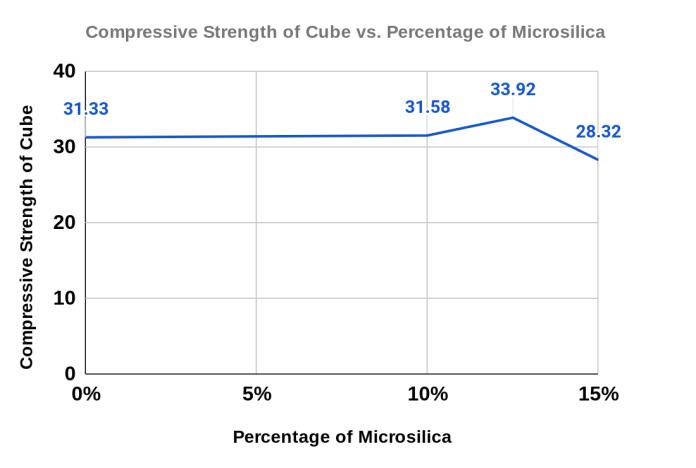
It is a mechanical test which assesses how much compressiveloadconcretewilltoleratebeforecollapsing.It wasacompressiontestingmachinethatwasused.
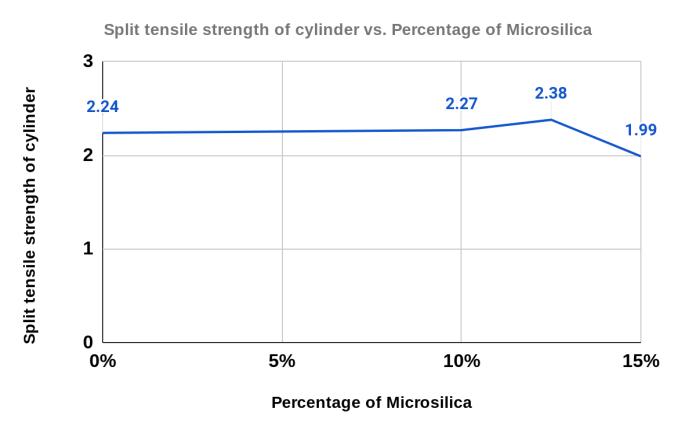
Itisadeceptivemethodofassessingtheconcrete'stensile strength.
3
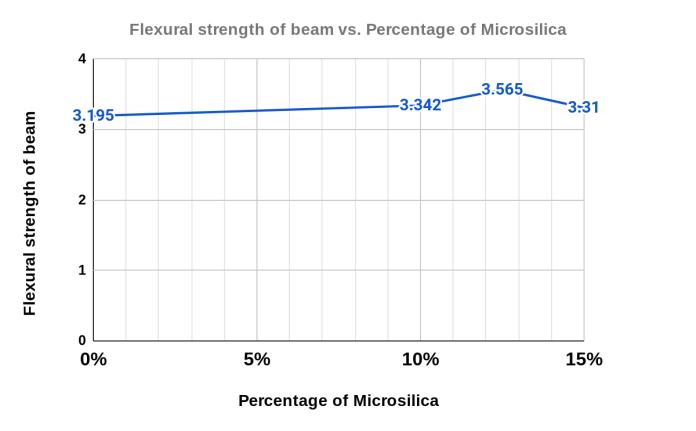
The flexural strength is the stress before failure in bending.Itmatchesorexceedsthefailurestressintension.
6. CONCLUSION
Compressivestrength:Thecompressivestrengthofthe concrete cube increases when silica fumes are added in a 10% concentration. Adding 12.5 % of silica again can increase its compressive strength. Thus optimumstrength of concrete is obtained at 12.5 % cement replacement by silica.
Split tensile strength: The concrete's split tensile strength canbeincreasedby10%silicafumes.Concretereachesits peakstrengthwhensilicareplacescementby12.5%
Flexural strength: Flexural strength rises as micro silica contentrises,reachingitspeakat12.5%.
7. REFERENCE
Chippada Srinivas, Satyavathi, and P. Gnana Prakash(2019); A study on Investigation of Micro Silica as Partial Replacement of Cement in Concrete.International Journal of Applied EngineeringResearchISSNVolume14.
Nikhil bhatt and Dr.Sanjeev Gill (2017); To study Advance Construction Material Micro Silica in Concrete.International Journal of Scientific & EngineeringandResearchVolume8,Issue10.
LakhbirSingh,ArjunKumar,andAnilSingh(2016); STUDY OF PARTIAL REPLACEMENT OF CEMENT BY SILICA FUME.International Journal of AdvancedResearch,Volume4,Issue7
8. BIOGRAPHIES
Lins Paul Kuriakose
Assistantprofessor
DepartmentofCivil Engineering



ViswajyothiCollegeofEngineeringand Technology,Vazhakulam,Kerala
Arif Ali
4th yearstudent,Civilengineering
ViswajyothiCollegeofEngineeringand Technology,kerala
Ann Mariya Baby
4th yearstudent,Civilengineering
ViswajyothiCollegeofEngineeringand Technology,kerala
Muhammed P A
4th yearstudent,Civilengineering
ViswajyothiCollegeofEngineeringand Technology,kerala
Sandhra Sibi
4th yearstudent,Civilengineering
ViswajyothiCollegeofEngineeringand Technology,kerala