
SUSTAINABLE & COST-EFFECTIVE DRAINAGE DESIGN SOLUTION FOR AN URBAN ROAD SCENARIO USING HYDRAULIC SOFTWARE APPLICATION
1 M. Tech Student, Department of Civil Engineering, Vishwakarma Institute of Information Technology, Pune Maharashtra, India
2 Principal Engineer - Storm Water Drainage, Civil & Infrastructure Sector, AECOM GDC, Bengaluru, India
3 Assistant Professor, Department of Civil Engineering, Pune, Maharashtra, India ***

Abstract - This paper presents an overview of sustainable and cost-effective drainage design solutions foranurbanroad scenario by evaluating the design based on Modified Rational Method against several parameters. It discusses theobjectives and benefits of sustainable and cost-effective drainagedesign, including effective management of surfacerunoff,attenuation of the flow to combat against flash discharge, ease of installation of drainage assets and finally meeting the regulations of Environment Agency, UK. It also examines the importance of optimizing the drainage assets there by reducing carbon footprint, cutting down onconstructioncosts by optimizing the drainage assets, achieving long-term cost savings, meeting regulatory requirements, and engaging stakeholders. The use of hydraulic software applications is explored as an effective tool for designing, modelling, analysing drainage systems for storage requirements,helping to identify the most efficientandcost-effective drainage design solution.
The study includes development of three drainage design alternatives which would best suit the new urban road site selected for the study and then comparing these three designs against several parameters to arriveatanoptimizedandcosteffective solution. Various combinations of available Surface and Subsurface drainage solutions are analysed in industry standard hydraulic software application, MicroDrainage and the most sustainable and Cost-effective Option is suggested which would best suit the site.
Key Words: Stormwater Drainage Design, Urban Road Scenario, Cost-effective Drainage Design, Microdrainage.
1.INTRODUCTION
Sustainableandcost-effectivedrainagedesignsolutionsare essential for managing urban stormwater runoff and to preventfloodingincities.Withtheincreasingurbanization and climate change impacts, there is a growing need for innovativedrainagesolutionsthatcanefficientlyhandlethe increasing volume of stormwater runoff due to newly developed impervious surfaces in urban areas. Hydraulic software applications are becoming a popular tool for designingandanalysingdrainagesystems.Climatechange
and urbanization are significant challenges that require effective strategies to mitigate their impacts on the environment,society,andeconomy[5].
The use of hydraulic software applications can aid in the designandanalysisofdrainagesystemsandhelpidentifythe most efficient and cost-effective solution for the specific requirementsofurbanroadscenarios.Hydraulicsoftware applicationsarecomputerprogramsthatcansimulate the hydraulic performance of drainage systems. These applicationsusevariousmathematicalmodelstopredictthe flow of water in drainage systems and evaluate their efficiency
Theobjectivesofasustainabledrainagedesignmayinclude:
Managing surface runoff by accounting for the climatechangefactor
Efficientuseofresourceswhichinturnreducethe carbonfootprint
Reducingconstructioncostsandtime
Meetingtheattenuationrequirements
Finallyliaisingwithregulatorystandards.
2.STUDY AREA
Thesitechosenforcomparativestudyofsuitabledrainage designsliesinUKalongastrategicroad.Itisassumedthat the new carriageway improvements would be proposed within the existing public highway boundary and that involves a minor realignment of the existing highway to accommodatetheproposednewaccessroundaboutandthe creation of a 3 m wide multi-use pedestrian and cycling routeasitisgenerallythecaseincaseofimprovisationof existingroadinfrastructure.TheProposedDevelopmentis located within a Metropolitan Council that acts as administrative&LocalPlanningAuthority.Thecouncilalso actsasLeadLocalFloodAuthority(LLFA),responsiblefor managing local flood risks and ensuring co-operation betweentheRiskManagementAuthoritiesinthearea.So,to
meettheobjectiveofcomparingthethreesuitabledrainage designs for the site and to arrive at a better optimised option,theabovenewproposalisassumedtobecarriedout.
3.DESIGN METHODOLOGY
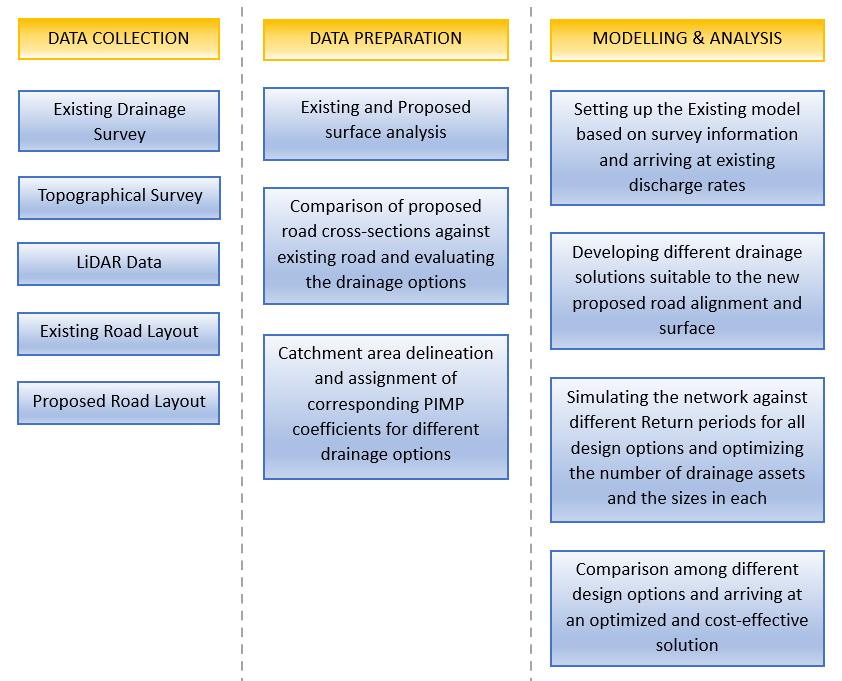
Inshort,itisassumedthatthedevelopmentproposalwould involvetheconstructionofthefollowing:
• Newaccessroundaboutandaccompanyingembankment earthworksforconnectingthefutureroadcomingfrom southdirection
• Carriagewayimprovementswhichincludeanew3mwide pedestrianandcycleaccessroute
• 2m wide grass verge spanning alongside south of the carriageway
• Surfacewaterdrainagenetworkcapableofattenuatingup toandincludingthe1in100-yearrainfalleventplus40% CCfactorwithdischargecontroltolimittherunoffrateto existingorpre-developmentscenario
4.EXISTING HYDRAULIC MODEL DEVELOPMENT
ToliaisewiththeEnvironmentAgencyregulationofmeeting the pre-development flow rate for any of the new developments,anexistingflowrateneedtobearrived.This can be achieved by building an existing model and then simulatingitagainstdifferentrainfallreturnperiods.Using theExistingdrainagesurveyandTopographicalinformation, theexistingnetworkwassimulatedusinghydraulicsoftware calledMicrodrainage.Byassigningcatchmentareasandthe correspondingPIMPcoefficients,themodel wasanalyzed, andtheexistingflowratesweredeterminedforrespective stormreturnperiods.
Table -1: DesignParametersconsideredwhile constructingandsimulatingthehydraulicmodel:
1.FSR(FloodStudiesReport)Rainfalldata
2.TimeofEntry–5minutes
3.GridReference:444510,403913
4.M5-60(mm):19
5.RatioM5-60/M5-2Day(R):0.375
6.PIMPforCarriageway/Footpath-100%
7.PIMPforVerge/Cutting/Embankment-20%

8.VolumetricRunoffCoefficientCv –0.75
5.PROPOSED DRAINAGE DESIGN
The proposed site is studied in detail by performing the catchment analysis to check if there was any effect of overlandflowthatwouldintercepttheroadembankments. Theproposedroadcross-sectionsarethencomparedagainst

theexistingroadsurfacetoidentifyifthereisanysectionof road that remained unchanged and to choose drainage collection system suitable for those road slopes. Since the proposalincludedtheprovisionofRoundaboutthatinturn wouldencroachtheexistingditch,aneedforrealigningof existingditchisidentified.Thisditchwillcutofftheoverland flow and will divert the runoff to the existing culvert downstream thus safeguarding the proposed road earthworks.
TheEnvironmentAgencyinUKwillnormallyrequirethat, for the range of annual flow rate probabilities, up to and includingthe1%annualprobability(1in100-yearevent) thedevelopedrateofrunoffintoawatercourseshouldbeno greater than the undeveloped rate of runoff for the same eventbasedonthecalculationofMeanAnnualFlood(QBAR) orMedianAnnualFlood(QMED)andtheuseofFSSRgrowth curves[5].
Thepurposeofthisistoretainanaturalflowregimeinthe receivingwatercourseand notincreasepeak ratesofflow foreventsofanannualprobabilitygreaterthan1%.Three annualprobabilitiesareusedtodefinedischargecompliance limits though the critical criteria are for the lowest and highestfrequencyevents:100%(1year),3.33%(30year) and1%(100year).Thus,anystormwaterdrainagesystem thatistobedesignedforanewdevelopmentshouldcollect runofforiginatingfromsite,storeorattenuateitandthen release only at Green Field or Pre-Development Runoff dischargeratetothereceivingwaterbodyaftersatisfying thewaterqualitycriteria.
5.1 Contributing Catchment Areas of Existing and Proposed Model
To identify the attenuation volume requirement, the catchment plans of both existing and new proposals are studied and the Gross Impervious Area is evaluated. The figures below depict the area contribution in existing and proposedscenario.

5.2 Design Options Arrived

Upon analyzing the existing and proposed road surfaces, threedesignalternativeswereidentifiedwhichbestsuitthe site.Theseinclude:

Option-1: Gullies and Pipe System along with Filter Drains at toe of cutting earthwork slopes.
Since Road Gullies form the conventional road drainage collectionsystemthatisadoptedby manycouncilsacross UK.Thisoptionwaschosenasoneofthedrainageoptions after meeting the Gully/Inlet spacing requirements as per the UK’s DMRB standard (CD526) by satisfying the Flow widthcriteria.Thegulliesareproposedwithoptimalspacing tocollectthehighwayrunoffandthenconveythroughthe carrier drains up to outfall. The online attenuation is providedincarrierdrainswiththehelpoforificeplatesto meettheexistingdischargeratesatoutfall.Thenetworkis optimisedfurtherbysimulatingitagainstrespectiverainfall eventsandthequantitiesareextractedtocompareagainst otherdrainageoptions.
Option-2: Slotted Drains and CKDs along with Filter drains at toe of cutting earthwork slopes
TheSlottedDrains(SD),CombinedKerbDrains(CKD)offer morebenefitsthantheGullysystemasitnotonlycollects therunoffbutconveytheflowthroughthesameconduits. Thiseliminatestheneedfornumberofpipeconnectionsand makethedrainagesystemclutterfree.Thissystemcanbe adopted at the edge of the road, thereby eliminating all potentialclasheswithundergroundutilitiesintheverge.The systemcomeswithprefabricatedunitsofspecificlengthand is easy to install which reduces the installation time to a greater extent. A combination of Slotted Drain and CKD
integratestheadvantagesofboththesystemstoprovidea moreefficientandeffectivedrainagesolution.
Incorporatingpartoftheexistingstormdrainagenetwork into a proposed network where it can be retained has several advantages such as savings in time and cost, environmental benefits and minimizes disruption. In this option,theexistingnetworkwithGulliesandPipesystemis retainedwheretheroadwidthandslopesare unchanged. Where the road alignment changes particularly at roundaboutportion,theproposedCKDsystemisconnected tothenewpipenetworkandisusedforattenuationtomeet thedischargeregulations.Thenetworkisoptimisedfurther by simulating it against respective rainfall events and the quantitiesareextractedtocompareagainstotherdrainage options.
6. COMPARATIVE STUDY OF DESIGN OPTIONS


After ensuring that each design is meeting the primary objectivesofrunoffcollection,conveyance,andattenuation requirements as per the UK DMRB standards and EnvironmentAgencyguidelines,adetailedanalysisiscarried out to check if it is feasible for construction. The optimizationprocessisperformedoneachdesignoptionto ascertain the minimal quantity of drainage assets are obtained for respective option, with the goal of reducing carbon footprint, maximizing efficiency and effectiveness. Thenetworkquantitiesareexportedseparatelytocompare thelengths,diametersofsimilarpipe&chambertypes,total costofassetsineachoptionagainstallthreedesignoptions. Belowisthegraphicalrepresentationoftotallengthsofpipe typesineachoption.Thesecannowbeevaluatedtoarriveat total cost of construction by looking at the breakdown of Capital,InstallationandMaintenancecosts.
6.1. Cost Comparison of Drainage Options Chosen


Although one particular drainage solution offers few advantagesaswellasdisadvantagesoverother,tostrikea rightbalance,amoreefficientandcost-effectivesolutionwill bewidelyadopted.Hence,thecostofdrainagenetworkon the whole is often the deciding factor in addition to its efficient functioning. This cost can mainly be divided into Capital Cost, Installation Cost and Maintenance Cost. The maintenancecostisarecurringcostandisaddedthroughout thelifeofthenetworkforitsseamlessfunctioning.
6.1.1:
Capital Cost.
Thecapitalcostinstormdrainagetypicallyincludesthecost of physical assets such as pipes, manholes, catch basins, gullies,grates,channels,slotdrains,combinedkerbdrains, pollutioncontrolchambersandothercomponentsthatmake upthedrainagesystem.Thesecostscanvarydependingon
the materials used, size of the assets, number of assets required for the project and the local suppliers. In the presentstudyanapproximatecostofthedrainageassetsin UKisconsideredatthetimeofwritingthisreport[9][12]. These costs vary with time and can also vary in different countries. However, the variation in cost of different drainage assets would still be equivalent in other geographicallocations.Thecapitalcostisarrivedatbydoing theliteraturereview,browsingthroughthelistofsuppliers andtheirofficialwebsites,andthenmakingsomerealistic assumptions to suit for the product types applied on this study.Thesameistabulatedbelowforeasyreference.


Thebarchartbelowpresentsthecomparisonofcapitalcost oftheselectedthreedrainagedesignoptionsforthepresent study.
Installationcostoftenmakesouttobethemostsignificant component in drainage network construction. The installationcostofstormdrainagesystemscanvarygreatly dependingonthesizeofthesystemi.e.,numberofassets,the materialsused,thecomplexityofthedesign,andthelocation oftheproject,typeandsignificanceofroadandthequantum oftraffictheroadhandlesetc.Typically,installationcostof stormdrainagesystemsincludestheequipmentrental,cost ofhumanresourcestoconductthejob,excavationofearth and any necessary permits or inspections. Again, this installation cost varies in different countries however the activitiesperformedintheinstallationmayremainsame.
6.1.3: Maintenance Cost:
Anefficientworkingofagooddrainagesystemliesinproper maintenanceofthewholenetwork.Theassetsshouldbefree fromdebris,cloggingduetosediments,moreoveritistobe ensuredthatthestructuralintegrityistakencareof,toavoid cracks,collapseofpipesduetoprotrusionoftreeroots.This maintenance cost of a storm drainage system can vary depending on factors such as the type of drainage assets installed, number of assets, the frequency and intensity of rainfalloccurrences,thelevelofdebrisandsedimentation, andtheconditionofthesystem[13].Generally,maintenance activitiesforastormdrainagesystemmayinclude:
Regular cleaning of gullies, slot drains, and other drainage assets to prevent blockages and ensure properfunctioning
Inspection and repair of damaged pipes, chambers, andotherstructuralcomponents
Clearing of debris, litter, and sedimentation from catchpits,manholes,andotherdrainagestructures
Removalofinvasivevegetation,suchastreeroots,that cancompromisetheintegrityofthesystem
Regular monitoring of water quality to ensure compliancewithenvironmentalregulations.
lifeofthe drainage system by assuminga designlifeof 40 years.Thiswillguideuswiththeimportanceofmaintenance costfortheefficientfunctioningofwholedrainagesystem.
6.2. Summary of Overall Cost
The following chart summarizes the cost of all three best suiteddesignoptionsforthisstudyarea.Theindividualcost categories of each design option are presented to quickly arrive at the significant cost component in each. The comparativestudyofthesedesignoptionsisalsocarriedout forthefirst1yearofitsoperationandalsothroughoutthe


7. CONCLUSIONS
Based on the results presented in the Overall Cost Comparisongraph,thefollowingconclusionsaredrawn:
Theinstallationcostmakesouttobethemostinanydesign option during the construction as most of the cost will be accountedfortrafficmanagement,safetymeasurestakenon site, hiring human resources to carry out the work, equipment rental, transportation of assets and corresponding equipment for their installation and necessarypermits.Option1ishavinghigherinstallationcost compared to other design options as there are a greater number of assets and their corresponding network connections. In contrast, Option 3 utilizes the existing drainage network, making it a cost-effective choice for installationcomparedtotheotheroptions.
Thecapitalcostofoption1withGulliesandPipesystemis lowercomparedtootheroptionsthoughtheassetsaremore inthedesign.Thisisduetothefactthatgulliesarecheaper compared to more recent drainage systems such as slot drain and CKDs. The Slot and CKD conduits have been evolvingovertheyearsthroughahighlevelofresearchto suit for different road and kerb configurations thus have becomemorecostliercomparedtoGullies.
Themaintenancecostofoption3comprisingofexistingand proposed assets offers better cost savings during the first yearofitsoperationandsubsequentlyoveritslifetimeasthe assets are fewer and most of the network comprise of a proposed linear kerb system which is relatively easier to maintain.Itisassumedthatthemaintenanceofthedrainage systemisdoneonayearlybasisandthatitmaydifferfrom regiontoregionandthefrequencyofrainfall,cloggingand sedimentation etc. However, a proper and regular maintenance is key for proper functioning of a system to meetitsobjectives.
Among all three options, Option 1 with Gullies and Pipe system provides better cost savings when looked at the overallcostforthefirstoneyearofoperation,butOption3 withamixofExistingGullies&PipesystemandProposed CKDnetworkprovestobeeconomicalwhenlookedatthe fulldesignlifeofthesystem.Thus,maintenancecostplaysa vitalroleinoverallcostofadrainagesystemwhenlookedat itsfulldesignlife.
REFERENCES
[1] Construction Industry Research and Information Association(CIRIA),Floodriskmanagementandsurface water drainage https://www.ciria.org/CIRIA/Topic_overviews/Flood_ri sk_management_and_surface_water_drainage.aspx?hkey =e2db6bec-aa41-41a4-bff8-bdb313739491
[2] DMRB Drainage Standards, UK https://www.standardsforhighways.co.uk/search?disci pline=DRAINAGE&suite=DMRB
[3] Duffy,A., Jefferies, C., Waddell,G., etal.(2008).Acost comparison of traditional drainage and SUDS in Scotland.WaterScienceandTechnology,57(9),1451–1459.
[4] Cely-Calixto, N. J., Carrillo-Soto, G. A., and BonillaGranados,C.A.(2020).Optimizationofastormdrainage network using the storm water management model software in different scenarios. Journal of Physics: ConferenceSeries,1708(1),012030.
[5] Environment Agency, UK https://www.gov.uk/government/organisations/enviro nment-agency
[6] ACO Drainage Design Solutions
https://www.aco.co.uk/drainage-design
[7] Drainage Supplies from Marshalls https://www.marshalls.co.uk/commercial/civils-anddrainage/drainage-supplies
[8] JDP. (n.d.). Surface Water Drainage Systems - JDP. Retrievedfrom https://store.jdpipes.co.uk/surface-water-drainage
[9] TheCompletePriceGuide.(n.d.).TheAverageDrainage Costs. Retrieved from https://www.homehow.co.uk/costs/drainage.
[10] D. Store. (n.d.). Drainstore | Drainage and Pumping Supplies - Drainstore. Retrieved from https://drainstore.com/.
[11] George Lines. (n.d.). Gully Pots - Gullies - Drainage. Retrieved from https://www.georgelines.co.uk/drainage/gullies/gullypots/.
[12] cmostores.com limited. (n.d.). ACO TotalFlow Nickel BronzeHeightAdjustableGully|DrainageSuperstore®. Retrieved from https://www.drainagesuperstore.co.uk/product/acototalflow-nickel-bronze-height-adjustable-gully.html.
[13] Checkatrade. (n.d.). Drain Unblocking Cost. Retrieved from https://www.checkatrade.com/blog/costguides/drain-unblocking-cost/.