Music Recommendation System
Akrit Sood1 , Uday Sharma2 , Harashleen Kour3
1 Department of Computer Science and Engineering, Chandigarh University, Mohali, Punjab, India
2 Department of Computer Science and Engineering, Chandigarh University, Mohali, Punjab, India
3 Department of Computer Science and Engineering, Chandigarh University, Mohali, Punjab, India ***
Abstract - This research paper presents a study on developing a machine learning-based system to provide suggestions for music, utilizing a dataset from Asia's leading music streaming service. The purpose is the study to build a better music system for suggestionsand providespersonalized recommendations for listeners based on their previous listening behavior. The proposed approach employs both content-based as well as collaborative filtering approaches to produce suggestions. The content-based approach analyzes the properties associated with music, such as genre, tempo, and melody, to find similar songs. The collaborative filtering approach uses user behavior data to recognize other people that have similar hobbies and music preferences and recommends songs that they have listened to. The paper presents the planning and carrying out of the system for a song suggestion, including the data collection, preprocessing, and feature extraction steps. The systemisevaluatedusingthe dataset from the music streaming service and compared to a number of baseline algorithms. The conclusions show if the suggested system exceeds the baseline algorithms in relation to recommendation accuracy and diversity. This paper ends with a discussion of conceivable applications and limitations in terms of the planned music recommendationsystem,aswell as future directions for investigating this field. In general, the research demonstratestheeffectivenessofmethodsoflearning from machines for building better suggestions for song systems which can improve the music experience withhearing for users.
Key Words: Music Recommendation System, Machine Learning, Data Pre-processing, Population model, Collaborative Filtering Model, Content-Based Mode, Clustering
1. INTRODUCTION
Inrecentdecades,musicrecommendationalgorithmshave grown into essential componentsfor musicfans. With the development of servicesthatstreammusic, the volume of music accessible to customers is huge and overwhelming, whichmakesithardtodiscovernewartistsandsongsthat match their interests. Music recommendation systems provide a solution by making individualized suggestions basedonthelistener'sinterests,listeninghistory,andother criteria.Musicrecommendationsystemsarecategorizedas follows:
1. Collaborative filtering: The notion behind filtering is to identify people with similar musical interests like similar songs.Theabovealgorithmgeneratessuggestionsaccording toauser'spreferencesorplayinghistory,albums,ratings, andinterestsofotheruserswithsimilarmusicallikes.
2.Content-basedfiltering:Toproviderecommendations,this filteringconcentratesonthequalitiesofthesongitself,such asgenre,tempo,andmood.
3. Hybrid systems: To deliver more reliable recommendations,hybridsystemsintegratecollaborativeor content-basedfiltering.
The algorithms used towards creating suggestions decide their effectiveness for these systems. To assess user information and provide recommendations, machine learningmethodsneuralnetworksforlearning,andtreesof decisiontreesareoftenused.Toincreasetheircorrectness overtime,thesealgorithmsaretrainedonhugedatabasesof music and consumer preferences. Unfortunately, the data providedcanrestricttheuseofthesesystems.Forexample, ifauserhasonlylistenedtoacoupleofsongsorhasasmall playlist,theresultingrecommendationsmaybeinaccurate. Asidefromtheirusefulness,musicrecommendationsystems involve ethical considerations such as confidentiality and algorithmic unfairness. Some customers may be worried about the volume of private information gathered for recommendation purposes. Despite these reservations, musicrecommendersystemshavehadatremendousimpact on both the music world and the people they serve. They allowfanstodiscoveradditionalmusicthattheymightnot havediscoveredelse,whilealsointroducingartiststonew listeners. As these systems develop, it will be essential to findanequilibriumbetweentheireffectivenessandethical issues to ensure that they deliver real benefits to both audiencesandartists
2. LITERATURE SURVEY
H. Ying et al., (2018) [1], propose a novel approach to building recommender systems for music by combining matrix factorization, recurrent neural networks, and attention based models. The proposed method uses a hierarchical attention network that can capture both the hierarchicalstructureofmusicmetadataandthesequential patterns of user behavior. The experimental results show thattheproposedmethodoutperformsseveralstate-of-the-

artbaselinemethods.Thepapercontributestothefieldof recommender systems by highlighting the importance of considering both sequential patterns and hierarchical structurewhenbuildingrecommendersystemsformusic
J.Li,K.Lu,Z.Huang,andH.T.Shen,(2021)[2],theauthor proposesamethodcombiningsocialnetworkanalysiswith matrix factorization to generate personalized user recommendations. The paper highlights the challenges of cold-start and long-tail recommendations and the use of social data to overcome these challenges. The proposed method is based on previous research on matrix factorization and social networks and provides a novel approach to address the challenges of personalized recommendation. The experimental results show that the proposed method outperforms several state-of-the-art baselinemethodsontwopublicdatasets.Thepaperprovides avaluablecontributiontothefieldofrecommendersystems by demonstrating how social data can be leveraged to addressthechallengesofpersonalizedrecommendation.
M.Jiang,Z.Yang,andC.Zhao(2017)[3],proposesamusic recommendation system that utilizes a recurrent neural network (RNN) to model the sequential patterns of music listeningbehaviour.Thepaperdiscussesthechallengesof musicrecommendationsystems,theuseofmachinelearning techniques, and RNNs for modelling sequential data. The proposedsystemextractsmusicfeaturesanduserlistening behaviour from music metadata and listening history and trainsanRNN-basedmodeltopredictthenextmusicitemin theuser'slisteningsequence.Themodelistrainedusinga combination of cross-entropy loss and ranking loss. The experimental results show that the proposed system outperformsseveralstate-of-the-artbaselinemethodsona publicdataset.Thepapercontributestothefieldofmusic recommendation systems by demonstrating the effectivenessofRNN-basedmodelsformodellingsequential patterns of music listening behaviour. Overall, the paper provides a valuable contribution to the field of music recommendationsystemsbydemonstratinghowRNN-based models can be used to improve the accuracy of music recommendationsbymodellingsequentialpatternsofmusic listeningbehaviour.
D.Bogdanov,M.Haro,F.Fuhrmann,A.Xambo(2011)[4],E. Gomez, and P. Herrera, (2011), proposes a music recommendation system that uses semantic notions to representuserpreferencesandgeneratepersonalizedmusic recommendations.Thesystemextractsmusicfeaturesand analyses the semantic content of the music using natural language processing techniques. The system recommends music items that are similar in terms of their semantic content, resulting in improved accuracy of personalized music recommendations. The paper provides a valuable contributiontothefieldofmusicrecommendationsystems.
N. Karbhari, A. Deshmukh, and V. D. Shinde (2017) [5], presents a case study on using data analytics and soft
computing techniques to predict the placement status of college students. The authors collected student data on academic performance, attendance, and extra-curricular activities,aswellasjoboffersfromvariouscompanies.They applied data mining and machine learning techniques to develop predictive models that can accurately predict the placementstatusofstudents
J. Gong et al. (2021) [6], proposes a score prediction algorithm for sensor cloud systems that combines deep learningandmatrixfactorizationtechniques.Thealgorithm learnsfeaturerepresentationsofsensordatausingadeep neural network and latent factors affecting scores using matrixfactorization.Theproposedalgorithmoutperforms severalstate-of-the-artbaselinemethodsandcontributesto the field of sensor cloud systems by demonstrating the effectiveness of combining deep learning and matrix factorizationtechniquesforscoreprediction
F. Fessahaye et al. (2019) [7], proposed a novel music recommendation system called T-RECSYS, which utilizes deep learning techniques to provide personalized and diverse music recommendations. The system extracts feature from music tracks and learns to associate these features with users' listening behaviours to create a personalized music preference model. T-RECSYS outperformstraditionalcollaborativefilteringmethodsand can handle cold start scenarios and long tail recommendations.Thesystemhasbeenevaluatedinseveral studies, which have shown its effectiveness in generating personalizedanddiversemusicrecommendations.
H.-W.Dong, W.-Y.Hsiao,L.-C.Yang,and Y.-H.Yang(2018) [8],introducesanovelapproachtogeneratingmusicinthe symbolicdomainusingamulti-tracksequentialconditional GAN architecturecalled MuseGAN. The paper provides an overview of related work in music generation and demonstrates the effectiveness of MuseGAN in generating high-quality, stylistically coherent and structurally consistent multi-track music. The authors also show that MuseGAN can be used to generate accompaniments for existing melodies and generate music in response to user input.Thepaperhasreceivedsignificantattentionandhas beencitedover600times,demonstratingitsimpactonthe fieldofmusicgeneration.
J.Zhang,D.Wang,andD.Yu,(2021)[9],authorpresentsa novel deep learning approach to the next-item recommendation that captures both long-term and shortterm user preferences over time. The authors provide an overviewofrelatedworkinthenext-itemrecommendation and introduce the proposed time-aware long- and shortterm attention network (T-LSTAN) approach, which uses attentionmechanismstocombinetheoutputsofalong-term memorynetwork(LSTM)andashort-termmemorynetwork (STAN)inordertopredicttheuser'snextitem.Theauthors demonstrate that the T-LSTAN approach outperforms several state-of-the-art next-item recommendation
approaches, including other deep learning methods, on several benchmark datasets. The paper provides an important contribution to the field of next-item recommendation and deep learning, addressing an important problem in the field and proposing a novel approachtosolveit.
Z.Liu,W.Xu,W.Zhang,andQ.Jiang(2023)[10],presentsa novelpersonalizedmusicrecommendationframeworkthat considers the user's emotional state and aims to improve theiremotionalwell-being.Theauthorsprovideanoverview ofrelatedworkinpersonalizedmusicrecommendationand introducetheproposedframework,whichconsistsoffour main components: emotion detection, music feature extraction, emotion classification, and personalized music recommendation. The authors demonstrate that the framework is effective in recommending music that improvestheuser'semotionalstatebasedonasmalldataset of user physiological signals. They discuss the potential applicationsoftheframeworkinthefieldsofmentalhealth andwell-beingandhighlighttheneedtoconsidertheuser's emotionalstateandthepotentialimpactofmusicontheir well-beinginpersonalizedmusicrecommendations.Overall, thepaperprovidesanimportantcontributiontothefieldof personalized music recommendation and highlights the potential of machine learning techniques to improve emotionalwellbeing.
3. PROPOSED SYSTEM
A music recommendation system is a type of recommendationsystemthatsuggestssongsorplayliststo usersbasedontheirpreferences.Inthisproposedsystem, we will use a collaborative filtering[11] algorithm to recommend music to users. The first step in building the musicrecommendation systemis tocollect data on users' listeninghabits.Thiscanbedonethroughusersurveys,data frommusicstreamingservices,orthroughdataminingsocial media platforms. Next, we will use collaborative filtering algorithms to find patterns in the data and generate recommendations for each user based on their listening history and preferences. Collaborative filtering involves analysing the listening habits of similar users and recommending songs or playlists that other users with similar listening habits have enjoyed. To improve the accuracyofourrecommendations,wewillalsoincorporate otherfeaturessuchasgenre,mood,andtempo.Wecanuse natural language processing to analyse the lyrics of songs andclassifythemaccordingtomoodorsentiment.Finally, wewillpresenttherecommendationstotheuserthrougha user-friendly interface such as a mobile app or web application. The user can then provide feedback on the recommendations,whichcanbeusedtofurtherrefinethe algorithm and improve the accuracy of future recommendations
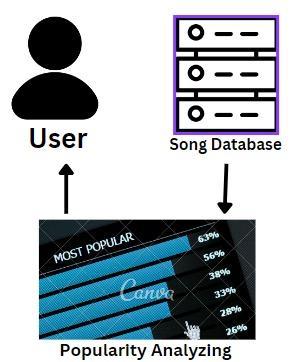
a. Filtering 1. Popularity Model
Itisastraightforwardapproachinmusicrecommendation systemsthatrecommendsongsorplaylistsbasedontheir popularityamongusers.Thismethodassumesthatusersare likelytoenjoysongsthatarepopularamongotherusers.To implementapopularitymodel,wefirstcollectdataonthe most popular songs or playlists among users. This can be done through various sources such as music streaming services or social media platforms. Then, we recommend these popular songs or playlists to users based on their listeninghistory.Whilethisapproachissimpleandeasyto implement, it may not provide personalized recommendations [12] and may not take into account the user'sindividualpreferences.
2. Content-Based Model
It is a type of music recommendation system that recommends songs or playlists to users based on the attributesofthesongsthemselves.Thismethodconsiders featuressuchasgenre,tempo,mood,andlyricstogenerate personalizedrecommendationsforeachuser.
To implement a content-based model, we first need to extractandanalyzethefeaturesofeachsonginthemusic library.Thiscanbedoneusingaudioanalysistools,natural languageprocessingtechniques,orothermethods.
Next,wecreateauserprofilebasedontheirlisteninghistory andpreferences.Thisprofilecanbebuiltbyanalyzingthe user'slisteninghistoryorthroughusersurveys.
Then,werecommendsongsorplayliststotheuserbasedon theirprofileandtheattributesofthesongsthemselves.For example,iftheuserhasapreferenceforupbeatsongswith
positive lyrics, the system may recommend songs that fit thesecriteria.
The advantage of a content-based model is that it can provide highly personalized recommendations to users. However,itmaynotrecommendsongsoutsideoftheuser's usual preferences and may not take into account the popularityofthesongsamongotherusers[13]
3.Collaborative Filtering Model
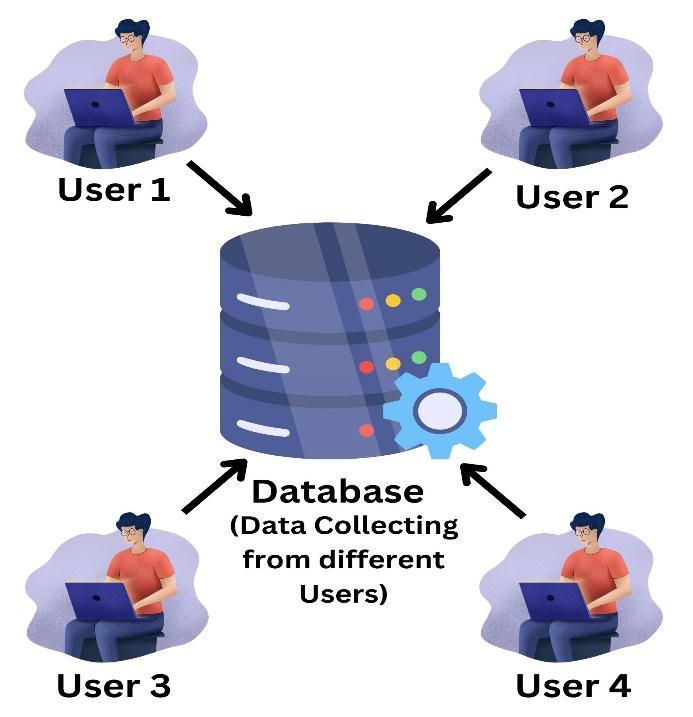
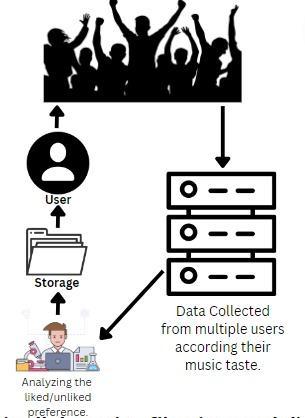
It is a music recommendation system that recommends songsorplayliststousersbasedonthelisteninghistoryand preferences of similar users. This approach assumes that userswithsimilarlisteninghabitsarelikelytoenjoysimilar songs.Itinvolvescollectingdataonuseractivity,identifying similar users through clustering algorithms[14], and recommending songs or playlists based on the listening history and preferences of similar users. Collaborative filteringcanprovidepersonalizedrecommendationstousers based on the preferences of similar users, but it may not recommend songs outside of the user's usual preferences and may not take into account the attributes of the songs themselves.
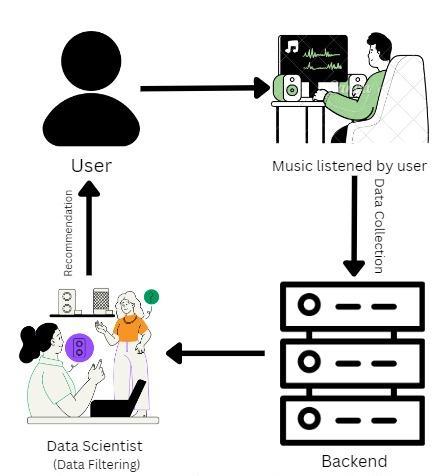
a. Functionality
Data Collection:Theinitialphaseistogatherinformation for training and testing the recommendation system. The informationmaybeobtainedviadifferentsources,including streamingplatforms,socialmedia,andusersurveys.
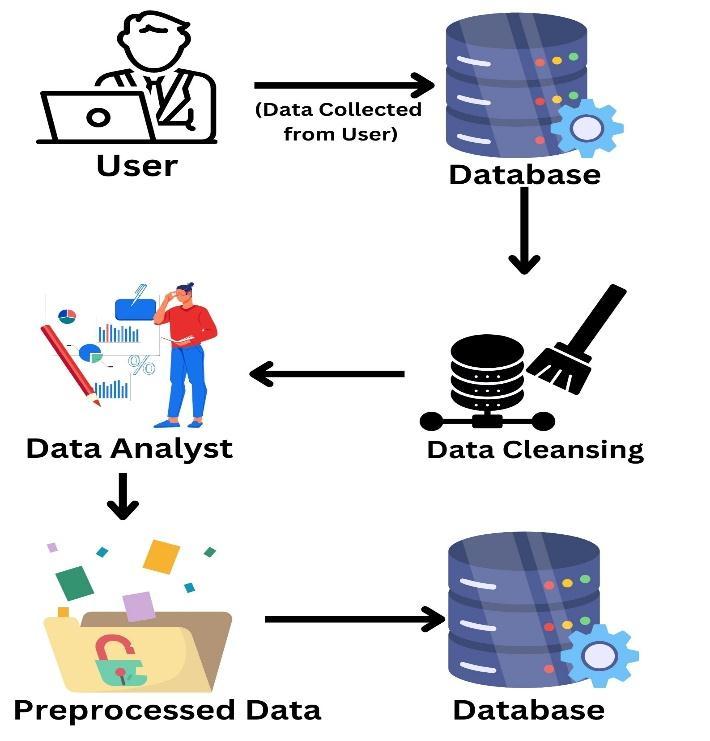
Data Preprocessing: The information needs to be preprocessed to disinfect, filter, as well as normalize the data.Thisstepinvolvesdeletingduplicates,resolvingvalues thataremissing,andtransformingtheinformationintoan arrangementappropriateforanalysis[15]
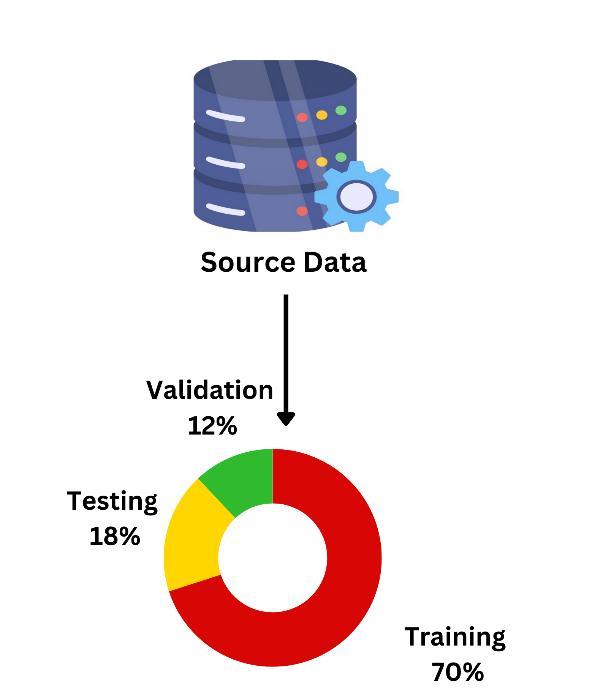
Data Splitting: The information is divided into sets for trainingandtestingsets,withaportionofthedatareserved fortestingtheperformanceoftherecommendationsystem. Thesplitcanbedonerandomlyorusingaspecificcriterion suchastimeoruserdemographics[16].
collaborativefiltering,andhybridtechniquesthatintegrate bothtechniques.
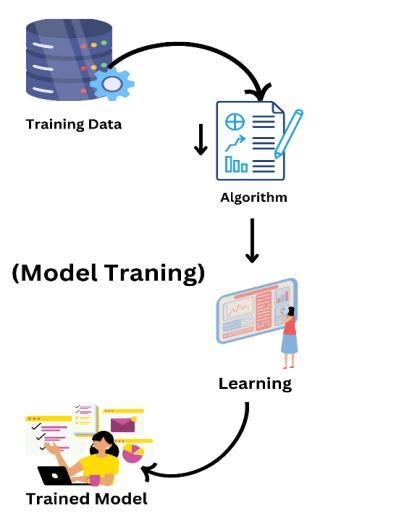
Model Training: The selectedalgorithm istrainedonthe training set to make customized music suggestions customizedforeveryclient’slisteninghistory,preferences, aswellascontextualfactors.
Splitting
Feature Extraction: Relevantfeaturesareextractedfrom the music tracks and user data. This step involves using methods like audio analysis, with processing of natural languages or sentiment analysis to obtain characteristics suchasgenre,tempo,mood,lyrics,anduserpreferences[17]
Algorithm Selection: Thealgorithmforgeneratingmusic recommendationsischosendependingontheinformation's propertiesandthetask’sclosetouch.Themostcommonly used algorithms include content-based filtering,
Model Evaluation: Theperformanceofmeasurementslike precision,recall,andrecallareusedtoassessthesystemof suggestions.thetypicalabsoluteaccuracyonthetestingset. Theevaluationcontributestodeterminingthepositiveand negativeaspectsofthesystemandoffersinformationinto areasinordertomakeimprovements[18].
Model Tuning: The model can be fine-tuned using techniques such as hyperparameter tuning, feature engineering, and data augmentation to improve its performance.
b. Implementation
DataCollection: CollectuserdatafromAsia'sleadingmusic streamingservice.
Data Preprocessing: Cleaning and preparing the informationtoguaranteeitsqualityaswellasconsistency.
Exploratory Data Analysis: Conduct exploratory data analysistounderstanduserbehaviorandpreferences.
FeatureEngineering: Usedataanalysistechniquestocreate relevantfeaturesfortherecommendationsystem.
Model Selection: Select appropriate machine learning algorithmsforbuildingtherecommendationsystem.
Model Training: It is the process of teaching a machine learningalgorithmtorecognizepatternsindata.
Model Evaluation: Itistheprocessofassessingamodel's performanceonnewdata.
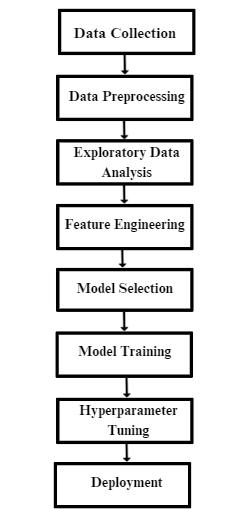
Hyperparameter Tuning: Optimize the model hyperparameterstoenhanceefficiency.
Deployment: Deploytheframeworkofsuggestionsinthe musicstreamingserviceplatform.
Monitoring and Maintenance: Monitor the recommendationsystem'sperformanceandmakenecessary adjustmentstomaintainitseffectiveness.
In [Figure 8], The flowchart represents the step-by-step processfordevelopingamusicrecommendationsystem.It outlines the key stages involved in building an effective recommendationsystemforamusicstreamingservice.The caption, "Music Recommendation System Development Process,"succinctlydescribesthemainpurposeandfocusof theflowchart.
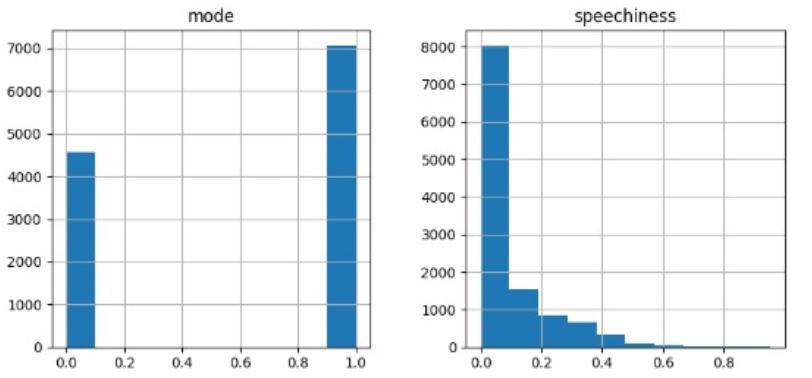
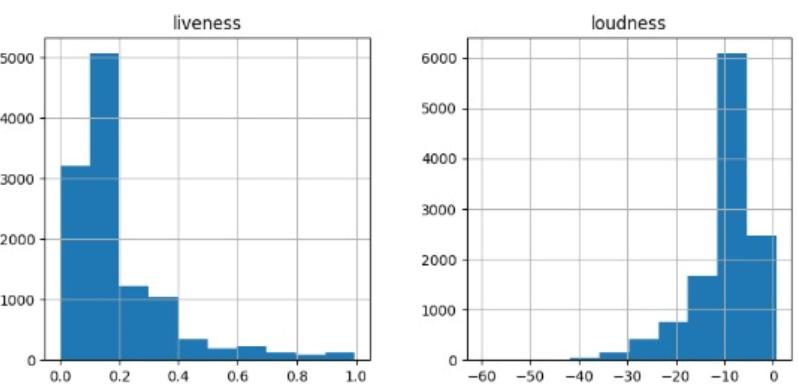
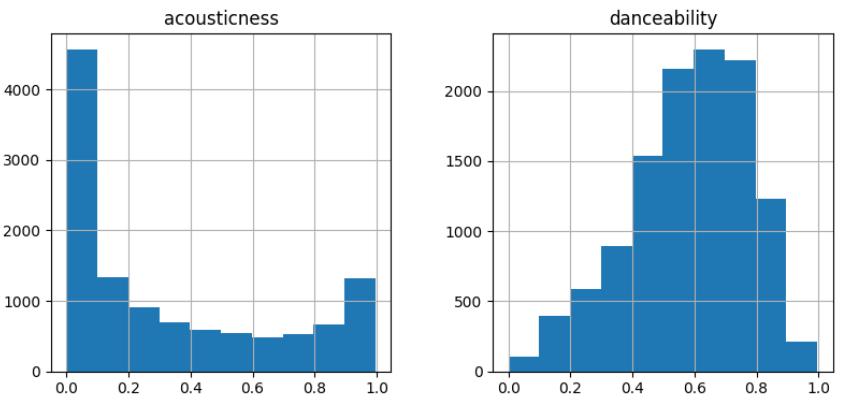
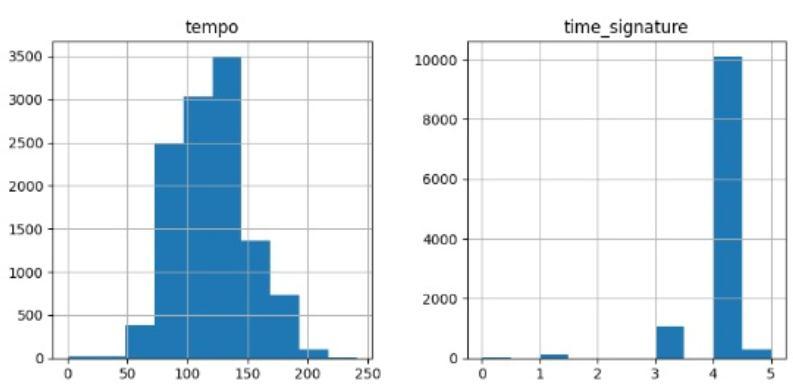
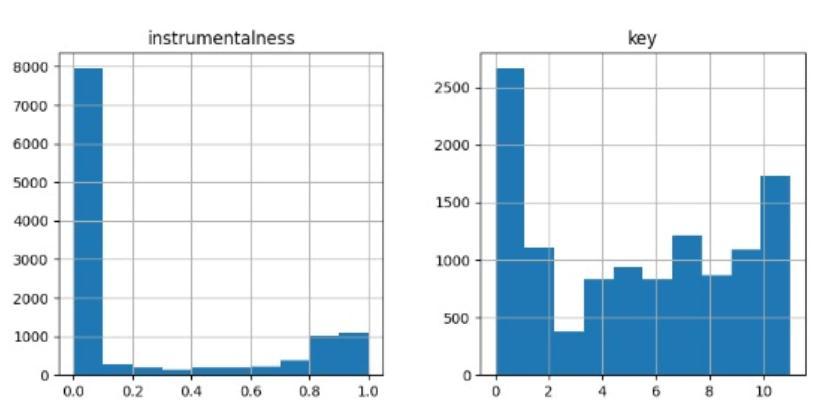
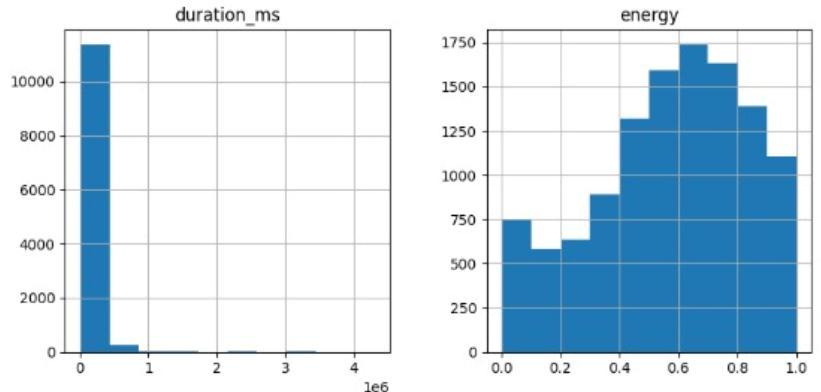
9:AnalyzingDataCharacteristics
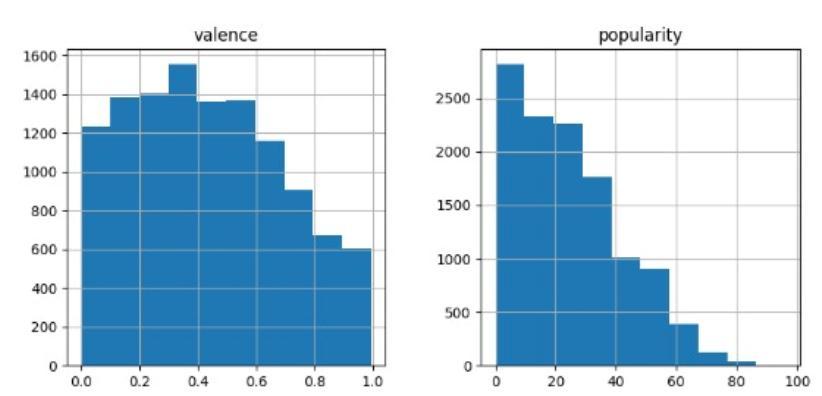
In [Figure 9], It provide valuable insights into the data's characteristics,includingitsdistribution,centraltendency, presenceofoutliers,anddatarangeandspread.Byanalyzing these aspects, you can make informed decisions, gain a deeperunderstandingofthedataset,andguidefurtherdata preprocessing,featureengineering,ormodelselection[19]
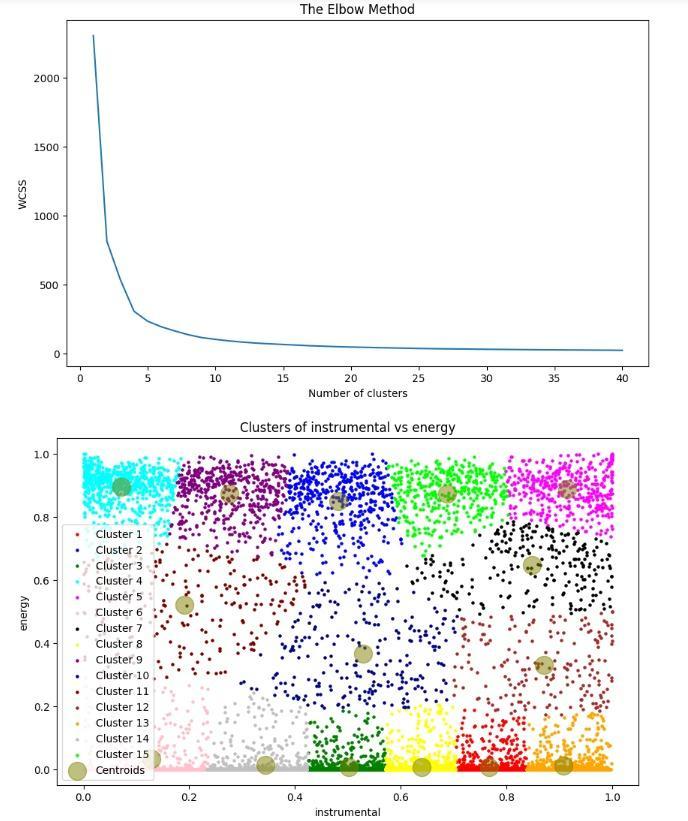
In [Figure 12], Based on a dataset of popular tracks on Spotify, this graph clusters songs into 15 (based on the elbowmethod)distinctgroupsbasedontheirinstrumental andenergywiththecentroidofeachclusterhighlighted[20].
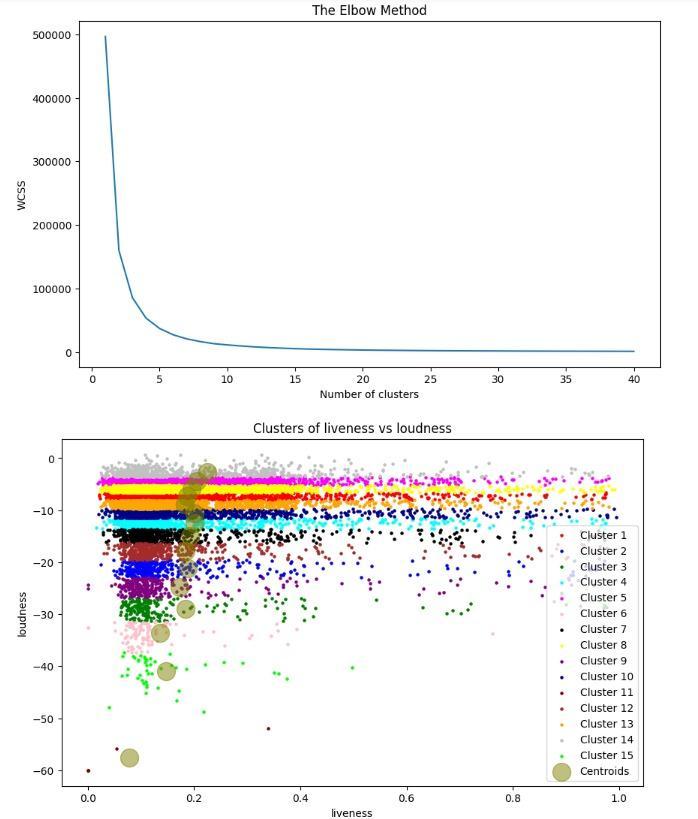
Figure11:ClustersofLivenessVSLoudness
In [Figure 11], Based on a dataset of popular tracks on Spotify, this graph clusters songs into 15 (based on the elbowmethod)distinctgroupsbasedontheirlivenessand loudnesswiththecentroidofeachclusterhighlighted.
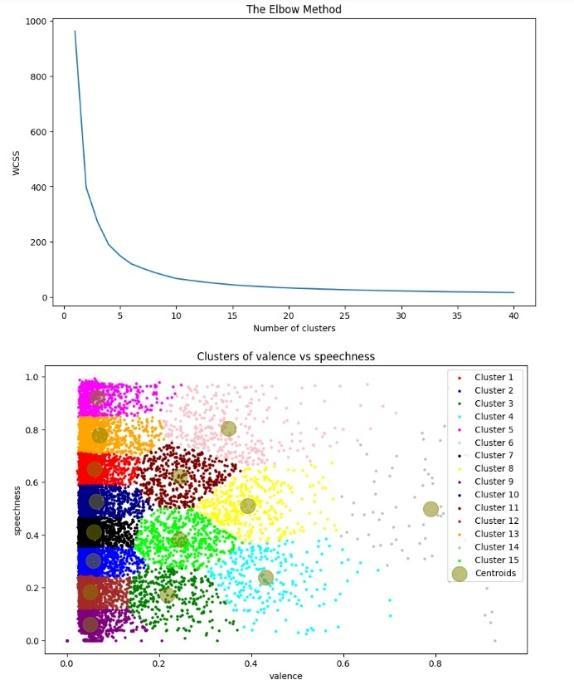
Figure10:ClustersofvalenceVSspeechness
In [Figure 10], Based on a dataset of popular tracks on Spotify, this graph clusters songs into 15 (based on the elbow method) distinct groups based on their valence andspeechnesswiththecentroidofeachclusterhighlighted.
In [Figure 12], Based on a dataset of popular tracks on Spotify, this graph clusters songs into 15 (based on the elbowmethod)distinctgroupsbasedontheirinstrumental andenergywiththecentroidofeachclusterhighlighted[20]
[3]M.Jiang,Z.Yang,andC.Zhao,“Whattoplaynext?ARNNbasedmusicrecommendationsystem,”in 201751stAsilomar Conference on Signals, Systems, and Computers,Oct.2017,pp. 356–358.doi:10.1109/ACSSC.2017.8335200.
[4]D.Bogdanov,M.Haro,F.Fuhrmann,A.Xambo,E.Gomez, and P. Herrera, “A content-based system for music recommendation and visualization of user preferences working on semantic notions,” in 2011 9th International Workshop on Content-BasedMultimediaIndexing(CBMI),Jun. 2011,pp.249–252.doi:10.1109/CBMI.2011.5972554.
[5] N. Karbhari, A. Deshmukh, and V. D. Shinde, “Recommendation system using content filtering: A case studyforcollegecampusplacement,”in 2017 International Conference on Energy, Communication, Data Analytics and Soft Computing (ICECDS), Aug. 2017, pp. 963–965. doi: 10.1109/ICECDS.2017.8389579.
[6] J. Gong et al., “Score Prediction Algorithm Combining Deep Learning and Matrix Factorization in Sensor Cloud Systems,” IEEE Access,vol.9,pp.47753–47766,2021,doi: 10.1109/ACCESS.2020.3035162.
[7] “T-RECSYS: A Novel Music Recommendation System Using Deep Learning.” https://ieeexplore.ieee.org/abstract/document/8662028/ (accessedMay09,2023).
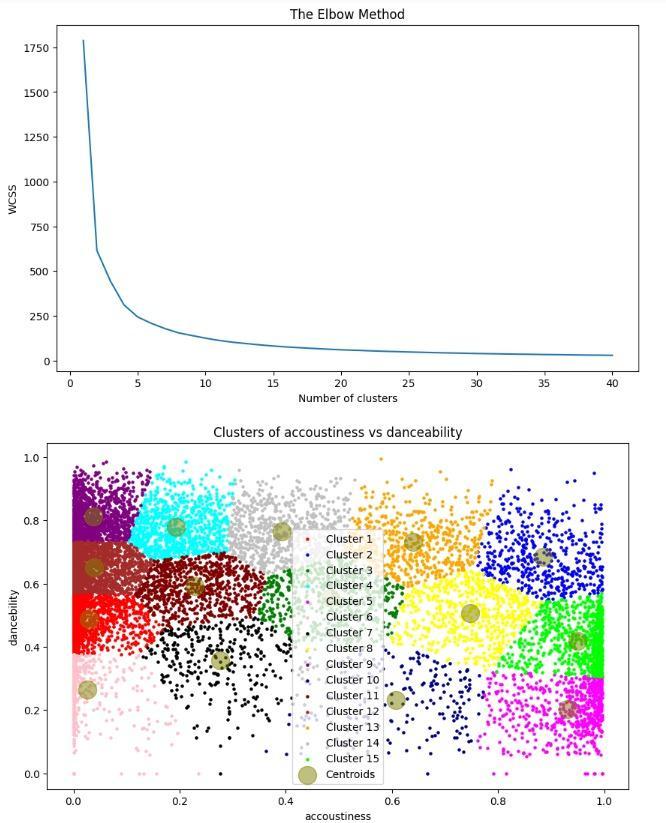
Figure13:DancebilityVSaccoustiness
In [Figure 13], Based on a dataset of popular tracks on Spotify,thisgraphclusterssongsinto15(basedontheelbow method) distinct groups based on their danceability andaccoustiness with the centroid of each clusterhighlighted.
6. CONCLUSIONS
Musicrecommendationsystemshavecomealongwayinthe lasttwodecades,withmanyMLalgorithmsandapproaches being proposed and implemented. Techniques that utilizecollaborativefiltering,content-based,andextensive learningapproacheshavingeverythinghasbeenshownto become efficient in making music recommendations. However, there is still room for improvement, and researchers are actively exploring new data sources and feedback mechanisms to create even more accurate and personalizedmusicrecommendationsystems.
REFERENCES
[1]H.Ying et al.,“Sequentialrecommendersystembasedon hierarchicalattentionnetwork,”in IJCAI International Joint Conference on Artificial Intelligence,2018.
[2]J.Li,K.Lu,Z.Huang,andH.T.Shen,“OnBothCold-Start and Long-Tail Recommendation with Social Data,” IEEE Trans. Knowl. Data Eng., vol. 33, no. 1, pp. 194–208, Jan. 2021,doi:10.1109/TKDE.2019.2924656.
[8] “MuseGAN: Multi-track Sequential Generative Adversarial Networks for Symbolic Music Generation and Accompaniment | Proceedings of the AAAI Conference on Artificial Intelligence.” https://ojs.aaai.org/index.php/AAAI/article/view/11312 (accessedMay09,2023).
[9]J.Zhang,D.Wang,andD.Yu,“TLSAN:Time-awarelongand short-term attention network for next-item recommendation,” Neurocomputing,vol.441,pp.179–191, Jun.2021,doi:10.1016/j.neucom.2021.02.015.
[10]Z.Liu,W.Xu,W.Zhang,andQ.Jiang,“Anemotion-based personalizedmusicrecommendationframeworkforemotion improvement,” Inf. Process. Manag.,vol.60,no.3,p.103256, May2023,doi:10.1016/j.ipm.2022.103256.
[11] J. Salter and N. Antonopoulos, “CinemaScreen recommenderagent:combiningcollaborativeandcontentbased filtering,” IEEE Intell. Syst., vol. 21, no. 1, pp. 35–41, Jan.2006,doi:10.1109/MIS.2006.4.
[12] D. Kowald, M. Schedl, and E. Lex, “The Unfairness of PopularityBiasinMusicRecommendation:AReproducibility Study,” in Advances in Information Retrieval, J. M. Jose, E. Yilmaz,J.Magalhães,P.Castells,N.Ferro,M.J.Silva,andF. Martins,Eds.,inLectureNotesinComputerScience.Cham: Springer International Publishing, 2020, pp. 35
42. doi: 10.1007/978-3-030-45442-5_5.
[13]A.vandenOord,S.Dieleman,andB.Schrauwen,“Deep content-based music recommendation,” in Advances in Neural Information Processing Systems, Curran Associates, Inc., 2013. Accessed: May 15, 2023. [Online]. Available: https://proceedings.neurips.cc/paper/2013/hash/b3ba8f1b ee1238a2f37603d90b58898d-Abstract.html
[14] “Unsupervised K-Means Clustering Algorithm | IEEE Journals & Magazine | IEEE Xplore.” https://ieeexplore.ieee.org/abstract/document/9072123 (accessedMay15,2023).
[15]D.Hendrycks,N.Mu,E.D.Cubuk,B.Zoph,J.Gilmer,and B. Lakshminarayanan, “AugMix: A Simple Data Processing MethodtoImproveRobustnessandUncertainty.”arXiv,Feb. 17,2020.doi:10.48550/arXiv.1912.02781.
[16] “Full article: SPlit: An Optimal Method for Data Splitting.” https://www.tandfonline.com/doi/full/10.1080/00401706. 2021.1921037(accessedMay15,2023).
[17] V. Chaturvedi, A. B. Kaur, V. Varshney, A. Garg, G. S. Chhabra,andM.Kumar,“Musicmoodandhumanemotion recognition based on physiological signals: a systematic review,” Multimed. Syst.,vol.28,no.1,pp.21–44,Feb.2022, doi:10.1007/s00530-021-00786-6.
[18]“Evolutionofglobalmusictrends:Anexploratoryand predictiveapproachbasedonSpotifydata-ScienceDirect.” https://www.sciencedirect.com/science/article/abs/pii/S1 875952122000593(accessedMay15,2023).
[19] W. Zhou, S. Gao, L. Zhang, and X. Lou, “Histogram of Oriented Gradients Feature Extraction From Raw Bayer PatternImages,” IEEE Trans. Circuits Syst. II Express Briefs, vol. 67, no. 5, pp. 946–950, May 2020, doi: 10.1109/TCSII.2020.2980557.
[20] A. S. Górski, “Implementation and deployment of a music recommender system,” Instytut Informatyki, 2023. Accessed: May 15, 2023. [Online]. Available: https://repo.pw.edu.pl/info/bachelor/WUT83649850622e4 5e993e7c7bb833282d9/