Quantifying E-waste Generation and Management: An Empirical Analysis
 Beulah Aswini
Pramod Kumar Jha
Beulah Aswini
Pramod Kumar Jha
1JRF, CAS DRDO, Hyderabad, Telangana, India

2JRF, CAS DRDO, Hyderabad, Telangana, India
3Technical Officer-C, CAS DRDO, Hyderabad, Telangana, India
4Scientist F, CAS DRDO, Hyderabad, Telangana, India ***
Abstract - One of the fastest-growing waste streams in the nation is electronic waste (E-waste). Because of the expansion of the information and communication technology (ICT) industry, there has been a significant increase in the use of electronic devices. Due to its quick obsolescence and subsequent improvements, consumers are being obliged to throw away old devices, which contribute a sizable volume of e-waste on the earth. E-waste is growing in India at a 10% annual rate. Inefficient and dangerous methods are generally used inthe market to recycle e-waste. Appropriate legislative actions and technological solutions that are reasonably priced, ecologically benign, and economically viable are neededto address the issue.
This study offers an empirical examination of the methods used to control e-waste. To evaluate the contemporary ewaste management infrastructure, surveys were used to get the primary data, and academic journals, government papers, and other pertinent sources were used to gather the secondary data. The investigation demonstrates that the current methods for managing e-waste are insufficient, with the majority of it being dumped in landfills, burned, or illegally transferred to underdeveloped nations. The issues experienced in India are also discussed, along with the management system and recycling procedures for handling E-waste.
This paper emphasizes the necessity for immediate action and the negative effects of insufficient e-waste management on the environment, human health, and socio-economic factors. To improve e-waste management methods, the report suggests business sector involvement, regulatory measures, and awareness campaigns. By offering a thorough examination of e-waste creation and management techniques inIndia, this study adds to the body of knowledge onthe management ofelectronic trash.
Keywords: E-waste, Empirical analysis, Take back, Refurbish, Recycling, Landfills.
1. INTRODUCTION
E-waste is a complex and hazardous waste stream, containinga rangeoftoxic andvaluablematerialssuchas
lead, mercury, cadmium, gold, and copper, which pose significant environmental and health risks if not properly managed. The management of e-waste is a pressing environmental challenge that requires urgent attention from all stakeholders, including governments, industry, civil society, and individuals. This study aims to provide insights into the challenges and opportunities associated with e-waste management and the need for a comprehensiveapproachthatinvolvesallstakeholders.
Thefindingsofthestudycontributetotheliteratureonewaste management by providing a detailed analysis of ewastemanagementpracticesinourcountry.Itemphasizes the urgent need for collective action to address the growing e-waste crisis and the need for a comprehensive andintegratedapproachtoe-wastemanagement.
1.1 Scenario of e-waste in India
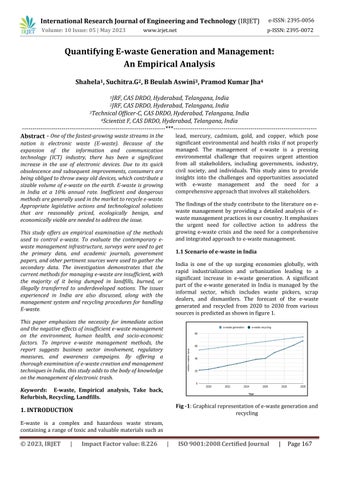
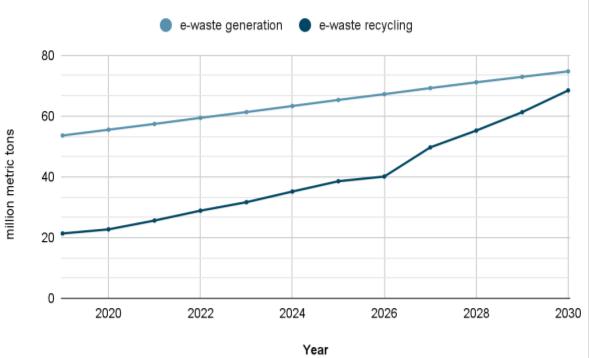
India is one of the up surging economies globally, with rapid industrialization and urbanization leading to a significant increase in e-waste generation. A significant part of the e-waste generated in India is managed by the informal sector, which includes waste pickers, scrap dealers, and dismantlers. The forecast of the e-waste generated and recycled from 2020 to 2030 from various sourcesispredictedasshowninfigure1.
There is an urgency for e-waste management because, when imprecise, unscientific methods are used to recover usefulcomponents,e-wastecomponentsmayposeserious health concerns and environmental harm. To protect natural resources, it is important to promote recycling of all precious and useful materials from e-waste. The majority of developing nations are struggling with the rapidlyexpandinge-wasteissues,andtheyneedreliableewaste management solutions for end-of-life ICT goods to preventthreatstotheenvironmentandpeople.
ITU (International Telecommunication Union) has acknowledged that many developing nations' WEEE (Waste Electrical and Electronic Equipment) policies are insufficient since they leave out important subjects and importantstakeholders,suchastheinformalsector.
1.2 Challenges associated with the e-waste management
(i) Lack of Awareness: Many people dispose of their electronic waste with regular trash because they are unaware of the harmful effects it has on the environment andhumanhealth.
(ii) Informal Sector: Informal workers use hazardous methods,suchasopenburningoracidstripping,toextract valuable metals from e-waste, which exposes them to healthrisks.
(iii) Lack of Infrastructure: There is a lack of proper infrastructure,includingcollectioncenters,transportation facilities, and recycling units, for e-waste management. This results in a significant amount of e-waste ending up inlandfillsorbeingdumpedinunauthorizedareas.
(iv) Inadequate Regulation: The existing laws and regulations related to e-waste management in India are insufficient and poorly enforced. This has led to illegal imports of e-waste and inadequate monitoring of e-waste recyclingunits.
(v)Limited Resources: The limited resources and funding available for e-waste management pose a significant challenge in India. The cost of setting up and maintaining e-waste management infrastructure is high, and the revenue generated from e-waste recycling is relatively low.
Addressing these challenges requires a multi-stakeholder approach, including government, industry, civil society, and the public, to create awareness, promote responsible e-waste management practices,anddevelopa sustainable e-wastemanagementsysteminIndia.
1.3 Tactics involved in e-waste management
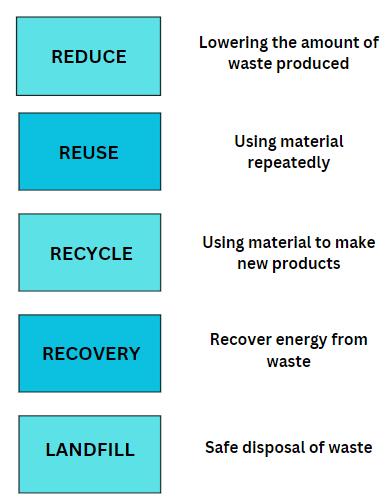
Here are some steps that can be taken for e-waste regulationasshowninfigure2.
Fig -2:E-wastemanagementhierarchy
a. Reducing e-waste generation: Onewaytoreducee-waste is by implementing a circular economy approach in the industry sector.Thisinvolvesdesigning productsthatcan beeasilyrepaired,upgraded,andrecycled.
b. Implementing a take-back program: Many industries have established take-back programs, where they collect old devices from consumers and recycle them. This helps to ensure that e-waste is handled responsibly and preventsitfromendingupinlandfills.
c. Disposing of e-waste responsibly: It is important to disposeofe-wasteinanenvironmentallyresponsibleway. Thisinvolvesensuringthat itiscollectedandtransported safely, and is recycled or disposed of in a way that minimizesharmtotheenvironment.
d. Educating consumers: Consumers need to be educated abouttheimportanceofresponsiblee-wastemanagement. This can be done through public awareness campaigns, productlabeling,andinformationoncompanywebsites.
e. Working with suppliers: Industries should work with their suppliers to ensure that they are also implementing responsible e-waste management practices. This can include requiring suppliers to use environmentally friendly materials in their products and to implement take-backprograms.
Overall, e-waste management is a complex issue that requires collaboration between different industries, consumers, and government regulators by working with certified e-waste recyclers. By implementing responsible e-wastemanagementpractices,wecanhelptoprotectthe environment and human health thus, promoting a more sustainablefuture.
2. SOURCES OF E-WASTE
Manufacturer sources for e-waste: According to surveys, roughly 50% of PCs sold across the nation come mostly from the second-hand market and are rebuilt using used parts. MNCs (30%) and Indian brands (20%) account for the remaining market share. Manufacturers are not the onlyoneswhoproducealotofe-waste.Thewasteismade up of damaged motherboards, CRTs, IC chips, and other production-related accessories. It also covers faulty computers covered by a guarantee that were bought as replacementsfromcustomers.
Consumer: Indian households are responsible for producing about 22% of garbage computers. Exchanging fromshopsorgivingtheoutdatedcomputerstofriendsor family are common methods of getting rid of them. In India, 78% of all installed PCs are in the business sector. The surplus computers from the commercial sector are frequently sold at auction or occasionally given to charitable organizations or educational institutions for reuse.
E-waste import: Although it is illegal to import e-waste, studies indicate that a significant amount of e-waste is being brought in from abroad. Since the ministry of the environmentlacksinformationontheimportofe-waste,it isimpossibletocompletelycontrolborders.
2.1 Risk Assessment
Riskassessmentisamethodicaltechniqueusedtoidentify potential risks associated with waste management. Communication skills regarding environmental risk are crucial for effective collaborations between the public, businesses, stakeholders, and state authorities. All stakeholders must be informed of the risk assessment policy in order to promote public participation in environmental decision-making. They must strive to ensure that trash is thrown away consistently, safely, and without damaging the environment or the health of the general public. A productive collaboration is a continual processthatneedstobeevaluatedonaregularbasis.
a) Identifying hazards is the process of locating and definingthepotentialthreats.
b) Exposureassessmentistheprocessofdeterminingthe exposurepathsandchannelsfromasourcetoaperson.
c) The outcomes of risk variables include exposure analysesandchemicaltoxicityinformation.
2.2 Recycling of E-waste
Recycling e-waste from various sources is an important step towards responsible e-waste management. Here are somewaysthate-wastefromindustriescanberecycled:
a. Collection: Thefirststepinrecyclinge-wasteistocollect it from industries. This can be done through take-back programs,collection events, orthrough partnershipswith e-wasterecyclingcompanies.
b. Sorting: After collection, it is sorted into different categories based on the type of material, such as metal, plastic,glass,andcircuitboards.
c. Dismantling: Oncesorted,itisdismantledintoindividual parts,suchasbatteries,chips,andwires.
d. Shredding: Thedismantledpartsarethenshreddedinto smallpieces.
e. Separation: The shredded material is separated into different categories using various techniques such as magneticoreddycurrentseparation.
f. Refining: The separated material is then refined and processed to recover valuable metals such as gold, silver, copper,andaluminum.
g. Disposal: Any material that cannot be recycled is disposed of safely, following local regulations and guidelines.
2.3 Elements of e-waste
The different components of an e-waste management systeminclude:
● LifeCycle Assessment(LCA)
● MaterialFlowAnalysis(MFA)
● Multi-CriteriaAnalysis(MCA)and
● ExtendedProducerResponsibility(EPR)
LCA is a tool used to reduce the issues caused by e-waste anddesignenvironmentallyfriendlyelectronicequipment. InIndia,itisusedto make decisionsabouthowtohandle garbagerelatedtocomputers.
MFA is used to analyze the flow of gold and copper from the recycling of personal computers in India as well as to regulatetheflowofe-wasteintheenvironment.
MCA is a tool for locating potential locations for e-waste recyclingfacilities.
EPR is a policy that ensures that electronic components are still accountable to their producers after they reach theendoftheirusefullives.[1]
3. MANAGEMENT OF E-WASTE
3.1 Existing management processes
The Government of India has adopted a number of initiativestomanagee-waste,including:
● E-Parisaraa is the first technologically advanced recycling facility built to reduce e-waste pollution and recovermetals.
● Trishyiraya Recycling recycles e-waste and has receivedcertificationfromtheIndiangovernment.
● Plug-intoE-cyclingistheprocessofrecyclingand recovery. This aids in lowering atmospheric greenhouse gasemissions.
● Installations of e-bins in Bangalore CityAccordingtoJhariyaetal.(2014),e-binsareputinplaceto educatecityresidentsaboute-waste.[2]
3.2 Initiatives of Department of Information Technology (DIT)
In order to meet the pressing demand for reasonably priced environmentally friendly technology, the Department of Information technology (DIT) is actively involved in encouraging Research & Development (R&D). Their goal is to create recycling technologies for all sorts ofe-wastethatwillresultinfewerlandfillsandabsolutely no emissions into the air, land, or water. To make recycling a financially viable enterprise, precious resourcesmustberecoveredandplasticsmustbereused. Numerous R&D initiatives have been started in Indian nationalinstitutions.Suchinitiativesinclude:
a. Harnessing rare metals from printed circuit boards (PCBs):
The authorized recycler, E-Parisaraa Pvt. Ltd., of Bangalore, is actively taking part in it at C-MET, (Centre for Materials for Electronics Technology), in Hyderabad. The project's objective is to create methods for depopulating, separating, and treating components that
are ecologically friendly as well as a way for recovering metalsfromdepopulatedPCBs.
b. Development of technological solutions for electronic waste recyclingand reuse:
Inthisproject,indigenoustechnologyhasbeendeveloped at the National Metallurgical Laboratory in Jamshedpur, whichhasa 90% recovery rateformetalsin e-waste. The procedure doesn't produce any hazardous effluents or toxic gases.Asa result,it wouldlessenthe environmental risks associated with e-waste recycling facilities. This processhassuccessfullyrecycledwasteuptoapilotscale ofaroundoneMetricTonnes(MT)ofe-waste.
c. Novel recovery and conversion of plastics from WEEE (Waste Electrical and Electronic Equipment) to modernized products:
It is put into practice at the Central Institute of Plastics Engineering & Technology (CIPET), Bhubaneswar. The seven groups of plastics that make up plastic e-waste are polycarbonate (PC), polypropylene (PP), polyvinyl chloride (PVC), nylons, epoxy, phenolic, and polyesters. The project intends to reduce the amount of plastic trash thataccumulatesinsociety bycreatingvalue-addeditems fromthesewasteplastics.
d. The creation of lead-free X-ray absorption coatings for CRT TVs (cathode ray tubes):
ItwasimplementedatC-MET,Pune, India,inMarch2011 where the ecologically benign phospho-silicate glass composite/phosphate composite is used as an X-ray absorption coating in place of the harmful lead found in CRTglassshell.
3.3 How to start an E-waste program?
Starting an e-waste management program in an organization can have a positive impact on the environment, reduce potential health risks, and promote sustainability.Hereisthemanoeuvretogetstarted:
Conducting a Waste Audit: A waste audit is conducted to assess the type and quantity of e-waste generated by an organization. This helps to identify areas that require improvement and create a baseline for future waste reductionefforts.
Creating an E-waste Policy: A policy outlining the proper disposalandmanagementofelectronicwasteismade.The policy should include guidelines for employees on how to handle e-waste, instructions on how to dispose of it responsiblyandhowtheorganizationhandlese-waste.
Identifying a Recycling Partner: A reputable e-waste recycling partner to handle the collection and disposal of e-waste is identified. We have to make sure the recycling partner is certified and follows all the necessary regulations and guidelines for responsible e-waste management.
Educating Employees: Employees are trained on the importance of e-waste management and the proper disposal methods. Regular training sessions, providing resources such as posters, emails, or newsletters are conducted to promote responsible e-waste management practices.
Implementing a Collection Program: An e-waste collection program within the organization is implemented. Set up collection bins in designated areas are arranged so that employees can easily dispose of their e-waste. Guidelines andinstructionsonwhattypesofelectronicsareaccepted andhowtopreparetheitemsfordisposalareprovided.
TrackingProgress: Wehavetokeeptrackoftheamountof e-waste collected and the progress made in reducing ewaste. Using this data, we measure the success of the programandidentifyareasforimprovement.
Considering Refurbishment: Refurbishing can help extend the life of the devices and reduce the amount of e-waste generatedbytheorganization.
Take backprograms: These are designed to encourage the proper disposal of e-waste by allowing consumers to return their old or unwanted electronics to the manufacturer or retailer for recycling or proper disposal. Startups like Cashify recycle the products from multibrands.
3.4 Processing techniques of E-waste
Theinitialstepintheprocessingofelectronicwasteisthe manual dismantling of the items into their component pieces(metalframes,circuitboards) whichisfollowed by automatic shredding machinery. The recycling machinery has a system in place to collect dust and is completely enclosed.Screensandscrubbersareusedtocapturesome pollutants, such as glass. Eddy currents are used to remove ferrous metals from plastic, and CRT glass is recycledintoleadwheelweights,ammunition.
Afewofthevaluablemetalssoldto smeltersforrecycling are palladium,gold,silver, andcopper. To reduce the risk to the environment, harmful smoke and gases are capturedandtreated.
Themethodslistedbelowcanbeusedtosecurelyrecover alloftheessentialelements.
S. N o
E-Waste Component Process Used Potential Environment al Hazard
1 Plastic Waste (plastic products like casing, cover)
2 PCB (metalslike gold,copper etc)
Shredding andmelting Air emission ofbrominated dioxins,heavy metals and hydrocarbons
Desoldering , acidbath open burning
Proposed Solution
Usage of biodegradab leplastic
3 Miscellaneo usWaste (Broken glasswaste)
4 Liquid Waste (Chemicals, acid stripping waste)
Chemical strippingby nitric acid, hydrochlori cacid
Air emission of heavy metals like tin, lead, cadmium, mercury inhalation.
Tin and lead contamination tosurfaceand groundwater
Sewerage system Acidification of surrounding areas
Usage of siliconchips instead of PCB
Urban mining Preventitin the first place
Physical separation
Table -1: Impactontheenvironmentduringthe processingofvariousE-waste&ourproposedsolution.
3.5 Establishing management strategies for a circular economy (CE)
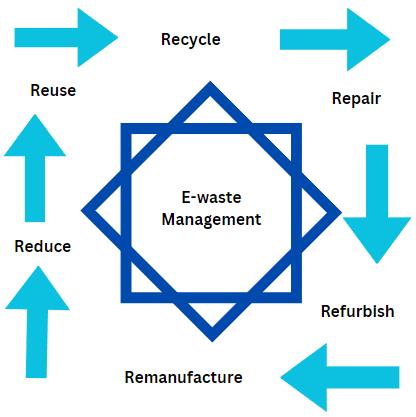
In the long run, CE is a theory that reduces the consumption of electricity and electronic devices (EEE). This includes the 7′R systems, which emphasize social, economic, and environmental factors: reduce, reuse, renew, repair, recycle, retrieve and redesign. The processes are slowed down by a number of factors, including inadequate collection mechanisms, subpar technology, a lack of training for the unorganized sector, andalackoffunding.Figure3showshowthisCEconcept plans methods, policies, and models for waste removal through recycling and product optimization. This CE concept works towards sustainable, renewable, and cleaner technologies. It is necessary for different sectors (governments, corporations, and consumers) to work together for the control of e-waste. As a result, it encourages locating improved chances for developmental interventionsto enhancee-wastemanagementandcreate asatisfyingprofessionaleconomy.
4. ADVANTAGES OF E-WASTE RECYCLING
(i)Reusingthebasicmaterialsfromthepastgenerationof electronicsistheprimarypracticalanswertothegrowing e-waste problem.Thispreventsthedisposal ofdangerous e-wastefromcausingairorwaterpollution.
(ii) Recycling lowers energy use, which in turn lowers greenhouse gas emissions. The demand for virgin materials is decreased when recycled materials are used tocreatenewitems.
(iii)Reinstallingthewasteplasticfromtheprinters,which is produced as a byproduct, allows for the production of new3Dprinteditems.
(iv)Becauseofthecurrentsurgeininterestin3Dprinting technology, few 3D printers are designed to produce wastethatcanbeeasilyrecycledandlowertheamountof dangerouspollutantsintheatmosphere.
5. FUTURE OUTLOOK
Innovative ways of E-waste management
Wecanmaximizeanobject'sutilityandcontrolourdigital garbage with the help of cutting-edge waste management solutions. Reusing, recycling, or reducing waste are three optionsfor doingthis. All of thisis relevant on a personal level. On the other hand, managing garbage at an industrial scale requires sophisticated technology and long-term planning. There are many creative options available,including:
Robotic E- waste Monitoring Systems
Wastemanagementcompaniescanmonitortheamountof rubbish gathered in containers with the use of IoT
(InternetofThings)e-wastemonitoringsystems.Theyuse this information to create e-waste disposal routes, ensuring that e-waste collecting vehicles take an economical and timesaving path. As a result, electronic trash disposal will be moved to a special online space, improvingconvenienceandeffectiveness.
Buy-Back & Exchange Programs
Garbage is building up because processing e-waste is cumbersome.However,itisessentialthatelectronicwaste be recycled through innovative e-waste management techniques as our mineral wealth declines. Buy-back programmes pay in cash when consumers deposit outdated digital products. Any type of portable electronic device,suchasaphone,computer,tablet,etc.,mightcome underthiscategory.
E-waste Management to Achieve Climate Sustainability Goals
It is challenging to recover metals from e-waste; for instance, the global cobalt recovery rate is only 30%. However, batteries for laptops, smartphones, and electric vehicles are in significant demand for this metal. Less energyisrequiredtomeltdownmetalsfromrecycledore than from fresh ore. Additionally, extracting gold from outdated technology produces 80% less carbon dioxide per unit of gold than mining it from the earth. As a consequence, increasing the amount of scrap materials used to make electronicproductscouldconsiderablyhelp usachieveoursustainabilitygoalsfortheenvironment.
6. CONCLUSION
E-waste is increasing at a rapid rate in India due to many reasonslikeexpansionoftheelectronicssectorand globalizationthat hasincreased the import ofelectronic items in the country. The e-waste is detrimental for the ecosystem. The toxic substances present in e-waste can cause serious damage to human health and other living organisms in the ecosystem. Even though management systems and strategies exist to handle the task of safe disposal of the e-waste, still there are various challenges faced by the system for their successful implementation. There are various recycling processes that have been discussed in this paper, which are not only helpful in removingtoxicsubstancesfromthewastebutalso helpful in recovering valuable metals which might ultimately create substantivebusinessopportunitiesinadeveloping nationlikeIndia. Also,bytheyear2030e-wasterecycling canmatchthe generated e-wasteand will helpto become wasteneutralwhichwillbeaverywelcomestep.
REFERENCES
[1] White paper on electronic waste management approaches.https://www.nqr.gov.in/sites/default/files/Fi le%202_waste%20mgt.pdf
[2] https://timesofindia.indiatimes.com/city/bengaluru/ bengaluru-gets-first-e-waste-bin-onroadside/articleshow/61706915.cms
[3] Reference paper on e-waste in India.]https://www.meity.gov.in/writereaddata/files/EW aste_Sep11_892011.pdf
[4] https://pubs.acs.org/doi/10.1021/es303166s.
[5] https://www.yourarticlelibrary.com/wastemanagement/e-waste-sources-constituent-materials-andproblem-created-by-e-waste-notes/123
[6] https://www.wipo.int/wipo_magazine/en/2014/03/ article_0001.html
[7] https://www.psa.gov.in/challenge-event/initiativese-waste-management/3738.
[8] https://www.inderscienceonline.com/doi/abs/10.15 04/IJPQM.2019.101934.
BIOGRAPHIES
[1] Smt Shahela is presently working as a JRF at DRDO, CAS, Hyderabad. She has 1.5 years of work experience in the field of IT & Cybersecurity. She has published four papers in the field of cybersecurity. She is certified as CISSP-CertifiedInformation SystemsSecurityProfessional andISO27001leadauditor.
[2] Smt G.Suchitra is presently working at DRDO, CAS, HyderabadasaJRF.Shehas2yearsofworkexperiencein the field of computer science. She is certified as CISSPCertifiedInformationSystemsSecurityProfessional.
[3] Smt B.Beulah Aswini is presently working as a Technical Officer-C in DRDO, CAS, Hyderabad. She has 22 years of experience in the field of embedded systems and published three research papers in Cybersecurity. She is certifiedasaninternalauditoronISO27001.
[4] Sri Pramod Kumar Jha, Scientist-F is presently working as a Technology Director, ITCS&AI at CAS DRDO Hyderabad. He has done his M Tech in Manufacturing Management from BITS Pilani. He has also obtained a couple of PG Diplomas and certifications in the areas of Operations and Project Management, Public Procurement etc. He has more than 22 years of research and techno-
managerial experience in the areas of Information Technology management and cyber security. He has published more than 20 research papers, articles in variousjournalsandconferences.