Floating solar plant with recycled plastic waste pontoons & overview
 Prof . Sarika .P. Thombare1, Utkarsh Balu Patil2, Aniket Sudhir Sonawane3, Manish Sanjay
More4, Mayur Vijay Kondhalkar5
Prof . Sarika .P. Thombare1, Utkarsh Balu Patil2, Aniket Sudhir Sonawane3, Manish Sanjay
More4, Mayur Vijay Kondhalkar5
1Guidance : Prof . Sarika.P.Thombare (M.E Construction Management)
(M.E Construction Management) Ajeenkya DY. Patil Collage Of Engineering Lohegaon, Pune, India
2,3,4,5 Civil Engineering Department DY. Patil, School of Engineering, Lohegaon Pune, Maharashtra, India ***
Abstract - Innovative methods are required to maximize energy production while resolvingenvironmental issues dueto the increasing rise of renewable energy. This research report provides a thorough analysis of the development of a floating solar plant using pontoons made from recycled plastic waste. The goal is to investigate whether usingrecycledplastic debris as a sustainable replacement for the flotationbases in floating solar arrays is feasible and could have positive effects. An overview of the current situation of the solar energy industry is presented at the outset of the study, emphasizing the growing importance of land optimization and sustainable practices. The consequences of plastic trash accumulation on the environment and the pressing need for efficient waste management techniques are then covered in depth. The research also explores the effects of using recycled plastic waste pontoons on the general effectiveness and efficiency of the floating solar plant. The potential for energy generation, cost efficiency, andenvironmentalsustainabilityareexamined, taking into account elements like solar panel orientation, system stability, and maintenance needs. The results demonstrate the enormous benefits of using pontoons made from recycled plastic trash in floating solar farms. Reduced environmental effect, optimal land use, andpotentialfinancial savings are a few of them.
Key Words: Pontoon,PhotovoltaicCells,Sustainability,Land optimization,Albedoeffect,HDPE
1.INTRODUCTION
Innovative strategies for utilising renewable energy have beendrivenbytherisingglobaldemandforsustainableand cleanenergysources.Particularlyinregionswithashortage ofavailableland or wheretheuseof waterbodies offersa chancetogeneraterenewableenergy,floatingsolarplants have come to be recognised as a feasible alternative. An overviewofafloatingsolarplantconceptthatusespontoons built from recycled plastic waste is given in this research studyfromthestandpointofcivilengineering.
Researchers and engineers have been forced to look into alternativeenergyoptionsduetothedepletionoftraditional sources of energy & the pressing need to minimise greenhousegasemissions.Inrecentyears,interestinsolar energy has grown significantly because it is a clean and plentiful source. However, the adoption of conventional

land-basedsolararraysishamperedbylandshortagesand environmentalissuesrelatedtotheaccumulationofplastic trash. In order to overcome these difficulties, the article suggests a concept for a floating solar plant that uses pontoons built of recovered plastic trash. From a civil engineering standpoint, the suggested design has many benefits.Byusingrecycledplasticforthepontoons,itfirst addresses the urgent problem of plastic waste pollution. Second,byutilisingunderutilisedwaterbodies,itoptimises landuse,makingita desirablesolutioninurbanorhighly populated areas. Additionally, the incorporation of recovered plastic waste pontoons offers chances for environmentallyresponsiblebuildingmethods.Thisstudy paper's main goal is to give a thorough description of the design of floating solar panels using pontoons made from recycledplasticwaste.Thisentailslookingatthestructural elements,viability,andpotentialadvantagesanddifficulties connectedwiththisnoveltechnique.
2. METHODS AND MATERIAL:
2.1 MATERIALS REQUIRED:
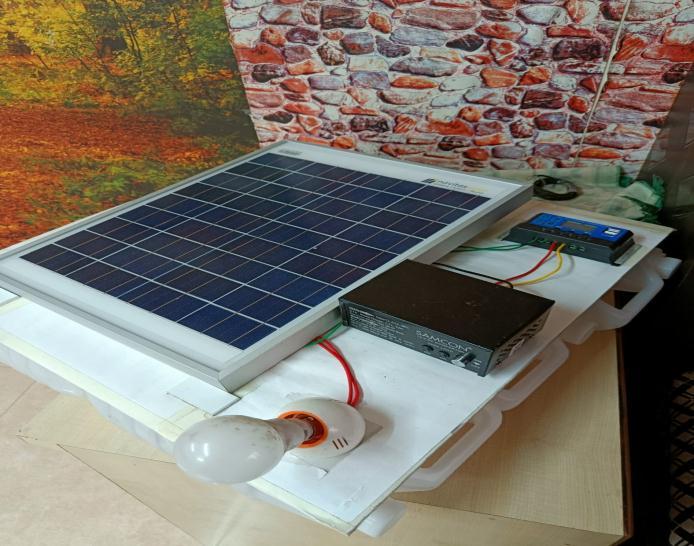
Several resources are required to build a prototype for a floatingsolarpowerplantmadeoutofpontoonsmadefrom recovered plastic trash. The stability, buoyancy, and durability provided by the floating platform have all been guaranteedbythecarefulselectionofthesecomponents.
Plastic Cans:
Size:5-litercansMaterial:High-densitypolyethylene(HDPE) oranothersuitableplasticmaterial
Dimensions:Heightisaround30-35cm,15cmWidth
Solar Panels:
Type:Photovoltaic(PV)panels
Wattage: Depending on the project's size and power requirements,choosepanels.(20Wforprototype”)
Dimensions:Dependentonthesizeandwattageofthepanel
Anchoring System:
Ropesforsecuringthesolarplantonthewater.
Electrical Components:
Solar charge controller- Select a controller based on the voltageandcurrentcapabilitiesofthesystem.
Inverter-convertssolarenergyfromDCtoACsothatitcan beusedorconnectedtoagrid.
(Optional) Batteries For off-grid applications requiring energystorage
High-quality cables, connectors, High-quality cables, connectors,
Marine-grade sealants to shield electrical circuits from moistureintrusion
2.2 PROCEDURE FOR MAKING PROTOTYPE
1. The plastic cans should be free of labels and stickers.Makesurethecansarefullycleanedand driedtogetridofanyimpuritiesorleftovers.
2. On the PVC foam sheet, measure and mark the appropriate dimensions. The floating solar plant prototype's particular specifications and dimensionswilldeterminethebase'ssize
3. Theplasticcans'bottomsurfaceshouldbecovered withglue.Assuringperfectalignment,placethePVC foam sheet on top of one of the cans' adhesivecoatedsurface
4. Makesuretoequallyspaceouttheplasticcanswith the PVC foam sheets attached in the desired configuration.Applygluetoacan'stopsurface,then carefullystackanothercanontopofitwhilemaking suretheyareperfectlyaligned.
5. In accordance with the manufacturer's recommendations,forthegluetocompletelycure anddry.Itcanrequireseveralhoursorperhapsa night.
6. Check the foundation structure for any loose connectionsorplacesthatneedmoreadhesiveafter the adhesive has dried.By putting the base in a body of water or a suitable container filled with water, you may check its stability and buoyancy. Verify that it floats and stays in place without exhibitinganysignsofinstabilityorsinking.
2.3 MERTS OF USING PONTOONS MADE OF RECYCLED PLASTIC WASTE IN FLOATING SOLAR PLANT:
Environmental Sustainability: By lowering the demandforvirginplasticresources,usingpontoons madeofrecycledplasticwastehelpstopreservethe environment.Itassists inpreventingplastictrash fromendingupinlandfillsorwaterways,reducing theharmthatplasticpollutiondoestoecosystems.
Recycling plastic trash for the construction of pontoonshelpstoconservepreciousresources.The requirement for new materials is lessened by turningplastictrashintousefulpartsofthefloating solar plant, which lowers the extraction of raw materialsandtheenergyrequiredtoproducethem.
Cost-Effectiveness:Makingpontoonsoutofrecycled plastic trash can be more affordable. Because recycledcomponentsarefrequentlylessexpensive thannewones,buildingthefloatingsolarplantwas able to be done for less money. Recycling plastic garbage could also lower waste management expensesforincinerationordisposal.
Pontoonscomposedofwasteplasticthathasbeen recycled can have great buoyancy and durability qualities. Long-term floating applications might benefitfromthewaterdegradationandcorrosion resistance of plastic materials like high-density polyethylene(HDPE).
Circular Economy Promotion: Adopting pontoons made from recycled plastic waste aligns with the principles of a circular economy. It demonstrates theabilitytoclosetheloopintheplasticvaluechain by transforming waste materials into valuable products,extendingtheirusefullifeandminimizing the environmental impact associated with traditionaldisposalmethods.
2.4 BENIFITS OF FLOATING SLOAR PLANT OVER CONVENTIONAL SOLAR PLANT
Increased Energy Production:Installingfloating solarplantsonwaterbodies,whichfrequentlyhave less impediments like trees or buildings, has an advantage.Asaresult,moresunlightisexposedto the earth throughout the day, which increases energyproductioncomparedtosolarpowerplants onland.
ReducedLandUse:Floatingsolarplantseffectively utiliseotherwiseunderutilisedareasbyusingwater surfaces like reservoirs, lakes, or ponds. This lessenstherequirementforbuyingland,makingita more long-term solution, and helps address the issueofrestrictedlandaccessibilityparticularlyin highlypopulatedplaces.
Water Conservation: The shadowing effect of floating solar panels lowers water surface evaporation,aidinginwaterresourcepreservation. The combination of energy production and preservation of water offers an additional advantage in arid regions or areas with a limited supply of water, where it is especially advantageous.
Increased Energy Efficiency: By lowering the working temperature of the solar panels, the coolingimpactof waterincreasestheir efficiency. The presence of water beneath the solar panels helps maintain cooler temperatures, resulting in higher energy output. Solar panels typically experience decreased efficiency as temperatures rise
3. RESULTS AND DISCUSSION
The study's findings show how economically viable and productive a floating solar plant utilising pontoons built fromrecycledplastictrashcanbe.Utilisingrecycledplastic trash as pontoons provides a long-term, environmentally responsibleoptionthatalsohasfinancialadvantages.
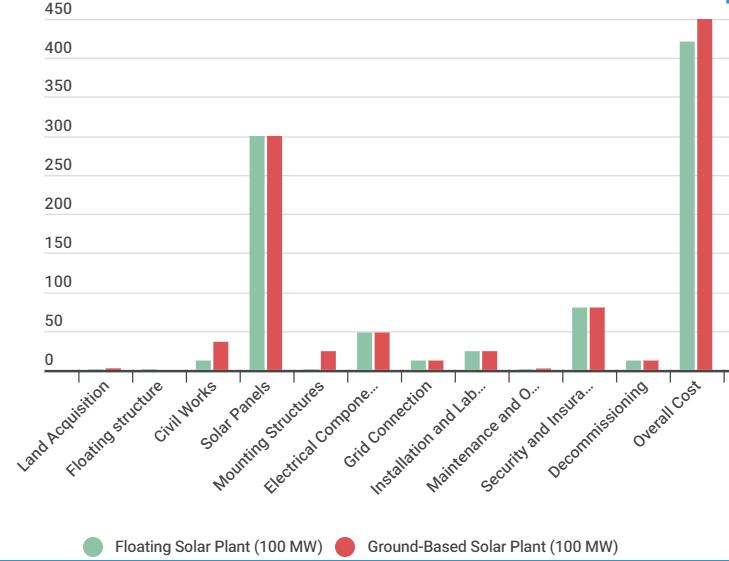
Cost comparison: When compared to conventional landbased solar plants, the floating solar plant using recycled plasticpontoonsoffersamoreaffordableoption,according tothecoststudy.Utilising recoveredplasticwastegreatly lowersthecostofmaterialsforpontoons,whichlowersthe overallprojectcost.Reducedlandacquisitiondemandsand the opportunity to use existing water bodies, which eliminatetheneedformajorlandpreparationandrelated costs,furtherincreasethecost-effectiveness
Table -1: Showscostcomparisonbetweenfloatingsolar plantandlandbasedsolarplantof100MWeach
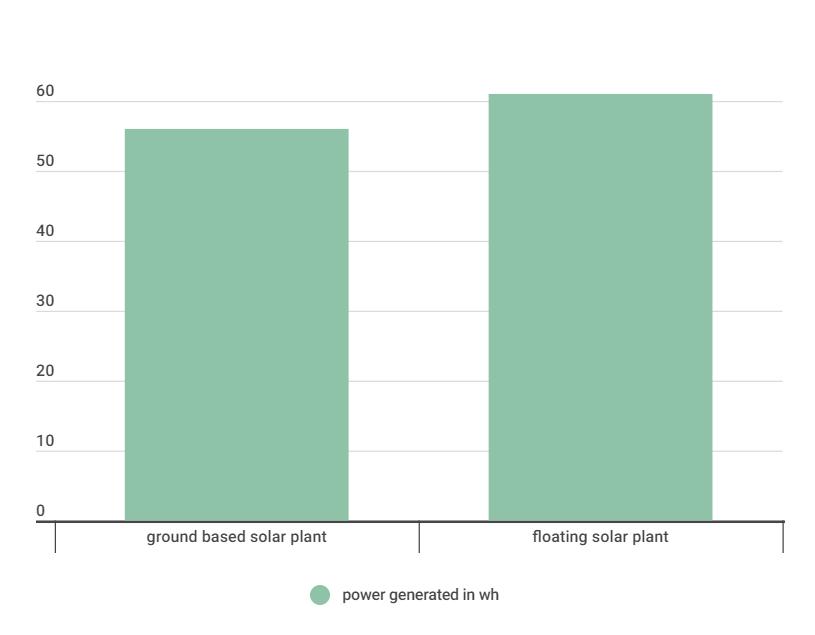
Energyoutput:Accordingtoananalysisofenergyoutput,a floating solar farm made of recycled plastic pontoons is capableofproducingasmuchenergyassolarfarmsonland. Thesun'senergyiseffectivelycapturedandconvertedinto electricitybythesolarpanelspositionedonthepontoons. Additionally, the plant's floating nature enables ideal orientation and synchronisation with the sun's path, enablingmaximumsolarirradiationalldaylong.Additional solar radiation on the bottom of the floating panels may result from the reflecting properties of water surfaces, improvingoverallenergygeneration.(albedoeffect).astudy ofcomparisonofpowerproductionbetweenfloatingsolar plantandlandbasedsolarplantinsouthKorea(Young-Kwan Choi"AStudyonPowerGenerationAnalysisofFloatingPV System Considering Environmental Impact” International Journal of Software Engineering and Its Application) has shownthatfloatingsolarplantproduced11%moreenergy thanlandbasedsolarplant.Wenoticedaincreaseof8.9% duringimplementationofourproject.
ofprototypein1day

Cost effectiveness of recycled plastic for making pontoons: When comparing the price per square metre betweenrecycledplasticpontoonsandtraditionalpontoons, recycledplasticpontoonsprovideamoreaffordableoption. The utilisation of recycled plastic material, which is frequentlymoreaffordablethannewlyproducedmaterials, addstothepontoons'totalaffordability.Recycledplasticis anticipatedtocost40rupeesperkilogram,makingrecycled plasticpontoonssubstantiallymoreaffordablepersquare metre that is 400 rupees per metre square than other materialswhichmaycostform700-2000rupeespermetre square. Additionally, the production of recycled plastic pontoonscoulduselesscomplexmethods,cuttingcosts.
Environmental Sustainability: Recycling plastic to make pontoonsforfloatingsolarfarmscanhaveabigimpacton environmentalsustainability.Reusingandrecyclingplastic materials creating pontoons helps lessen the pressure on landfills and reduces plastic pollution in our environment due to the significant amount of plastic waste produced globally. In addition, manufacturing recycled plastic pontoons often requires less energy and emits less greenhousegasesthanmanufacturingpontoonsfromfresh plastic. The circular economy's guiding principles are supported by this strategy, which encourages resource efficiencyandreduceswaste.TheWorldEconomicForum reported that from about 1.5 million metric tonnes in the 1950stomorethan359millionmetrictonnesin2018,the world's plastic manufacturing has surged. Due to their adaptabilityanddurability,plastics,particularlyHDPE,have establishedthemselvesasawidespreadmaterialinavariety of industries. Plastic garbage output has significantly increased globally as a result of plastic production and consumption.AstudythatappearedinthejournalScience Advancesprojectedthatasof2015,theworldhasproduced 6.3 billion metric tonnes of plastic garbage. Additionally, accordingtothisreport,thetotalamountofplasticgarbage mightexceed12billionmetrictonnesbytheyear2050.Ifwe considerthatwerequire10kgofrecycledplasticpermeter square then we would require 5,00,00,000 kg to make pontoonsfora100MWfloatingsolarplant.Thismighthelp totakeasteptowardsenvironmentalsustainability.
4. CONCLUSIONS
Inconclusion,researchintotheconstructionoffloatingsolar farms using pontoons made from recycled plastic waste offersaviablealternativeforthesectorofrenewableenergy. Using recycled plastic trash as pontoons has a number of benefits, including affordability and environmental sustainability. According to the cost research, recovered plasticwastepontoonscanbeamoreaffordableoptionthan traditional pontoons. Furthermore, the energy output comparison shows that floating solar plants can produce energyoutputsthatareequivalenttoorevengreaterthan those of their land-based equivalents. This discovery emphasises floating solar technology's promise as a workablechoiceforcapturingsolarenergy.
Additionally, by encouraging a circular economy strategy andlimitingthebuildupofplastictrash,theuseofrecovered plasticwasteforpontoonsisconsistentwithenvironmental sustainabilitygoals.Thisstudyaidsinresourcepreservation andthedecrease of plasticpollution by turningdiscarded plasticintousefulpontoons.Intheend,theuseofpontoons made from recycled plastic waste in floating solar plants marksasignificantadvancementintheproductionofclean energyandenvironmentalsustainability.
REFERENCES
[1] Young-Kwan Choi " A Study on Power Generation Analysis of Floating PV System Considering Environmental Impact” International Journal of SoftwareEngineeringandItsApplication
[2] SampurnaPanda,ManojGupta,"Comprehensivereview on Advanced Cooling Techniques for Photovoltaic Panel", 2022 2nd International Conference on Power
Electronics&IoTApplicationsinRenewableEnergyand itsControl(PARC),pp.1-5,2022
[3] FeasibilityanalysisofFloatingSolarPhotovoltaicPlant atSrisailaminAndhraPradesh:IndiabyPSKulkarniG Mamatha.
[4] Techno economic Analysis of 1 MW Floating Solar PV Plant Swati S Gurfude Deshetty Tanusha Dhayapule Mounika
[5] SreenathSukumaran,SudhakarK.Fullysolarpowered Raja Bhoj International Airport: A feasibility study. ResourceEfficientTechnologies.2017
[6] HyderFarhan,SudhakarK, RizalmanMamat.SolarPV tree design: A review. Renewable and Sustainable EnergyReviews.2018;82(2018):1079−1096