AI-Learning style prediction for primary education
R. Varun Reddy1 , A. Haritha2 , Sri Vaishnavi3, Mr. Miryala Rama krishna4B.Tech Scholars, Department of Computer Science and Engineering, SNIST, Hyderabad-501301, India
4 Professor, Department of Computer Science and Engineering, SNIST, Hyderabad- 501301, India

Abstract - Thewidespreaduseofonlinelearningisaresultof information technology advancements. For primary school children, there are, however, fewer pertinent evaluations and applications. The goal ofany learning innovation project is to make learning more engaging for students while also raising the standard of instruction. By choosing instructional materials that complement each student's preferred learning style, teachers can increase their students' engagement in the teaching-learning process. The goal of the study is to create and assess the effectiveness of an AI-based learning style prediction model in an online learning environment for elementary school pupils. Grades 4 through 6 Indonesian elementaryschoolkidswereusedasthesubjects.TheAImodelin the online learning portal was created to offer educational materials that fit students' learning preferences in order to uphold the notion of personalized learning. We developed a novel AI strategy that enables learning style prediction to drive collaborative filtering-based AI models.
Key Words: Learning Style, Strategy, Matrix, Students, Ability, Rating.
1. INTRODUCTION
Forprimaryschoolstudentstolearneffectively,morework must be put into raising the standard of instruction. In primaryschools,avarietyofresearchtechniquesareusedto createanengaginglearningenvironmentthatwillimprove motivation and independent learning. According to the findingsofearlierstudies,activestudentparticipationinthe learningprocess suchasthroughtheimplementationofthe Team-Based Learning (TBL) approach, advancements in informationtechnology,andonlinelearning wouldresultin successful learning. In order for students to actively participateinthelearningprocess,theteacher,whoservesas thelearningmanager,mustbeabletoselectthebestteaching strategy.Thiscanbeaccomplishedbyutilizingtechnological advancements to enhance the results of the educational process.Withtheuseoftechnology,suchasonlinelearning, which promotes an interactive learning environment, teacherscanalsodevelopandmaintainstudentmotivationand independent learning. Online education is now being developed in response to information technology advancements.Studentshaveaccesstoavarietyoflearning toolsthathavebeenproducedbytheteacherthroughtheuse of online learning. The severalkindsof learning resources mentioned include slideshows, e- books, animated films, video lectures, and online articles. Teachers can arrange
***
theselearningresourcesinanonlinelearning management system (LMS) portal like Moodle to makethemeasierfor studentstoaccess.Onebenefitofusingonlinelearningisthat individualstudentpeculiaritiesaretakenintoaccount.
1.1 Existing System
Learningenhancementasaspecifictopicofstudyhasgiven risetotweakedlearning,particularlymechanizedmodified learning with pre-packaged courses, assessment, and constantdatacollection.ArtificialIntelligence(AI)onadigital platform can deliver personalized learning. To choose the understudy'spreferredlearningmethod,oneofthemisused. Speaking styles, learning systems, how to complete obligations,howtoassistothers,andotherembeddedworks outareexamplesoflearningstyles,whicharethepreference ormethodbywhichstudentssuccessfullyacquireandimpart information.
1.2 Proposed System
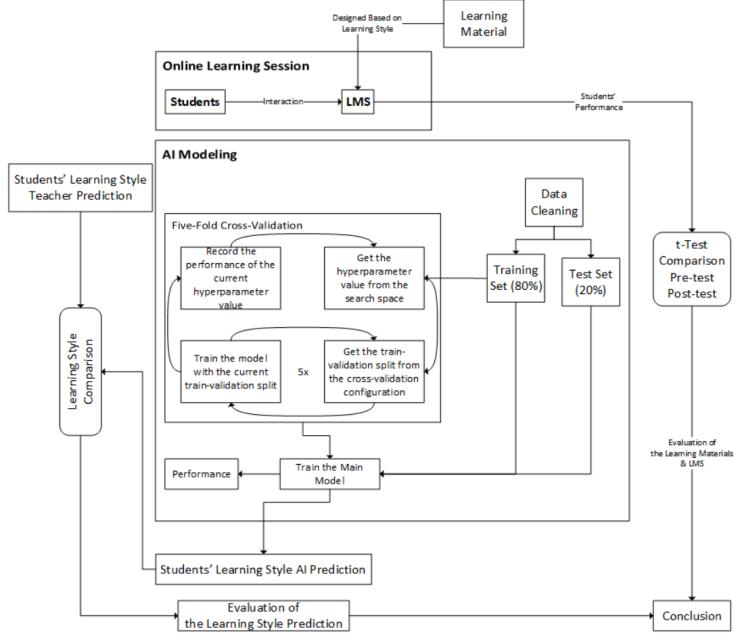
The goal of this work is to plan and assess the effects of deploying a synthetic intelligence-based internet learning gatewayinordertobooststudentengagementandbenefit from data technology advancements. The artificial intelligence model for the electronic learning entry was developedtosuggestsuitablelearningmaterialsdepending onthestudent'spreferredlearningmethods.Todothis,we developedanovelstrategythatenabledthecoordinationofa viableisolating-basedAImodelbasedonthesuppositionof learningstyle.ThetechniqueenablestheAImodeltowork autonomouslyasalearningstyleassumptionplanmodelat this time. Our suggested computation differs from earlier artificialintelligence-basedmethodsinthatitisindependent ofthelearningstrategychosenbypeople.Theinertlearning material vectors in the practical filtering structure are layered with a softmax assumption layer to create the suggested strategy's independence. The proposed assessment limits the human propensity to take the understudy's learning style into account while identifying assetsbecauseofitsautonomy.Theonlinelearningentrance couldmakeuse of thisartificial intelligence framework to provideresourcesthataretunedtoeachstudent'spreferred learningmethodsandlearningstyles.
2. LITERATURE SURVEY
UsingtheTeam-BasedLearning(TBL)teachingandlearning strategy,thisarticlewascreatedtohelplecturersestablisha
teachingportfoliothathelpsthemmaximizetheadvantagesof blended learning, which combines in-person and online learning [2]. According to studies, TBL can help students learn how to work together effectively and can improve activelearning,twothingsthatcouldhelptomakeupforthe shortcomingsofblendedlearningimplementation[6].The creationofablendedteachingportfolioforaninternational human resource management course included a course overview,graduatecompetency,syllabus,courseresources, teaching scenario, reading assurance test, midterm/final exams, student assignments, assessment of learning outcomes,andacoursequalityimprovementsheet.[1]The course'sattributeswereusedtobuildeachitem.Thisstudyis a first step to provide comparative quantitative empirical evidencefortheusefulnessofTBLforleadingtocontinuous improvement in the learning process, which has been identifiedasonewaytoimprovestudentlearningoutcomesin undergraduatehealthsciencecurriculam[10].
3. IMPORT LIBRARIES:
Theappropriatelibrariesandframeworksmustbeinstalled before we can begin the model-building process. The followinglibrariesarenecessaryforthisprojecttorun.
PythonNumpyTensorflowPythonPandasPythonMatplotlib Scikitlearn
4. METHODOLOGIES:
4.1 Matrix Factorization
A group of cooperative filtering methods used in recommendersystemsiscalledmatrixfactorization[7].The user-iteminteractionmatrixisbrokendownintotheproduct oftworectangularmatriceswithlesserdimensionsbymatrix factorizationmethods.AsnotedbySimonFunkinhisblogpost from2006,wherehesharedhis findingswiththeresearch community,thisfamilyoftechniquesgainednotorietyduring theNetflixprizechallengeduetoitsefficacy.[8]Byallocating various regularization weights to the latent components based on the popularity of the itemsand the level of user activity,thepredictionoutcomescanbeenhanced.Consider LDAasanexampleofnonnegativematrixfactorization.
4.2 Support Vector Machine
An approach for supervised machine learning called the Support Vector Machine (SVM) is utilized for both classification and regression. Even if we also refer to regression issues, classification is the best fit. Finding a hyperplaneinanN-dimensionalspace36thatcategorizesthe datapointsclearlyistheSVMalgorithm'sgoal.
4.3 Random Forest
An incredibly well-liked supervised machine learning approachcalledtheRandomForestapproachisutilizedto
solveclassificationandregressionissues.Weareawarethata forestismadeupofcountlesstrees,andthemoretreesthere are,themorerobusttheforestwillbe.
4.4 Decision Tree
Thenon-parametricsupervisedlearningapproachusedfor classificationandregressionapplicationsisthedecisiontree.It is organized hierarchically and has a root node, branches, internalnodes,andleafnodes.
4.5 Voting Classifier
Kagglersfrequentlyemploythemachine-learningalgorithm votingclassifiertoimprovetheperformanceoftheirmodel andmoveuptherankladder.VotingClassifierhasvarious restrictions but can be used for real-world datasets to enhanceperformance.
5. ALGORITHM:
Inordertoassiststudents'masteryofthesubjectmatterand self-learning, personalized learning is a teaching strategy basedonindividuallearningstyles,aptitudes,andinterests.In accordance with the demands and preferences of the students, the learning system also offers instructions and suggestionstoenhancestudents'abilities.
A certain area of student learning growth is currently personalized learning, particularly digital personalized learningwithpre-packagedcourses,testing,andongoingdata collection.Currently,thedigitalplatformmakespersonalized learningconvenientbyutilizingavarietyofmediaintheform ofanimatedimages,videos,andaudiothatsupportpreschool andprimaryschoolstudents' preferred learning styles. [3] Additionally,usingAItoassistlearners,suchasfiguringout theconcernedstudent'slearningstyle,personalizedlearning on a digital platform can be realized. [4]A student's inclinationtoefficientlyabsorbandtransmitinformationcan becharacterizedbytheirlearningstyle,whichalsoincludes how they complete assignments, interact with others, and engage in other favored activities. Students with diverse talentsandhabitsinmonitoringlearningsettingsarethought to benefit from learning styles depending on personality, which may help them develop their cognitive skills. According to Cassidy's study, learning styles that are predicted using modules and assessments that take into account cognitive personality style performance are those thatareconsistentwiththeinterestsandroutinesofpupilsin primaryschools.
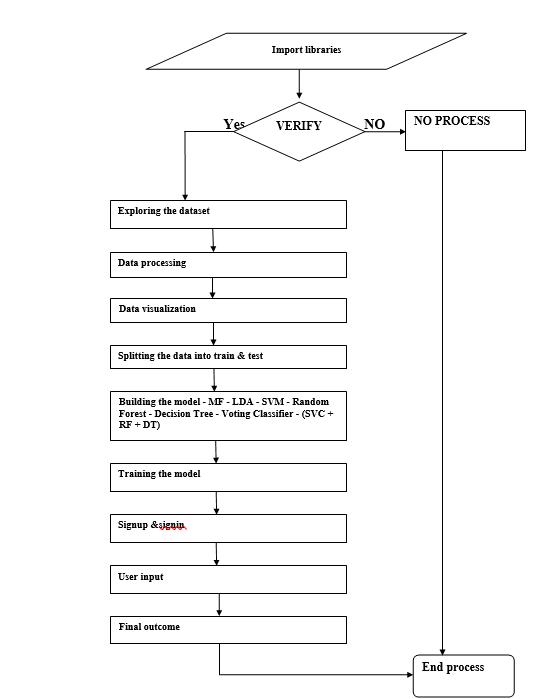
6. MODULES
The module will enable us to incorporate data into the system.Dataanalysesinclude.
Responsible: We'll look at the details required to use this moduletomanagethings.
Data separation for testing and preparation: Using this module, information will be divided into train and test groups.
Modeldevelopment:
constructingthemodel:
MF, LDA, SVM, Decision Tree, and Voting Classifier are examplesof(SVC+RF+DT).
correctnessofthecalculationalgorithm
Clientdatatradingandlogin:Tousethismodule,youmust registerandauthenticate.
Customer feedback: This module will elicit the desired answer.
Expectation:Thelastexpectedrespectismanifested.
7. DATA COLLECTION:
Asampleof72studentsfromhighereducationinstitutions was randomly chosen to participate in our study. Four distinct learning styles visual (V), auditory (A), reading/writing(R),andkinesthetic(K) werefoundinthe sampledatausingtheVARKInventoryquestionnaire[9].The questionnairehas16questionsthateachaddressadifferent aspect of how students prefer to learn or present information.Thequestionsarebasedonscenariosinwhich choicesanddecisionsaboutwhatmighthappenareavailable. WecreatedanonlineversionusingMicrosoftFormstomake it simple to get the responses from the students. The responses are then imported as an Excel file, where each responseisshownasabinaryvectorwiththeletters"A,V,K, R"init.Afterthat,thedataispreprocessed(asexplainedin Section [5]) to make it suitable for the machine learning techniquesbeingused.Here,wedivided theentiredataset intofourmatrices,oneforeachtypeoflearning.Eachmatrix has16columnsthatshowwhetheralearningstyleispresent or absent and 5 output columns (4 columns show the probabilityofthelearningstyles,andthelastcolumnshows thelabelofthechosenlearningstyle).
8. SYSTEM ARCHITECTURE
10. OUTPUT
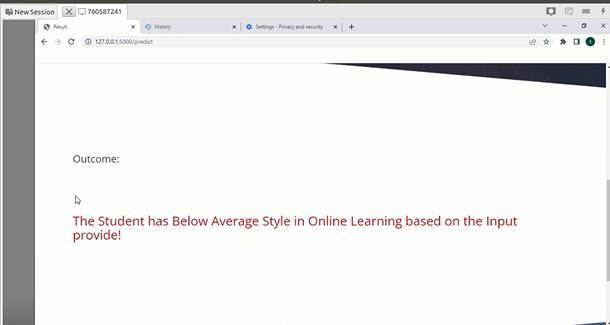
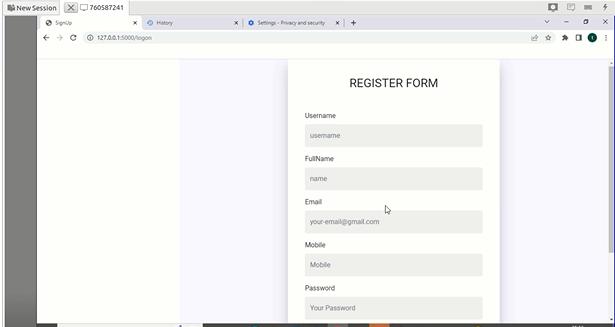
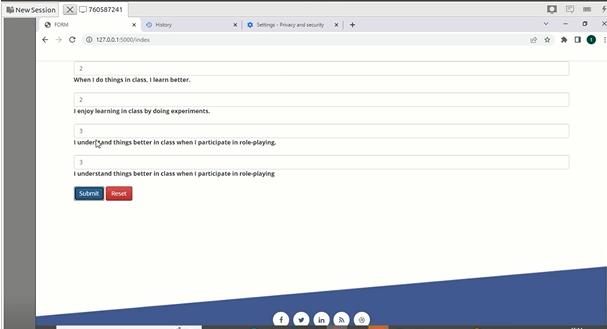
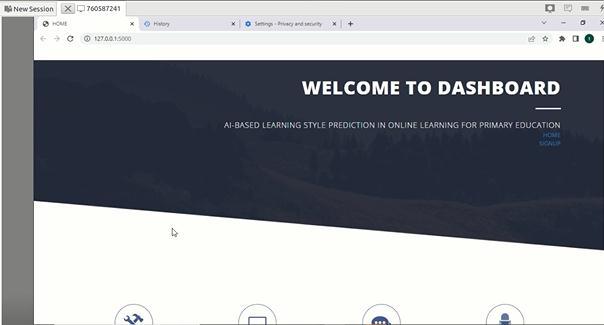
Launch the path of the code directory into the Anaconda prompt.Nowexecutethecommandpythonapp.pytogetthe link of the running code. Now copy the command thathas displayedonthescreenandpasteitinthegoogle.Nowyou
can see the web pages that are needed for our model to predictthelearningstyleofthestudentbasedonthegiven ratingfrom1to5readingasshowninthefiguresfig-8.1,fig8.2,fig-8.3.
11. SYSTEM TESTING
Systemtestingisatechniqueforqualityassurance(QA)that looksathowdifferentapplicationcomponentshelpcreatea structuredfoundationorrequest.Thereareothernamesfor the foundation compromise experiment and the building experiment mix form level experiment. A program's construction tries to ensure that everything works, especiallyasdesired.Theeaseofaninsertrequestservesas the cornerstone of this foundation, which has some capabilities as a flight data recorder experiment. One foundation experiment, for instance, commits research to determinewhethereachcustomerrecommendationfurther strengthensrequestkilling.
System testing phases: a broadcast handbook for this test level.Structuretestingexamineseveryaspectofarequestto ensurethatitiscompleteoverall.AQAteamoftenconducts aschemeexperimentafterbeneficialorcustomeraccount experimentsofindividualmodulesandblendexperimentsof eachcomponenthavebeencompleted.
If a part is constructed in accordance with building experiment requirements, it uses up its final assessment throughprofitexperimentpriortomovingontoinvention, wherecustomerswillmarkettheproduct.Animprovement teamexaminesalldefectsanddetermineswhichtypesand howmanyareacceptable.
12. CONCLUSIONS
With the new methodology we developed for this study, predictivelearningstylescanbeusedtodrivecollaborativefiltering-basedAImodels.WithanaverageRMSEof0.9035 onascaleof1to5,thetestingperformanceofthisAImodel wassatisfactory.Witha0.0313lowerRMSEvaluethanthe typicalMF-basedmodel,itperformedbetter.Theproposed methodnotonlyperformsbetterbutalsodoesawaywith the need for learning style ground truth from humans becauseitdoesnotusesupervisedlearning.Asa resultof thisstudy,wenoticedapotentialchangeinprimaryschool children'applicationonlinelearningstyles.Teachersshould therefore take a more active role in exploring learning resources that are tailored to their students' learning
preferences.Thiscanbefacilitatedbyhavingthemusethe onlinelearningplatformthatwecreatedforthisstudy.The online learning platform employed in this study is advantageousforbothteachersandstudents,asseenbythe improvementinthestudents'testscores.
13. ACKNOWLEDGEMENT
Wewouldliketoexpressourspecialthankstoourmentor Mr.MiryalaRamakrishnawhogaveusagoldenopportunityto dothiswonderfulprojectonthistopicwhichalsohelpedusin doingalotofresearchandwecametoknowaboutsomany new things. We are really thankful to them. Secondly, we wouldalsoliketo thank myfriends whohelpedus alotin finalizingthisprojectwithinthelimitedtimeframe.
14. REFERENCES
[1]E.Bodur,F.Özkan,E.Altun,andÖ.Şimşek,‘‘Theroleof teacher in web enhanced learning activities in primary schoolinformationtechnologieslesson:Acasestudy,’’Proc. SocialBehav.Sci.,vol.1,no.1,pp.1043–1051,2009.
[2]B.Pardamean,H.Prabowo,H.H.Muljo,T.Suparyanto,E. K. Masli, and J. Donovan, ‘‘The development of blendedlearningteachingportfoliocourseusingTBLapproach,’’Int. J.VirtualPers.Learn.Environ.,vol.7,no.1,pp.30–43,Jan. 2017.
[3] B. Pardamean, J. Donovan, E. Masli, T. Suparyanto, H. Muljo, and H. Prabowo, ‘‘Team based learning as an instructional strategy: A comparative study,’’ New Educ. Rev.,vol.50,no.4,pp.134–145,Dec.2017.
[4] K. Gunawan and B. Pardamean, ‘‘School information systemsdesignformobilephones,’’J.Comput.Sci.,vol.9,no. 9,pp.1140–1145,Sep.2013.
[5]B.Pardamean,‘‘Enhancementofcreativitythroughlogo programming,’’Amer.J.Appl.Sci.,vol.11,no.4,pp.528–533, Apr.2014.
[6]B.Pardamean,T.Suparyanto,E.Masli,andJ.Donovan, ‘‘Enhancing the use of digital model with team-based learningapproachinscienceteaching,’’inProc.Inf.Commun. Technol.-EurAsiaConf.Denpasar,Indonesia:Springer,2014, pp.267–276.
[7]B.Pardamean,T.Suparyanto,andE.Evelyn,‘‘Improving problem-solvingskillsthroughlogoprogramminglanguage,’’ NewEduc.Rev.,vol.41,no.3,pp.52–64,Sep.2015.
[8]F.XiaoandB.Pardamean,‘‘MOOCmodel:Dimensionsand modeldesigntodeveloplearning,’’NewEduc.Rev.,vol.43, no.1,pp.28–40,2016.
[9] B. Pardamean, T. Suparyanto, and R. Kurniawan, ‘‘Assessment of graph theory e-learning utilizing learning
managementsystem,’’J.Theor.Appl.Inf.Technol.,vol.55,no 3,pp.353–358,2013.
[10] B. Pardamean and T. Suparyanto, ‘‘A systematic approachtoimprovingE-learningimplementationsinhigh schools,’’TurkishOnlineJ.Educ.Technol.,vol.13,no.3,pp. 19–26,2014.