Taxi Demand Prediction using Machine Learning.
P. Sudheer Benarji1, P. Sai Bharadwaj2, B. Neeha3, D. Srikanth4 , V. Ankitha51Professor, VNR Vignana Jyothi Institute of Engineering & Technology, Hyderabad

2345Under Graduate Student, VNR Vignana Jyothi Institute of Engineering & Technology, Hyderabad ***
Abstract - Taxi demand prediction is the process of using historical data to forecast future taxi requests in a particular area. Managers may pre-allocate taxi resources in cities with the aid of accurate and real-time demand forecasting, which helps drivers find clients more quickly and cuts down on passenger waiting times This project is aimed to choose the best model in predicting the taxi demand where we use various Machine learning techniques such as regression analysis and time series forecasting. Various baseline models, including moving averages (simple, weighted, and exponential), linearregressionwithgridsearch,randomforest regressor with random search, and XGBoost regressor with random search are used. We find out which model is more suitable in predicting the output using the metrics we obtain.
Key Words: LinearRegressionwithGridSearchCV,Random ForestRegressorwithRandomSearchCV,XGBoostRegressor withRandomSearchCV
1.INTRODUCTION
Taxidemandpredictionistheprocessofusinghistorical data to forecast future taxi requests in a particular area. Managersmaypre-allocatetaxiresourcesincitieswiththe aid of accurate and real-time demand forecasting, which helps drivers find clients more quickly and cuts down on passengerwaitingtimes.
Inourproject,we’veuseddataontaxiridesinNewYork citytototrainandtestthemodelsusingLinearregression, RandomForestregressorandXGBoostregressor.
Along with the Linear regression and Random Forest algorithms,we’vealsousedtheXGBoostalgorithm.XGBoost is a machinelearning algorithm that is commonly used in classification and regression problems. It is an ensemble learningmethodthatcombinestheweakpredictionmodels, suchasdecisiontreestocreateastrongeroverallprediction model. XGBoost has gained popularity due to its high accuracy,scalability,andabilitytohandlemissingdata.
With our project, we get an understanding of which modelisbesttopredicttherealtimetaxidemandandtaxi companiesbeabletotailorstrategiestoallocateresources basedondemand.
2. Literature Review
Multi-attention network-based graph prediction of taxi demand: In order to better address the taxi demand
prediction problem, this study develops a Graph MultiAttentionNetwork(GMAN),whichtriestoforecastthetaxi demandsineverysectionofaroadnetwork.(Achieveda72% Accuracy).Becauseonlysignificantdataneedstobelearned bythemodels,applyingattentionincreasesmodelaccuracy to extremely high levels. The Attention mechanism's drawbackisthatitrequiresalotoftimeandischallengingto parallelize
Taxidemandforecastusingtherandomforestmodel: Decisiontreesareemployedintherandomforest.Theterm "random" refers to our usage of a random bootstrap sampling, and the term "forest" refers to the collection of trees seen in decision trees. (Achieved 77% Accuracy). excellent forecasting abilities that improve application precision. Easy data preparation is made possible by not requiringnormalization.Generallyspeaking,thisalgorithmis quicktotrainbuttakesawhiletoproducepredictionsafter training
Demand projection for taxis XGBoost algorithmbased: The hot spot locations are identified and their boundaries are drawn using the density-based DBSCAN clusteringtechnique,andthedemandforthehotspotareasis predictedusingtheXGBoostalgorithm.XGBprovidesvarious features, such as parallelization, cache optimization, and more.Likeanyotherboostingmethod,XGBoostissensitiveto outliers.
Taxi Demand Forecast Based on Regional Heterogeneity Analysis and Multi-Level Deep Learning: With the aid of the taxi zone clustering technique and pairwiseclusteringtheory,theMulti-LevelRecurrentNeural Networks (MLRNN) model is put out.(83.33% Accuracy Attained). concentrates on how to exploit inter-zone heterogeneity to enhance prediction. The use of MLRNN resultsinhighprocessingcostsandgreatercomplexitywhen fittingdata.
Probabilistic Taxi Demand Prediction with Bayesian DeepLearning:ProposesaBayesiandeeplearningapproach forprobabilistictaxidemandprediction.(AchievedAccuracy of 83%). Estimates the uncertainty of predictions and providesprobabilisticforecasts.Greatertechnicalcomplexity, defining a prior distribution can be hard using Bayesian statistics.
Prediction of Taxi Demand Using Ensemble Model: Utilizesapointofinterest(POI)tomatchtaxidemandwitha locationsothatitcanbestudiedusingadifferentfunction.
This method is based on RNNs and XGBOOST. Achieved Accuracy of 72%). It increases the accuracy, improved resourceallocation,effectivedataanalysis.Limitedcoverage, incompletedata,limitedgeneralizability.
BRIGHT,Drift-Aware Demand Predictions for Taxi Networks:Accurateforecastingofshort-termtaxidemand amountsusinga novel combinationoftimeseriesanalysis techniques that can manage various sorts of concept drift.(Achieved Accuracy of 78%). Could offer a range of benefits, such as increased efficiency and revenue, and improved customer service. The cost of implementing the BRIGHTplatformmaybehigh,andongoingmaintenanceand updatesmayalsoberequired.
Taxi demand prediction using hybrid deep neural networks:Hybriddeepneuralnetworkapproachtopredict taxi demand based on a variety of factors. The authors compare their approach to other machine learning algorithmsandfindthattheirhybridapproachachievesthe highest prediction accuracy.(Achieved Accuracy of 80%). Haveshowntobeeffectiveatcapturingcomplexpatternsin data,andahybridapproachthatcombinesdifferenttypesof networkscanhelpimprovepredictionaccuracy.Themodelis toocomplexandbeginstomemorizethetrainingdatarather thanlearninggeneralizablepatterns.
Creating a Customised Transportation Model to Predict Online Taxi Demand: a personalized demand forecast model is suggested along with a broad demand predictionforonlinecabhailing.Itissuggestedthatamodel with two attentional blocks be used to account for both temporal and spatial viewpoints.(Achieved Accuracy of 75.7%). By using user-specific data, personalized transportationmodelscanmakemoreaccuratepredictions fordemandandsupplyofrides.Personalizedtransportation modelsrelyonuser-specificdata,whichmaynotbeavailable forallusers.Thiscanlimittheeffectivenessofthemodeland makeitlessaccurate.
Convolutional Spatiotemporal Multi-Graph Network for Taxi Demand: TheytestedDeepTDPontworeal-world trafficdatasets,andtheresultsshowedthatitwaseffective when compared to self- and other baseline variations.(Achieved Accuracy of 80.5%). STMGCNs can handle input data in various formats, such as graph-based dataandtimeseriesdata,makingthemversatilefordifferent typesofapplications.Themodeldoesnothavetheabilityto extractmulti-scalecorrelationsofnon-adjacentframes.
A method for predicting taxi demand using an ensemble: The authors discuss their ensemble technique, which integrates many machine learning models, such as random forest regression, linear regression, and support vector regression.They made use of a variety of metrics, includingrootmeansquarederror,meansquarederror,and mean absolute error. (Achieved Accuracy of 88%). Has several potential benefits, including improved prediction
accuracyandrobustness.Itmayalsobemorecomplexthan otherapproaches.
3. Existing system
There are several existing systems for taxi demand predictionusingmachinelearning.Hereareafewexamples:
Uber Movement: Uber Movement is a platform that uses machine learning to predict the demand for Uber rides in various cities. It provides historical and real-time data on traffic patterns, events, and weather conditions to help drivers optimize their routes and improve passenger wait times.
NYC Taxi Demand Prediction: TheNewYorkCityTaxiand Limousine Commission (TLC) has developed a system for predicting taxi demand in New York City using machine learningalgorithms.Thesystemuseshistoricaldataontaxi trips, weather, and events to forecast the number of taxi requestsinvariouspartsofthecity.
Didi Chuxing: Didi Chuxing is a Chinese ride-hailing company that has developed a machine learning-based system for predicting demand for its services. The system usesreal-timedataontrafficconditions,weather,andevents to optimize ride allocation and reduce wait times for passengers.
GrabTaxi: GrabTaxi is a Southeast Asian ride-hailing companythatusesmachinelearningtopredictdemandfor itsservices.Thesystemuseshistoricaldataonriderequests, traffic, and weather conditions to forecast demand and allocatedriversaccordingly
4. Proposed system
Thepurposeofthisprojectistobuildamodeltoanalyze data-patterns and predict the demand of taxis based on number of requestsin a given time period to help the taxi companiestopre-allocatetheresourcesoptimally.
Theobjectivesistoanalyzetaxidemandpatterns,segment requestsbasedonpickupanddrop-offpointsanddurationof ride,extractfeaturesformachinelearningmodels,andbuild machinelearningmodelsusingLinearregression,Random Forest algorithm and XGBoost regressor to predict taxi demandinthefuture
5. System Architecture
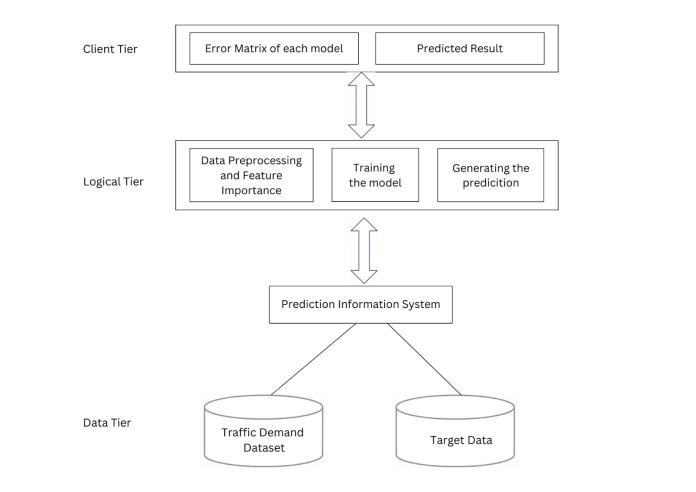
Fig 1: System Architecture
Client tier:Thistierisresponsibleforpresentingtheuser interfaceofthesystem.Itincludeswebpages,mobileapps,or otherinterfacesthatallowuserstointeractwiththesystem. Theclienttiercommunicateswiththelogicaltiertoreceive anddisplaydata.
Logical tier: This tier contains the business logic and applicationcodeofthesystem.Itreceivesrequestsfromthe client tier, processes them,and sends responses back. The logicaltierincludesthedatapreprocessing,trainingmodels, andpredictionalgorithmsthatpredicttaxidemand.Thistier alsocommunicateswiththedatatiertoaccessandretrieve data.
Data tier: This tier is used for storing and retrieving data from database. It includes the storage of data or data warehousethatstoreshistoricaltaxidemanddata,weather data, traffic data, and otherrelevant data sources used for prediction.
6. Functionalities
i)
Functionality of User Input:
The user input is taken through the keyboard, then it analysesparametersandpredictsthe demand.
ii)
Functionality of Pipeline Module:
Various machine learning algorithms are considered and storedinthepipeline.All themachinelearningalgorithms thatareavailableinthepipelineareusedtotrainthemodel withthedataset.
iii)
Functionality of Model Selection Module:
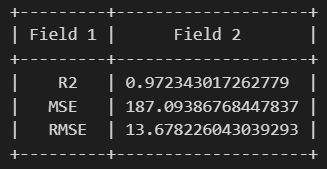
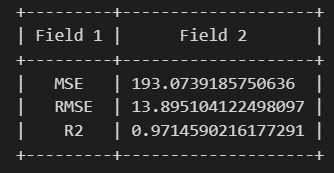
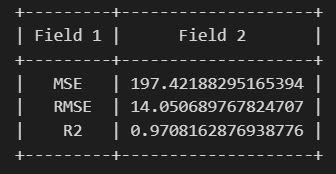
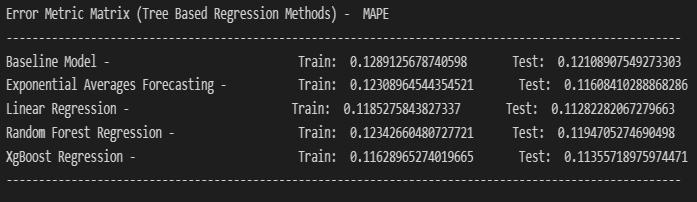
RMSE and R2 score values for the above models are calculated.ThenthemodelwiththebestfiguresofRMSEand R2scoreisconsideredasthefinalmodelfortheprediction.
iv) Functionality of Prediction:
Variousdatapointsaretakenandtheaboveselectedmodelis beingused topredictthetaxidemand
7. UML Diagrams
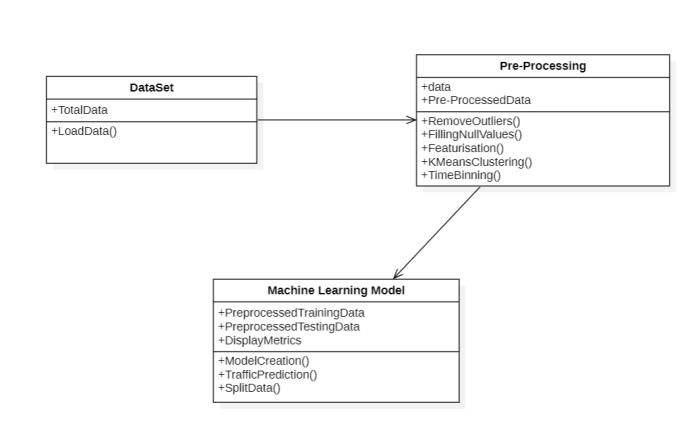
A class diagram is another name for a static diagram. It showstheapplication'sstaticview.Aclassdiagramcanbe used to generate an executable code directly from the diagramforasoftwareprogrammeraswellastovisualize, describe,anddocumentvariouscomponentsofasystem.A class diagram describes the characteristics, actions, and limitationsofaclass.
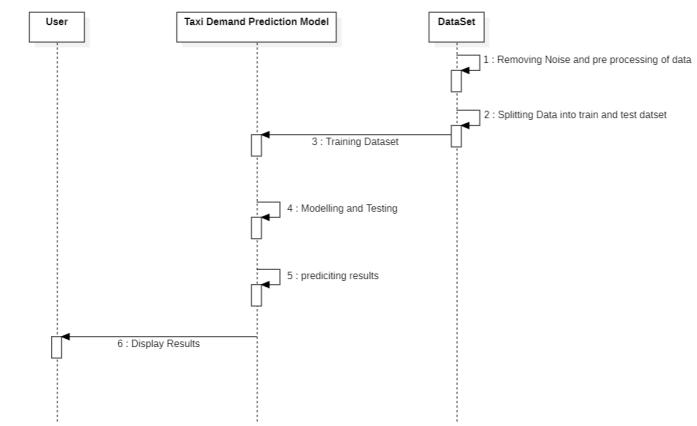
Thelifelinesare:
● User
● Prediction(ML)Model
● DataSet
Asequencediagramisatypeofinteractiondiagrambecause it shows how a group of actors communicate with one another.Softwareengineersandbusinessprofessionalsuse thesediagramstounderstandthespecificationsfora new system
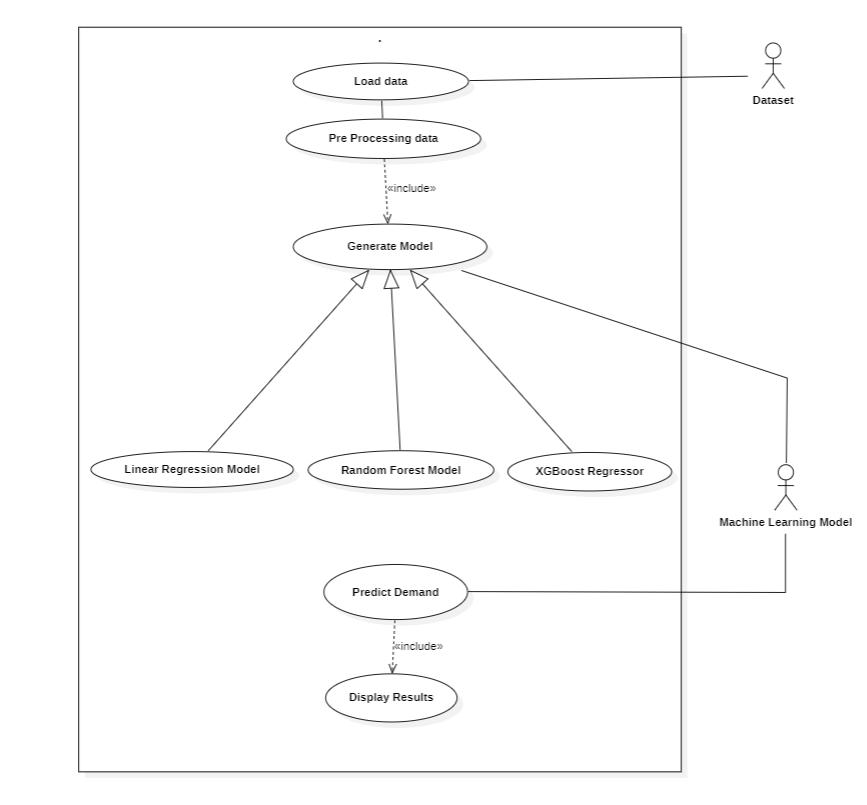
Awrittenexampleofhowuserswillcarryouttasksonyour websiteisknownasausecase.Itestablisheshowasystem reactstoarequestfromtheperspectiveofauser.Aseriesof fundamentalactionsthatbeginwiththeuser'saimandend whenthatgoalisaccomplisheddefineeachusecase.
8. RESULTS
Modelsaretrainedusingthedatasetandaccuracyofeach modelisanalyzedtofindoutthebestmodelforprediction thatcanbesttellthedemand.
9. CONCLUSION
In conclusion, taxi demand prediction using machine learningisausefulapplicationthatcanhelptaxicompanies optimize their operations and improve customer satisfaction. Use of machine learning provided many advantages in predicting Taxi Demand. The model saved timebypreventingallthecomplexcalculationsandgiving the demand of taxi in particular area. We used several essentialattributesandregressiontechniquesparticularly linear Regression, Random Forest Regressor, XGBoost RegressorandK-Meansforclusteringofdatapoints.Wegot evenmoreaccuracythanothermodels.
REFERENCES
[1] Mohamed Hanafy, Assiut University” Predict Health InsuranceCostbyusingMachine Learning and DNN Regression”,Researchgate,348559741,2021
[2] Shyamala Devi , Swathi Pillai , Vel Tech ”Linear and Ensembling Regression Based Health Cost Insurance Prediction Using Machine Learning “,Research gate, 353231212,2021.
[3] Ch Anwar Ul Hassan, Jawaid Iqbal“A Computational IntelligenceApproachforPredictingMedicalInsurance CostHindawijournal,1162553,2021.
[4] Kashish Bhatia, Shabeg Singh Gill, Navneet Kamboj, ManishKumar”HealthInsuranceCostPredictionusing MachineLearning”IEEExplore,984201,2022.
[5] ChaparalaJyothsna,K.Srinivas,BandiBhargavi”Health InsurancePremiumPredictionusingXGboostRegressor“ IEEExplore,9793258,2022
[6] PreetJayendrakumarModi,VrajJatinNaik “Insurance ManagementwithPremiumPrediction“IJRASET,2022
[7] Ghosh Madhumita “Health Insurance Premium Predictionusing Blockchain Technology and Random Forest Regression Algorithm”IJOESTarticle,346,2022.
[8] Keshav Kaushik , Akashdeep Bhardwaj ”Machine Learning-Based Regression Framework to Predict HealthInsurancePremiums”NCBI,35805557,2022.
[9] Zhu, M., Li, Y., Li, L., & Li, Z. (2019). Time series predictionoftaxidemandbasedondeeplearning.IEEE Access,7,179647-179655.
[10] Yang,L.,Zhang,B.,Chen,Y.,&Chen,L.(2018).ADeep Learning Method for Taxi Demand Prediction. IEEE Transactions on Intelligent Transportation Systems, 19(3),782-791.
[11] Ma, T., Yang, Z., Wang, C., Hu, Y., Zhang, Y., & Liu, Y. (2019).DeepMulti-ViewSpatial-TemporalNetworkfor Taxi Demand Prediction. IEEE Transactions on IntelligentTransportationSystems,20(5),1745-1756.
[12] Yu,X.,&Jiang,Y.(2019).Ahybriddeeplearningmodel for taxi demand prediction. Transportation Research PartC:EmergingTechnologies,101,206-218.
[13] Zhang, S., Chen, J., & Chen, C. (2021). Hierarchical Spatiotemporal Network for Taxi Demand Prediction. IEEE Transactions on Intelligent Transportation Systems,22(5),2918-2928.
[14] Zheng, X., Yang, X., & Sun, X. (2020). Deep SpatioTemporalResidualNetworksforCitywideTaxiDemand Prediction. IEEE Transactions on Intelligent TransportationSystems,21(3),1032-1042.
[15] Li,Y.,Li,Z.,Li,S.,Li,W.,&Li,G.(2020).Anovelurban taxi demand prediction model using spatio-temporal deep learning method. Journal of Cleaner Production, 259,120877.
[16] Zhang,K.,Li,K.,Lin,P.,&Liu,K.(2021).Anewattentionbasedneuralnetworkmodelfortaxidemandprediction. TransportationResearchPartC:EmergingTechnologies, 126,102988.