Treatment of Hospital Wastewater by Electro-Coagulation Technique
Lins Paul Kuriakose1, Muhammed Jefin S2, Rose Mariya Vincent3, Roshna Liss Mathew4, Stephen P Santhosh51Assistant professor, Department of Civil Engineering Viswajyothi College of Engineering and Technology, Vazhakulam, Kerala, India
2,3,4,5UG scholars Department of Civil Engineering, Viswajyothi College of Engineering and Technology, Vazhakulam, Kerala, India
Abstract - In addition to using a lot of water, hospitals also generate a lot of wastewaters that contains several dangerous substances. Not disposing of medical waste appropriately can have detrimental impacts on both neighborhood residents and those who work in clinical institutions. Therefore, this kind of contamination cannot be dischargedintothe sewer systemas untreatedeffluent.
Our project involves employing electrocoagulation to treat hospital wastewater. Hospital wastewater is treated with aluminum electrodes. After the completion of initial wastewater characteristics study COD and Iron content were 1220 mg/l and 3.32 mg/l. Electrode distance, pH and Electrolysis Time where taken as varying parameters and each parameter had three different values. The optimum value obtained is 4 cm distance, 7 pH and 45 min time. The COD and Iron content after the electrocoagulation was reducedto230 mg/l and0.04mg/l.
Key Words: Hospital wastewater, Electrocoagulation, Aluminiumelectrodes,Contaminants,Optimization

1.INTRODUCTION
1.1 General
Hospital wastewater is one of the most dangerous sources of pollution. The prevalence of pathogens in hospital wastewater highlights the importance of the pollutioncauses.Electrical coagulation,anelectrochemical waste-water treatment method, uses direct current electricitytodrawcontaminantsoutofthesolution.Inthis process, a suitable anode is electrolytically oxidized to create a coagulant there instead. Then, it is possible to remove charged ionic species by either letting the waste producemetal hydroxidesorbyenablinga reactiontothe opposite charge. Due to the need for straightforward and simpleoperation,goodsludgesettlingability,lowersludge production, larger produced flocks compared to chemical treatment, and reducing secondary pollution by not using chemical compounds, electrocoagulation technology has recently grown in popularity for waste-water treatment. Pollutants like heavy metals can be removed with this technique. To treat synthetic solutions containing
refractory substances like antibiotics, heavy metals, and petroleum, electrocoagulation has drawn increasing attention because to its low cost, in-situ generation of coagulants, high adsorption capacity, requirement for less land,andecologicallybenigncharacteristics.
1.2 Objectives
a) To investigate the characteristics of hospital wastewater.
b) To estimate the concentration of COD & other contaminantsinthewastewater.
c) To optimise the different factors, including time, pH,andelectrodedistance.
d) To analyse to what extend the purity is achieved by the electro coagulation process using aluminiumelectrodes.
2. MATERIALS AND METHODS
2.1 Sample collection
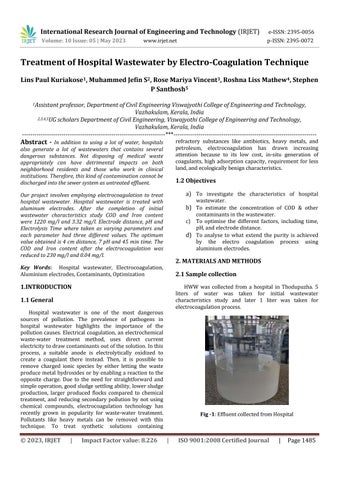
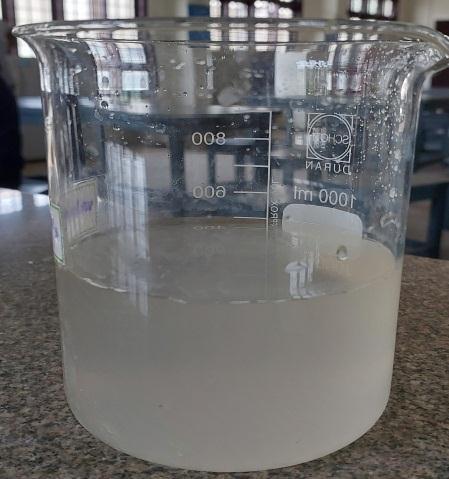
HWW was collected from a hospital in Thodupuzha. 5 liters of water was taken for initial wastewater characteristics study and later 1 liter was taken for electrocoagulationprocess.
2.2 Initial wastewater characteristics study
The features of the water sample were investigated, and numerous metrics were analyzed. The findings are displayedintable1
Table -1: WastewaterCharacteristics
cations are deposited in the cathode and anions are deposited in the anode, and this is only feasible when the polarityoftheelectrodesremainsconstant.
2.4 Optimization of various operating parameters
1 gm of glucose and 20 ml of stock iron solution was used to prepare the synthetic solution. Both these were dissolved in 1000 ml distilled water to make a synthetic solution with the necessary amounts of COD and iron. Three different operating settings are chosen in order to achieve the best value. Electrode separation, pH, and electrolysis time are these parameters. Three distinct values are chosen for each parameter. This refers to the electrodedistance,whichmightbe4cm(about1.57in),6 cm(about2.36in),and8cm(about3.15in).ThepHisthen changedbetween6.5,7and7.5.Theelectrolysisdurationis then modified to be 15 minutes, 30 minutes, and 45 minutes.
3. RESULT
3.1 Effect of electrode distance
According to the Kerala Pollution Control Board, the maximum allowed concentrations of COD and iron in wastewater that is to be disposed of in a public sewer are 250mg/Land3mg/L,respectively.Thehospitaleffluent's COD and iron concentration were determined to be over theallowablelimitbasedonthecharacteristicsanalysis.So, before being released, this hospital wastewater must be treated.
2.3 Electrocoagulation apparatus
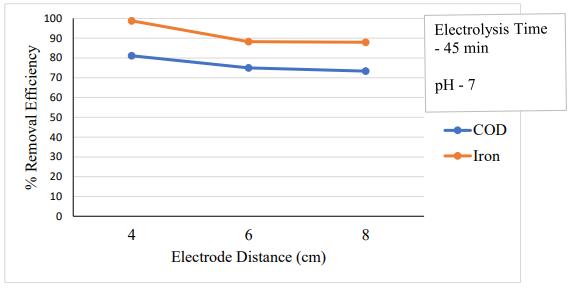
In this instance, all other parameters were held constant while the electrode distance was changed to 4 cm,6cm,and8cm.Itwasdiscoveredfromfig.5.1thatthe CODandironremovalefficiencydecreasesasthedistance between the electrodes increases. At a distance of 4 cm between the electrodes was accomplished in 45 minutes. This is owing to the fact that, with constant cell voltage, current falls as interelectrode distance increases due to a reduction in electrode resistance. At the high current value, the anodic dissolution increases, leading to more collisions of the ions that promote coagulation, which raises the number of coagulants. Therefore, the lowest electrode spacing was necessary to obtain the best COD andironremovalefficiency.
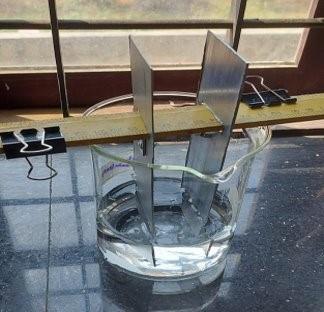
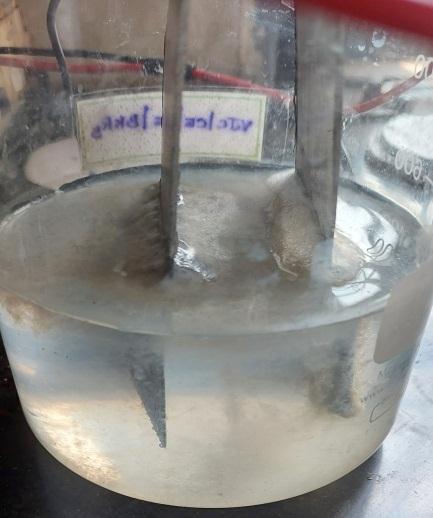
:Electro-coagulationapparatus
Thedeviceconsistsoftwocomponents:electrodesand areactor.Thereactorismadeofacircular,1Lcapacity,15 cm(about5.91in)highby10cm(about3.94in)wideglass beaker.Weusedrectangularaluminumplateswitha19cm (about7.48in)length,a6cm(about2.36in)width,anda1 mm (about 0.04 in) thickness as electrodes. It is bipolar andpositionedparallel.Weutilizedirectcurrenttooperate the device because electrocoagulation only occurs when
3.2 Effect of electrolysis time
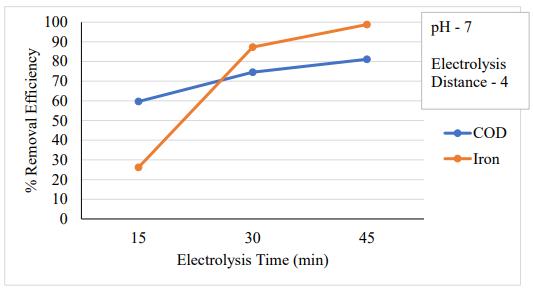
One of the crucial factors in electrocoagulation is the electrolysistime(ET),alsoknownasthetreatmenttime.In this instance, the electrolysis duration was changed to 15, 30, and 45 minutes while all other variables remained the same. The elimination of fluoride becomes more pronouncedovertime,asseeninfigure5.2.MaximumCOD andironremovalwasdiscoveredtooccurat45minutesof contact time. By extending the EC procedure, the removal efficiency was increased until it reached the acceptable level. This is due to Faraday's law, which states that dissolved coagulants from the aluminum electrode increased with time. The COD and iron ions were trapped by a significant amount of coagulant that had been dissolved from the aluminum electrode, leading to better removalefficiencyoveralongerperiodoftime.
3.3 Effect of pH
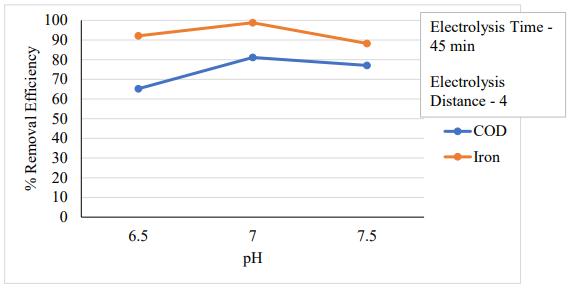
ThepHofthesolutionisrecognizedtobecrucialinthe electrocoagulationprocess.TheoriginalpHwaschangedto 6.5, 7 and 7.5 to study its impact. Figure 5.3 revealed that thepHrangeof7waswhereCODandironeliminationwas atitshighest.Additionally,itwasshownthatwhenacidity or alkalinity increases, the effectiveness of removing COD and iron diminishes. This is because aluminum hydroxide (Al (OH)3) exhibits amphoteric properties. Al (OH)3 dissociatesintoAl3+cationsatacidicpH,whereasAl(OH)4 is formed as a monomeric anion at alkaline pH. All of the aluminum generated at the anode formed polymeric species (Al13O4(OH)247+) and precipitated Al (OH)3 when the initial pH was neutral. Al (OH)3 is known to contribute to the elimination of fluoride during electrocoagulation utilizing aluminum electrodes. Therefore, great removal efficiency is reached at neutral pH.
International Research Journal of Engineering and Technology (IRJET) e-ISSN:2395-0056
Volume: 10 Issue: 05 | May 2023 www.irjet.net p-ISSN:2395-0072
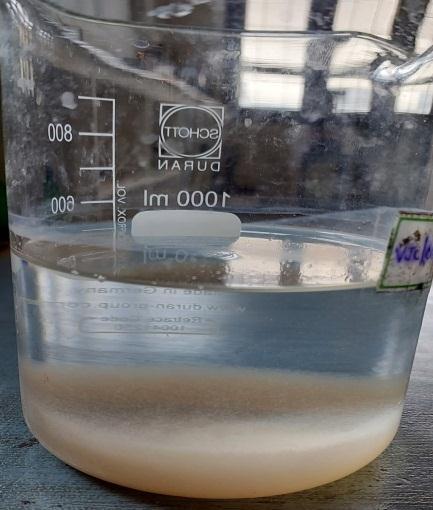
An ideal of 7 pH, a 4 cm electrode distance, and a 45minute electrolysis period were selected from the electrocoagulation experiment done on synthetic water. The final COD and iron electrocoagulation procedure of hospital wastewater was carried out using the optimized settings. The removal of COD and iron by electrocoagulationwithelectrodesmadeofaluminumwas 81.14% and 98.79% respectively. Thus, hospital wastewater COD and iron removal using the electrocoagulation technique was shown to be quite successful.
Table
OptimizationofParametersforCODRemoval
2. Tavana, Aptin Rahnavard and Farid Gholamreza Fahimi, "Effective removal of cefazolin from hospital wastewater by the electrocoagulation process”: IWA Publishing Water Science & Technology,2019
3. Sergi Garcia-Seguraa, Maria Maesia S.G. Eibanda, Jailson Vieira de Meloa, Carlos Alberto MartínezHuitle , “Electrocoagulation and advanced electrocoagulation processes: A general review about the fundamentals, emerging applications and its association with other technologies”, Journal of Electro analytical Chemistry
801(2017)267–299,2017
BIOGRAPHIES
Table
OptimizationofParametersforIronRemoval
4. CONCLUSIONS
The outcomes of the experiment demonstrated the effectivenessofaluminumelectrodesinremovingironand COD. It was discovered that the electrolysis time, pH, and electrodedistanceallaffectedtheremovaleffectiveness.
The greatest COD and iron removal efficiency using electrocoagulation technique was determined to be 81.14%and98.79%foraninitialCODandironcontentof 1220 mg/L and 3.32 mg/L, respectively. The procedure's ideal parameters were determined to be a pH of 7, a distance between the electrodes of 4 cm, and an electrolysisperiodof45minutes.
Tosumup,ECappearstobeapracticalandcost-effective alternative in the purification of various types of water and wastewater, but more research is required, particularly using larger-scale and/or continuous systems andconcentratingonthefundamentalsoftheECprocess.
REFERENCES
1. RihamGh.Najeeba,AliH.Abbarb,” Treatment of AlDewaniya hospital wastewater by Electrocoagulation method using SS/Fe electrodes”:Al-qadisiyah journal for engineering sciences,2021
Lins Paul Kuriakose
Assistantprofessor
DepartmentofCivilEngineering ViswajyothiCollegeof EngineeringandTechnology, Vazhakulam,Kerala
Muhammed Jefin S
4thyearstudent,Civil engineeringViswajyothiCollege ofEngineeringandTechnology, Kerala
Rose Mariya Vincent 4thyearstudent,Civil engineeringViswajyothiCollege ofEngineeringandTechnology, Kerala


Roshna Liss Mathew
4thyearstudent,Civil engineeringViswajyothiCollege ofEngineeringandTechnology, Kerala
Stephen P Santhosh
4thyearstudent,Civil engineeringViswajyothiCollege ofEngineeringandTechnology, Kerala