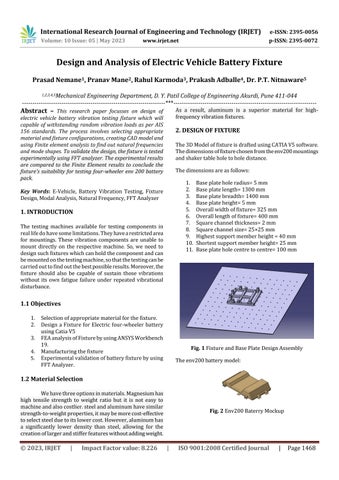
Design and Analysis of Electric Vehicle Battery Fixture
Abstract – This research paper focusses on design of electric vehicle battery vibration testing fixture which will capable of withstanding random vibration loads as per AIS 156 standards The process involves selecting appropriate material and fixture configurations, creating CAD model and using Finite element analysis to find out natural frequencies and mode shapes. To validate the design, the fixture is tested experimentally using FFT analyzer. The experimental results are compared to the Finite Element results to conclude the fixture's suitability for testing four-wheeler env 200 battery pack.
Key Words: E-Vehicle, Battery Vibration Testing, Fixture Design,ModalAnalysis,NaturalFrequency,FFTAnalyzer

1. INTRODUCTION
The testing machines available for testing components in reallifedohavesomelimitations.Theyhavearestrictedarea for mountings. These vibration components are unable to mount directly on the respective machine. So, we need to designsuchfixtureswhichcanholdthecomponentandcan bemountedonthetestingmachine,sothatthetestingcanbe carriedouttofindoutthebestpossibleresults.Moreover,the fixture should also be capable of sustain those vibrations without its own fatigue failure under repeated vibrational disturbance.
1.1 Objectives
1. Selectionofappropriatematerialforthefixture.
2. Design a Fixture for Electric four-wheeler battery usingCatiaV5

3. FEAanalysisofFixturebyusingANSYSWorkbench 19.
4. Manufacturingthefixture
5. Experimentalvalidationofbatteryfixturebyusing FFTAnalyzer
1.2 Material Selection
Wehavethreeoptionsinmaterials.Magnesiumhas high tensile strength to weight ratio but it is not easy to machineandalsocostlier.steelandaluminumhavesimilar strength-to-weightproperties,itmaybemorecost-effective toselectsteelduetoitslowercost.However,aluminumhas a significantly lower density than steel, allowing for the creationoflargerandstifferfeatureswithoutaddingweight.
As a result, aluminum is a superior material for highfrequencyvibrationfixtures.
2. DESIGN OF FIXTURE
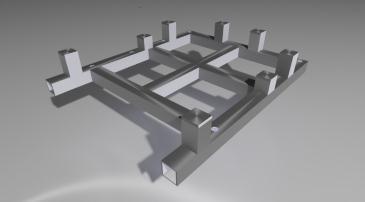
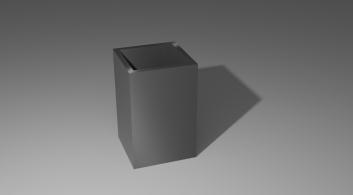
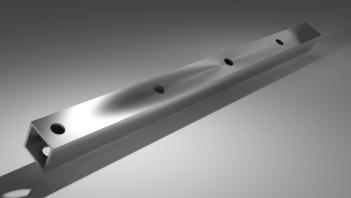
The3DModeloffixtureisdraftedusingCATIAV5software. Thedimensionsoffixturechosenfromtheenv200mountings andshakertableholetoholedistance.
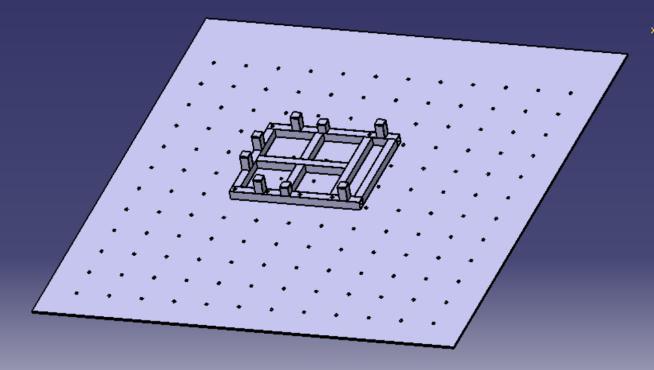
Thedimensionsareasfollows:
1. Baseplateholeradius=5mm
2. Baseplatelength=1300mm
3. Baseplatebreadth=1400mm
4. Baseplateheight=5mm
5. Overallwidthoffixture=325mm
6. Overalllengthoffixture=400mm
7. Squarechannelthickness=2mm
8. Squarechannelsize=25×25mm
9. Highestsupportmemberheight=40mm
10. Shortestsupportmemberheight=25mm
11. Baseplateholecentretocentre=100mm
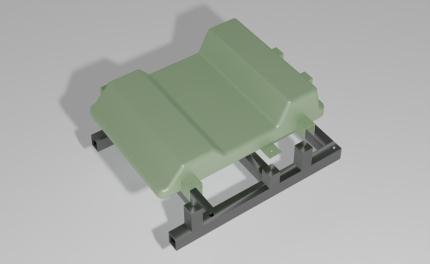
Theenv200batterymodel:
Primarymemberoffixture:
3. FINITE ELEMENT ANALYSIS
3.1 Modal Analysis

Modal analysis is performed to find out the natural frequencyandmodeshapes.Thedesiredfixtureshouldhave natural frequency of first mode beyond the operational testingfrequencyrange.Modalanalysisiscarriedoutusing Ansysworkbench.
Thematerialpropertiesusedasfollows:
Young’s
Base Plate:

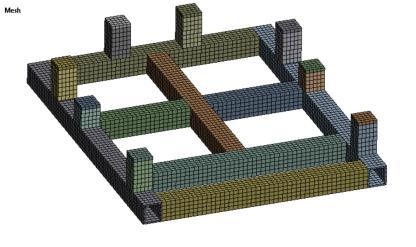
MeshinginAnsys:
FixtureAssembly:
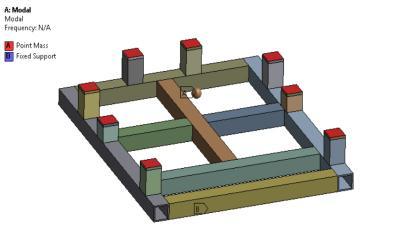
BoundaryconditionsinAnsys:
Battery
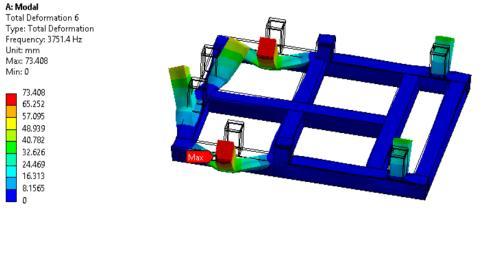
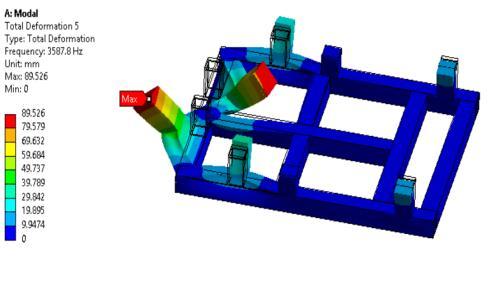
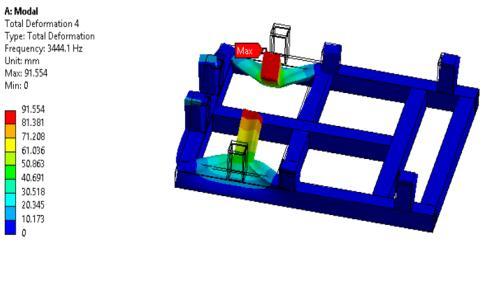
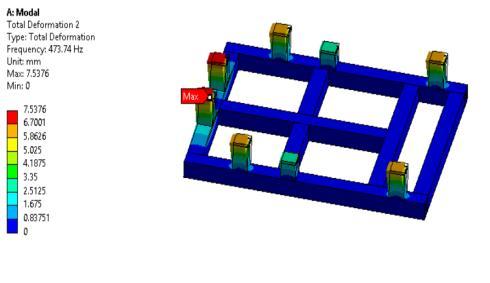
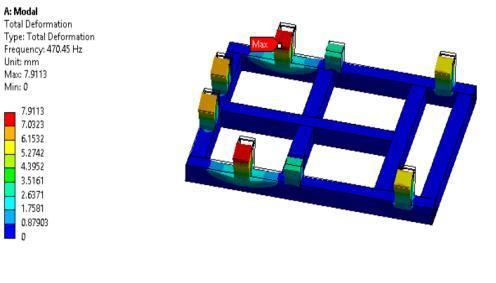
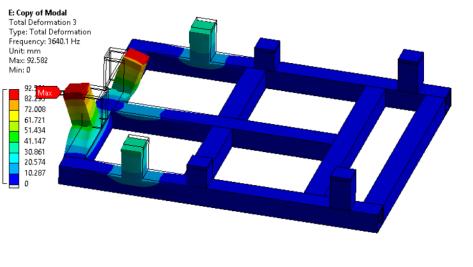
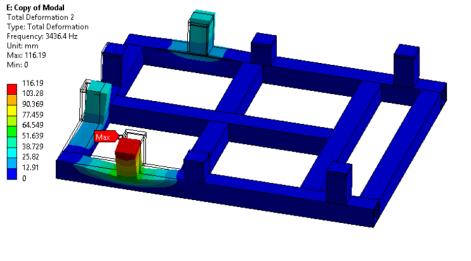
Results:Totaldeformationresultsofrespectivemodeshapes
NaturalFrequencyobtainedareasfollows:
Natural frequencies obtained from modal analysis lyingbeyond200Hzwhichismaximumoperatingrange.the firstmodeshapeobtainedas470.45Hzwhichiswaybeyond 200Hz
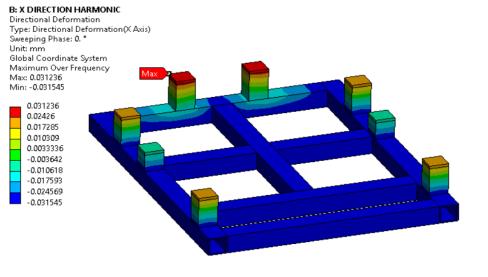


HarmonicresponseinX-axisareasfollows:
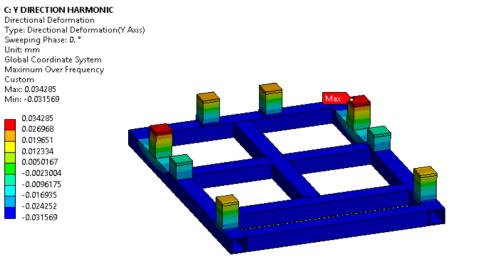
HarmonicresponseinY-axisareasfollows:
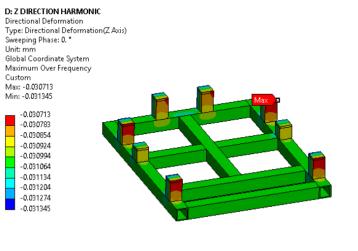
HarmonicresponseinZ-axisareasfollows:
3.3
Totaldeformationresultsofrespectivemodeshapes areasfollows:
ResultsobtainedfromexperimentalFEAareasfollows:
4.
The experimental validation is done by using FFT (Fast FourierTransform)analyzer



4.1
Impact Excitation method is commonly uused for experimental modal testing Hammer impacts are widely recognizedfortheirabilitytogenerateabroadanddiverse excitation signal, making them highly suitable for modal testing purposes. With minimal equipment and setup requirements,thismethodoffersconvenienceandflexibility. Itsversatilityandmobilityenableefficienttestinginvarious settings,whileconsistentlydeliveringdependableresults
Although it has limitations with respect to precise positioning and force level control, overall its advantages greatly outweigh its disadvantages making it extremely attractiveandeffectiveformanymodaltestingsituations
4.2 Experimental Procedure
1. Initially fixture is designed according to existing boundaryconditionasperFEAresults.
2. FFT consists of impact hammer, accelerometer, data acquisition system in which each supply is applied to DAS and laptop with DEWSOFT software to view FFT plot.
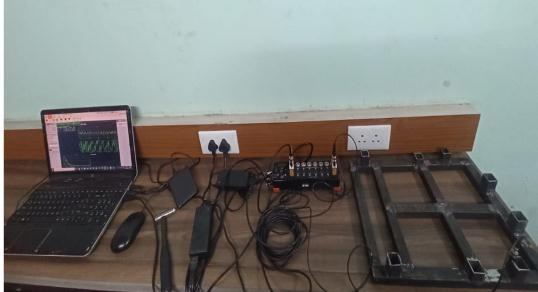
3. Accelerometer is mounted at edge as per high deformationobservedinFEAresultsalongwithinitial impact of hammer are placed for certain excitation to determinefrequencyofrespectivemodeshapes.
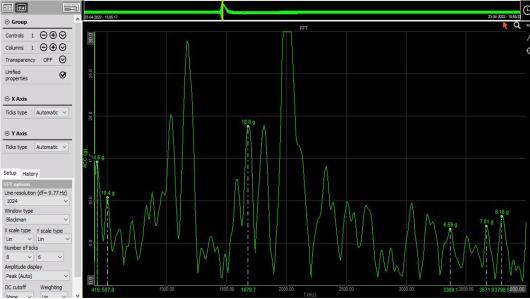
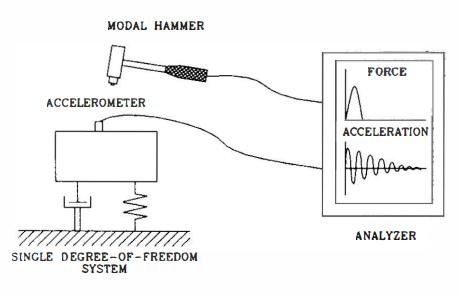
4. After impact FFT plot are observed on laptop and comparison of FEA and experimental results are analyzed.
4.3 Comparison of Numerical and Experimental Results
5. CONCLUSIONS
Thefixturedesignismostimportantpartinindustrydueto checking of component in real world condition. In this projectstudyonthedesignparameterrequiredtodesignthe automobile component holding vibration fixtures develop the literature survey on the design parameter of the vibration fixture. The fixture needs to sustain all types of loadingcondition.Performthemodalanalysisonthefixture to find out the natural frequency of the battery holding fixture. The fundamental frequency of 4-wheeler battery fixture at loading condition observed is 470.45 Hz. ExperimentaltestingdonebyFFTandcomparedNumerical resultswithexperimentalresults.
ACKNOWLEDGEMENT
Firstly,wewouldthanktoourguideDr.P.T.Nitnawarefor guiding us and showing us way to proceed with the dissertationeffectively.WethankDr.P.T.Nitnaware,HODMechanicalEngineeringforencouragingustodothingswith integrityandhaveresearch-basedapproach.Wewouldlike tothankotherfacultiesfortheirguidanceandsharingtheir knowledge,institution.Lastbutnotleast,wewouldliketo thank our friends who helped us make our work more organizedandwell-stacked.
REFERENCES
[1] XiaHua,AlanThomasandKurtShultis“Recentprogress in battery electric vehicle noise, vibration, and harshness”SAGEJournals,March-31-2021
[2] Yi Zheng,“Finite element analysis for fixture stiffness”,Thesis submitted toWorcester polytechnic Institute2005
[3] Shailesh S. Pachbhai, Laukik P. Raut - “A Review on Design of Fixtures”. Journal - International Journal of EngineeringResearchandGeneralScienceVolume–02 DOI–Feb2014
[4] Dr.K.V.Vidyanandan-“BatteriesforElectricVehicles”. Journal - A House e-Journal of Corporate Planning Volume–01DOI–June2019
[5] Guide to FFT Analysis (Fast Fourier Transform) | Dewesoft
[6] How To Perform Modal Analysis Lesson 1 - ANSYS InnovationCourses