Implementing Blockchain based Architecture for Securing Electronic Health Record System
Prof Jeenath Laila N1, Sathya M2
Abstract -Modern healthcare systems are known for being quite expensive and complex. However, this can be decreased by using blockchain technology, better health record management, and insurance agencies. Blockchain was initially developed to offer decentralised records of financial transactions independent from centralised authorities or financial organisations. Improvements in medical record, insurance billing, and smart contract transactions have been made possible by advances in blockchain technology, which also provides a distributed database of transactions and permanent access to and security over data. The capacity to improve the interoperability of healthcare databases and expand access to patient medical information, device tracking, and prescription databases is a key benefit of employing blockchaintechnologyinthehealthcaresector. Toproperly prescribe medication, access to individuals' medical history is necessary, andblockchain technology has thepotential to significantly improve the healthcare services framework. In thisproject,a numberofblockchain-basedimprovements to present healthcare system restrictions are investigated, includingframeworksandtoolstogaugetheeffectivenessof such systems, including Hyperledger Composer. The suggested system employs blockchain in place of the clientserver architecture used by conventional EHR systems to increaseefficiencyandsecurity.
Key Words: Healthcare systems, Security, Chaincode, Electronic healthcare records
1. INTRODUCTION
A blockchain is a peer to peer (p2p) distributed database (i.e.,ledger)thatmaintainsanever-growinglistofrecords, called blocks, that are linked and secured, typically using public-keycryptography[13].Withblockchaintechnology, newinformationisaddedtoablockandmadeavailableto all nodes in a decentralized network, instead of being addedtoacentralizeddatabaseinatraditionalcentralized system.Eachblockintheblockchainisidentifiedbyahash value, which is usually generated using a secure hash algorithm (SHA-256) [13]. The hash value of the header (parent) of the current block is bound and stored in the next block (child) [12]. Blockchain participants have privatekeysthattheycanusetodigitallysignandconfirm transactions.
Fig-1: Anexampleledgerwithdetailsofblocks
As shown in Figure 1, a block consists of a header containing metadata and a long list of transactions made inthatblock.Ablockheaderusuallycontainsatimestamp, token, version and proof of weight. The timestamp indicatesthetimewhentheblockwascreated; nonceisa random number generated by the consensus algorithm to comparethehashvalueoftheblock; versionindicatesthe blockchain version number; and proof of difficulty is generated by a hash value that must be less than the current target hash value. The first block, known as the Genesis block, is hard-coded by embedding random data into the blockchain application [13]. In a block, all events are linked with each other using a Merkle tree [13]. A Merkle tree is an inverted binary tree that blockchain technology uses to summarize all transactions in a block. To form this tree, a pair of events is recursively compressed until they form only one root node at the top ofthetree,calledtheMerkleRooT.Specifically,theMerkle istheroothashofallthetransactionsthatmakeupablock of the blockchain. Every small change in the data changes the Merkle root hash value, resulting in an incorrect record. The most common cryptographic hash algorithm used to build a Merkle tree is the Secure Hash Algorithm (SHA-256).Ifthereisanoddnumberofevents,thehashof the last event is multiplied to produce an even number of events, resulting in a balanced tree. Blockchain can be permissionless or permissionless [11]. A permissionless network or public blockchain allows any user to create a personal address, join the network and participate in consensus, while a permissioned or private blockchain network allows only a limited number of nodes to join. Although each block has only one parent and one child, a valid block can temporarily have two or more children created when two or more nodes are added simultaneouslytoblocksleadingtotwoormorebranches from the same parent [12]. This situation is called "fork"

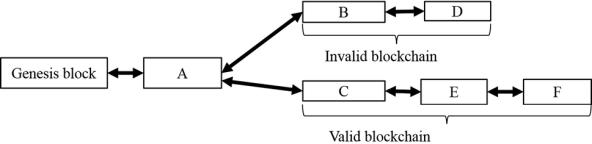
andiseliminatedbytaking thechainthatbecomeslonger thantheothersasthevalidblockchainandinvalidatingall the others that are shorter (the orphan chain), where Figure3showsthebifurcatedsituation.Itispossible.that the formed branches are of equal length; in this situation, the process of adding new blocks continues for all validation chains until one branch becomes longer than theothers,thusvalid.
identifier ensures that all records on the chain with that identifier are linked to create a comprehensive EHR for that patient across all of their providers and payers. The health metadata blockchain avoids the scalability challenges that placing large data-intensive EHR records directlyontheblockchaincanpresenttothetechnology.
1.2 Medical Blockchain Platform
Fig -2: Blockchainvalidationfortheforksituation
Nodes in the blockchain network perform a consensus algorithm to confirm transactions. Several consensus algorithms are available for blockchain technology, such as Proof of Work (PoW), Proof of Stake (PoS), Delegated ProofofStake(DPoS)andProofofDifficulty(PoD)[6,13]. InPoW,miningnodesthatwanttoadd(mine)anewblock totheblockchainmustfirstsolveacomplexmathematical puzzle that requires a lot of computing power. A miner who solves the puzzle adds a new block and is paid in bitcoins. UnlikePoW,inPoS,the node thatcreates a new blockisdeterministicallychosenbasedonitscontribution (wealth). PoS saves the energy needed to solve the mathematical puzzle in PoW, and only a validator is needed to validate new transactions and blocks. DpoS triestosolvetheconsensusproblembyusingdelegates.It uses a real-time voting and reputation system to create a limited number of trusted agents that validate and validate blocks.Theyareallowedtocreateblocksandadd themtotheblockchainnetwork,aswellasdenymalicious nodesfromparticipatinginaddingblocks.
1.1 Blockchain and Electronic Health Record
Blockchain can enable a comprehensive, interoperable and secure electronic information system data,wherehealthcareconsumersaretheultimateowners of their electronic card devices. These events and records aregeneratedbydifferentnodesinthenetwork,suchasa service provider or a consumer downloading health data. Blockchain provides authentication of data on the chain by requiring users to provide a signature and timestamp with a private key to access the data. Therefore, the logic built into the blockchain allows consumers the best of both worlds, providing access to doctors when needed, while protectingdatafromunauthorizedusers.Theuseof multiple digital signatures via PKI and cryptographic hashes ensures that healthcare metadata and EHR hashes travelsecurelyoverthenetwork andare onlyavailableto parties with the correct public keys for access. Using blockchain digital signatures to create a unique patient
Medical BC allows various healthcare providers, such as doctors, hospitals, laboratories, pharmacists and insurancecompanies,torequestpermissiontoaccessand interact with patient data. Every interaction is auditable, transparent and secure, and recorded as a transaction in Medical BC's distributed ledger. It is built on the permission-based Hyperledger Fabric architecture, which allows different levels of access; patients control who can see their records, how much and for how long. The blockchain is currently under development. Medical BC is collaborating with Wings and Hyperledger to bring the platform to life. Medical BC aims to provide patients and healthcare providers with the following key benefits: information can only be accessed using the patient's private key; even if the database is hacked, the patient data is unreadable (all encrypted). Patients can fully control access to their health information; patients control who sees their data and what they see Instant transfer of medical data, where every member of the decentralized network of healthcare blockchain would have the same information about the patient; the risk of errorsislowerand patientcareisbetter
2. LITERATURE SURVEY
Lixia Chen et al. [1] proposed that electronic health records reduce the cost of traditional medical data storage. EHRs are designed to allow patients to manage their medical information.Data usershavelimitedaccess to the EHR. At the same time, patients do not share their private medical information with data users, demonstrating the value of patient EHR security and privacy.Regardingtheuseof electronichealthrecords,an encrypted search of such data must be carried out. Based on this, a permissioned blockchain-based medical informationsystemispresented,whichusescipher-based attribute encryption to control data confidentiality and medical information access. The premise to ensure the privacyofthepatient'sidentityistheuseof apolynomial equation to combine arbitrary keywords, after which blockchain technology is combined. In addition, the proposed system has a keyword indistinguishable from keyword attacks selected based on the random oracle model.
ShangJiangetal.[2]proposedablockchain-based platform called BloCHIE for health information exchange, which is proposed to overcome the challenge. First, the
requirements for sharing health information from different sources are analyzed. Based on the above analysis, two loosely coupled blockchains are used to process various health data. EMR - circuit for electronic patient records and PHD - circuit for personal health services.Off-chainstorageandon-chainauthenticationare combined to meet both privacy and authenticity requirements. Finally, two compression algorithms are proposed to improve system performance and user controllability.
Hui Li et al. [3] hypothesized that advances in digitization and cloud storage have led to the conversion of data from paper to electronic devices. Interoperability between different hospital systems hinders information sharing. In order to meet the high requirements of information sharing, some researchers have proposed relative systems of cloud storage and data processing technologiestoprovidesuitablesolutionsforcompression storage and processing requirements. To solve the above problems, MedBlock, a blockchain-based information management system, is offered for patient information processing. In this system, an advanced consensus mechanism achieves consensus on EMRs without high energy consumption and network congestion. MedBlock also has high security, combining custom access control protocolsandsymmetricencryption
Rui Zhang et al. [4] proposed a distributed attribute-based signature system for health blockchain that provides effective privacy-preserving verification of HER data authenticity and signer identity. In addition, a comprehensive on-chain and off-chain shared storage system for efficient storage and authentication of HER dataisdescribed.Analyzesandtestsshowthatthesystem iseffectiveandusable
Guan Yan et al.[5] proposed that public health workers provide different health services in different locations. Users who grant access rights to databases can request regular user records from other service providers if necessary,forexample,lookingatrelatedrecordstomake a diagnosis. Due to the lack of standardized system integration, managing the entire healthcare system is currently a major challenge. Often, the demands of users andhealthcareprovidershavealsoraisedquestionsabout data interoperability, security and privacy. Therefore, a blockchain-based architecture is proposed to improve the interoperability issues of current HER systems and prevent user record corruption and malicious misuse. A blockchain-based architecture for electronic health information systems (HER) is presented. The proposed architecture also introduces a new incentive mechanism for creating new blocks on the blockchain. The architecture is independent of specific blockchain platforms and open to further extensions, making it
potentially suitable for other electronic storage systems that require protection against tampering and abuse.
HaoWangetal.[6]proposedasecureEHRsystem based on attribute-based encryption and blockchain technology to achieve confidentiality, authentication, medical data integrity, and access control support. In the proposed system, attribute-based encryption (ABE) and identity-based encryption (IBE) are used, and identitybased signature (IBS) is used to implement digital signatures. To achieve the different functions of ABE, IBE, and IBS in a single cryptographic system, a new cryptographic primitive called Combined AttributeBased/Identity-BasedEncryptionandSignature(C-AB/IBES)isintroduced.Thismakessystem management easier, and there is no need to implement different encryption systemsfordifferentinformationsecurityrequirements
Rui Guo et al.[7] argued that electronic health records (EHRs) are controlled by hospitals rather than patients, making it difficult to seek medical care from differenthospitals.Patients needtofocusonthedetailsof their treatment and regain control of their medical information. This technology provides patients with comprehensive,immutableinformationandaccesstoEHR data without the need for providers and care locations. EHRs are encapsulated in a blockchain, attribute-based signature model with multiple authorities. In addition, there are several institutions that do not have a reliable single or central device that generates and distributes patientpublic/privatekeys,whichavoids theproblemof escrow and validates decentralized data storage on the blockchain. By sharing secret seeds of pseudo-random operationsbetweenpowers,thisprotocolresists Nsecret attacksfromN-1corrupt powers.Withunforgeabilityand completeprivacy,thisattributesignatureschemeissecure inarandomoraclemodel.
Qi Xia et al. [8] pointed out that the dissemination of patient medical records brings various risks to patient privacy, because malicious activity in those records seriously damages the reputation, economy, etc. of all parties directly or indirectly related to the data. The system is based on blockchain and provides data origination, review and management of shared medical information in cloud storage across big data entities. The design uses smart contracts and an access control mechanism that effectively monitors data behavior and prevents intruders from accessing data when violations aredetected.Itusessmartcontractsandanaccesscontrol mechanism that effectively monitors data behavior and revokesaccesstoviolatedrulesand data.Performance is analyzedandcomparedwithstate-of-the-artsolutionsfor sharingdatabetweencloud providersandentitiessuchas research and medical institutions without compromising dataprotection.
According to Liang. X. et al. [9], mobile and wearable technology enable personal health data to give significant and growing value for healthcare, benefiting both care providers and medical research.The current systemsforstoringandsharingpersonalhealthdatahave a number of possible privacy flaws and risks, hence a noveluser-centeredsolutionforexchanginghealthdatais suggested. In order to guarantee privacy utilising a channel formation scheme and improve identity management using a membership service powered by blockchain, this proposal uses a decentralised and permissioned blockchain. For the purpose of exchanging health information with healthcare professionals and healthinsuranceproviders,amobileapplicationisusedto gather data from medical equipment, wearable personal gadgets, manual input, and other sources.The system is constructed throughout the implementation of HyperledgerFabric
Xiao Y. et al [10] proposed a blockchain-based Healthcare Data Gateway (HDG) architecture that allows patients to easily and securely own, manage and share their data withoutcompromisingprivacy.healthsystems keepinginformationprivate.Theproposedmodelensures that patients own and control their health information; a simple unified indicator-centric scheme (ICS) allows organizing all kinds of personal health information in a practical and simple way. Based on the architecture, patients do not need to trust any third party and are alwaysawareofwhoisusingthedataandhowitisbeing used. A decentralized platform makes it easier to make legalandregulatorydecisionsaboutthecollection,storage andsharingofpatientdata.
3. PROPOSED SYSTEM
However, in terms of EHR management, traditional blockchain solutions have two major drawbacks. First, while the blockchain can ensure data integrity, it lacks adequate access control mechanisms to encompass the activities of various actors. Second, the blockchain block size is too limited for EHR data that containsimages(eg,X-ray,CTscanandMRI)and/orvideo (eg, ultrasound). A hybrid architecture using both blockchain and edge nodes is proposed to facilitate attribute-based EHR data accesscontrol.This isachieved usingHyperledgerComposer.Specifically,theHyperledger Composer Fabric blockchain implements smart contracts programmed with access control lists (ACLs) to enforce identity-based access control of EHR data and record legitimateaccess events on the blockchainfortraceability and accountability. A hybrid architecture using the Hyperledger Composer Fabric platform was proposed to validatethedesign.In addition,several experiments were conducted to validate both smart contracts and access controlpolicies,whichshowthattheproposedsystemcan
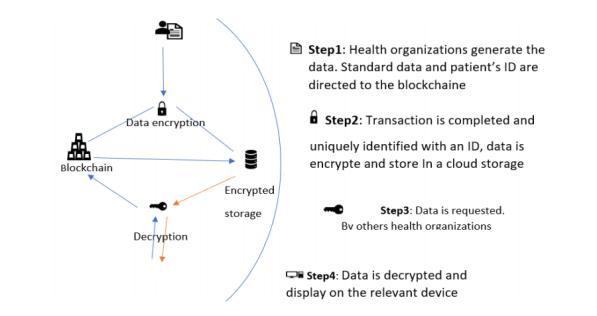
maintain traceableaccessreturnsandtransactionrecords for EHR data management. System performance was evaluated by testing multiple transaction processing times and average response times to unauthorized EHR data requests in various settings. Hyperledger Composer Fabric supports ready-made chaincode written in Go and JavaScript, as well as in other languages such as Java by installing the corresponding modules.The process flow of a blockchain transaction can be summarized in four main stepsshownintheFig.3:
1. The healthcare organization stores information in the blockchain: The healthcare organization provides services to the patient and storesthepatient'sdata(adoctorcanwriteanote or a pharmacy can dispense medicines) in the existinghealthcareITsystem.Thedata fieldsand the patient's public identifier are then pushed to theblockchainviaAPIs.
2. The transaction is completed and uniquely identified: each transaction is encrypted and given an identity stored on a blockchain containing the public (de-identified) ID of the patient[2].
3. Healthcare organizations and institutions can make requests directly from the blockchain: Healthcare organizations and institutions send their requests through APIs and use the patient's publicIDontheblockchaintoretrieve encrypted information. Patient information (eg, age, gender, disease, physician) is now visible and can be analyzedfornewinsights.
4. Patients can specifically give anyone access to their medical information: a patient's private key links their identity to blockchain data. This private key can be shared with new healthcare organizations that can use it to decrypt patient data. Thus, the data is not identifiable to those whodonothavethekey.
3.1 System Architecture
The figure shows a hybrid architecture that facilitates access control of EHR data using both blockchainandedgenodes.Thefollowingentitiesthat contributetoarchitecturearelisted.
1.Patient:Thepatientisthepersonwhoownsthe EHR data being used. The patient can define the principlesofuseoftheEHRdatabelongingtohim.
2.Healthcareprovider:Ahealthcareprovider(eg doctorandnurse)isalegalentitythatneedsaccessto patient EHR data. The health care provider actively seeksaccessauthorizationsfrompatients.
3. Smart sensor/imaging device: A smart sensor is a device that collects EHR data from patients and sends it to the edge node. Imaging equipment can include X-rays, CT scans, MRIs and ultrasounds that generateEHRdataaboutpatients.
4. EHR data: EHR data is data owned by patients that can be accessed by authorized healthcare providers.
5. Blockchain: Blockchain is used as an architectural controller that manages access control policiesandactsasanunauthorizedaccessprotocol.
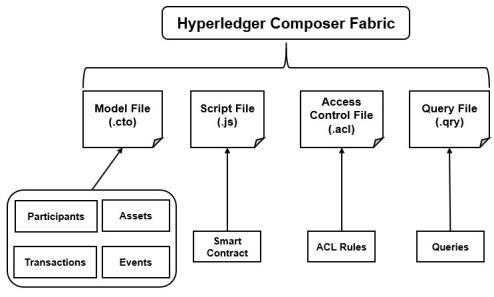
A web application based on the Hyperledger Composer Fabric blockchain is designed and developed to implement and evaluate the access control mechanism. As shown in Figure 4, the Hyperledger Composer Fabric infrastructure includes four programmable components. The first part is to definenetwork properties in a template file (.cto), which includes participants, URLs, events and an access control log. The second part is to write smart contracts in a script file(.js), which contain the event handling functions. The third part is to define ACL rules for different participants in the Access Control File (.acl).Finally, databasequeries are defined in the QueryFile(.qry).
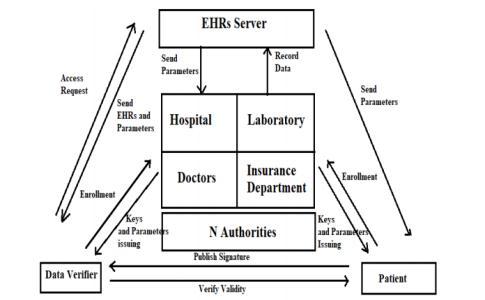
ThisEHRsystemmodelconsistedofthefollowingfour parties:EHRserver,Nfacility,patients,anddatacertifiers. As shown in Figure 6, the EHR server is just like a cloud storage server responsible for storing and sending EHRs. N authorities are various organizations such as hospitals, health insurance organizations, medical research institutes, etc., which are responsible for receiving registrationsandexchangingpatientinformation.Patients cancreate,manage,administerthedatacontrollerhasthe righttoaccess andverifythissignature.
Fig-5:
systemmodel
3.1.1 Implementing Hyperledger Composer Fabric Blockchain
A web application based on the Hyperledger ComposerFabricblockchainisdesignedanddevelopedto implement and evaluate the access control mechanism. Hyperledger Composer Fabric is a blockchain application platform that provides a modular and extensible architecture that allows components such as a consensus mechanismtobeconnectedandused.Additionally,ituses container technology to host smart contracts called "chaincode"thatcontainthesystem'sapplicationlogic.
3.1.2 Creation of Participants in the Network
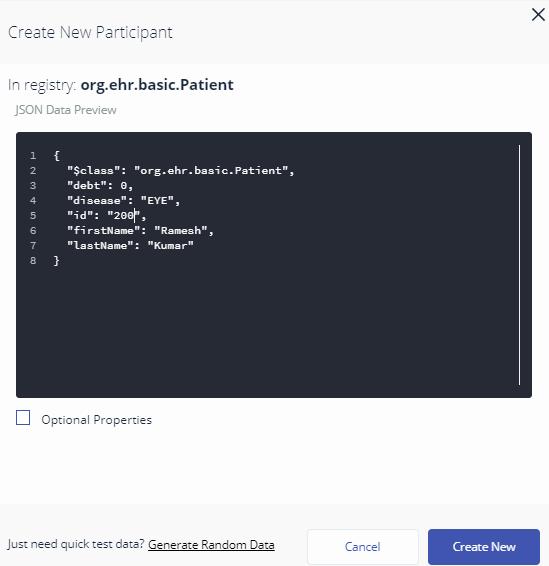
Participants register using the client application orSDK.Alltransactionsaresharedacrossthehyperleader fabricblockchainnetwork. Patientscanaddrecordsusing a client application that calls a chain code to link the transaction to the network. Once a transaction is committed to the blockchain network,updated transactions are shared across the network. The administrator has full access to the system, including writing, reading, updating and deleting participants. If doctors, patients or laboratory workers are eligible, the administrator can give each participant an appropriate token that allows access to the blockchain network. If a participant's behavior is found inappropriate, an administrator can remove the participant with a note via thehyperledgerblockchainnetwork..
3.1.3 Defining Access Control Lists using Smart Contracts

Patient’s EHR addressisstoredasa personal asseton the blockchain network. An access control list (ACL) allows physicians to obtain patient EHR addresses while the patient can only obtain their own EHR address. The requestprocessisdefinedasaneventprocessinthesmart contract, and the participants who initiate it send their requests. Finally,all historical searcheventsarestored as immutable and traceable EHR access control logs on the blockchain network. After the edge nodes have collected the patient's EHR data, the patient can enforce an ACL policyontheirEHR data.BydefininganACL policy,itcan determine which data users can read, write, and update content. In other words, we provide conditions and restrictions on: "who" can do "what" on the blockchain ledger
3 1.4 Committing Transactions to the network
The records are updated and visible to every user of the blockchain network. Service providers, such as doctors and laboratory workers, can request the necessary information online. If the patient gives the right to view andupdatetheirrecordsintheEHRregistrationnetwork, the physician or laboratory participant can view and update the patients' consent records as needed. After accessing the blockchain network, the patient has several rights,suchasreading,writingandcancelingEHRrecords. This operation of the patient node applies this identificationtotheblockchainnetwork.Ifa patienthasa valid node, patient, physician, and laboratory personnel datacanbeviewedorsearchedonline.Thedoctoralsohas access to his list of patients, which includes first and last names.If a physicianwants toretrievea specificpatient's EHR data,heorshemustsubmita transaction request by entering the patient's ID number. Once the request is submitted, the system returns the patient's EHR. At the same time, the blockchain network permanently records this search operation as a transaction transaction, includingthetransactionIDand timestamp.
4. RESULTS AND DISCUSSION
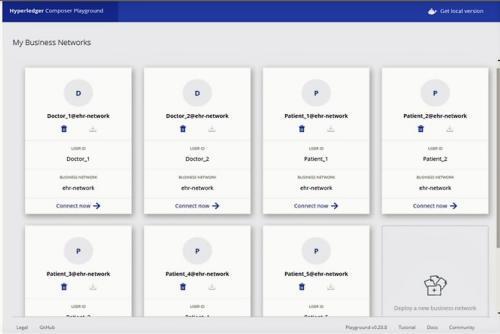
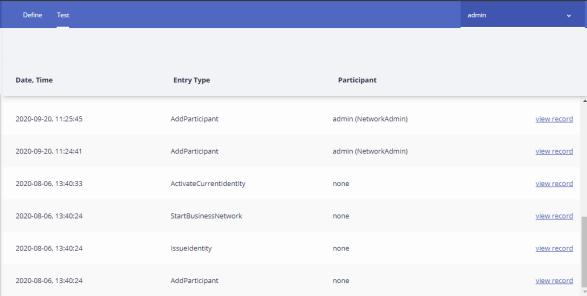
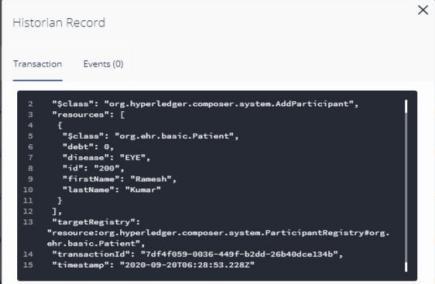
Fig. 5 shows the experimental setup on Hyperledger Composer Fabric with two doctors and five patients as participants where each participant has a unique digital ID to log into the blockchainFig. 6 shows theprocessofcreationofnewparticipantsinthenetwork.
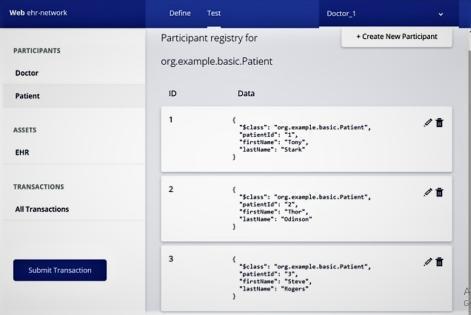
Thepatienthasvariousrights,suchasread,write and revoke EHR records. If the patient has a valid node, then patient, clinician and laboratory staff records can be viewed or searched over the network. Also, a doctor is allowed to access his/her list of patients, including ID numbersfirstandlastnamesasshownintheFig.10:
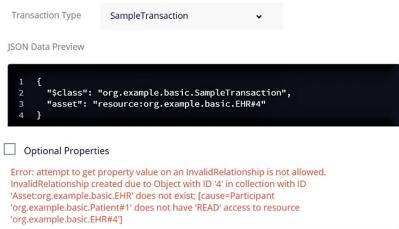
retrievalactionasatransactionevent,includingtheevent IDandthetimestampasshownintheFig.11.Forinstance, if a patient attempt to retrieve the EHR data of another patient,thesystemwillrejectthistransactionrequestand returnanerrormessageindicatingthatthisrequestisnot allowed,asshowninFig.12
Fig-10: Adoctoraccesseshis/herlistofpatients
Fig-11 :Adoctorcanretrievehis/herpatients’EHRs
If a doctor wants to retrieve one specific patient’s EHR data, the doctor needs to submit a transaction request by entering the patient’s ID number. Upon submitting the request,thesystemwillreturnpatient’sEHR. Atthesame time,theblockchainnetworkwillpermanentlyrecordthis
:Apatientcannotretrieveotherpatients’EHRs
The network was tested using Hyperledger caliper. Hyperledger caliper is a blockchain benchmark tooldevelopedbyLinuxfoundationthatteststhenetwork usingthefollowingparameters:

Transaction throughput: the rate in which it commits valid transaction in the defined period of time.
Transaction latency: transaction latency is the time takenbetweenwhenthetransactionissubmittedand when the transaction is confirmed committed across thenetwork.
Send Rate: send rate is defined as number of transactionssentpersecond.
Table 1 and 2 indicates performance of the proposed hyperledger composer blockchain network. Increase in the number of transaction increases the throughput and send rate with latency. While an increase in the number of peers decreases throughput and increases latency while the send rate is constant for the same number of transactions. This is due to the fact that an update in the ledger now has more peers to send the proposed change for verification and final updation to theirlocalcopyoftheledgerthroughoutthenetwork.
Table -1: Performanceanalysis forthoroughput
Table -1: Averagelatencyfordifferenttransactions
[5] YangG,LiC.Adesignofblockchain-basedarchitecture for the security of electronic health record (EHR) systems. In: 2018 IEEE International conference on cloud computing technology and science (CloudCom); 2018.p.261–5.
[6] WangH,SongY.Securecloud-basedEHRsystemusing attribute-based cryptosystem and blockchain. J Med Syst2018;42(8):152.
[7] GuoR,ShiH,ZhaoQ,Zheng D.Secureattribute-based signature scheme with multiple authorities for blockchain in electronic health records systems. IEEE Access2018;776(99):1–12.
5. CONCLUSIONS
The integration of blockchain technology in healthcare research can bring many benefits, including improved data sharing and tracking, enhanced transparency, and better privacy for patients. This proposal suggests an architecture that uses blockchain technology in national electronic health record (EHR) systems to ensure data integrity and interoperability. The framework offers secure record storage, granular access rules, and measures to address data storage issues, information asymmetry, and access control. Hyperledger Composer is used to execute smart contracts and impose access control policies, ensuring traceable access events and transaction records for EHR data management. By using blockchain, trust among healthcare organizations can be ensured, the overall cost of treatment can be reduced, and the standard of the healthcare industry can beimproved.Althoughitmaytaketimetoadapt,including HyperledgerFabriccanprovideanindustrialstandardfor the field of healthcare, enabling the tracking of patient recordsfromstarttofinish.
REFERENCES
[1] Niu, S., Wang, J., Chen, L. (2019) Electronic health record sharing scheme with searchable attributebasedencryptiononblockchain.IEEEAccess.
[2] Jiang S, Cao J, Wu H, Yang Y, Ma M, He J. Blochie: a blockchain-based platform for healthcare information exchange. In 2018 IEEE International conference on smartcomputing(SMARTCOMP);2018.p.49–56.
[3] FanK,WangS,RenY,LiH,YangY.Medblock:efficient andsecuremedicaldatasharingviablockchain.JMed Syst2018;42(8):136.
[4] SunY,ZhangR,WangX,GaoK,LiuL.Adecentralizing attribute-based signature for healthcare blockchain. In: 2018 27th International conference on computer communicationandnetworks(ICCCN);2018.p.1–9.
[8] Xia Q, Sifah EB, Asamoah KO, Gao J, Du X, Guizani M. Medshare: trust-less medical data sharing among cloud service providers via blockchain. IEEE Access 2017;5:14757–67.
[9] Liang X, Zhao J, Shetty S, Liu J, Li D. Integrating blockchain for data sharing and collaboration in mobile healthcare applications. In: Personal, indoor, and mobile radio communications (PIMRC), 2017 IEEE 28th annual international symposium on; 2017. p.1–5.
[10] Yue X, Wang H, Jin D, Li M, Jiang W. Healthcare data gateways:foundhealthcareintelligenceonblockchain with novel privacy risk control. J Med Syst 2016; 40(10):218.
[11] Swan, M. (2015). Blockchain: Blueprint for new economy.Newton:O’ReillyMedia,Inc.
[12] Antonopolous, A. M. (2014). Mastering bitcoin: Unlocking digital cryptocurrencies. Newton: O’Reilly Media,Inc.
[13] Nakamoto,S.(2008).Bitcoin:Apeertopeerelectronic cashsystem.https://www.bitcoin.org/bitcoin.pdf