Developing Algorithm for Fault Detection and Classification for DC Motor Using Predictive Maintenance
 Karan Jagdish Chanchlani1 , Dr. Dipesh H Makwana2
1Student, Instrumentation and Control Dept, LD College of Engineering, Ahmedabad, Gujarat, India
2Associate Professor, Instrumentation and Control Dept, LD College of Engineering, Ahmedabad, Gujarat, India

Abstract - Maximizing production quantity and quality while retaining the lowest possible production and maintenance costs is the primary goal of an industrial facility or utility. This can only be accomplished if the plant operates effectively; hence, regular maintenance is required. There are numerous tactics, but industry 4.0 predictive maintenance is among the most important. Predictive maintenance assists in foreseeing faults that will happen following data processing and alerts the operator. Predictive maintenance technology increases the efficiency of plant maintenance, lowers maintenance costs, and extends the useful life of the equipment. This study examines the design and development of the predictive maintenance algorithm for anticipating both healthy and defective data from real-time data from DC Motor Hardware
Key Words: PredictiveMaintenance,DCMotor,Industry 4.0,Tree,MATLAB
1.INTRODUCTION
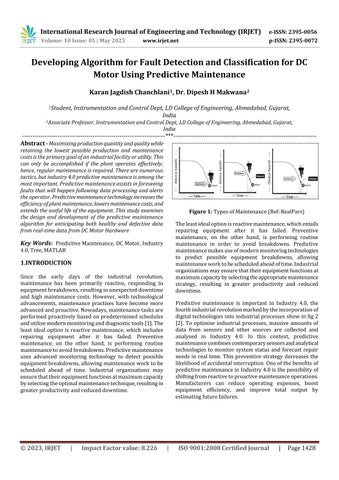
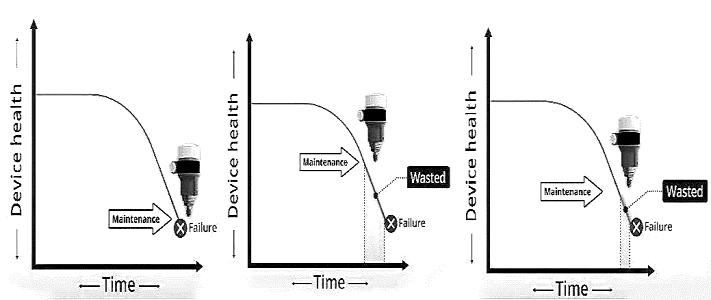
Since the early days of the industrial revolution, maintenance has been primarily reactive, responding to equipmentbreakdowns,resultinginunexpecteddowntime and high maintenance costs. However, with technological advancements, maintenance practises have become more advancedandproactive.Nowadays,maintenancetasksare performedproactivelybasedonpredeterminedschedules andutilisemodernmonitoringanddiagnostictools[1].The least ideal option is reactive maintenance, which includes repairing equipment after it has failed. Preventive maintenance, on the other hand, is performing routine maintenancetoavoidbreakdowns.Predictivemaintenance uses advanced monitoring technology to detect possible equipmentbreakdowns,allowingmaintenanceworktobe scheduled ahead of time. Industrial organisations may ensurethattheirequipmentfunctionsatmaximumcapacity byselectingtheoptimalmaintenancetechnique,resultingin greaterproductivityandreduceddowntime.
Theleastidealoptionisreactivemaintenance,whichentails repairing equipment after it has failed. Preventive maintenance, on the other hand, is performing routine maintenance in order to avoid breakdowns. Predictive maintenancemakesuseofmodernmonitoringtechnologies to predict possible equipment breakdowns, allowing maintenanceworktobescheduledaheadoftime.Industrial organisationsmayensurethattheirequipmentfunctionsat maximumcapacitybyselectingtheappropriatemaintenance strategy, resulting in greater productivity and reduced downtime.
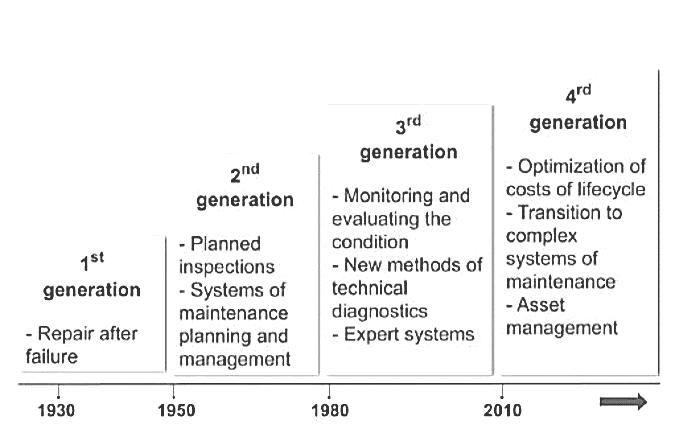
Predictive maintenance is important in Industry 4.0, the fourthindustrialrevolutionmarkedbytheincorporationof digitaltechnologiesintoindustrialprocesses showinfig2 [2]. To optimise industrial processes, massive amounts of data from sensors and other sources are collected and analysed in Industry 4.0. In this context, predictive maintenancecombinescontemporarysensorsandanalytical technologies to monitor system status and forecast repair needs in real time. This preventive strategy decreases the likelihoodofaccidentalinterruption.Oneofthebenefitsof predictivemaintenanceinIndustry4.0isthepossibilityof shiftingfromreactivetoproactivemaintenanceoperations. Manufacturers can reduce operating expenses, boost equipment efficiency, and improve total output by estimatingfuturefailures.
Predictive maintenance methods are classified into three types:data-driven,model-based,andhybridapproaches[3] Machinelearningandstatisticalapproachesareusedindatadrivenwaystoestimateequipmentfailuresandmaintenance requirementsbasedondatafrommultiplesources.Modelbased approaches use physics-based models to simulate equipment behaviour and predict maintenance requirementsundervariousoperatingsituations.Toprovide more precise and dependable estimates of equipment performanceandmaintenancerequirements,hybridsystems combinedata-drivenandmodel-basedmethodologies.
There are many additional predictive maintenance technologiesavailable,suchasvibrationanalysisusingthe FastFouriertransform[4],predictingpowersystemhealth through ageing mechanisms [5], and locating hot areas in transformers using thermal imaging [6]. Predictive maintenance can also be accomplished by anomaly identification based on thermodynamic equations for compressor discharge temperature [7], neural network analysis of data patterns [8], and root cause analysis to determinetheunderlyingcausesofequipmentfailures[9].
Predictivemaintenancesolutionsbasedonprognosticsand health management (PHM) and condition-based maintenance (CBM) methodologies are critical tools for industries, especially in this age of rapidly evolving information and communication technologies (ICTs) [10] These strategies help firms manage maintenance more effectively and reduce expenses by recognising possible problemsearlyon[11].ThenotionoftheOnlineSystemfor Condition Monitoring and Maintenance (OSA-CBM) is a criticalindustrystandardthatallowsfortheearlydetection of maintenance issues through online data analysis [12] Industriescanavoidequipmentfailuresbyembracingthis moderntechnology.
2. ARCHITECTURE OF PDM.
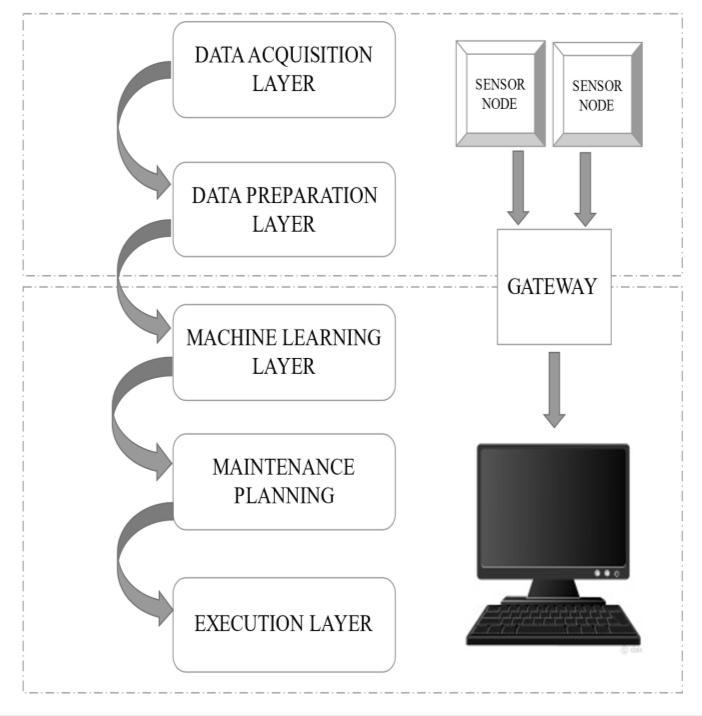
A predictive maintenance system's standard structure involves several stages. The data acquisition layer enables sensorsandotherdevicestoacquireoperationaldatafrom the equipment. The obtained data is pre-processed and filteredinthedatapreparationlayertoverifyitsquality.The machine learning layer then enters the picture, where algorithmsaretrainedtodetectpatternsandanomaliesin thedata.Finally,themaintenanceexecutionlayerisincharge of doing any necessary repairs or replacements. This architecture enables organizations to proactively discover andrepairequipmentfaults,avoidingcostlydowntimeand loweringmaintenancecosts.Asshowninfig3
3. PREDICTIVE MAINTENANCE ALGORITHM.
Asetofinstructionsusedbyacomputertosolveaproblem orcompleteataskisknownasanalgorithm.Itisasetofwelldefinedrulesusedincomputeralgorithmsforanumberof objectives including data analysis, machine learning, and optimization.Advanceddataanalyticsareusedbypredictive maintenance algorithms to predict equipment faults and maintenance requirements. These algorithms look for patterns and anomalies in historical and real-time data. Predictive maintenance algorithms help minimize costly breakdowns and enhance equipment reliability by proactively recognizing possible concerns. In Predictive MaintenanceAlgorithmtherearemainsixsteps.Theyareas follows:
Step 1: Theinitialstepistocollectdatafromdiversesources, suchassensors,machines,andsystems.
Step 2: Thegathereddataisthenpre-processedtoremove anyirrelevantornoisydataandtoconvertitintoananalysisreadyformat.
Step 3: Fromthepre-processeddata,featuresrelatedtothe maintenanceworkareextracted.
Step 4: Using the retrievedfeatures, a predictive model is createdthatcandetectanomaliesandanticipateequipment breakdowns.
Step 5: Toensureaccuracyandreliability,thecreatedmodel isvalidatedusinghistoricalortestdata.
Step 6: Thefinal stepistoputthepredictivemodel intoa real-timeproductionenvironmentwhereitcanmonitorthe equipmentandsendoutmaintenancenotifications.
4. IMPLEMENTATION OF PDM.
A. DC Motor Hardware System
The DC motor hardware system is a complicated arrangementthatincorporatescomponentssuchasa Hall effectsensor,NTCthermistor,piezoelectricsensor,Arduino Uno, and L298N controller IC. All of these components developaexampleofclosed-loopsystemthatcollectsdata suchastemperature,vibration,RPM,ADCtemperature,and thermistorresistance.This systemisan illustration of the coolingsystem.

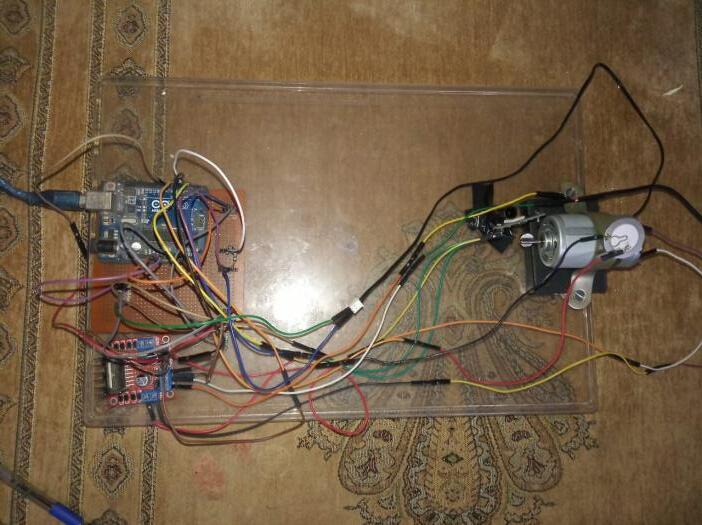
The Hall effect sensor detects the magnetic field of the motor, allowing it to calculate the RPM and monitor performance.TheNTCthermistorservesasatemperature sensor, monitoring heat levels to ensure safe operating temperatures.The piezoelectricsensor detectsvibrations, which aid in the diagnosis of mechanical faults or imbalances.TheArduinoUnoservesasthecontrol center, gatheringandprocessingsensordatawiththeADC.Basedon theinformationreceived,theL298NdriverICregulatesthe motor'sspeedanddirection.
Once all of these components are combined, a comprehensive monitoring and control setup is created, exemplifying a cooling system. It monitors vibrations and offers vital data on RPM and thermistor resistance while ensuringoptimalmotoroperationwithintemperaturelimits. Thistechnologyimproves motor performance, extendsits lifespan,andguardsagainstfuturefailures.
B. DATA COLLECTION
The hardware system is effortlessly linked to a computer using a USB port. The Arduino code is loaded into the Arduino IDE software. The code is for gathering real-time datafromthecloseloophardwaresystem,andfivefeatures are collected from the sensors linked to the system. Temperature, vibration, speed, ADC temperature, and thermocoupleresistancearethefivefeatures.Aconditionis set for operating the motor so that if the temperature exceeds the required value, the motor will start working. Thereisalsoarequirementformotorspeed,suchthatthe motor should operate at the desired value. For that PID Controller is used in Arduino code. If the motor is overloaded,itwillindicate"faulty"and"healthy"So,thelast column of data consists of a class of data, whether it is workinginahealthyconditionorafaultycondition.These dataarecollectedintheCSVfileforfurtherprocessing.
C. DATA PROCESSING
In this section, the data gathered from the DC motor hardwareisprocessedusingamachinelearningmethod.We used MATLAB to create the predictive maintenance fault detectionandclassificationProgramme.MATLABfeaturesa predictivemaintenancetoolboxthatincludestheDiagnostic Feature Designer tool and the Classification Learner application.TheDiagnosticFeatureDesignertoolisusedto extract the features, and the Classification Learner application is used to train data using multiple machine learningmodels.Aftergathering enoughdata toexecute a machinelearningtechnique,thedataisusedinclassification learnersoftwaretotrainvarioustypesofmachinelearning algorithms.70%ofthedataisusedfortrainingand30%for testing,withfivepointsofcross-validation.Furtherthedata is trained for all available machine learning models. The modelwiththehighaccuracyandminimumtimetotrainis selected and the trained model is then exported for the testingpurpose.Themachinelearningmodel’saccuracyand timeismentionedinthebelowtable.
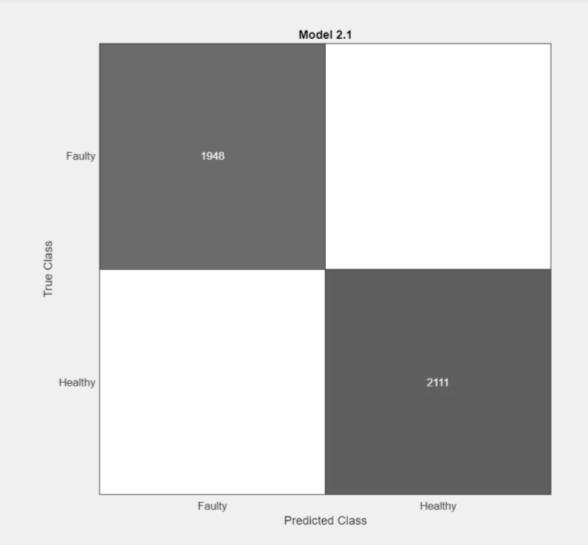
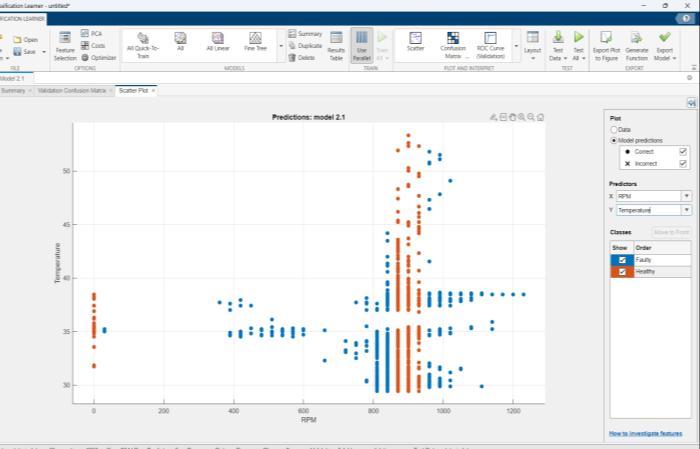
ItisobservablethatthedatacollectedfromtheHardware system can be easily interpreted. In Scatter Plot the Blue describestheFaultydataandOrangedescribesHealthydata. For plotting the scatter plot two variables are used Temperature and Speed. The X-Axis represent the TemperatureandY-AxisrepresentsRPM.AconfusionMatrix isalsoobtainedforthetraineddata.Asshowninfig7.
AfterTrainingthedataintheClassificationLearnerApp.We adoptedtheDecisionTree(DT)machinelearningmodelfor trainingsinceitprovideshigheraccuracy,moreobservation persecondsandtakeslesstimetotrainthemodelthanother machine learning algorithms. Scatter Plot is obtained for Tree.Asshowninfig6
Next, the trained model is exported to MATLAB for the furtherexperiment.Thetrainedmodelisusedtoclassifythe realtimedatawhichwehavecollectedafterdeployingthe DCMotorHardwareSystem.Therealtimedataiscollected fromthecloseloopsystemfortestingpurpose.Thedatais storedintoexcelfilewhichisusedtopredictandclassifythe data.
D. RESULTS
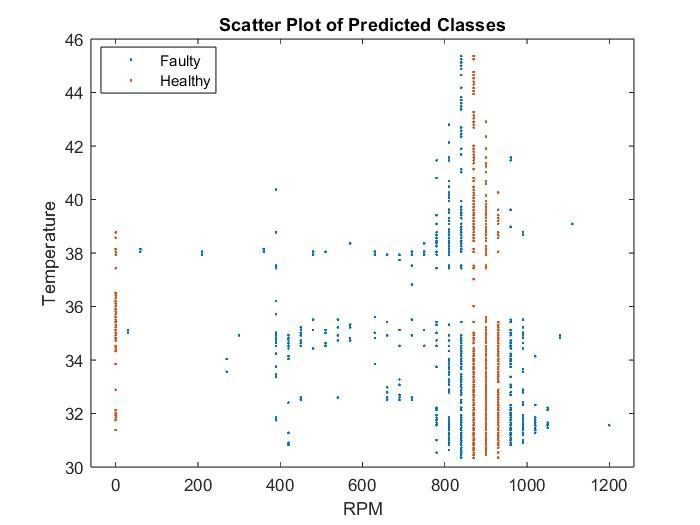
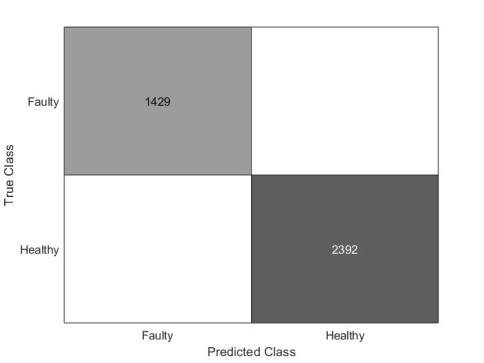
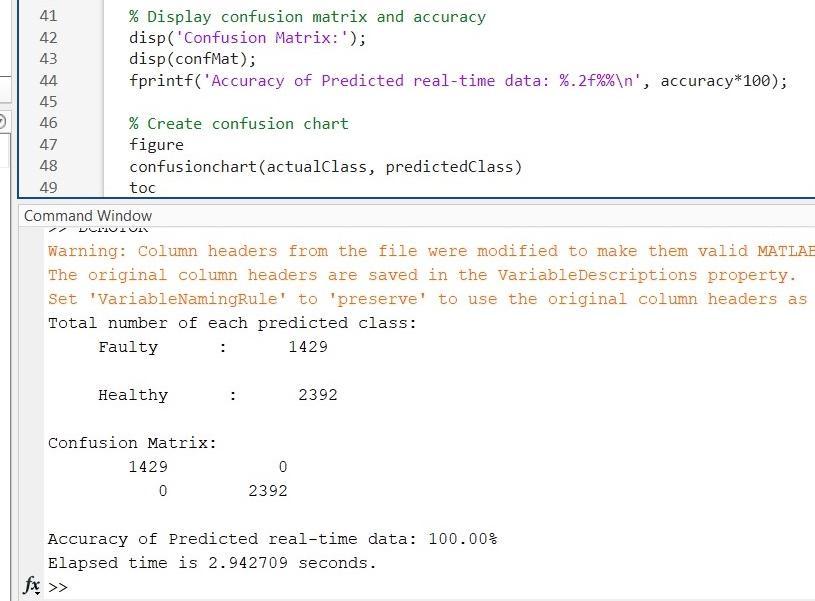
The results are show in the command which states the numberofpredictedvaluesofeachclassandalsogivesthe exactnumbersofhealthyandfaultydata.Italsogenerated theconfusionmatrixforthetestingdataandScatterPlotfor New Test Data after prediction is made. The accuracy of predictionis>95%.Asshowninfig8,9,10
5. CONCLUSIONS
In conclusion, using decision trees in MATLAB's ClassificationLearnerAppoffersaconvenientandefficient methodforcorrectlyidentifyingand categorizing faultsin DC motors. Industries can change their maintenance procedures to improve performance, reduce costs, and increase operational efficiency by utilizing decision trees' adaptability. Decision trees' interpretability promotes educated decision-making, proactive maintenance, and downtimeminimization.Allthingsconsidered,decisiontrees providea strongmethodto enhancetheperformanceand dependabilityofDCmotorsinmanyindustries.
ACKNOWLEDGEMENT
Iwanttoexpressmygratitudetomysupervisor,Dr.Dipesh Makwana,forhiscrucialadviceandassistanceduringthis work. I am also thankful to Dr. Manish Thakker (Head of Department),ICDepartment,LDCollegeofEngineering,for hissupportandcontributionstothiseffort.Theirassistance hasbeeninvaluableinhelpingmemeetmygoals.
Furthermore,I'dliketothankmyfamilyandfriendsfortheir unwavering encouragement and support. Their words of supportandunderstandinghavebeenasourceofstrength formeduringthiswork.
REFERENCES
[1] Predictive Maintenance Architecture, By Omkar
Motaghare,AnjuSPillai,KIRamachandran,IEEE
[2] Predictive Maintenance
4.0 as next evolution step in industrial maintenance development, by P Poor, J Basl, D Zensik,IEEE
[3]MachineLearningApproachforpredictivemaintenance in industry 4.0, by Marina Paolanti, Luca Romeo, Andrea Felcieli,AdrianoMancini,EnamuleFrontoni,IEEE
[4]VibrationAnalysisofElectrical rotatingmachineusing FFT(AMethodofPdM)bySSPatil,JAGaikwad,IEEE
[5] Optimization of maintenance for power system equipment’susingpredictivemaintenancebyGBajracharya, JJSmit,T.Koltunowicz,R.R.Negenborn,Z.Papp,D.Djairam, B.DeSchutter,IEEE
[6] Predictive Maintenance Approach for Transformers
Based on Hot Spot Detection In Thermal images, by Amit Kaul,JoelS,IEEE
[7]AnomalyDetectionofaReciprocatingCompressorusing AutoencodersbyChittkasemCharoenchitt,PojTangamchit, IEEE
[8] Performance Prediction using Neural Network and Confidence Intervals: A Gas Turbine application by Silvia Cisotto,DrRandaHerzallah,IEEE
[9]RootCauseAnalysisofcompressorbymachinelearning byBramSteurtewagen,DirkVandenPoel,IEEE
[10] Deployment of a Smart and Predictive Maintenance SysteminanIndustrialCaseStudybyFilipeAlves∗,Hasmik Badikyan∗,António H.J. Moreira†, João Azevedo‡ , Pedro MiguelMoreira‡,LuísRomero‡,PauloLeitão∗,IEEE
[11]ChallengestoIoT-enabledPredictiveMaintenancefor Industry4.0,byMicheleCompare,PieroBaraldi,andEnrico Zio,IEEE
[12]Maintenance4.0:IntelligentandPredictiveMaintenance SystemArchitecturebyAnaCachada∗,JoséBarbosa∗,Paulo Leitão∗,CarlaA.S.Geraldes†‡,LeonelDeusdado†,Jacinta Costa† Carlos Teixeira• , João Teixeira• , António H.J. Moreira¶,PedroMiguelMoreirak,LuísRomerok,IEEE