Smart Grid Resilience Issues & Enhancements
Abdulla Alblooshi1 , Dr. Abdulla Ismail21 Graduate Student, Dept. of Electrical Engineering, Rochester Institute of Technology, Dubai, UAE
2 Professor, Dept. of Electrical Engineering, Rochester Institute of Technology, Dubai, UAE

Abstract - This paper talks about generation information about the progress of smart grids, and the concepts of resilience. Then it highlights resilience issues in smart grids, in addition to solutions and enhancement techniques. The paper highlights issues like cyber threats such as FDI and DoS attacks. Natural disasters like earthquakes Typhoons, floods, wildfires, and hurricanes. Then goes to talk about some enhancement techniques such as using Energy Storage Systems, Distributed Energy reousces, Electric Vehicles ,Microgrids, mobiles devices. The paper also include applicationof Blockchain in smart grid.
Key Words: Smart Grid, Resilience, Cyber-Physical Protection, Islanding, Microgrids, Natural Disaster, Blockchain
1.INTRODUCTION
With the rapid increase of demand for high quality, reliable,efficient,environmentallyfriendly,andaffordable electricity, the movement toward the adoption and the implementation of smart grid technologies and concepts become a priority for utilities, regulators, governments, andresearchers[1].EPRIdefinessmartgridasa network that uses sensors, communication, and processing computers to control and enhance the functionality and the grid’s ability to deliver electricity. It also is optimized to use it infrastructure like generation plants, transmission, distribution, distributed energy resources (DER) and storage methods such as batteries and electric vehicles (EV) to improve operation, decrease environmental impact, and efficiently manage the grid assets [2], as well as features like self-healing, selfmonitoring, two-way communications, and two-way power flow supported by advanced metering infrastructure(AMI) [3]. Withsuchandramaticchange in thedesign, behaviourandcomponentsofthegrid,several challenges raised such as renewable energy integration, which due to their unpredictable nature, advanced and expensivetechnologiesneedtobeintegratedtoanalready old grid. Another issue related to cyber security. The increased penetration of components such as smart meters, Internet-of-Things (IoT), phasor measurement unit (PMU) will require safe internet connection to be reliably used to monitor and take actions that will affect the operation of the grid [4]. Natural disasters or LowFrequency High Impact (LFHI) such as earthquakes and tornados have always impacted the reliability of the grid WithintegrationofDERssuchassolarforms,orgridclose
to the sea or exposed to the environment that are easily affected by typhoons and heavy rainfall [5]. the complexity and the interconnectedness of the grid makes it interdependent on other auxiliary services such as supply chains, fuel sources, and communication infrastructure. Other challenges include physical attacks such as sabotage and vandalism, social acceptance and publicparticipation,lackofstandardizationandprotocols, aging grid and equipment failure, interoperability, and interdependencies[6]
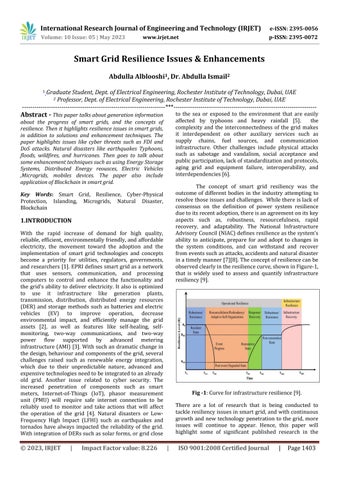
The concept of smart grid resiliency was the outcome of different bodies in the industry attempting to resolvethoseissuesandchallenges. Whilethereislackof consensus on the definition of power system resilience duetoitsrecentadoption,thereisanagreementonitskey aspects such as, robustness, resourcefulness, rapid recovery, and adaptability. The National Infrastructure AdvisoryCouncil(NIAC)definesresilienceasthesystem’s ability to anticipate, prepare for and adopt to changes in the system conditions, and can withstand and recover fromeventssuchasattacks,accidentsandnaturaldisaster inatimelymanner[7][8] Theconceptofresiliencecanbe observedclearlyintheresiliencecurve,showninFigure-1, that is widely used to assess and quantify infrastructure resiliency[9]
There are a lot of research that is being conducted to tackleresiliencyissuesinsmartgrid,andwithcontinuous growth and new technology penetration to the grid, more issues will continue to appear. Hence, this paper will highlight some of significant published research in the

field of smart electric grid resilience enhancement and impactreductionoreliminationmethods,especiallyinthe field of cyber-security, micro-grid islanding, equipment failure and grid performance degradation, natural disasters,andextremeweatherevents.
2. Cyber Security issues
There are many components of the smart grid that are connected through the internet such as the smart meters, IoTs, home appliances and CCTV. Other are connected throughprivatecommunicationmethodssuchasPMUand SCADA systems and even substations Attacks like False Data Injected (FDI), or Distributed Denial of Service (DDosS),ManinTheMiddle(MITM)canimpacthowthose component operation, and can cause severe consequences such as blackouts and restoration impacting resilience , andmightaffectpersonalsuchasincreaseinmonthlybills duetolackofcommunicationwithutility.[11].
2.1 False Data Injection
The cyber security aspect of smart grid resilience focuses on performing risk assessment, prevention, detection, and mitigation of various cyber threats such as false data injection (FDI) against wide-area monitoring, protection, and control application (WAMPAC) [10]. FDI allows users to manipulate data going to the grid’s data centers to facilitate energy theft, load shedding and even blocking the data from being obtained by the control centers[12].
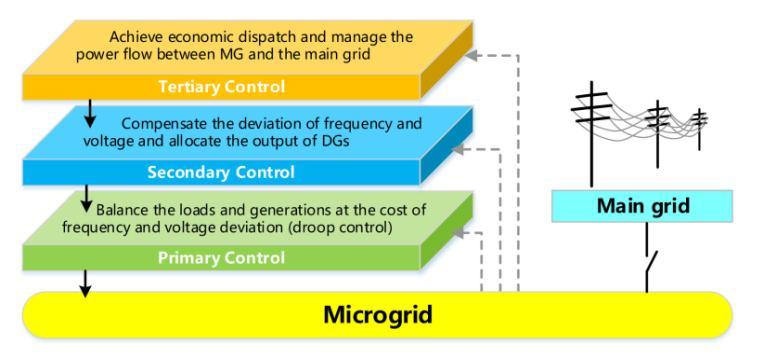
In[13],itisproposedthatanoptimizedcodingscheme be used to detect FDIs more precisely and allow sufficient resources to be allocated to mitigate its impact. Another strategy is proposed by [14] to reduce the to detect and isolate the source of corrupted data source without impacting the operation of the grid using distributed communication schemes that can act as a secondary controlsystem.Anotherschemeissuggestedby[15]aimed at increasing the cyber- resilience of microgrids (MG) underFDIattacksagainstthegrid’ssensors,actuators,and communicationlinks,byintroducingahiddencontrollayer in addition to the standard three layers of control associated with MGs as shown in Figure-2. The hidden layer will be responsible for the timely restoration of the MGinadditiontomitigatingtheimpactoftheattacktothe primarycontrollayers.
Theauthorsof[16]createdamulti-sensorbasedtemporal prediction algorithm that enhances cyber-resilience of WAMPAC by detecting bad system parameters data injected to the system such as wrong voltages that might cause grid instability or blackouts. Another scheme is designedbytheauthorsof[17]thatenablesthemtodetect sophisticated FDI, also called CFDI, aimed the PMUs used bysmartgrid.TheirpaperintroducestheconceptofSecure CFDI Detection and Mitigation scheme (SeCDM) that uses decentralized computation schemes along side knowledge sharingalgorithmstocalculatemeasurementresidualsand allow a centralized FDI detection scheme to analyze the data and detect any CFDI in progress. A control based defensive strategy is proposed by [18] where a sliding modeadaptivecontrollerwillensurethereliableoperation ofthesmartgridduringanFDI byautomaticallyupdating the parameters of the control system in a way it will eliminatetheeffectoftheFDIaimedattheactuatorsofthe generators,oranyotherexternaldisturbancessuchasload shedding. In [19], a lag compensation is introduced between the primary and secondary control loops of the MGs in order to create a timescale separation between them. This allows better detection and mitigation timing againstmultiplicativeFDIattacks,inadditiontoincreasing the frequency and voltage stability margins without the need for additional components which adds to the overall systemresilienceandefficiency. Afastdetectionalgorithm is proposed by [20], using a time-varying dynamic model that reduces the worst-casedelays (WDDs) ofFDI attacks. This model can detect and capture the state transition changes due to attacks through a state estimation algorithm.Thealgorithmcandifferentiatebetweenattacks andnormalgridtransientsallowingthereductionofdelays and increase grid availability and resilience Another proposed dynamic model aimed at optimizing wide area dampingcontrollers(WADC)tomitigatetheimpactoffalse data injection on the PMU and the shared communication methods. The strategy entitles switching the control loop from the one being attacked another one. Furthermore, a used-definedlawcanbeprogrammedtodetectandswitch theloopsifattackswerehidden[21].Afalsedatainjection against the synchronization systems of a DER based microgrid is investigated in [22]. They proposed a mitigationstrategy is to establish a system to detect rapid
change in frequency of the system -which is an indication of a cyberattack- andgivingsignal tothe governor control to react for quick system performance restoration and added resiliency The prevention of FDI attack on Load Frequency Control system (LFC) is discussed in [23]. The workproposestrainingmachinelearningmethodssuchas support vector machine (SVM) on the historical data of frequency, active power and load deviation in the grid to enable them to detect any anomalies. Then a proposed KalmanFiltering(KM)isusedtomitigatetheimpactofthe false data and restore the LFC to normal operation by calculating the optimal control signal. Another machine learningmodelisproposedby[24]inordertoclassifybad data and actual attempts of FDI attacks. The paper proposes back-propagation neural networks to improve the work of state estimation, in order to identify FDI. The trained model allows reduction of action time and computational power requirements. While the method of detection is getting more sophisticated, the paper in [25] suggests Remedial Action Scheme (RAS) in case detection methods have failed, and swift recovery of the grid is required. The proposed method include using deep recurrent neural network (DRNN) to optimally located FACT devices, formulate FDI attacks and combine the resultstocreateandRAS.Anotherdefensestrategyagainst FDI attacks is proposed by [26]. The paper tackles FDI attacksfromanetworkandasystemwise.Itaimstodesign a virtual hidden network connected to the physical network toovercomethestructuralchallengesthatcanbe exploited during an FDI attack and adds overall flexibility to the system. In [27], the threat of FDI attack toward Electric Vehicle (EV) connected to smart grid is studiedto attempt timely detection. The authors use machine learning algorithms in order to distinguish between safe data and compromised data flowing through the system duringpeer-to-peer(P2P)transactionbetweenEVowners, and initiate mitigation protocols with the assistance of available systems. The design of a micro–Automatic Generation Control system (uAGC) for microgrids is suggestedin[28].Theproposedschemeallowsmicrogrids (MG)to be resilient againstlossof frequencycontrol from thegrid.BecauseofthesizeoftheuAGC,itisabletoreact quickly to changes in frequency and power fluctuations during FDI attacks or normal load or renewable energy changes. Another paper focuses on the cyber resilience of AGC proposes the using of H-infinity filter to detect and mitigate transferred signals in smart grid. The H-Infinity based state estimator to detect the bad data injected into the data going tothecontrol center and use tocontrol the AGC[29].Adeepunsupervisedmachinelearningalgorithm is developed in order to detect false data injection into large amount of sensor across large portions of the smart grid. The proposed method by [30] uses real time and efficient algorithms to detect anomalies and causal interactionbetweenthedifferentsubs-systemsinthegrid.
2.2 Denial of Service Attack
Due to the vast natural of smart grids, and interconnectedness of different components with different manufacturing and protection standard, and the grids reliance of fast and reliable internet and communication methodtodeliveritsservices,ithasbecomeausualtarget for a Distributed Denial of Service attacks causing reduction in the grid resilience by increase the data loss and corruption , and therefore, the detection and correction mitigation technique is required [31] This is done by overloading the system communication infrastructure with scam data, or wrong signals going to Remote Terminal Units (RMU) or Phasor Measurement Units (PMU) [32]. Similar to FDI, DoS is also countered using the method of Prevention, Detection, Isolation & Mitigation[33].
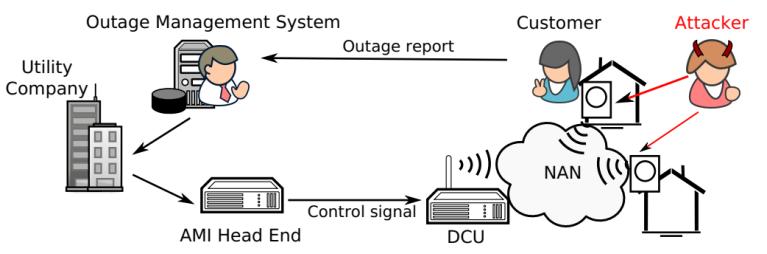
In smart grid, one of the forms of denial of service is denial of electric service. Smart grid allows the utility to control the flow of electricity to user through the use of RemoteConnectionorDisconnection(RCD)unitsinsmart meters. Attacker might hijack the signal going to the RCD and cause service interruption to different user types like individuals or commercial as shown in Figure-3. A vast number of hijacked RCD might cause grid instability or blackouts. The paper suggested setting a time delay between the execution of signal from all RCD which allow time for detection and isolation. Also, slow changes in the load status will make it easy for the grid to stabilize. The paper also suggested methodical time delays and delay mechanismsfordifferentcasesof RCDusages andtypeof loads[34].WhenitcomestoDosattackagainstmicrogrids, the authors of [35] discuss method to detect, location and isolate faults associated with DoS attacks. This is done by creating a discrete model that enable control centers to estimate magnitude changes in the system which is indicativeofattackpresence.
The resilience of a load frequency system is enhanced usingapredictor-basedschemein[36].Theauthorsstudy theeffectofDoSattackonmulti-regionLFCandmethodof resilient restoration. Using Lyapunov theory, the authors established a set of conditions that will allow the LFC systemtoremainstableforlongestperiodduringdifferent DoS attack, allowing detection and isolation time. A piecewise observer is proposed by [37] to increase the
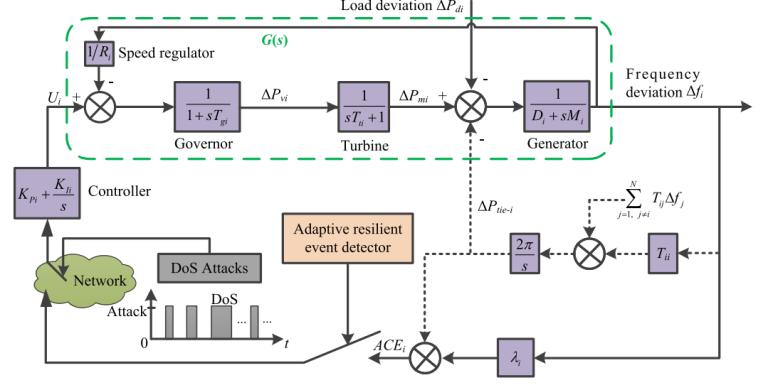
resilience of frequency regulators in microgrids through providing real-time estimate of the system’s states and unknown ongoing signal. Furthermore, it provides criterionthatallowthesystemtobestableduringdifferent cyber-attacks using H∞ controller. A machine learning based DoS detection method is proposed by [38]. The method include collecting network data and using algorithmslikeSVMtodetectanyabnormalitieswithinthis data stream. The SVM model allow distinction between normal data, bad data and data showing signs of sabotage like DoS, illegal access to remote machines (R2L), and illegal access by users (U2R). the SVM model show higher detection rate, which improve the security of the communication and the overall resilience of the grid. The uncertaintytothesystemcausedbyDoSattacksisstudied by [39] to create a scheme that allows saving the communication bandwidth which help with operation continuity. Furthermore, an adaptive H∞ controller is introduced based on Lyapunov-Krasovskii to improve stability during DoS attacks as shown in Figure-4. By implementingthisschemeintotheLFCsystem,itwillallow the triggering of mitigation method in early stages, while maintainingthestabilityoftheoperation.
world were accredit to natural disasters. Data from the USAareshowninTable-1[42].
In [40], a protocol to provide resilience against DoS attacking using Flocking-Based method is proposed. The considerdatapacketsinsidethenetworkinteractsimilarly asflockofbirds.Studiedflocksbehaviorlikecenteringand matchingwereassociatedwithsmartgridparameterslike phase angles, and frequency synchronization. This similarity allowed the author to based their resilient communicationprotocoltobebasedonflockingmodels.In [41], the defense against load altering attacks is studied. unlike typical methods, the authors propose a model-free approach that deal with actuator faults using simplified representations of the system. The paper showed that model-free approach demonstrate great performance againstdatapacketlossescausedbyDoS.
3. Natural Disasters
Natural disasters are one of the main resilience issuesofsmartgrid,asmanyoftherecentblackoutsinthe
In[43],theauthorsstudiedtheeffectofearthquakeson smartgridwithgreat DERpenetration. Theyproposethat while increasing DER improves energy availability, it does increase the chance of being impacted by localized earthquakes. The paper [44] establishes a framework for evaluating and improving the resilience of small grids or IslandCityIntegratedEnergysystem(IC-IEC)byanalyzing both failures on system and component wise to allow the establishment of recovery strategy in case of earthquakes and increase the resilience of the system. A dynamic restoration strategy is proposed by [45] to minimize the power outage after events like earthquakes, which helps with the grid resilience. Their algorithm will be fed with real-time data about the event happening, available DERs and grid condition, allow it to dynamically produce a grid reconfiguration plan that will provide optimal amount of power for the impacted area. The paper [46] proposes a economically practical approach to move from reliability based network investment to resilience based one. This is donebyidentifyingthebestnetworkinvestmentthathave resilience against risks like earthquakes or other HILP events. A distribution network resilience enhancement method based on energy storage is proposed by [47]. The historical data of earthquake location and magnitude are modeled and studied to determine the location and the sizing of Battery Energy Storage Systems (BESS) are determined in order to supply critical loads during earthquakesinaresilienceandtimelymannerasshownin Figure-5.
In [48], a quick restoration of power supply using the energy stored in local electric vehicles (EV) through the concept of vehicle-to-grid (V2G) is proposed. The paper introduced a recovery model that uses data of network faults events, EV users behavior and travel patterns to create a spatial and temporal distribution that serve as a dispatch plan for post-disaster restoration strategy. Addition enhancement strategies to the distribution network were introduced in [49] by going through the historical data of the region, and allocating distributed generation (DG) units in certain nodes that will allow power restoration to that area post-earthquake. Mobile generation units such as Mobile Emergency Generator (MEGs), Truck Mounted Energy Storage System (MESS) and electric vehicles (EV) can be used to enhance the resilience of the distribution network by offering rapid restoration of power during high impact low probability eventslikeearthquakes[50]
Hurricanes are one of the natural disasters that had a lotofimpactonthegridcausinglargeblackoutssuchasthe oneinTexaswinterblackoutin2021.Byimplementingthe fragilitycurve,theauthorsof[51]identifiedtheprobability of line outage due to high wind speed associated with hurricanes. In addition to that, they considered risk of overloading lines, load shedding to create a risk-based assessment. Another team created a spatio-temporal hurricaneimpactanalysis (STHIA) toquantitythedamage of hurricanes on the power grid based on the historical data of the region and potential risk factors, which can be used in the design of the grid [52]. A Markov based proactive dispatch process is proposed by [53] to prepare an optimal generation location and dispatch plan before incoming hurricane or typhoon and post-even operation which reduces curtailment and increases resilience. Another stochastic model is developed in order to predict the chance of flood caused by the hurricanes that might impact substation. Resilience is enhanced by protection important energy distribution hubs from going offlinedue to floods [54] The authorsof [55] took into consideration minimizing the power curtailment during hurricane in addition to considering the financial costs of creating a hurricane resilient generation dispatch plant, and considering the consequences of such strategies after
system returns to normal. Increase the resilience of the distribution grid through optimal placement of switches. The paper [56] simulates the impact of the hurricanes on the availability of different components of the smart grid. Then an optimization model is used to place the switches where it is more resilient during HILP events. In [57], the resilience of the transmission line and the generation plantsaresimulatedwiththeconsiderationofcapacitylost, restorationcostsandthedamagetothesystem.Thepaper managed to demonstrate how increase of DER might impact the resilience negatively without proper modeling and placement. Another resilience enhancement method during hurricanes is proposed by [58]. Using Dynamic MicroGrid(DMG)toimprovetheresilienceofasmartgrid partitionduringhurricaneisproposed.Thepaperalsouse simulation to highlight the difference in resilience improvement between Fixed MGs and Dynamic MGs. The proposed enhancement method uses optimization formulations for deploying the two types of micro grids duringahurricanes. ThesimulationshowedtheDMGscan carrymoreloadduringgridfailuresthanFMGsasshownin Chart-6.

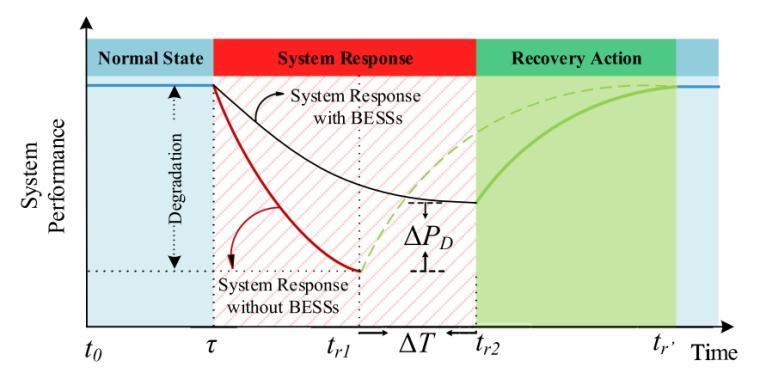
By combining the data from hurricane prediction algorithms, and the proactive prediction of grid line outages during hurricanes, a hybrid model based on component fragility curve, simulation, and scenario reduction algorithm, is established. This model enhances the planning and deployment of grid resources while consideringlineoutages[59].Anotherproactivestrategyis suggested by [60] to optimally locate DERs and the optimized formulation of the microgrids that can serve optimal amount of loads during interruption. In [61], the deployment of mobile emergency resources is considered duringhurricanetosupplytheislandedcriticalloads. The proposed algorithm also produces the best deployment location, path to location optimization, transportation and anyconstraintsintermsofavailableinfrastructuresuchas blockedroadsornon-criticalloads.
A method to enhance resilience during typhoon disasters is highlighted by [62]. The proposed scheme involved optimal preventative scheduling approaching in addition to taking actions toward optimizing the topology of the transmission line to maximize power delivery. Furthermore, the authors of [63] attempt to tackle the issueofuncertainpaththattyphoonstakesandconsidera three-stageday-aheadunitcommitmentforthegeneration unit. This will allow optimal dispatch during the disaster and during restoration. This is done by implementing stochastic model for typhoon paths. In [64], resilience would be considered during the planning stages of transmission system and components by creating a probabilistic typhoon model incorporated into fragility curve.ARegionalIntegratedEnergySystem(RIES)optimal operation through coordinated optimization considering availableenergyequipmentanddemandresponseiscreate by [65]. The paper proposes an enhancement for RIES duringtyphoonsallowingoptimaloperation.
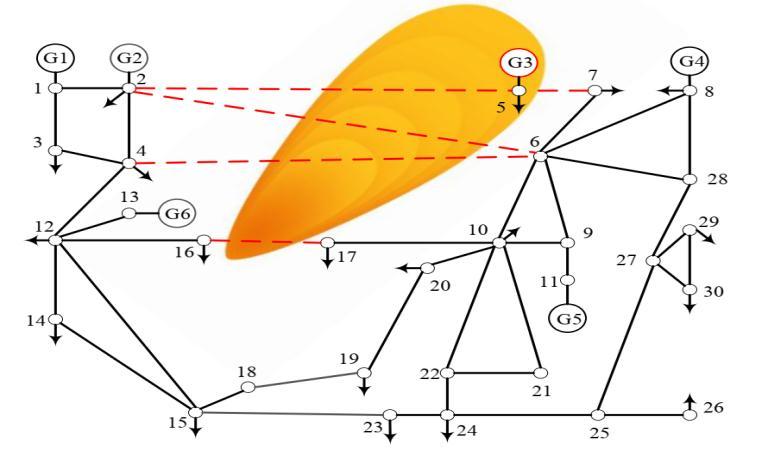
In [66], an overall review of the impact of wildfire on different parts of the smart grid is conducted. The paper highlightsdifferentactionsthatcanbetakenbefore,during and after the wildfire impacting the grid. This includes forecastingrisksanddamages,stateestimation,preventive and corrective actions, and restoration and the end of the event.Theauthorsof[67]and[68]discussseveralimpacts of wildfires on the smart grid system damaging transmission towards causing the collapse of the line. In additiontotheparticlesandsmokefromthefireimpacting the properties of the insulation and the conductors. An increase of conductor temperature would increase resistance and cause expansion and sagging The paper [69]discussesprotectivegenerationplanandunitdispatch strategy to allow the mitigation of the impact of the wildfire. It also utilizes Markov decision process to model the condition and provide the operator of the system to take rapid decisions that ensure the resilience and the reliabilityofthegridandreducecurtailmentofpowerand costs. The fire growth, progression and trajectory is also simulated in [70] as a way to enhance understanding of required preventative response and impact to the grid as showninFigure-6
In[71],thepaperattemptstosimulateawildfireeventand its impact on the components of the power system. The proposedmethodwillallowmitigationoftheimpactofthe wildfire, in addition to identifying the behavior of the fire suchasintensity,arrivaltime,pathandignitionpoint. This allows better decision making, planning future strategies. The authors of [72] studied the impact of wildfires on the dynamics and performance of micro grids. The paper modelsthewildfireinformofheatgainandheatloss,and then uses optimization method to decrease the impact of the fire on the power delivery with restraints on DERs, ESSs and power balance. EV penetration can also impact the grid’s resilience against wildfires. In [73], suggest the impactofmassEVmobilizationandchargingrequirements duringwildfires.Amodel isdesigned tosimulateEVusers evacuatingandchargingtheircarsduringanevent.In[74], the authors provide an optimal expansion strategy to the stake holders of the grid supporting their decision to add new transmission lines, or enhancing the resilience of the current infrastructure in addition to development of new Distributed Energy resources (DERs). The use of deep reinforcedlearningtoanalyzethatthatcanbeusedbythe operators to take decision during wildfires toimprove the resilience of the grid is investigated in [75]. Wildfire propagation model, and Markov decision process is used with IEEE test system showed this approach can help reduceloadbyreducingpowerflowintodamagedlines. In [76], microgrids are used to improve the resilience of the grid during wildfires. This is done by integrating several micro grids in strategically placed location to allow different operational mode to be entered easily. Similar workisdoneby[77]whichfocusesontheoptimallocation formicrogridstoimprovetheresilienceofthegridduring extreme weather while overbudgeting. Improving the resilience of the existing grid against wildfires and other naturaldisastersbyreplacingwoodtransmissionpolesand vegetation management [78] The authors of [79] propose a flexible scheduling strategy using EV ax auxiliary power sourceincasemajorDERswentofflineduetowildfiresor otherdisasters.Theoptimalschedulingandlocationwillbe determinedusingtwo-stagemodelconsideringtherandom behavior of EV users. A multi spatio-temporal resilience assessment strategyagainst extreme weather issuggested by [80] using assessment techniques incorporating the fragilitycurveandstatisticalsimulationinordertobuilda real-timemappingofthegridcomponentsandtheirfailure potential against events like high wind speed. A similar planning strategy for the long-term resilience of the electricalnetworkthatcombatsextremeweathereventsis proposed by [81]. The framework will consider high penetration of DERs, IRES and will include mitigation techniques based on the improved design of the grid. A simulation base don fragility curve is used to create a strategy for defensive islanding during extreme events [82]. The strategy includes dividing the system into stable and safe sections, and sections that can be at risk of cascade failure, or might impact the operation of other
sections of the grid. The use of microgrids to improve resiliency is also proposed in [83]. The authors analyzed the mechanism extreme events affect he resilience of the smartgrid,andusedMarkovandMonteCarlosimulationto outputastrategyfordeployingmicrogridstosupplypower toload,.TheeffectofthemicrogridcanbeseeninFigure-7
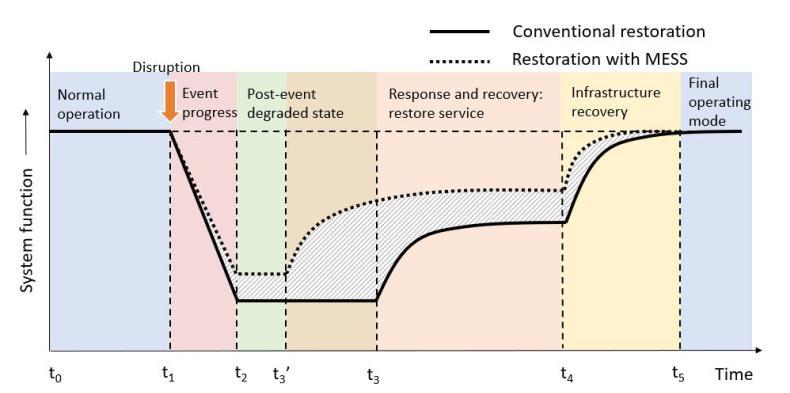
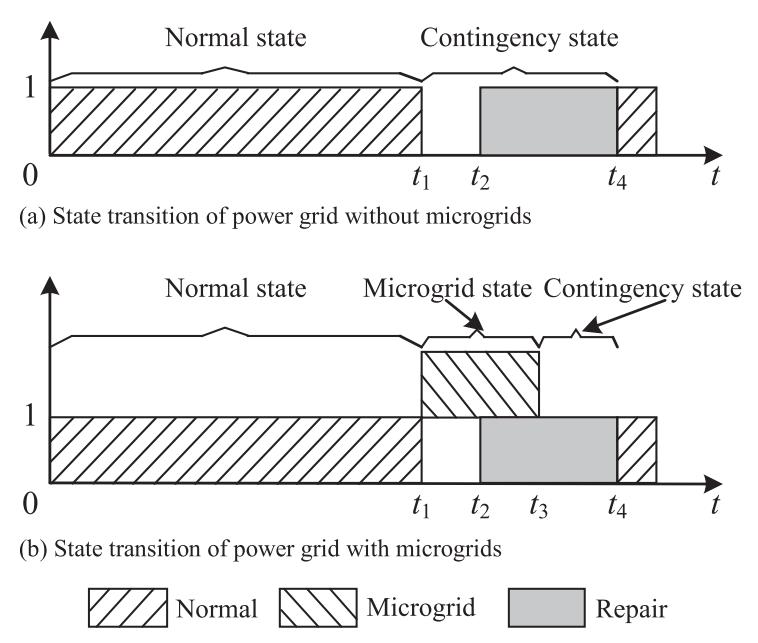
In [84], the authors attempt to tackle the issue of reactive power shortage during an extreme event because of DERs inability to produce enough. The paper proposes different optimization techniques that will optimally dispatch networked microgrids to improve reactive power magnitude and overall mitigate the impact of the extreme conditions.
An optimization method that can optimize the economicsofanewEnergyStorageSystems(ESS)andthe bestlocationandroutingtobeconsideredduringacrisisis proposedby[88].Themodelwillalsoprovideinformation about the optimal dispatch to create a high resilience microgrid to support smart grid during failures. The applicationofmobileenergystoragedevicetoenhancethe resilience of the smart grid is studied in [89]. The paper showstheadvantagesofmobileenergystoragesuchasfast deployment time, better control schemes and infrastructure, andload serving capabilities. Alsobatteries are more environmentally friendly comparing to mobile dieselgenerationforexample.Furthermore,themobilityof the systemallow its installation in more economicallyand technicallyfeasiblelocationsasdemonstrateintheFigure8.
4. Smart Grid Resilience Enhancements
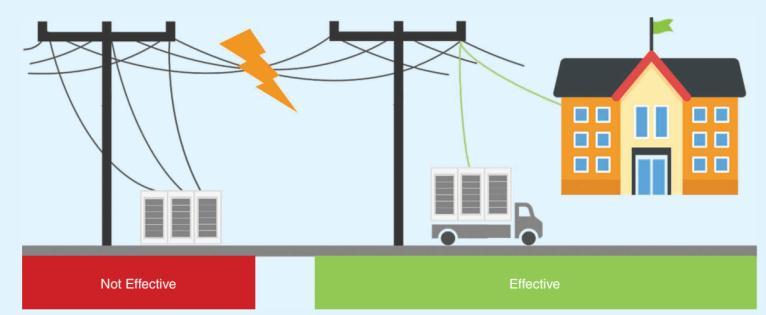
A frequency control method based on distributed energy storage devices is proposed in [85] as a methodto increase the resilience of the grid during abnormal grid transients enabling the grid to overcome rapid frequency changesandacceleratesynchronizationandstabilityofthe system. In[86],a framework isestablishedtouseDESSto overcome frequency and voltage transient issues during cyber-attacks or natural disasters. The paper [87] reviews the method of which battery and energy storage systems (ESS) can improve the resilience of the smart grid. If the operationofthegridwashinderedduetosevereweather, sabotage of theft, battery systems can take over the lost loads, and supply them with power. The battery systems canbedispatchtodamagedgridlocations,andhelpcreate and support microgrids to compensate for lost load, speeding up restoration and increasing resilience at the sametimeasshowninFigure-8.
In [90], an optimization model is created to optimize the locationandthecapacityoftheenergystoragesystemwith technical and economic restrictions such as operating costs, accessibility for power demand and non-black-start (NB-S).theworkalsoextendstopropersizingandlocation of photovoltaic cells (PV). In [91], the distributed energy storage devices owned by individuals are examined to perform a resilience enhancement task during crisis. The paper creates a framework for optimizing the process of sellingand buyingelectricity from individuals andMGOto increasemicrogridavailability[92]
In [93] proposes using Smart Contracts through Blockchain technology to enhance cyber security by decentralizing the energy management and data
processing hubs which makes it extremely difficult to manipulate date it requires the verification of 50% of the nodes in the network and passing different consensus algorithms. Furthermore, it introduces using Smart Contracts that facilitates P2P transactions between small and commercial power producers without established trust or prior communication and encouraged more small producers to connect to the grids, which reduces interruptiontimes,andincreasestheresilienceofthegrid. This allows rapid energy transaction during disaster and peak demand, increase the grid overall resilience. Blockchain is also used to enhance the security and improve the communication between the Distributed System Operators (DSO) and the localized AMIs during powertransactionbetweenDERsownersandthegrid.The role of blockchain is to create a high security, transparent and private communication between the DSOs and smart meters that enable the exchange of real-time pricing, energy consumptiondataand patterns, diagnosis,billing, planning and prediction[94] the peer-to-peer (P2P) transaction in smart grid would also be more secure and rapidallowingprosumerstoinjectenergyfromtheirDERs and DESSs which help with supply electricity during peak demand or loss of generation units due to crisis [95]. Taking advantage of the blockchains security features to usesmartcontractstobuyandsell electricityinincreased speed, scale, and high security levels [96]. The authors of [97] show the blockchain security features in the energy trading between DSOs and independent energy suppliers and prosumers, and how it can improve the resilience of the grid due toavailable energy supplies. In [98] highlight further advantages of blockchain to counter some cyberattacks bydetectingabnormaldatainthesystem,anddue tothedecentralizedpropertyoftheblockchain,countering cyber attacks is facilitated through rapid detection and mitigation techniques. It also provides real-time transparent transactive environmental improving demand andsupplymanagementandallowssecureparticipationof differentpartiesinthegridlikeprosumers,EVowners,and DSOs. Enhancingtheresilienceoftheenergymarketusing blockchain is studied in [99]. The paper proposed blockchain technology to establish self-sovereign Identify (SSI) allowing user to control their market identity as a method of secure trading energy through the blockchain smart contract technology. By encouraging all grid participants to become SSIs, the transaction will become moresecure,andfastersinceSSIprovidetrustandidentify customers during the creation of the identity. The proposedframeworkisshowninFigure-8.
A distributed predictive control scheme using blockchain as infrastructure is proposed by [100] to provide DC microgrids with high levels of security for their two way communication protocols to prevent any sabotages or cyber-attacks The control strategy will improve proactive resilience and the robustness of the DC microgrid. It also takes advantage of blockchain’s resilience toward hacking to improve the security of the DC micro grids without compromisingthesystemsabilitytointerveneduringpeak demand or during natural disasters or grids loss of generationunits.

Reliable and autonomous Microgrid are main part of a resilient smart grid. It connects loads with DERs and allows customers to have a secure and reliable source of electricity,especiallyduringanticipateddisasters[101]. In [102], the location of microgrid location is determined usinginformationaboutthecriticalinfrastructureavailable along a certain geographical area, such as gas lines, water treatment facilities or hospitals. One method to improve theresiliencyofmicrogridsistoimplementFACTSdevices into the design of microgrids to allow trouble-free transition between grid-connected mode to islanded or autonomous mode of MG operation [103]. This allow maintaining frequency and voltage withing acceptable range of operation, which can help loads to maintain normal operation. If the network is very large, then implementing microgrids would increase the resilience of he grid while maintaining economical feasibility. The case of the European grid [104], which require increase of capacity through penetration of DERs, DESSs and introduction of backup generation which are part of a typicalschemeofmicrogrids.In[105]differentadvantages of microgrids are highlighted. During failure of certain pointofthetransmissionordistributionnetwork,theload connected to affected node can be fed from a different
microgrid connected through different routes. Furthermore, if the microgrid was fully isolated from the grid due to disaster of man-made failure, it can operate in islanded mode to supply the local connected load reliably. DifferentfailurescenarioscanbeseenfromFigure-8.

In [106], the authors suggest proper planning and deploymentofmicrogridsinfuturesmartgridsinorderto countertheimpactofnaturalandmade-madedisasterson the power system. The study showed resilience against issues like islanding, cybersecurity, and natural disasters. The authors of [107] review different resilienceaspectsof networkedmicrogrids(NMG).ThestudyshowsthatNMGs improved grid resilience during large scale outage compared to standalone microgrids or standard outage management protocols. This is due to NMG’s coordination that maximizes the utilization of the power supply available.Furthermore,NMGscantakepowerfromregular utility network allowing more coverage of customers. In [108] the resilience oriented microgrid formation and scheduling is discussed. Formation help with determining theswitchingplanandtheboundariesofeachMGtoallow maximumcoverageofloadsduringdifferentscenarios.The scheduling part focuses on optimal energy dispatch in termsofmeetingdemandandoptimizingcosts.Microgrids are also flexible when it comes to location, operating
voltages and concepts, connected DERs and operational modesastheycanbeconnectedtoothermicrogrids,utility grisoroperatedinstandalone[109].Duringaccidents,the DSOisabletoconverttheoperationmodeofmicrogridsto islanded mode to serve local critical loads as studied in [110]. The autonomous microgrid can manage the DER to supplysufficientpowertotheconnectedloads.Asamatter of fact, if the microgrid has enough generating units, it mightbecometheprimarysourceofenergywhilekeeping the utility as a secondary source. The paper [111] highlights the role of microgrids in overall grid resilience during disasters and peak demand, and its ability to manage alternative energy sources optimally so that changesinloadinthemaingridwillnotimpactthenormal operation.In[112],theauthorsinvestigatedtheproperties that makes a microgrid more resilient to different natural and man-made events. With he objective to recover and supply critical loads the moment disaster happens, the location and sizing of microgrids are important. Furthermore, interconnecting the microgrids to different and critical nodes in the grid will help increase the resilience and the effectiveness of microgrid in restoring loads. The paper [113] proposes a two-stage approach to restore power to critical loads after a HILP event. The stagesincludeconfigurationoftheconnected microgridto supply damaged sectors, and the next stage is to use demandresponsefromthecriticalloadtooptimallysupply them with electricity. The algorithm proposed will also plan to integrate the microgrid back to the main grids or creatingnewcircuitswiththenon-effectswitchesandlines aftertheeventpasses. Thesmallsignalstabilityofthegrid might cause frequency propagation and eventually blackouts if not controlled properly. In [114] microgrids are used to improve the dynamic resilience of the microgrid through the use of power-electronic interfaced energy resources. This is done by using several optimization techniques to find the optimal operational pointsandstabilitymargins.Thestabilityofthemicrogrids would add up to the overall resilience of the smart grid. The paper [115] also introduces the concept of electric springs that improve microgrid responses during fluctuating renewable distributed energy resources, by acting like an inertial mass like flywheel in transitional generators.
In [116], the propose an optimization technique to select the optimal location for the generators in microgrids. The paper tackles issues related to the discrete nature of selectingthelocationoftheDGandthecontinuous nature of sizing the generator in addition to integrating a cost function to consider the economic factor. The authors of [117] suggest Intentional Islanding Techniques (IIT) in ordertomitigatetheimpactofsevereconditionsandallow better probability to serve critical loads. A machine learning model is created to predict the chances of failure of different components of the microgrid during disaster using historical data , and suggest optimal location and
deployment scheme [118]. A Decentralized decision making algorithm is proposed by [119] in order to allow optimal decision making in case control centers were impacted by HILP events through a consensus based system.
Electromagnetic Pulse (EMP) is one of the rare natural phenomena that would several damage the smart grid. EMP can disable entire electrical and electronical infrastructureinshortperiodoftime.Theauthorsof[119] studytheimpactofEMPonthesmartgrid.Theimpactcan vary from no effect at all, to complete destruction of the Printed Circuit Board (PCB) that is a core part of every device in the smart grid. The only method to restore service is replacement of those PCBs. Furthermore, EMP wouldbringacascadedamagetoallconnectedequipment such as transformers, communication and protection devices, and generators. Table-2 shows the impact of differenttypeofEMPonthecomponentoftypicalelectrical Grid. Possible mitigation techniques include installing protectors on critical equipment like communication devices, inverters, and power supplies. Protectors include Faraday cages, mesh wires, or installing them deep underground.
The restoration speed is a significant part of the resilience of the grid. In [121], the optimal strategy to restore the grid after HILP event have passed is determined using optimization algorithms that ensures that power is restored to critical loads using secondary network nodes through technical information about grid condition, available equipment, future demand for the loads and implementation of restorative computerized procedure. Another restoration strategy is suggested by [122]. It is assumed that after a major unplanned outage, theenergysourcesbynormalutilityfeederswillbescarce. One method to rapidly restore electric power is the use of available mobile emergencyresourcessuch mobile energy storage system, or dynamic microgrid. A model is created to optimally determine the path to travel to critical grid nodestobesuppliedbytheMESs.Whenthebestroutesare determined, the critical loads nearby are scheduled to be fed. The restoration method proposed by [123] implements a restoration strategy based on Electrical Vehicles. Restoration using optimized location of DERs consideringtypicalloadflowtocriticalloadsaresuggested by [124] as a method of rapid restoration and resilience increase of the smart grid. The paper [125] suggests a ResilientDistributionNetwork(RDN)thatconsistsofDERs thatsupporttheefforttorestoreenergytoallcriticalloads. This is done by restoration area plans with partial load restorationsuchashospitalsormilitarycamps.Theneach areawillhaveadeployedDERsthatcansustainitsenergy needs until utility is returned to service. A mathematical optimizingproblemiscreatedtooptimallycreateelectrical boundaries for the RDNs. The authors of [126] suggest similar work utilizing dynamics microgrids and Markov decisionmakingalgorithmtosupportcriticalloads.
3. CONCLUSIONS
In this paper, resilience issues facing smart grid were surveyed and summarized. The topics ranged between cyber threats such as FDI and DoS, Natural disasters like earthquakes, typhoons, hurricanes and floods. In addition to some general enhancement techniques to improve the resilienceagainstknowissuesinSmartGrid.
REFERENCES
DPE=DirectPermanentEffects
EU=DirectEffectsUncertain.
CE=CascadingEffects(ifnobackuppower).
DPE+CE=PotentialPermanentEffectsplusCascadingEffects.
TE=TemporaryEffect(0.5-36hours)assumingbackuppower.
[1] M.Hashmi,S.HänninenandK.Mäki,"Surveyofsmart grid concepts, architectures, and technological demonstrations worldwide," 2011 IEEE PES CONFERENCE ON INNOVATIVE SMART GRID TECHNOLOGIESLATINAMERICA(ISGTLA),Medellin, Colombia, 2011, pp. 1-7, doi: 10.1109/ISGTLA.2011.6083192.
[2] M. P. Wakefield, "Smart distribution system research in EPRI's Smart Grid Demonstration Initiative," 2011 IEEE Power and Energy Society General Meeting, Detroit, MI, USA, 2011, pp. 1-4, doi: 10.1109/PES.2011.6039386.
[3] H. Farhangi, "The path of the smart grid," in IEEE Power and Energy Magazine, vol. 8, no. 1, pp. 18-28, January-February 2010, doi: 10.1109/MPE.2009.934876.
[4] C. P. Vineetha and C. A. Babu, "Smart grid challenges, issues and solutions," 2014 International Conference onIntelligentGreenBuildingandSmartGrid(IGBSG), Taipei, Taiwan, 2014, pp. 1-4, doi: 10.1109/IGBSG.2014.6835208.
[5] Y. Zhang, H. Wu, F. Zhang, Y. Li, L. Tang and J. Mo, "InfluenceofTyphoononModernSmartGridinChina and Suggested Countermeasures," 2020 Chinese Automation Congress (CAC), Shanghai, China, 2020, pp. 2169-2172, doi: 10.1109/CAC51589.2020.9327813.
[6] J. Beyza, E. Garcia-Paricio, and J. M. Yusta, ‘Ranking critical assets in interdependent energy transmission networks’,ElectricPower SystemsResearch, vol.172, pp.242–252,2019.
[7] “NIAC Critical infrastructure resilience final report and recommendations”, The Cybersecurity and Infrastructure Security Agency (CISA), https://www.cisa.gov/resourcestools/resources/niac-critical-infrastructureresilience-final-report-and-recommendations (AccessedMay.5,2023).
[8] “Presidentialpolicydirective21–critical infrastructuresecurityandresilience”,Thewhite houseofficeofthepresssecretary. https://obamawhitehouse.archives.gov/the-pressoffice/ 2013/02/12/presidential-policy-directive-criticalinfrastructure-security-andresil.(AccessedMay.5, 2023).
[9] M.PanteliandP.Mancarella,"TheGrid:Stronger, Bigger,Smarter?:PresentingaConceptualFramework ofPowerSystemResilience,"inIEEEPowerand EnergyMagazine,vol.13,no.3,pp.58-66,May-June 2015,doi:10.1109/MPE.2015.2397334.
[10] Y. Song, C. Wan, X. Hu, H. Qin and K. Lao, "Resilient powergridforsmartcity,"iniEnergy,vol.1,no.3,pp. 325-340, September 2022, doi: 10.23919/IEN.2022.0043.
[11] G. Rajendran, H. V. Sathyabalu, M. Sachi and V. Devarajan, "Cyber Security in Smart Grid: Challenges andSolutions,"20192ndInternationalConferenceon Power and Embedded Drive Control (ICPEDC), Chennai, India, 2019, pp. 546-551, doi: 10.1109/ICPEDC47771.2019.9036484.
[12] R. Nawaz, M. A. Shahid, I. M. Qureshi and M. H. Mehmood, "Machine learning based false data injection in smart grid," 2018 1st International Conference on Power, Energy and Smart Grid (ICPESG),MirpurAzadKashmir,Pakistan,2018,pp.16,doi:10.1109/ICPESG.2018.8384510.
[13] R. Deng, P. Zhuang and H. Liang, "False Data Injection Attacks Against State Estimation in Power Distribution Systems," in IEEE Transactions on Smart Grid, vol. 10, no. 3, pp. 2871-2881, May 2019, doi: 10.1109/TSG.2018.2813280.
[14] Q. Zhou, M. Shahidehpour, A. Alabdulwahab and A. Abusorrah, "A Cyber-Attack Resilient Distributed Control Strategy in Islanded Microgrids," in IEEE Transactions on Smart Grid, vol. 11, no. 5, pp. 36903701,Sept.2020,doi:10.1109/TSG.2020.2979160.
[15] Y.Chen,D.Qi,H.Dong,C.Li,Z.Liand J.Zhang,"AFDI Attack-Resilient Distributed Secondary Control Strategy for Islanded Microgrids," in IEEE Transactions on Smart Grid, vol. 12, no. 3, pp. 19291938,May2021,doi:10.1109/TSG.2020.3047949.
[16] A. S. Musleh, H. M. Khalid, S. M. Muyeen and A. AlDurra, "A Prediction Algorithm to Enhance Grid Resilience Toward Cyber Attacks in WAMCS Applications," in IEEE Systems Journal, vol. 13, no. 1, pp. 710-719, March 2019, doi: 10.1109/JSYST.2017.2741483.
[17] B.Li,R.Lu,G.Xiao,T.LiandK.-K.R.Choo,"Detection of False Data Injection Attacks on Smart Grids: A Resilience-Enhanced Scheme," in IEEE Transactions on Power Systems, vol. 37, no. 4, pp. 2679-2692, July 2022,doi:10.1109/TPWRS.2021.3127353.
[18] Z. Xu et al., "A resilient defense strategy against false datainjectionattackinsmartgrid,"202140thChinese Control Conference (CCC), Shanghai, China, 2021, pp. 4726-4731,doi:10.23919/CCC52363.2021.9549783.
[19] G. Raman, K. Liao and J. C. -H. Peng, "Improving AC Microgrid Stability Under Cyberattacks Through Timescale Separation," in IEEE Transactions on Circuits and Systems II: Express Briefs, doi: 10.1109/TCSII.2023.3234073.
[20] S. Nath, I. Akingeneye, J. Wu and Z. Han, "Quickest DetectionofFalseDataInjectionAttacksinSmartGrid with Dynamic Models," in IEEE Journal of Emerging and Selected Topics in Power Electronics, vol. 10, no. 1, pp. 1292-1302, Feb. 2022, doi: 10.1109/JESTPE.2019.2936587.
[21] A. Patel, S. Roy and S. Baldi, "Wide-Area Damping ControlResilienceTowardsCyber-Attacks:ADynamic
Loop Approach," in IEEE Transactions on Smart Grid, vol. 12, no. 4, pp. 3438-3447, July 2021, doi: 10.1109/TSG.2021.3055222.
[22] A. S. Mohamed, M. F. M. Arani, A. A. Jahromi and D. Kundur, "False Data Injection Attacks Against Synchronization Systems in Microgrids," in IEEE Transactions on Smart Grid, vol. 12, no. 5, pp. 44714483,Sept.2021,doi:10.1109/TSG.2021.3080693.
[23] Z. Zhang, J. Hu, J. Lu, J. Cao and F. E. Alsaadi, "Preventing False Data Injection Attacks in LFC System via the Attack-Detection Evolutionary Game Model and KF Algorithm," in IEEE Transactions on Network Science and Engineering, vol. 9, no. 6, pp. 4349-4362, 1 Nov.-Dec. 2022, doi: 10.1109/TNSE.2022.3199881.
[24] L. Shiqi and H. Yinghui, "Detection of Bad Data and False Data Injection Based on Back-Propagation Neural Network," 2022 IEEE PES Innovative Smart Grid Technologies - Asia (ISGT Asia), Singapore, Singapore, 2022, pp. 101-105, doi: 10.1109/ISGTAsia54193.2022.10003501.
[25] E.NaderiandA.Asrari,"ADeepLearningFramework to Identify Remedial Action Schemes Against False Data Injection Cyberattacks Targeting Smart Power Systems," in IEEE Transactions on Industrial Informatics,doi:10.1109/TII.2023.3272625.
[26] X.Luo,J.He,X.Wang,Y.ZhangandX.Guan,"Resilient DefenseofFalseDataInjectionAttacksinSmartGrids via Virtual Hidden Networks," in IEEE Internet of ThingsJournal,vol.10,no.7,pp.6474-6490,1April1, 2023,doi:10.1109/JIOT.2022.3227059.
[27] D. Said and M. Elloumi, "A New False Data Injection Detection Protocol based Machine Learning for P2P Energy Transaction between CEVs," 2022 IEEE International Conference on Electrical Sciences and Technologies in Maghreb (CISTEM), Tunis, Tunisia, 2022, pp. 1-5, doi: 10.1109/CISTEM55808.2022.10044067.
[28] T.Huang,D.WuandM.Ilić,"Cyber-resilientAutomatic Generation Control for Systems of AC Microgrids," in IEEE Transactions on Smart Grid, doi: 10.1109/TSG.2023.3272632.
[29] S. Beura and B. P. Padhy, "False Data Injection Detection using H Infinity Filter in an Automatic GenerationControlledTwoAreaPowerSystem,"2023 IEEE PES Conference on Innovative Smart Grid Technologies - Middle East (ISGT Middle East), Abu Dhabi, United Arab Emirates, 2023, pp. 1-5, doi: 10.1109/ISGTMiddleEast56437.2023.10078579.
[30] H.Karimipour,A.Dehghantanha,R.M.Parizi, K.-K.R. Choo and H. Leung, "A Deep and Scalable Unsupervised Machine Learning System for CyberAttack Detection in Large-Scale Smart Grids," in IEEE Access, vol. 7, pp. 80778-80788, 2019, doi: 10.1109/ACCESS.2019.2920326.
[31] A.Huseinović, S.Mrdović, K. BicakciandS. Uludag,"A Survey of Denial-of-Service Attacks and Solutions in the Smart Grid," in IEEE Access, vol. 8, pp. 177447177470,2020,doi:10.1109/ACCESS.2020.3026923.
[32] F. Mohammadi, M. Saif, M. Ahmadi and B. Shafai, "A Review of Cyber–Resilient Smart Grid," 2022 World Automation Congress (WAC), San Antonio, TX, USA, 2022, pp. 28-35, doi: 10.23919/WAC55640.2022.9934511.
[33] M. Abliz, ‘‘Internet denial of service attacks and defense mechanisms,’’ Dept. Comput. Sci., Univ. Pittsburgh, ittsburgh, PA, USA, Tech. Rep. TR-11-178, Marc. 2011. [Online]. Available: http://miralishahidi.ir/resources/InternetDenialofSer viceAttacksandDefense.pdf
[34] W. G. Temple, B. Chen and N. O. Tippenhauer, "Delay makes a difference: Smart grid resilience under remote meter disconnect attack," 2013 IEEE International Conference on Smart Grid Communications (SmartGridComm), Vancouver, BC, Canada, 2013, pp. 462-467, doi: 10.1109/SmartGridComm.2013.6688001.
[35] C.M.P.Valencia,R.E.Alzate,D.M.Castro,A.F.Bayona and D. R. García, "Detection and isolation of DoS and integrityattacksinCyber-Physical MicrogridSystem," 2019 IEEE 4th Colombian Conference on Automatic Control(CCAC),Medellin,Colombia,2019,pp.1-6,doi: 10.1109/CCAC.2019.8920902.
[36] C.M.P.Valencia,R.E.Alzate,D.M.Castro,A.F.Bayona and D. R. García, "Detection and isolation of DoS and integrityattacksinCyber-Physical MicrogridSystem," 2019 IEEE 4th Colombian Conference on Automatic Control(CCAC),Medellin,Colombia,2019,pp.1-6,doi: 10.1109/CCAC.2019.8920902.
[37] S. Hu, X. Ge, X. Chen and D. Yue, "Resilient Load Frequency Control of Islanded AC Microgrids Under Concurrent False Data Injection and Denial-of-Service Attacks," in IEEE Transactions on Smart Grid, vol. 14, no. 1, pp. 690-700, Jan. 2023, doi: 10.1109/TSG.2022.3190680.
[38] W. Zhe, C. Wei and L. Chunlin, "DoS attack detection model of smart grid based on machine learning method," 2020 IEEE International Conference on Power, Intelligent Computing and Systems (ICPICS),
Shenyang, China, 2020, pp. 735-738, doi: 10.1109/ICPICS50287.2020.9202401.
[39] K. -D. Lu, G. -Q. Zeng, X. Luo, J. Weng, Y. Zhang and M. Li, "An Adaptive Resilient Load Frequency Controller for Smart Grids With DoS Attacks," in IEEE Transactions on Vehicular Technology, vol. 69, no. 5, pp. 4689-4699, May 2020, doi: 10.1109/TVT.2020.2983565.
[40] J. Wei and D. Kundur, "A flocking-based model for DoS-resilient communication routing in smart grid," 2012 IEEE Global Communications Conference (GLOBECOM), Anaheim, CA, USA, 2012, pp. 35193524,doi:10.1109/GLOCOM.2012.6503660.
[41] M. Fliess, C. Join and D. Sauter, "Defense against DoS and load altering attacks via model-free control: A proposal for a new cybersecurity setting," 2021 5th International Conference on Control and FaultTolerant Systems (SysTol), Saint-Raphael, France, 2021, pp. 58-65, doi: 10.1109/SysTol52990.2021.9595717.
[42] Y.Wang,C.Chen,J.WangandR.Baldick,"Researchon Resilience of Power Systems Under Natural Disasters AReview,"inIEEETransactionsonPower Systems, vol. 31, no. 2, pp. 1604-1613, March 2016, doi:10.1109/TPWRS.2015.2429656.
[43] J.Guenaou,P.HenneauxandD.S.Kirschen,"Impactof distributed energy resources on power system resilience against earthquakes," 2022 IEEE PES Innovative Smart Grid Technologies Conference Europe(ISGT-Europe),NoviSad,Serbia,2022,pp.1-5, doi:10.1109/ISGT-Europe54678.2022.9960485.
[44] T. Jiang, T. Sun, G. Liu, X. Li, R. Zhang and F. Li, "Resilience Evaluation and Enhancement for Island CityIntegratedEnergySystems,"inIEEETransactions onSmartGrid,vol.13,no.4,pp.2744-2760,July2022, doi:10.1109/TSG.2022.3157856.
[45] W. Liu, F. Ding and C. Zhao, "Dynamic Restoration Strategy for Distribution System Resilience Enhancement," 2020 IEEE Power & Energy Society Innovative Smart Grid Technologies Conference (ISGT), Washington, DC, USA, 2020, pp. 1-5, doi: 10.1109/ISGT45199.2020.9087726.
[46] T. Lagos et al., "Identifying Optimal Portfolios of Resilient Network Investments Against Natural Hazards, With Applications to Earthquakes," in IEEE Transactions on Power Systems, vol. 35, no. 2, pp. 1411-1421, March 2020, doi: 10.1109/TPWRS.2019.2945316.
[47] M. Nazemi, M. Moeini-Aghtaie, M. Fotuhi-Firuzabad and P. Dehghanian, "Energy Storage Planning for Enhanced Resilience of Power Distribution Networks Against Earthquakes," in IEEE Transactions on Sustainable Energy, vol. 11, no. 2, pp. 795-806, April 2020,doi:10.1109/TSTE.2019.2907613.
[48] Y. Wu et al., "A Rapid Recovery Strategy for PostEarthquakePowerGridswiththeAuxiliarySupportof V2G," 2022 IEEE/IAS Industrial and Commercial Power System Asia (I&CPS Asia), Shanghai, China, 2022, pp. 1680-1685, doi: 10.1109/ICPSAsia55496.2022.9949967.
[49] M. Ahmadi, M. Bahrami, M. Vakilian and M. Lehtonen, "Application of Hardening Strategies and DG Placement to Improve Distribution Network Resilience against Earthquakes," 2020 IEEE PES Transmission & Distribution Conference and Exhibition - Latin America (T&D LA), Montevideo, Uruguay, 2020, pp. 1-6, doi: 10.1109/TDLA47668.2020.9326205.
[50] Z. Yang, P. Dehghanian and M. Nazemi, "Enhancing Seismic Resilience of Electric Power Distribution Systems with Mobile Power Sources," 2019 IEEE Industry Applications Society Annual Meeting, Baltimore, MD, USA, 2019, pp. 1-7, doi: 10.1109/IAS.2019.8912010.
[51] A. Pan, X. Fang, Z. Yan, Z. Dong, X. Xu and H. Wang, "Risk-Based Power System Resilience Assessment Considering the Impacts of Hurricanes," 2022 IEEE/IAS Industrial and Commercial Power System Asia (I&CPS Asia), Shanghai, China, 2022, pp. 17141718,doi:10.1109/ICPSAsia55496.2022.9949709.
[52] J. W. Muhs and M. Parvania, "Stochastic SpatioTemporal Hurricane Impact Analysis for Power Grid Resilience Studies," 2019 IEEE Power & Energy Society Innovative Smart Grid Technologies Conference (ISGT), Washington, DC, USA, 2019, pp. 15,doi:10.1109/ISGT.2019.8791647.
[53] M. Abdelmalak and M. Benidris, "A Markov Decision Process to Enhance Power System Operation Resilience during Hurricanes," 2021 IEEE Power & Energy Society General Meeting (PESGM), Washington, DC, USA, 2021, pp. 01-05, doi: 10.1109/PESGM46819.2021.9637871.
[54] B. Austgen, S. Gupta, E. Kutanoglu and J. Hasenbein, "StochasticHurricaneFloodMitigationforPowerGrid Resilience," 2022 IEEE Power & Energy Society General Meeting(PESGM), Denver,CO,USA,2022, pp. 1-5,doi:10.1109/PESGM48719.2022.9916992.
[55] M.AbdelmalakandM.Benidris,"ProactiveGeneration Redispatch to Enhance Power System Operation Resilience during Hurricanes," 2020 52nd North AmericanPowerSymposium(NAPS),Tempe,AZ,USA, 2021, pp. 1-6, doi: 10.1109/NAPS50074.2021.9449715.
[56] M. Zare, A. Abbaspour, M. Fotuhi-Firuzabad and M. Moeini-Aghtaie, "Increasing the resilience of distribution systems against hurricane by optimal switch placement," 2017 Conference on Electrical Power Distribution Networks Conference (EPDC), Semnan, Iran, 2017, pp. 7-11, doi: 10.1109/EPDC.2017.8012732.
[57] E. B. Watson and A. H. Etemadi, "Modeling Electrical Grid Resilience Under Hurricane Wind Conditions WithIncreasedSolarandWindPowerGeneration,"in IEEE Transactions on Power Systems, vol. 35, no. 2, pp. 929-937, March 2020, doi: 10.1109/TPWRS.2019.2942279.
[58] H. Sun et al., "How Can Dynamic MGs Benifit Distribution System Resilience in Hurricanes? A Quantitative Evaluation," 2021 IEEE Sustainable PowerandEnergyConference(iSPEC),Nanjing,China, 2021, pp. 1548-1553, doi: 10.1109/iSPEC53008.2021.9735766.
[59] O. S. Omogoye, K. A. Folly and K. O. Awodele, "Distribution System Network Resilience Enhancement Against Predicted Hurricane Events Using Statistical Probabilistic System Line Damage Prediction Model," 2021 IEEE PES/IAS PowerAfrica, Nairobi, Kenya, 2021, pp. 1-5, doi: 10.1109/PowerAfrica52236.2021.9543464.
[60] M. Abdelmalak and M. Benidris, "A Proactive Resilience Enhancement Strategy to Electric Distribution Systems during Hurricanes," 2021 International Conference on Smart Energy Systems and Technologies (SEST), Vaasa, Finland, 2021, pp. 16,doi:10.1109/SEST50973.2021.9543309.
[61] A. Kavousi-Fard, M. Wang and W. Su, "Stochastic Resilient Post-Hurricane Power System Recovery Based on Mobile Emergency Resources and Reconfigurable Networked Microgrids," in IEEE Access, vol. 6, pp. 72311-72326, 2018, doi: 10.1109/ACCESS.2018.2881949.
[62] H. Zhang, S. Zhang, H. Cheng, G. Li, X. Zhang and Z. Li, "Enhancing Power Grid Resilience against Typhoon Disasters by Scheduling of Generators along with Optimal Transmission Switching," 2022 IEEE/IAS IndustrialandCommercialPowerSystemAsia(I&CPS Asia), Shanghai, China, 2022, pp. 1725-1730, doi: 10.1109/ICPSAsia55496.2022.9949900.
[63] T. Ding, M. Qu, Z. Wang, B. Chen, C. Chen and M. Shahidehpour, "Power System Resilience Enhancement in Typhoons Using a Three-Stage DayAhead Unit Commitment," in IEEE Transactions on Smart Grid, vol. 12, no. 3, pp. 2153-2164, May 2021, doi:10.1109/TSG.2020.3048234.
[64] X. Liu et al., "A Planning-Oriented Resilience Assessment Framework for Transmission Systems Under Typhoon Disasters," in IEEE Transactions on Smart Grid, vol. 11, no. 6, pp. 5431-5441, Nov. 2020, doi:10.1109/TSG.2020.3008228.
[65] J. Zhou, W. Zhao, S. Zhang, Y. Liu, J. Gong and Y. Ye, "Resilience Enhancement of Power Grid Considering Optimal Operation of Regional Integrated Energy System Under Typhoon Disaster," 2021 3rd Asia Energy and Electrical Engineering Symposium (AEEES), Chengdu, China, 2021, pp. 546-551, doi: 10.1109/AEEES51875.2021.9403154.
[66] H. Nazaripouya, "Power Grid Resilience under Wildfire:AReviewonChallengesandSolutions,"2020 IEEE Power & Energy Society General Meeting (PESGM), Montreal, QC, Canada, 2020, pp. 1-5, doi: 10.1109/PESGM41954.2020.9281708.
[67] S. Hojjatinejad and M. Ghassemi, "Resiliency Enhancement against Wildfires," 2021 IEEE Power & Energy Society Innovative Smart Grid Technologies Conference (ISGT), Washington, DC, USA, 2021, pp. 15,doi:10.1109/ISGT49243.2021.9372206.
[68] Q. A. Saeed and H. Nazaripouya, "Impact of Wildfires on Power Systems," 2022 IEEE International Conference on Environment and Electrical Engineering and 2022 IEEE Industrial and Commercial Power Systems Europe (EEEIC / I&CPS Europe), Prague, Czech Republic, 2022, pp. 1-5, doi: 10.1109/EEEIC/ICPSEurope54979.2022.9854777.
[69] M. Abdelmalak and M. Benidris, "Enhancing Power System Operational Resilience Against Wildfires," in IEEE Transactions on Industry Applications, vol. 58, no. 2, pp. 1611-1621, March-April 2022, doi: 10.1109/TIA.2022.3145765.
[70] M. Abdelmalak and M. Benidris, "A Markov Decision Process to Enhance Power System Operation Resilience during Wildfires," 2021 IEEE Industry ApplicationsSocietyAnnualMeeting(IAS),Vancouver, BC, Canada, 2021, pp. 1-6, doi: 10.1109/IAS48185.2021.9677416.
[71] M. Nazemi and P. Dehghanian, "Powering Through Wildfires: An Integrated Solution for Enhanced Safety and Resilience in Power Grids," in IEEE Transactions
onIndustryApplications,vol.58,no.3,pp.4192-4202, May-June2022,doi:10.1109/TIA.2022.3160421.
[72] M. Nazemi, P. Dehghanian, M. Alhazmi and Y. Darestani, "Resilience Enhancement of Electric Power Distribution Grids against Wildfires," 2021 IEEE Industry Applications Society Annual Meeting (IAS), Vancouver, BC, Canada, 2021, pp. 1-7, doi: 10.1109/IAS48185.2021.9677372.
[73] D. L. Donaldson, M. S. Alvarez-Alvarado and D. Jayaweera,"PowerSystemResiliencyDuringWildfires Under Increasing Penetration of Electric Vehicles," 2020 International Conference on Probabilistic Methods Applied to Power Systems (PMAPS), Liege, Belgium, 2020, pp. 1-6, doi: 10.1109/PMAPS47429.2020.9183683.
[74] R. Bayani and S. D. Manshadi, "Resilient Expansion Planning of Electricity Grid under Prolonged Wildfire Risk," in IEEE Transactions on Smart Grid, doi: 10.1109/TSG.2023.3241103.
[75] M. Nazemi, P. Dehghanian, M. Alhazmi and Y. Darestani, "Resilience Enhancement of Electric Power Distribution Grids against Wildfires," 2021 IEEE Industry Applications Society Annual Meeting (IAS), Vancouver, BC, Canada, 2021, pp. 1-7, doi: 10.1109/IAS48185.2021.9677372.
[76] W. Yang, S. N. Sparrow, M. Ashtine, D. C. H. Wallom, and T. Morstyn, ‘Resilient by design: Preventing wildfires and blackouts with microgrids’, Applied Energy, vol. 313, p. 118793, doi: 10.1016/j.apenergy.2022.118793 2022.
[77] R. Eskandarpour, H. Lotfi and A. Khodaei, "Optimal microgrid placement for enhancing power system resilienceinresponsetoweatherevents,"2016North AmericanPowerSymposium(NAPS),Denver,CO,USA, 2016,pp.1-6,doi:10.1109/NAPS.2016.7747938.
[78] S. Ma, B. Chen and Z. Wang, "Resilience Enhancement Strategy for Distribution Systems Under Extreme WeatherEvents,"inIEEETransactionsonSmartGrid, vol. 9, no. 2, pp. 1442-1451, March 2018, doi: 10.1109/TSG.2016.2591885.
[79] F. Yao, J. Wang, F. Wen, J. Zhao, X. Zhao and W. Liu, "Resilience Enhancement for a Power System with ElectricVehiclesunderExtremeWeatherConditions," 2019 IEEE Innovative Smart Grid Technologies - Asia (ISGT Asia), Chengdu, China, 2019, pp. 3674-3679, doi:10.1109/ISGT-Asia.2019.8881313.
[80] M.Panteli,C.Pickering,S.Wilkinson,R.DawsonandP. Mancarella, "Power System Resilience to Extreme Weather: Fragility Modeling, Probabilistic Impact
Assessment, and Adaptation Measures," in IEEE Transactions on Power Systems, vol. 32, no. 5, pp. 3747-3757, Sept. 2017, doi: 10.1109/TPWRS.2016.2641463.
[81] A. F. Abdin, Y. Fang and E. Zio, "Power System Design for Resilience and Flexibility Against Extreme Weather Events," 2018 3rd International Conference on System Reliability and Safety (ICSRS), Barcelona, Spain, 2018, pp. 321-327, doi: 10.1109/ICSRS.2018.8688850.
[82] M. Panteli, D. N. Trakas, P. Mancarella and N. D. Hatziargyriou, "Boosting the Power Grid Resilience to Extreme Weather Events Using Defensive Islanding," in IEEE Transactions on Smart Grid, vol. 7, no. 6, pp. 2913-2922, Nov. 2016, doi: 10.1109/TSG.2016.2535228.
[83] X.Liu,M.Shahidehpour,Z.Li,X.Liu,Y.CaoandZ.Bie, "Microgrids for Enhancing the Power Grid Resilience in Extreme Conditions," in IEEE Transactions on SmartGrid,vol.8,no.2,pp.589-597,March2017,doi: 10.1109/TSG.2016.2579999.
[84] A. Shaker, A. Safari and M. Shahidehpour, "Reactive Power Management for Networked Microgrid Resilience in Extreme Conditions," in IEEE Transactions on Smart Grid, vol. 12, no. 5, pp. 39403953,Sept.2021,doi:10.1109/TSG.2021.3068049.
[85] Q. Geng, H. Sun, X. Zhou and X. Zhang, "A Storagebased Fixed-time Frequency Synchronization Method for Improving Transient Stability and Resilience of Smart Grid," in IEEE Transactions on Smart Grid, doi: 10.1109/TSG.2023.3259685.
[86] A.Farraj,E.HammadandD.Kundur,"AStorage-Based Multiagent Regulation Framework for Smart Grid Resilience," in IEEE Transactions on Industrial Informatics, vol. 14, no. 9, pp. 3859-3869, Sept. 2018, doi:10.1109/TII.2018.2789448.
[87] J.Dugan,S.Mohagheghi,andB.Kroposki,“Application of Mobile Energy Storage for Enhancing Power Grid Resilience: A Review,” Energies, vol. 14, no. 20, p. 6476, Oct. 2021, doi: 10.3390/en14206476. [Online]. Available:http://dx.doi.org/10.3390/en14206476.
[88] J.KimandY.Dvorkin,"EnhancingDistributionSystem Resilience With Mobile Energy Storage and Microgrids," in IEEE Transactions on Smart Grid, vol. 10, no. 5, pp. 4996-5006, Sept. 2019, doi: 10.1109/TSG.2018.2872521.
[89] S. Chuangpishit, F. Katiraei, B. Chalamala and D. Novosel,"MobileEnergyStorageSystems:AGrid-Edge Technology to Enhance Reliability and Resilience," in
IEEE Power and Energy Magazine, vol. 21, no. 2, pp. 97-105, March-April 2023, doi: 10.1109/MPE.2023.3246899.
[90] B. Zhang, P. Dehghanian and M. Kezunovic, "Optimal Allocation of PV Generation and Battery Storage for Enhanced Resilience," in IEEE Transactions on Smart Grid, vol. 10, no. 1, pp. 535-545, Jan. 2019, doi: 10.1109/TSG.2017.2747136.
[91] G. El Rahi, A. Sanjab, W. Saad, N. B. Mandayam and H. V. Poor, "Prospect theory for enhanced smart grid resilience using distributed energy storage," 2016 54th Annual Allerton Conference on Communication, Control,andComputing(Allerton),Monticello,IL,USA, 2016, pp. 248-255, doi: 10.1109/ALLERTON.2016.7852237.
[92] F. S. Wicaksana, R. S. Wibowo and N. Ketut Aryani, "Determining Optimal Location and Capacity of Batteries for Enhancing Microgrid Resilience," 2021 IEEE International Conference in Power Engineering Application (ICPEA), Malaysia, 2021, pp. 62-67, doi: 10.1109/ICPEA51500.2021.9417858.
[93] A. Hajian and H.C. Chang, “A Blockchain-Based Smart Grid to Build Resilience Through Zero-Trust Cybersecurity”,inHandbookofSmartEnergySystems, M. Fathi, E. Zio, and P. M. Pardalos, Eds. Cham: SpringerInternationalPublishing,2021,pp.1–19.
[94] S. M. S. Hussain and S. M. Farooq, "Blockchain Based Security and Privacy Scheme for Smart Meter Communication,"2023IEEEIASGlobalConferenceon Renewable Energy and Hydrogen Technologies (GlobConHT), Male, Maldives, 2023, pp. 1-6, doi: 10.1109/GlobConHT56829.2023.10087709.
[95] M.B.Mollahetal.,"BlockchainforFutureSmartGrid: A Comprehensive Survey," in IEEE Internet of Things Journal, vol. 8, no. 1, pp. 18-43, 1 Jan.1, 2021, doi: 10.1109/JIOT.2020.2993601.
[96] M. Mylrea and S. N. G. Gourisetti, "Blockchain for smart grid resilience: Exchanging distributed energy at speed, scale and security," 2017 Resilience Week (RWS), Wilmington, DE, USA, 2017, pp. 18-23, doi: 10.1109/RWEEK.2017.8088642.
[97] A. K. Vishwakarma and Y. N. Singh, “mart Grid Resilience and Security Using Blockchain Technology”, http://home.iitk.ac.in/~ynsingh/papers/MCNC2019-Amit.pdf
[98] D.Orazgaliyev,Y.Lukpanov, I.A.UkaegbuandH.S.V. Sivanand Kumar Nunna, "Towards the Application of BlockchaintechnologyforSmartGridsinKazakhstan,"
2019 21st International Conference on Advanced Communication Technology (ICACT), PyeongChang, Korea (South), 2019, pp. 273-278, doi: 10.23919/ICACT.2019.8701996.
[99] U. Cali, M. Fogstad Dynge, M. Sadek Ferdous and U. Halden,"ImprovedResilienceofLocalEnergyMarkets using Blockchain Technology and Self-Sovereign Identity," 2022 IEEE 1st Global Emerging Technology Blockchain Forum: Blockchain & Beyond (iGETblockchain), Irvine, CA, USA, 2022, pp. 1-5, doi: 10.1109/iGETblockchain56591.2022.10087157.
[100] Y. Yu, G. -P. Liu and W. Hu, "Blockchain ProtocolBasedSecondaryPredictiveSecureControlforVoltage RestorationandCurrentSharingofDCMicrogrids,"in IEEE Transactions on Smart Grid, vol. 14, no. 3, pp. 1763-1776, May 2023, doi: 10.1109/TSG.2022.3217807.
[101] A. Gholami, F. Aminifar and M. Shahidehpour, "Front Lines Against the Darkness: Enhancing the Resilience oftheElectricityGridThroughMicrogridFacilities,"in IEEE Electrification Magazine, vol. 4, no. 1, pp. 18-24, March2016,doi:10.1109/MELE.2015.2509879.
[102] A. Alqahtani, D. Tipper and K. Kelly-Pitou, "Locating Microgrids to Improve Smart City Resilience," 2018 Resilience Week (RWS), Denver, CO, USA, 2018, pp. 147-154,doi:10.1109/RWEEK.2018.8473464.
[103] L. A. Paredes, M. G. Molina and B. R. Serrano, "Enhancing the Voltage Stability and Resilience of a Microgrid Using FACTS Devices," 2021 IEEE PES Innovative Smart Grid Technologies ConferenceLatinAmerica(ISGTLatinAmerica),Lima,Peru,2021, pp. 1-5, doi: 10.1109/ISGTLatinAmerica52371.2021.9543021.
[104] G. Strbac, N. Hatziargyriou, J. P. Lopes, C. Moreira, A. Dimeas and D. Papadaskalopoulos, "Microgrids: Enhancing the Resilience of the European Megagrid," inIEEEPowerandEnergyMagazine,vol.13,no.3,pp. 35-43, May-June 2015, doi: 10.1109/MPE.2015.2397336.
[105] E.-I.E.Stasinos,D.N.TrakasandN.D.Hatziargyriou, "Microgrids for power system resilience enhancement," in iEnergy, vol. 1, no. 2, pp. 158-169, June2022,doi:10.23919/IEN.2022.0032.
[106] O. Egbue, D. Naidu and P. Peterson, "The role of microgrids in enhancing macrogrid resilience," 2016 International Conference on Smart Grid and Clean Energy Technologies(ICSGCE),Chengdu,China,2016, pp.125-129,doi:10.1109/ICSGCE.2016.7876038.
[107] B. Chen, J. Wang, X. Lu, C. Chen and S. Zhao, "Networked Microgrids for Grid Resilience, Robustness, and Efficiency: A Review," in IEEE Transactions on Smart Grid, vol. 12, no. 1, pp. 18-32, Jan.2021,doi:10.1109/TSG.2020.3010570.
[108] M. Hamidieh and M. Ghassemi, "Microgrids and Resilience: A Review," in IEEE Access, vol. 10, pp. 106059-106080, 2022, doi: 10.1109/ACCESS.2022.3211511.
[109] Z. Li and M. Shahidehpour, "Role of microgrids in enhancing power system resilience," 2017 IEEE Power & Energy Society General Meeting, Chicago, IL, USA, 2017, pp. 1-5, doi: 10.1109/PESGM.2017.8274054.
[110] Z. Li, M. Shahidehpour, F. Aminifar, A. Alabdulwahab andY.Al-Turki,"NetworkedMicrogridsforEnhancing the Power System Resilience," in Proceedings of the IEEE, vol. 105, no. 7, pp. 1289-1310, July 2017, doi: 10.1109/JPROC.2017.2685558.
[111] J. Abdubannaev, S. YingYun, A. Xin, N. Makhamadjanova and S. Rakhimov, "Investigate Networked Microgrids to Enhance Distribution NetworkSystemResilience,"2020IEEE/IASIndustrial and Commercial Power System Asia (I&CPS Asia), Weihai, China, 2020, pp. 310-315, doi: 10.1109/ICPSAsia48933.2020.9208597.
[112] P. Ghosh and M. De, "Impact of Microgrid towards Power System Resilience Improvement during Extreme Events," 2021 International Conference on Computational Performance Evaluation (ComPE), Shillong, India, 2021, pp. 767-772, doi: 10.1109/ComPE53109.2021.9752302.
[113] A. S. Kahnamouei and S. Lotfifard, "Enhancing Resilience of Distribution Networks by Coordinating Microgrids and Demand Response Programs in ServiceRestoration,"inIEEESystems Journal,vol.16, no. 2, pp. 3048-3059, June 2022, doi: 10.1109/JSYST.2021.3097263.
[114] H. Jing, J. Kweon, Y. Li and V. Monga, "Enhancing Dynamic Resilience of Networked Microgrids with a High Penetration of Power-Electronic-Interfaced DERs," 2022 IEEE Power & Energy Society General Meeting(PESGM),Denver,CO,USA,2022,pp.1-5,doi: 10.1109/PESGM48719.2022.9916816.
[115] L. Liang, Y. Hou, D. J. Hill and S. Y. R. Hui, "Enhancing Resilience of Microgrids With Electric Springs," in IEEE Transactions on Smart Grid, vol. 9, no. 3, pp. 2235-2247, May 2018, doi: 10.1109/TSG.2016.2609603.
[116] P. M. Sonwane, P. Gakhar, T. Varshney, N. K. Garg, K. Jayaswal and G. Jain, "Optimal Allocation of Distributed Generator placement: An Optimal Approach to Enhance the Reliability of Micro-Grid," 2021 6th IEEE International Conference on Recent Advances and Innovations in Engineering (ICRAIE), Kedah, Malaysia, 2021, pp. 1-6, doi: 10.1109/ICRAIE52900.2021.9703971.
[117] L. Hayez, F. Faghihi, P. -E. Labeau and P. Henneaux, "Enhancing Power System Resilience With Controlled Islanding Strategies," 2022 17th International Conference on Probabilistic Methods Applied to Power Systems (PMAPS), Manchester, United Kingdom, 2022, pp. 1-6, doi: 10.1109/PMAPS53380.2022.9810578.
[118] R.Eskandarpour,A. KhodaeiandA.Arab,"Improving power grid resilience through predictive outage estimation," 2017 North American Power Symposium (NAPS), Morgantown, WV, USA, 2017, pp. 1-5, doi: 10.1109/NAPS.2017.8107262.
[119] L. D. Ramirez-Burgueno, Y. Sang and N. Santiago, "Improving Power System Resilience through Decentralized Decision-Making," 2022 North American Power Symposium (NAPS), Salt Lake City, UT, USA, 2022, pp. 1-5, doi: 10.1109/NAPS56150.2022.10012171.
[120] D. Wang, Y. Li, P. Dehghanian and S. Wang, "Power Grid Resilience to Electromagnetic Pulse (EMP) Disturbances: A Literature Review," 2019 North American Power Symposium (NAPS), Wichita, KS, USA, 2019, pp. 1-6, doi: 10.1109/NAPS46351.2019.9000227.
[121] Y. Xu et al., "DGs for Service Restoration to Critical Loads in a Secondary Network," in IEEE Transactions on Smart Grid, vol. 10, no. 1, pp. 435-447, Jan. 2019, doi:10.1109/TSG.2017.2743158.
[122] Y. Xu, Y. Wang, J. He, M. Su and P. Ni, "ResilienceOrientedDistributionSystemRestorationConsidering Mobile Emergency Resource Dispatch in Transportation System," in IEEE Access, vol. 7, pp. 73899-73912, 2019, doi: 10.1109/ACCESS.2019.2921017.
[123] A. Hussain and P. Musilek, ‘Resilience Enhancement Strategies For and Through Electric Vehicles’, Sustainable Cities and Society, vol. 80, p. 103788, 2022.doi.org/10.1016/j.scs.2022.103788
[124] W. Wu, D. Han, W. Sun and T. Tian, "ResilienceOriented Load Restoration in Distribution Systems ConsideringDistributedEnergyResources,"20182nd IEEE Conference on Energy Internet and Energy
SystemIntegration(EI2),Beijing,China,2018,pp.1-6, doi:10.1109/EI2.2018.8582428.
[125] Y. Deng, W. Jiang, F. Hu, K. Sun and J. Yu, "ResilienceOriented Dynamic Distribution Network With Considering Recovery Ability of Distributed Resources,"inIEEEJournalonEmergingandSelected TopicsinCircuitsandSystems,vol.12,no.1,pp.149160, March 2022, doi: 10.1109/JETCAS.2022.3150470.
[126] H. Gao, Y. Chen, Y. Xu and C. -C. Liu, "ResilienceOrientedCriticalLoadRestorationUsingMicrogridsin Distribution Systems," in IEEE Transactions on Smart Grid, vol. 7, no. 6, pp. 2837-2848, Nov. 2016, doi: 10.1109/TSG.2016.2550625.