BlockVote: Harnessing Blockchain for Transparent E-Voting
2,3,4,5Student, Department of Information Technology, International Institute of Information Technology, Pune, India
1Professor, Department of Information Technology, International Institute of Information Technology, Pune, India ***

Abstract - The advent of blockchain technology has shown great potential in various domains, and one of the most promising applications is in the field of electronic voting (e-voting) systems. This paper presents a detailed scientificanalysisofablockchain-basede-votingsystemand provides a mathematical framework to address its key components, including security, transparency, privacy, and robustness. The proposed framework leverages cryptographic techniques and mathematical formulas to ensure the integrity and trustworthiness of the voting process. Through a rigorous analysis, we demonstrate the effectiveness of the blockchain-based e-voting system in preventing fraud, preserving privacy, and enhancing overall trustintheelectoralprocess.
Key Words: E-voting, Blockchain, Security, Encryption, Decentralization,Smartcontract, Solidity,Ethereum.
1. INTRODUCTION
Blockchain technology, characterised by its decentralised and immutable nature, enables the creation of a transparent and tamper-resistant ledger that records all transactions or votes. The decentralised nature of the blockchain eliminates the need for a central authority, reducing the risk of single points of failure or manipulation. Additionally, the immutability of the blockchain ensures that once a vote is recorded, it cannot bealtered,enhancingtheintegrityofthevotingprocess.
BlockStructure:
block=(previous_hash,transactions,timestamp,nonce,hash)
This formula represents the structure of a block in a blockchain.Eachblockcontainsseveralcomponents:
● previous_hash: The hash value of the previous blockinthechain.
● transactions:Asetoftransactionsincludedin the block.
● timestamp: The timestamp indicating when the blockwascreated.
● nonce:Arandomvalueusedintheminingprocess tofindavalidhash.
● hash:Thehashvalueoftheentireblock,obtained by applying a cryptographic hash function to the blockdata.
The cryptographic algorithms employed in blockchain-based e-voting systems play a critical role in ensuringthesecurityandprivacyofvoterinformationand ballot data. Public key cryptography enables the generation of key pairs, digital signatures, and encryption techniquesthatauthenticatetheidentityofvoters,protect the integrity of ballots, and enable secure communication within the system. Consensus mechanisms, such as Proof of Work (PoW), Proof of Stake (PoS), or Byzantine Fault Tolerance(BFT)algorithms,arefundamentalcomponents of blockchain-based e-voting systems. These mechanisms establish agreement among participants on the validity and order of transactions, ensuring a distributed and trustworthy decision-making process. The consensus algorithms provide resilience against adversarial attacks, such as double voting or collusion, through mathematical modelsandgame-theoreticalframeworks.
Privacy-preserving techniques, including zero-knowledge proofs and homomorphic encryption, address concerns regardingvoteranonymityandtheconfidentialityofballot data. Zero-knowledge proofs allow voters to prove the validity of their votes without revealing sensitive information, while homomorphic encryption enables vote aggregation and counting on encrypted data, preserving privacy while ensuring verifiability. The scientific introduction presented in this paper aims to provide a comprehensive understanding of the principles and mechanisms behind blockchain-based e-voting systems. Byexploringthemathematicalfoundations,cryptographic algorithms, consensus mechanisms, and privacyenhancingtechniques,weaimtohighlightthepotentialof this innovative technology to enhance the integrity, transparency,andaccessibilityofdigitalelections.
2. LITERATURE SURVEY
2.1BlockchainTrustModel:
A blockchain trust model refers to the use of blockchain technology to establish trust in various contexts, such as digital transactions, supply chain management, or decentralised systems. The fundamental
principle behind blockchain's trust model is to create a transparent, decentralised, and immutable ledger that enables secure interactions and eliminates the need for intermediariesorcentralisedauthorities.Herearethekey elementsandcharacteristicsofablockchaintrustmodel:
● Decentralisation: Blockchain operates on a decentralised network of nodes, where no single entity has full control. This decentralised nature ensures that trust is not reliant on a single point offailureorauthority.Instead,trustisdistributed among multiple participants, enhancing security andresilience.
● Transparency: Blockchain provides a transparent ledger where all transactions and data are recorded and made publicly accessible. Participants can independently verify and audit the information on the blockchain, promoting trust by eliminating the need to rely on a centralisedentity.
● Immutability: Once data is recorded on the blockchain, it becomes virtually impossible to alter or tamper with. The immutability of blockchain records ensures the integrity and permanence of transactions, reducing the risk of fraud or manipulation. This feature enhances trust as participants can rely on the historical accuracyoftheblockchaindata.
● Consensus Mechanisms: Blockchain networks employ consensus mechanisms to agree on the state of the blockchain and validate transactions. Consensus ensures that all participants reach agreement on the validity of transactions, preventing malicious activities and establishing trustinthesystem.
● Cryptographic Security: Blockchain uses advanced cryptographic techniques to secure the data stored on the network. Public-key cryptography, digital signatures, and cryptographic hashes are employed to authenticate users, ensure data integrity, and protect against unauthorised access. These security measures contribute to building trust in theblockchainecosystem.
● Trustless Interactions: Blockchain allows for trustless interactions, meaning participants can engage in transactions or collaborations without havingtotrusteachotherexplicitly.Therulesand logic of the blockchain network, often encoded in smartcontracts,provideatrustedandautomated environment, reducing the need for intermediariesandincreasingefficiency.
● Auditing and Accountability: With the transparent and immutable nature of blockchain, auditing becomes easier and more reliable. Participants can trace and verify the history of transactions, ensuring accountability and trust among network participants. This transparency alsoactsasa deterrenttofraudulentorunethical behaviour.
Byincorporatingtheseelements,ablockchaintrustmodel establishes a robust and secure environment where participants can confidently engage in transactions, share information, and collaborate without relying on central authoritiesorintermediaries.
2.2SecurityAnalysis:
In the context of blockchain-based e-voting, the threat model involves identifying potential threats to the securityandintegrityofthevotingsystem.Herearesome commonthreatstoconsider:
● Malicious Actors: Adversaries may include hackers, insider attackers, or external entities aiming to manipulate or disrupt the voting process. They may attempt to compromise the blockchain network, tamper with votes, or compromise the confidentiality of voter information.
● Sybil Attacks: Sybil attacks involve creating multiplefakeidentitiesornodesintheblockchain network to gain control or influence over the votingprocess.Thiscanleadtovotemanipulation ordisruptionofconsensus.
● Double Spending: Double spending occurs when avotertriestocastmultiplevotesusingthesame digital token or identity. Preventing double spending iscrucial to maintaining theintegrityof thevotingsystem.
● Denial of Service (DoS) Attacks: Attackers may launch DoS attacks to overwhelm the blockchain network or the voting application, causing disruption and preventing voters from casting theirvotesoraccessingthesystem.
● Insider Threats: Insider threats involve individuals with authorised access to the system who misuse their privileges for personal gain or to manipulate the voting results. This can include election officials, system administrators, or developers.
● Compromised Endpoints: The security of the votingsystemreliesontheintegrityofthedevices
and software used by voters to cast their votes. Compromised endpoints,suchasinfected devices or malicious software, can lead to unauthorised accessormanipulationofvotes.
● Privacy Concerns: Preserving voter privacy is essential in e-voting systems. Threats may arise from inadequate privacy measures, such as the possibilityoflinkingvoteridentitiestotheirvotes orunauthorisedaccesstovoterinformation.
2.2.1CryptographicTechniques:
Cryptographic techniques are essential for ensuring the security and privacy of blockchain-based evoting systems. Here are some cryptographic techniques commonlyemployed:
● Public Key Infrastructure (PKI): PKI enabled secure communication and verification of identities in the e-voting system. Digital certificates bind public keys to voters, ensuring authenticityandintegrityintransactions.
● Digital Signatures: Digital signatures provide integrityandnon-repudiation,ensuringthatvotes cannot be tampered with and that voters cannot deny casting their votes. Each vote can be signed withthevoter'sprivatekey,andthesignaturecan beverifiedwiththeirpublickey.
● Zero-Knowledge Proofs: Zero-knowledgeproofs allow the verification of certain statements without revealing any additional information. They can be used to prove that a vote is valid without disclosing the actual vote itself, preservingvoterprivacy.

● Homomorphic Encryption: Homomorphic encryption allows computations to be performed onencrypteddatawithoutdecryptingit.Itcanbe utilised to process vote tallies while keeping the votesthemselvesencrypted,maintainingprivacy.
● Hash Functions: Hash functions ensure the integrity of data by generating unique fixed-size hash values. Votes can be hashed to detect any modificationsortamperingattempts.
● Key Management: Effective key management practices, including key generation, storage, and distribution, are essential to maintaining the confidentiality and integrity of cryptographic operationsinthee-votingsystem.
2.2.2 ByzantineFaultTolerance:
Byzantine Fault Tolerance (BFT) is a concept in distributed computing that refers to the ability of a distributed system to reach a consensus or agreement, even in the presence of faulty or malicious nodes. The term "Byzantine" comes from the Byzantine Generals' Problem, a theoretical problem in computer science that explores the challenges of achieving consensus in a distributed system where some nodes may be unreliable orbehavemaliciously.
In a Byzantine fault-tolerant system, the goal is to ensure that the system can continue to operate correctly and make progress even if some nodes exhibit arbitrary and potentially conflicting behaviours. These behaviours can include sending incorrect or misleading information, forging messages, or intentionally trying to disrupt the system. To achieve Byzantine fault tolerance, various consensus algorithms have been developed, such as Practical Byzantine Fault Tolerance (PBFT), Byzantine Fault-Tolerant Replication (BFT-R), and ByzCoin. These algorithms use different approaches to enable nodes in a distributed system to agree on a single value or decision, despite the presence of faulty or malicious nodes. One commontechniqueusedinBFTalgorithmsisredundancy, where multiple copies of data or computation are maintained across different nodes. By comparing the results from different nodes and using voting or agreementprotocols,thesystemcanidentifyandmitigate the effects of faulty or malicious nodes. By incorporating BFT mechanisms, blockchain-based e-voting systems can enhance the security, reliability, and resilience of the systemagainstvariousthreatsandattacks.
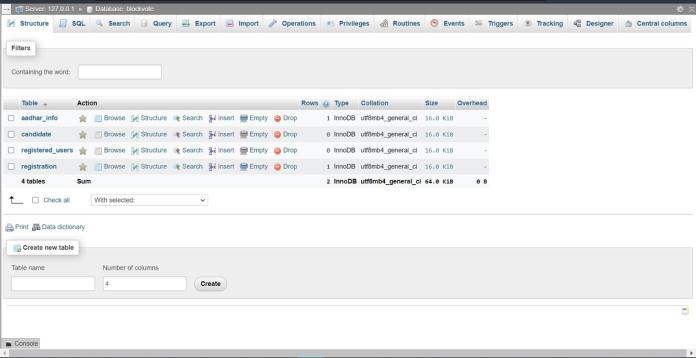
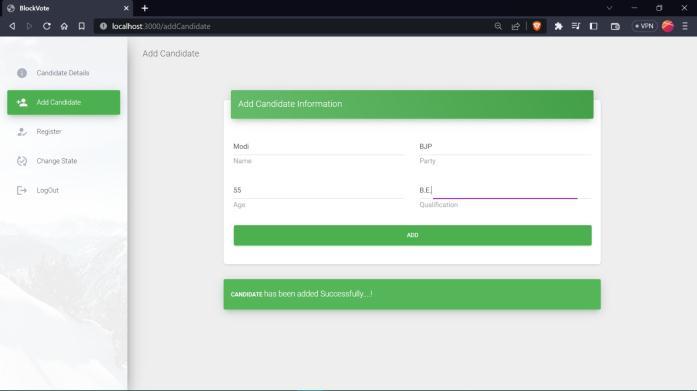
2.3Implementation Screenshots:
Performancemetricsinblockchain-basede-voting systems focus on measuring the efficiency, speed, and capacity of the system. Here are some performance metrics commonly used in e-voting blockchain-based systems:
● Transaction Throughput: This metric measures the number of voting transactions that can be processed per unit of time. It indicates the system'scapacitytohandleahighvolumeofvotes efficiently. Higher throughput allows for more votestobeprocessedwithinagiventimeframe.
● Transaction Latency: Latency refers to the time delay between a vote being cast and its confirmation on the blockchain. Lower latency is desirable to ensure that votes are recorded and validated quickly, reducing the waiting time for voters.
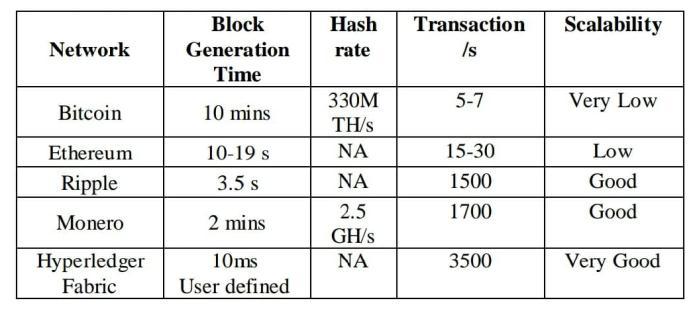
● Block Confirmation Time: Block confirmation timemeasures the timetaken toadd a new block to the blockchain. In e-voting systems, it represents the time required for votes to be



added to the blockchain and considered as confirmed. A shorter block confirmation time ensuresfastervalidationandinclusionofvotesin theblockchain.
● Scalability: Scalability assesses the system's ability to handle an increasing number of voters and votes without sacrificing performance. It measures how well the system can scale up to accommodate a growing user base and a larger volumeofvoteswithoutsignificantdegradationin transactionthroughputorlatency.
● Network Congestion: Network congestion refers to the situation where the network becomes overloaded with voting transactions, leading to delays or bottlenecks. Monitoring network congestion helps identify potential issues that could impact the performance of the e-voting system and allows for the implementation of appropriatemeasurestoalleviatecongestion.
● Consensus Algorithm Efficiency: Theconsensus algorithm used in the blockchain impacts the performance of the e-voting system. Metrics such as the time required to reach consensus among nodes and the energy consumption of the consensus mechanism can be measured to assess the efficiency of the consensus algorithm and its impactontheoverallsystemperformance.
● Fault Tolerance: Fault tolerance measures the system's ability to continue functioning correctly even in the presence of failures or attacks. It includesmetricssuchastheabilitytohandlenode failures, recover from network partitions, and maintain data integrity in the event of malicious actionsortechnicalglitches.
● User Experience: User experience metrics evaluate the usability and convenience of the evoting system from the perspective of voters. It includesfactorssuchasthe easeof accessingand using the system, clarity of instructions, responsiveness of the user interface, and overall satisfactionofvotersduringthevotingprocess.
Monitoring and optimising these performance metrics help ensure that blockchain-based e-voting systems can efficiently handle a large number of votes, provide timely confirmation and validation, and maintain a high level of reliability and security throughout the votingprocess.
2.6Algorithms:
A) SHA-256 (Secure Hash Algorithm 256-bit) is a widely used cryptographic hash function. It takes aninputmessageandproducesa fixed-size(256bit) hash value, which is commonly represented asahexadecimalstring.
Properties:
● Deterministic: Forthesameinputmessage,SHA256willalwaysproducethesamehashvalue.
● Preimage resistance: Given a hash value, it is computationally infeasible to find the original inputmessage.
● Collision resistance: It is extremely unlikely for twodifferentinputmessagestoproducethesame hashvalue(collision).
● Avalanche effect: A small change in the input message will result in a significantly different hashvalue.
SHA-256 is commonly used in various applications, including digital signatures, data integrity checks, password storage, and as a building block in blockchain technology for ensuring the immutability and integrityofdatawithinblocks.
B) Zero-knowledge proofs (ZKPs) are cryptographic protocols that allow a prover to demonstrate knowledge or possession of certain information to a verifier without revealing any additionaldetailsabouttheinformationitself.
Working:
● Setup: Initially, P and V agree on a common reference, such as a public key or a common assumptionthattheybothtrust.
● Statement: P wants to prove to V that a certain statement is true, such as possessing a secret valuexthatsatisfiesaspecificproperty.
● Interactive Proof: P engages in an interactive protocol with V, where they exchange messages and perform computations based on the agreedupon rules and cryptographic primitives. This protocol is designed in a way that, upon completion, V gains confidence in the validity of the statement without learning anything beyond that.
● Completeness, Soundness, and ZeroKnowledge: The zero-knowledge proof should satisfythreefundamentalproperties:
● Completeness: Ifthestatementistrue,anhonest prover P can convince an honest verifier V of its truth.
● Soundness: If the statement is false, no cheating provercanconvinceanhonestverifierwithahigh probability.
● Zero-Knowledge: Theproofrevealsnoadditional information beyond the validity of the statement. Even if an observer were to eavesdrop on the entire interaction between P and V, they would not gain any useful knowledge about the underlyingsecretvalueortheproofitself.
C) Homomorphic encryption relies on mathematical formulas to perform computations on encrypted data. The specific formulas used depend on the type of homomorphic encryption schemebeingemployed.
The BGV scheme is based on lattice cryptography andutilisestheconceptoftheLearningWithErrors(LWE) problem. It allows for both addition and multiplication operationstobeperformedonencrypteddata.
Key Generation: Public Key (pk) and Secret Key (sk) are generatedusingspecificalgorithms.Thepublickeyisused forencryption,andthesecretkeyisusedfordecryption.
Encryption: Plaintext (m) is encoded as a lattice point. Randomnoise(e)isaddedtothelatticepointtomakethe encryption probabilistic. The encryption algorithm producestheencryptedciphertext(c)usingthepublickey (pk).
EncryptionFormula:
c=Encrypt(pk,m)=(A* s+e+pk* m)modq
Addition: Addition of two ciphertexts can be performed homomorphically. The addition algorithm takes two ciphertexts (c1 and c2) and adds them to produce a new ciphertext(c').
AdditionFormula:c'=c1+c2=(c1 +c2)modq
Multiplication: Multiplication of two ciphertexts can also be performed homomorphically. The multiplication algorithmtakestwociphertexts(c1andc2)andmultiplies themtoproduceanewciphertext(c').
MultiplicationFormula:c' =c1* c2=(c1*c2) mod q
Decryption: The decryption algorithm takes the ciphertext (c) and uses the secret key (sk) to recover the originalplaintext(m).
DecryptionFormula:
m=Decrypt(sk,c)=(c- sk*c)mod q
In the above formulas, the variables represent the following:
pk:Publickey sk:Secretkey
m:Plaintextmessage
c:Ciphertext
A:Publicparameter
s:Secretparameter
e:Randomnoise
q:Modulus
These formulas provide a simplified overview of the BGV scheme, which is a powerful fully homomorphic encryptionscheme.
2.7 Limitationsand Adoptions
The adoption of blockchain technology for e-voting presents several limitations and considerations that need to be addressed before widespread implementation. Here aresomekeypointstoconsider:
● Accessibility and Digital Divide: Blockchain evoting assumes that all voters have access to the necessary technology and internet connectivity. However,thiscanexcludecertainsegmentsofthe population, such as older individuals or those in remote areas with limited infrastructure. Ensuring equal access and bridging the digital divideiscrucial.
● Security and Vulnerabilities: While blockchain technology provides security benefits, it is not completely immune to vulnerabilities. Threats such as hacking, malware, and phishing attacks can compromise the integrity of the e-voting system. Thorough security measures, including strongencryptionandmulti-factorauthentication, mustbeinplacetomitigatetheserisks.
● Privacy and Anonymity: Maintainingthesecrecy of the vote is fundamental in any voting system. Blockchain, as a transparent and immutable ledger, may pose challenges in preserving voter privacy. Striking a balance between transparency andvoteranonymityiscrucialtoensureafairand trustede-votingprocess.
● Scalability and Throughput: Blockchain networksoftenfacescalabilityissues,particularly when handling a large volume of transactions. As e-voting involves a significant number of participants, the blockchain must be capable of processingvotesquicklyandefficiently.Solutions like sharding, side chains, or layer-two protocols canenhancescalability.
● Governance and Consensus: Consensus mechanisms are central to blockchain networks, but the choice of consensus algorithm can impact the e-voting system's performance and security. The selection process should involve careful consideration of factors such as decentralisation, energyefficiency,andresistancetoattacks.
● Legal and Regulatory Framework: Implementing blockchain e-voting requires a supportive legal and regulatory framework. This includes addressing issues related to identity verification, jurisdiction, dispute resolution, and the legal status of blockchain-based transactions Collaboration between policymakers, legal experts, and technologists is crucial to establish comprehensiveregulations.
● VoterEducation and Trust: Introducinganewevotingsystemrequiressignificantvotereducation to build trust and confidence. Clear communication about the benefits, security measures, and transparency of the blockchain evotingsystemisessentialtoaddressconcernsand ensureacceptancefromthepublic.
● System Auditability and Transparency: While blockchain provides transparency, it is important to establish mechanisms for auditing and verifying the integrity of the e-voting system. Independentaudits,open-sourcecode,andpublic scrutinycanhelpdetectandaddressanypotential flawsorvulnerabilities.
● Technical Expertise and Maintenance: Implementing and maintaining a blockchain evoting system requires technical expertise and ongoing support. Sufficient resources and skilled professionals must be allocated to ensure the system's smooth operation, timely upgrades, and responsetoemergingthreats.
● Adoption and Transition: The adoption of blockchain e-voting requires a gradual transition from traditional voting methods. Pilots and smaller-scale implementations can help identify challenges, fine-tune the system, and gain confidencefromstakeholdersbeforeexpandingto largerelections.
3. CONCLUSIONS
Implementingblockchaintechnologyinelectronic voting systems has the potential to drastically alter election operations. By utilising the decentralised, immutablepropertiesofblockchain,e-votingsolutionscan ensure the correctness and transparency of the voting process. E-voting can also increase voter turnout and improve accessibility for those who might find it difficult to physically visit a polling site. It is important to emphasise, however, that the implementation of an electronic voting system based on blockchain also raises concerns about voter anonymity and the possibility of hacking or system manipulation. It is essential that the proper security measures are implemented in order to assuage these concerns and ensure the validity of the votingprocess.
REFERENCES
1. What is blockchain technology - IBM Blockchain [Internet]. IBM. [cited 2023Mar14]. Available from: https://www.ibm.com/in-en/topics/whatis-blockchain#
2. Ibrahim MA. What is blockchain technology, an overview. [Internet]. Medium. Medium; 2023 [cited 2023Mar15]. Available from: https://medium.com/@MohammedAminIb2/wh at-is-blockchain-technology-an-overviewcf1a7067c04
3. Benabdallah A, Audras A, Coudert L, El Madhoun N,BadraM.Analysisofblockchainsolutionsforevoting: A systematic literature review. IEEE Access.2022Jul1.
4. Beedham M. Japan is experimenting with a blockchain-powered voting system [Internet]. TNW | Fintech-Ecommerce. 2018 [cited 2023Mar14]. Available from: https://thenextweb.com/news/japan-cityblockchain-voting
5. Ketizmen AM. Smart contracts in EU law [Internet]. ketizmen.av.tr. ketizmen.av.tr.; 2023 [cited 2023Mar15]. Available from: https://www.ketizmen.av.tr/en/post/smartcontracts-in-eu-law
6. Farooq MS, Iftikhar U, Khelifi A. A framework to makevotingsystemtransparentusingblockchain technology.IEEEAccess.2022Jun3;10:59959-69.
7. Blockchain Tutorial [Internet]. Tutorials Point. [cited 2023Mar14]. Available from: https://www.tutorialspoint.com/blockchain/inde x.htm
8. Kshetri N, Voas J. Blockchain-enabled e-voting. IeeeSoftware.2018Jul6;35(4):95-9.
9. Al-MadaniAM,GaikwadAT,MahaleV,AhmedZA. Decentralized E-voting system based on Smart Contract by using Blockchain Technology. In2020 International Conferenceon SmartInnovationsin Design, Environment, Management, Planning and Computing (ICSIDEMPC) 2020 Oct 30 (pp. 176180).IEEE.
10. DeskP.Votingdaoannouncesupcominginaugural Blockchain Person of the Year decentralized voting event [Internet]. ZyCrypto. 2022 [cited 2023Mar14]. Available from: https://zycrypto.com/votingdao-announcesupcoming-inaugural-blockchain-person-of-theyear-decentralized-voting-event/
11. (2018). Swiss-Based Agora Records First Government Election on Blockchain as Accblackited Observer in Sierra Leone. (Jan. 15, 2022). [Online]. Available: https://medium.com/agorablockchain/swissbasedagora-powers-worlds-first-ever-blockchainelections-in-sierra-leone984dd07a58ee.
12. ElMadhounN,HatinJ,BertinE.Adecisiontreefor building IT applications: What to choose: blockchain or classical systems?. Annals of Telecommunications.2021Apr;76:131-44.
13. Vivek SK, Yashank RS, Prashanth Y, Yashas N, Namratha M. E-voting systems using blockchain: An exploratory literature survey. In2020 Second InternationalConferenceonInventiveResearchin ComputingApplications(ICIRCA)2020Jul15(pp. 890-895).IEEE.