Crack Detection using Deep Learning
Dr. Hansaraj Wankhede1 , Abhishikth Thul2 , Deep Malviya3 , Pratik Pathe4 , Shivam Kuite5 1,2,3,4,5 GHRCE Nagpur, India ***Abstract Concrete cracks are one of the primary signs of a structure that would cause major harm to the entire infrastructure. The conventional method of addressing cracks is manual inspection. We discovered during the survey that there are numerous existing technologies, including approaches based on computer vision and image processing. There are several techniques for locating fractures on different surfaces utilizing manual inputs. Different factors influenced the performance of traditional models, which provided results with variable degrees of accuracy. Because there are many different strategies that can be used to produce a good crack detection output, the performance and efficiency were influenced by the environment. Using a Convolutional Neural Network, we have constructed a deep learning model for fracture classification and segmentation. Convolution, activation, and pooling layers make up the foundation of convolutional neural networks. These layers enhance the performance and generalization of neural networks by extracting picture information, introducing nonlinearity, and reducing feature dimensionality. The observed model's accuracy was between 97 and 98 percent. This model can be used to keep track of the condition of the concrete surfaces of bridges, tunnels, and other public transportation infrastructure.
Keywords Crack detection, Deep Learning, Image Processing, Convolutional Neural Networks, Edge detection,ImageSegmentation,FeatureExtraction.
Introduction
Finding surface cracks is crucial for maintaining infrastructure like roads and buildings. Using any of the processing approaches, crack detection is the process of locating cracks in structures. Early identification enables the implementation of preventative steps to stop potential failureand damage [1]. Theconventional method required a lot of time and labor. By using a range of contemporary camerastorecordcrackimages,itispossibletogetbeyond the lack of manual inspection and complete successful maintenance. The issue of fracture identification has recently been solved by modern technology, although it is not particularly precise because cracks can differ from structuretostructureandbedifferentondifferentsurfaces. Accurately recognizing various types of cracks is also difficult because of the intricacy of crack topologies and noiseincollectedcrack pictures.Pavementcrackdetection
usingimageprocessingisnowbothaffordableandeffective [2][3].
In practice, approaches for hand-crafted feature extraction from sub-windows based on intensity thresholding, edge detection, and other image processing techniques are frequentlyused[4].Althoughtheefficiencyofthesesystems indetectingpavementsurfaceshasbeenestablished, there is still room for development, particularly in the classificationofdifferentpavementfracturekinds.However, both computer vision and non-computer vision techniques have difficulties recovering fracture characteristics from pavement with shadows and complicated background pavement, as well as extracting cracks using low-level imagecues[5].
ConvolutionalNeural Networks(CNN),a prominenttoolof the artificial intelligence branch of Deep Learning (DL), havedemonstratedtheireffectivenessinobjectdetection.
In contrast to conventional machine learning techniques, deep learning (DL) offers end-to-end classifiers that internally learn characteristics and can recognise objects automatically. The recent advancement of graphics processing units (GPU), which allows for extremely quick computations, together with this characteristic of DL algorithms have increased their use in a variety of sectors. In the instance of crack detection from images, the user needonlysupplyvariousphotosasinput,andanydetected cracks in these photos are returned as output without the need for any operator involvement [6]. Mendeley's ConcreteCrack Imagesfor is thesource of the information in our model. Our deep learning model has a classification accuracyofbetween97and98percent.
I. LITERATURE REVIEW

Crack detection is identified and segmented based on a variety of characteristics because it is an intriguing issue withnumerouschallengingparameters.Therearedifferent ways to find cracks. There are several techniques that use manualinputstofindfracturesinavarietyofsurfaces.
Imageprocessingmethodsusingcameras
Thissectionprovidesasummaryoftheprocessingmethods used to identify cracks in engineering structures using camera images. Many of the publications that were reviewedhereusedcamerainput.
International Research Journal of Engineering and Technology (IRJET) e-ISSN: 2395-0056
Volume: 10 Issue: 05 | May 2023 www.irjet.net p-ISSN: 2395-0072
Theinformationregardingthefractureisgatheredthrough pre-processing,imagesegmentation,andfeatureextraction. Followingthesmoothingoftheacceptableinputimage,the Threshold method of segmentation was applied. The size and perimeter of the roundness index are determined for picturejustification.Thepresenceofthecrackintheimage is then assessed in comparison [7]. Many commercial camera-based image processing methods simply require pre-processing, however some methods focus on the integration algorithm, which is where feature extraction is doneThe faults are represented quantitatively in a model thatwascreated.Thefracturequantificationanddetection, neuralnetwork,and3-Dvisualizationmodels,respectively, makeuptheintegrationmodel[8].
A stitching algorithm for images was created. For the retrieval of the crack segments, that has been utilized, whichusesafeature-basedregistrationandskeletonization technique.Theevaluationofthecrackquantificationmodel served as the sole foundation for the width and lengthbased crack detection. An integrated model that combined fracturelengthandchangedetectionwith3Dcrackpattern visualizationandneural network predictionofcrack depth wasdeveloped[1].
ImageProcessingMethods
Preprocessing is a phase used in image processing techniques to reduce noise and improve crack characteristics. To identify cracks, it uses threshold segmentation. The morphological approach method finds fracture formations by evaluating curvature and using mathematical morphology. The neighbourhood pixels are used to estimate the size of the crack in the percolationbasedapproachtoidentifywhetherafocuspixelisapartof it. While the automatic route-finder algorithm calculates thelengthandwidthofthecracksinthepracticaltechnique, the endpoints of the crack are manually identified. As the initial stage in enhancing the crack detection algorithm's performance, all IP approaches preprocess photos. There has been a lot of research done on these IP approaches' accuracy[1].
The majority of studies concentrate on non-intrusive techniques like feature extraction and thresholding. The lack of uniformity in particular IP techniques has been highlighted, nevertheless. Thresholding, for instance, has relied on extremely basic techniques like a fixed 0.5 or halving the maximum image brightness; this differs with moresophisticatedtechniqueslikeOtsuandNiblack[9].
Edgedetection
Concretecracksareoneoftheprimarysignsofastructure that would cause major harm to the entire infrastructure. The conventional method of addressing cracks is manual inspection. Manual procedures omit the quantitative and qualitative analysis. Experiments with automatic fracture
identification utilizing image processing techniques yield reliableresults.Inmorerecentpublications,awidevariety of image-processing approaches have been tested. For the purposeofidentifyingconcretecracks,a thoroughanalysis of several edge detection methods is done. Prewitt, Sobel, Gaussian, Roberts, Canny, and Laplacian edge detector performanceisdiscussed[18].
Abreak intheintensityfieldofthegreyscaleisreferredto as an ideal edge. In order to discover image cracks more quickly and effectively within a big picture dataset, edge detection refers to the employment of filters in an image processingalgorithmtodetect orenhance the cracksinan image. Matrix representations of images are used in mathematics[20].
A discontinuity in the intensity level is referred to as an edge. Methods for crack identification use filters in the spatial or frequency domain to locate edges. These techniques outperform manual examination in terms of reliability. The following stages are generally followed by alledgedetector-basedfracturedetectiontechniques:
Smoothing
Enhancement
Detection
Binarization
TypesofEdgedetectoralgorithm:
SobelEdgeDetector
CannyEdgeDetector
Prewitt
Robert
LaplacianofGaussian(LOG)
FastFourierTransform(FFT)
Thissuggeststhatvisualassessmentofconcretestructures by people is a more time- and money-intensive task. Concrete structure cracks are automatically detected, reducing the need for human intervention. This study examines various edge detection techniques' analyses of concrete crack detection. We investigate two frequency domain-based edge detector approaches and four spatial domain-based edge detector methods. The outcomes from the edge detection techniques were fairly satisfactory. It should be expanded using deep learning techniques in order to achieve higher performance in conventional edge detectiontechniques[18].
International Research Journal of Engineering and Technology (IRJET) e-ISSN: 2395-0056
Volume: 10 Issue: 05 | May 2023 www.irjet.net p-ISSN: 2395-0072
TraditionalMLmethods:
Crack evaluation has always been done manually using human field surveys. These manual survey methods, however, have low repeatability and reproducibility, require a lot of time and labour, and put surveyors in danger. Additionally, due to subjectivity of the raters, the data collected may differ. There have been significant research efforts to develop automated crack survey methodstoaddressthedrawbacksofmanualsurveys.Data collection,crackdetection,andcrackdiagnosismakeupthe automaticcrackevaluation.
The crack detection method receives two- or threedimensional(2Dor3D)inputdatafromdatacapture.Crack detection is the process of identifying cracks in the 2D and/or 3D data provided by automated data capture, with the least amount of human participation. Crack diagnosis requires key inputs from crack detection, including classification data like type, severity, and extent that are critical for planning maintenance. Through the management process, crack diagnosis can be utilized to choosethebesttimeandintensityoftherapy[11].
Beforetrainingthemodels,traditionalMLtechniquesusea predetermined feature extraction stage. Support vector machines(SVM),artificial neural networks(ANN), random forests, clustering, Bayesian probability, and naive Bayes fusion are the most popular conventional ML techniques. Both crack identification and image processing with the best parameters have been accomplished using conventional ML algorithms. These are also frequently employed for the extraction of predetermined features. They are unable to handle massive datasets, though. TraditionalMLtechniqueshaveadrawbackinthattheyare unable to learn more complicated features and cannot handle the complex data included in photos, such as backdroppavementwithvaryinglighting[9].
Predefined feature extraction requires image-processing procedures, and diverse features have been applied in various research projects, including statistical values of images,verticalandhorizontalprojectionsoffeaturemaps, and characteristics of specified crack objects. The primary issue with conventional ML approaches is that they only use superficial learning strategies. Those approaches can't handle the complicated information in the photos without learninghigher-levelfeatures.Forinstance,lightingandthe environment have a significant impact on the background ofphotosofpavement.
II. METHODOLOGY
In our approach, crack segmentation is formulated as a binary image labelling problem, where "Positive" and "Negative" stand for, respectively,"crack" and"non-crack." Ifthereisacrackintheoutputimage,deeplearningwillbe usedtofurthersegmentit.Atasklikethisnecessitatesboth
high-level features and low-level clues. Convolution, activation, and pooling layers make up the foundation of convolutional neural networks (CNNs). These layers enhance the performance and generalization of neural networks by extracting picture information, introducing nonlinearity,andreducingfeaturedimensionality.
Layers used in convolution, activation, and pooling are the foundationofCNNs.Theselayersenhancetheperformance andgeneralisationofneuralnetworksbyextractingpicture information,introducingnonlinearity,andreducingfeature dimensionality.ConvolutionlayersinCNNsareusedmostly for feature extraction, which also maintains the spatial relationship between pixels in the source pictures. The output of the convolution kernel or filter is computed by sliding the image by pixels, performing element-wise multiplication,andaddingthepixels.Thefeaturemapisthe name of the output matrix. A collection of 2D arrays of weights is what makes up a convolution kernel or filter in deeplearning.Each2Darrayofweightsisusedtogenerate additional channels by applying it to all of the input channelsfromtheprecedinglayer.
Whilefeaturemapsofhigherlayersincludemoresemantic meaning and less location information, lower convolution layers primarily extract structural elements and location information from an image. An error backpropagation techniquecanbeusedtolearnandimprovetheconvolution kernels with weights during training. A CNN is one of the severalkindsofartificialneuralnetworksthatareusedfor different applications and data sources. It is also a sort of network architecture for deep learning algorithms and is specifically utilised for tasks like image recognition and pixel data processing. An activation function is used to provide nonlinearity to neural networks after the convolution process. Rectified Linear Units are frequently usedactivationfunctions.
CNNArchitecture:
TherearetwomainpartstoaCNNarchitecture
Feature extraction is a procedure that uses a convolution tool to separate and identify the distinctcharacteristicsofanimageforstudy.
There are numerous pairs of convolutional or poolinglayersinthefeatureextractionnetwork.
a fully connected layer that makes use of the convolutionalprocess'soutputanddeterminesthe class of the image using the features that were previouslyextracted.
This CNN feature extraction model seeks to minimize the quantity of features in a dataset. It generatesnewfeaturesthatcondenseaninitialset of features' existing features. The number of CNN layersisnumerous,asseeninFigure1.
International Research Journal of Engineering and Technology (IRJET) e-ISSN: 2395-0056
Volume: 10 Issue: 05 | May 2023 www.irjet.net p-ISSN: 2395-0072
ClassificationReport
The function for creating classification reports generates a text report with the key classification metrics.
The ratio of true positives to the total of true and falsepositivesisthedefinitionofprecisionforeach class..
Recall is determined for each class as the proportion of true positives to the total of true positivesandfalsenegatives.
[Source: Binary Image classifier CNN using TensorFlowMedium.com]
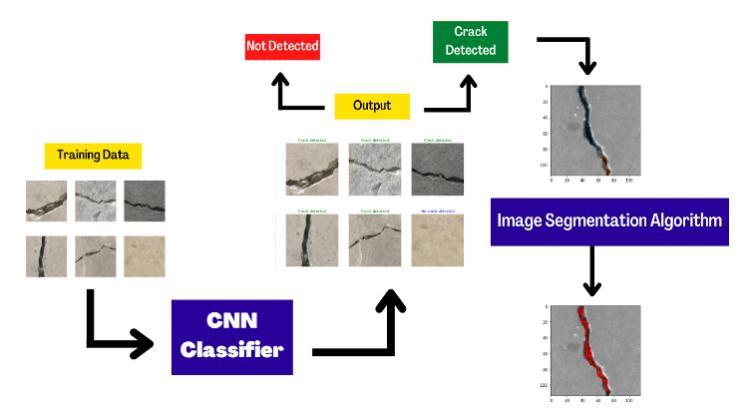
AnoverviewofhowtouseaCNNtofindcracksisshownin Figure2below.Thedatasetforconcretecracks,modelling, and testing the trained CNN classifier are the three processes. Many raw photos of the concrete surface are obtained in order to train this model. The gathered raw images are reduced in size by cropping, and the reduced images are then manually differentiated into photographs withandwithoutcracks.Thetrainingsetandvalidationset arethenarbitrarilychosenfromthedatasetandloadedinto a CNN for training and validation, respectively. A CNN classifier is created through training that can distinguish betweenimageswithandwithoutcracks.Cracksinphotos can be distinguished from others using the trained CNN classifier.
Since F1 scores incorporate precision and recall intotheircomputation,theyarelessaccuratethan accuracymeasures.
III. DATA COLLECTION & PLATFORMS USED
Tools / Platform Description
Miniconda
A free basic installer for conda is called miniconda. It is a stripped-down, bootstrapped version of Anaconda that just contains conda, Python, and the packages they require, as well as a select fewotherimportantpackageslikepip,zlib, andafewmore..
CUDA
NVIDIA’s CUDA is a general-purpose parallel computing platform and programming model thataccelerates deep learningandothercompute-intensiveapps by taking advantage of the parallel processingpowerofGPUs.
Thenumberofepochscanbeincreasedtoimprove accuracy.
Here, learning pace is equally crucial. Training at various learning speeds can lead to better results. However, this significantly lengthens the training period.
If a low learning rate is chosen, training moves more slowly; if a high learning rate is chosen, trainingmovesfasterbutaccuracysuffers.
Google Colab
Google Research produces Google Colaboratory, sometimes known as "Colab." Colab is particularly useful for machine learning, data analysis, and education because it enables anyone to write and run arbitrary Python code throughthebrowser.

Jupyter
Command Prompt
VSCode
The first web application for producing andsharingcomputationaldocumentswas called a Jupyter Notebook. It provides a straightforward, efficient, documentfocusedexperience.
For the operating systems OS/2, eComStation, ArcaOS, Microsoft Windows, and ReactOS, it serves as the default command-lineinterpreter.
On your desktop, Visual Studio Code is a quick yet effective source code editor that runsonWindows,macOS,andLinux.
International Research Journal of Engineering and Technology (IRJET) e-ISSN: 2395-0056
Volume: 10 Issue: 05 | May 2023 www.irjet.net p-ISSN: 2395-0072
IV. DATASET
CLASSIFICATIONIMAGESOFCONCRETECRACK
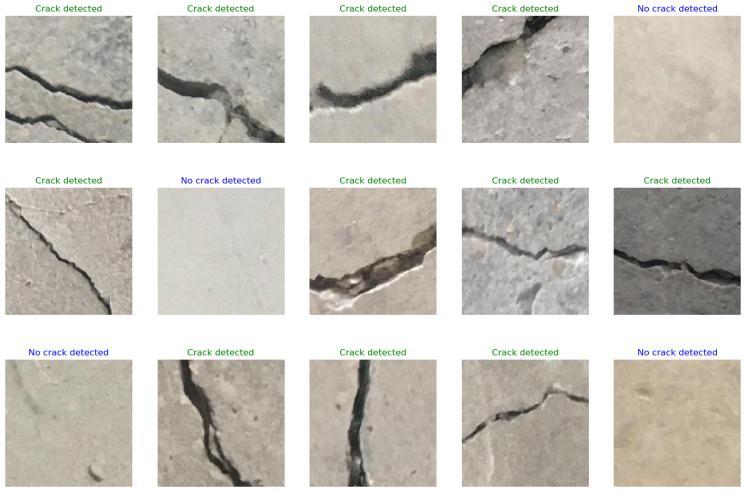
Imagesofdiverseconcretesurfaces,bothwithandwithout cracks,canbefoundinthedatasets.Forimageclassification, the picture data are split into two categories: negative (without crack) and positive (with crack). Totaling 40000 photoswith227×227pixelsandRGBchannels,eachclass comprises 20,000 images. 458 high-resolution photos are usedtocreatethedataset(4032x3024pixel).Highlevelsof variancewerediscoveredinhighresolutionphotos[19].
V. DESIGN, IMPLEMENTATION AND MODELLING
Step-1:SettingtheDataframe
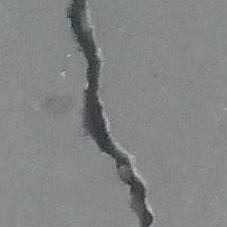
Images that have cracks are kept in a category called "POSITIVE," whereas those without cracks are kept in "NEGATIVE."
Step-2:TrainingPeriod
We have a fullyconvolutional model that has been trained andfedtheaforementioneddataset.
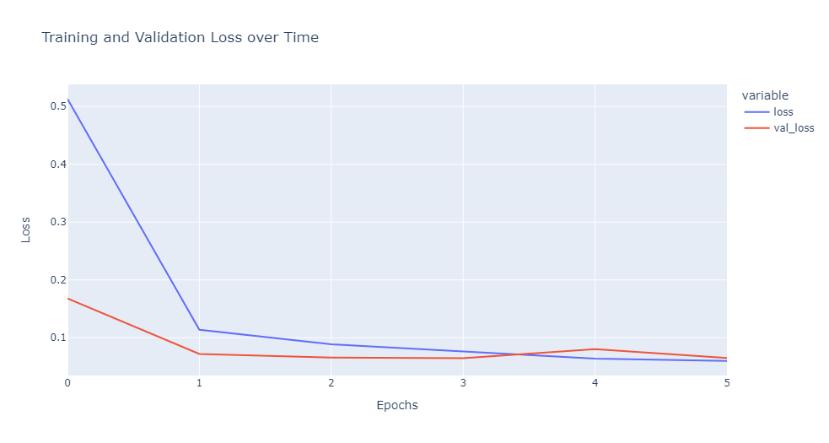
We installed the prerequisites, imported the required libraries,andhandledtheproject'sdependenciestoensure proper implementation. Thedataset including images with andwithoutcracksisinitiallyinputtothemodel.Theinitial dataset was split into 60 percent Training data and 40 percent Testing data,with the epochs setat 10.The model successfully classifies the Test pictures into two groups when each epoch is complete: "Crack Detected" and "No CrackDetected."
becausetheyproducemoreaccurateresultsfortheproject athand.
ImageSegmentation
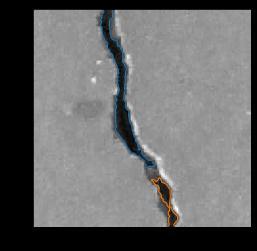
The model has been trained and can now label the new photos. We'll be dealing with photos that have cracks in them.Anyimagecanbeusedasaninputtothemodel.
Step-3:ModelSummary
UsingKeras,aneuralnetworkiscreatedinthisstage.ReLu andsigmoidactivationfunctionswereusedfortheselayers
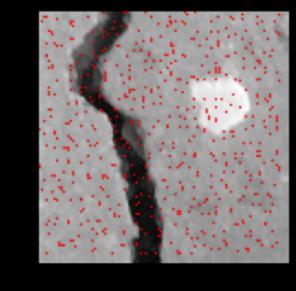
For this, the images with cracks are saved into a folder calledpositive.Themodel will nowbetransmittedwithan imagethatincludesacrack.Anappropriatesizechangewill be made to this image. Red dots, also known as scatter marks in the matrix, will be used to label the whole image afteradjustments.Inthenextstep,thereddotsarereduced sothatthefeatures,Crackmarksarecoveredwithreddots. Finally,thismarkedpartwillbecoloredred.
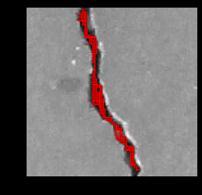
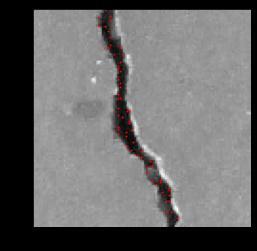
Thefinaloutputgeneratedisanimagethatisclassifiedinto acracklabelwithcrackhighlights.

ImageProcessingtechnique:
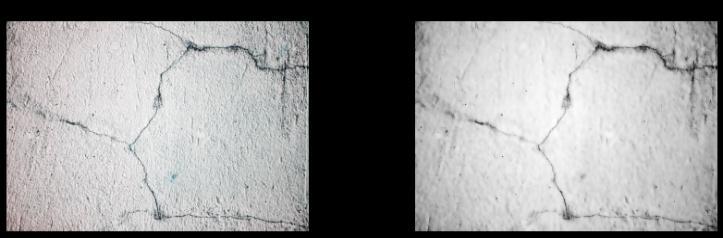
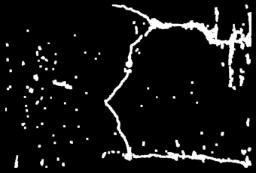
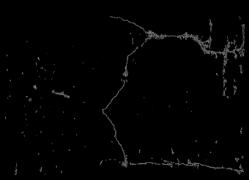
a model that applies multiple image processing methods, including grayscale image conversion, hue scale, and other methods.Thesemethodsareemployedtodrawattentionto theentireimageandextractthefeatures.Thenextstageis to use a clever edge detection method after image processing. The multi-stage technique Canny Edge DetectiondeterminestheEdgeGradientfromtheimagesto marktheoutlines.
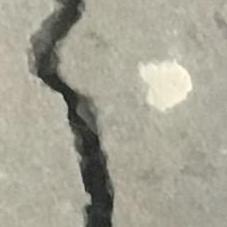
The model will categorise this image as having been cracked when it enters the first stage. This image is now utilisedinthefollowingstage,wheretheimage'scrackwill be highlighted and indicated in red. Any image can be provided to the model as an input. This image has a label indicatingwhetheritiscrackedornot.Themodelthatwill markthecrackisnowgiventheimage.
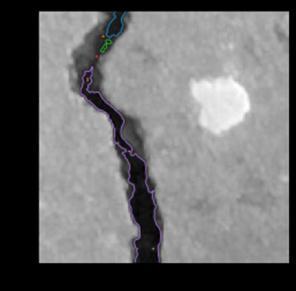
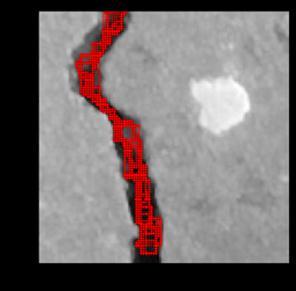


This method had a problem with photos that were noisy, overexposed to light, and blurry. The following is a list of theresultsthattheimageprocessingtechniquesproduced.
In the testing phase, we used an image that contains a crack.Example-
Confusion Matrix
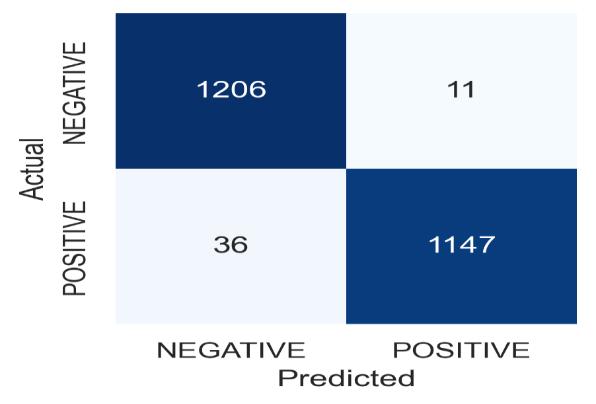
Thefigurebelowmentionstheconfusionmatrixproduced using10epochs.Theactualpositiveandnegativenumbers arehighest.Themistakerateissignificantlyreduced.After being used as an input by the model, the testing starting imageisaccuratelyclassifiedashavingaCrack.
The number ofimages that actuallyhadnocracksandthe anticipatedvaluewerebothcorrectlycharacterized,hence thealgorithm wasableto estimate True Valuesaccurately for1206images.
However, 1147 of the photos genuinely had crack and wereaccuratelyclassified.
Themodel'saccuracywasbetween97and98percent,and it can recognize photos with cracks. The generated f1score is 98 percent. This indicates that the model is preparedtoassessadditionalphotos.
(GISAT), Kottayam, Kerala KCG College of Technology, Chennai,India(2017)
[2] WangXandFengX2011PavementDistressDetection And Classification With Automated Image Processing in Proceedings 2011 International Conference on Transportation, Mechanical, and Electrical Engineering,TMEE(2011)
[3] Broberg P 2013 Surface Crack Detection In Welds UsingThermographyNDTEInt.
[4] ZouQCaoY,LiQ,MaoQ,andWangS2012Cracktree: Automatic Crack Detection From Pavement Images PatternRecognit.Lett.
[5] Li B Wang K C P Zhang A Yang E, and Wang G 2018 AutomaticClassificationOfPavement
[6] Dais, D., Bal, İ. E., Smyrou, E., & Sarhosis, V. (2021). Automatic crack classification and segmentation on masonrysurfacesusingconvolutionalneuralnetworks and transfer learning. Automation in Construction, 125,103606.
[7] Zhang Yiyang. The design of glass crack detection system based on image pre-processing technology, in: Proceedings of Information Technology and Artificial IntelligenceConference,(2014).
[8] R.S. Adhikari, O. Moselhi1, A. Bagchi, Image-based retrieval of concrete crack properties for bridge inspection,Autom.Constr.39(2014).
The classification of photos into "Crack detected" and "Crack not Detected" is successful. A random image provided as input is reliably and precisely labelled. The model correctly classified the image labels with an accuracy of 97–98%. Further processing is applied to the cracked images, and the cracks are segmented. Cracks are firstdesignatedwitha redcolorbeforebeingaccentuated. The outputisa picture with a segmentedcrack asitsfinal form. A multi-class algorithm called Edge detection is implemented as part of a similar strategy for image preprocessing in order to identify the image's cracks. When compared to image processing methods, deep learning algorithms do better in segmenting images. Image processingmethods,blur,noise,andlightingconditionsall have downsides. To classify a crack and then separate the crackfromtheimage,adeeplearningmodellearnshowto labelvarioussortsofimages.
REFERENCES
[1] Crack detection using image processing: A critical review and analysis Arun Mohan, Sumathi Poobal Gurudeva Institute of Science and Technology
[9] Golding, V.P.; Gharineiat, Z.; Munawar, H.S.; Ullah, F. Crack Detection in Concrete Structures Using Deep Learning(2022).
[10] Image-based concrete crack detection in tunnels using deep fully convolutional networks Yupeng Ren, Jisheng Huang b, Zhiyou Hong c, Wei Lu b, Jun Yin b, LejunZoua,XiaohuaShen(2020).
[11] Hsieh,Y.-A., &Tsai,Y. J.(2020).MachineLearning for Crack Detection: Review and Model Performance Comparison. Journal of Computing in Civil Engineering.

[12] D.E.Rumelhart,G.E.Hinton,R.J.Williams,Learning representations by backpropagating errors, Nature 323(1986).
[13] V. Nair, G. Hinton, Rectified linear units improve restricted Boltzmann machines, in: Proc. 27th Int. Conf.Mach.Learn.,(2010).
[14] A.L. Maas, A.Y. Hannun, A.Y. Ng, Rectifier nonlinearities improve neural network acoustic models,in:Proc.Int.Conf.Mach.Learn(2013).
[15] D. Scherer, S. Behnke, Evaluation of pooling operations in convolutional architectures for object recognition, in: K. Diamantaras, W. Duch, L.S. Iliadis (Eds.),Artif.NeuralNetworks–ICANN2010,Springer, Berlin,Heidelberg,Thessaloniki,Greece,2010.
[16] H. Simon, Neural network: a comprehensive foundation,2nded.,PrenticeHall,1998.
[17] Dimitris Daisabİhsan Engin BalaEleni Smyroua Vasilis Sarhosisb. Automatic crack classification and segmentation on masonry surfaces using convolutional neural networks and transfer learning (2021).
[18] A. Diana Andrushia, N. Anand and I. Antony GodwinKarunyaInstituteofTechnologyandSciences, Coimbatore, India C. Aravindhan Bannari Amman Institute of Technology, Sathyamangalam, India. Analysis of edge detection algorithms for concrete crackdetection(2018).
[19] Özgenel, Çağlar Fırat (2019), “Concrete Crack ImagesforClassification”,MendeleyData,V2
[20] Dorafshan, Sattar; Thomas, Robert J.; Maguire, Marc(2018).Comparisonofdeepconvolutionalneural networks and edge detectors for image-based crack detection in concrete. Construction and Building Materials.