
Review of Various Cooling Techniques to Improve the Performance of the Solar Photovoltaic Panel
1Professor, Dept. of Mechanical Engineering, PVG’s COET PUNE, Maharashtra, India

2Student, Dept. of Mechanical Engineering, PVG’s COET PUNE, Maharashtra, India
3Student, Dept. of Mechanical Engineering, PVG’s COET PUNE, Maharashtra, India
4Student, Dept. of Mechanical Engineering, PVG’s COET PUNE, Maharashtra, India ***
Abstract:
With limited Non Renewable resources and considering Environmental pollution concerns due to Nonrenewableenergysources,SolarPanelswillplayavitalrolein satisfying global energy demands in the upcoming future. WhileevaluatingtheperformanceofSolarPhotovoltaicPanel, various parameters are required to be taken into consideration. Apart from External parameters, various internal parameters also affect the efficiency of PV Panels. Several external and internal parameters like Weather Conditions, Shading, Panel Orientation, Wind Velocity, Location, Angular inclination of Solar Panel Cleanliness of Solar Panel surface, Ageing of Solar panel mainly affect the performance of Solar Panel Output. Researchers came to know the fact that the efficiency of Solar Panels decreases as the temperature of the back surface of Solar PV Panels increasesduetotheaccumulationofheatinsidethePVpanels. This paper enlists various techniques used to cool down the operating temperature of a photovoltaic system.
Key Words: Photovoltaic Module, Conversion Efficiency, Cooling Techniques, Operating Cell Temperature, PCM, Forced Water Cooling, Air Cooling, Heat Transfer
1. INTRODUCTION
The global energy landscape is witnessing a significantshiftfromtraditionaltonon-conventionalenergy sources, triggering the need to reduce environmental pollution and promote sustainable development. Conventional energysources,suchascoalandfossil fuels, leadtovariousenvironmentalissues,includingairpollution, acid rain and greenhouse gas emissions. In contrast, nonconventional energy sources like solar, wind, hydro and biomass offer cleaner and more sustainable alternatives. Solarenergy,inparticular,hasemergedasapromisinggreen energysourceduetoitsabundantavailabilityandminimal environmental impact. Solar power generation systems harness sunlight to produce electricity without emitting harmful pollutants. Moreover, solar energy is renewable, meaningitcanbereplenishednaturallyandwillnotrunout, unlikefossilfuels.
However,onechallengefacedbysolarPVpanelsis thereductioninefficiencycausedbyanincreaseinambient temperature.Asthetemperaturerises,theoutputpowerof thePVpaneldecreases,leadingtoloweroverallefficiency. Toaddressthisissue,researchershavedevelopedvarious coolingmethodsforPVpanels,whichcanbeclassifiedinto active and passive techniques. Active cooling methods involvetheuseofmovingparts,suchasfansorpumps,to dissipateheat fromthesolarpanels.Examplesinclude air cooling, water cooling, and a combination of both. On the otherhand,passivecoolingtechniquesdonotrequireany movingpartsandrelyonnaturalprocesseslikeconvection and radiation to remove heat. Some examples of passive cooling methods are phase change materials (PCMs), heat sinks, and nanofluids. Additionally, integrating thermoelectric generators (TEGs) with solar PV panels can help extract energy from waste heat, further enhancing the overallefficiencyofthesystem.
1.1 Effect of environmental factors on the efficiency of PV module:
ManasRanjanDas(2019)workedontheeffectsof temperature,humidity,windvelocity,lightintensity,altitude andatmosphericpressureontheefficiencyandperformance of the panel. He found the temperature being inversely proportional to I-V characteristics decreases the performanceofsolarpanelwithanincreaseintemperature. Presence of humidity surrounding solar panel results in reflectingthesun'sraysaffectingtheoveralloutputofthe panel and rusting of metal used in the panel and thus decreasing its performance. The wind velocity positively impacts the performance of the panel thereby improving efficiency.Hisresultsalsoshowedthatvoltageandcurrent decrease as the light intensity decreases with the direct proportionality of the two. Thus he included different environmental factors affecting the efficiency and performanceofSolarPVpanels.
2. ACTIVE COOLING TECHNIQUES
ActiveCoolingtechniques mainlyincludesForced AirCooling,Forcedwatercooling&PV/Tthermalsystemsto cooldowntheoperatingtemperatureofPVmodule.
2.1 Forced Air Cooling
Sajjad et al. (2019) performed research on two photovoltaicmodulesinwhichonewasair-cooledandthe other was without cooling. The module which was cooled showed 7.5% electrical efficiency and a 6.4% higher performance ratio when compared to the photo voltaic modulewithoutcooling.
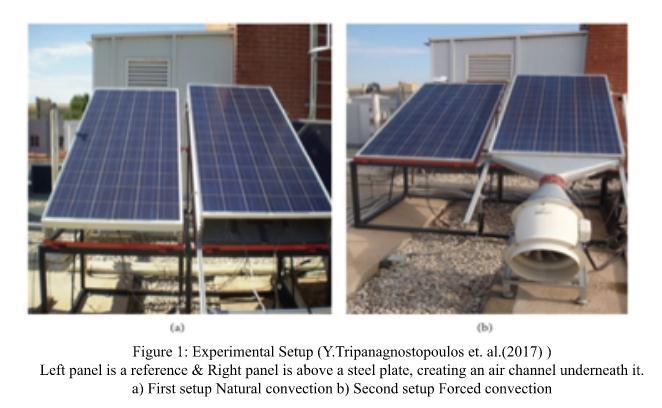
Y.Tripanagnostopoulosetal.(2017)studiedPVair cooling in several modes whose objective was to create a practical and efficient system configuration for its applicationinPVinstallationsofbuildings.Theyusedtwo referencesystems,onewasacommercialPC-SiPVmodule which was used as a reference and the second was a fabricatedPC-SiPVmodulewithtransparenttedlaronthe frontandnormalglassonthebacksurface.Thesesystems were tested in two conditions, first with forced air circulation and second with natural air circulation. The results of the experiment showed that the modifications done on the PV module contributed to satisfactory PV cooling.
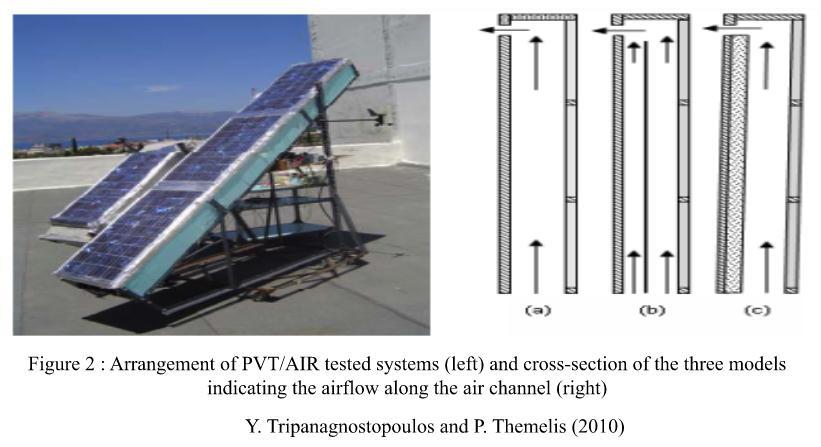
was a significant improvement in the efficiency of solar photovoltaiccellswhichwasduetotheflowofnaturalair.
J. R. García-Cascales et al. (2013) conducted researchtomodifythedesignofPVmodulesthatareplaced on roofs to ensure low operating cell temperatures. The experimentwasconductedattheUniversidadPolitécnicade CartagenainSpain.Thesetupconsistsoftwosimilarsolar panels in which one was taken as it is and the other was modified and mounted on different channels to allow the passage of air. The results show that there must be considerableairspacebetweenthephotovoltaicpanelsand the roof for cooling the panel thereby increasing its efficiency.
Y. Tripanagnostopoulos and P. Themelis (2010) performedcoolingofsolarpanelswithnaturalairflowwith theobjectiveoftheimprovementofelectricalefficiencyof solarpanelInstallationonbuildingsthroughcoolingofsolar panels with natural airflow. The experiments were performedindaylightforseveraldayswiththeadditionof thin metal sheet (TMS) or metal fins in the middle of air channelandreadingswereobserved.Itwasfoundthatthere
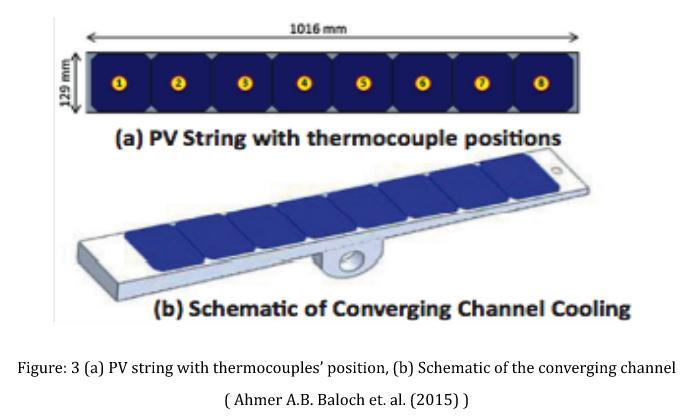
Ahmer A.B.Balochetal.(2015)conductedresearch onaninnovativecoolingtechniqueofsolarPVpanelswhich isknownastheconvergingchannelcoolingtechniquewhich wasappliedtoachievelowanduniformtemperaturesonthe surfaceofsolarPVpanels.Theexperimentwasconductedin Saudi Arabia in the month of June and December. The temperaturereadingswererecordedinboththemonthsof uncooled solar PV panels and cooled solar PV panel by applyingtheconvergingcoolingtechnique.Thetemperature for the uncooled PV panel was71.2°C and 48.2°C for the months of June and December respectively and for the cooled PV panel it was 41.6°C and 36.4°C for June and December respectively. Due to this significant drop in temperature,therewasariseinboththepoweroutputand electrical efficiency. The output power and electrical efficiencywereincreasedby35.5%and36.4%respectively, hencemakingiteconomicallyviable.
2.2 Forced Water Cooling:
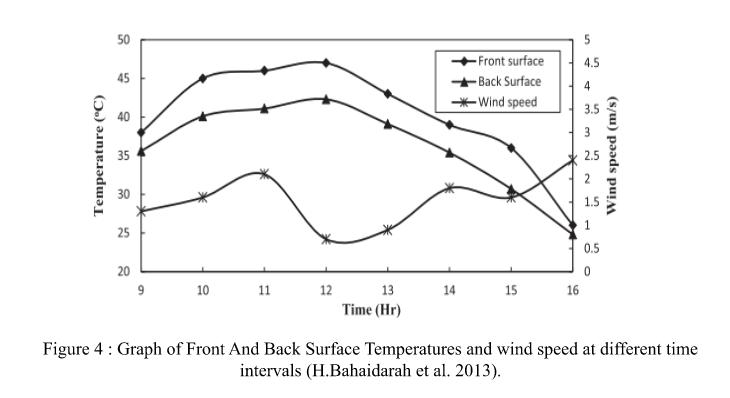
H.Bahaidarahetal.(2013)usedawaterjacketatthe backofthepaneltoimprovetheefficiencyofthepanelby controllingthewatertemperatureTheyanalyzedthemodule temperature vs wind speed and variation of irradiance vs ambienttemperature.
Theyalsodevelopedandtestedanumericalmodel comprisingtheThermalandElectricalmodelspredictingthe
performance of thermal and electrical parameters on the efficiencyofPVpanel.Afterexperimentingandanalysisthey foundoutthenumericalresultswereincoordinationwith experimentalresultsandusingawatercoolingtechniquethe panel temperature dropped significantly to nearly 20% therebyincreasingthePVpanelefficiencyby9%.
theconventionalPVmoduleandalsotheaverageconversion efficiencywasincreasedby33.28%.
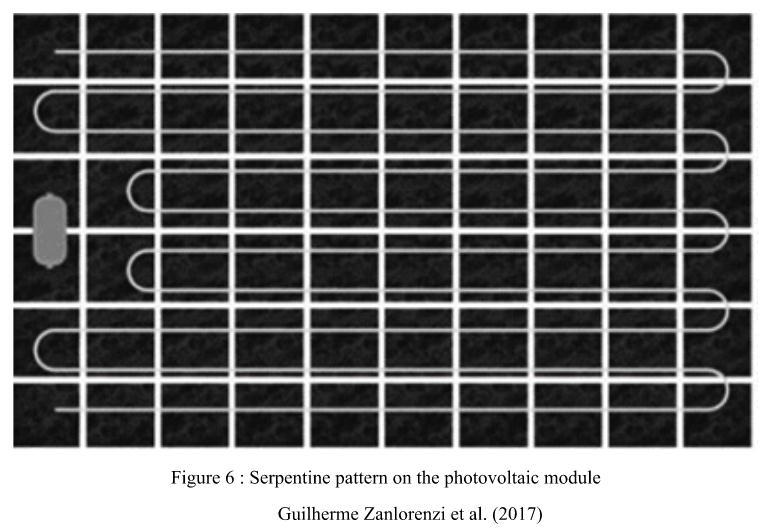
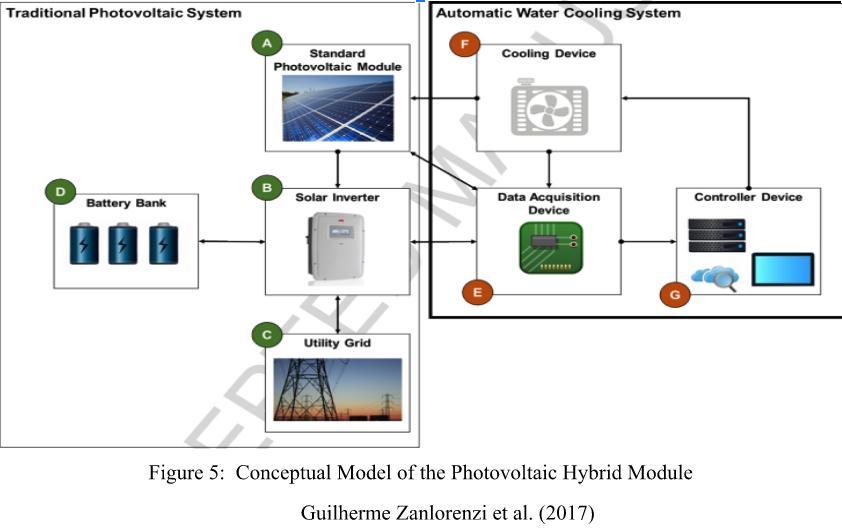
Guilherme Zanlorenzi et al. (2017) conducted an experiment for cooling of solar photovoltaic modules by deployingwatercoolingsystemtoincreasetheconversion efficiencyofsolarPVpanels.Theresearchersworkedonthe modelwhichcomprisedofaPhotovoltaichybridmodulethat consists of a traditional photovoltaic system and an automaticwatercoolingsystem.
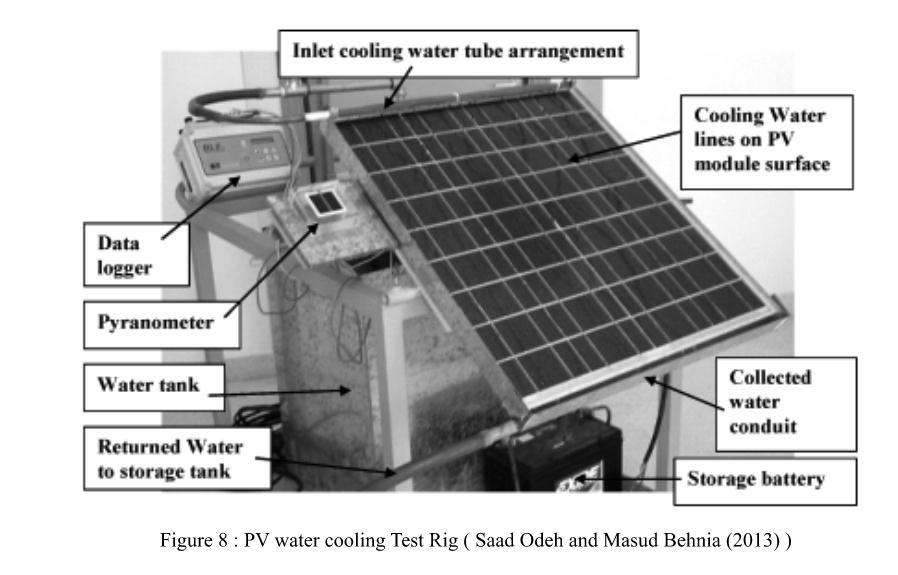

SaadOdehandMasudBehnia(2013)conductedan experimentforimprovingSolarPVpanelefficiencywhichis tobedonebyreducingtheaverageoperatingtemperatureof thesolarPVmodulethroughsurfacecoolingofthefrontside of the PV panel using water dripping technique. An experimentalsetupwasorganizedtoinvestigatetheresults and performance of solar panels which were to be cooled usingthesurfacecoolingtechnique.Duetosurfacecooling theheatwaslostduetoconvectionbetweenthewaterand thefrontsideofPVpanelwhichresultedin15%increasein theoutputpowerofthepanelandtheelectricalefficiency wasincreasedby5%.
The water cooling system used by researchers consistedofserpentinetubeswhichcoveredeachandevery cellofsolarPVpanel.Forserpentineformation,coppertubes wereusedwitha3/8’’diametersuchthat96%ofthesolar PVpanelbacksidesurfacegetscoveredandonly3%ofitwas leftduetothecompulsoryplacingofjunctionbox.
Researchers conducted experiments on the prototype in an area of the state of Parana, Brazil in the monthofDecemberduringdaytimesfor23days.Thedata was collected for different time batches and the collected datasuchastemperature,voltageandcurrentwasanalyzed and synthesized properly using graphs and statistics. The resultsshowedadropin11.42%oftheaverageoperating temperatureofthesolarPVpanelandtheenergyproduced bythewater-cooledPVpanelwasincreasedby8.22%than
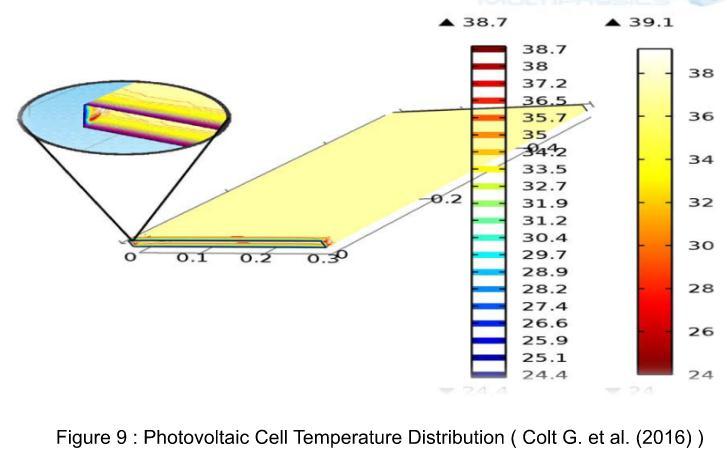
ColtG.usedactivewatercoolingonthebacksurface to cool down the cell temperature and also performed
numerical as well as experimental study and analysis. He used an Aluminum cooling radiator with Silicon thermal conductingpasteforheattransferbetweenthepanelandthe radiator.UsingCOMSOLsimulationheperformedanalysis regarding water temperature distribution in the flow channelandtemperaturedistributionofthePVcell.
Withcontrolledparametersandpassivecoolingof thesystemnumericalandexperimentalelectricalefficiencies for both (i) PVT and (ii) PVT-PCMwere (i) 12.4% and 12.28% and (ii) 12.75% and 12.59% respectively. The electricalperformanceswereimprovedat10.13&9.2%for PVTand12.91&12.75%forPVT-PCM.
3. PASSIVE COOLING
Unlike Active cooling systems, Passive cooling techniquesaremainlydependentonconduction,convection and radiation-assisted heat transfer without consuming energy. Natural air convection using surrounding air as a working fluid and thermosyphon cooling using liquid coolantsarethesimplestandmostcommonlyimplemented techniques.
With the use of PV panel with a forced cooling systemhemaintainedthetemperatureofthePVpaneland of the radiator decreased when the pump is started determiningtherisein watertemperatureattheoutlet of the radiator. With this analysis, he found a compelling temperaturedropfrom50°Cto34°Cabout32%givingan increasetopanelefficiencyby57%from7Wto11W.Thus having a total increase in the energy produced by about 25%.
2.3 Research on PV/T Thermal Systems
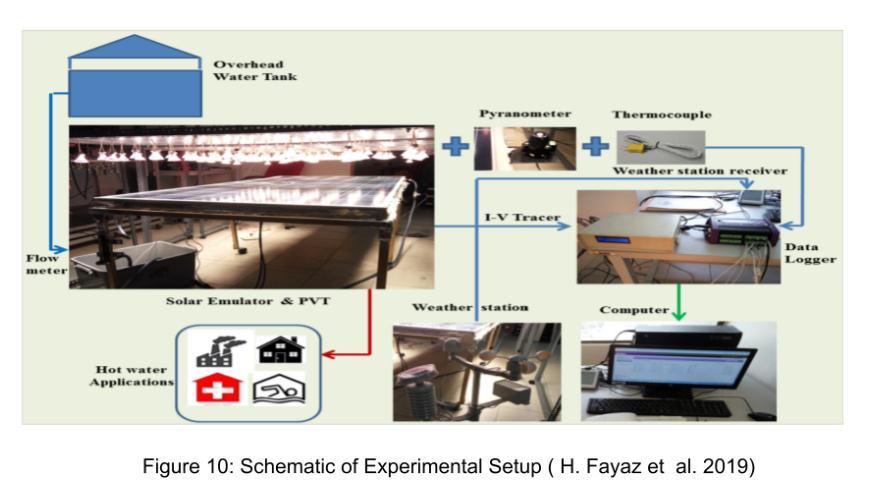
H.Fayezetal.(2019)carriedoutnumericalaswell as experimental investigations forimpacts on the performance of PVT and PVT-PCM panels. They used a thermal collector of serpentine design with an aluminum pipebeingusedasthepassiveflowpassageforworkingfluid byanoverheadwatertank.Firstly,theyattachedathermal collector with a PV module without PCM for preparation ofPVTandinthesecondsystem;PCMwasaddedalongwith acollectortopreparePVT-PCMfornumericalassessment. Fortheconduction ofexperimental analysis,Polyethylene wasusedasaninsulatingmaterialforbothconfigurations withmaximumcare.
JuanDuan(2021)conductedanumericalstudyona novelheatsinktoanalyzetheeffectsofPCMporoussystems with different porosities and different heights on the electrical efficiency of CPV Modules. With the decrease in porosity, solar cell electrical efficiency increases. For the same porosity, increase in the enclosure height ofPCM porous cavity could improve electric efficiency. But, CPV cooled by pure PCM will have a prolonged duration than PCMporousforthesamecavityvolumeduetotheslowheat absorptionandlowthermalconductivityofPCM.
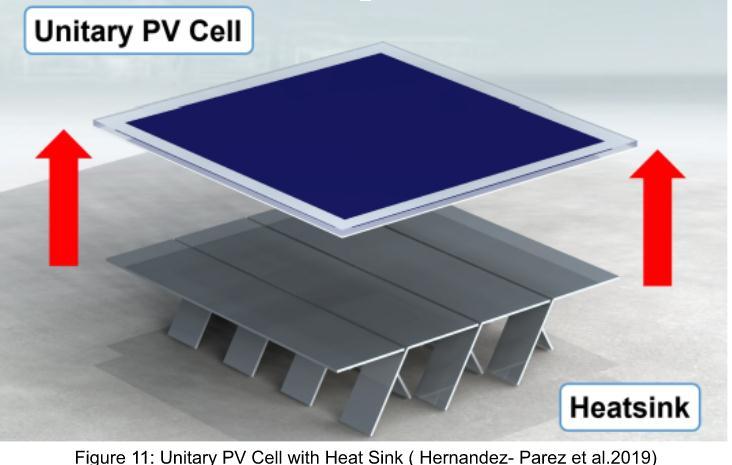
Hernandez- Parez et al. (2019) proposed a series of3D models of the heat sink and evaluated the newly designedmodel using CFD Software. They used a segmentedAl sheet to allow better airflow. Numerical Analysisshowedareductionofabout9.4°C.Whenthelength of fin is increased, due to the reduced extent of heat transmission from the base fin, results depicted an exponentialfallinthethermalefficiencyofafin.Theyalso experimentedwiththeeffectofthedirectionofairflowon theperformanceoftheheat sink.Thelowesttemperature wasregisteredwhentheairflowwasperpendiculartothe finsandthehighertemperaturewasregisteredwhentheair flowsparalleltothefins.
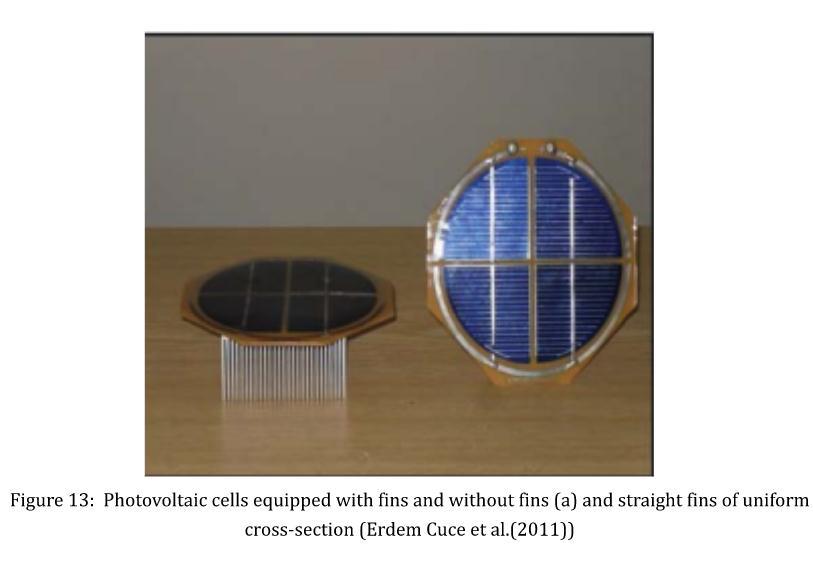
Erdem Cuce et al.(2011) performed studies regardingtheeffectsofpassivecoolingonsolarphotovoltaic cells. In this experiment heat sink made of aluminum was usedtodissipatewasteheatfromaphotovoltaic(PV)cell.A solarsimulatorwasusedinthisexperimenttosimulatethe differentconditionsofambienttemperature.Intheresults,it wasseenthata20%increaseinpoweroutputofPVcellwas achievedwhichshowsaconsiderableincreaseinconversion efficiency.Maximumefficiencyinoperatingconditionswas achievedat800W/m2 .

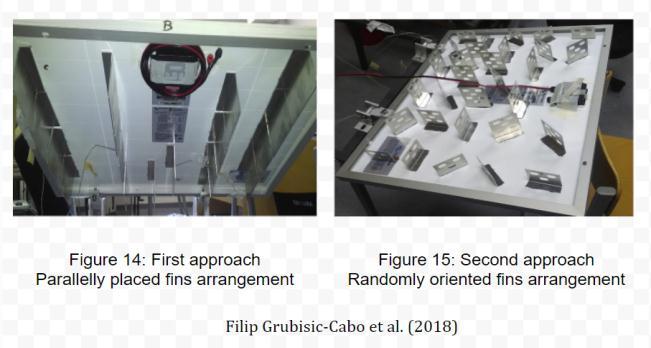
Thesecondapproachwasfoundtobemoreefficient thanthefirstone,sothesecondonewasanalyzedfurther. Thefirstapproachwasdroppedsinceitresultedinonly2% efficiencyimprovement.Theresearchwasperformedincity of split, Croatia in month of November. The results of the researchwerepositivei.e.thecoolingtechniqueemployed resultedinincreasingtheoverallconversionefficiencyofPV panelbyloweringtheiroperatingtemperature.
4. PCM COOLING
TheuseofWater-basedCoolingsystemsmayface constraints like Water availability issues, and the requirementofpumpingpowertomaintainacontinuousor periodicwatersupply.Also,waterbeingrecirculatedforPV PanelCoolingrequiresaCoolingmechanismtocontrolthe temperatureof coolantwater. Owing toall these practical limitations, researchers are working use of Phase Change MaterialforSolarPVModuleCooling.
FilipGrubisic-Caboetal.(2018)conductedresearch on passive cooling technique consisting of aluminum fins mounted with epoxy glue on the backside surfaceof PV panels to reduce its temperature thereby increasing its conversion efficiency. There were two approaches for cooling,infirstapproachthealuminumfinswerepositioned paralleltoeachotherinL-profilewhileinsecondapproach thealuminumfinswerepositionedarbitrarily.
Salemetal.(2019)usedAl2O3/PCMmixturewith variousconcentrationsofAluminaNanoparticlesforcooling PV modules and compared outcomes with Water-based Cooling Alternatives. They fabricate a setup consisting of twentyparallelchannelswithacommoninletandacommon outletwithaflowrateadjustedbytherequirednumberof ballvalves.Siliconoilwasusedonthetopandbottomofthe channels to maintain thermal contact between contact surfaces. Higher concentrations of Alumina nanoparticles resultinmoreheat-storingcapacityatcomparativelylower meltingpointtemperatures.Aluminanano-particleaddition ofconcentrationofφ=1%showedbetterresultsthanpure water-based cooling. But, results also depicted that, in general, solely water cooling provides more conversion efficiencyandmoreexergyandtherebymorepower.Despite this,PCM-basedPVModulecoolingisusedwidelyduetothe fact that PCM does not utilize additional power or expenditureduringroutineoperation.
S.A.Nada etal.performed anexperiment onthree polycrystalline Silicon PV Modules; one without PCM, one with PCM and one with PCM impregnated with Al2O3 nanoparticles to investigate the effects of the addition of nanoparticlesinPCM.ForPeakSolarradiationbetween12 PMto1PM,peaktemperaturesregisteredwere75°C,61°C and 57°C respectively. The addition of nanoparticles benefited in increased. Results of the experiment showed temperaturedropsof8.1°Cand10.6 °Candanincreaseof 5.7%and13.2%forpurePCMandenhancedPCM-basedPV modules.
M.Rajvikrametal. (2019)experimentedwiththe cooling of a solar module using PCM entrenched with aluminium attached to the back side of the solar panel. Paraffinic Organic PCM was used for this experiment. The maximumtemperatureofthePV-PCMentrenchedaluminum panel was reduced to 47.7°C as compared to 55.4°C
temperaturethecorrespondingtemperatureofanaturally ventilatedpanelwhichgave4%moreelectricalefficiency.
Leila Siahkamari et al. worked to postpone the meltingpointofPCMmaterial.Forthis,theyusedsheepfat+ CuOnanoparticles.Theresultsofpuresheepfatandparaffin waxasPCMmaterialexhibitedbettercoolingperformance. Maximumpowergenerationincreasedby24.6%to26.2% using Sheep Fat+CuO nanoparticles in comparison with naturally ventilated cooling systems and 5.3% to 12 % in comparisonwithparaffinwax.
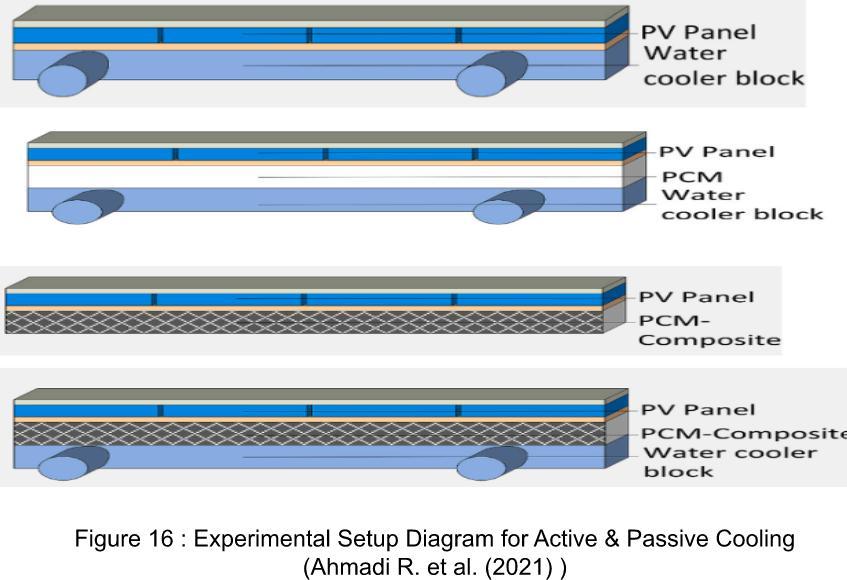
AhmadiR.etal.(2021)studiedpassiveandactive coolingsystemsandthepowerefficiencyofPVcellsystems with the use of solar simulators as an artificial source of solarirradiation.Alltheseexperimentswereconductedin the solar radiation range of 800-1700 Wm-1 The passive coolant used was Phase change Material (PCM) and to overcomethedisadvantageoflowthermalconductivityof PCM,specialmaterialcalledPS-CNTheatconductivefoam was also used for analyzing the impacts on the power performance. According to the results, PCM material can lessencelltemperaturebyupto6.8%withincrementsofup to14%.
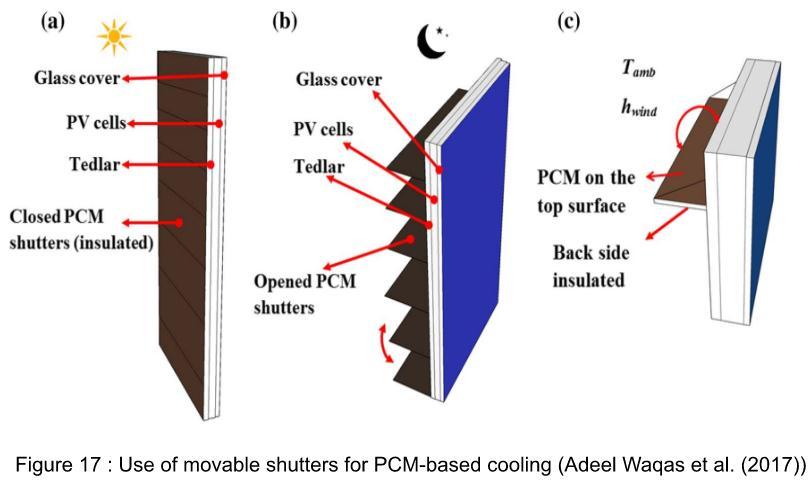
meltingtemperaturesfrom30°Cto40°C.ForTm=30°C,PV temperature was found to be even more than naturally ventilatedPVpanels.Thisoccurredduetothefactthatthe ambienttemperatureofairsurroundingrarelyfallsbelow 30°Cduringnon-sunshinehourswhichkeepsmeltedPCMin liquid state only prohibiting the Solidification of PCM. Further,thePCMenclosurereducedtheabilityofthePanel to be cooled naturally. For Tm =35°C, incomplete solidificationresultedinaverylowheatstoragecapacity45 % of the total capacity. For Tm = 40°C, complete solidification of PCM helped to maintain PV Cell Temperaturebelow45°C.ConsideringtheaveragePVpanel celltemperatureof63°C,theuseofPCMenclosedinShutters reduced cell temperature to 42.1°C using PCM which is havingmeltingpointat35°C
Cooling Methods Advantages Disadvantages
Natural Convection ofair
Theyalsoperformedthesetupofanactivecooling systeminstalledonthebacksidesurfaceofthesystem.On performing the results depict that the performance of the active cooling system was superior to the passive PVT system.ThesystemofPV-PCMCompositewasalsoinspected in the study and found to be the best system with energy efficiencyinactivecoolingbeing66.8to82.6%.
AdeelWaqasandMieJi(2017)usedOrganicPCM RT44 to cool Solar PV Module Cell temperature. Movable RotatatableshuttersweredeployedtoencapsulatePCM.To ensure complete solidification of PCM, Shutters are kept openduringnon-sunshinehoursandkeptclosedotherwise. The maximum fall observed in temperature when PCM is usedwasfrom90Cto55C.
ToanalyzetheeffectofthemeltingpointofPCMon SolarPVpaneltemperatureandefficiency,theyalteredPCM
Forced Convection ofair
LongerLife Easyintegration
Noiseless
Nopowersupply
PassiveHeatExchange
Higher heat transfer rate,massflowrate& temperaturereduction compared to natural convection
Dust accumulation at inlet hampers Heat transferrate
Lowheattransferrate
Limited temperature drop
Extra Power Requirement
Noisyoperation
High Investment & Maintenance cost due touseoffansandducts
Water cooling
PCM Cooling
High heat capacity, Higher heat transfer compared to both previousmethods
Higher heat transfer and higher heat storagecapacitydueto latentheat
No power supply requirement
Noiseless
Less life due to corrosion
High Investment & Maintenance cost due touseofpumps
HighCostofPCM
Selection of PCM material for application is difficult task
Careful Disposal required
5. CONCLUSIONS
Afterstudyingvariousresearchpapers,wecameto conclusion that the operating cell temperature of solar photovoltaic module has significant impact on the conversionefficiencyofsolarpanels.Henceitisnecessaryto bring down the cell temperature to optimum level for increasing electrical efficiency of solar cells. For this researchershaveimplementedvariouscoolingtechniques such as Forced air convection, forced water cooling, PCM based cooling, PV/T Thermal cooling, Thermosyphon cooling,waterdrippingtechniquestocooldownoperating temperature.Fromallthesestudieswecanconcludethatall above mentioned techniques results in improved performanceofPhotovoltaicmodule.Watercoolingisfound to be most reliable and cost effective technique and PCM coolingiswidelyresearched duetoitscompactstructural requirements.
REFERENCES
1) Performanceenhancementofthephotovoltaiccells using Al2O3/PCM mixture and/or water cooling techniques (2019),M.R. Salem , M.M. Elsayed, A.A. Abd-Elaziz and K.M. Elshazly https://doi.org/10.1016/j.renene.2019.02.032
2) Improving the thermal regulation and efficiency enhancementofPCMIntegratedPVmodulesusing nanoparticles (2018), S.A. Nada, D.H. El-Nagar, H.M.S. Hussein doi:10.1016/j.enconman.2018.04.035
3) Experimental investigation on the abasement of operatingtemperatureinsolarphotovoltaicpanel usingPCMandaluminium(2019);M.Rajvikram,S. Leoponraj, S. Ramkumar, H. Akshaya, A. Dheeraj doi:10.1016/j.solener.2019.05.067
4) Siahkamari,L.,Rahimi,M.,Azimi,N.,&Banibayat,M. (2019),Experimentalinvestigationonusinganovel phase change material (PCM) in microstructure photovoltaic cooling system. doi:10.1016/j.icheatmasstransfer.2018.12.020
5) TripanagnostopoulosY,ThemelisP(2010),Natural fow air cooled photovoltaics. AIP Conf Proc 1203:1013–018.https://doi.org/10.1063/1.332230
6) Manas Ranjan Das (2019), Effect of different environmentalfactorsontheperformanceofsolar panelhttps://www.ijitee.org/wpcontent/uploads/papers/v8i11/J98890881019.pdf
7) Adeel Waqas and Mie Ji (2017); Thermal managementofconventional PVpanel usingPCM with movable shutters – A numerical study doi:10.1016/j.solener.2017.10.050
8) Juan Duan (2021); A novel heat sink for cooling concentrator photovoltaic system using PCMporous system doi:10.1016/j.applthermaleng.2020.116522
9) Colt G. (2016); Performance evaluation of a PV panelbyrearsurfacewateractivecooling.IntConf Appl Theor Electr ICATE2016 ; Performance evaluation of a PV panel by rear surface water activecooling|IEEEConferencePublication|IEEE Xplore
10) Hernandez-Perez, J.G.; Carrillo, J.G.; Bassam, A.; Flota-Banuelos,M.;Patino-Lopez,L.D.(2019).Anew passive PV heatsink design to reduce efficiency losses: A computational and experimental evaluation
https://doi.org/10.1016/j.renene.2019.09.088
11) GabrielColt(2016);PerformanceevaluationofaPV panelbyrearsurfacewateractivecooling,IntConf Appl Theor Electr ICATE 2016 - Proc. 1–5 https://doi.org/10.1109/ICATE.2016.7754634
12) Guilherme Zanlorenzi, Anderson L. Szejka, Osiris Canciglieri ; Hybrid Photovoltaic Module for efficiencyimprovementthroughanautomaticwater cooling system: a prototype case study
https://doi.org/10.1016/j.jclepro.2018.06.065
13) Ahmadi R, Monadinia F, Maleki M (2021); Passive/activephotovoltaicthermal(PVT)system implementing infiltrated phase change material (PCM)inPS-CNTfoam.SolEnergyMaterSolCells 222:110942.
https://doi.org/10.1016/j.solmat.2020.110942
14) Fayaz H, Rahim NA, Hasanuzzaman M, Nasrin R, RivaiA(2019) Numerical and experimental investigationoftheeffectofoperatingconditionson performanceofPVTandPVT-PCM.RenewEnergy 143:827–841.
https://doi.org/10.1016/j.renene.2019.05.041
15) OdehS,Behnia M(2009),Improvingphotovoltaic moduleefficiencyusingwatercoolingHeatTransf Eng30:499–505.doi:10.1080/01457630802529214
16) Performance evaluation of a PV (photovoltaic) module by back surface water cooling for hot climatic conditions (2013), H. Bahaidarah, Abdul Subhan,P.Gandhidasan,S.Rehman
https://doi.org/10.1016/j.energy.2013.07.050
17) SajjadU,AmerM,AliHM,DahiyaA,AbbasN(2019), Cost effective cooling of photovoltaic modules to improve efficiency. Case Study on Therm Eng
14:100420.
https://doi.org/10.1016/j.csite.2019.100420
18) TripanagnostopoulosY,ThemelisP(2010),Natural fow air cooled photovoltaics. AIP Conf Proc 1203:1013–018.https://doi.org/10.1063/1.332230
19) Y.Tripanagnostopoulos,T.N.andM.S.,(2001),Test results of air cooled modifed PV modules. System 2519–2522.
https://www.researchgate.net/publication/268329 035_Test_results_of_air_cooled_modified_PV_modul es
20) Baloch AAB, Bahaidarah HMS, Gandhidasan P, AlSulaiman FA (2015),Experimental and numerical performanceanalysisofaconvergingchannelheat exchanger for PV cooling

https://doi.org/10.106/j.enconman.2015.06.018
21) Grubišić-ČaboF,NižetićS,ČokoD,MarinićKragićI, Papadopou-losA(2018)Experimentalinvestigation of the passive cooled free-standing photovoltaic panel with fixed aluminum fins on the backside surface.J Clean Prod 176:119–129. https://doi.org/10.1016/j.jclepro.2017.12.149
BIOGRAPHIES
Prof.VishalChavan Professor in Mechanical EngineeringDepartmentof PVG’sCOET,Pune


Email:vsc_mech@pvgcoet.ac.in
SubhashchandraKanade
B.E. scholar in Mechanical EngineeringDepartmentof PVG’sCOET,Pune
Email: subhashchandrak2002@gmail.com
RajSingh
B.E. scholar in Mechanical EngineeringDepartmentof PVG’sCOET,Pune
Email: msd7912411@gmail.com
NishantBhanage

B.E. scholar in Mechanical EngineeringDepartmentof PVG’sCOET,Pune
Email: nivenishi200@gmail.com