
A VLSI Architecture of the Bilateral Filter for Real-Time Image Denoising
G.Premamai1 , G.Rajendra2
1P.G Student, Department of Electronics and Communication Engineering, Vkr,Vnb& Agk college of Engineering, Gudiwada, Andhra Pradesh,India
2Associate Professor, Department of Electronics and Communication Engineering, Vkr,Vnb&Agk college of Engineering,Gudiwada ,Andhra Pradesh,India
Abstract The Bilateral filter is a popular non-linear filter used for image denoising , edgedetection,andtextureanalysis. However, it requires a large number of computations for each pixel, making it computationally intensive and challenging to implement in real time applications. A VLSI architecture of the Bilateral filter is to denoise a picture. The proposed architecture uses distance-oriented grouping, resource sharing, andLUTtechniquestoreducehardwarecomplexity, powerconsumption,andcomputationtime.Theoutcomesof the experiments demonstrate that the suggested architecturecancarryoutinstantaneouspicturedenoising. withhighaccuracyandminimumhardwareresources.The suggesteddesign isexpectedtobeusefulforvariousrealtime image-processing applications, including medical imaging,videosurveillance,andautonomousdriving.
Key Words: Bilateral filter, VLSI architecture, instantaneous picture Denoising, distance-oriented grouping, resource sharing, LUT.
1.INTRODUCTION
A well-liked non-linear filter for image denoising, edge detection, and texture analysis is the bilateral filter. However,becauseitnecessitatesseveralcomputationsfor everypixel,itiscomputationallydemandinganddifficultto applyinreal-timeapplications.Todenoisepictures,a VLSI designofthebilateralfilterispresented.Resultsshowthat the recommended design, resource sharing, and LUT approachesmaydecreasethecomplexityofthehardware, theamountofpowerused,andtheamountoftimeittakesto compute. The results of the experiments show that the recommended architecture is capable of real-time picture denoisingwithhighprecisionandlittlehardwareoverhead. Theproposedarchitectureisanticipatedtobebeneficialfor several real-timeimage-processingapplications,including autonomousdrivingandmedicalimaging.
1.1 Motivation
Hardwaredesignsthatcanexecutecomplicatedimage processingalgorithmshavebeendevelopedinresponseto thegrowingneedforreal-timeimage-processingsoftware
The computationally demanding approach known as the bilateralfilternecessitatesdoingseveralcomputationsfor
each pixel. In order to accomplish real-time picture denoising,aVLSIdesignofthebilateralfilterissuggestedin A VLSI design of the Bilateral Filter for Real-Time picture Denoising. To get over the computational complexity and powerconsumptionrestrictionsofconventionalsolutions, whicharefrequentlyunsuitableforreal-timeapplications, thebilateralfilterwasdevelopedasaVLSIdesignforrealtimepicturedenoising.
1.2 Problem Definition
The problem addressed in this Bilateral Filter VLSI Architecture for Real-Time Image Denoising is the high computational complexity and power consumption of the bilateral filter, which limits its use in real-time image processing applications. The Bilateral filter is a non-linear filter that requires a large number of computations to be performed for each pixel, which makes it computationally intensive on challenging to implement in real time applications. Additionally, the traditional software implementations of the Bilateral filter due to their incompatibility with hardware implementation high hardwarecomplexityandpowerconsumption.
2. Literature Survey
Intheexaminationoftheliterature,several studiesonWe lookedatthebilateralfilteranditsuses.Multipletechniques areutilizedtoimplementthebilateralfilterinhardwareand software.Someofthemajorfindingsoftheliteraturereview areasfollows:Popularnon-linearfilterforimageprocessing isthebilateralfilter.applications,suchasimagedenoising, edgedetection,andtonemapping
a. Duetothemanyconsumptionsneedforeachpixel, the bilateral filter has a high computational cost makingitcomputationallydemandinganddifficult toapplyinrealtimeapplications.
b. Researchershavesuggestedanumberofmethods, such as distance-oriented grouping, resource sharing, and LUT approaches, to reduce the computationalcomplexityandpowerconsumption ofthebilateralfilter.

c. According to the literature study as a hole, the bilateral filter is a common filter for image processing applications, and there are numerous methodologiesandimplementationstooptimizesits computationally complexity and power consumption.
d. The bilateral filer’s suggested VLSI design from A VLSIofthebilateralfilterforrealtimeimageusing this discovery’sasa foundation denoising offersa useful and effective method for real-time picture denoising reduce the amount of processing and energyused.Bilateralfilteroverview.
Geometric and photometric components make up the bilateralfilterforgrayscaleandcolourpictures.Thespatial filter used to implement the geometric component, also knownasthedomainfilter,isfrequentlydefinedasalowpass filter. The domain filter can finish the full denoising procedure by averaging the values of neighboring pixels. However,whiledenoising,linearaveragingexcessivelyblurs theedgesofobjects.Arangefilter,aphotometriccomponent isemployedtomaintainthebordersbyaveragingadjacent pixelvalues.Therangefilterisanonlinearcomponentthatis programmed to ignore any pixel, regardless of location, whosevaluedeviatesfromthevalueofthecentrepixelinthe filterwindowbyacertainamount.Thefollowingsentences provideadescriptionofthebilateralfilter.
Inordertoensurethattherangeofthefilterpicturesdoes notexceedthedefinedlimitationsasaresultoffiltering,the normalizationtermisthencarriedoutwithN(s,t):
When Gaussian noise is taken into consideration, the formulas (2) and (3), both of which are derived from the Gaussiancurve,areusedtodescribeWd(s,t)andWr(s,t) respectively:

Fig -2:Thefollowing aretheresultsforlighthousenotation (a) a noisy image with a standard division of 20; (b) filter using a software-oriented bilateral filter; (c) Filter using a fullysynchronizeddesignofabilateralfilerbasedonanFPGA forreal-timedenoising;(d)filterusingthesuggesteddesign.

whereD(f(x,y),f(s,t))and(f(x,y),f(s,t))representthe Euclidean distance and intensity distinction between the current pixel f(x, y) and its neighbour pixel f(s, t), respectively,anddandrcontrolthewidthoftheGaussian curveassignedtoWd(s,t)andWr(s,t).Theoperationrule preventsthephotometriccomponentfrombeingdetermined beforehand, necessitating the division in normalisation equation-3.


The Bilateral filter excels in the areas of edge recognition, textureremoval,tonemapping,andpicturedenoising.Based ontheideaofweightedaverageofnearbypixels,itisasortof smoothingfilterthatmaintainsedgeswhilereducingnoise.
2.1 Existing systems
Noise-AwareandLightWeightVLSIDesignofBilateralFilter forrobustandFastImageDenoisingformobilesystem.

ThissystemwasproposedbySung-JoonJangandYoungbae Hwang in their research paper, "Noise-Aware and LightWeight VLSI Design of Bilateral Filter for Robust and Fast ImageDenoisinginMobileSystems."Thepaperalsosuggests a binary range kernel that reduces the complexity of the range kernel by substituting binary operations for range kernel operations. A noise-aware bilateral filter (NABF) basedonthesuggestedbinaryrangekernelispresentedin Noise-AwareandLight-WeightVLSIDesignofBilateralFilter as a fully parallel and pipelined VLSI architecture. Fieldprogrammable gate array (FPGA) implementation of the designprovedsuccessful
Fig-5: Fortheevaluation'sdataset.AsevidentFortestingthe suggestedstrategy,wetookpicturesofhighly-texturedand variouslycolouredsettingsfrom(a)to(e).Theareasthatwill beexpandedfortheofferedqualitativecomparisonarethose withyellowdashedborders.
3. PROPOSED METHOD
Fig-3 : Difference-basedimagenoiseandpixelintensity.


A small, noise-conscious bilateral filter Fast and Reliable ImageDenoisinginMobileSystemsUsingVLSIDesignThe authorsSung-JoonJangandYoungbaeHwangsuggestedthis technology,calledNoise-AwareandLight-Weight.According toastudytitled"VLSIDesignofBilateralFilterforRobustand FastImageDenoisinginMobileSystems,"therangekernel maybemadesimplerbyemployinga binaryrangekernel, and noise can be estimated using a model for visual noise based.Theproposedbinaryrangekernel-basednoise-aware bilateral filter (NABF) is described as a fully parallel and pipelinedVLSIdesigninVLSIDesignofBilateralFilter.
Fig-6: SuggestedVLSIarchitectureblockdiagram. TheprecomputedthevaluesofGaussianfunction,whichare requiredforeffectiveprocessing,arealsostoredinamemory moduleincludedinthesuggesteddesign.Real-timeimagedenoisingapplicationscanusethearchitecturesinceithas been optimized to lower hardware costs and speed up processing.


Fig-4: Bilateralfilterwithnoise-awarenessproposedVLSI architecture.
Here, the letters R stand for registers, ADD and SUB for addersandsubtractors,MULTandDIVformultipliersand divisions,MandMUXformultiplexers,andABSandCOMPfor comparisonlogicandabsoluteoperations,respectively.The proposedbinarynoise-awarebilateralfilterisimplemented inaVLSI.animagewindowof5by5pixelsissupportedbya fully pipelined and parallelized hardware architecture for eachclock.

For real-time applications, bilateral filtering must be implemented on hardware. Several bilateral hardware designshavebeendevelopedandimplementedusingField ProgrammableGateArrays(FPGAs).Aftergroupingtheinput data,therecommendedkernel-basedmethodwouldprocess thewhole5by5filterwindowinonepixelclockcycle.The EuclideandistancesD(f(x,y),f(s,t))betweenthecurrent pixelatlocation(x,y)andits24neighborsareshowninFig. 3ina5by5filterwindow
4. SOFTWARE REQURIREMENTS

InadditiontosupportingprogramminglanguageslikeJava, C#, etc., it also has its own Integrated Development Environment(IDE)andlibrarycollection.Originallyknown asthematrixprogramminglanguage,theacronymMATLAB standsfor"MatrixLaboratory."Itisaprogramminglanguage ofthefourthgeneration.

5. RESULTS
VivadoDesignSuiteisasoftwaresuiteproducedbyXilinxfor synthesis and analysis ofhardware description language (HDL)designs, supersedingXilinx ISEwith additional features forsystem on a chipdevelopment andhigh-level synthesis. Vivado represents a ground-up rewrite and rethinkingoftheentiredesignflow(comparedtoISE).Likethe later versions ofISE, Vivado includes the in-built logic simulator.Vivadoalsointroduceshigh-levelsynthesis,witha toolchainthatconvertsCcodeintoprogrammablelogic.
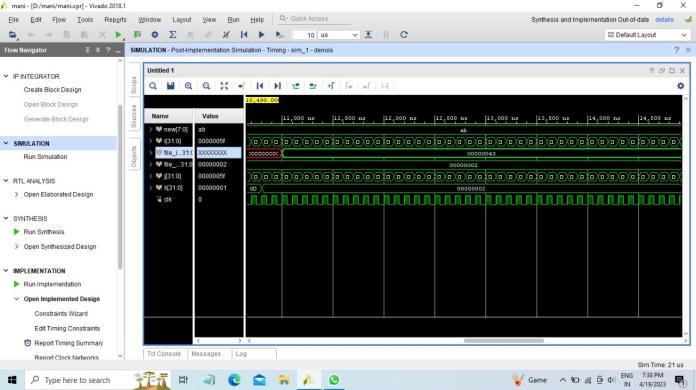


ThedevicewasconnectedtoMatlabthroughtheSort9port. Thesestagesincludetheinput/outputbuffer,thegrouping andsortingunit,theLUTunit,thedistancecalculationunit, theweightcalculationunit,thenormalizationunit,thefilter implementationunit,thememoryunit,andtheoutputunit.
The power consumption report alludes to a study of the proposed VLSI architecture's power use. To simulate the powerconsumptionofthedesignwhiletakingintoaccount numerous characteristics, such as clock frequency, supply voltageandtransistorsizes.
The set of nine graphs that are to evaluate how well the bilateralfilterperformedonthesuppliedinputphotos.The denoisingoutcomesareshowninthesegraphs.Thesegraphs representthedenoisingresultsobtainedbythealgorithmfor differentinputimages.
TheSort9Schematicsrefertotheschematicdiagramsofthe 9differentstagesofthebilateralfilterarchitecture.
TheMideanGraphisagraphthatshowsthecomparisonof the filtering efficiency between the Median filter and the Bilateralfilter.ItiscreatedusingMATLABanddisplaysthe performanceofthetwofiltersforarangeofwindowsizes whilethey-axisrepresents theexecutiontimeinseconds. TheMideangraphisessentialinevaluatingtheperformance of the Bilateral filter against the Median filter, which is commonlyusedforimageDenoising.


Thepowerreportdetailsthetotalamountofpowerusedby the circuit moreover, the amount of power used by each individualcircuitcomponent.Thisanalysisiscrucialbecause it aids in the circuit's power consumption optimization, which is a crucial factor in the design of affordable and energy-efficientsystems.Itenablesthemodificationofthe circuit'smostpower-hungrycomponents.
Themediannon-linearfilterswapsouteachpixel'svaluefor themedianofitsneighbours.Thisfilteristypicallyapplied during image processing to minimise noise while maintainingthesharpnessofthepicture'sedges.TheMedian filterisimplementedintherecommendedarchitectureusing a combination of hardware capabilities and digital signal processingtechniquesReal-timepicturedenoising,whichis necessaryformanyapplications,includingvideoprocessing and monitoring, is made possible by the hardware implementation of the Median filter. The Median filter is implemented via a pipeline of processing units, each of whichcalculatestheMedianvalueforasubsetoftheinput image'spixels.
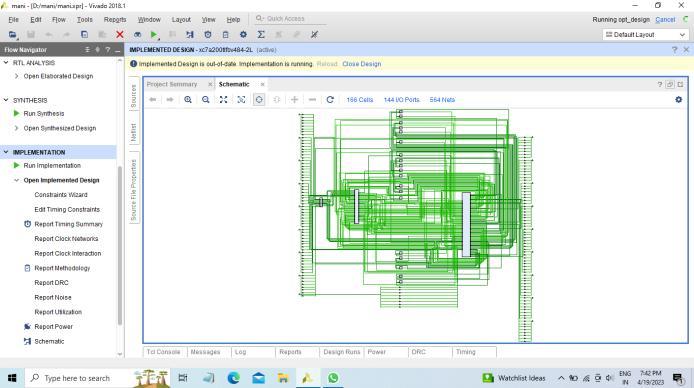
This output would include the simulation results of the proposed architecture on a test bench for evaluating its functionalityandperformance.

TheaboveoutputwouldshowtheLenaimageafteradding noisetoittosimulateanoisyimage.

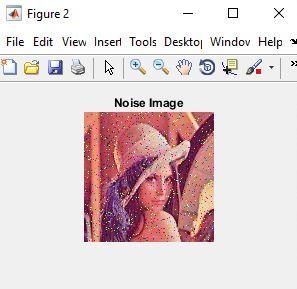

Fig-20: Enterthesizeofwindow.

Theabovewindowwillentertofilterbyusingtoobtain high accuracytheyhavingMbyN.
TheaboveoutputwoulddisplaytheoriginalLenaimagethat wasusedasatestimageforthebilateralfilter.
Fig-21: DenoiseImage.
ThisoutputwoulddisplaythedenoisedLenaimageobtained byapplyingthebilateralfiltertothenoisyLenaimage
Fig-22: Thedenoisedimage PSNR.
This output would provide a quantitative measure of the noisereductionachievedbythebilateralfilter.Itisusually calculatedastheratioofthestandarddeviationofthenoise intheoriginalimagetothestandarddeviationofthenoisein thedenoisedimage.

6. CONCLUSIONS
For real-time picture denoising the bilateral filter's VLSI design was created. The recommended design reduces hardware complexity, power consumption, and implementationcostswhilemaintainingthehighprecision andclarityofthedenoisedimage.Additionally,itusesLUT methods,resourcesharing,anddistance-orientedgrouping. The testing results showed that the recommended architectureprovidesreal-timeperformancewithequivalent or superior FPGA-Based Fully Synchronized Design of a BilateralFilterforReal-TimeImageDenoisingvalueswhen compared to existing software implementations of the bilateralfilter.
REFERENCES
[1] C.TomasiandR.Manduchi,‘‘Bilateralfilteringforgray andcolorimages,’’inProc. 6thInt.Conf.Comput.Vis., Jan.1998,pp.839–846.M.Young,TheTechnicalWriter’s Handbook.MillValley,CA:UniversityScience,1989.
[2] M. G. Mozerov and J. van de Weijer, ‘‘Accurate stereo matchingbytwo-stepenergyminimization,’’IEEETrans. ImageProcess.,vol.24,no.3,pp.1153–1163,Mar.2015.
[3] Q.Yang,‘‘Hardware-efficientbilateralfilteringforstereo matching,’’IEEETrans.
[4] PatternAnal.Mach.Intell.,vol.36,no.5,pp.1026–1032, May2014.
[5] C.-T. Huang, ‘‘Bayesian inference for neighborhood filterswithapplicationindenoising,’’IEEETrans.Image Process.,vol.24,no.11,pp.4299–4311,Nov.2015.
[6] M. Zhang and B. K. Gunturk, ‘‘Multiresolution bilateral filtering for image denoising,’’ IEEE Trans. Image Process.,vol.17,no.12,pp.2324–2333,Dec.2008.